
Thao is the CTO of a Vietnamese fintech that processes 40,000 loan applications a month. The fraud-score is not built in-house; it comes from an AI API, billed by the token, chosen because her team of nine engineers cannot train and host a frontier model at Vietnamese cloud prices. Every month she signs off on a report that says "fraud risk: 0.83, model: credit-risk-v3." She has no way to know whether credit-risk-v3 actually produced that 0.83, whether a cheaper quantized build was swapped in during a traffic spike, or whether the output was silently re-scored by a rules engine. This is the problem verifiable ai inference solves: it turns "trust the API provider" into "check the proof yourself," and it is moving from cryptography labs into the procurement requirements of Vietnamese enterprises, banks, and regulators.
The old contract between an AI provider and its customer is verbal and one-sided. The customer pays; the provider promises; nobody can verify. When that provider is a SaaS API, an outsourced ML team, or an oracle node feeding a smart contract, the customer has no cryptographic channel to confirm three things: which model ran, whether it is the model they contracted, and whether the output was computed honestly from the input they sent. For Vietnamese enterprises relying on FPT.AI, Zalo AI, VNG Cloud, or global LLM APIs -- often under the data-residency rules of the State Bank of Vietnam's regulatory sandbox (Nghị định 94/2025/NĐ-CP, effective 1 July 2025) -- the phrase tin cậy kết quả ai is no longer a slogan. It is a compliance requirement with no existing tool to satisfy it.
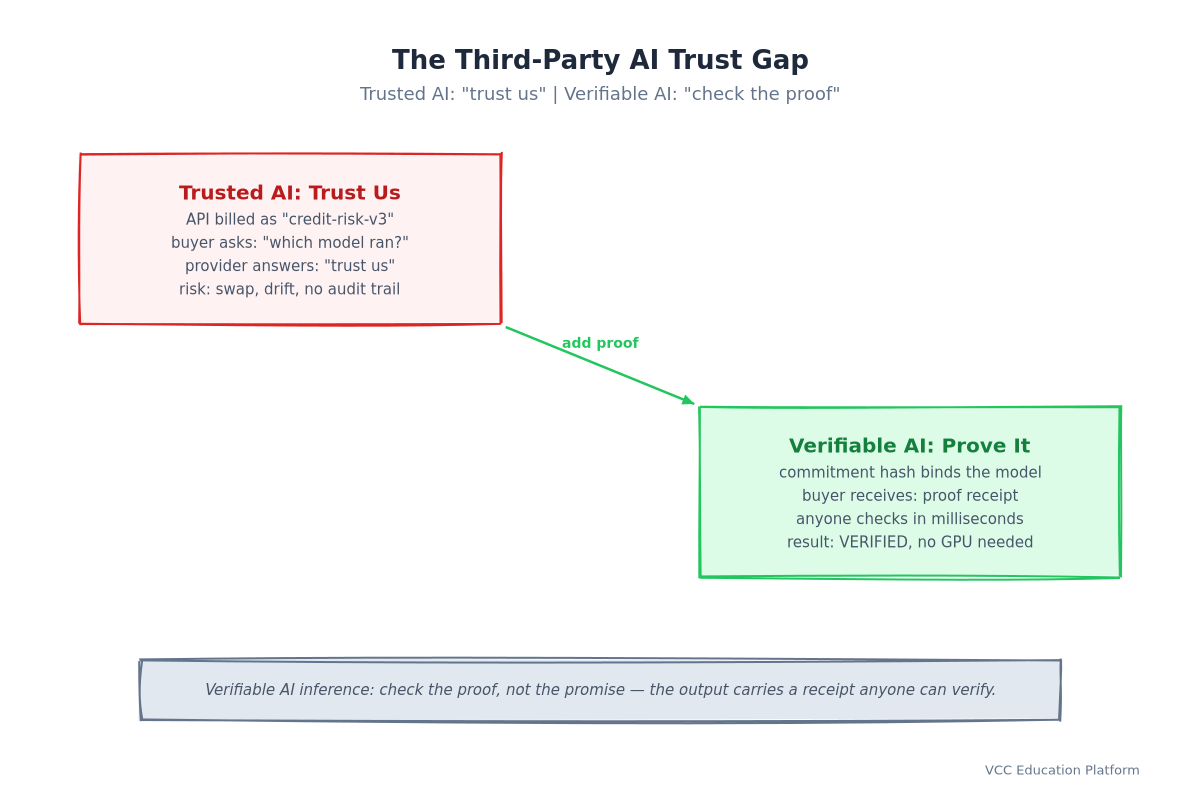
The trust gap is economic before it is technical
The most rigorous attack on the "trust the provider" model came from UC Berkeley in 2025. Researchers formalized model substitution: a provider replaces the contracted model with a cheaper one -- a quantized build, a smaller parameter count, a distilled variant -- to cut compute cost while charging the premium price. They showed that software-only detection is fundamentally unreliable. Statistical tests on text outputs are query-intensive and fail against low-rate randomized substitution. Log-probability methods are defeated by the inherent nondeterminism of production inference. The paper's conclusion is stark: you cannot reliably audit a black-box API by looking at its outputs.
The economics explain why this matters in Vietnam. Serving a model is memory-bandwidth bound; a quantized 8B model is dramatically cheaper to serve than the 70B it is billed as. For a Vietnamese enterprise consuming tens of millions of tokens per month, the difference is real money, and the quality difference is invisible in any single response. A loan application rejected by the substituted model is a customer loss nobody can attribute.
There is a second failure mode that Berkeley's framing understates: silent parameter drift. The API is versioned on the provider's side, and the model served today is not the model served last quarter. For a credit-scoring API, that drift is a regulatory event -- the model that the compliance team approved in Q2 is not the model scoring customers in Q4, and there is no receipt proving either way.
What verifiable inference actually guarantees
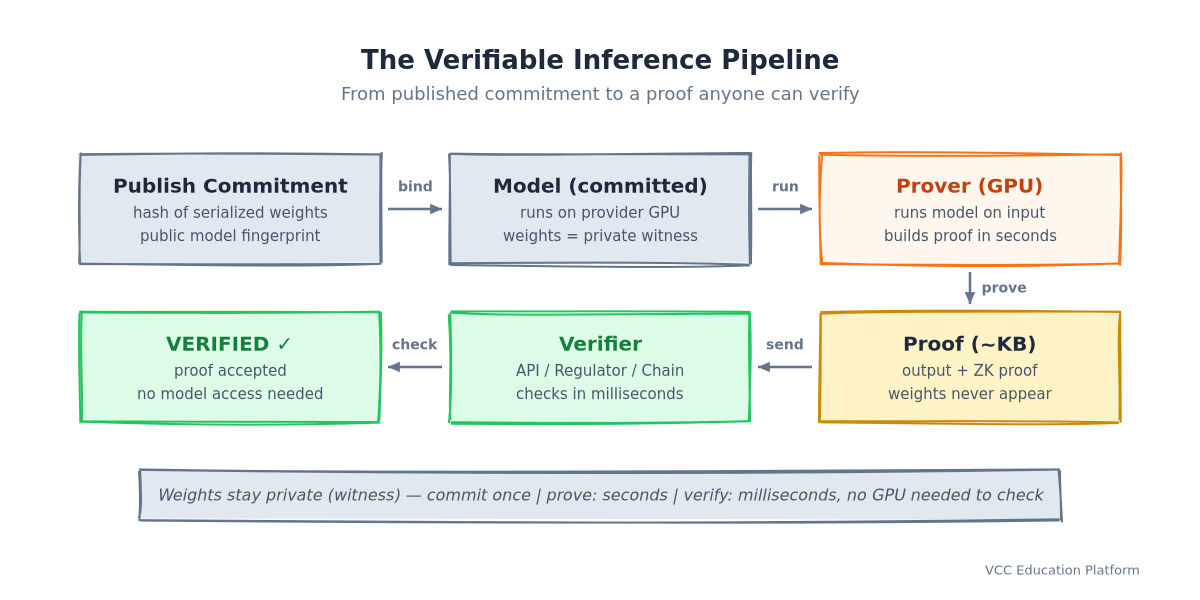
Verifiable ai inference is a three-part protocol: commit, prove, verify.
Commit. The provider publishes a commitment: a cryptographic hash (Poseidon or Keccak) of the serialized model weights. This hash is the model's fingerprint. It is public, small, and impossible to fake cheaply. From this moment, "the model" has a precise mathematical identity: the weight file whose hash is H.
Prove. On each request, the provider runs the committed model on the input and generates a zero-knowledge proof that output Y was produced by committed model H on input X. The proof is compact -- kilobytes -- and reveals nothing about the weights themselves. The weights are the private witness: they participate in the computation but never appear in the output.
Verify. Anyone holding the commitment, the verification key, the input, the output, and the proof can check the proof in milliseconds -- off-chain in a Python client, or on-chain in a smart contract. No GPU, no model, no trust required.
The critical property to internalize: the proof binds the commitment. If the provider substitutes a different weight file, the commitment no longer matches, and every subsequent proof fails. This is what turns the API contract from a promise into a measurement. The pipeline is identical whether the model runs on the provider's cloud, on an outsourced ML vendor's GPU, or on an oracle node feeding a DeFi protocol.
The honest framing matters here. A ZK proof proves the committed model ran honestly on this input. It does not prove the model is fair, accurate, or unbiased. A biased credit model, correctly executed, produces a correct proof of a biased decision. Verification of the computation and verification of the model are two different audits, and verifiable inference covers only the first. Every enterprise CTO should repeat this sentence before signing the contract: "the proof tells me the model that ran is the model I bought -- it does not tell me the model I bought is good."
Why "the provider has a reputation" is insufficient in Vietnam
Three forces make the Vietnamese market converge on verifiable inference faster than most:
Regulatory pressure. Nghị định 94/2025/NĐ-CP created a controlled-experimentation sandbox for credit scoring, Open API data sharing, and P2P lending. Participants must present security plans, keep systems and data inside Vietnam, and report credit information to CIC. The sandbox does not say "prove your inference with ZK." It does say the state must be able to supervise what the AI decided and why. A cryptographic proof is the only artifact that lets a regulator verify model behavior without the enterprise handing over proprietary weights or shipping customer data offshore.
Data-residency rules. Offshore inference collides with the sandbox requirement that systems and stored data remain in Vietnam. When a Vietnamese fintech sends customer features to a foreign LLM API, the data leaves the jurisdiction. Verifiable inference gives the in-country option a strong audit trail: the model runs on a Vietnamese GPU, the proof is generated locally, and the regulator verifies onshore.
API dependency at scale. Vietnamese enterprises are already deep consumers of third-party AI. FPT.AI runs a full ecosystem -- speech, OCR, chatbots, and the AI Factory supercomputer line (thousands of NVIDIA H100/H200, ranked in the global Top 500). Zalo AI is embedded in Vietnam's dominant messaging platform. MoMo's AI credit scoring cut verification and disbursement to one to three minutes for first-time borrowers -- and won a Top 3 prize at AI Awards 2025. The Liên minh AI Âu Lạc (June 2025) formalized public-private AI cooperation across MoMo, VNG, FPT, VNPT, and MobiFone. All of these players will eventually face the same question from a counterparty or a regulator: how do we know the result is what your model produced?
ZK oracle AI: verifiable inference for the blockchain
The phrase zk oracle ai names the intersection where verifiable inference meets oracle design. A classical AI oracle is a node that runs a model off-chain and reports the result to a smart contract. The contract trusts the report because it trusts the node -- a single point of failure that can be bribed, compromised, or simply wrong.
A ZK oracle changes the trust topology. The model commitment is published; the oracle node runs the model, generates a proof, and submits result + proof on-chain. The smart contract verifies the proof before acting on the result. The answer is no longer reported -- it is derivable by anyone from the input and the proof, without re-running the model. The contract's trust shifts from "the node is honest" to "the committed model demonstrably produced this output."
The architecture is well established. Chainlink's verifiable AI stack (formalized in 2026) layers secure data sourcing, off-chain computation, cryptographic verification (zkML or TEE), and on-chain delivery; its corporate-actions pilot with 24 global financial institutions reported near-total consensus among AI models across evaluated actions. Academic work (arXiv 2504.04794) demonstrated zk-SNARK verification of a model's claims routed through a Chainlink-style oracle network. Proof-of-inference systems such as Nexis' InferenceCommitment record inputHash, outputHash, and modelHash on-chain, with proof artifacts on IPFS. For Vietnamese DeFi, stablecoin, or on-chain lending products, a ZK oracle means a liquidation decision or a credit score can be cryptographically justified rather than trusted from a single node.
Trusted vs verifiable AI: three tradeoffs every CTO must price
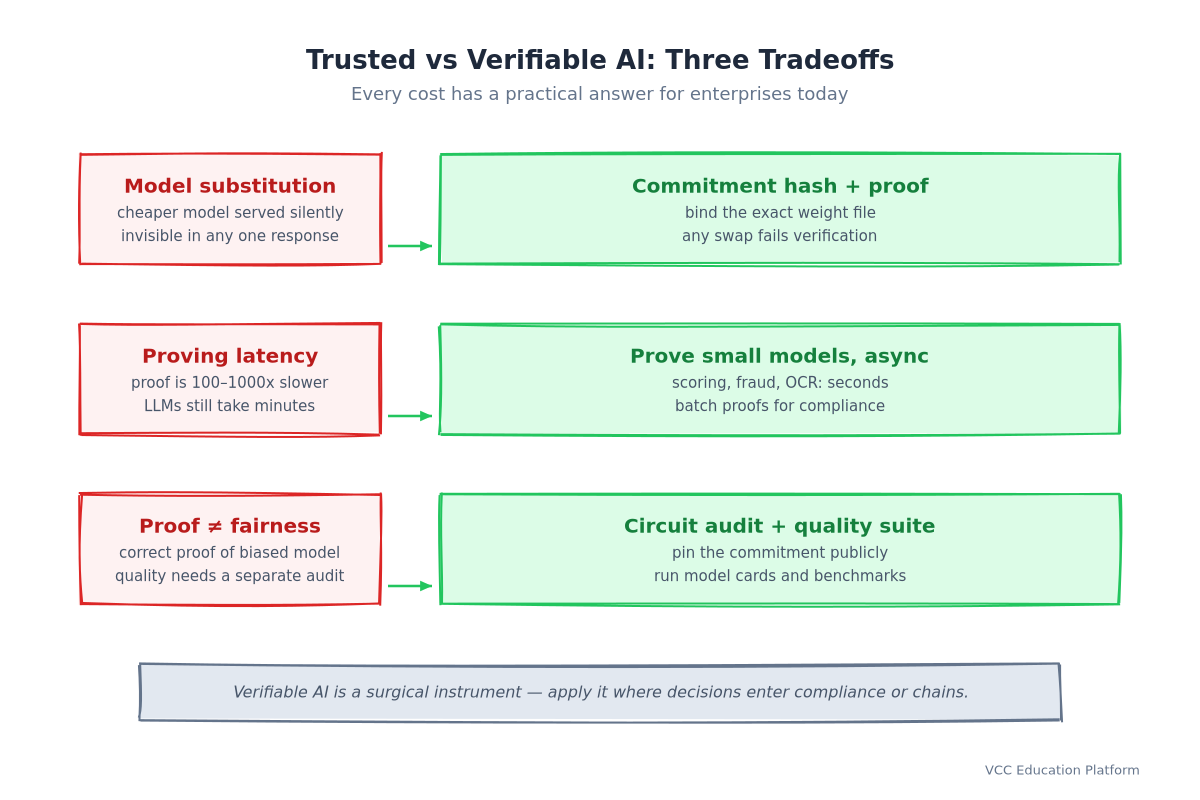
Verifiable inference is not free, and honest procurement requires pricing the cost. Three tradeoffs dominate:
Tradeoff 1: Latency and cost of proving. Generating a proof is 100 to 1000 times slower than the inference itself. Small models -- credit scoring, fraud detection, image classifiers -- prove in seconds on commodity GPUs. Frontier LLMs still take minutes per proof. The rule for enterprises: prove the inferences that enter compliance, audit, or on-chain state; leave chat and summarization on plain performance. A credit decision tolerates a 10-second proof window; a chat completion does not.
Tradeoff 2: The model-size ceiling. Today's production systems prove models in the tens of millions of parameters comfortably, and the frontier is advancing fast -- DeepProve proved full GPT-2 in 2025, and parallel proving and lookup-table optimizations keep shrinking the gap. But a Vietnamese fintech should not wait for 70B-class real-time proving. It should pick the small, high-value models -- scoring, fraud, OCR -- where proving is already practical.
Tradeoff 3: What the proof actually proves. The proof binds the committed weights to the output. It does not prove the model is fair, nor that the training data was clean, nor that the commitment hash corresponds to the model the sales deck described. A provider could commit to a plausible-but-different weight file and prove it honestly. The buyer must verify the commitment is real: audit the circuit, pin the commitment in a public registry, and confirm the hash corresponds to the contracted artifact.
A practical adoption path for Vietnamese enterprises
For a CTO who has decided to start, the path is deliberately narrow -- prove the highest-value inference first.
Step 1: Identify the three to five model calls that enter decisions or reports. Credit scores, fraud flags, KYC classifications, anything that reaches a regulator or a smart contract. Leave everything else alone.
Step 2: Pin the commitments. For each in-scope model, compute the hash of the serialized weights and publish it -- in a public registry, on-chain, or in the compliance file the sandbox application references. This is a one-time act that takes minutes and creates the audit anchor.
Step 3: Instrument the proof path. Use a ZKML toolchain that accepts ONNX exports (most Vietnamese teams already export to ONNX for cross-framework deployment). EZKL compiles ONNX to a Halo2 circuit, generates proving and verification keys, and produces proofs verifiable off-chain or via an EVM verifier contract. The pipeline is: export, compile, calibrate, setup, prove, verify.
Step 4: Build the verifier into the workflow. The verification step is milliseconds and needs no GPU. Put it in the credit-decision pipeline, in the regulatory report generator, or in the smart contract that consumes an oracle answer. The report that Thao signs off on every month can now include, for each score: commitment hash, proof reference, verify status, timestamp.
Step 5: Ask the provider, then the regulator. Add a question to the next procurement: "Can you serve a verifiable inference endpoint for this model?" The market is beginning to respond -- verifiable inference is being sold as a product feature, not a research demo. And in the sandbox filing, offer the proof as the evidence artifact; early participants will define the standard the regulator recognizes.
The realistic timeline: one week to pin commitments for the in-scope models, two to three weeks to instrument the first proof path with EZKL on a cloud GPU, and a month to wire the verifier into production reports and contracts. The cost is GPU time for proving -- measured in cents to a few dollars per proof -- not a proof-systems PhD. The alternative cost is unquantifiable: a regulator, counterparty, or customer that cannot verify what your AI did, in a market where the regulator is explicitly asking.
Frequently asked questions
Can verifiable AI inference guarantee the quality of a third-party AI result?
No -- and this is the most common misunderstanding. Verifiable ai inference proves the computation was honest: the committed model produced the output. It does not prove the model is accurate, fair, or safe. A correct proof of a biased model is still a correct proof. Quality assurance (test sets, benchmarks, model cards) is a separate audit that must run alongside, not instead of, cryptographic verification.
What does "tin cậy kết quả ai" actually require in practice?
For a Vietnamese enterprise, trusting AI results means answering three questions with evidence: which model ran, did it run honestly, and did the output come from my input. Cryptographic verification answers the first two with a commitment and a proof. The third -- input binding -- is achieved by committing the input hash alongside the output hash, as proof-of-inference systems do. Until these three artifacts exist, "we trust the API provider" is a legal statement with no evidence behind it.
Is ZK oracle AI production-ready for on-chain use?
For small, deterministic models -- the kind that feed liquidation decisions, credit scores, or stablecoin risk metrics -- yes. Proof generation takes seconds, verification costs roughly 200k to 500k gas on EVM chains, and oracle frameworks (Chainlink-style stacks, proof-of-inference contracts) provide the on-chain plumbing. Frontier LLM oracles are not yet real-time viable; batch and async verification are the current production patterns.
How much does verifiable inference cost a Vietnamese fintech?
The incremental cost is GPU time during proving: for a scoring or fraud model with tens of millions of parameters, a dedicated cloud GPU generates proofs in seconds, and a few thousand proofs per day cost tens of dollars in GPU-hours. Verification is effectively free (milliseconds, no GPU). The larger cost is engineering -- wiring commitments, proofs, and verifiers into existing pipelines -- which a small team can do in weeks, not quarters.
Conclusion
Vietnamese enterprises have reached the point where "trust the API provider" is the weakest link in their AI stack. The API is cheaper than building in-house, but the customer pays in unverifiable quality, hidden substitution risk, and an unanswerable regulatory question. Verifiable ai inference replaces that promise with a measurement: a commitment that names the model, a proof that binds the output to it, and a milliseconds-long check that anyone can run. For a fintech under Nghị định 94/2025/NĐ-CP, a ZK oracle feeding on-chain credit, or an enterprise buying FPT.AI or Zalo AI capacity at scale, the question is no longer whether this technology works -- it does, and the tools are open source. The question is which enterprise will be first to present a regulator with proof instead of promises.
Quick Reference
| Model identity | Provider's version label → Public commitment hash (Poseidon/Keccak) |
| Which model ran | Provider's word → Cryptographic proof, checkable by anyone |
| Output integrity | Unchecked → Proof binds input → committed model → output |
| Verification cost | N/A → Milliseconds off-chain; ~200k–500k gas on-chain |
| Proving cost | N/A → Seconds for small models; minutes for LLMs (100–1000x inference) |
| Proof size | N/A → Kilobytes |
| What stays private | Provider's weights → Model weights (private witness), training data |
| What it proves | Nothing cryptographically → "The committed model ran honestly on this input" |
| What it does NOT prove | — → Model fairness, accuracy, or bias-free status |
| Tooling | API keys, SLAs → EZKL, ONNX, Halo2, EVM verifier contracts |
| Vietnam fit | Pre-sandbox status quo → NĐ 94/2025 sandbox evidence, data-residency audits, ZK oracles for on-chain lending |
| Time to first verified inference | N/A → 1–3 weeks with one cloud GPU and an open-source toolchain |