
You've heard the word "decentralization" thrown around in crypto — usually as a selling point, rarely explained. "No one controls it!" sounds great until you ask: controls what, exactly? And if no one controls it, how does anything get done? This article gives you a plain-language answer, with Cardano as the concrete example.
Here's the one-sentence version: decentralization means no single party can halt, censor, or change the rules of a system — because the work of running it is spread across many independent participants who each follow the same protocol. That's it. Everything else — nodes, stake pools, governance, DReps — is the machinery that makes this real.
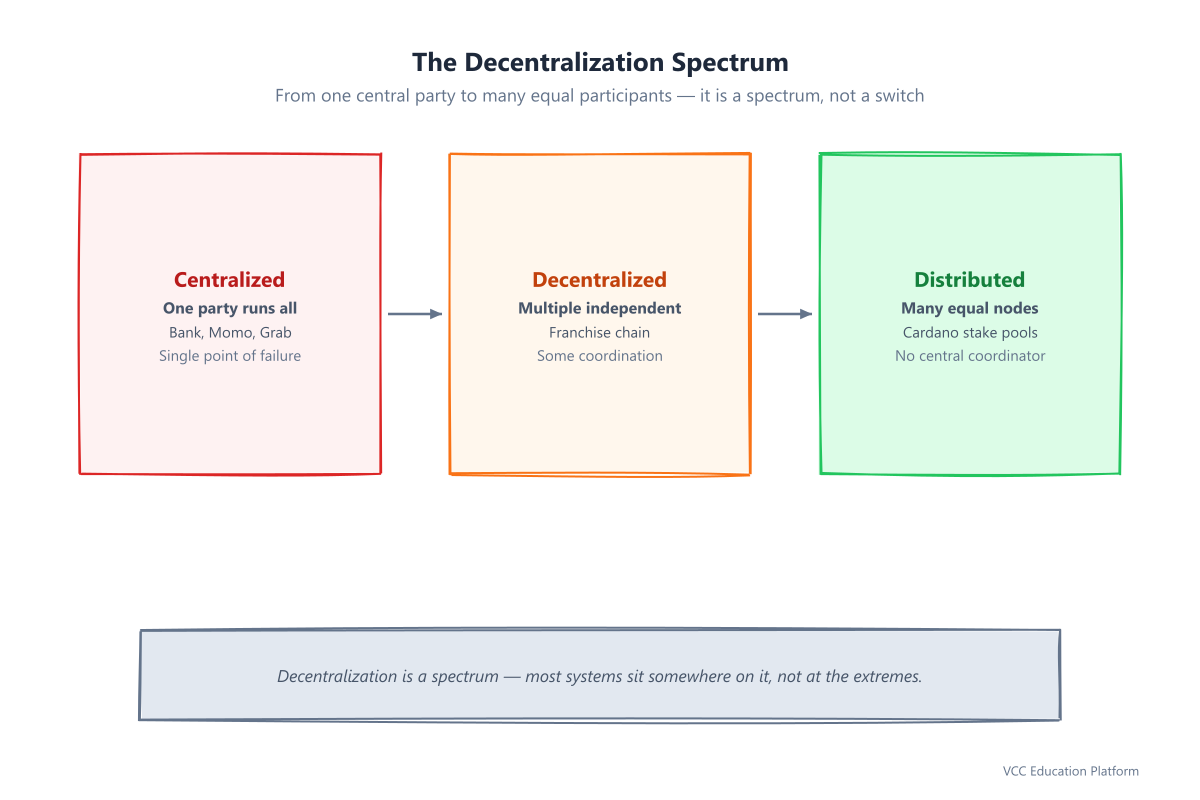
Figure 1: Decentralization is a spectrum — from one central party to many equal participants
The Spectrum: Centralized → Decentralized → Distributed
Decentralization is not a switch — it's a spectrum. Most systems you interact with daily sit at different points on it:
- Centralized: one party runs everything. Your bank, Momo, ZaloPay, Grab, Shopee — all centralized. One company controls the servers, the rules, and your access. If they decide to freeze your account, they can. If their server goes down, you're locked out.
- Decentralized: multiple independent parties run the system, but there's still some coordination structure. A franchise restaurant chain is decentralized — many owners, but one brand and rulebook.
- Distributed: many equal participants, no central coordinator at all. This is the blockchain ideal. Cardano's ~3000+ stake pools each produce blocks independently, following the same protocol. No "Cardano HQ" can shut it down.
Here's the key insight from Vitalik Buterin (Ethereum's founder): decentralization has three axes, not one. Architectural (how many physical computers), logical (does the system act as one), and political (how many individuals ultimately control it). A blockchain is architecturally and politically decentralized — many computers, many owners — but logically centralized: one ledger, one set of rules. That's the point. The ledger is shared; the control is not.
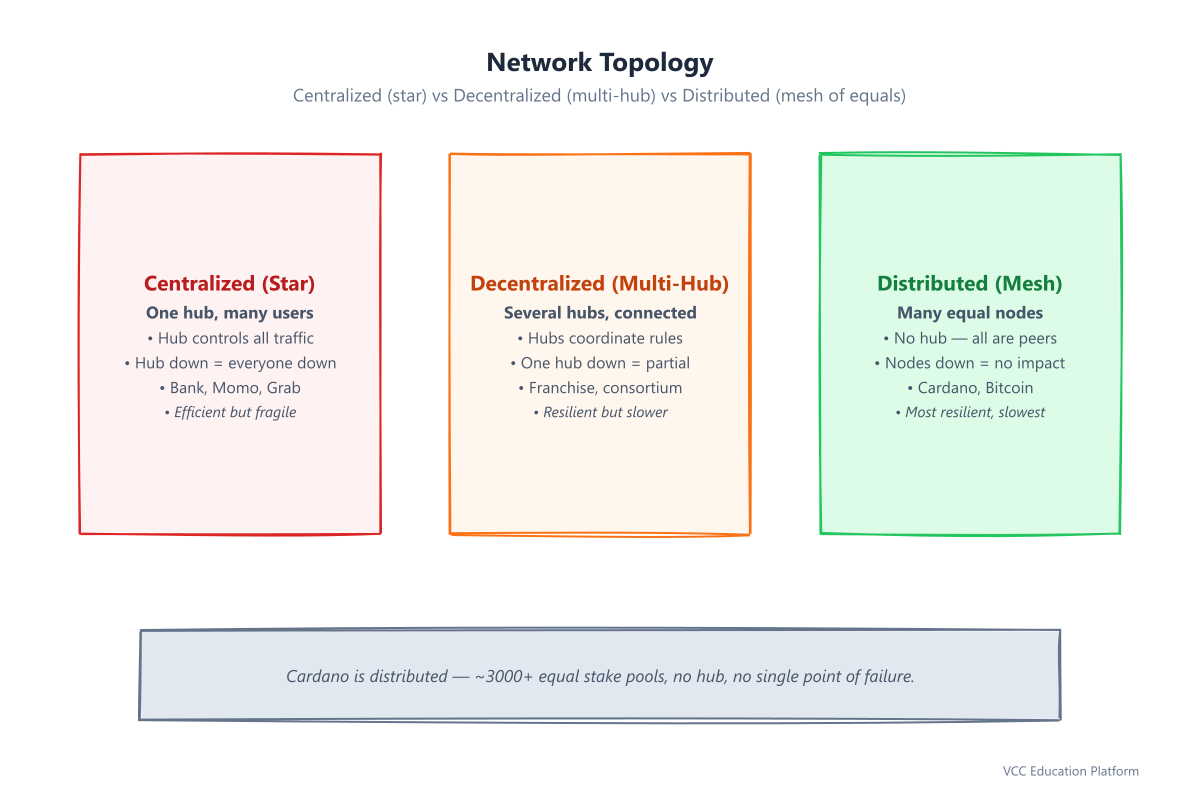
Figure 2: Network topology — centralized (star), decentralized (multi-hub), distributed (mesh of equals)
What Decentralization Actually Buys You
Why does spreading control across many parties matter? Three concrete properties:
- No single point of failure. If one bank's server burns down, millions of customers lose access. If one Cardano stake pool goes offline, the network doesn't notice — 2999+ others keep producing blocks. Resilience comes from redundancy.
- Censorship resistance. A bank can refuse your transaction (and in some countries, they do — for political, not just legal, reasons). On Cardano, a transaction that follows the protocol rules will be included in a block by some slot leader. No single pool can blacklist your address — they'd have to coordinate 51% of all stake, which is economically irrational when doing so would crash the value of their own ADA.
- Trustless verification. With a bank, you trust the bank's statement of your balance. With Cardano, you don't trust anyone — you verify. Every node independently checks every transaction against the protocol rules. You can run your own node and see the truth yourself. "Don't trust, verify" isn't a slogan; it's a property of the system.
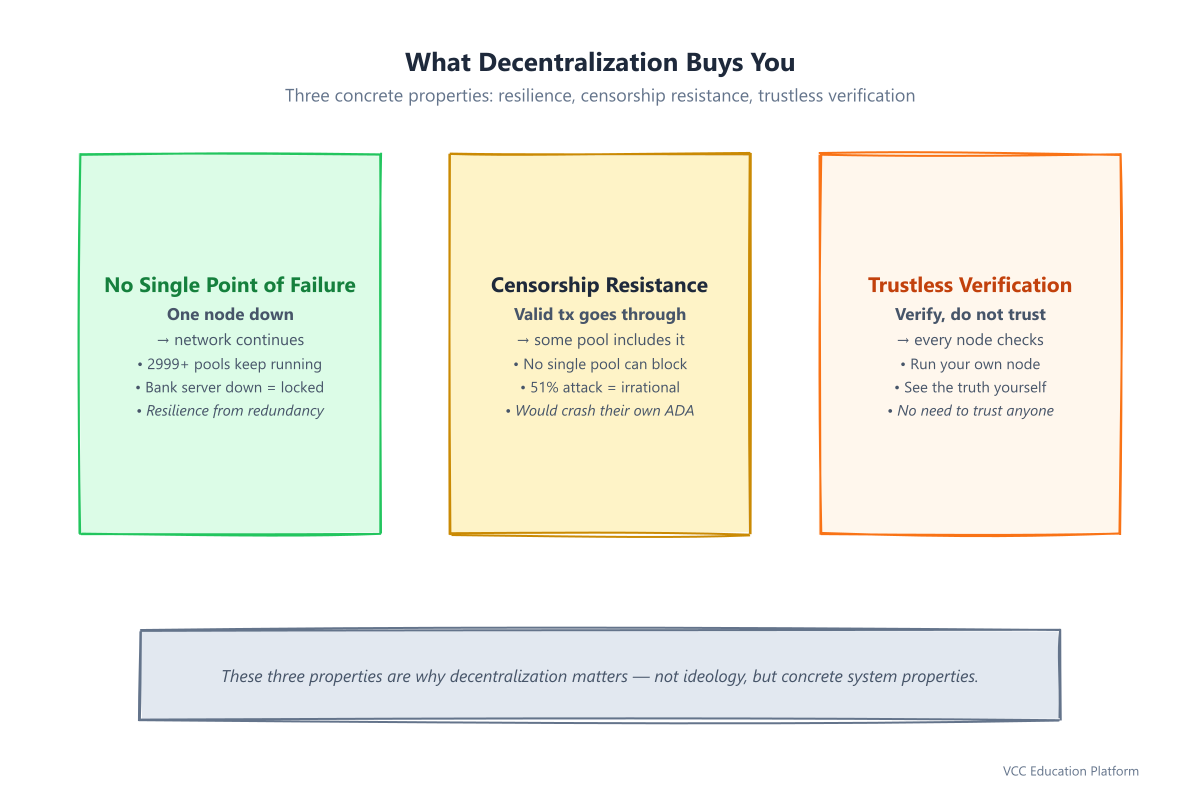
Figure 3: What decentralization buys you — resilience, censorship resistance, trustless verification
Cardano's Decentralization Story (Two Phases)
Cardano's decentralization happened in two distinct phases — and confusing them is a common mistake.
Phase 1: Block production decentralization (D=0, March 2021). For the first years, IOG (Input Output Global, the company that built Cardano) ran federated nodes — they controlled block production while the network bootstrapped. On March 31, 2021, IOG turned off their block-producing nodes. From that moment, 100% of blocks were produced by community-run stake pools. This is called the "D=0" milestone. Today, ~3000+ stake pools operated by independent individuals and companies around the world produce every block.
Phase 2: Governance decentralization (CIP-1694, ongoing). Block production is decentralized, but who decides which rules the network follows? Until recently, that was still IOG + Cardano Foundation. CIP-1694 introduced on-chain governance: DReps (Delegated Representatives) elected by ADA holders vote on governance actions — parameter changes, hard forks, treasury withdrawals. A Constitutional Committee acts as a check on extreme changes. This is the Voltaire era: decentralizing decision-making, not just block production.
The distinction matters: a network can have decentralized block production but centralized governance (many chains do). Cardano is working on both.
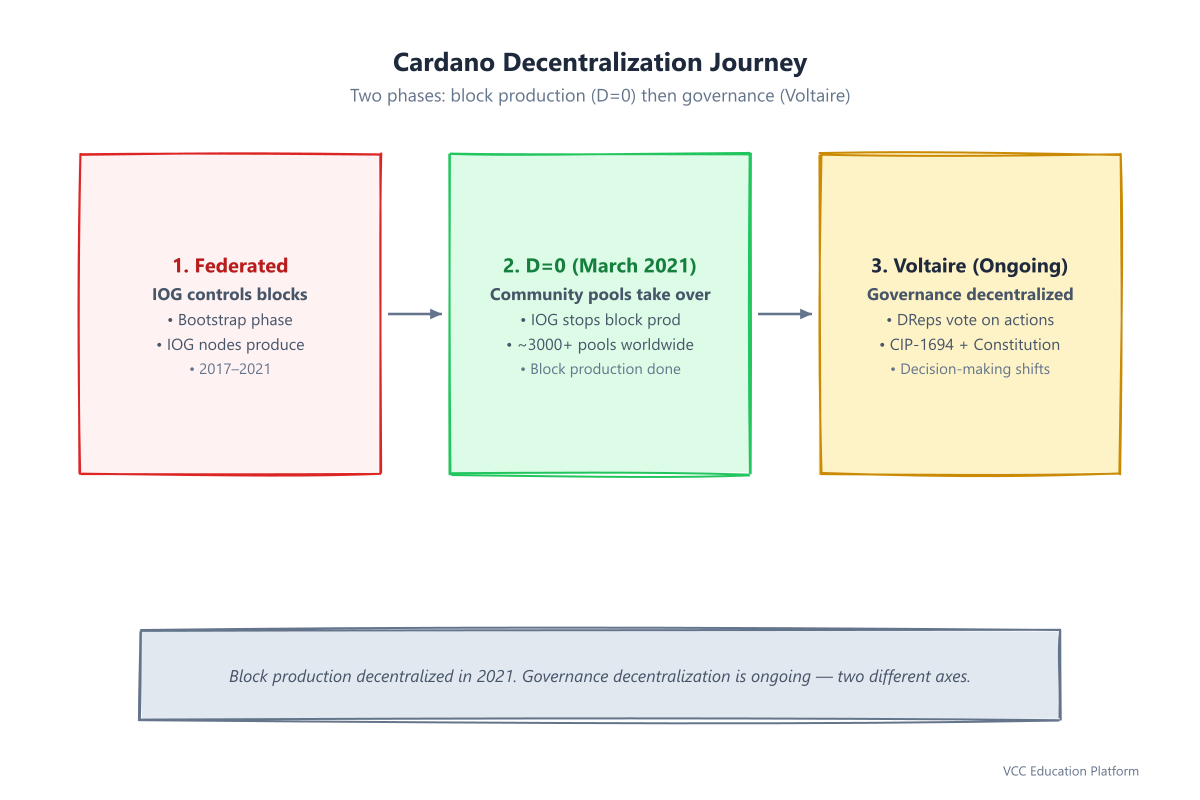
Figure 4: Cardano two-phase decentralization — block production (D=0) then governance (Voltaire)
"Sufficient" Decentralization, Not Perfect
Here's the honest part that most beginner articles skip: no blockchain is perfectly decentralized. Cardano has ~3000 stake pools, but some are operated by the same entity. Bitcoin has ~1 million miners, but a handful of mining pools control most hash power. Ethereum has hundreds of thousands of validators, but large staking services concentrate stake.
The practical goal is sufficient decentralization: enough independent participants that no single party (or small cartel) can:
- Censor transactions (would need 51%+ of stake/hashrate)
- Halt the network (would need to take down a majority of nodes)
- Change rules unilaterally (would need to convince the majority to run new software)
Cardano's ~3000 pools, geographically distributed, with no single operator controlling more than a small fraction, meets this bar. Is it perfect? No. Is it sufficient? Yes — and "sufficient" is the honest word, not "perfect."
The Trade-offs (Be Honest)
Decentralization isn't free. The same properties that make it resilient also make it:
- Slower. A bank can update its app overnight. Cardano upgrades require coordination across thousands of independent node operators — each must choose to upgrade. Hard forks take months of planning.
- Harder to govern. No CEO can make a quick decision. Governance proposals go through DRep voting, which takes time and requires broad agreement. This is by design — but it's a cost.
- More complex for users. With a bank, you call customer service if something goes wrong. With Cardano, if you lose your seed phrase, no one can help you. Self-custody is freedom and responsibility — you can't have one without the other.
These trade-offs are real. The question isn't "is decentralization always better?" — it's "for which use cases do the benefits (resilience, censorship resistance, trustlessness) outweigh the costs (speed, complexity, governance friction)?" For money that can't be debased or frozen, the trade is worth it. For a ride-sharing app, centralization is probably fine.
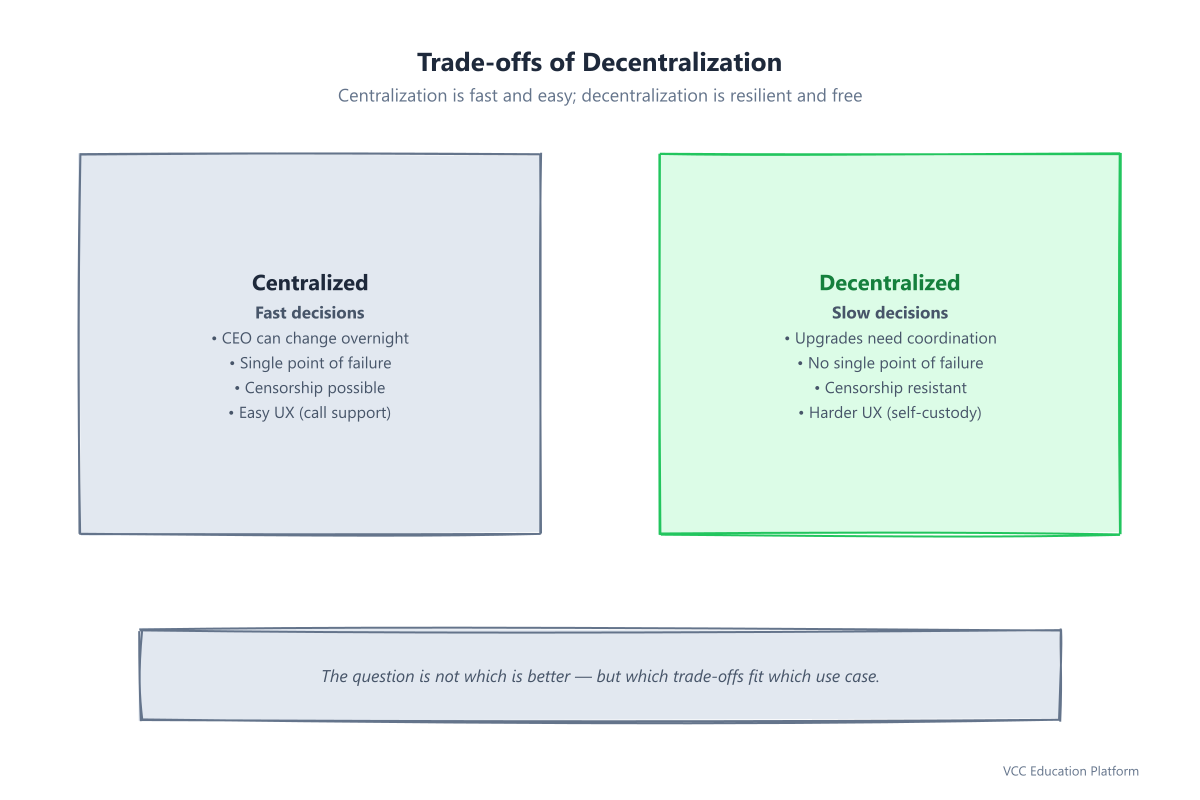
Figure 5: Trade-offs — centralization is fast and easy; decentralization is resilient and free
For Vietnamese Readers: Why This Matters Here
Vietnam's digital life is highly centralized. Momo, ZaloPay, Grab, Shopee, TikTok — each is run by one company that can change rules, freeze accounts, or shut down overnight. Your bank balance is a claim on a bank, which is regulated by the State Bank of Vietnam. Government services (VNeID, national database) are centralized by design.
This isn't necessarily bad — centralization is efficient, and Vietnamese institutions generally work. But it means most Vietnamese have never had reason to question the model. Decentralization's value becomes clearer when you consider:
- What if a platform you depend on blocks you? It happens — accounts get frozen for reasons users don't always understand. On Cardano, no one can freeze your address.
- What if a service shuts down? Companies fail. If Momo went bankrupt tomorrow, your balance is a legal claim, not a guarantee. On Cardano, your ADA exists on the ledger as long as the network runs — and it runs as long as anyone runs a node.
- What if rules change without your consent? Platforms update terms of service constantly. On Cardano, rule changes require DRep votes — and you can vote (or run for DRep yourself).
Decentralization isn't anti-government or anti-bank. It's a tool for certain use cases where resilience, censorship resistance, and self-custody matter more than speed and convenience. Understanding when to use which tool is the real skill.
Quick Reference
| Term | Definition |
|---|---|
| Decentralization | No single party can halt, censor, or change the rules — work is spread across many independent participants |
| Centralized | One party runs everything (bank, Momo, Grab) — efficient but single point of failure |
| Distributed | Many equal participants, no central coordinator (Cardano's stake pools) |
| D=0 milestone | March 31, 2021 — IOG stopped producing blocks, 100% community stake pools took over |
| Stake pool | Independent operator that produces blocks on Cardano (~3000+ pools worldwide) |
| DRep | Delegated Representative — elected by ADA holders to vote on governance actions (CIP-1694) |
| CIP-1694 | Cardano's on-chain governance proposal — DReps + Constitutional Committee |
| Sufficient decentralization | Enough independent participants that no cartel can censor, halt, or unilaterally change rules |
| Three axes (Vitalik) | Architectural (computers), logical (one system?), political (who controls?) |
| Trustless | You verify yourself instead of trusting a third party — "don't trust, verify" |