
Dr. Linh, head of the IT department at a large Vietnamese hospital, has a problem that looks nothing like a machine learning problem. Her hospital has just rolled out electronic medical records — the paperless bệnh án that Bạch Mai and Chợ Rẫy pioneered and the Ministry of Health now pushes across 1,200+ hospitals. The records hold two million patient encounters a year: chest X-rays, lab results, pathology slides, readmission histories. A screening model trained on all of it could catch early cancer sooner and predict which patients need intensive care. The data is right there — and that is exactly why she cannot use it. Privacy machine learning y tế lets a hospital train AI on sensitive patient records while the records never leave the building, never touch a cloud vendor, and never expose any single patient.
The legal floor is not negotiable. Vietnam's Nghị định 13/2023/NĐ-CP classifies health status recorded in hồ sơ bệnh án as sensitive personal data, and the 2023 Law on Medical Examination and Treatment (Luật 15/2023/QH15) gives patients the right to keep their records confidential. Bulk-uploading patient records to a cloud ML vendor is a violation of the law as written. Yet the clinical need is real, and the hospitals leading Vietnam's digital transformation already train AI on their own imaging data. The path between "data cannot move" and "AI can still learn" runs through techniques — federated learning, secure aggregation, differential privacy, and zero-knowledge proofs — that this article assembles into one working pipeline.
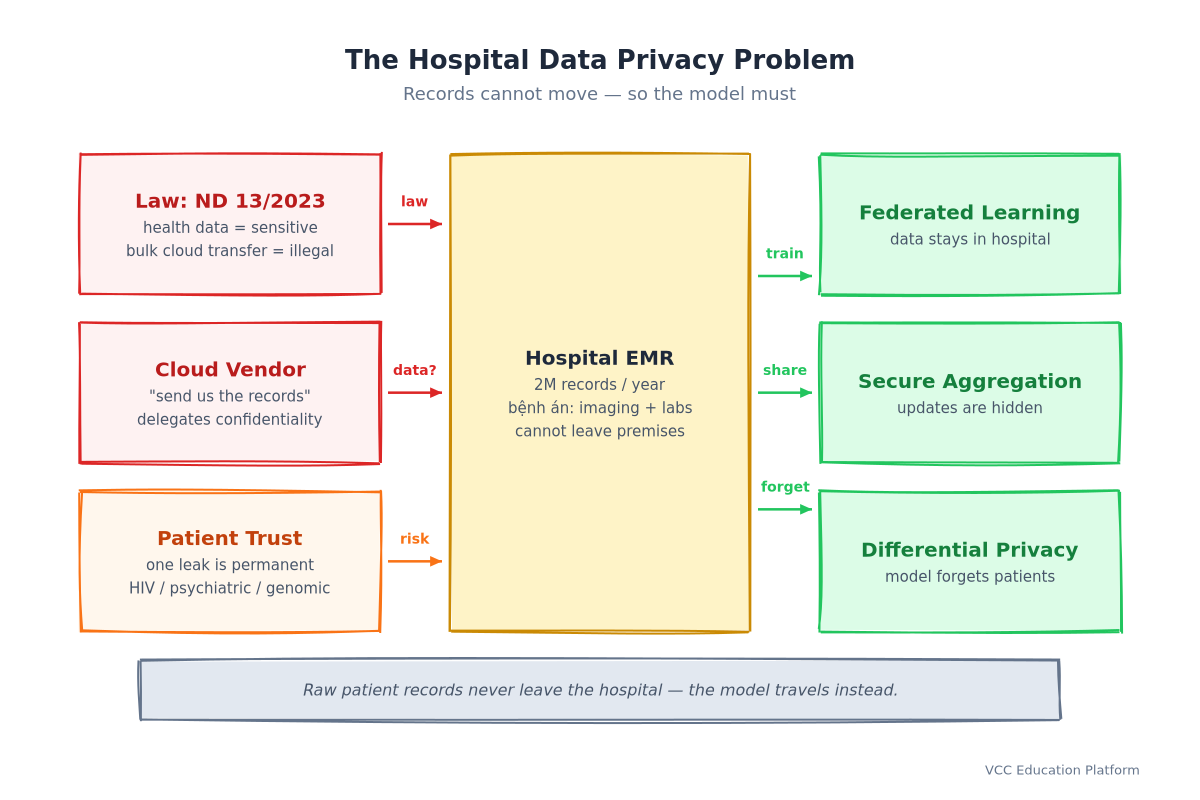
Why "move the data to the cloud" is a dead end for hospitals
The naive answer to "we want to train AI on patient data" is to send the data somewhere with GPUs. For a Vietnamese hospital, that answer fails on every axis. Legally, transferring sensitive data requires consent and a documented processing framework under Nghị định 13/2023, and the Ministry of Health's record-confidentiality rules leave almost no room for bulk research use without explicit patient consent. Practically, the data is trapped inside hospital information systems (HIS) never designed to export research-grade datasets — hospitals use different schemas, coding systems, and record structures. Ethically, the one thing a hospital can never rebuild is patient trust: a leak of HIV status, psychiatric history, or genomic data is permanent damage.
Worse, the standard cloud-era solution quietly makes the privacy problem harder. Centralized training means the model's weights are trained on every patient record in the dataset. A model is a compressed memory: membership inference attacks can often determine whether a specific patient's record was in the training set, and gradient-inversion attacks on medical images can reconstruct recognizable input data. A hospital that hands its records to a vendor does not just delegate custody — it delegates the patient-level confidentiality that the law reserves to the hospital itself.
So the constraint is fixed: raw patient records never leave the hospital's own infrastructure. Everything below is built on it.
The toolkit for huấn luyện ai riêng tư: three layers that stack
Huấn luyện ai riêng tư — private AI training — is a stack of three layers, each solving a different failure mode with a real cost.Layer 1: Federated learning — records stay put, models travel
Federated learning flips the training loop. Instead of sending data to a central server, a global model is sent out to each participating hospital. Each hospital trains the model locally on its own records — inside its own firewall — then sends back only the model update (gradients or weights), not the records. The orchestrator averages the updates and sends the improved model back out for another round. Bạch Mai's two million annual encounters, Chợ Rẫy's pathology archive, and a provincial hospital's chest-X-ray store can all contribute to one shared model without exposing a single bệnh án.
This solves data custody. It does not solve confidentiality. The updates that leave the hospital still encode information about the records they were trained on; a curious or compromised aggregator can infer whether a particular patient was in the training set. So federated learning alone is not privacy machine learning y tế; it is only its foundation.
Layer 2: Secure aggregation — nobody sees your update but the average
Secure aggregation closes the confidentiality gap at the exchange point. Using multi-party computation, each hospital masks its update with random noise that cancels out when enough hospitals' updates are summed. The aggregator receives the sum — the global average it needs — but cannot isolate any single hospital's contribution. Newer protocols (2026) tolerate a malicious aggregator and run in asynchronous networks where hospitals drop offline mid-round.
With secure aggregation in place, an honest-but-curious aggregator learns the average model movement and nothing else. This is the layer that makes a multi-hospital consortium legally plausible: no participating hospital can be identified as the source of any particular training signal.
Layer 3: Differential privacy — the model itself forgets your patients
Secure aggregation protects the exchange; it does not stop the model from remembering. Differential privacy (DP) fixes that by adding calibrated noise during training, so the model's behavior changes negligibly whether or not any single patient's record was included. The guarantee is quantified by a privacy budget, ε (epsilon): the smaller the budget, the stronger the privacy and the lower the accuracy.
DP has a property hospital IT leaders need to hear up front: the budget is depletable. Every training round on a patient's data spends a slice of their privacy budget. Choosing ε is therefore not an engineering decision — it is a clinical and legal decision about how much accuracy the hospital trades for how much protection, made once per use case and documented like any clinical protocol. On medical-imaging benchmarks, DP-trained models have shown state-of-the-art accuracy (a NeurIPS 2024 result on blood-cell classification) — the cost is real but not prohibitive.
The three layers compose: records stay inside each hospital (FL), updates are unlinkable to any hospital (secure aggregation), and the final model cannot reveal whether any specific patient was involved (DP).
Zkml bệnh án: proving the training ran correctly on sensitive data
There is a fourth question none of the three layers answers: prove it. When the Ministry of Health, a research consortium, or an auditor asks a hospital to demonstrate that a model was trained only on consented records — or that the model running in production is the exact model that was approved — the hospital currently has nothing to show but a signed PDF. Zkml bệnh án closes that gap: zero-knowledge machine learning produces a cryptographic proof that a computation happened correctly, revealing nothing about the data it used.
The intuition is the same zero-knowledge proof that powers private blockchains: a prover with a secret can convince a verifier of a statement without ever disclosing the secret. Applied to health AI, the statement can be "this global model was trained by exactly the three hospitals whose commitments are published, using exactly the agreed aggregation rule" — or "this inference on patient X's imaging data was produced by the approved model version." The proof is small, verification takes milliseconds, and anyone — a regulator, a research board, an insurer — can check it without access to the bệnh án.
This is no longer theoretical. A 2025 architecture called zkFL-Health combines federated learning with zero-knowledge proofs and a trusted execution environment: each hospital commits its local update, the aggregator computes the global update inside a protected enclave, and emits a succinct proof (Halo2/Nova) that it used exactly the committed inputs and the correct aggregation rule — while revealing no hospital's update to anyone. Meanwhile, ZKPROV (2025) demonstrates verifiable binding of training datasets, model parameters, and outputs with proof generation under about 3.3 seconds for models up to 8 billion parameters, and Jolt Atlas (2026) brings zero-knowledge verification to ONNX tensor operations. The building blocks for a Vietnamese zkml bệnh án pilot exist today.
The honest caveat, borrowed from critics of the ZKML hype cycle: a zero-knowledge proof proves that the circuit ran honestly, not that the model is clinically correct. A biased model or a flawed training set can be proved to have run exactly as coded. ZKML gives a hospital accountability for "what was computed" — never absolution for "was it the right thing to compute." Clinical validation remains the hospital's job.
The complete private training pipeline
Assembling all four layers produces a pipeline that maps one-to-one onto Vietnamese legal obligations.
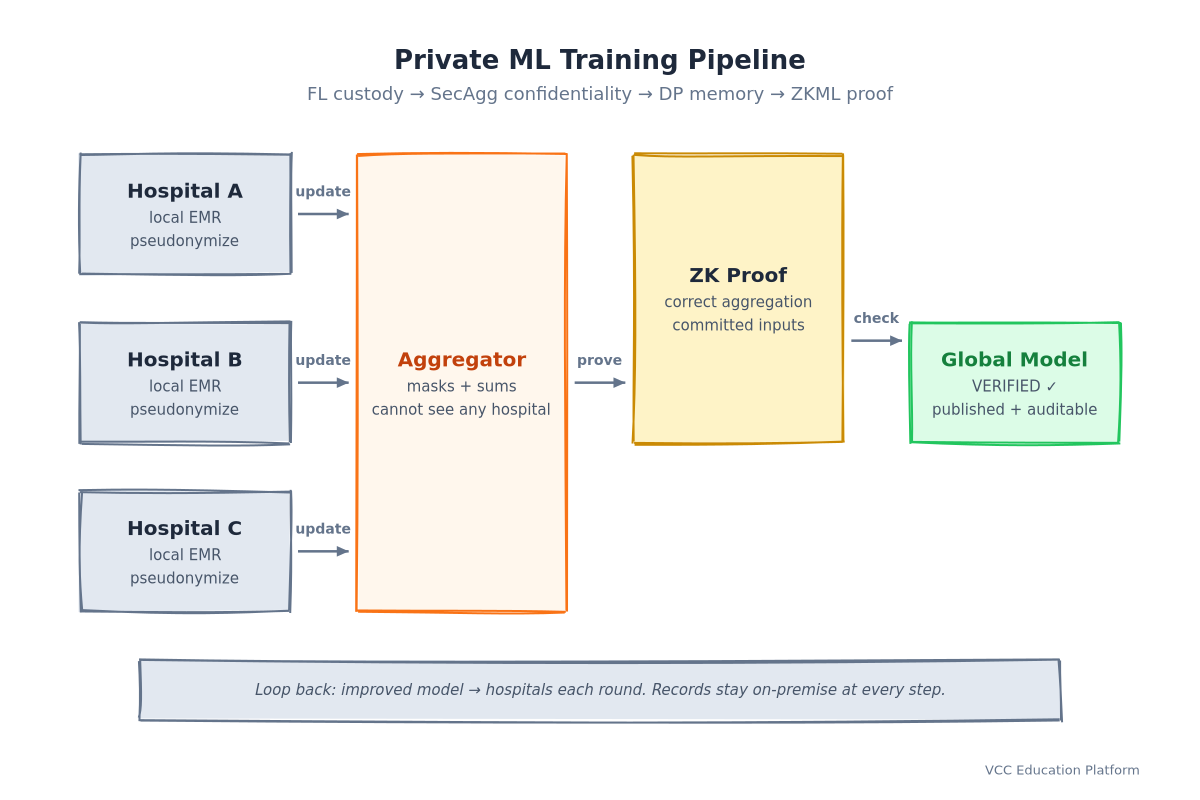
The pipeline has seven stages. Each hospital prepares and pseudonymizes its local EMR snapshot behind its own firewall (this is where most of the real engineering cost lives — schema normalization, ICD-10 alignment, feature extraction). A coordinator broadcasts the current global model. Each hospital trains locally for several epochs, applies a per-hospital privacy budget, and masks its update for secure aggregation. The aggregator combines the masked updates, verifies them against the published commitments, and produces a new global model with a zero-knowledge proof that aggregation ran correctly on exactly the committed inputs. The model and proof are published; patient data never moves.
For a real-time bedside use case, the same architecture applies in inference mode: a hospital runs the approved model on a new patient's imaging data locally, generates a proof that the approved model version produced that output, and presents it without exposing the weights or the record. Proof generation for hospital-scale screening models is seconds to minutes on a GPU; verification is milliseconds. That makes the pipeline right for regulatory audit and batch reporting today, and wrong for real-time decision support where sub-second latency is mandatory — the first tradeoff below.
Three honest tradeoffs for health AI
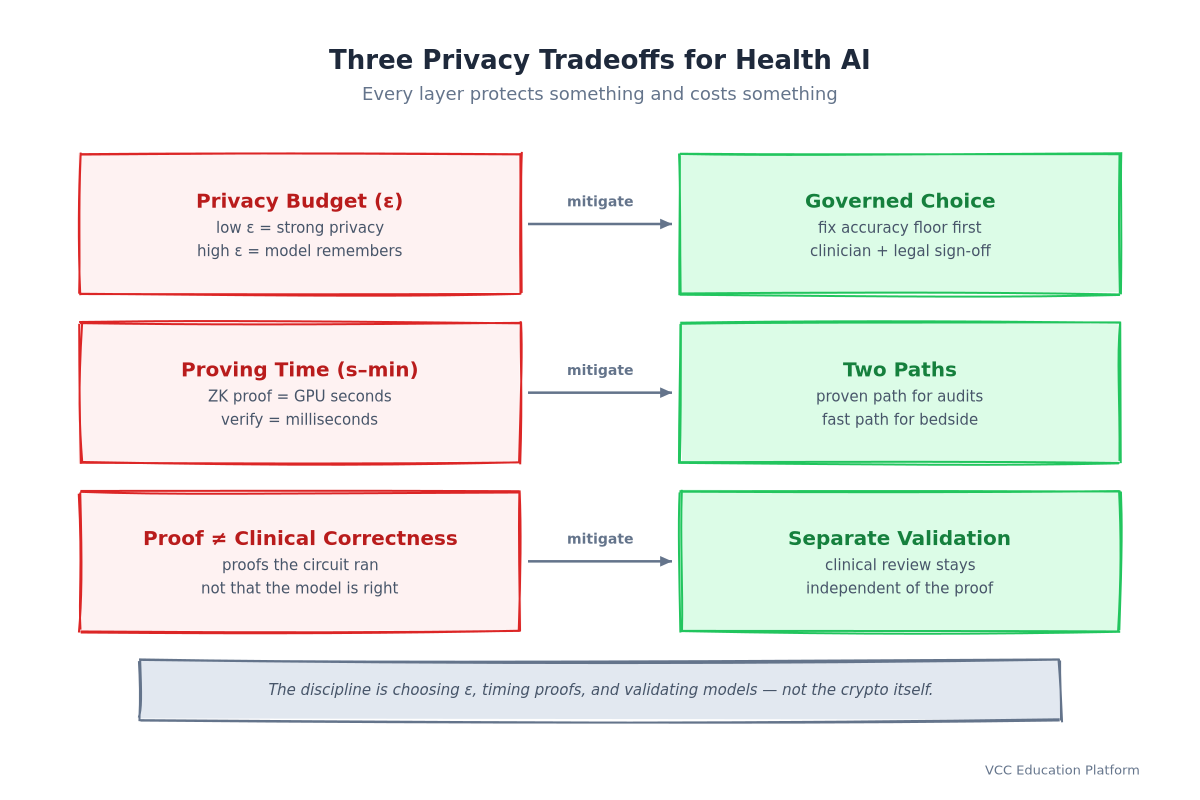 Tradeoff 1: Privacy budget vs. clinical accuracy. Differential privacy is a real, depletable currency. Every round of training spends a slice of each patient's ε; push ε too low and predictions degrade, push ε too high and the model starts remembering individual patients. The resolution is per-use-case governance: fix an acceptable accuracy floor first, compute the ε that achieves it, and have a clinician and a legal officer sign off — exactly the way a treatment protocol is approved.
Tradeoff 2: Proving cost vs. timeliness. Zero-knowledge proof generation is the expensive step (seconds to minutes on GPU for medium models); verification is cheap and instant. This asymmetry suits the periodic, asynchronous audit tasks that dominate hospital compliance — a monthly consortium round, a yearly regulatory report — but not real-time bedside inference. The pragmatic answer is to separate the two paths: fast unproven inference for bedside care, proven inference for anything that will be audited or published.
Tradeoff 3: The "garbage in, gospel out" trap. A proof of correct computation can lend false authority to a flawed model. The pipeline protects the data pipeline — where records came from, how they were aggregated, which model version ran — not the clinical validity of the model. Keep model validation (accuracy, bias across regions, calibration) a separate, ordinary process. A proof is a receipt for a computation; it is not a medical opinion.
Tradeoff 1: Privacy budget vs. clinical accuracy. Differential privacy is a real, depletable currency. Every round of training spends a slice of each patient's ε; push ε too low and predictions degrade, push ε too high and the model starts remembering individual patients. The resolution is per-use-case governance: fix an acceptable accuracy floor first, compute the ε that achieves it, and have a clinician and a legal officer sign off — exactly the way a treatment protocol is approved.
Tradeoff 2: Proving cost vs. timeliness. Zero-knowledge proof generation is the expensive step (seconds to minutes on GPU for medium models); verification is cheap and instant. This asymmetry suits the periodic, asynchronous audit tasks that dominate hospital compliance — a monthly consortium round, a yearly regulatory report — but not real-time bedside inference. The pragmatic answer is to separate the two paths: fast unproven inference for bedside care, proven inference for anything that will be audited or published.
Tradeoff 3: The "garbage in, gospel out" trap. A proof of correct computation can lend false authority to a flawed model. The pipeline protects the data pipeline — where records came from, how they were aggregated, which model version ran — not the clinical validity of the model. Keep model validation (accuracy, bias across regions, calibration) a separate, ordinary process. A proof is a receipt for a computation; it is not a medical opinion.
A practical roadmap for Vietnamese hospitals and health-tech startups
The realistic path, for a hospital or a health-tech startup serving hospitals:
Step 1: Choose a low-liability, high-volume use case. Start with triage and risk scoring — chest-X-ray flagging, admission-risk prediction, readmission prediction — not direct diagnosis. These deliver measurable value with a small ethical surface. Step 2: Standardize and pseudonymize the data first. This is 80% of the real work. Normalize the EMR schema, align ICD-10 coding, strip identifiers, and version the extraction pipeline. If the data pipeline is unreliable, every privacy layer on top of it is theater. Step 3: Build the FL + secure aggregation baseline. Use an open-source framework (Flower, TensorFlow Federated, PySyft) in a sandbox with two or three synthetic hospital slices. Measure accuracy against the centralized baseline before adding privacy machinery. Step 4: Add differential privacy and measure the cost at your target ε. Record accuracy at ε = 1, 5, 10 and let the clinical team choose the point. Document the decision as a data-protection impact assessment under Nghị định 13/2023 — it is legally required anyway, and it forces the governance conversation early. Step 5: Add ZKML only where an external party must verify. For a single in-hospital model, zero-knowledge proofs are over-engineering today. Add them when a regulator, a research consortium, or a paying client needs independently checkable evidence — then the zkml bệnh án proof becomes a sales asset rather than a cost.Frequently asked questions
Does privacy machine learning y tế work if my hospital has no GPU and no ML team?
Yes — this is the most common entry point. A hospital does not need to run training at all: it can join a federation as a data contributor while a health-tech partner runs the orchestration, as long as secure aggregation ensures the partner cannot see the hospital's updates. The hospital's obligation is data quality and pseudonymization; the compute can live elsewhere.
How do huấn luyện ai riêng tư and zkml bệnh án fit together in practice?
Huấn luyện ai riêng tư is the training method: federated learning keeps records in place, secure aggregation hides each hospital's update, and differential privacy stops the model from remembering patients. Zkml bệnh án is the proof layer on top: it lets the consortium prove to an auditor that training used exactly the committed, consented data and the agreed aggregation rule. Training produces the model; zero-knowledge produces the receipt that makes the training defensible.Does differential privacy hurt accuracy enough to matter clinically?
On structured prediction tasks (risk scores, triage flags) the accuracy cost at reasonable ε is typically small but not zero, and it must be measured per use case, not assumed. Fix the clinical accuracy floor first, then find the ε that satisfies it — and remember that an unprivacy-protected model that leaks a patient's record has failed regardless of its AUC.
What should a hospital do if a vendor asks for a copy of the records to train "their" model?
Treat it as a legal event, not a technical one. Under Nghị định 13/2023, health data in bệnh án is sensitive personal data; transferring it requires consent, a documented processing agreement, and the hospital remains accountable after transfer. The private-ML answer — train federated, aggregate securely, prove with zero-knowledge — delivers the same model without the transfer. If the vendor cannot work under that constraint, they are not building privacy machine learning y tế; they are building a data collection business.
Conclusion
Vietnamese hospitals sit on some of the most valuable and most regulated data in the country. The Ministry of Health's EMR push has digitized 1,200+ hospitals; Bạch Mai and Chợ Rẫy are training AI on their own records today. The question was never whether the data is good enough — it is — but how a hospital trains on sensitive patient records without violating Nghị định 13/2023, the Law on Medical Examination and Treatment, or the trust of every patient. The answer is a layered pipeline: federated learning for custody, secure aggregation for confidentiality, differential privacy for patient-level protection, and zero-knowledge proofs for accountability. Each layer has a real cost, and the honest engineering — choosing ε, timing proofs, validating models — is where the discipline lives. Hospitals that build this now will be the ones defining what responsible health AI looks like in Vietnam.
---
Quick Reference
| Layer | What it protects | What it does not protect | Typical cost |
| --- | --- | --- | --- |
| Federated learning | Data custody (records never leave the hospital) | Confidentiality of the model's memory | Communication rounds, local GPU |
| Secure aggregation | Update confidentiality (no hospital's update is visible) | The model remembering individual patients | MPC protocol overhead |
| Differential privacy | Patient-level protection (model behavior ≈ with/without one patient) | Auditability, provenance | Accuracy loss at chosen ε |
| ZKML (zkml bệnh án) | Accountability (proof training/inference ran on the committed data) | Clinical correctness of the model | GPU proving time (s–min), ms verify |
| Legal floor (VN) | Nghị định 13/2023/NĐ-CP sensitive data; Luật 15/2023/QH15 Art. 10/69 | — | Impact assessment, consent framework |
| Reference model | GDPR Art. 9 (health = special category) | — | — |
| Best first use case | Triage, admission-risk, readmission prediction | — | — |
| Open-source stack | Flower, TensorFlow Federated, PySyft, OpenMined, EZKL | — | — |