# Tokenized US Treasuries: Safe as Bank Deposits, Higher Yield
**Meta Title:** Tokenized US Treasuries: Safe as Bank Deposits, Higher Yield (2024 Guide)
**Meta Description:** Compare tokenized treasury funds (BUIDL, USYC, iBENJI, WTGXX) yielding 4.5-5.5% APY. Risks, access from Vietnam, tax guide.
**Primary Keyword:** tokenized treasuries
**URL Slug:** /tokenized-us-treasuries-safe-as-bank-deposits
---
Imagine this: You walk into a Vietnamese bank in August 2024. The 12-month VND savings rate is 4.8%. Inflation is running at 3.45%. Your real return? A measly **1.35%**. Meanwhile, the USD has appreciated ~5.6% against the VND since 2022. Your savings are losing purchasing power in hard currency terms.
Now imagine an alternative: A USD-denominated instrument backed by US Treasury bills — the world's safest asset — yielding **4.5-5.5% APY**, settling 24/7, accessible from your phone with as little as **$100**. No accredited investor requirement. No $1M minimum. No T+1 settlement wait.
This is the promise of **tokenized treasuries** — and it's not theoretical. As of August 2024, over **$1.8 billion** sits in tokenized US Treasury funds, led by giants like BlackRock, Franklin Templeton, and WisdomTree. For Vietnamese investors, this represents the first practical bridge between traditional finance safety and DeFi efficiency.
In this guide, we'll explain what tokenized treasuries are, how they work, the major players (BUIDL, USYC, iBENJI, WTGXX, Ondo, Franklin Templeton), the real risks, and exactly how to access them from Vietnam — including tax implications under the US-Vietnam treaty.
---
## What Are Tokenized Treasuries?
### The Core Concept: Treasury Bills on Blockchain
**Tokenized treasuries** are blockchain-based tokens that represent ownership shares in a fund holding US Treasury bills (T-bills), repurchase agreements (repos), and cash. Each token is a digital wrapper around a regulated money market fund — specifically, a fund registered under the US Investment Company Act of 1940 ('40 Act).
Think of it like this: A traditional money market fund (like Vanguard's VMFXX) issues shares. You buy shares, the fund buys T-bills, you earn yield. Tokenized treasuries do the exact same thing, but the shares are **ERC-20 tokens** (or SPL/Stellar equivalents) on a public blockchain. You hold them in your own wallet. You can transfer them 24/7. You can use them as collateral in DeFi.
### How They Differ from Stablecoins and Money Market Funds
| Feature | Bank Deposit (VND) | Money Market Fund (VMFXX) | **Tokenized Treasury (BUIDL/OUSG)** |
|---------|-------------------|---------------------------|-------------------------------------|
| **Denomination** | VND | USD | USD (tokenized) |
| **Yield (Aug 2024)** | 4.5-5.0% nominal | ~5.2% (7-day SEC yield) | **4.5-5.5%** |
| **Real Yield (Vietnam)** | **~1.35%** (after 3.45% CPI) | **~3.2%** (after ~2% US CPI) | **~3.2%** |
| **Settlement** | Instant (internal) | T+1 | **24/7, seconds** |
| **Minimum** | ~$1 (VND) | $3,000 (retail) | **$100** (via apps) |
| **Custody** | Bank (counterparty risk) | Broker (SIPC) | **Self-custody** (wallet) |
| **Access from VN** | Local branch | Intl brokerage needed | **CEX/DeFi wallet** |
| **Regulatory Protection** | VSDIC (VND 75M) | SIPC ($500K) | **'40 Act fund + SPV** |
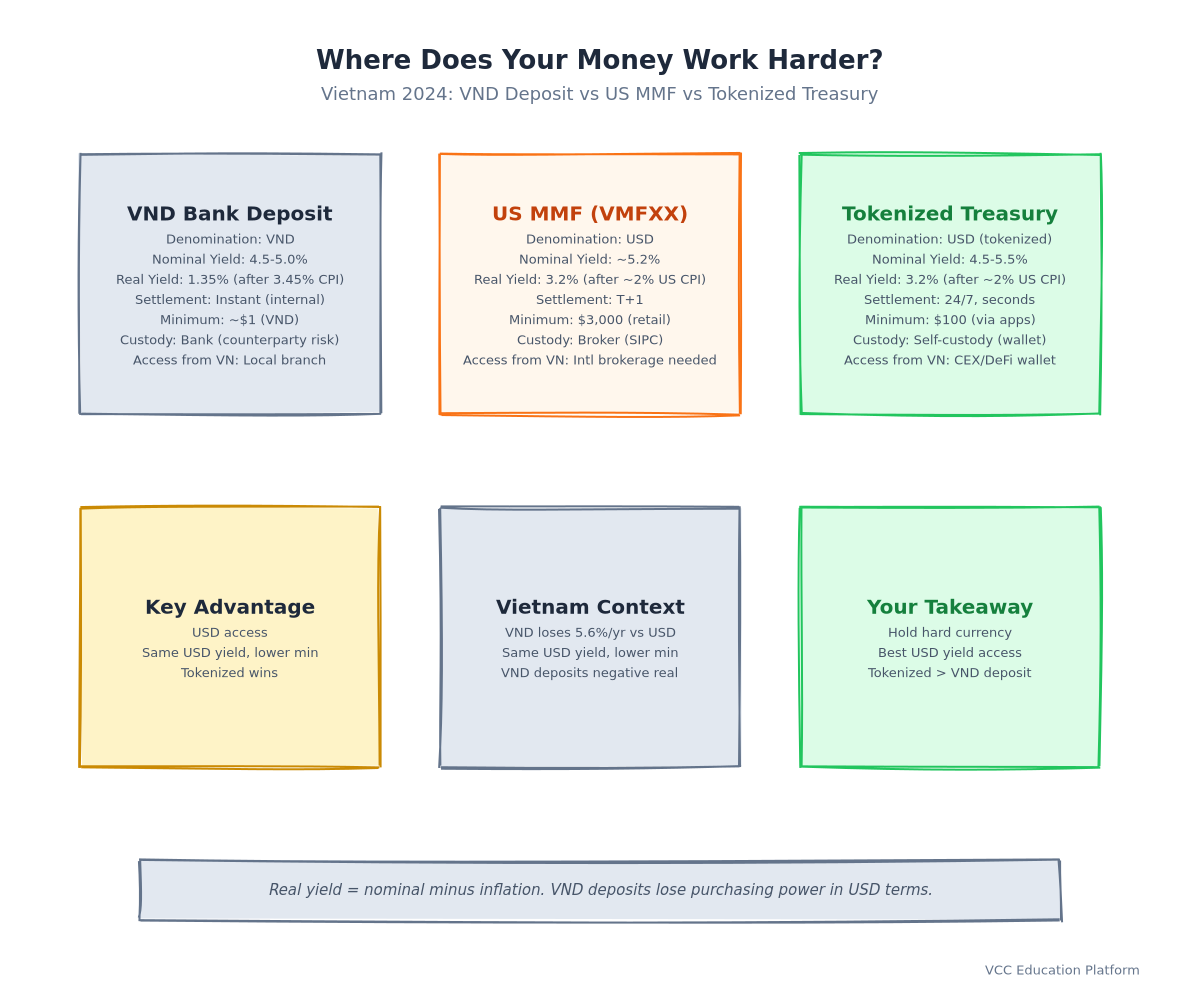
**Key insight:** Tokenized treasuries are **not stablecoins**. USDT/USDC are payment tokens with peg risk. Tokenized treasuries are fund shares — their value fluctuates slightly (typically $0.995-$1.005) based on the underlying T-bill portfolio's mark-to-market. They're also not "yield-bearing stablecoins" like sDAI or stETH — those are DeFi-native with smart contract risk as the primary exposure. Tokenized treasuries' primary risk is the **US government defaulting on T-bills** — the same risk as any Treasury holder.
---
## How Tokenized Treasury Funds Work
### Mint → Invest → Accrue → Redeem Lifecycle
The mechanics are elegantly simple:
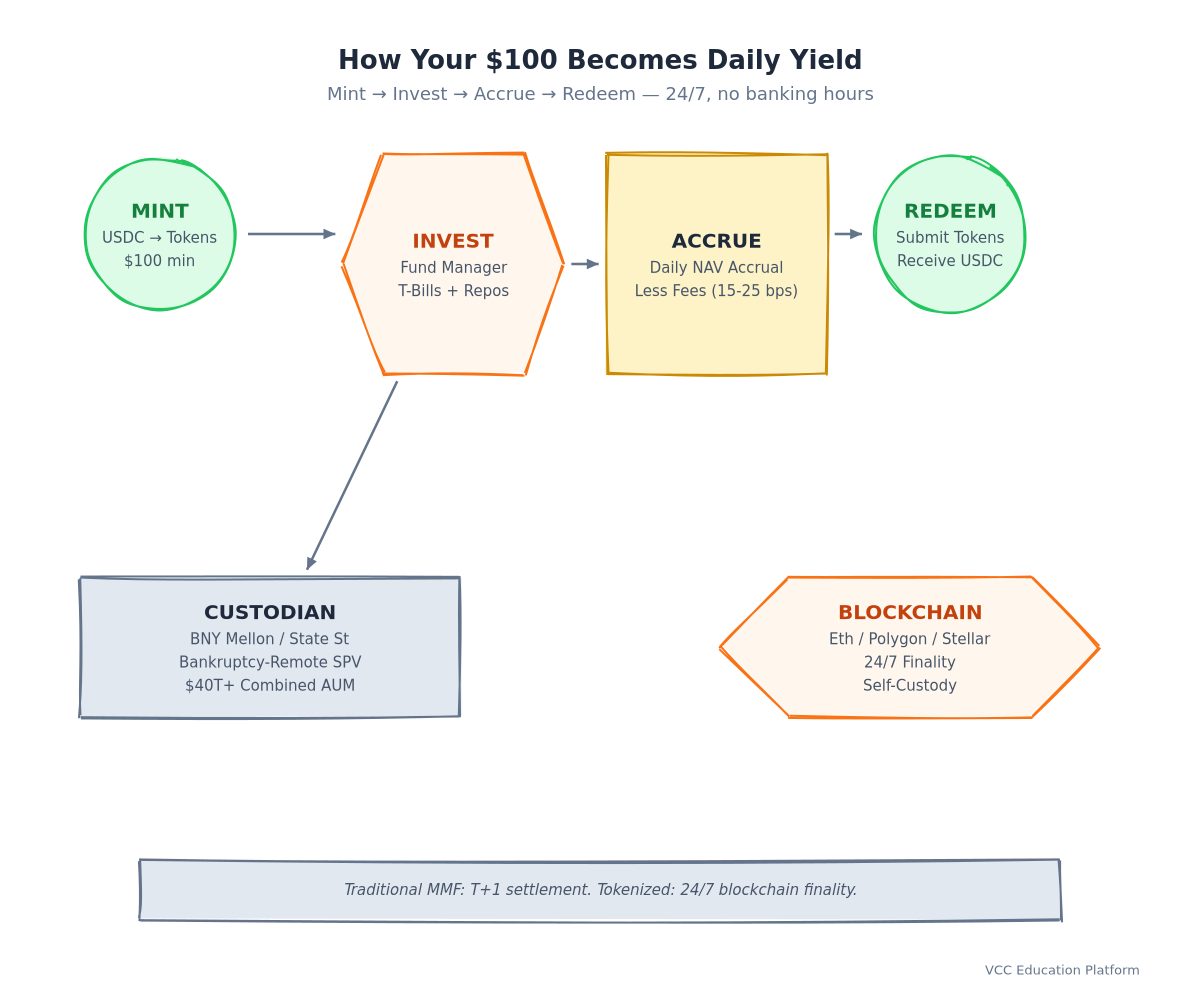
1. **Mint (Subscribe):** You send USDC/USDT (or wire USD) to the fund's smart contract or transfer agent. The contract issues you tokens representing fund shares.
2. **Invest:** The fund manager (BlackRock, Ondo, Franklin Templeton) deploys capital into T-bills (via primary dealer) and repos (via custodian like BNY Mellon).
3. **Accrue:** T-bill coupons + repo interest accumulate daily. The fund's net asset value (NAV) ticks up. Your token balance **stays constant** — value accrues in NAV, not token count (except Ondo's USDY which rebases).
4. **Redeem:** You submit tokens for redemption. The fund sells T-bills/repos, sends USDC/USDT to your wallet. Settlement: **seconds to hours**, 24/7.
### 24/7 Settlement vs Traditional T+1
Traditional money market funds settle T+1: sell Monday, cash Wednesday. Tokenized funds settle on **blockchain finality** — Ethereum (~12 min), Polygon (~2 min), Stellar (~3-5 sec). No banking hours. No weekend freeze. This matters when you need liquidity during a market crisis (like March 2020 or March 2023) — traditional funds gate redemptions; tokenized funds process continuously.
### Yield Source: T-Bill Coupons + Repo Revenue
Where does the 4.5-5.5% come from? Decomposition:
| Component | Typical Contribution |
|-----------|---------------------|
| T-Bill Coupon (3-6 month) | 4.8-5.3% |
| Repo Lending Revenue | +0.1-0.2% |
| **Gross Portfolio Yield** | **~5.0-5.5%** |
| Management Fee (15-25 bps) | -0.15-0.25% |
| Operational/Admin | -0.05-0.10% |
| **Net 7-Day SEC Yield** | **~4.7-5.2%** |
Funds like BUIDL and OUSG publish daily NAV and 7-day SEC yield on their websites and on-chain. You can verify yield in real time — no waiting for monthly fact sheets.
---
## The Major Players: BUIDL, USYC, iBENJI, WTGXX & More
As of August 2024, six funds dominate the tokenized treasury landscape. Here's your scorecard:
### BlackRock BUIDL — The $500M+ Leader
- **Full Name:** BlackRock USD Institutional Digital Liquidity Fund
- **Token:** BUIDL (ERC-20, Ethereum mainnet)
- **AUM:** $517M (Aug 2024) — **largest by far**
- **7-Day SEC Yield:** 5.21% (Aug 16, 2024)
- **Minimum:** $100K direct; $100 via Ondo/other distributors
- **Custodian:** BNY Mellon | **Administrator:** State Street
- **Redemption:** 24/7, T+0 on business days
- **Key Differentiator:** BlackRock brand, deepest liquidity, Ethereum mainnet (highest security), institutional on-ramp via Securitize
### Ondo Finance OUSG / USDY — DeFi-Native Access
- **OUSG:** Ondo Short-Term US Government Fund (accredited only, ERC-20, Ethereum/Polygon)
- **USDY:** US Dollar Yield (retail-friendly, rebasing token, Solana/Polygon/Ethereum)
- **AUM:** OUSG $185M + USDY $95M = **~$280M combined**
- **7-Day SEC Yield:** OUSG 5.35% | USDY 5.25% (Aug 2024)
- **Minimum:** **$100** via Ondo App (KYC required)
- **Custodian:** BNY Mellon (OUSG) | **Transfer Agent:** Securitize
- **Redemption:** Instant via Ondo App; USDY rebases daily (token count increases)
- **Key Differentiator:** Best retail UX, DeFi integrations (USDY as collateral on Morpho, Aave), multi-chain
### Franklin Templeton BENJI (iBENJI) — TradFi Giant Enters
- **Full Name:** Franklin OnChain US Government Money Fund
- **Token:** BENJI (Stellar) / iBENJI (Polygon bridge)
- **AUM:** $360M (Aug 2024)
- **7-Day SEC Yield:** 5.18% (Aug 2024)
- **Minimum:** $100K direct; lower via distributors
- **Custodian:** State Street | **Blockchain:** Stellar (native) + Polygon (iBENJI)
- **Redemption:** 24/7 via Stellar (3-5 sec finality)
- **Key Differentiator:** Stellar's built-in compliance (KYC/AML at protocol layer), Franklin Templeton's 75-year fund history
### WisdomTree WTGXX — ETF Pioneer's Tokenized Fund
- **Full Name:** WisdomTree Government Money Market Fund
- **Token:** WTGXX (Stellar native)
- **AUM:** $45M (Aug 2024) — smaller but growing
- **7-Day SEC Yield:** 5.15% (Aug 2024)
- **Minimum:** $100K direct
- **Custodian:** BNY Mellon | **Blockchain:** Stellar
- **Key Differentiator:** WisdomTree's ETF distribution network, Stellar efficiency
### Brevan Howard USYC — Hedge Fund Grade
- **Full Name:** BH Macro US Treasury Fund (via Superstate)
- **Token:** USYC (ERC-20, Polygon)
- **AUM:** $85M (Aug 2024)
- **7-Day SEC Yield:** 5.28% (Aug 2024)
- **Minimum:** $100K direct; $100 via Superstate app
- **Custodian:** State Street | **Blockchain:** Polygon (low fees, fast finality)
- **Key Differentiator:** Brevan Howard's macro expertise, Superstate's retail on-ramp
### Comparison Table: Top 6 Tokenized Treasury Funds
| Fund | Token | Chain | AUM | Yield | Min (Retail) | Custodian | Best For |
|------|-------|-------|-----|-------|--------------|-----------|----------|
| **BlackRock BUIDL** | BUIDL | Ethereum | $517M | 5.21% | $100 (via Ondo) | BNY Mellon | Brand trust, liquidity |
| **Ondo OUSG** | OUSG | Eth/Poly | $185M | 5.35% | $100 (Ondo App) | BNY Mellon | DeFi integration |
| **Ondo USDY** | USDY | Sol/Poly/Eth | $95M | 5.25% | $100 (Ondo App) | BNY Mellon | Rebasing yield, DeFi |
| **Franklin BENJI** | BENJI/iBENJI | Stellar/Poly | $360M | 5.18% | $100K direct | State Street | Stellar speed, compliance |
| **WisdomTree WTGXX** | WTGXX | Stellar | $45M | 5.15% | $100K direct | BNY Mellon | ETF distribution |
| **Brevan Howard USYC** | USYC | Polygon | $85M | 5.28% | $100 (Superstate) | State Street | Macro expertise, low fees |
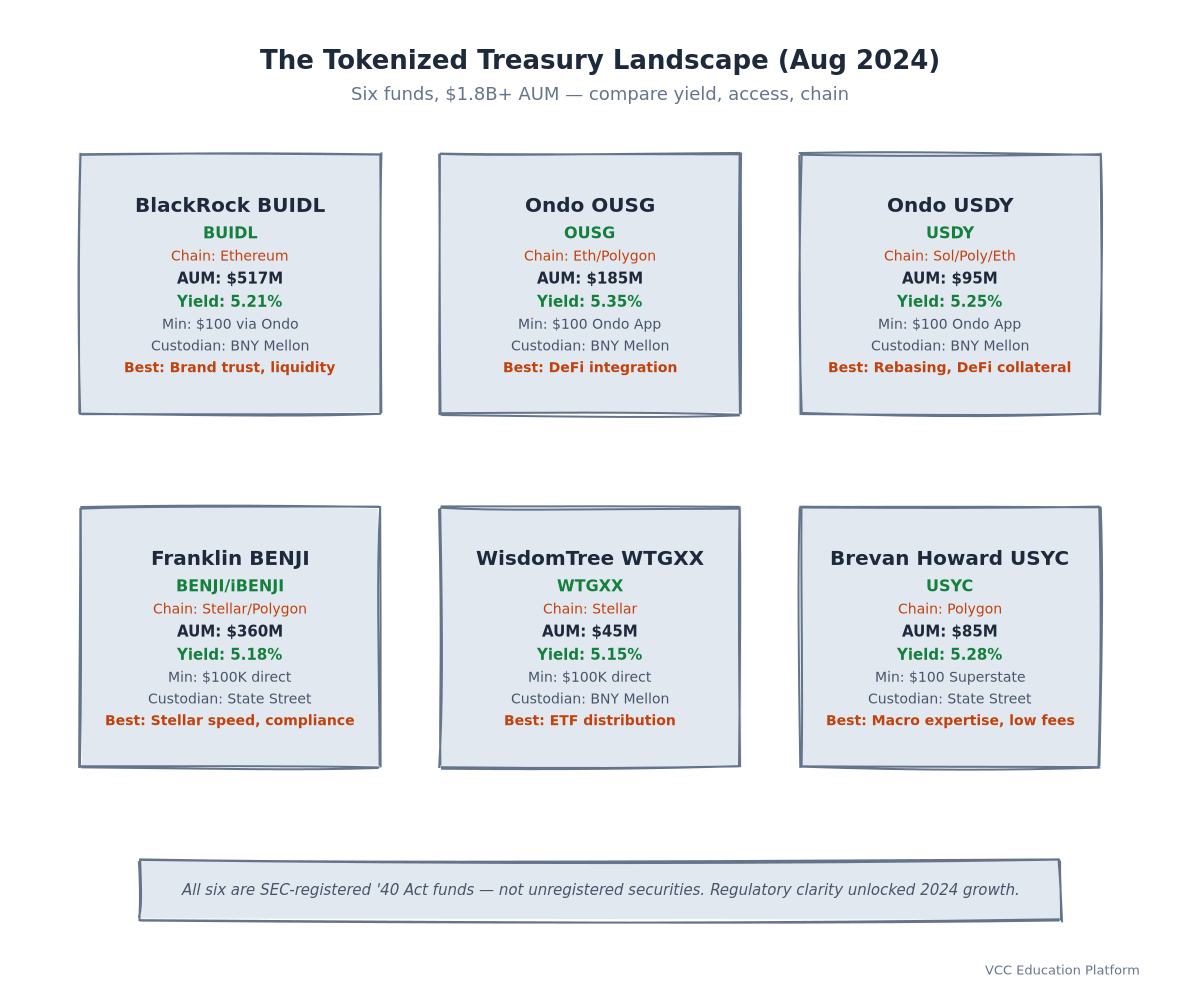
**Critical note:** All six are **registered '40 Act funds**. They are NOT unregistered securities. The SEC has explicitly stated (April 2024) that tokenized shares of registered funds are not "crypto assets" for custody rule purposes. This regulatory clarity is what unlocked institutional participation in 2024.
---
## Yield Comparison: Bank Deposits vs Money Market Funds vs Tokenized Treasuries
### Nominal Yield vs Real Yield (Inflation-Adjusted)
Nominal yield is what the headline says. **Real yield** is what you actually keep after inflation. For Vietnamese investors, this distinction is everything.
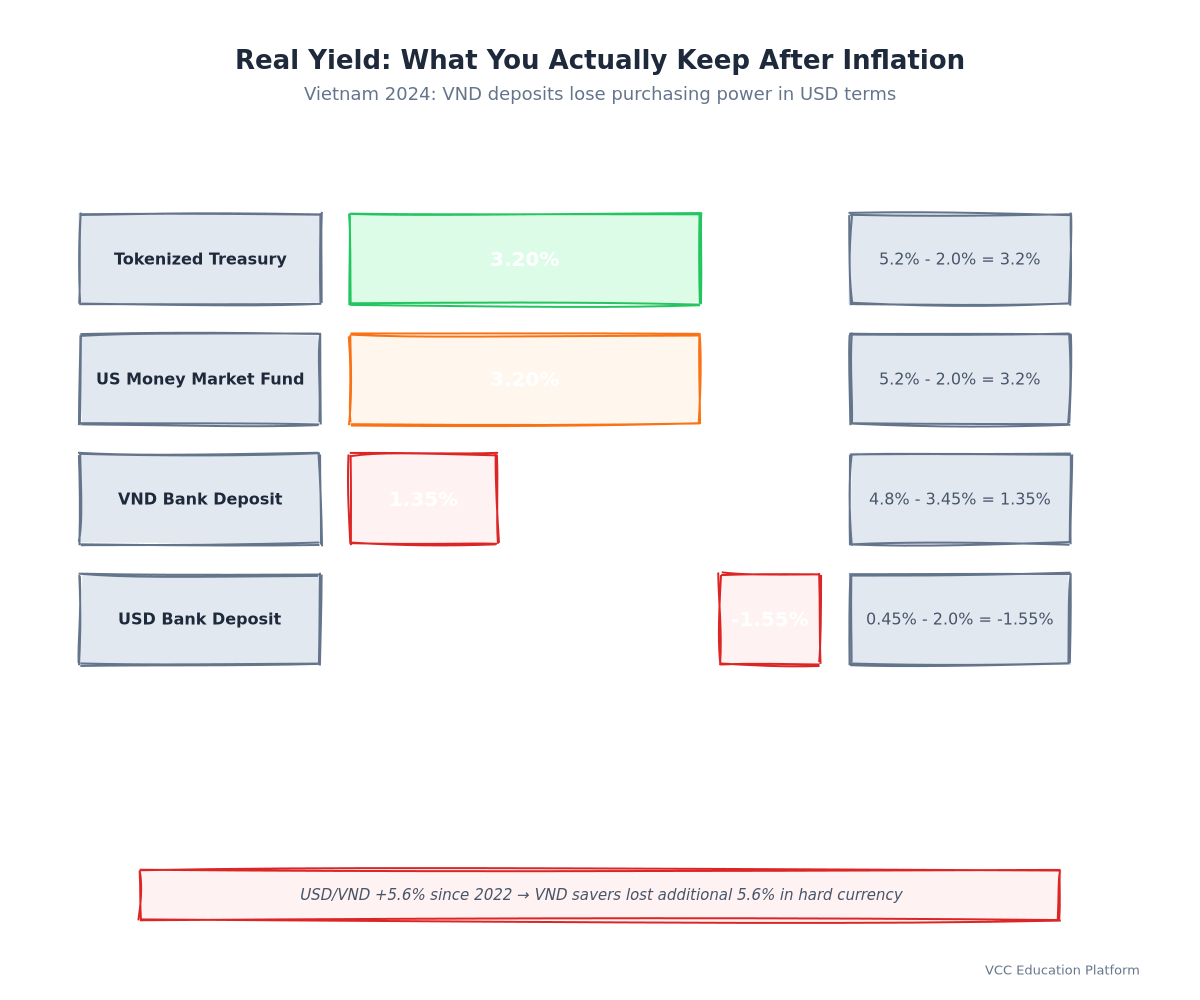
| Instrument | Nominal Yield | Inflation Benchmark | **Real Yield** |
|------------|---------------|---------------------|----------------|
| VND 12M Savings (VCB/BIDV) | 4.8% | Vietnam CPI: 3.45% | **1.35%** |
| USD Bank Deposit (US) | 0.45% | US CPI: ~2.0% | **-1.55%** |
| US MMF (VMFXX) | 5.2% | US CPI: ~2.0% | **3.2%** |
| **Tokenized Treasury (BUIDL/OUSG)** | **5.2%** | US CPI: ~2.0% | **3.2%** |
### Vietnam Context: The Hidden Currency Loss
Vietnam's inflation (3.45% in 2024) exceeds VND deposit rates at most banks. Meanwhile, the USD/VND rate moved from 23,200 (Jan 2022) to 24,500 (Aug 2024) — a **5.6% depreciation**. A VND saver earned ~4.8% nominal but lost 5.6% in USD terms. **Net: -0.8% in hard currency.**
A tokenized treasury investor earned ~5.2% USD yield. Even with 2% US inflation, that's **+3.2% real USD return**. The gap is **400 basis points** — not from taking more risk, but from accessing the **risk-free rate in the reserve currency**.
This is the core thesis: **Tokenized treasuries give Vietnamese investors access to the US risk-free rate — previously reserved for institutions — with retail minimums and 24/7 liquidity.**
---
## Risk Framework: What Could Go Wrong?
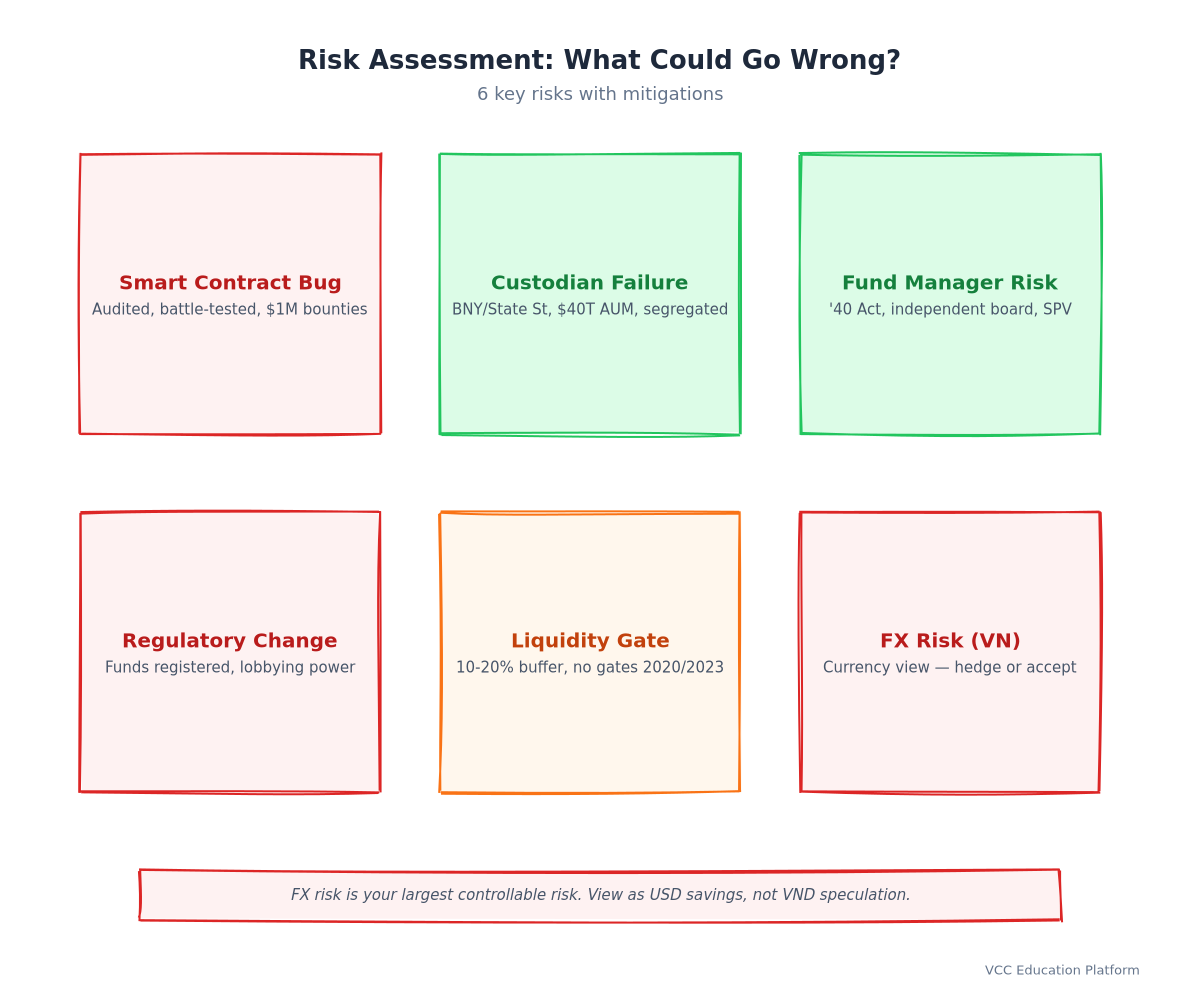
No investment is risk-free. Tokenized treasuries carry specific risks that differ from bank deposits. We assess each on a **Likelihood × Impact** matrix:
### Risk Matrix
| Risk | Likelihood | Impact | Score | Mitigation |
|------|------------|--------|-------|------------|
| **Smart Contract Bug/Exploit** | Low | Critical | **Medium** | Multiple audits (Trail of Bits, OpenZeppelin); battle-tested contracts; bug bounties up to $1M |
| **Custodian Failure (BNY/State St)** | Very Low | Critical | **Low** | Systemically important banks; segregated assets; FDIC/SIPC on cash portion |
| **Fund Manager Risk (BlackRock/Ondo)** | Very Low | High | **Low** | '40 Act oversight; independent board; assets in bankruptcy-remote SPV |
| **Regulatory Change (SEC/Stablecoin Bill)** | Medium | High | **Medium** | Funds already registered; tokens = fund shares; legislation likely clarifies, not bans |
| **Liquidity/Redemption Gate** | Low | High | **Medium** | 10-20% liquid buffer; T-bill ladder; repo facility; no gates in March 2020/2023 |
| **FX Risk (USD/VND for VN Investors)** | High | Medium | **High** | Hedge via USD holdings; view as USD savings, not VND speculation |
| **DeFi Composability Risk** | Medium | Medium | **Medium** | Only if using tokens as DeFi collateral; avoid if pure savings goal |
### Deep Dive: Top 3 Risks
#### 1. Smart Contract Risk (The "Code is Law" Risk)
**Reality check:** BUIDL's contract (0x7D...) has held $500M+ since March 2024 with zero incidents. OUSG's contracts audited by Trail of Bits, OpenZeppelin. BENJI uses Stellar's native asset issuance — no custom contract risk. **Mitigation:** Stick to audited, battle-tested funds. Avoid unaudited "yield tokens" from unknown teams.
#### 2. Counterparty Risk (Custodian + Issuer)
Your T-bills sit with **BNY Mellon** (BUIDL, OUSG, WTGXX) or **State Street** (BENJI, USYC) — the world's largest custodians, holding $40T+ combined. Assets are in **bankruptcy-remote SPVs** — if BlackRock fails, your T-bills are not part of BlackRock's estate. **This is stronger protection than a bank deposit** (where you're an unsecured creditor up to deposit insurance limits).
#### 3. Regulatory Risk (The Unknown Variable)
The US is drafting stablecoin legislation (Lummis-Gillibrand, McHenry-Waters). **Tokenized '40 Act funds are explicitly carved out** in current drafts — they're already regulated. The risk is not a ban, but compliance cost increases. Funds have legal teams and lobbying budgets (BlackRock, Franklin Templeton) — retail token holders are free riders on their defense.
### Vietnam-Specific: FX Risk Is Your Biggest Risk
If USD/VND drops from 24,500 to 23,000 (6% appreciation), your 5.2% USD yield becomes -0.8% in VND terms. **This is not a tokenized treasury risk — it's a currency view.** If you believe VND will weaken (structural trade deficit, USD reserve status), tokenized treasuries are a hedge. If you bet on VND strengthening, stay in VND deposits.
---
## How to Access Tokenized Treasuries from Vietnam
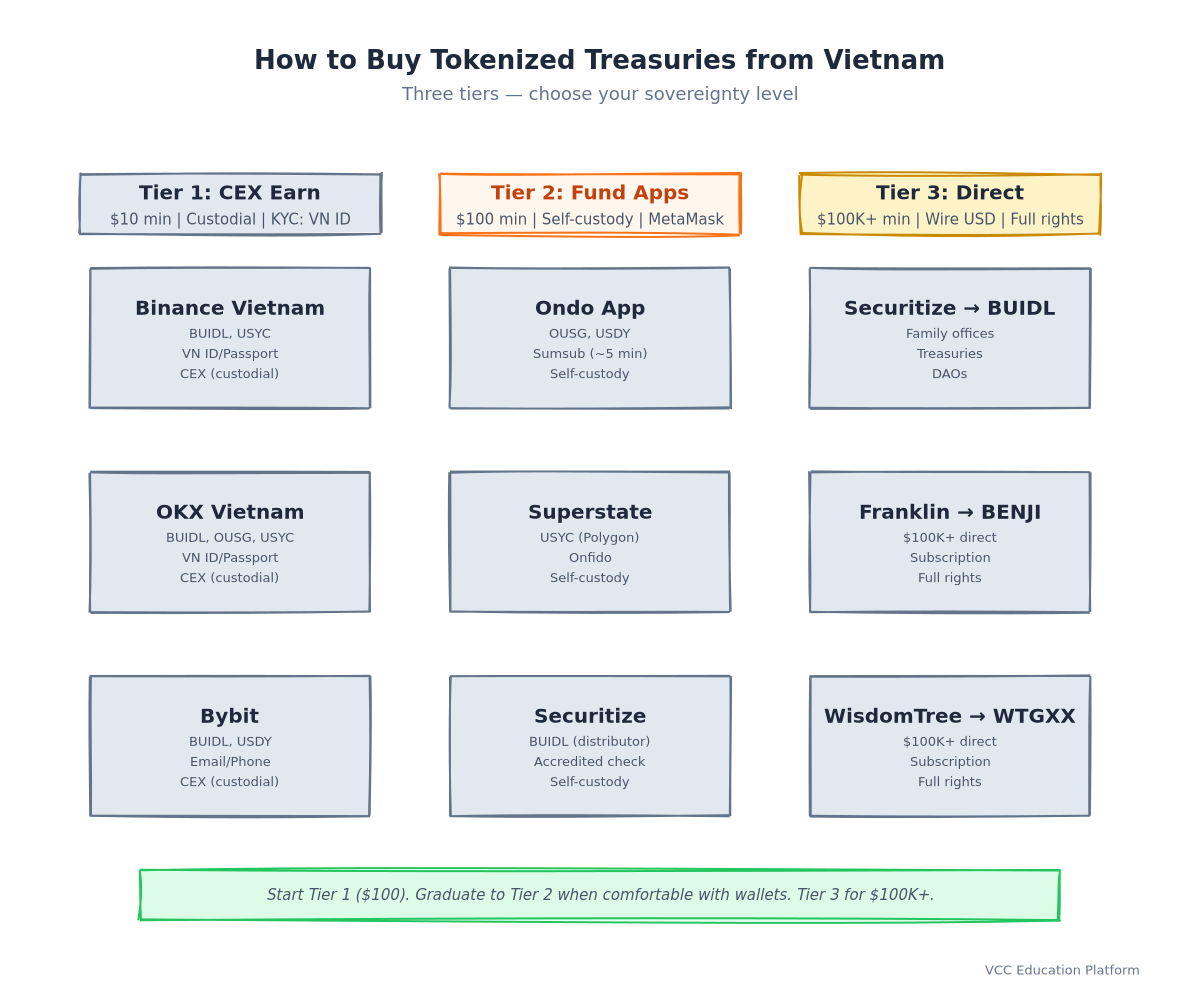
Three tiers of access, from easiest to most sovereign:
### Tier 1: Centralized Exchange Earn (Easiest, $10 Min)
| Platform | Products | KYC | Custody | Best For |
|----------|----------|-----|---------|----------|
| **Binance Vietnam** | BUIDL, USYC (via Earn) | VN ID/Passport | CEX (custodial) | Beginners, small amounts |
| **OKX Vietnam** | BUIDL, OUSG, USYC | VN ID/Passport | CEX (custodial) | Low fees, variety |
| **Bybit** | BUIDL, USDY | Email/Phone | CEX (custodial) | Global access |
**Process:** Create account → KYC (VN ID) → Deposit VND/USDT → Navigate to "Earn" → "RWA" or "Tokenized Treasuries" → Subscribe. Redemption: same path, instant to USDT.
**Trade-off:** You don't hold tokens. You have a CEX IOU. Counterparty risk = exchange. But simplest UX.
### Tier 2: Fund Apps / Transfer Agents (Self-Custody, $100 Min)
| Platform | Funds | Chain | Wallet | Process |
|----------|-------|-------|--------|---------|
| **Ondo App** | OUSG, USDY | Eth/Poly/Sol | MetaMask, Phantom, Rainbow | Connect wallet → KYC (Sumsub) → Deposit USDC → Mint |
| **Superstate** | USYC | Polygon | MetaMask, WalletConnect | Connect wallet → KYC → Deposit USDC → Mint |
| **Securitize** | BUIDL (distributor) | Ethereum | MetaMask | Accredited check → Wire/USDC → Mint |
**Process (Ondo App example):**
1. Install MetaMask (browser) or Rainbow (mobile)
2. Fund wallet with USDC on Polygon (cheap gas) — buy via Binance/OKX → withdraw to wallet
3. Go to app.ondo.finance → Connect wallet
4. Complete KYC (Sumsub: passport + selfie, ~5 min)
5. Select OUSG or USDY → Enter amount ($100 min) → Confirm transaction
6. Tokens appear in wallet. Yield accrues automatically.
7. To redeem: App → Redeem → USDC returned to wallet in minutes.
### Tier 3: Direct Fund Subscription (Institutional, $100K+)
Contact fund transfer agents (Securitize for BUIDL, Franklin Templeton for BENJI, WisdomTree for WTGXX). Wire USD. Receive tokens. Full redemption rights. For family offices, treasuries, DAOs.
---
## Tax Implications for Vietnamese Investors
### US Withholding Tax: 30% Default → 15% with Treaty
US-source interest paid to foreign persons faces **30% withholding** by default. The **US-Vietnam Income Tax Treaty (Article 11)** reduces this to **15%** — but only if you submit **Form W-8BEN** to the fund's transfer agent.
| Scenario | US Withholding | Vietnam PIT | Net Effective |
|----------|----------------|-------------|---------------|
| No W-8BEN | 30% | 20% (credit 30%*) | ~20% |
| **With W-8BEN (Treaty)** | **15%** | **20% (credit 15%)** | **~20%** |
| Via CEX (Binance/OKX) | Handled by CEX | 20% on net | ~20% |
*Vietnam allows foreign tax credit up to Vietnam tax liability (20%). Excess US credit not refundable.
### Practical Steps
1. **Tier 1 (CEX):** Exchange handles W-8BEN. You receive net yield. Declare on Vietnam PIT annual return (Form 02/KK-TNCN).
2. **Tier 2 (Ondo/Superstate):** Submit W-8BEN during KYC (Sumsub/Onfido includes it). Fund withholds 15%. You get net.
3. **Tier 3 (Direct):** Work with transfer agent to file W-8BEN before first distribution.
**Recommendation:** For most Vietnamese retail investors, **Tier 1 or 2 is optimal** — the platform handles tax complexity. Keep records of net distributions for Vietnam PIT filing.
---
## FAQ
### Are tokenized treasuries FDIC insured?
**No.** They are not bank deposits. They are shares in an SEC-registered fund. Protection comes from: (1) '40 Act regulatory framework, (2) bankruptcy-remote SPV structure, (3) custodian segregation (BNY Mellon/State Street), (4) SIPC on cash portions via broker-dealer. **Not FDIC/SIPC on the token itself.**
### What's the minimum investment?
- **$100** via Ondo App (OUSG/USDY) or Superstate (USYC)
- **$100K** direct with BlackRock (BUIDL), Franklin Templeton (BENJI), WisdomTree (WTGXX)
- **$10** via Binance/OKX Vietnam Earn (custodial)
### Can I lose principal?
**Theoretically, yes.** Risks: (1) US Treasury default (near-zero), (2) Smart contract exploit (low, audited), (3) Custodian fraud (extremely low, systemic banks), (4) NAV fluctuation (typically ±0.5% — you could redeem at $0.995). **Historically:** No '40 Act money market fund has broken the buck since 2008 (Reserve Primary Fund) — and that was commercial paper exposure, not T-bills.
### How often is yield paid?
- **BUIDL, OUSG, BENJI, WTGXX, USYC:** Daily accrual, **monthly distribution** (new tokens or USDC)
- **USDY:** **Daily rebasing** — token balance increases daily (1 USDY → 1.00014 USDY next day)
- Check each fund's distribution calendar.
### What happens if the issuer goes bankrupt?
Assets are in a **bankruptcy-remote Special Purpose Vehicle (SPV)**. The fund manager (BlackRock, Ondo, etc.) is the investment advisor — not the owner of assets. If the advisor fails, a new advisor is appointed. Your T-bills are untouched. This structure is mandated by the '40 Act.
---
## Conclusion
Tokenized US Treasuries solve a genuine problem: **Vietnamese savers earn negative real yields in VND, while the US risk-free rate sits at 5%+ — but was inaccessible at retail scale.**
Today, that barrier is gone. With **$100**, a Vietnamese investor can:
- Hold a **regulated fund share** (not a stablecoin, not a DeFi experiment)
- Backed by **US T-bills** (the global risk-free asset)
- Custodied at **BNY Mellon/State Street** (systemic custodians)
- Settling **24/7 in seconds** (not T+1)
- Yielding **4.5-5.5% APY** in USD (3.2% real vs 1.35% VND real)
- Accessible via **Binance Vietnam, OKX Vietnam, or a MetaMask wallet**
The trade-offs are clear: **smart contract risk** (low, audited), **FX risk** (your currency view), **regulatory evolution** (likely clarifying, not banning), and **no deposit insurance** (replaced by SPV segregation).
**Start small.** Put $500-1,000 into Ondo USDY or Binance Earn. Watch the daily yield accrue. Experience 24/7 redemption. Compare to your VND savings statement after 3 months. The math speaks for itself.
The future of savings isn't choosing between "safe but low yield" and "high yield but risky." It's **tokenized risk-free rate** — and it's live today.
---
*Disclaimer: This article is for educational purposes only and does not constitute financial advice. Tokenized treasuries carry risks including smart contract, counterparty, regulatory, and FX risk. Past yield does not guarantee future returns. Consult a qualified financial advisor and tax professional before investing.*
