
Meta Title: Selective Disclosure Explained: The Two-Pocket Wallet for Digital Privacy Meta Description: Learn how selective disclosure and zero-knowledge proofs let you prove facts without oversharing. The two-pocket wallet analogy makes digital privacy simple. URL Slug: /selective-disclosure-two-pocket-wallet Primary Keyword: selective disclosure Secondary Keywords: quyền riêng tư ví điện tử, privacy preserving
The Problem: Your Digital Wallet Shows Everything
Imagine walking into a convenience store to buy a bottle of wine. The cashier needs to verify you're over 18. You hand over your ID card. In that moment, the cashier sees your full name, your address, your date of birth, your ID number, your ethnicity, your religion—everything.
They only needed one fact: "Is this person ≥ 18?"
This is the fundamental problem with digital identity today. Every verification demands over-disclosure. You prove your age by revealing your identity. You prove your income by revealing your entire bank statement. You prove your citizenship by exposing your biometric data.
But what if you could prove just the fact—and nothing else?
The Two-Pocket Wallet Analogy
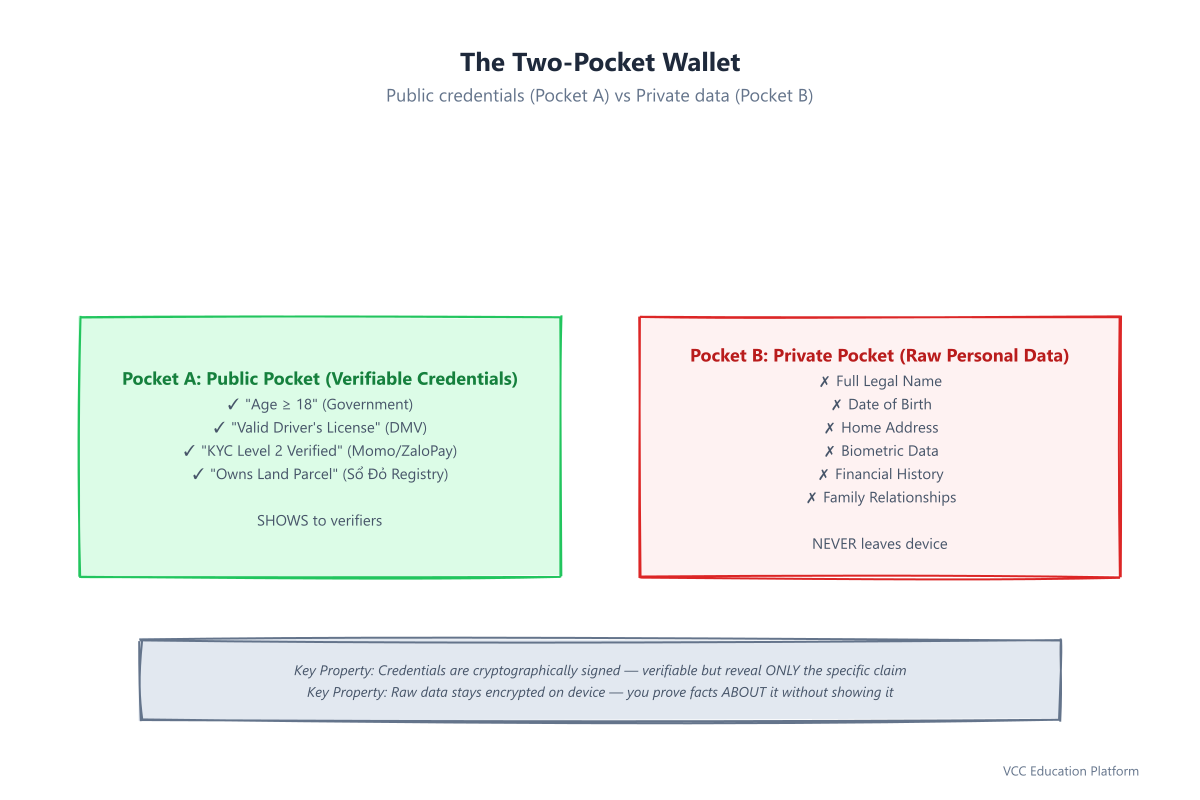
Figure 1: The two-pocket wallet — Pocket A shows verifiable credentials; Pocket B keeps raw data encrypted on device
Picture a physical wallet with two separate compartments:
Pocket A: The Public Pocket (Verifiable Credentials)
This pocket holds credentials—tamper-proof statements issued by trusted authorities:- "This person is ≥ 18" (issued by government)
- "This person holds a valid driver's license" (issued by DMV)
- "This person completed KYC Level 2" (issued by Momo/ZaloPay)
- "This person owns this land parcel" (issued by land registry - the Sổ Đỏ)
Key property: Anyone can verify these credentials are authentic. No one can forge them. But they reveal only the specific claim—not the underlying data.
Pocket B: The Private Pocket (Raw Personal Data)
This pocket holds your actual personal information:- Full legal name
- Date of birth
- Home address
- Biometric data
- Financial history
- Family relationships
Key property: This data never leaves your wallet. It stays encrypted on your device. You prove facts about this data without ever showing the data itself.
How It Works: The Magic of Selective Disclosure
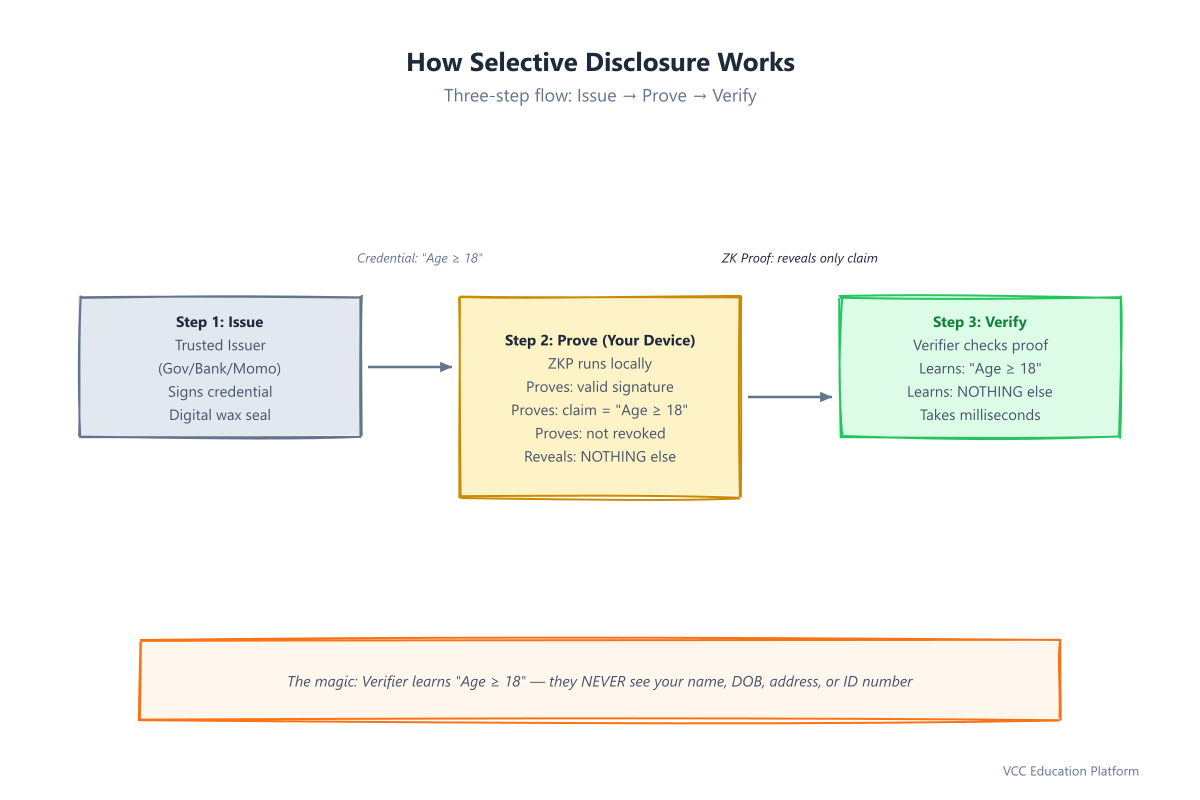
Figure 2: How selective disclosure works — Issue → Prove → Verify
Selective disclosure is the cryptographic technique that makes the two-pocket wallet possible. Here's the flow:
Step 1: Credential Issuance
A trusted issuer (government, bank, Momo) creates a verifiable credential containing a claim about you. This credential is cryptographically signed—like a digital wax seal.` Issuer (Government) → Signs → Credential: "Age ≥ 18" → Your Pocket A `
Step 2: Proof Generation (Your Device)
When a verifier (store, bank, game) requests proof, your wallet runs a zero-knowledge proof (ZKP) locally on your device. The ZKP mathematically proves:- "I possess a valid credential signed by the Government"
- "The credential states: Age ≥ 18"
- "The credential has not been revoked"
Crucially: The proof reveals nothing about your date of birth, name, or any other data.
Step 3: Verification
The verifier checks the proof. They learn: "This person is ≥ 18." They learn nothing else. The verification takes milliseconds.Traditional vs. Selective Disclosure: Side by Side
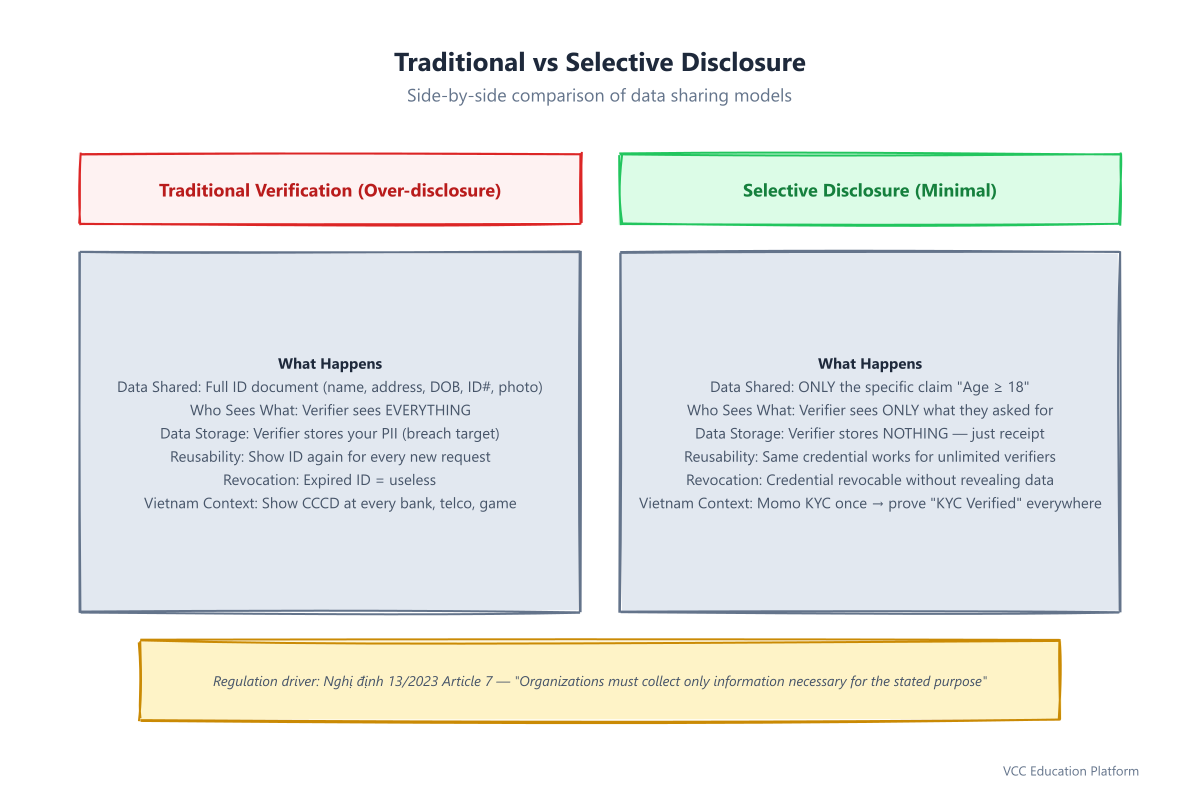
Figure 3: Traditional verification (over-disclosure) vs Selective disclosure (minimal)
| Aspect | Traditional Verification | Selective Disclosure |
|---|---|---|
| Data Shared | Full ID document (name, address, DOB, ID number, photo) | Only the specific claim: "Age ≥ 18" |
| Who Sees What | Verifier sees everything | Verifier sees only what they asked for |
| Data Storage | Verifier stores your PII (hack target) | Verifier stores nothing—just a verification receipt |
| Reusability | Show ID again for every new request | Same credential works for unlimited verifiers |
| Revocation | Expired ID = useless | Credential can be revoked without revealing data |
| Vietnam Context | Show CCCD at every bank, telco, game | Momo KYC once → prove "KYC Verified" everywhere |
Real-World Use Cases in Vietnam
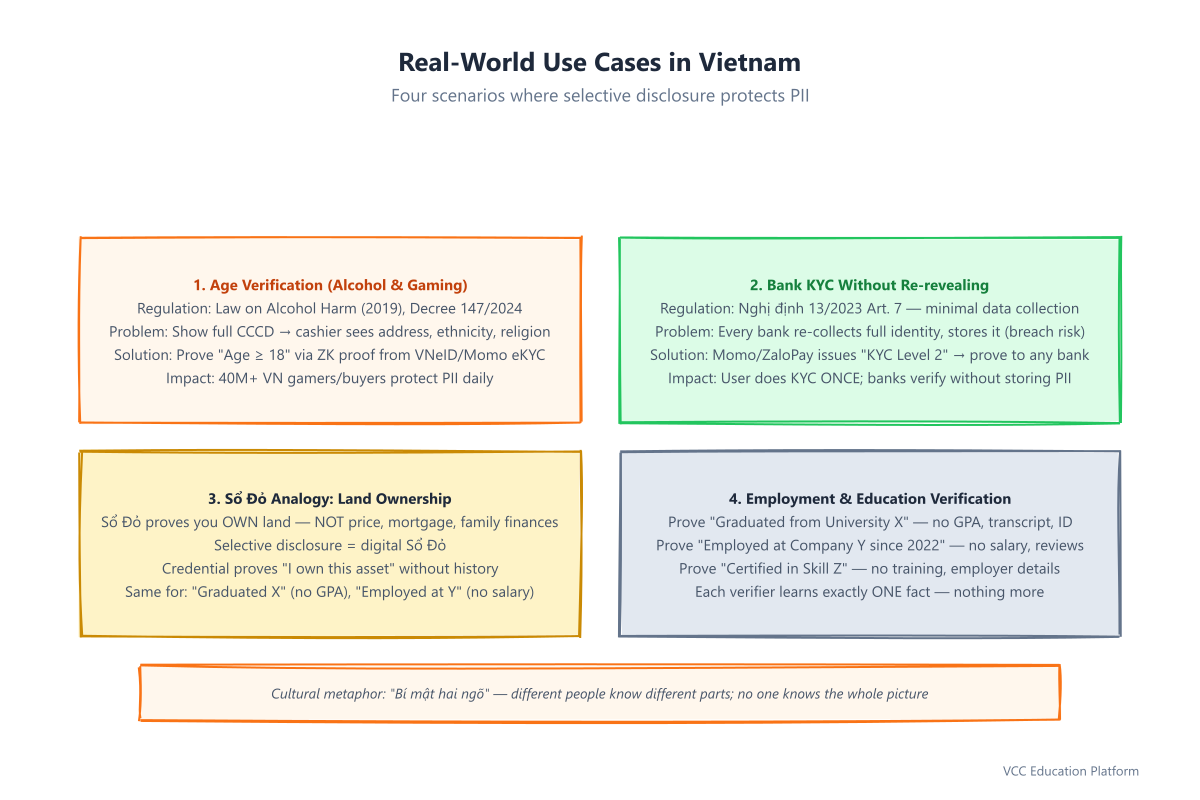
Figure 4: Four Vietnam use cases where selective disclosure protects PII
1. Age Verification for Alcohol & Gaming (The Killer App)
Regulation: Law on Prevention of Alcohol Harm (2019), Decree 147/2024 (gaming) Current Problem: Show full CCCD → cashier sees address, ethnicity, religion Selective Disclosure Solution: Prove "Age ≥ 18" via ZK proof from VNeID or Momo eKYC Impact: 40M+ Vietnamese gamers and alcohol buyers protect their PII daily2. Bank KYC Without Re-Revealing Everything
Regulation: Nghị định 13/2023/ND-CP (eKYC) — Article 7 mandates minimal data collection Current Problem: Every bank re-collects full identity, stores it (breach risk) Selective Disclosure Solution: Momo/ZaloPay issues "KYC Level 2 Verified" credential → prove to any bank Impact: User does KYC once; every bank verifies instantly without storing PII3. The Sổ Đỏ (Red Book) Analogy: Land Ownership Without Financial History
Every Vietnamese adult knows the Sổ Đỏ—the red certificate proving land ownership. It proves that you own the land. It does not reveal:- Purchase price
- Mortgage details
- Family finances
- Previous owners
Selective disclosure is the digital Sổ Đỏ. Your credential proves "I own this asset" or "I have this qualification" without exposing the transaction history behind it.
4. Employment & Education Verification
- Prove "Graduated from University X" without revealing GPA, transcript, or student ID
- Prove "Employed at Company Y since 2022" without revealing salary, contract terms, or performance reviews
The Cultural Metaphor: "Bí Mật Hai Ngõ"
Vietnamese culture has a concept: "bí mật hai ngõ" (a secret with two entrances).
Different people know different parts of the same secret. Your mother knows your birthday. Your bank knows your income. Your employer knows your degree. No single person knows the whole picture.
The two-pocket wallet formalizes this wisdom. You hold the complete secret (Pocket B). Each verifier enters one entrance (Pocket A) and learns only what they need. The architecture is the cultural value.
Technical Foundation: Zero-Knowledge Proofs
You don't need to understand the math to use it—just like you don't need to understand TLS to use HTTPS. But here's the essence:
ZK-SNARKs (Groth16)
- Proof size: ~128 bytes (tiny)
- Verification time: ~5 ms (instant)
- Trade-off: Requires trusted setup ceremony
- Used in: Zcash, early Ethereum privacy tools
ZK-STARKs
- Proof size: ~45 KB (larger)
- Verification time: ~10-50 ms
- Advantage: No trusted setup, quantum-resistant
- Used in: StarkNet, newer wallet implementations
BBS+ Signatures (W3C Standard)
- Designed for: Selective disclosure on verifiable credentials
- Proof size: ~1-2 KB
- Standard: W3C VC Data Model v2.0
- Used in: Hyperledger AnonCreds, Microsoft Entra Verified ID
For mobile wallets in Vietnam: BBS+ or Groth16 are practical today. Proving takes 2-5 seconds on a modern phone—acceptable for occasional KYC/age checks.
Why This Matters Now: Nghị định 13/2023
Vietnam's Nghị định 13/2023/ND-CP on eKYC isn't just regulation—it's a market mandate for selective disclosure.
Article 7: "Organizations must collect only information necessary for the stated purpose."
Ministry of Public Security Framework: Explicitly references "selective disclosure" as a compliance mechanism.
Momo & ZaloPay (50M+ combined users) are effectively default wallets for Vietnamese users. They're not "apps to install"—they're infrastructure. Selective disclosure isn't a feature to adopt; it's a regulatory requirement for the wallets people already use.
The Future: Your Wallet, Your Rules
The two-pocket wallet shifts power:
| Old Model | New Model |
|---|---|
| Verifiers demand data → You comply | You hold credentials → Verifiers request proofs |
| Your PII scattered across 50 databases | Your PII stays in one place: your device |
| Breach at one site = your identity stolen | Breach at one site = they learn nothing new |
| "Trust us with your data" | "Verify this fact without seeing my data" |
FAQ
Q: Is this the same as a password manager?
No. Password managers store secrets for websites. Selective disclosure proves facts to websites without giving them secrets.Q: What if I lose my phone?
Recovery: Credentials can be backed up encrypted (like seed phrases). Revocation registries let you invalidate old credentials and re-issue to a new device.Q: Can the issuer (Momo/government) track where I use my credentials?
No—if designed right. Blind signatures and unlinkable proofs prevent issuers from correlating presentations. This is a design choice; good wallets enforce it.Q: Does this work offline?
Proof generation works offline (on your device). Verification requires the verifier to be online to check revocation status.Q: What's the Vietnamese term I should know?
"Tiết lộ có chọn lọc" (selective disclosure) — or more naturally: "Chỉ tiết lộ cần thiết" (reveal only what's needed).Summary
The two-pocket wallet isn't a metaphor—it's an architecture:
- Pocket A (Public): Verifiable credentials you show — "I am ≥ 18", "I passed KYC", "I own this land"
- Pocket B (Private): Raw data you keep — name, DOB, address, finances, biometrics
Selective disclosure (powered by zero-knowledge proofs) is the cryptographic bridge between them.
For Vietnam, this isn't theoretical. Nghị định 13/2023 demands it. Momo and ZaloPay are building it. 50 million users will benefit from it.
The next time someone asks for your ID, ask yourself: Which pocket am I opening?
Ready to see how selective disclosure works in your wallet? Check if your eKYC provider (Momo, ZaloPay, VNeID) supports verifiable credentials—and start keeping Pocket B closed.