
Meta Title: Synthetic Asset Platforms: How DeFi Derivatives Work | VCC Education URL Slug: synthetic-asset-platforms Primary Keyword: synthetic asset platforms
Why This Matters: The Problem Synthetic Assets Solve
Imagine you're a developer in Ho Chi Minh City. You want exposure to Tesla stock (TSLA), but your Vietnamese brokerage requires a minimum 100-share lot (~$25,000), T+2 settlement, and only trades during US market hours (9:30 PM - 4:00 AM VN time). You want gold as a hedge against VND depreciation, but buying physical gold means storage fees and 10-15% spread. You want USD yield, but Vietnam's capital controls limit overseas investment to $5,000/year per person.
This is where synthetic asset platforms change the game.
Synthetic asset platforms are DeFi protocols that create blockchain-based derivatives—called "synths"—tracking the price of any asset with a reliable price feed: US stocks, commodities, forex pairs, crypto tokens, even NFT floor prices. You don't own the underlying asset. You own a smart contract position that behaves like the asset, 24/7, with fractional amounts, instant settlement, and no custody of the real thing.
By the end of this guide, you'll understand how synthetic assets work under the hood, the key protocols powering them, the risks that have bankrupted protocols before, and specifically what Vietnamese users need to know before minting their first synth.
What Are Synthetic Assets? (And What They're Not)
The Core Concept: Price Exposure Without Custody
A synthetic asset is a tokenized derivative. Its value derives entirely from an oracle price feed, not from holding the underlying asset. When you hold sTSLA (Synthetix's Tesla synth), you don't own Tesla shares. You hold a claim on the protocol's collateral pool that pays out 1:1 with TSLA's price.
Analogy: Think of a casino chip. The chip isn't "backed by" a specific dollar bill in the vault. It's backed by the casino's entire balance sheet. As long as the casino is solvent, the chip = $1. Synthetic assets work similarly: the synth = the asset price, backed by the protocol's total collateral, not a specific stock certificate.
Synthetic Assets vs. Traditional Derivatives vs. Tokenized Assets
| Feature | Synthetic Assets (DeFi) | Traditional Derivatives (TradFi) | Tokenized Assets (RWA) |
|---|---|---|---|
| Underlying custody | None (oracle only) | Centralized clearinghouse | Yes, real asset held by custodian |
| Settlement | Instant, 24/7 | T+1 to T+2, market hours only | Near-instant, 24/7 |
| Minimum size | Fractional (0.001 synth) | 1 contract (100 shares typical) | Fractional possible |
| Counterparty | Smart contract / protocol | Centralized exchange / bank | Custodian + issuer |
| Regulatory status | Gray area / unregistered | Regulated (SEC, CFTC, VN SBV) | Emerging regulation (SEC Reg A+) |
| Examples | sTSLA, mAAPL, UMA tokens | TSLA options, gold futures | OUSG (tokenized Treasuries), BUIDL |
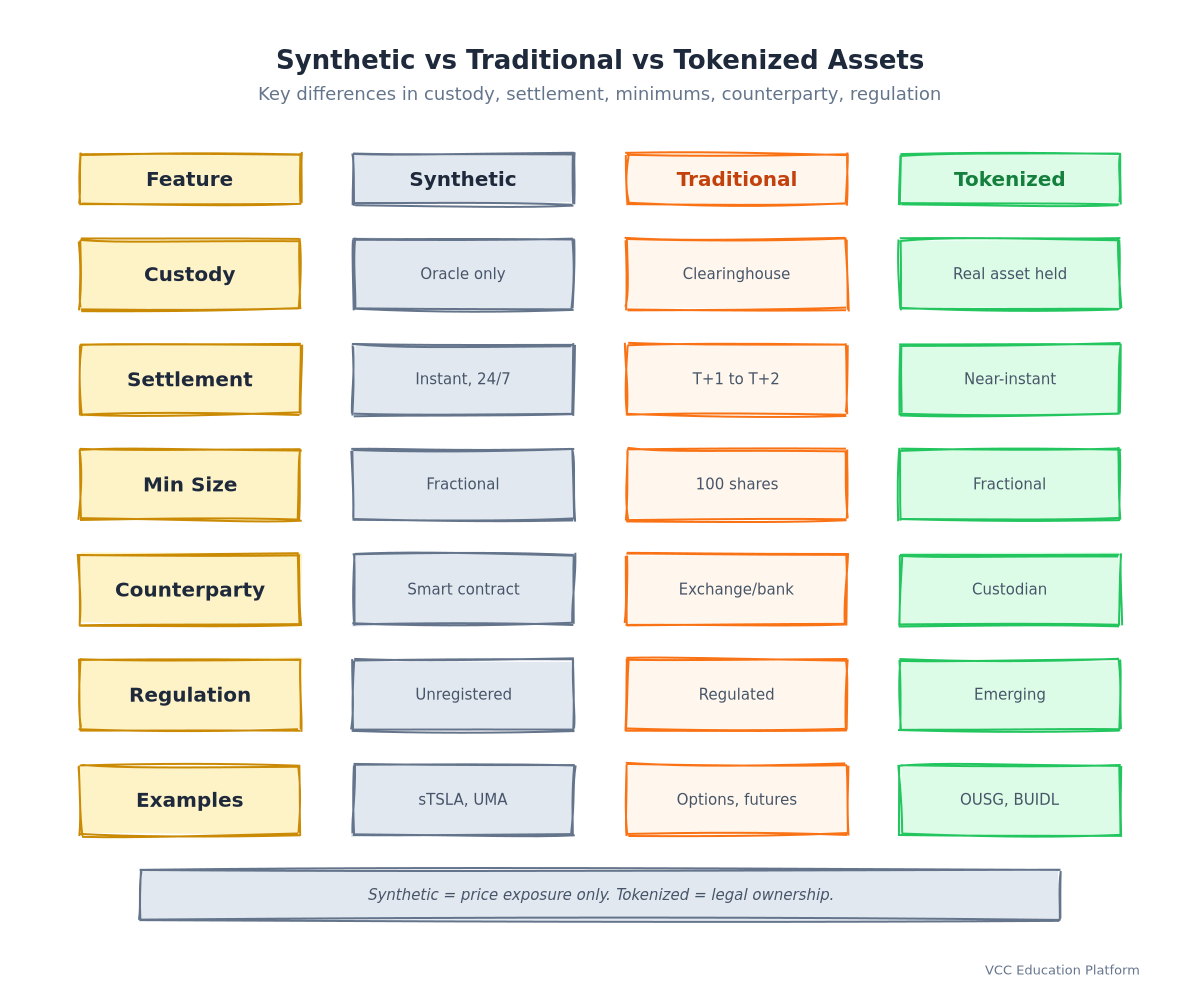
Key distinction: Tokenized assets (RWA) like Ondo's OUSG hold real US Treasuries. Synthetic assets like sTSLA track the price without holding Tesla shares. The convergence of these two worlds (Synthetix SIP-205 "Spot Synths") is the next frontier—covered in [Future Trends](#future-trends-synthetics-meet-rwa).
How Synthetic Assets Work: The Mechanics
The Universal Mint-Redeem Loop
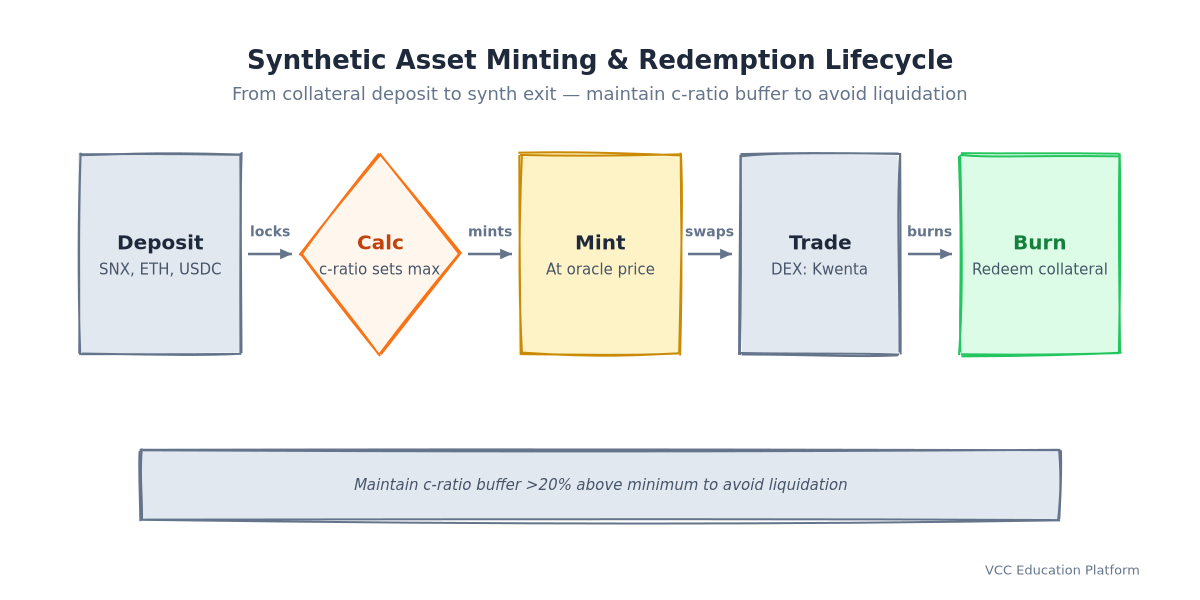
Every synthetic asset platform follows this pattern:
`
- USER DEPOSITS COLLATERAL
(SNX, ETH, USDC, or protocol token)
- PROTOCOL CALCULATES MAX MINT
Based on collateralization ratio (c-ratio) Example: 750% c-ratio → $1000 collateral = $133 max synth value
- USER MINTS SYNTHS
Protocol burns collateral capacity, issues synths at oracle price
- SYNTHS TRADE FREELY
On DEXs (Curve, Uniswap) or protocol's own exchange
- USER BURNS SYNTHS TO EXIT
Returns synths, receives collateral back (minus fees) Must maintain c-ratio throughout `
Collateralization Models: Pooled vs. Isolated
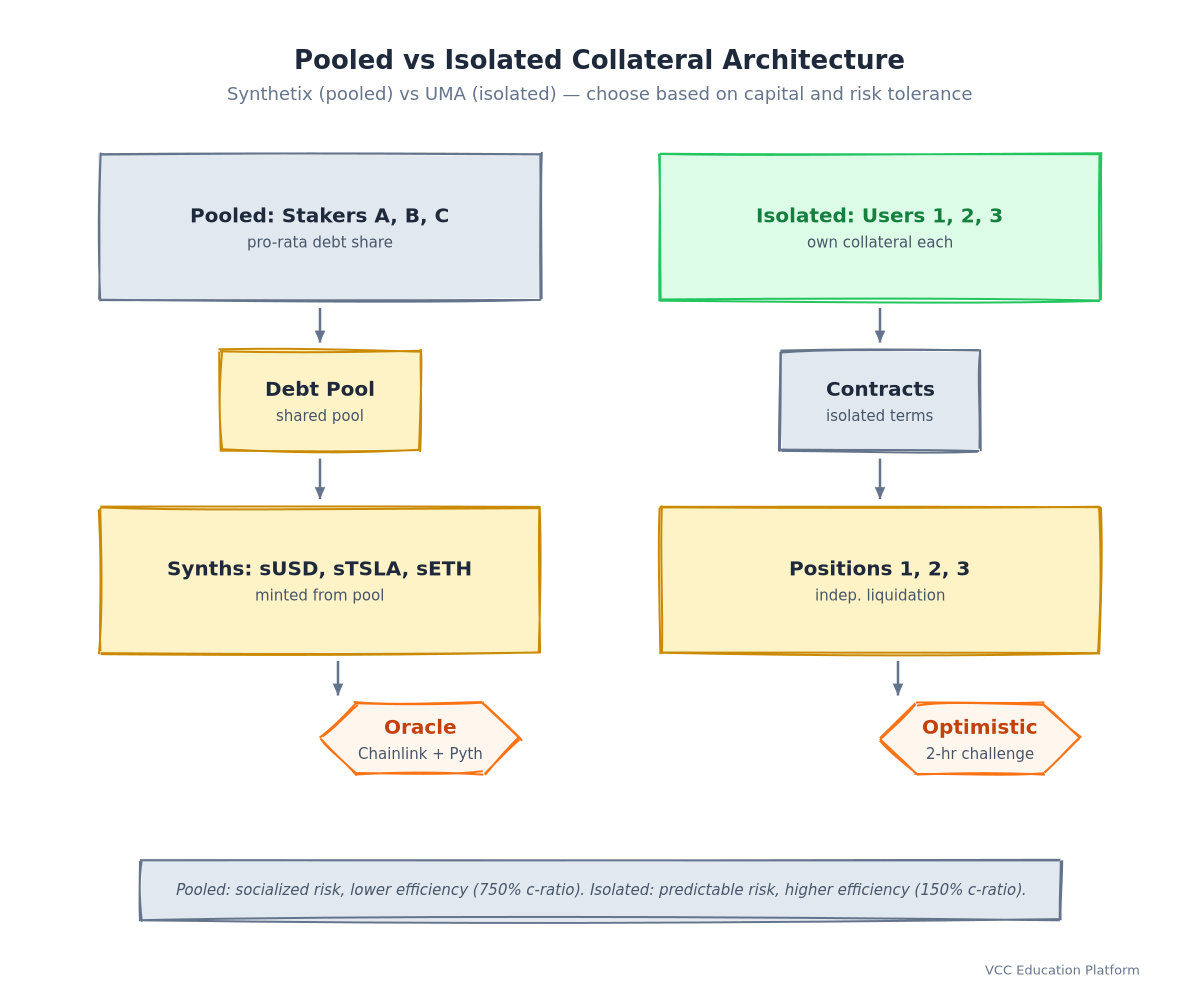
This is the most important architectural decision affecting your risk.
Model 1: Pooled Collateral (Synthetix)
All stakers share a debt pool. When you mint sUSD, you inherit a pro-rata share of the pool's total debt. If other minters' positions go underwater, your debt share increases.
- Pros: Deep liquidity, socialized tail risk, no need to manage individual positions
- Cons: "Debt drift" — your collateral requirement changes based on others' profits/losses
- Capital efficiency: Low (750% c-ratio = 13.3% capital efficiency)
Model 2: Isolated Collateral (UMA, dYdX Perps)
Each position stands alone. Your collateral backs only your synths. No socialized losses.
- Pros: Predictable risk, higher capital efficiency (150-200% c-ratio), no debt drift
- Cons: Fragmented liquidity, user manages own liquidation risk
- Capital efficiency: High (150% c-ratio = 66% capital efficiency)
Model 3: Algorithmic/Seigniorage (Mirror Protocol — Failed)
Collateral was the protocol's own token (LUNA). When asset prices dropped, protocol minted more LUNA to buy back synths → death spiral. Never use this model. Terra/Luna (May 2022) proved it fatal.
The Oracle Problem: Where Price Comes From
Synths are only as trustworthy as their price feeds. Three main approaches:
| Oracle Type | Protocols | Latency | Security Model |
|---|---|---|---|
| Pull (Chainlink/Pyth) | Synthetix, dYdX | ~400ms-3s | Decentralized node operators / first-party publishers |
| Push + Challenge (Optimistic) | UMA | ~2 hours challenge window | Economic: disputers bond capital, wrong disputes lose bond |
| TWAP (Time-Weighted Average Price) | Some AMM-based | Block-time dependent | Manipulation-resistant but laggy |
Critical for Vietnamese users: US stock markets open at 9:30 PM VN time. Oracle latency + market-open volatility = wider spreads and higher liquidation risk if you mint during this window. Synthetix uses "circuit breakers" — if price moves >50% in 1 hour, minting halts. But the oracle still updates, and your c-ratio can breach before you react.
Major Synthetic Asset Protocols: Deep Comparison
1. Synthetix (SNX) — The Pioneer, Still the Leader
Launch: 2018 (Havven → Synthetix) TVL (2024): ~$400M Collateral: SNX (primary), ETH, LUSD, sUSD (multi-collateral via SIP-120) c-ratio: 750% (SNX), 200% (ETH), 130% (LUSD/sUSD) Assets: 50+ synths (stocks, crypto, forex, commodities, indexes) Exchange: Kwenta (order book), Lyra (options), native Atomic Swaps
How it works: Stake SNX → mint sUSD → swap for any synth. Stakers earn: (1) trading fees, (2) inflationary SNX rewards, (3) protocol fees. But rewards are escrowed for 1 year — you can't sell immediately.
Vietnamese context: High SNX price ($2-3 range 2024) means 750% c-ratio requires significant capital. $1000 SNX = only $133 synth capacity. For VN retail ($100-500 typical), this is prohibitive unless using ETH/LUSD collateral (lower c-ratio).
2. UMA (Universal Market Access) — The Flexible Contract Layer
Launch: 2020 TVL (2024): ~$50M Collateral: Any ERC-20 (USDC, ETH, wBTC, etc.) c-ratio: Configurable per contract (typically 150-200%) Oracle: Optimistic Oracle (OO) — requester proposes price, 2-hour challenge window Use case: Not just synths — any financial contract (binary options, KPI tokens, insurance)
How it works: Create a "financial contract" template → deploy with parameters → users deposit collateral → positions settled via OO. No pooled debt. Each contract is isolated.
Vietnamese context: Lower capital requirement (150% c-ratio = $1000 USDC → $666 synth capacity). More accessible for VN users. But UI/UX less polished; fewer pre-built markets. You often need to create your own contract or find community-deployed ones.
3. dYdX (dYdX Chain) — Perpetuals Specialist
Launch: 2017 (v1), 2021 (v3 StarkEx), 2023 (v4 Cosmos app-chain) TVL (2024): ~$300M Focus: Perpetual futures (not spot synths) — but functionally similar for traders Collateral: USDC (cross-margin) Leverage: Up to 20x Order book: Off-chain matching, on-chain settlement (v4: fully on-chain)
Key difference: dYdX is for trading with leverage, not holding synthetic exposure. Funding rates apply every 8 hours. Not ideal for "buy and hold" TSLA exposure.
4. Mirror Protocol (mAssets) — The Cautionary Tale
Launch: 2020 (Terra) Status: Defunct (collapsed with Terra/Luna May 2022) Lesson: Algorithmic collateral (protocol token) + correlated oracle = systemic fragility. mAssets lost peg because LUNA collateral collapsed and Terra's oracle failed simultaneously.
Vietnamese lesson: Many VN users lost funds in Mirror. The "high yield" (Mirror farming 100%+ APY) was a red flag. Sustainable synthetic platforms have modest yields (5-15% from fees + inflation), not triple-digit APY.
Risk Deep-Dive: What Can Go Wrong
1. Oracle Risk (The #1 Killer)
Scenario: Oracle reports wrong price → synths minted/burned at wrong value → protocol insolvent or users unfairly liquidated.
Real incidents:
- Synthetix sETH oracle exploit (2019): $37M loss via manipulated price feed. Fixed by migrating to Chainlink.
- bZx oracle manipulation (2020): Flash loan + Kyber oracle → $1M loss.
- Mango Markets (2022): $117M via oracle manipulation on low-liquidity token.
Mitigation:
- Use protocols with multiple oracle sources (Synthetix: Chainlink + Pyth)
- Check for circuit breakers (price deviation limits)
- Avoid synths tracking low-liquidity assets (micro-cap stocks, obscure tokens)
2. Liquidation Cascades
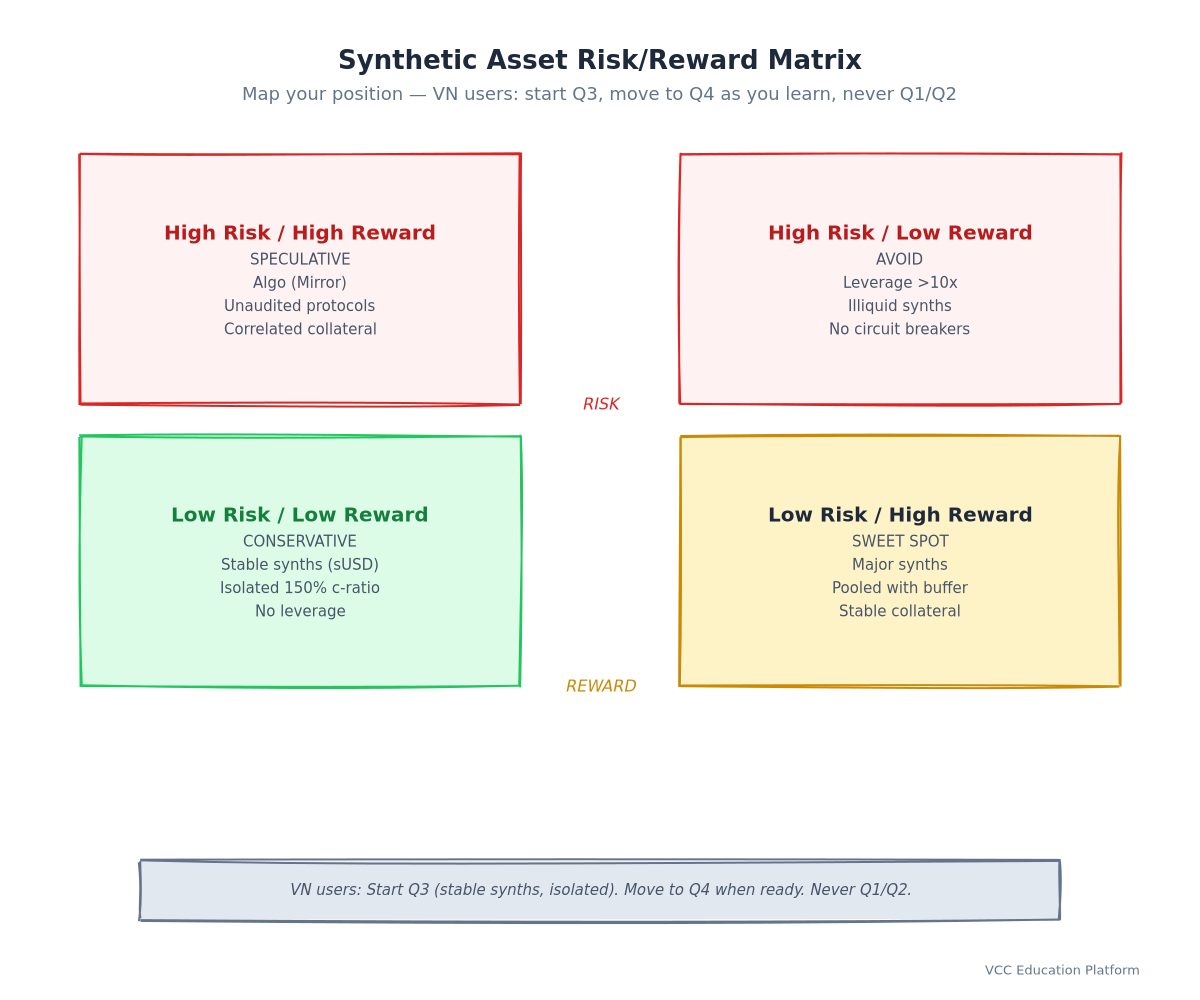
In pooled models (Synthetix), a sharp price move liquidates multiple positions → collateral sold → price drops further → more liquidations. Gauntlet Networks modeled this: a 40% asset drop can trigger 3x more liquidations than isolated models.
Your defense:
- Maintain buffer above minimum c-ratio (e.g., target 1000% if min is 750%)
- Use stablecoin collateral (LUSD, sUSD) for lower volatility
- Monitor protocol health dashboards (Synthetix.staking.io, UMA's risk framework)
3. Smart Contract Risk
- Audits: Synthetix (10+ audits, Trail of Bits, CertiK), UMA (OpenZeppelin, Sigma Prime), dYdX (Zokyo, ABDK)
- Bug bounties: Up to $1M (Synthetix), $500k (UMA)
- Upgradeability: Most protocols use proxy patterns — governance can upgrade contracts. Check timelock delays (Synthetix: 3-day timelock).
4. Regulatory Risk (Vietnam Specific)
| Risk | Vietnam Status | Implication |
|---|---|---|
| Legal classification | Unclear — not explicitly banned, not recognized | No legal recourse if protocol fails |
| Taxation | Circular 96/2015/TT-BTC: 20% on "transfer of securities/other assets" | Track cost basis; gains = taxable income |
| Capital controls | Ordinance on FX: $5k/year overseas limit | Synthetic US stocks may violate spirit of law |
| On/off-ramp | P2P (Binance P2P, local OTC) + MoMo/ZaloPay | Fiat ↔ USDC works but carries counterparty risk |
| SBV stance | "Crypto not legal payment" (Circular 01/2024) | Holding synths = holding crypto = legal gray zone |
Practical advice for VN users:
- Declare gains as "thu nhập khác" (other income) at 20%
- Keep records of every mint/burn/swap (timestamp, price, tx hash)
- Use reputable P2P merchants with high completion rates
- Never invest more than you can afford to lose entirely
Practical Guide: Minting Your First Synth (Synthetix Example)
Prerequisites
- Wallet: MetaMask, Rainbow, or Coinbase Wallet (Ethereum mainnet or Optimism/Arbitrum for lower fees)
- Collateral: SNX (staking) OR ETH/LUSD/sUSD (multi-collateral)
- Gas: ~$5-20 on Ethereum, <$1 on Optimism/Arbitrum
- VN on-ramp: Buy USDC on Binance P2P → send to wallet → swap to collateral asset
Step-by-Step on Optimism (Recommended for VN Users — Lower Fees)
- Bridge funds to Optimism
- Use Hop Protocol, Synapse, or official Optimism Gateway
- Send USDC/ETH from Ethereum mainnet or buy directly on Optimism via Binance P2P (some merchants support OP network)
- Get collateral (choose one)
- Option A (Staking): Buy SNX on Kwenta/Velodrome → stake on Synthetix Staking dApp
- Option B (Multi-collateral): Deposit ETH, LUSD, or sUSD directly (no SNX needed, lower c-ratio)
- Mint sUSD
- Go to
staking.synthetix.io→ Connect wallet → "Mint" - Enter amount → confirm → wait for oracle update (usually 1 block on OP)
- Critical: Keep c-ratio > 800% (buffer above 750% min)
- Swap for target synth
- Use Kwenta (order book) or 1inch/CowSwap (aggregators)
- Swap sUSD → sTSLA, sAU (gold), sEUR, sBTC, etc.
- Check slippage: set 0.5-1% for large synths, 2-3% for smaller ones
- Monitor & manage
- Check c-ratio daily (Synthetix dashboard shows "Liquidation Ratio")
- If c-ratio drops → add collateral OR burn synths
- Claim weekly rewards (SNX escrowed 1 year, sUSD fees claimable weekly)
Fee Reclamation: The 2-Week Wait
When you mint synths, you owe a share of the debt pool. Staking rewards (SNX inflation) are escrowed for 1 year. But trading fees (sUSD) accumulate in your "Fee Pool" and can be claimed every Wednesday (epoch close). You must manually claim — they don't auto-compound.
VN user tip: Claim fees Wednesday morning VN time (Tuesday night US). Gas on Optimism is negligible.
Vietnamese User Checklist: Before You Start
| Checklist Item | Why It Matters |
|---|---|
| ☐ Understand you can lose 100% of collateral | Liquidation = collateral sold at discount |
| ☐ Have 2x minimum c-ratio buffer | Prevents midnight liquidation while you sleep |
| ☐ Use Optimism/Arbitrum, not Ethereum mainnet | Gas fees: $15 vs $0.05 — 300x difference |
| ☐ Track cost basis for 20% tax | VN tax law applies; no exchange sends 1099 |
| ☐ Test with $50 first | Learn UI, oracle delays, fee mechanics cheaply |
| ☐ Bookmark protocol status pages | Synthetix.statuspage.io, Discord alerts |
| ☐ Have exit plan: synth → sUSD → USDC → P2P → VND | Full round-trip tested before large amounts |
Future Trends: Synthetics Meet RWA
The line between synthetic assets (price tracking) and tokenized assets (real custody) is blurring.
Synthetix SIP-205: Spot Synths
Proposal to back synths with real assets (tokenized Treasuries, corporate bonds) instead of pure collateral. sUSD would be redeemable for underlying T-bills. This makes synths yield-bearing (4-5% risk-free rate) instead of pure price exposure.
Tokenized Treasuries as Collateral
Ondo Finance's OUSG (tokenized US Treasuries) yields ~5.2% APY. If accepted as Synthetix collateral at 130% c-ratio, you could:
- Buy OUSG (5.2% yield)
- Deposit as collateral (130% c-ratio)
- Mint sUSD → buy sTSLA
- Net: TSLA exposure + 5.2% yield on collateral - borrowing cost
Vietnam angle: VN bank deposits pay 4-6% VND. OUSG pays 5.2% USD. But FX risk (USD/VND) + smart contract risk + no deposit insurance. Not a free lunch.
Permissioned vs. Permissionless
Institutional players (BlackRock BUIDL, Franklin OnChain) use permissioned blockchains with KYC. DeFi synthetics are permissionless. The convergence will likely be: permissioned RWAs as collateral in permissionless synthetic engines. Best of both worlds — real yield backing, open access.
FAQ: Synthetic Asset Platforms
Q: What are synthetic assets in DeFi?
A: Synthetic assets (synths) are blockchain tokens that track the price of real-world assets (stocks, gold, forex) using oracle price feeds and smart contract collateralization, without holding the underlying asset.
Q: How do synthetic asset platforms work?
A: Users deposit collateral (crypto tokens) → protocol calculates max mint based on collateralization ratio → user mints synths at oracle price → synths trade on DEXs → user burns synths to redeem collateral. Liquidation occurs if collateral value drops below threshold.
Q: What is the difference between synthetic assets and tokenized assets (RWA)?
A: Synthetic assets track price via oracles without holding the asset (e.g., sTSLA). Tokenized assets (RWA) represent legal ownership of real assets held by a custodian (e.g., OUSG = tokenized US Treasuries).
Q: Which synthetic asset protocols are still active in 2024?
A: Synthetix (largest, pooled collateral), UMA (isolated contracts, optimistic oracle), dYdX (perpetuals focus). Mirror Protocol collapsed in 2022.
Q: What collateralization ratio do I need for Synthetix?
A: 750% for SNX staking, 200% for ETH, 130% for LUSD/sUSD. Always maintain a buffer (recommend 1000%+ for SNX) to avoid liquidation during volatility.
Q: Can Vietnamese users legally trade synthetic assets?
A: Vietnam has not explicitly banned synthetic assets, but they fall in a regulatory gray zone. Crypto is not legal payment (SBV Circular 01/2024). Gains are taxable at 20% (Circular 96/2015/TT-BTC). Capital controls ($5k/year overseas limit) may apply.
Q: What happens if the oracle price is wrong?
A: Protocols use circuit breakers (price deviation limits) and multiple oracle sources. If manipulation occurs, governance can intervene (Synthetix has 3-day timelock). But oracle failure remains the #1 systemic risk.
Q: How are synthetic assets taxed in Vietnam?
A: Likely classified as "thu nhập khác" (other income) at 20% personal income tax on gains. Keep detailed records of every transaction (mint, burn, swap, timestamp, price, tx hash).
Q: What's the minimum capital to start with synthetic assets?
A: On Optimism/Arbitrum with UMA (150% c-ratio): ~$50 USDC for meaningful position. On Synthetix with SNX (750% c-ratio): ~$500 SNX for $66 synth capacity. Multi-collateral (ETH/LUSD) lowers this to ~$150.
Q: Are synthetic assets safe for long-term holding?
A: They carry smart contract, oracle, liquidation, and regulatory risks. Not "safe" like bank deposits. Suitable only for risk capital you can afford to lose. Diversify across protocols and collateral types.
Key Takeaways
- Synthetic asset platforms give you 24/7, fractional, instant-settlement exposure to any asset with a price feed — no custody, no brokerage minimums, no market hours.
- Architecture matters: Pooled collateral (Synthetix) = socialized risk, lower capital efficiency. Isolated collateral (UMA) = predictable risk, higher efficiency. Algorithmic (Mirror) = avoid.
- Oracle risk is #1. Use protocols with multiple oracle sources, circuit breakers, and deep liquidity.
- Vietnamese users: Optimism/Arbitrum L2s make fees viable. Track taxes (20%). Capital controls create regulatory gray zone. Start small, learn the mechanics.
- The future: Synthetics + RWA convergence (tokenized Treasuries as collateral) brings real yield to synthetic positions — but adds custodian and smart contract risk layers.
Further Reading
- Synthetix Documentation: docs.synthetix.io (start with "Staking & Minting Guide")
- UMA Developers: docs.umaproject.org (Optimistic Oracle spec)
- DeFiLlama Synthetics Category: defillama.com/category/Synthetics (live TVL rankings)
- Chainlink Oracle Security: blog.chain.link/oracle-security (deep technical)
- Vietnam Tax Guide: Circular 96/2015/TT-BTC (official Vietnamese)
Disclaimer: This article is for educational purposes only. Not financial advice. Synthetic assets carry high risk including total loss of collateral. Consult a qualified financial advisor and tax professional before investing. Vietnamese regulatory environment is evolving — verify current rules before transacting.