Stablecoin mechanisms are the invisible engineering that lets a digital token trade at $1.00 day after day, through market crashes, bank failures, and regulatory storms. Behind every USDC, DAI, or FRAX lies a distinct mechanical design — a set of rules, incentives, and fail-safes that answer the same question: how do you make a volatile asset behave like a dollar?
This guide breaks down the four mechanism families, shows how peg arbitrage actually works under the hood, and maps the risk landscape so you can choose the right stablecoin for your use case — whether you're a DeFi yield farmer in Ho Chi Minh City, a remittance sender in Hanoi, or a protocol builder on Cardano.
Why Peg Stability Matters in DeFi
A stablecoin that holds its peg is boring. A stablecoin that breaks it makes headlines — and destroys wealth.
In March 2023, USDC dropped to $0.87 after Silicon Valley Bank (where Circle held $3.3B of reserves) failed. In May 2022, Terra's UST collapsed from $1 to near-zero in days, erasing $40B and triggering a contagion that took down Three Arrows Capital, Celsius, and Voyager. In March 2020, DAI spiked to $1.12 during "Black Thursday" because liquidation engines couldn't keep up.
These aren't abstract failures. They're mechanical failures — the peg mechanism couldn't absorb the shock.
The peg is not a promise. It's a market equilibrium maintained by economic incentives. When those incentives break, the peg breaks.
For Vietnamese users, this isn't theoretical. USDT and USDC are de facto USD access in a capital-controlled economy. A depeg means your "digital dollars" suddenly buy less VND — exactly when you need stability most.
The Four Mechanism Families
Every stablecoin fits into one of four mechanism families. Think of them as different engineering solutions to the same problem: how to anchor a digital token to $1 without a central bank.
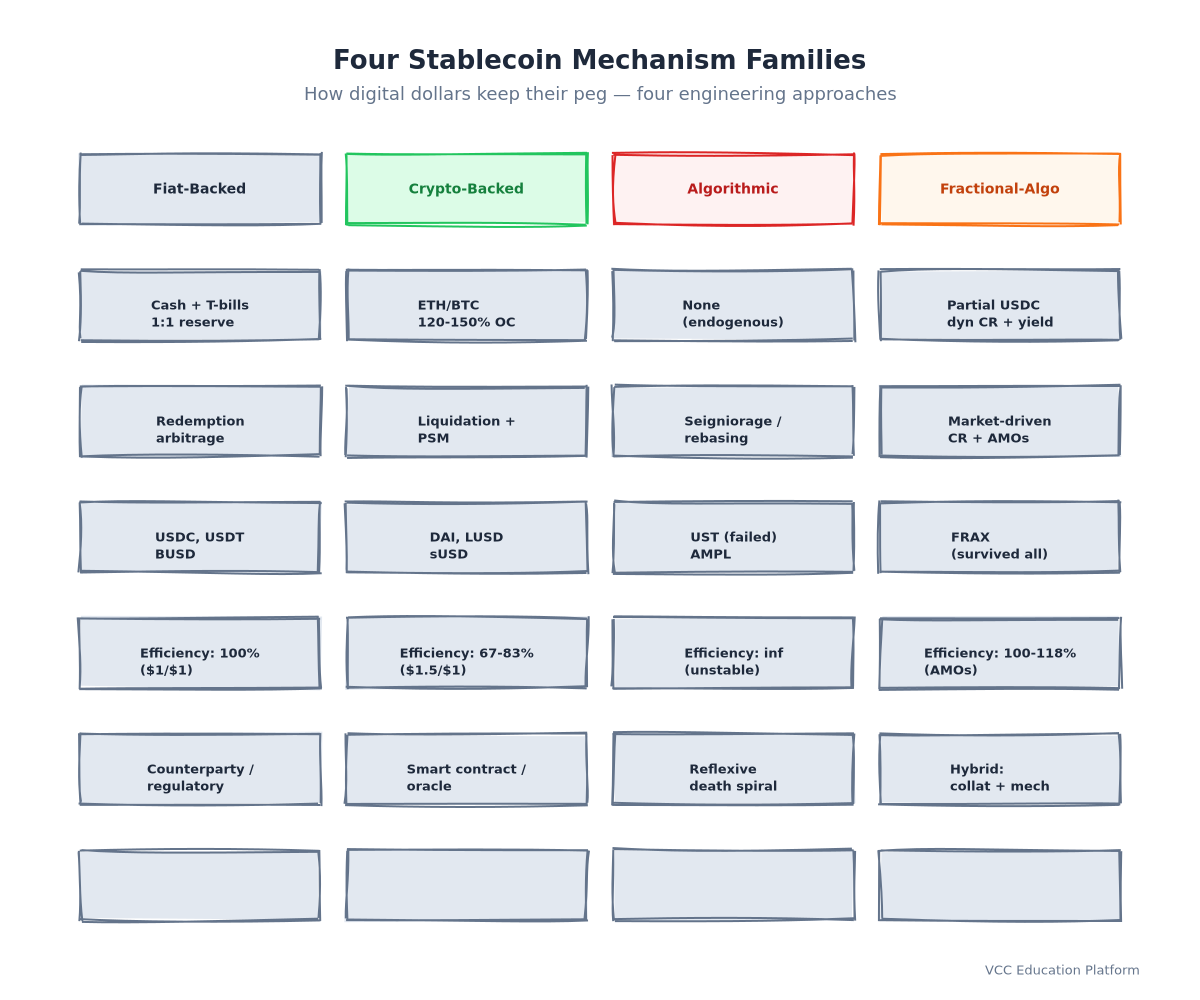
| Family | Collateral | Peg Mechanism | Key Examples | Capital Efficiency |
|---|---|---|---|---|
| Fiat-Backed | Off-chain USD/T-bills | 1:1 Redemption arbitrage | USDC, USDT, BUSD, USDP | 100% (fully backed) |
| Crypto-Backed | On-chain ETH/BTC/USDC | Overcollateralization + Liquidation | DAI, LUSD, sUSD | 120-150%+ (overcollateralized) |
| Algorithmic | None (endogenous token) | Supply expansion/contraction | UST (failed), AMPL, ESD (failed) | ∞ (no collateral) |
| Fractional-Algorithmic | Partial collateral + endogenous | Dynamic collateral ratio + AMOs | FRAX | 85-100% (adjustable) |
1. Fiat-Backed: The Digital Bank Model
How it works: You deposit $1 with the issuer (Circle, Tether, Paxos). They put it in a bank account or short-term T-bills. They mint 1 token. You can redeem 1 token for $1 (minus fees, above minimums).
The peg mechanism is redemption arbitrage:
- If USDC trades at $1.01 → Arbitrageurs buy $1M USDC from Circle → Sell on market for $1.01M → Pocket $10k profit → Supply increases → Price drops to $1
- If USDC trades at $0.99 → Arbitrageurs buy USDC on market for $0.99M → Redeem at Circle for $1M → Pocket $10k profit → Supply decreases → Price rises to $1
The catch: Redemption isn't equal.
- Circle: $100k minimum, institutional KYC only. Retail depends on secondary markets.
- Tether: $100k minimum, selective access. Most retail never redeem directly.
- Paxos (USDP/BUSD): More accessible but smaller scale.
This creates a two-tier peg. Institutions enforce the peg directly. Retail enforces it indirectly — and pays the spread.
March 2023 Stress Test: Circle held $3.3B (8% of reserves) at SVB. When SVB failed, redemption fear drove USDC to $0.87. The Fed's emergency backstop restored confidence. The mechanism worked — but only because the backstop existed.
Vietnam context: USDC is the DeFi standard on Ethereum/Polygon/Arbitrum. USDT (TRC-20 on TRON) dominates retail transfers due to near-zero fees. Both are "digital USD" for a dollarized economy.
2. Crypto-Backed: The Overcollateralized Vault
How it works: You deposit $150 worth of ETH into a smart contract vault. The protocol mints you 100 DAI. Your collateralization ratio: 150%. If ETH drops and your ratio hits the minimum (e.g., 130% for Maker), your vault gets liquidated — collateral sold to repay the DAI.
The peg mechanism has two layers:
Layer 1: Overcollateralization Buffer
- $150 ETH backs 100 DAI. ETH can drop 33% before the system is underwater.
- This buffer absorbs volatility without needing external intervention.
Layer 2: Liquidation Engine
- When a vault breaches minimum collateral ratio (MCR), keepers bid to repay the vault's debt in exchange for discounted collateral.
- Liquidation penalty (13% on Maker) goes to the protocol, not the keeper.
- This clears bad debt automatically, keeping the system solvent.
Layer 3 (Maker only): Peg Stability Module (PSM)
- Direct 1:1 swap: USDC ↔ DAI at $1 with 0% slippage.
- Solved chronic DAI >$1 problem (2017-2020) but made DAI ~60% USDC-backed.
- Recursive risk: DAI now inherits USDC's counterparty/regulatory risk.
Liquity (LUSD) — The Governance-Minimized Alternative:
- Immutable contracts, no governance, no USDC dependency.
- Fixed 110% MCR (highest capital efficiency).
- Algorithmic interest rate (redemption fee) adjusts to demand.
- Trade-off: No PSM → harder to defend upward peg drift.
March 2020 Stress Test: ETH dropped 50% in 24h. Maker's oracles lagged. Liquidations cascaded. DAI hit $1.12 (upward depeg — too much demand, not enough supply). PSM later fixed this.
Vietnam context: DAI is niche — used by DeFi natives who value censorship resistance. High gas fees on Ethereum L1 make vault management expensive for small holders. L2s (Arbitrum, Optimism) and Cardano's upcoming stablecoins change this calculus.
3. Algorithmic: The Pure Code Experiment
How it works: No collateral. The protocol adjusts supply to match demand, like a central bank — but with code, not discretion.
Two sub-mechanisms:
A. Seigniorage Shares (Basis, Terra/LUNA, ESD, DSD)
- Expansion (price > $1): Protocol mints new tokens → sells them for the stablecoin → burns the stablecoin → supply contracts → price drops.
- Contraction (price < $1): Protocol issues "bonds" (coupons) at a discount → buyers pay in stablecoin → stablecoin burned → supply contracts → price rises. Bonds redeem at $1 only when price recovers.
- Recursive flaw (Terra): The volatile token (LUNA) was minted to buy UST. When confidence broke, infinite LUNA minted → hyperinflation → death spiral.
B. Rebasing (Ampleforth/AMPL)
- Universal supply adjustment: Every wallet balance changes proportionally daily.
- Price > $1 → supply expands → everyone gets more tokens (but each worth less).
- Price < $1 → supply contracts → everyone loses tokens (but each worth more).
- Result: AMPL price still volatile ($0.50-$2.00 range). It's not a stablecoin — it's a "unit of account with elastic supply."
Why most failed: Recursive designs create reflexive death spirals. Non-recursive (rebasing) avoids death spirals but fails at stability — the unit of account itself fluctuates.
Vietnam context: UST was popular in VN yield farms (Anchor Protocol 20% APY). The collapse wiped out many local retail investors. This trauma shapes VN skepticism toward "algorithmic" anything.
4. Fractional-Algorithmic: The Hybrid That Survived
FRAX (Frax Finance) is the only fractional-algorithmic stablecoin to survive multiple stress events (Terra, USDC depeg, bear market).
How it works:
- Dynamic Collateral Ratio (CR): Starts at 100% (fully backed). Market forces adjust it:
- FRAX > $1 → Protocol lowers CR (less collateral needed) → mints FRAX with less backing → supply expands
- FRAX < $1 → Protocol raises CR (more collateral needed) → buys back FRAX → supply contracts
- Two Tokens: FRAX (stablecoin) + FXS (governance/seigniorage capture). FXS holders earn fees + act as backstop.
- AMOs (Algorithmic Market Operations): Idle collateral deployed to lending (Aave), LPing (Curve), staking — generates yield for protocol.
Why it survived:
- Non-recursive: FXS is not minted to buy FRAX. FRAX is backed by USDC + yield-bearing assets.
- Market-driven CR: No governance vote needed to adjust collateralization. The market sets it via price.
- Productive collateral: AMOs turn "idle reserves" into revenue — a DeFi-native improvement on TradFi fractional reserve banking.
Stress tests passed:
- Terra collapse (May 2022): FRAX held peg, CR adjusted from ~88% → 92%
- USDC depeg (Mar 2023): FRAX held peg, AMOs provided liquidity
- Bear market 2022-2023: FRAX supply grew from 1B → 2.5B while maintaining peg
Trade-off: Still partially dependent on USDC (collateral). If USDC fails, FRAX's collateral fails. But the dynamic CR provides a buffer USDC doesn't have.
Deep Dive: How Peg Arbitrage Actually Works
Every mechanism relies on the same fundamental loop: price deviation → profit opportunity → capital flow → price correction.
` ┌─────────────────────────────────────────────────────────────┐ │ THE PEG ARBITRAGE LOOP │ ├─────────────────────────────────────────────────────────────┤ │ │ │ Price > $1 (Premium) Price < $1 (Discount)│ │ │ │ │ │ ▼ ▼ │ │ ┌─────────┐ ┌─────────┐ │ │ │ MINT / │ │ BUY / │ │ │ │ BORROW │ │ REDEEM │ │ │ │ at $1 │ │ at $1 │ │ │ └────┬────┘ └────┬────┘ │ │ │ │ │ │ ▼ ▼ │ │ Sell at Buy at │ │ │ market market │ │ │ price price │ │ │ │ │ │ │ ▼ ▼ │ │ Profit → Supply ↑ Profit → Supply ↓ │ │ │ │ │ │ └──────────────────┬─────────────────────┘ │ │ ▼ │ │ Price → $1 │ │ │ └─────────────────────────────────────────────────────────────┘ `
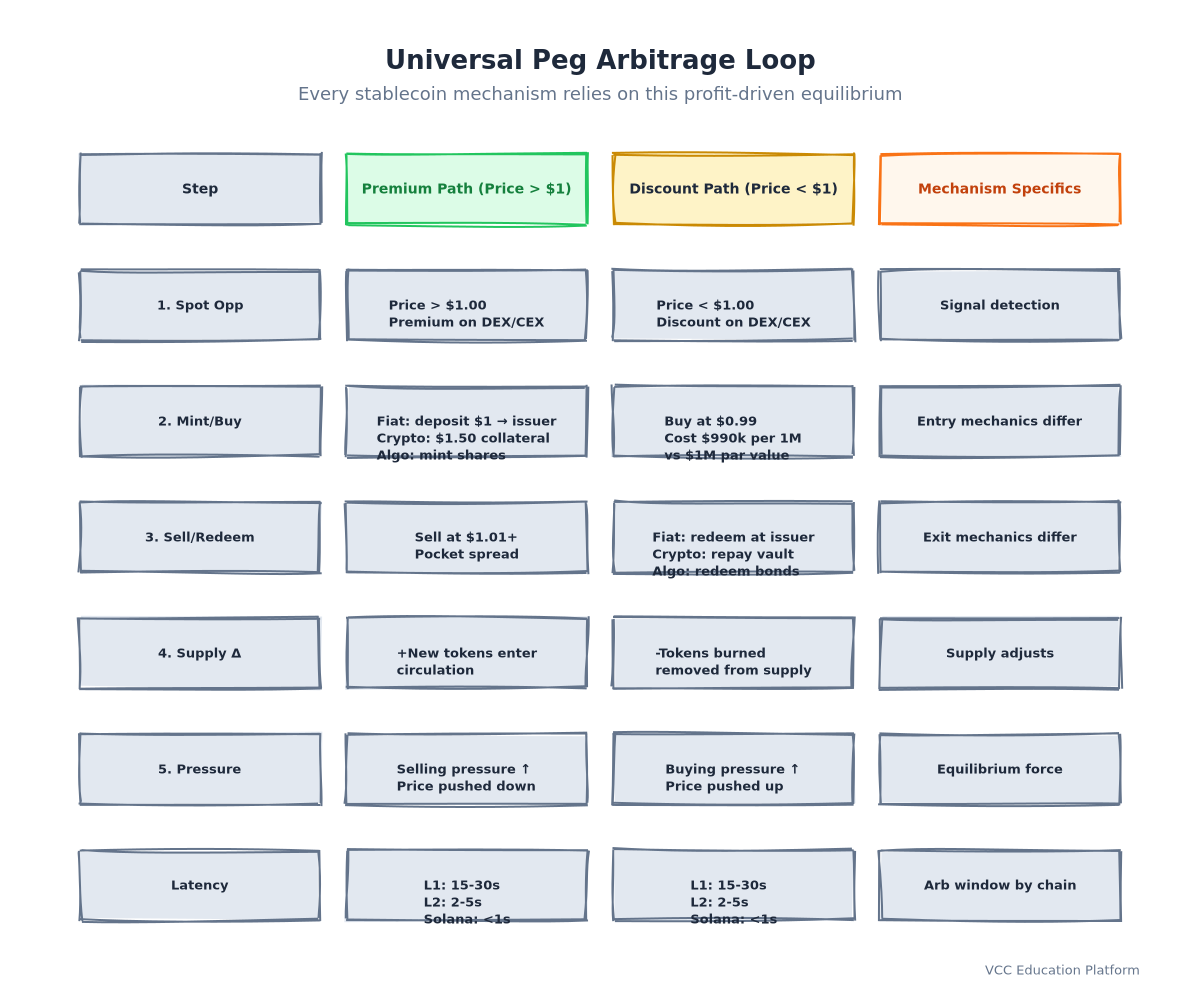
But arbitrageurs aren't infinite. They face:
- Capital constraints: Need $1M+ for meaningful size
- Settlement latency: Ethereum L1 = 12-15 sec + mempool. Arbitrum/Optimism = ~2 sec. Solana = ~400ms.
- Counterparty risk: Will the issuer honor redemption? (USDC at SVB)
- Smart contract risk: Will the vault liquidate fairly? (Maker 2020)
- Oracle risk: Is the price feed accurate? (Chainlink manipulation)
Arbitrage latency matters. During the March 2023 USDC depeg, the price gap persisted for hours because:
- Redemption window: US banking hours only (Circle)
- Settlement: Wire transfers take hours
- Arbitrageurs needed to bridge TradFi + DeFi — slow, costly, risky
On-chain arbitrage (DAI, FRAX, LUSD) is faster — seconds, not hours. But it's limited to on-chain liquidity.
Risk Comparison: Which Mechanism Survives Stress?
The Three-Layer Risk Model (Original Framework)
Every stablecoin carries risk across three layers. Most analyses miss Layer 2 and 3.
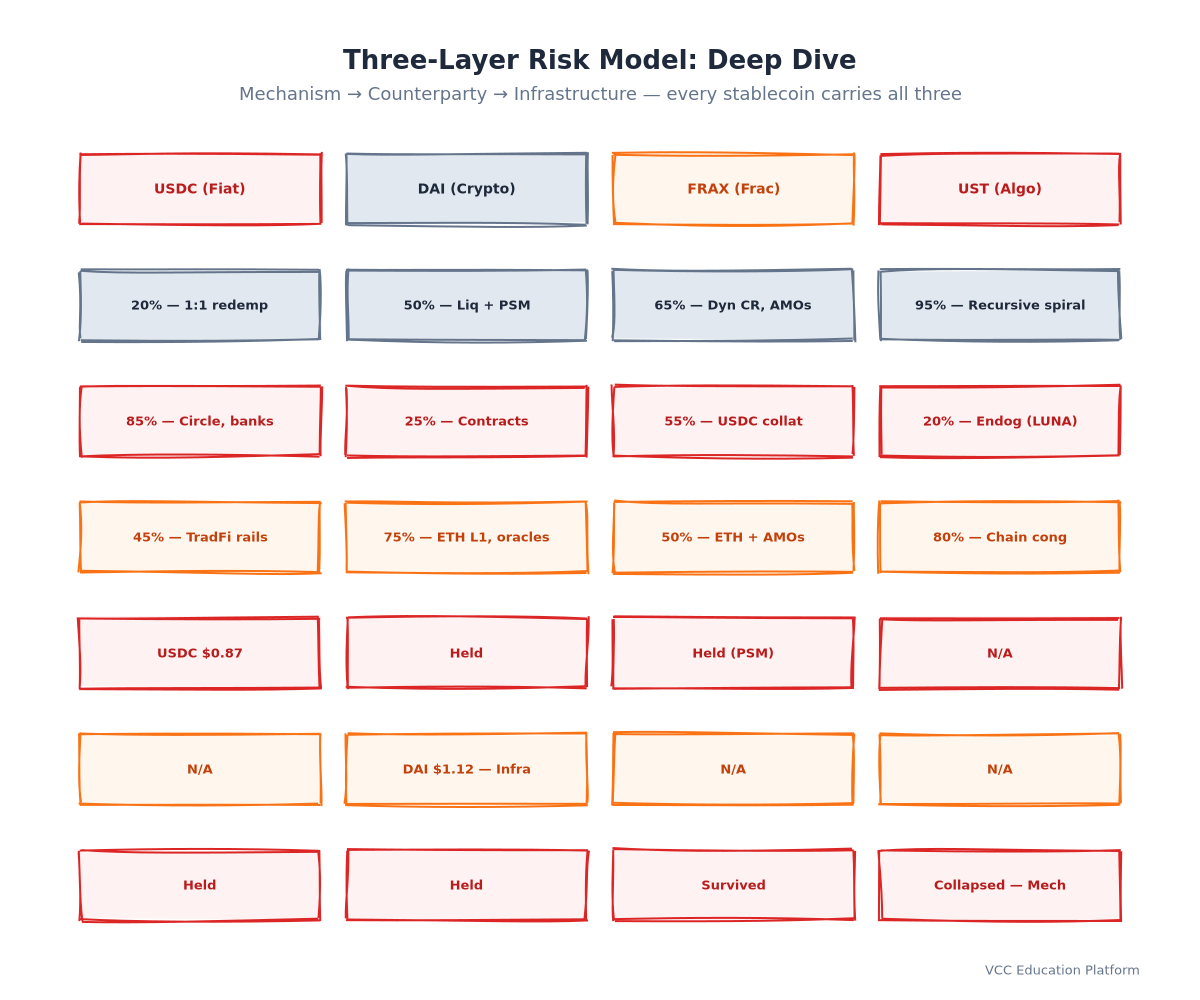
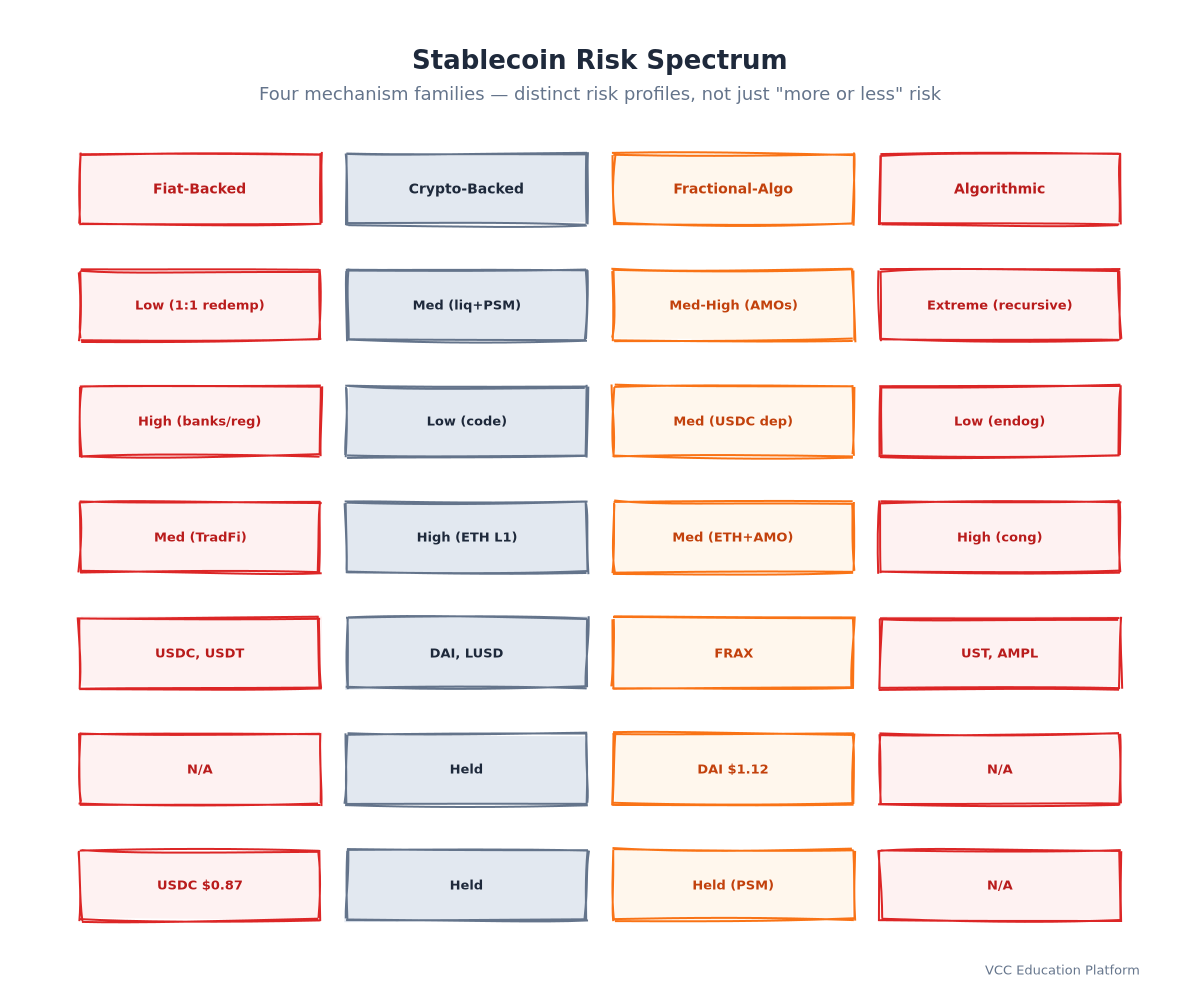
| Layer | Fiat-Backed (USDC) | Crypto-Backed (DAI) | Fractional (FRAX) | Algorithmic (UST) |
|---|---|---|---|---|
| 1. Mechanism Risk | Low (simple 1:1) | Medium (liquidation engine) | Medium-High (dynamic CR) | Extreme (recursive) |
| 2. Counterparty Risk | High (Circle, banks, regulators) | Low (smart contracts) | Medium (USDC collateral) | Low (but endogenous) |
| 3. Infrastructure Risk | Medium (TradFi rails) | High (Ethereum L1 congestion, oracles) | Medium (Ethereum + AMOs) | High (chain congestion) |
Historical Stress Test Results:
| Event | USDC | USDT | DAI | FRAX | UST |
|---|---|---|---|---|---|
| Mar 2020 Crash | N/A | Held | $1.12 (upward) | N/A | N/A |
| May 2022 Terra | Held | Held | Held | Held | Collapsed |
| Nov 2022 FTX | Held | Held | Held | Held | N/A |
| Mar 2023 SVB | $0.87 | Held | Held (PSM helped) | Held | N/A |
| Recovery Time | 2 days (Fed backstop) | N/A | Hours | Hours | Never |
Key Insight: No mechanism is risk-free. The risk profile differs:
- Fiat-backed: Tail risk (rare but catastrophic — regulatory seizure, bank failure)
- Crypto-backed: Chronic risk (ongoing smart contract/oracle/liquidity risk)
- Fractional: Hybrid risk (both, but diversified)
- Algorithmic: Structural risk (design flaw → inevitable failure under stress)
For Vietnamese users: USDT/USDC carry regulatory tail risk (SBV could restrict access). DAI/FRAX carry smart contract risk but are censorship-resistant. The "safest" choice depends on your threat model: bank freeze vs code bug.
Vietnam Context: Stablecoins in VN DeFi
Vietnam ranks #3 globally in crypto adoption (Chainalysis 2023). Stablecoins are the backbone.
Usage Patterns
| Use Case | Dominant Stablecoin | Why |
|---|---|---|
| Remittance (Overseas → VN) | USDT (TRC-20) | Near-zero fees, instant, P2P/OTC ramp to VND |
| DeFi Yield Farming | USDC, DAI | Ethereum/Polygon/Arbitrum native, audited |
| Trading Pair / Quotation | USDT | Universal quote asset on VN exchanges (Bvnex, Remitano) |
| Savings / Dollarization | USDC, USDT | "Digital USD" in capital-controlled economy |
Local Projects
- VNDC: Centralized VND-pegged stablecoin. Used for OTC/remittance. Not DeFi-native. 1 VNDC = 1 VND (not $1).
- VNDT: TRON-based VND stablecoin. Low fees, limited DeFi integration.
- No major decentralized VND stablecoin exists — opportunity for Cardano/VN builders.
Regulatory Landscape
- SBV (State Bank of Vietnam): Crypto not legal tender, not payment method (2018, 2021, 2024 circulars).
- Holding/trading: Not explicitly banned. P2P/OTC operates openly.
- DeFi usage: Tolerated but unregulated. No consumer protection.
- CBDC Pilot: SBV researching digital đồng (2023-2024). Could compete with private stablecoins.
Practical takeaway for VN users:
- Diversify mechanism exposure: Don't put all savings in one stablecoin type.
- Prefer audited, battle-tested: USDC (fiat), DAI/LUSD (crypto), FRAX (fractional).
- Avoid unaudited algorithmic: Post-UST, the burden of proof is on the protocol.
- Use L2s for cost efficiency: Arbitrum/Polygon for USDC/DAI; Cardano (future) for native stablecoins.
- Monitor SBV signals: Regulatory shift could change on-ramp/off-ramp access overnight.
FAQ
Q: What happens when a stablecoin loses its peg? A: It depends on the mechanism. Fiat-backed: redemption pressure forces issuer to sell reserves (USDC 2023). Crypto-backed: liquidations clear bad debt, peg restores if collateral holds (DAI 2020). Algorithmic: death spiral if recursive (UST 2022) or prolonged volatility if non-recursive (AMPL).
Q: Are algorithmic stablecoins safe after Terra? A: Recursive algorithmic (UST-style) — no, the design flaw is structural. Non-recursive (rebasing like AMPL, coupon-based with exogenous value) — they avoid death spirals but don't achieve stable $1 peg. No fully uncollateralized stablecoin has maintained $1 peg long-term.
Q: How does USDC maintain its 1:1 peg? A: 1:1 reserves (cash + T-bills) + institutional redemption arbitrage. When price deviates, institutions mint/redeem directly with Circle. Retail benefits from the resulting supply adjustment.
Q: What is the difference between DAI and USDC? A: USDC = centralized, fiat-backed, 1:1 reserves, regulatory exposure. DAI = decentralized, crypto-backed, overcollateralized, smart contract/oracle exposure. DAI now ~60% USDC-backed via PSM — so it inherits some USDC risk.
Q: Can a stablecoin be fully decentralized and stable? A: LUSD (Liquity) comes closest — immutable, no governance, ETH-only collateral. But it lacks a PSM, so upward peg drift occurs. FRAX is partially decentralized but USDC-dependent. Trade-off triangle: Decentralization, Stability, Capital Efficiency — pick two.
Q: What are the risks of using stablecoins in DeFi? A: Smart contract risk (protocol hack), oracle risk (price feed manipulation), depeg risk (mechanism failure), regulatory risk (issuer sanctioned), infrastructure risk (L1 congestion, bridge failure). Never treat stablecoins as risk-free.
Q: How do stablecoin issuers make money? A: Fiat-backed: Interest on reserves (T-bill yield) — Circle earns ~$1B+/year on USDC reserves. Crypto-backed: Stability fees (interest on borrowed DAI) + liquidation penalties. FRAX: AMO yield (lending, LP fees, staking) + FXS seigniorage.
Summary: Choosing Your Stablecoin
| Priority | Recommendation | Why |
|---|---|---|
| Maximum safety (institution-grade) | USDC, USDP | Regulated, audited, 1:1 reserves, legal recourse |
| Censorship resistance | LUSD, DAI | No central issuer, immutable (LUSD) or minimal governance (DAI) |
| Capital efficiency + yield | FRAX | Dynamic CR, AMO yield, survived multiple crises |
| VN retail transfers | USDT (TRC-20) | Lowest fees, universal acceptance on VN P2P/OTC |
| DeFi composability | USDC, DAI | Deepest liquidity, widest protocol support |
The mental model: Stablecoins are not dollars. They're claims on dollars (fiat-backed), claims on crypto collateral (crypto-backed), or confidence games coded in math (algorithmic). Know which claim you're holding.
This article is part of the VCC Education Platform's DeFi curriculum. For hands-on practice, see our guides on [AMM Mechanics], [Liquidity Pool Risks], and [DeFi Risk Assessment].