
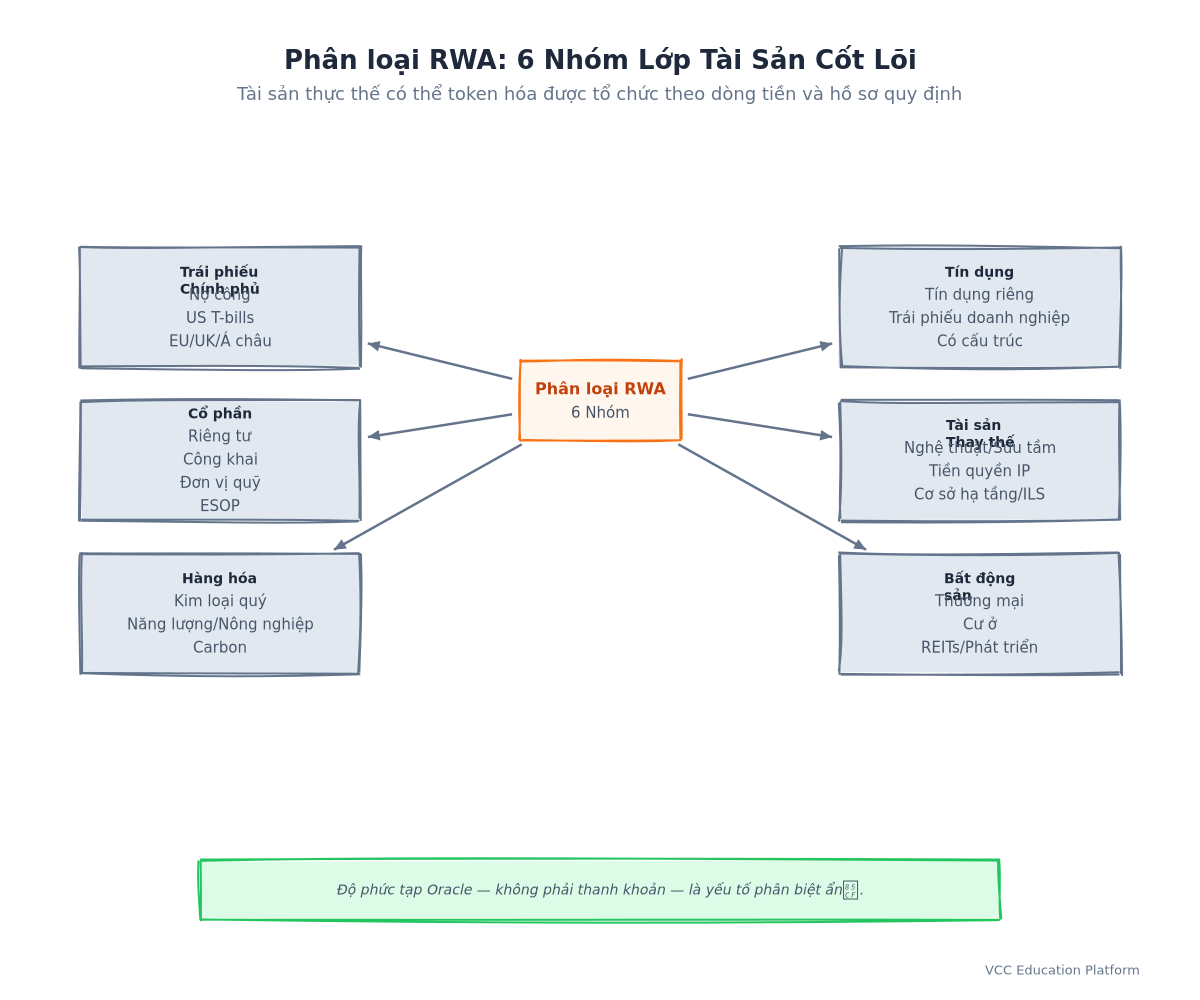
Real World Asset (RWA) taxonomy classifies tokenizable real-world assets vào sáu core categories: Treasuries, Credit, Commodities, Real Estate, Equity, và Alternative assets. Mỗi category khác nhau về legal structure, liquidity profile, yield source, oracle requirements, và regulatory treatment. Hiểu rõ taxonomy này là điều thiết yếu cho researchers, builders, và investors khi navigate cơ hội tokenization trị giá 16 trillion USD được dự báo bởi BCG và 21.co cho năm 2030.
 ## Tại sao RWA Taxonomy Quan Trọng
Thị trường tokenized asset đã phát triển từ experimental pilots thành một multi-billion dollar ecosystem với live products từ Franklin Templeton, Ondo Finance, Paxos, và Centrifuge. Tuy nhiên, hầu hết analyses vẫn treat RWAs như một monolith. Chúng không phải là một khối thống nhất. Một tokenized T-bill behaves fundamentally differently từ một tokenized carbon credit hoặc một fractional real estate deed. Những differences quyết định mọi thứ: how the asset is custodied, what data feeds it needs, which regulators have jurisdiction, và whether a Vietnamese investor can legally access it.
Bài viết này cung cấp first unified framework mapping all six categories với sub-types, tokenization mechanics, oracle requirements, và regulatory classifications — plus a Vietnam-specific readiness assessment cho each category.
## The 6 Core RWA Asset Classes — Taxonomy Overview
Taxonomy của chúng tôi organizes RWAs by the nature of the underlying asset và its cash flow characteristics. Đây không phải arbitrary grouping — nó reflects how institutions actually structure, custody, và regulate these assets.
---
## Category 1: Treasuries & Sovereign Debt
Tokenized treasuries là most mature RWA category, với over $2 billion AUM (Assets Under Management) across 20+ products tracked by rwa.xyz as of 2024.
### Sub-types
- **US T-bills:** 4-week to 1-year bills, primary dealer pricing
- **EU Sovereign Bonds:** German Bunds, French OATs, Italian BTPs
- **UK Gilts:** Conventional và index-linked
- **Asian Government Bonds:** Singapore SGS, Japanese JGBs, Australian CGS
### Tokenization Structure
Almost all tokenized treasuries use **Special Purpose Vehicle (SPV)** structure. The SPV purchases the underlying bonds và issues tokens representing proportional ownership. A regulated custodian (BNY Mellon, State Street) holds the physical securities. Tokens are typically issued under SEC Regulation D (accredited investors only) hoặc Regulation S (offshore).
Franklin Templeton's BENJI fund (BENJI) takes a different approach: a 1940 Act registered money market fund, making it accessible to retail investors. Ondo Finance's OUSG uses a Reg D SPV. Matrixdock's STBT operates under MAS Singapore's regulatory sandbox.
### Key Characteristics
| Dimension | Profile |
|-----------|---------|
| Liquidity | Daily redemption windows (T+0 to T+1) |
| Yield Source | Risk-free rate benchmark (SOFR, €STR, SORA) |
| Oracle Needs | Minimal — primary dealer price feeds |
| Regulatory | MiCA ART, SEC Reg D/Reg S, MAS VCC |
| Min Investment | $100–$1,000 |
### Vietnam Context
The State Bank of Vietnam (SBV) restricts foreign currency denominated bonds cho domestic investors. VND-denominated government bonds exist but lack tokenization infrastructure. No Vietnamese entity has launched a tokenized treasury product. The regulatory gap: SBV Circular 02/2023/TT-NHNN governs foreign currency activities but does not address tokenized securities.
---
## Category 2: Credit (Private & Public)
Credit represents the largest addressable market — global private credit market exceeds $1.5 trillion, yet less than 1% is tokenized (Messari, 2024).
### Sub-types
- **Private Credit Funds:** Direct lending, mezzanine, distressed debt
- **Corporate Bonds:** Investment grade and high yield issuances
- **Structured Credit:** ABS, CLOs, mortgage-backed securities
- **Trade Finance Receivables:** Invoice financing, supply chain finance
### Tokenization Structure
Three distinct models compete:
1. **SPV-per-asset** (Centrifuge Tinlake): Each loan pool gets a bankruptcy-remote SPV. True asset isolation, high setup cost.
2. **Protocol-level pool** (Maple Finance, Goldfinch): Capital efficient but contagion risk — a default in one credit line affects the whole pool.
3. **Fund LP tokenization** (Figure/Provenance): Token represents LP interest in a 40 Act fund. Regulatory clarity, double-layer fees.
### Key Characteristics
| Dimension | Profile |
|-----------|---------|
| Liquidity | Low-medium (quarterly/annual windows, lockups common) |
| Yield Source | Credit spread + base rate |
| Oracle Needs | NAV feeds, credit rating updates, default monitoring |
| Regulatory | SEC accredited investor, AIFMD (EU), MAS accredited regimes |
| Min Investment | $1,000–$100,000+ |
### Vietnam Context
Vietnam's corporate bond market has grown rapidly (VN Corporate Bond Index ~$50B). The SSC has run pilot programs for digital bond issuance with VPBank and Techcombank (2023). However, the Law on Securities 2019 requires SSC registration for all corporate bonds, creating a bottleneck for tokenized issuance. The pilot framework is promising but not yet scaled.
---
## Category 3: Commodities
Commodities split into two fundamentally different oracle regimes: precious metals (centralized price feeds sufficient) và everything else (geographic pricing, quality grades, MRV data).
### Sub-types
- **Precious Metals:** Gold (PAXG, XAUT, XAUŌ), Silver, Platinum
- **Energy:** Crude oil, natural gas, refined products
- **Agriculture:** Grains, soft commodities, livestock
- **Carbon Credits:** Verra VCS, Gold Standard, ART/TREE credits
### Tokenization Structure
- **Metals:** Warehouse receipt tokenization. Physical bars in LBMA-approved vaults. ERC-20 tokens with proof-of-reserve attestations.
- **Energy/Ag:** Quality/location-specific. Requires grade certificates, storage proofs, geographic pricing.
- **Carbon:** Registry bridging (Verra → Toucan → on-chain). MRV (Measurement, Reporting, Verification) data is the oracle.
### Key Characteristics
| Dimension | Profile |
|-----------|---------|
| Liquidity | Medium (gold: high; carbon: medium; energy: low) |
| Yield Source | Price appreciation + storage yield (carbon: credit retirement value) |
| Oracle Needs | **CRITICAL** — spot price, proof-of-reserve, MRV data |
| Regulatory | CFTC (US), MiCA (EU), MAS (SG) |
| Min Investment | $50–$100 |
### Vietnam Context
**Gold is Vietnam's strongest RWA opportunity.** Vietnamese households hold an estimated 300–500 tons of SJC gold bars (99.99% purity) as a cultural store of value. Decree 24/2024/ND-CP regulates gold trading businesses. A VND-denominated, locally vaulted gold token would tap into existing cultural behavior.
Carbon credits offer export potential: Vietnam's mangrove forests (Mekong Delta, Can Gio) represent 10M+ tons CO2e potential. However, no tokenization framework exists. The revised Law on Environmental Protection 2020 enables carbon market development but implementing decrees are pending.
---
## Category 4: Real Estate
Real estate tokenization does not solve illiquidity — secondary market volumes remain below 1% annually (Green Street Advisors, 2023). What it does solve is access fragmentation and administrative overhead.
### Sub-types
- **Commercial:** Office, retail, industrial, multifamily
- **Residential:** Single-family rentals, condo units
- **REITs:** Public and private real estate investment trusts
- **Development Projects:** Pre-construction, value-add repositioning
### Tokenization Structure
Four models with different legal/liquidity profiles:
1. **Equity in SPV/LLC** (RealT — Series LLC per property): Securities law applies. Rental income = dividends. Passive ownership.
2. **Debt/Revenue Participation** (Da Nang pilot): Not equity. Token holders receive revenue share. Different regulatory treatment.
3. **REIT Share Tokenization:** Regulated fund, potential public market access. No live Vietnamese examples yet.
4. **NFT Deed:** Legal enforceability untested. County recorders don't recognize blockchain transfers (Harvard Law, 2024).
### Key Characteristics
| Dimension | Profile |
|-----------|---------|
| Liquidity | Low (real estate illiquidity persists on-chain) |
| Yield Source | Rental income + capital appreciation |
| Oracle Needs | Property valuation, rental verification, occupancy data |
| Regulatory | SEC (US), Property law (title), MiCA (EU), Stamp duty |
| Min Investment | $50–$500 |
### Vietnam Context
Foreign ownership is capped at 30% per condo building, 10% per landed project (Law on Housing 2014, amended 2023). The 2023 Law on Real Estate Business established a REIT framework but no REITs have listed. Da Nang's "Digital Real Estate Platform" pilot (2023) tokenizes hotel revenue rights — a revenue participation model avoiding foreign ownership limits. This is the most viable near-term path for Vietnam.
---
## Category 5: Equity (Private & Public)
Private equity tokenization dominates public equity in volume. The value chain — Issuance → Compliance/KYC → Corporate Actions → Secondary Trading → Cap Table Sync — remains fragmented across platforms.
### Sub-types
- **Private Company Shares:** Pre-IPO, venture-backed, growth equity
- **Public Equities:** Fractional shares via transfer agent integration
- **Fund Units:** VC/PE fund LP interests
- **Employee Equity:** ESOP tokenization, secondary liquidity
### Tokenization Structure
- **Private:** Reg D/Reg A+/Reg CF issuance. Cap table on-chain. Transfer agent (Securitize, Tokensoft) handles compliance.
- **Public:** Transfer agent + CSD integration. Tokens mirror existing share registry. EU DLT Pilot Regime enables CSD-native settlement (T+0).
- **Funds:** LP interest tokenization. VCC (Singapore) or LP (Delaware) wrappers.
### Key Characteristics
| Dimension | Profile |
|-----------|---------|
| Liquidity | Private: very low (lockups); Public: high (fractional) |
| Yield Source | Dividends + capital gains |
| Oracle Needs | Cap table sync, corporate actions, voting, dividends |
| Regulatory | SEC Reg D/A+/CF, Prospectus Reg (EU), CSRC (CN), SSC (VN) |
| Min Investment | $10–$1,000 |
### Vietnam Context
The SSC's "Digital Securities Pilot" (2023–2025) targets UPCoM (Unlisted Public Companies Market) — 200+ companies with low liquidity. VSDC (Vietnam Securities Depository) as CSD can anchor on-chain cap tables. But SSC requires VND denomination and VN KYC, limiting foreign capital. The pilot is the most concrete regulatory sandbox for equity tokenization in Southeast Asia.
---
## Category 6: Alternative Assets
"Alternative" is a residual category — everything that doesn't fit the first five. No common structure exists. The taxonomy value lies in identifying which sub-types have recurring cash flows vs. appreciation-only.
### Sub-types
- **Art & Collectibles:** Masterworks (SEC Reg A+), NFT fractional
- **Intellectual Property:** Music royalties (Royalty Exchange), patent royalties
- **Infrastructure:** Toll roads, solar farms, data centers — revenue rights
- **Litigation Finance:** Case funding, settlement claims
- **Insurance-Linked Securities (ILS):** Cat bonds, parametric triggers
- **Wine/Whisky:** Vint, Vinovest — physical storage, insurance, provenance
### Tokenization Structure
- **Cash-flow assets** (royalties, ILS, infrastructure): Fund/SPV model with cash flow assignment.
- **Appreciation-only** (art, wine, collectibles): SPV equity model or NFT + legal wrapper hybrid.
- **Hybrid** (IP with both): Bespoke structures per asset.
### Key Characteristics
| Dimension | Profile |
|-----------|---------|
| Liquidity | Very low to medium |
| Yield Source | Royalty streams, appreciation, insurance premiums, harvest yield |
| Oracle Needs | **Very High** — provenance, cash flow verification, parametric triggers |
| Regulatory | Highly jurisdiction-specific, often falls through cracks |
| Min Investment | $100–$10,000+ |
### Vietnam Context
Vietnam's software outsourcing industry ($5B+ exports) and growing content creator economy create IP royalty tokenization potential. Infrastructure revenue rights (BOT toll roads, solar farms under DPPA) have verifiable cash flows and existing legal frameworks for assignment. Art market is nascent (no major auction house presence). Wine: Dalat wine emerging but no secondary market.
---
## Comparative Framework: 6 Categories Side-by-Side
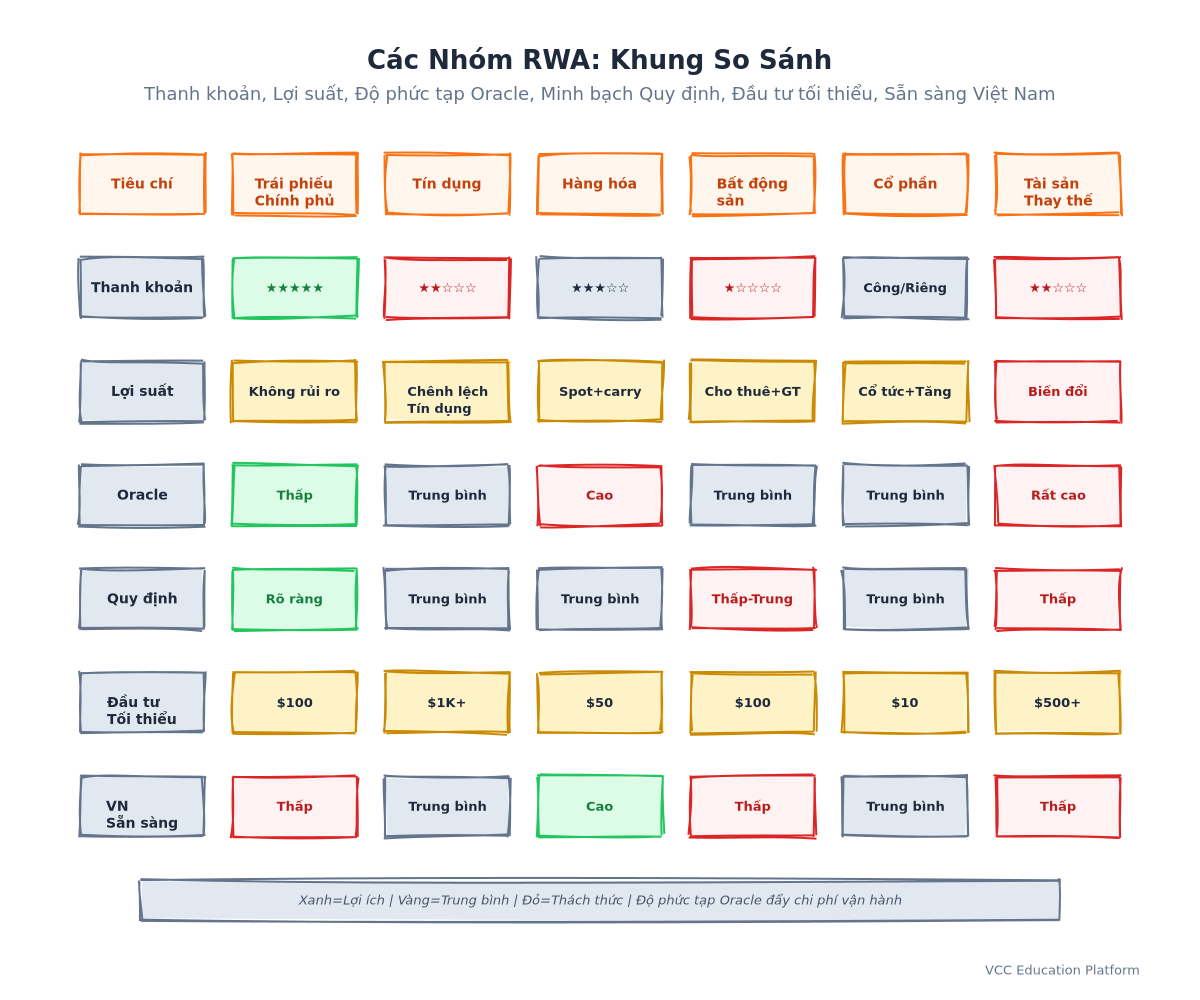
The table below synthesizes data from 15+ primary sources into a single decision matrix. **Oracle complexity — not liquidity or yield — is the hidden differentiator** because it determines operational cost and manipulation surface.
## Tại sao RWA Taxonomy Quan Trọng
Thị trường tokenized asset đã phát triển từ experimental pilots thành một multi-billion dollar ecosystem với live products từ Franklin Templeton, Ondo Finance, Paxos, và Centrifuge. Tuy nhiên, hầu hết analyses vẫn treat RWAs như một monolith. Chúng không phải là một khối thống nhất. Một tokenized T-bill behaves fundamentally differently từ một tokenized carbon credit hoặc một fractional real estate deed. Những differences quyết định mọi thứ: how the asset is custodied, what data feeds it needs, which regulators have jurisdiction, và whether a Vietnamese investor can legally access it.
Bài viết này cung cấp first unified framework mapping all six categories với sub-types, tokenization mechanics, oracle requirements, và regulatory classifications — plus a Vietnam-specific readiness assessment cho each category.
## The 6 Core RWA Asset Classes — Taxonomy Overview
Taxonomy của chúng tôi organizes RWAs by the nature of the underlying asset và its cash flow characteristics. Đây không phải arbitrary grouping — nó reflects how institutions actually structure, custody, và regulate these assets.
---
## Category 1: Treasuries & Sovereign Debt
Tokenized treasuries là most mature RWA category, với over $2 billion AUM (Assets Under Management) across 20+ products tracked by rwa.xyz as of 2024.
### Sub-types
- **US T-bills:** 4-week to 1-year bills, primary dealer pricing
- **EU Sovereign Bonds:** German Bunds, French OATs, Italian BTPs
- **UK Gilts:** Conventional và index-linked
- **Asian Government Bonds:** Singapore SGS, Japanese JGBs, Australian CGS
### Tokenization Structure
Almost all tokenized treasuries use **Special Purpose Vehicle (SPV)** structure. The SPV purchases the underlying bonds và issues tokens representing proportional ownership. A regulated custodian (BNY Mellon, State Street) holds the physical securities. Tokens are typically issued under SEC Regulation D (accredited investors only) hoặc Regulation S (offshore).
Franklin Templeton's BENJI fund (BENJI) takes a different approach: a 1940 Act registered money market fund, making it accessible to retail investors. Ondo Finance's OUSG uses a Reg D SPV. Matrixdock's STBT operates under MAS Singapore's regulatory sandbox.
### Key Characteristics
| Dimension | Profile |
|-----------|---------|
| Liquidity | Daily redemption windows (T+0 to T+1) |
| Yield Source | Risk-free rate benchmark (SOFR, €STR, SORA) |
| Oracle Needs | Minimal — primary dealer price feeds |
| Regulatory | MiCA ART, SEC Reg D/Reg S, MAS VCC |
| Min Investment | $100–$1,000 |
### Vietnam Context
The State Bank of Vietnam (SBV) restricts foreign currency denominated bonds cho domestic investors. VND-denominated government bonds exist but lack tokenization infrastructure. No Vietnamese entity has launched a tokenized treasury product. The regulatory gap: SBV Circular 02/2023/TT-NHNN governs foreign currency activities but does not address tokenized securities.
---
## Category 2: Credit (Private & Public)
Credit represents the largest addressable market — global private credit market exceeds $1.5 trillion, yet less than 1% is tokenized (Messari, 2024).
### Sub-types
- **Private Credit Funds:** Direct lending, mezzanine, distressed debt
- **Corporate Bonds:** Investment grade and high yield issuances
- **Structured Credit:** ABS, CLOs, mortgage-backed securities
- **Trade Finance Receivables:** Invoice financing, supply chain finance
### Tokenization Structure
Three distinct models compete:
1. **SPV-per-asset** (Centrifuge Tinlake): Each loan pool gets a bankruptcy-remote SPV. True asset isolation, high setup cost.
2. **Protocol-level pool** (Maple Finance, Goldfinch): Capital efficient but contagion risk — a default in one credit line affects the whole pool.
3. **Fund LP tokenization** (Figure/Provenance): Token represents LP interest in a 40 Act fund. Regulatory clarity, double-layer fees.
### Key Characteristics
| Dimension | Profile |
|-----------|---------|
| Liquidity | Low-medium (quarterly/annual windows, lockups common) |
| Yield Source | Credit spread + base rate |
| Oracle Needs | NAV feeds, credit rating updates, default monitoring |
| Regulatory | SEC accredited investor, AIFMD (EU), MAS accredited regimes |
| Min Investment | $1,000–$100,000+ |
### Vietnam Context
Vietnam's corporate bond market has grown rapidly (VN Corporate Bond Index ~$50B). The SSC has run pilot programs for digital bond issuance with VPBank and Techcombank (2023). However, the Law on Securities 2019 requires SSC registration for all corporate bonds, creating a bottleneck for tokenized issuance. The pilot framework is promising but not yet scaled.
---
## Category 3: Commodities
Commodities split into two fundamentally different oracle regimes: precious metals (centralized price feeds sufficient) và everything else (geographic pricing, quality grades, MRV data).
### Sub-types
- **Precious Metals:** Gold (PAXG, XAUT, XAUŌ), Silver, Platinum
- **Energy:** Crude oil, natural gas, refined products
- **Agriculture:** Grains, soft commodities, livestock
- **Carbon Credits:** Verra VCS, Gold Standard, ART/TREE credits
### Tokenization Structure
- **Metals:** Warehouse receipt tokenization. Physical bars in LBMA-approved vaults. ERC-20 tokens with proof-of-reserve attestations.
- **Energy/Ag:** Quality/location-specific. Requires grade certificates, storage proofs, geographic pricing.
- **Carbon:** Registry bridging (Verra → Toucan → on-chain). MRV (Measurement, Reporting, Verification) data is the oracle.
### Key Characteristics
| Dimension | Profile |
|-----------|---------|
| Liquidity | Medium (gold: high; carbon: medium; energy: low) |
| Yield Source | Price appreciation + storage yield (carbon: credit retirement value) |
| Oracle Needs | **CRITICAL** — spot price, proof-of-reserve, MRV data |
| Regulatory | CFTC (US), MiCA (EU), MAS (SG) |
| Min Investment | $50–$100 |
### Vietnam Context
**Gold is Vietnam's strongest RWA opportunity.** Vietnamese households hold an estimated 300–500 tons of SJC gold bars (99.99% purity) as a cultural store of value. Decree 24/2024/ND-CP regulates gold trading businesses. A VND-denominated, locally vaulted gold token would tap into existing cultural behavior.
Carbon credits offer export potential: Vietnam's mangrove forests (Mekong Delta, Can Gio) represent 10M+ tons CO2e potential. However, no tokenization framework exists. The revised Law on Environmental Protection 2020 enables carbon market development but implementing decrees are pending.
---
## Category 4: Real Estate
Real estate tokenization does not solve illiquidity — secondary market volumes remain below 1% annually (Green Street Advisors, 2023). What it does solve is access fragmentation and administrative overhead.
### Sub-types
- **Commercial:** Office, retail, industrial, multifamily
- **Residential:** Single-family rentals, condo units
- **REITs:** Public and private real estate investment trusts
- **Development Projects:** Pre-construction, value-add repositioning
### Tokenization Structure
Four models with different legal/liquidity profiles:
1. **Equity in SPV/LLC** (RealT — Series LLC per property): Securities law applies. Rental income = dividends. Passive ownership.
2. **Debt/Revenue Participation** (Da Nang pilot): Not equity. Token holders receive revenue share. Different regulatory treatment.
3. **REIT Share Tokenization:** Regulated fund, potential public market access. No live Vietnamese examples yet.
4. **NFT Deed:** Legal enforceability untested. County recorders don't recognize blockchain transfers (Harvard Law, 2024).
### Key Characteristics
| Dimension | Profile |
|-----------|---------|
| Liquidity | Low (real estate illiquidity persists on-chain) |
| Yield Source | Rental income + capital appreciation |
| Oracle Needs | Property valuation, rental verification, occupancy data |
| Regulatory | SEC (US), Property law (title), MiCA (EU), Stamp duty |
| Min Investment | $50–$500 |
### Vietnam Context
Foreign ownership is capped at 30% per condo building, 10% per landed project (Law on Housing 2014, amended 2023). The 2023 Law on Real Estate Business established a REIT framework but no REITs have listed. Da Nang's "Digital Real Estate Platform" pilot (2023) tokenizes hotel revenue rights — a revenue participation model avoiding foreign ownership limits. This is the most viable near-term path for Vietnam.
---
## Category 5: Equity (Private & Public)
Private equity tokenization dominates public equity in volume. The value chain — Issuance → Compliance/KYC → Corporate Actions → Secondary Trading → Cap Table Sync — remains fragmented across platforms.
### Sub-types
- **Private Company Shares:** Pre-IPO, venture-backed, growth equity
- **Public Equities:** Fractional shares via transfer agent integration
- **Fund Units:** VC/PE fund LP interests
- **Employee Equity:** ESOP tokenization, secondary liquidity
### Tokenization Structure
- **Private:** Reg D/Reg A+/Reg CF issuance. Cap table on-chain. Transfer agent (Securitize, Tokensoft) handles compliance.
- **Public:** Transfer agent + CSD integration. Tokens mirror existing share registry. EU DLT Pilot Regime enables CSD-native settlement (T+0).
- **Funds:** LP interest tokenization. VCC (Singapore) or LP (Delaware) wrappers.
### Key Characteristics
| Dimension | Profile |
|-----------|---------|
| Liquidity | Private: very low (lockups); Public: high (fractional) |
| Yield Source | Dividends + capital gains |
| Oracle Needs | Cap table sync, corporate actions, voting, dividends |
| Regulatory | SEC Reg D/A+/CF, Prospectus Reg (EU), CSRC (CN), SSC (VN) |
| Min Investment | $10–$1,000 |
### Vietnam Context
The SSC's "Digital Securities Pilot" (2023–2025) targets UPCoM (Unlisted Public Companies Market) — 200+ companies with low liquidity. VSDC (Vietnam Securities Depository) as CSD can anchor on-chain cap tables. But SSC requires VND denomination and VN KYC, limiting foreign capital. The pilot is the most concrete regulatory sandbox for equity tokenization in Southeast Asia.
---
## Category 6: Alternative Assets
"Alternative" is a residual category — everything that doesn't fit the first five. No common structure exists. The taxonomy value lies in identifying which sub-types have recurring cash flows vs. appreciation-only.
### Sub-types
- **Art & Collectibles:** Masterworks (SEC Reg A+), NFT fractional
- **Intellectual Property:** Music royalties (Royalty Exchange), patent royalties
- **Infrastructure:** Toll roads, solar farms, data centers — revenue rights
- **Litigation Finance:** Case funding, settlement claims
- **Insurance-Linked Securities (ILS):** Cat bonds, parametric triggers
- **Wine/Whisky:** Vint, Vinovest — physical storage, insurance, provenance
### Tokenization Structure
- **Cash-flow assets** (royalties, ILS, infrastructure): Fund/SPV model with cash flow assignment.
- **Appreciation-only** (art, wine, collectibles): SPV equity model or NFT + legal wrapper hybrid.
- **Hybrid** (IP with both): Bespoke structures per asset.
### Key Characteristics
| Dimension | Profile |
|-----------|---------|
| Liquidity | Very low to medium |
| Yield Source | Royalty streams, appreciation, insurance premiums, harvest yield |
| Oracle Needs | **Very High** — provenance, cash flow verification, parametric triggers |
| Regulatory | Highly jurisdiction-specific, often falls through cracks |
| Min Investment | $100–$10,000+ |
### Vietnam Context
Vietnam's software outsourcing industry ($5B+ exports) and growing content creator economy create IP royalty tokenization potential. Infrastructure revenue rights (BOT toll roads, solar farms under DPPA) have verifiable cash flows and existing legal frameworks for assignment. Art market is nascent (no major auction house presence). Wine: Dalat wine emerging but no secondary market.
---
## Comparative Framework: 6 Categories Side-by-Side
The table below synthesizes data from 15+ primary sources into a single decision matrix. **Oracle complexity — not liquidity or yield — is the hidden differentiator** because it determines operational cost and manipulation surface.
 | Dimension | Treasuries | Credit | Commodities | Real Estate | Equity | Alternative |
|-----------|------------|--------|-------------|-------------|--------|-------------|
| Liquidity | ★★★★★ | ★★☆☆☆ | ★★★☆☆ | ★☆☆☆☆ | ★★★★☆ (pub) / ★☆☆☆☆ (priv) | ★★☆☆☆ |
| Yield Profile | Risk-free | Credit spread | Spot + carry | Rent + appreciation | Dividends + growth | Highly variable |
| Oracle Complexity | Low | Medium | **High** | Medium | Medium | **Very High** |
| Regulatory Clarity | High | Medium | Medium | Low-Medium | Medium | Low |
| Min Investment | $100 | $1,000+ | $50 | $100 | $10 | $500+ |
| Vietnam Readiness | Low | Medium | **High (gold)** | Low | Medium (pilot) | Low |
---
## Tokenization Mechanics by Category
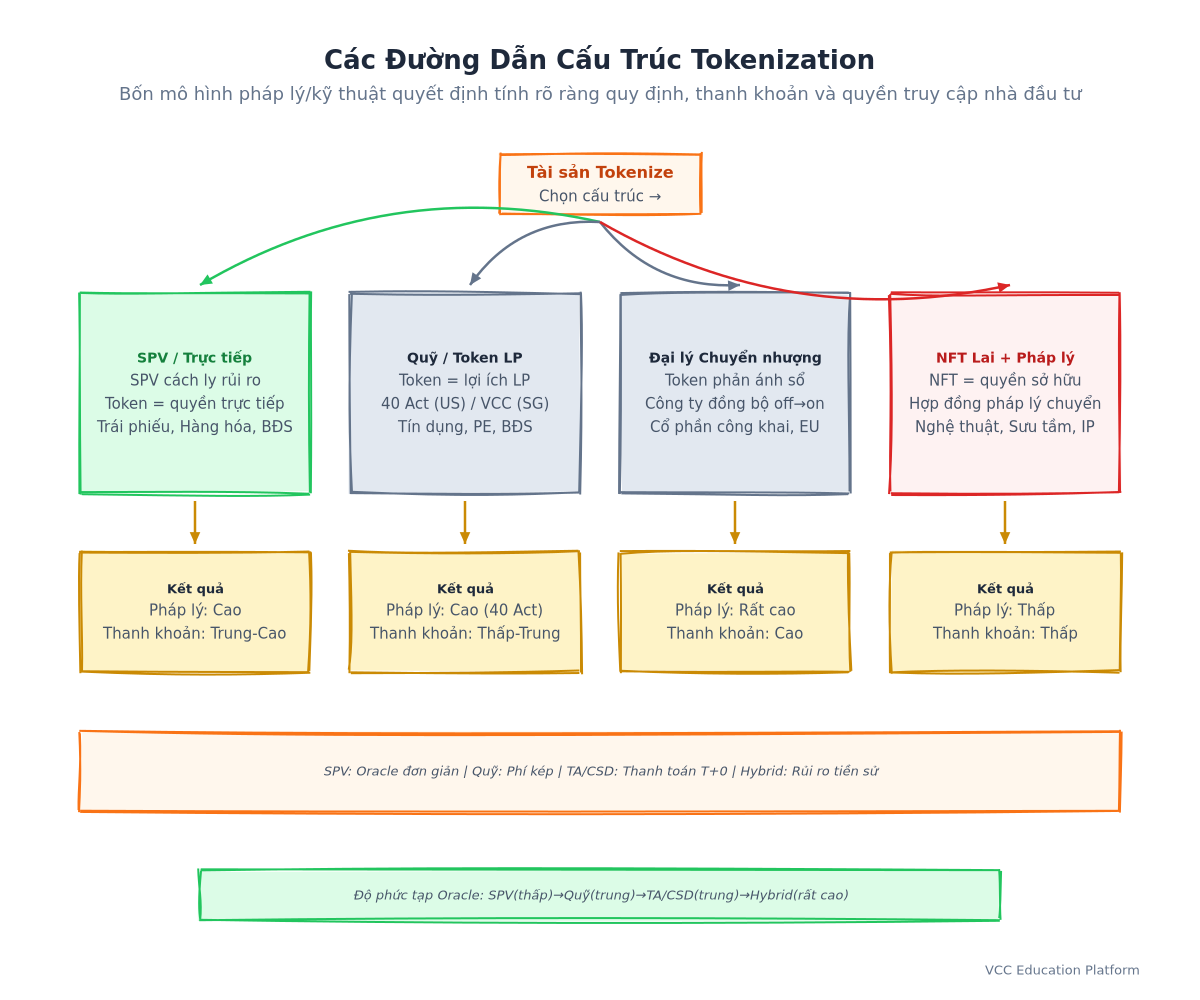
Four structures cut across asset categories. The choice determines legal clarity, liquidity potential, and investor access.
| Dimension | Treasuries | Credit | Commodities | Real Estate | Equity | Alternative |
|-----------|------------|--------|-------------|-------------|--------|-------------|
| Liquidity | ★★★★★ | ★★☆☆☆ | ★★★☆☆ | ★☆☆☆☆ | ★★★★☆ (pub) / ★☆☆☆☆ (priv) | ★★☆☆☆ |
| Yield Profile | Risk-free | Credit spread | Spot + carry | Rent + appreciation | Dividends + growth | Highly variable |
| Oracle Complexity | Low | Medium | **High** | Medium | Medium | **Very High** |
| Regulatory Clarity | High | Medium | Medium | Low-Medium | Medium | Low |
| Min Investment | $100 | $1,000+ | $50 | $100 | $10 | $500+ |
| Vietnam Readiness | Low | Medium | **High (gold)** | Low | Medium (pilot) | Low |
---
## Tokenization Mechanics by Category
Four structures cut across asset categories. The choice determines legal clarity, liquidity potential, and investor access.
 | Structure | Categories Using It | Legal Clarity | Liquidity Potential |
|-----------|---------------------|---------------|---------------------|
| SPV/Direct Asset | Treasuries, Commodities, some RE | High | Medium-High |
| Fund/LP Tokenization | Credit, Private Equity, some RE | High (40 Act) | Low-Medium |
| Transfer Agent/CSD | Public Equity | Very High | High |
| Hybrid NFT+Legal | Art, Collectibles, IP | Low | Low |
**SPV/Direct Asset:** Asset held in bankruptcy-remote vehicle. Token = direct claim. Used for treasuries (Ondo, Franklin Templeton), gold (Paxos, Matrixdock), some real estate.
**Fund/LP Tokenization:** Token = LP interest in a fund. Regulatory clarity via 40 Act (US) or VCC (Singapore). Used for credit funds, PE funds, some REITs.
**Transfer Agent/CSD Integration:** Token mirrors existing share registry. Corporate actions (splits, dividends) sync off-chain → on-chain. Used for public equities, EU DLT Pilot.
**Hybrid NFT + Legal Wrapper:** NFT represents ownership + legal contract assigns rights. Used for art (Masterworks), collectibles, IP royalties.
---
## Common Misconceptions in RWA Classification
1. **"All RWAs are securities"** — False. Commodities (gold) often classified as commodities under CFTC jurisdiction, not SEC. MiCA distinguishes ART (Asset-Referenced Tokens) từ financial instruments.
2. **"Tokenization = instant liquidity"** — False. Legal transfer restrictions (Reg D lockups, accredited investor checks, foreign ownership caps) persist on-chain. Secondary markets are nascent.
3. **"One oracle fits all"** — False. Carbon credits need MRV data; Treasuries need dealer prices; Real estate needs appraisals. Oracle complexity varies by 100x across categories.
4. **"Regulatory clarity exists"** — False. Most jurisdictions still classifying. MiCA ART is the closest to a comprehensive framework. Vietnam has conflicting signals: SBV anti-crypto, SSC pro-digital securities.
---
## FAQ
**What is the difference between tokenized treasuries and tokenized credit?**
Treasuries are sovereign debt with risk-free yields; credit encompasses corporate/private debt with credit spreads. Different risk, regulation, oracle needs.
**Can Vietnamese investors access tokenized RWAs?**
Currently limited. SBV restricts crypto payments; SSC pilots digital securities. VN investors access via offshore entities or future regulated frameworks.
**Which RWA category has the highest oracle risk?**
Commodities (especially carbon credits) and Alternative assets require specialized, often non-standardized data feeds — manipulation risk is highest.
**What legal structure is used for tokenized real estate?**
Typically an LLC or SPV holds title; tokens represent membership interests. Direct deed tokenization is rare due to recording office requirements.
**How does MiCA classify the 6 RWA categories?**
Treasuries/Credit → ART (Asset-Referenced Tokens) or EMT (E-Money Tokens). Commodities/Real Estate/Equity/Alternative → Financial instruments under MiFID II or ART depending on structure.
---
## Vietnam Readiness Heatmap
| Structure | Categories Using It | Legal Clarity | Liquidity Potential |
|-----------|---------------------|---------------|---------------------|
| SPV/Direct Asset | Treasuries, Commodities, some RE | High | Medium-High |
| Fund/LP Tokenization | Credit, Private Equity, some RE | High (40 Act) | Low-Medium |
| Transfer Agent/CSD | Public Equity | Very High | High |
| Hybrid NFT+Legal | Art, Collectibles, IP | Low | Low |
**SPV/Direct Asset:** Asset held in bankruptcy-remote vehicle. Token = direct claim. Used for treasuries (Ondo, Franklin Templeton), gold (Paxos, Matrixdock), some real estate.
**Fund/LP Tokenization:** Token = LP interest in a fund. Regulatory clarity via 40 Act (US) or VCC (Singapore). Used for credit funds, PE funds, some REITs.
**Transfer Agent/CSD Integration:** Token mirrors existing share registry. Corporate actions (splits, dividends) sync off-chain → on-chain. Used for public equities, EU DLT Pilot.
**Hybrid NFT + Legal Wrapper:** NFT represents ownership + legal contract assigns rights. Used for art (Masterworks), collectibles, IP royalties.
---
## Common Misconceptions in RWA Classification
1. **"All RWAs are securities"** — False. Commodities (gold) often classified as commodities under CFTC jurisdiction, not SEC. MiCA distinguishes ART (Asset-Referenced Tokens) từ financial instruments.
2. **"Tokenization = instant liquidity"** — False. Legal transfer restrictions (Reg D lockups, accredited investor checks, foreign ownership caps) persist on-chain. Secondary markets are nascent.
3. **"One oracle fits all"** — False. Carbon credits need MRV data; Treasuries need dealer prices; Real estate needs appraisals. Oracle complexity varies by 100x across categories.
4. **"Regulatory clarity exists"** — False. Most jurisdictions still classifying. MiCA ART is the closest to a comprehensive framework. Vietnam has conflicting signals: SBV anti-crypto, SSC pro-digital securities.
---
## FAQ
**What is the difference between tokenized treasuries and tokenized credit?**
Treasuries are sovereign debt with risk-free yields; credit encompasses corporate/private debt with credit spreads. Different risk, regulation, oracle needs.
**Can Vietnamese investors access tokenized RWAs?**
Currently limited. SBV restricts crypto payments; SSC pilots digital securities. VN investors access via offshore entities or future regulated frameworks.
**Which RWA category has the highest oracle risk?**
Commodities (especially carbon credits) and Alternative assets require specialized, often non-standardized data feeds — manipulation risk is highest.
**What legal structure is used for tokenized real estate?**
Typically an LLC or SPV holds title; tokens represent membership interests. Direct deed tokenization is rare due to recording office requirements.
**How does MiCA classify the 6 RWA categories?**
Treasuries/Credit → ART (Asset-Referenced Tokens) or EMT (E-Money Tokens). Commodities/Real Estate/Equity/Alternative → Financial instruments under MiFID II or ART depending on structure.
---
## Vietnam Readiness Heatmap
 | Category | Regulatory | Infrastructure | Cultural Fit | Priority |
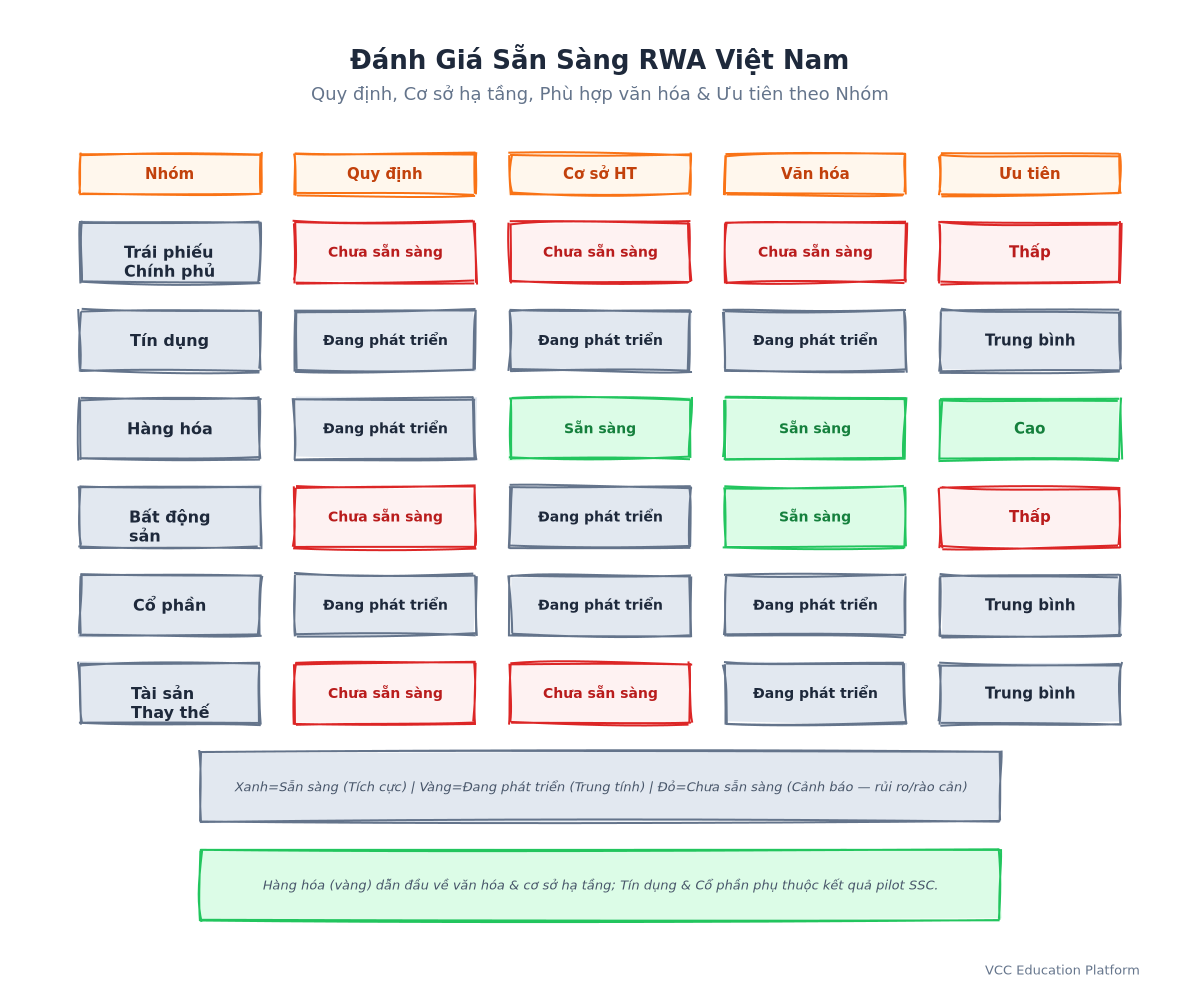
|----------|------------|----------------|--------------|----------|
| Treasuries | 🔴 | 🔴 | 🔴 | Low |
| Credit | 🟡 | 🟡 | 🟡 | Medium |
| Commodities | 🟡 | 🟢 | 🟢 | **High** |
| Real Estate | 🔴 | 🟡 | 🟢 | Low |
| Equity | 🟡 | 🟡 | 🟡 | Medium |
| Alternative | 🔴 | 🔴 | 🟡 | Medium |
🟢 Ready | 🟡 Developing | 🔴 Not Ready
---
## Conclusion
RWA taxonomy is not academic — it's operational. The category determines the legal wrapper, the oracle architecture, the regulatory perimeter, and the investor access. For Vietnamese builders and investors, **commodities (gold)** and **credit (corporate bonds)** offer the clearest near-term paths. Real estate and equity depend on SSC pilot outcomes. Treasuries and alternatives face structural regulatory barriers.
The next frontier is not more tokenization — it's interoperable standards for oracle data, cross-border legal recognition, and secondary market infrastructure. The taxonomy provides the map. The execution is what's missing.
---
*Disclaimer: This article is for educational purposes only and does not constitute investment advice. Tokenized assets carry regulatory, custody, smart contract, and market risks. Consult qualified legal and financial advisors before engaging with any RWA product.*
| Category | Regulatory | Infrastructure | Cultural Fit | Priority |
|----------|------------|----------------|--------------|----------|
| Treasuries | 🔴 | 🔴 | 🔴 | Low |
| Credit | 🟡 | 🟡 | 🟡 | Medium |
| Commodities | 🟡 | 🟢 | 🟢 | **High** |
| Real Estate | 🔴 | 🟡 | 🟢 | Low |
| Equity | 🟡 | 🟡 | 🟡 | Medium |
| Alternative | 🔴 | 🔴 | 🟡 | Medium |
🟢 Ready | 🟡 Developing | 🔴 Not Ready
---
## Conclusion
RWA taxonomy is not academic — it's operational. The category determines the legal wrapper, the oracle architecture, the regulatory perimeter, and the investor access. For Vietnamese builders and investors, **commodities (gold)** and **credit (corporate bonds)** offer the clearest near-term paths. Real estate and equity depend on SSC pilot outcomes. Treasuries and alternatives face structural regulatory barriers.
The next frontier is not more tokenization — it's interoperable standards for oracle data, cross-border legal recognition, and secondary market infrastructure. The taxonomy provides the map. The execution is what's missing.
---
*Disclaimer: This article is for educational purposes only and does not constitute investment advice. Tokenized assets carry regulatory, custody, smart contract, and market risks. Consult qualified legal and financial advisors before engaging with any RWA product.*
## Tại sao RWA Taxonomy Quan Trọng
Thị trường tokenized asset đã phát triển từ experimental pilots thành một multi-billion dollar ecosystem với live products từ Franklin Templeton, Ondo Finance, Paxos, và Centrifuge. Tuy nhiên, hầu hết analyses vẫn treat RWAs như một monolith. Chúng không phải là một khối thống nhất. Một tokenized T-bill behaves fundamentally differently từ một tokenized carbon credit hoặc một fractional real estate deed. Những differences quyết định mọi thứ: how the asset is custodied, what data feeds it needs, which regulators have jurisdiction, và whether a Vietnamese investor can legally access it.
Bài viết này cung cấp first unified framework mapping all six categories với sub-types, tokenization mechanics, oracle requirements, và regulatory classifications — plus a Vietnam-specific readiness assessment cho each category.
## The 6 Core RWA Asset Classes — Taxonomy Overview
Taxonomy của chúng tôi organizes RWAs by the nature of the underlying asset và its cash flow characteristics. Đây không phải arbitrary grouping — nó reflects how institutions actually structure, custody, và regulate these assets.
---
## Category 1: Treasuries & Sovereign Debt
Tokenized treasuries là most mature RWA category, với over $2 billion AUM (Assets Under Management) across 20+ products tracked by rwa.xyz as of 2024.
### Sub-types
- **US T-bills:** 4-week to 1-year bills, primary dealer pricing
- **EU Sovereign Bonds:** German Bunds, French OATs, Italian BTPs
- **UK Gilts:** Conventional và index-linked
- **Asian Government Bonds:** Singapore SGS, Japanese JGBs, Australian CGS
### Tokenization Structure
Almost all tokenized treasuries use **Special Purpose Vehicle (SPV)** structure. The SPV purchases the underlying bonds và issues tokens representing proportional ownership. A regulated custodian (BNY Mellon, State Street) holds the physical securities. Tokens are typically issued under SEC Regulation D (accredited investors only) hoặc Regulation S (offshore).
Franklin Templeton's BENJI fund (BENJI) takes a different approach: a 1940 Act registered money market fund, making it accessible to retail investors. Ondo Finance's OUSG uses a Reg D SPV. Matrixdock's STBT operates under MAS Singapore's regulatory sandbox.
### Key Characteristics
| Dimension | Profile |
|-----------|---------|
| Liquidity | Daily redemption windows (T+0 to T+1) |
| Yield Source | Risk-free rate benchmark (SOFR, €STR, SORA) |
| Oracle Needs | Minimal — primary dealer price feeds |
| Regulatory | MiCA ART, SEC Reg D/Reg S, MAS VCC |
| Min Investment | $100–$1,000 |
### Vietnam Context
The State Bank of Vietnam (SBV) restricts foreign currency denominated bonds cho domestic investors. VND-denominated government bonds exist but lack tokenization infrastructure. No Vietnamese entity has launched a tokenized treasury product. The regulatory gap: SBV Circular 02/2023/TT-NHNN governs foreign currency activities but does not address tokenized securities.
---
## Category 2: Credit (Private & Public)
Credit represents the largest addressable market — global private credit market exceeds $1.5 trillion, yet less than 1% is tokenized (Messari, 2024).
### Sub-types
- **Private Credit Funds:** Direct lending, mezzanine, distressed debt
- **Corporate Bonds:** Investment grade and high yield issuances
- **Structured Credit:** ABS, CLOs, mortgage-backed securities
- **Trade Finance Receivables:** Invoice financing, supply chain finance
### Tokenization Structure
Three distinct models compete:
1. **SPV-per-asset** (Centrifuge Tinlake): Each loan pool gets a bankruptcy-remote SPV. True asset isolation, high setup cost.
2. **Protocol-level pool** (Maple Finance, Goldfinch): Capital efficient but contagion risk — a default in one credit line affects the whole pool.
3. **Fund LP tokenization** (Figure/Provenance): Token represents LP interest in a 40 Act fund. Regulatory clarity, double-layer fees.
### Key Characteristics
| Dimension | Profile |
|-----------|---------|
| Liquidity | Low-medium (quarterly/annual windows, lockups common) |
| Yield Source | Credit spread + base rate |
| Oracle Needs | NAV feeds, credit rating updates, default monitoring |
| Regulatory | SEC accredited investor, AIFMD (EU), MAS accredited regimes |
| Min Investment | $1,000–$100,000+ |
### Vietnam Context
Vietnam's corporate bond market has grown rapidly (VN Corporate Bond Index ~$50B). The SSC has run pilot programs for digital bond issuance with VPBank and Techcombank (2023). However, the Law on Securities 2019 requires SSC registration for all corporate bonds, creating a bottleneck for tokenized issuance. The pilot framework is promising but not yet scaled.
---
## Category 3: Commodities
Commodities split into two fundamentally different oracle regimes: precious metals (centralized price feeds sufficient) và everything else (geographic pricing, quality grades, MRV data).
### Sub-types
- **Precious Metals:** Gold (PAXG, XAUT, XAUŌ), Silver, Platinum
- **Energy:** Crude oil, natural gas, refined products
- **Agriculture:** Grains, soft commodities, livestock
- **Carbon Credits:** Verra VCS, Gold Standard, ART/TREE credits
### Tokenization Structure
- **Metals:** Warehouse receipt tokenization. Physical bars in LBMA-approved vaults. ERC-20 tokens with proof-of-reserve attestations.
- **Energy/Ag:** Quality/location-specific. Requires grade certificates, storage proofs, geographic pricing.
- **Carbon:** Registry bridging (Verra → Toucan → on-chain). MRV (Measurement, Reporting, Verification) data is the oracle.
### Key Characteristics
| Dimension | Profile |
|-----------|---------|
| Liquidity | Medium (gold: high; carbon: medium; energy: low) |
| Yield Source | Price appreciation + storage yield (carbon: credit retirement value) |
| Oracle Needs | **CRITICAL** — spot price, proof-of-reserve, MRV data |
| Regulatory | CFTC (US), MiCA (EU), MAS (SG) |
| Min Investment | $50–$100 |
### Vietnam Context
**Gold is Vietnam's strongest RWA opportunity.** Vietnamese households hold an estimated 300–500 tons of SJC gold bars (99.99% purity) as a cultural store of value. Decree 24/2024/ND-CP regulates gold trading businesses. A VND-denominated, locally vaulted gold token would tap into existing cultural behavior.
Carbon credits offer export potential: Vietnam's mangrove forests (Mekong Delta, Can Gio) represent 10M+ tons CO2e potential. However, no tokenization framework exists. The revised Law on Environmental Protection 2020 enables carbon market development but implementing decrees are pending.
---
## Category 4: Real Estate
Real estate tokenization does not solve illiquidity — secondary market volumes remain below 1% annually (Green Street Advisors, 2023). What it does solve is access fragmentation and administrative overhead.
### Sub-types
- **Commercial:** Office, retail, industrial, multifamily
- **Residential:** Single-family rentals, condo units
- **REITs:** Public and private real estate investment trusts
- **Development Projects:** Pre-construction, value-add repositioning
### Tokenization Structure
Four models with different legal/liquidity profiles:
1. **Equity in SPV/LLC** (RealT — Series LLC per property): Securities law applies. Rental income = dividends. Passive ownership.
2. **Debt/Revenue Participation** (Da Nang pilot): Not equity. Token holders receive revenue share. Different regulatory treatment.
3. **REIT Share Tokenization:** Regulated fund, potential public market access. No live Vietnamese examples yet.
4. **NFT Deed:** Legal enforceability untested. County recorders don't recognize blockchain transfers (Harvard Law, 2024).
### Key Characteristics
| Dimension | Profile |
|-----------|---------|
| Liquidity | Low (real estate illiquidity persists on-chain) |
| Yield Source | Rental income + capital appreciation |
| Oracle Needs | Property valuation, rental verification, occupancy data |
| Regulatory | SEC (US), Property law (title), MiCA (EU), Stamp duty |
| Min Investment | $50–$500 |
### Vietnam Context
Foreign ownership is capped at 30% per condo building, 10% per landed project (Law on Housing 2014, amended 2023). The 2023 Law on Real Estate Business established a REIT framework but no REITs have listed. Da Nang's "Digital Real Estate Platform" pilot (2023) tokenizes hotel revenue rights — a revenue participation model avoiding foreign ownership limits. This is the most viable near-term path for Vietnam.
---
## Category 5: Equity (Private & Public)
Private equity tokenization dominates public equity in volume. The value chain — Issuance → Compliance/KYC → Corporate Actions → Secondary Trading → Cap Table Sync — remains fragmented across platforms.
### Sub-types
- **Private Company Shares:** Pre-IPO, venture-backed, growth equity
- **Public Equities:** Fractional shares via transfer agent integration
- **Fund Units:** VC/PE fund LP interests
- **Employee Equity:** ESOP tokenization, secondary liquidity
### Tokenization Structure
- **Private:** Reg D/Reg A+/Reg CF issuance. Cap table on-chain. Transfer agent (Securitize, Tokensoft) handles compliance.
- **Public:** Transfer agent + CSD integration. Tokens mirror existing share registry. EU DLT Pilot Regime enables CSD-native settlement (T+0).
- **Funds:** LP interest tokenization. VCC (Singapore) or LP (Delaware) wrappers.
### Key Characteristics
| Dimension | Profile |
|-----------|---------|
| Liquidity | Private: very low (lockups); Public: high (fractional) |
| Yield Source | Dividends + capital gains |
| Oracle Needs | Cap table sync, corporate actions, voting, dividends |
| Regulatory | SEC Reg D/A+/CF, Prospectus Reg (EU), CSRC (CN), SSC (VN) |
| Min Investment | $10–$1,000 |
### Vietnam Context
The SSC's "Digital Securities Pilot" (2023–2025) targets UPCoM (Unlisted Public Companies Market) — 200+ companies with low liquidity. VSDC (Vietnam Securities Depository) as CSD can anchor on-chain cap tables. But SSC requires VND denomination and VN KYC, limiting foreign capital. The pilot is the most concrete regulatory sandbox for equity tokenization in Southeast Asia.
---
## Category 6: Alternative Assets
"Alternative" is a residual category — everything that doesn't fit the first five. No common structure exists. The taxonomy value lies in identifying which sub-types have recurring cash flows vs. appreciation-only.
### Sub-types
- **Art & Collectibles:** Masterworks (SEC Reg A+), NFT fractional
- **Intellectual Property:** Music royalties (Royalty Exchange), patent royalties
- **Infrastructure:** Toll roads, solar farms, data centers — revenue rights
- **Litigation Finance:** Case funding, settlement claims
- **Insurance-Linked Securities (ILS):** Cat bonds, parametric triggers
- **Wine/Whisky:** Vint, Vinovest — physical storage, insurance, provenance
### Tokenization Structure
- **Cash-flow assets** (royalties, ILS, infrastructure): Fund/SPV model with cash flow assignment.
- **Appreciation-only** (art, wine, collectibles): SPV equity model or NFT + legal wrapper hybrid.
- **Hybrid** (IP with both): Bespoke structures per asset.
### Key Characteristics
| Dimension | Profile |
|-----------|---------|
| Liquidity | Very low to medium |
| Yield Source | Royalty streams, appreciation, insurance premiums, harvest yield |
| Oracle Needs | **Very High** — provenance, cash flow verification, parametric triggers |
| Regulatory | Highly jurisdiction-specific, often falls through cracks |
| Min Investment | $100–$10,000+ |
### Vietnam Context
Vietnam's software outsourcing industry ($5B+ exports) and growing content creator economy create IP royalty tokenization potential. Infrastructure revenue rights (BOT toll roads, solar farms under DPPA) have verifiable cash flows and existing legal frameworks for assignment. Art market is nascent (no major auction house presence). Wine: Dalat wine emerging but no secondary market.
---
## Comparative Framework: 6 Categories Side-by-Side
The table below synthesizes data from 15+ primary sources into a single decision matrix. **Oracle complexity — not liquidity or yield — is the hidden differentiator** because it determines operational cost and manipulation surface.
| Dimension | Treasuries | Credit | Commodities | Real Estate | Equity | Alternative |
|-----------|------------|--------|-------------|-------------|--------|-------------|
| Liquidity | ★★★★★ | ★★☆☆☆ | ★★★☆☆ | ★☆☆☆☆ | ★★★★☆ (pub) / ★☆☆☆☆ (priv) | ★★☆☆☆ |
| Yield Profile | Risk-free | Credit spread | Spot + carry | Rent + appreciation | Dividends + growth | Highly variable |
| Oracle Complexity | Low | Medium | **High** | Medium | Medium | **Very High** |
| Regulatory Clarity | High | Medium | Medium | Low-Medium | Medium | Low |
| Min Investment | $100 | $1,000+ | $50 | $100 | $10 | $500+ |
| Vietnam Readiness | Low | Medium | **High (gold)** | Low | Medium (pilot) | Low |
---
## Tokenization Mechanics by Category
Four structures cut across asset categories. The choice determines legal clarity, liquidity potential, and investor access.
| Structure | Categories Using It | Legal Clarity | Liquidity Potential |
|-----------|---------------------|---------------|---------------------|
| SPV/Direct Asset | Treasuries, Commodities, some RE | High | Medium-High |
| Fund/LP Tokenization | Credit, Private Equity, some RE | High (40 Act) | Low-Medium |
| Transfer Agent/CSD | Public Equity | Very High | High |
| Hybrid NFT+Legal | Art, Collectibles, IP | Low | Low |
**SPV/Direct Asset:** Asset held in bankruptcy-remote vehicle. Token = direct claim. Used for treasuries (Ondo, Franklin Templeton), gold (Paxos, Matrixdock), some real estate.
**Fund/LP Tokenization:** Token = LP interest in a fund. Regulatory clarity via 40 Act (US) or VCC (Singapore). Used for credit funds, PE funds, some REITs.
**Transfer Agent/CSD Integration:** Token mirrors existing share registry. Corporate actions (splits, dividends) sync off-chain → on-chain. Used for public equities, EU DLT Pilot.
**Hybrid NFT + Legal Wrapper:** NFT represents ownership + legal contract assigns rights. Used for art (Masterworks), collectibles, IP royalties.
---
## Common Misconceptions in RWA Classification
1. **"All RWAs are securities"** — False. Commodities (gold) often classified as commodities under CFTC jurisdiction, not SEC. MiCA distinguishes ART (Asset-Referenced Tokens) từ financial instruments.
2. **"Tokenization = instant liquidity"** — False. Legal transfer restrictions (Reg D lockups, accredited investor checks, foreign ownership caps) persist on-chain. Secondary markets are nascent.
3. **"One oracle fits all"** — False. Carbon credits need MRV data; Treasuries need dealer prices; Real estate needs appraisals. Oracle complexity varies by 100x across categories.
4. **"Regulatory clarity exists"** — False. Most jurisdictions still classifying. MiCA ART is the closest to a comprehensive framework. Vietnam has conflicting signals: SBV anti-crypto, SSC pro-digital securities.
---
## FAQ
**What is the difference between tokenized treasuries and tokenized credit?**
Treasuries are sovereign debt with risk-free yields; credit encompasses corporate/private debt with credit spreads. Different risk, regulation, oracle needs.
**Can Vietnamese investors access tokenized RWAs?**
Currently limited. SBV restricts crypto payments; SSC pilots digital securities. VN investors access via offshore entities or future regulated frameworks.
**Which RWA category has the highest oracle risk?**
Commodities (especially carbon credits) and Alternative assets require specialized, often non-standardized data feeds — manipulation risk is highest.
**What legal structure is used for tokenized real estate?**
Typically an LLC or SPV holds title; tokens represent membership interests. Direct deed tokenization is rare due to recording office requirements.
**How does MiCA classify the 6 RWA categories?**
Treasuries/Credit → ART (Asset-Referenced Tokens) or EMT (E-Money Tokens). Commodities/Real Estate/Equity/Alternative → Financial instruments under MiFID II or ART depending on structure.
---
## Vietnam Readiness Heatmap
| Category | Regulatory | Infrastructure | Cultural Fit | Priority |
|----------|------------|----------------|--------------|----------|
| Treasuries | 🔴 | 🔴 | 🔴 | Low |
| Credit | 🟡 | 🟡 | 🟡 | Medium |
| Commodities | 🟡 | 🟢 | 🟢 | **High** |
| Real Estate | 🔴 | 🟡 | 🟢 | Low |
| Equity | 🟡 | 🟡 | 🟡 | Medium |
| Alternative | 🔴 | 🔴 | 🟡 | Medium |
🟢 Ready | 🟡 Developing | 🔴 Not Ready
---
## Conclusion
RWA taxonomy is not academic — it's operational. The category determines the legal wrapper, the oracle architecture, the regulatory perimeter, and the investor access. For Vietnamese builders and investors, **commodities (gold)** and **credit (corporate bonds)** offer the clearest near-term paths. Real estate and equity depend on SSC pilot outcomes. Treasuries and alternatives face structural regulatory barriers.
The next frontier is not more tokenization — it's interoperable standards for oracle data, cross-border legal recognition, and secondary market infrastructure. The taxonomy provides the map. The execution is what's missing.
---
*Disclaimer: This article is for educational purposes only and does not constitute investment advice. Tokenized assets carry regulatory, custody, smart contract, and market risks. Consult qualified legal and financial advisors before engaging with any RWA product.*