
The RWA secondary market is where tokenized real-world assets change hands after primary issuance. Unlike crypto-native tokens that trade on permissionless DEXs 24/7, tokenized treasuries, corporate bonds, and private credit funds trade on regulated Alternative Trading Systems (ATS) — venues that look like exchanges but operate under a distinct legal framework. For traders and market makers, understanding this structure is the difference between accessing liquidity and staring at empty order books.
What Is an RWA Secondary Market?
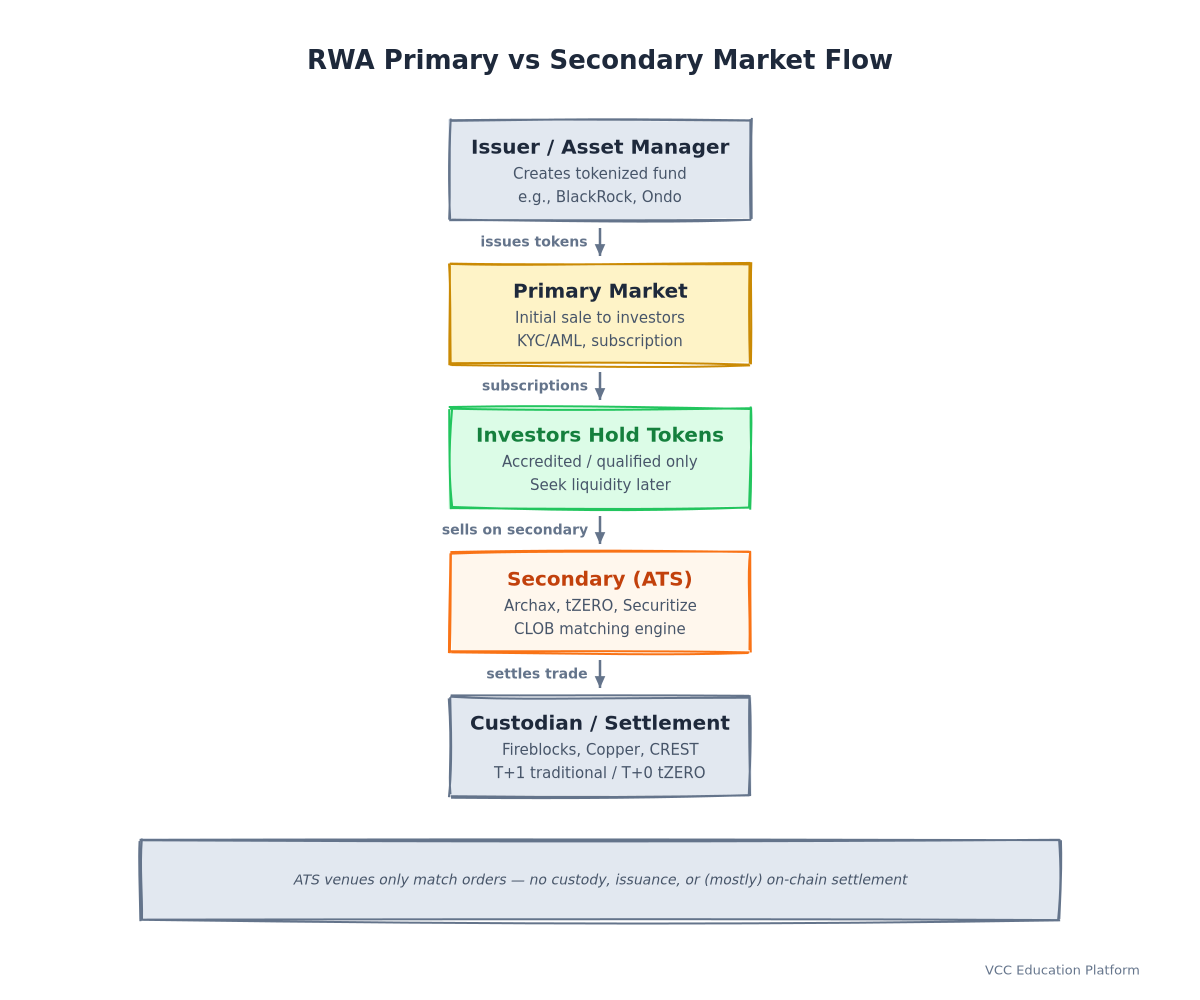
When an asset manager tokenizes a money market fund (like BlackRock's BUIDL) or a private credit fund (like Maple's pools), the initial sale to investors is the primary market. The secondary market is where those investors sell to each other — ideally without waiting for fund redemptions.
In traditional finance, this happens on stock exchanges or over-the-counter desks. For tokenized RWAs, the infrastructure is newer and more fragmented. As of Q3 2024, three venues dominate: Archax (UK), tZERO (US), and Securitize Markets (US). All three operate as ATS venues — not national securities exchanges.
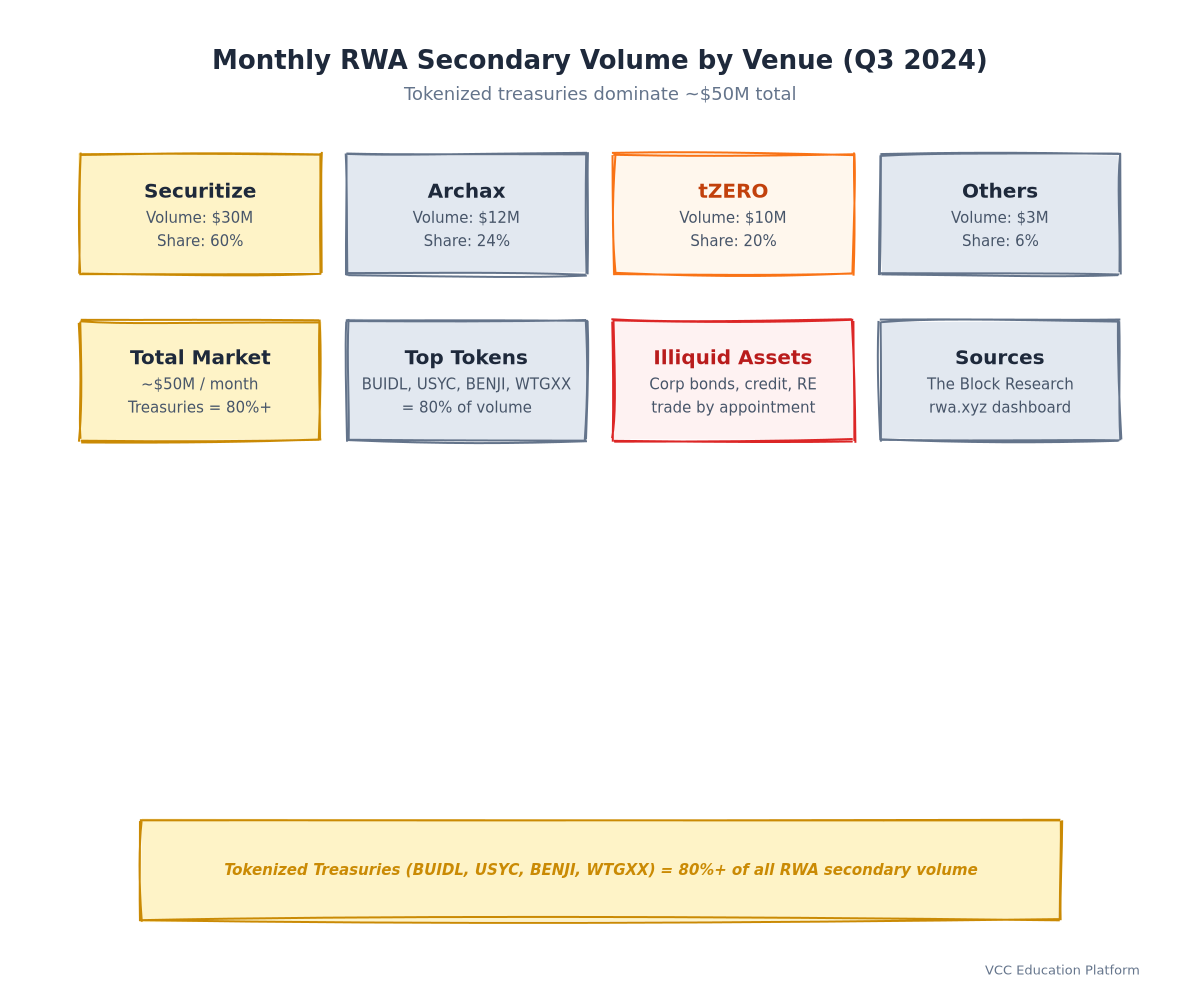
The liquidity picture is sobering. The Block Research estimates ~$50M monthly volume across all RWA ATS venues combined. For context, a single mid-cap crypto token often does that in an hour. But volume concentration tells the real story: 80%+ of that $50M sits in the top three tokenized treasury products (BUIDL, USYC, BENJI). Everything else — tokenized corporate bonds, private credit, real estate — trades by appointment.
The ATS Framework: Why These Venues Aren't Traditional Exchanges
An Alternative Trading System (ATS) is an SEC-regulated venue that matches buyers and sellers but cannot list securities, set listing standards, or exercise self-regulatory authority. Think of it as a "matching engine with a broker-dealer license."
Legally, an ATS must:
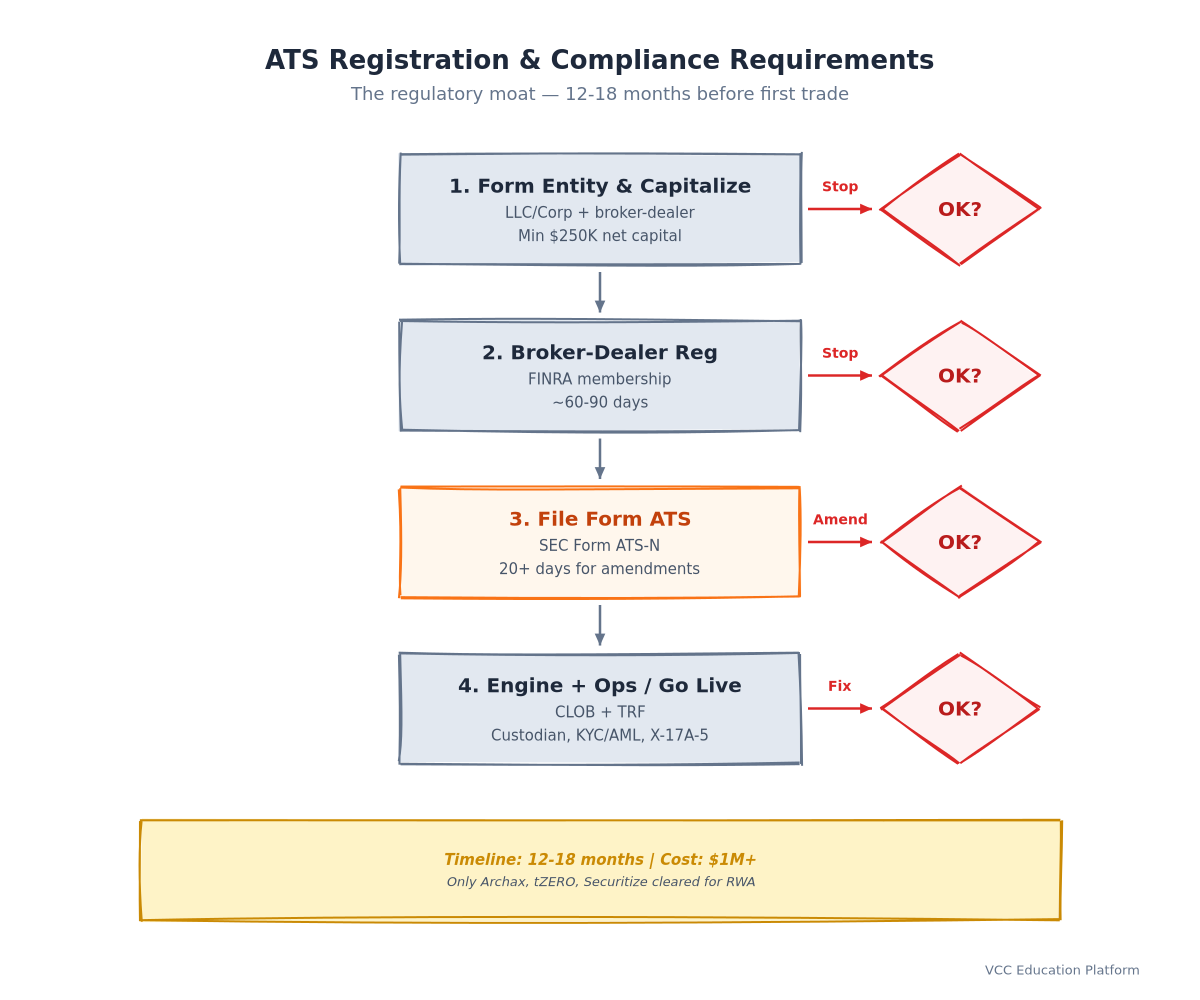
- Register as a broker-dealer with FINRA
- File Form ATS with the SEC (20+ business days for amendments)
- Operate under Regulation ATS (17 CFR 242.300-301)
- Report trades to a Trade Reporting Facility (TRF)
This framework was designed in the 1990s for institutional dark pools — not for 24/7 programmable assets. The result: a regulatory moat. Only well-capitalized firms can afford the compliance burden. Archax, tZERO, and Securitize Markets form an effective oligopoly. New entrants face 12-18 months of legal work before matching their first order.
Critical distinction: ATS venues match orders. They don't custody assets (that's a separate custodian), they don't issue tokens (that's the issuance platform), and they don't settle on-chain (mostly — tZERO is the exception). The ATS is purely the meeting place.
Venue Deep Dive: Archax — The Institutional Distribution Rail
Regulatory status: UK FCA-authorised Multilateral Trading Facility (MTF), FRN 937292. Functionally equivalent to a US ATS but under UK regime.
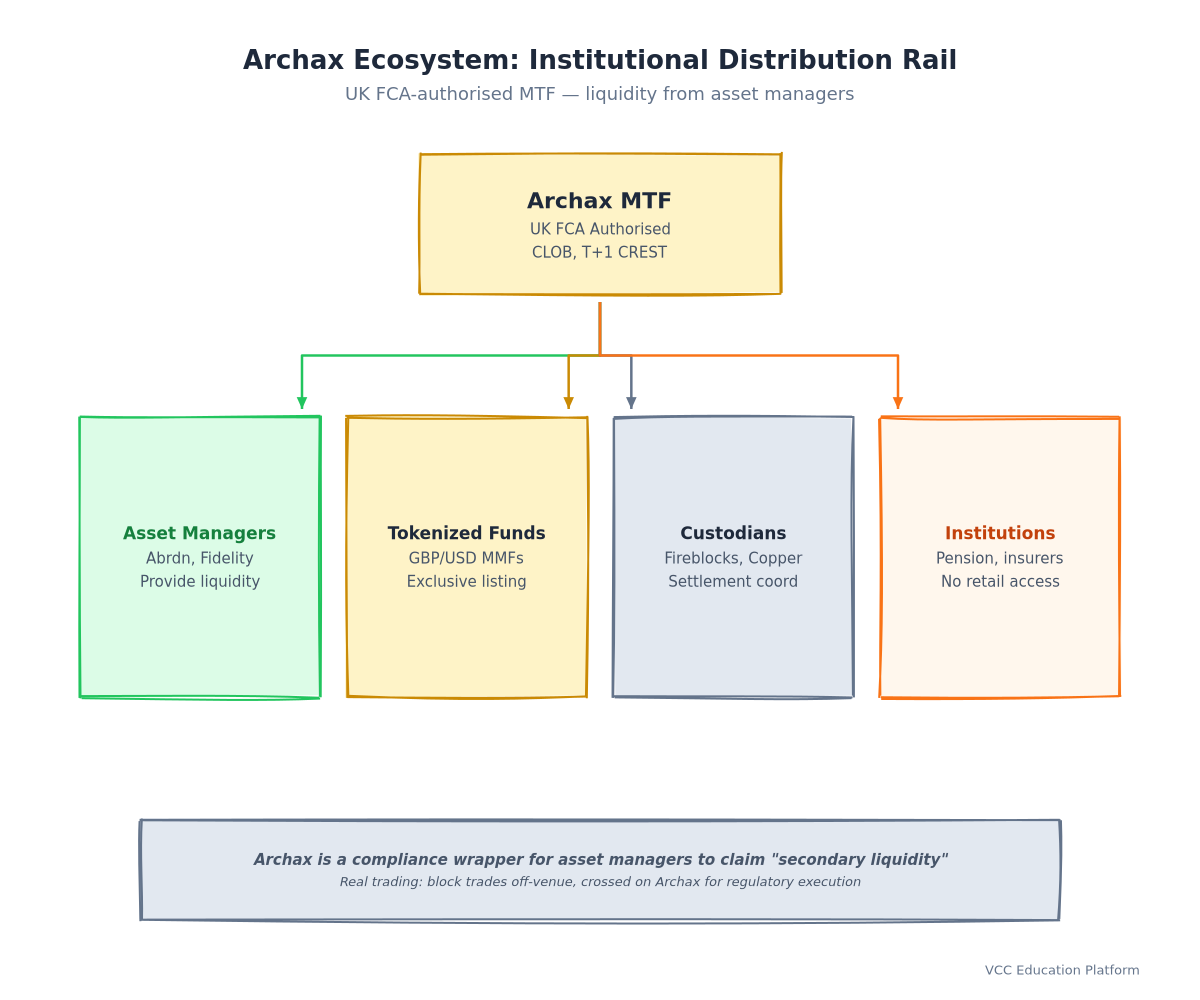
What makes Archax different: It doesn't chase retail flow. Archax's liquidity comes from asset managers — Abrdn, Fidelity International, and others — using the venue as a distribution rail for their tokenized money market funds. When Abrdn launches a tokenized GBP treasury fund, Archax is the designated secondary venue. The asset manager provides the initial liquidity; Archax provides the regulated venue.
Trading model: Central limit order book (CLOB), price-time priority. UK market hours (8:00-16:30 GMT), T+1 settlement via traditional rails (CREST/Euroclear). No blockchain settlement.
Fees: Not publicly disclosed. Industry sources suggest 5-10 bps for institutional tickets, volume-tiered.
Investor base: Professional/institutional only. No retail access. Onboarding requires full KYC/AML, accredited/professional investor verification, and often a custodian relationship (Fireblocks, Copper, etc.).
Original insight: Archax is not really a "trading venue" in the exchange sense. It's a compliance wrapper that lets asset managers say "our tokenized fund has secondary liquidity" to their LPs. The actual trading is often block trades negotiated off-venue, then crossed on Archax for regulatory execution.
Venue Deep Dive: tZERO — The Blockchain-Native Settler
Regulatory status: tZERO Markets, LLC — SEC-registered broker-dealer (CRD# 283726) with Form ATS-N on file. Subsidiary of tZERO Group Inc (OTCQB: TZRO).
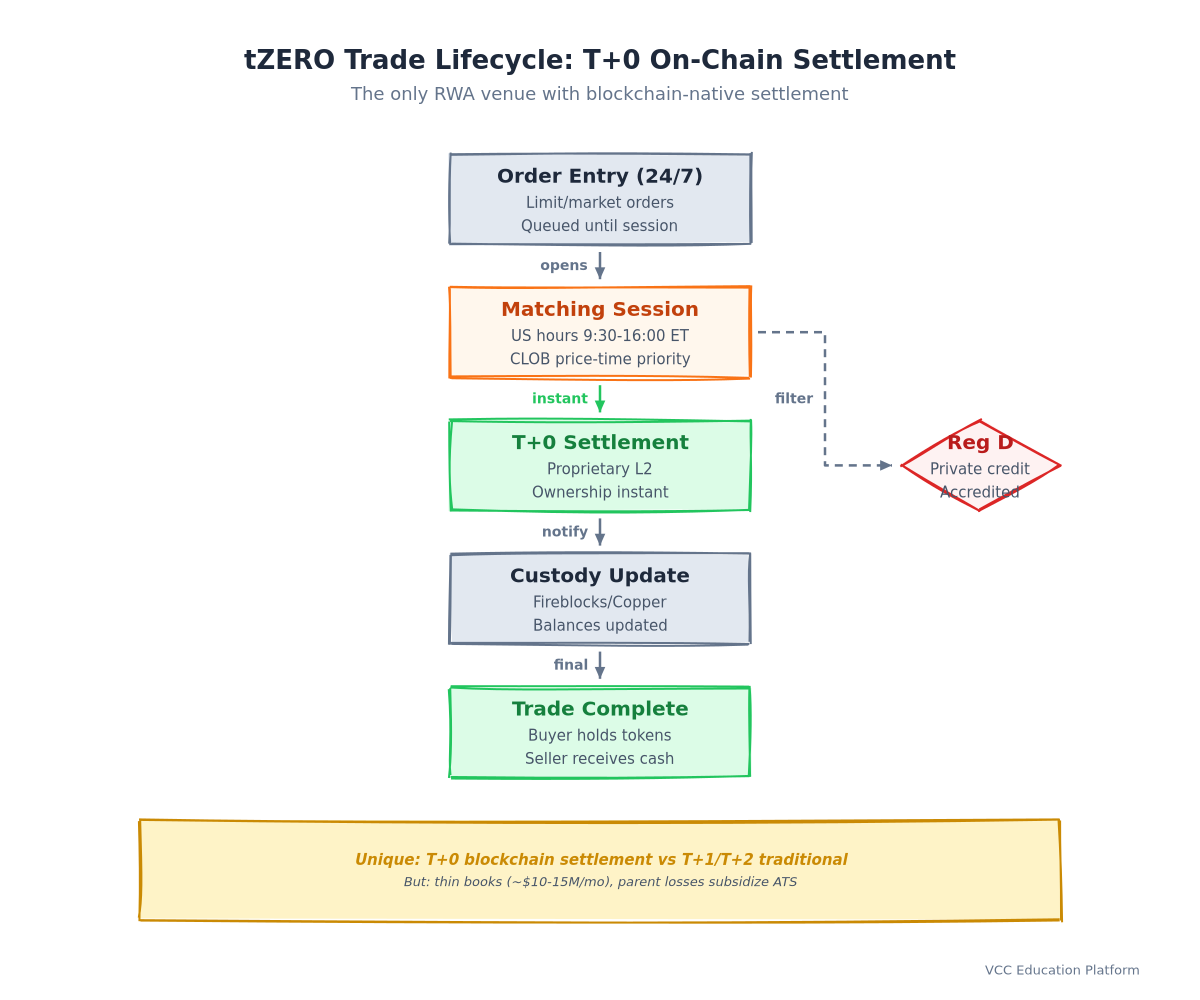
What makes tZERO different: T+0 blockchain settlement. While Archax and Securitize Markets use traditional T+1/T+2 rails, tZERO settles trades on-chain via their proprietary blockchain (originally Ravencoin-based, now Ethereum L2). When a trade matches, ownership transfers instantly — no DTCC, no CREST, no custodian reconciliation lag.
Product focus: Reg D 506(c) private placements, Reg A+ qualified offerings, and Reg S offshore securities. This means tZERO's inventory skews toward private credit, real estate, and alternative assets — not tokenized treasuries.
Trading model: CLOB during US market hours (9:30-16:00 ET), but 24/7 order entry. Orders queue and match at next session open.
Fees: ~10-15 bps reported, plus blockchain gas fees for settlement.
Volume reality: Self-reported $10-15M monthly across all securities. OTC Markets Group's 2024 analysis flags sustainability concerns — tZERO Group's public financials show consistent operating losses, with the ATS subsidized by the parent.
Original insight: tZERO solved the technical settlement problem (T+0 on-chain) but not the economic liquidity problem. Their venue is technically superior for settlement finality, but without issuer-driven flow (unlike Securitize) or asset-manager distribution (unlike Archax), the order book stays thin.
Venue Deep Dive: Securitize Markets — The Volume Leader by Default
Regulatory status: Securitize Markets, LLC — SEC-registered broker-dealer (CRD# 297713), Form ATS filed 2020, amended 2023.
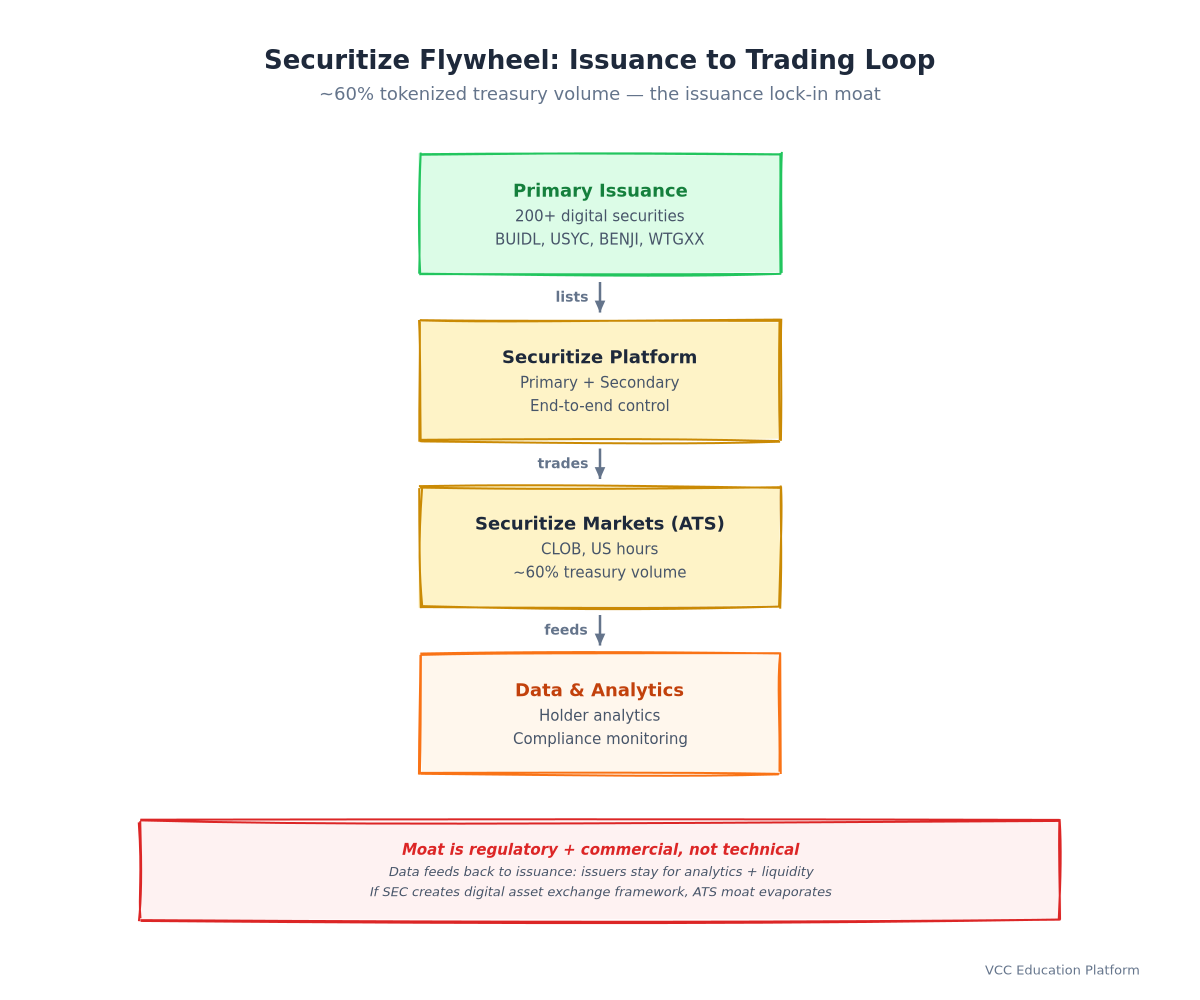
What makes Securitize Markets different: They control the primary issuance platform (Securitize). When an issuer tokenizes through Securitize, the path of least resistance for secondary trading is Securitize Markets. This "issuance-to-trading flywheel" gives them ~60% market share of tokenized treasury secondary volume (rwa.xyz data, Q3 2024).
Key listings: BUIDL (BlackRock), USYC (Ondo), BENJI (Franklin Templeton), WTGXX (WisdomTree) — the four horsemen of tokenized treasuries.
Trading model: CLOB, US market hours, T+1/T+2 settlement via traditional rails. No blockchain settlement.
Fees: ~5-8 bps for tokenized treasuries, tiered by volume. Market maker programs exist for designated LPs.
Investor base: Accredited investors (Reg D) and qualified purchasers (Reg A+). Onboarding via Securitize's KYC/AML pipeline — streamlined if you already passed primary issuance KYC.
Original insight: Securitize Markets' moat is regulatory and commercial. They own the issuer relationship at primary issuance. The ATS is a retention tool: "tokenize with us, get secondary liquidity included." Competing on matching engine tech alone won't displace them.
Order Book vs AMM: Why RWAs Chose CLOBs
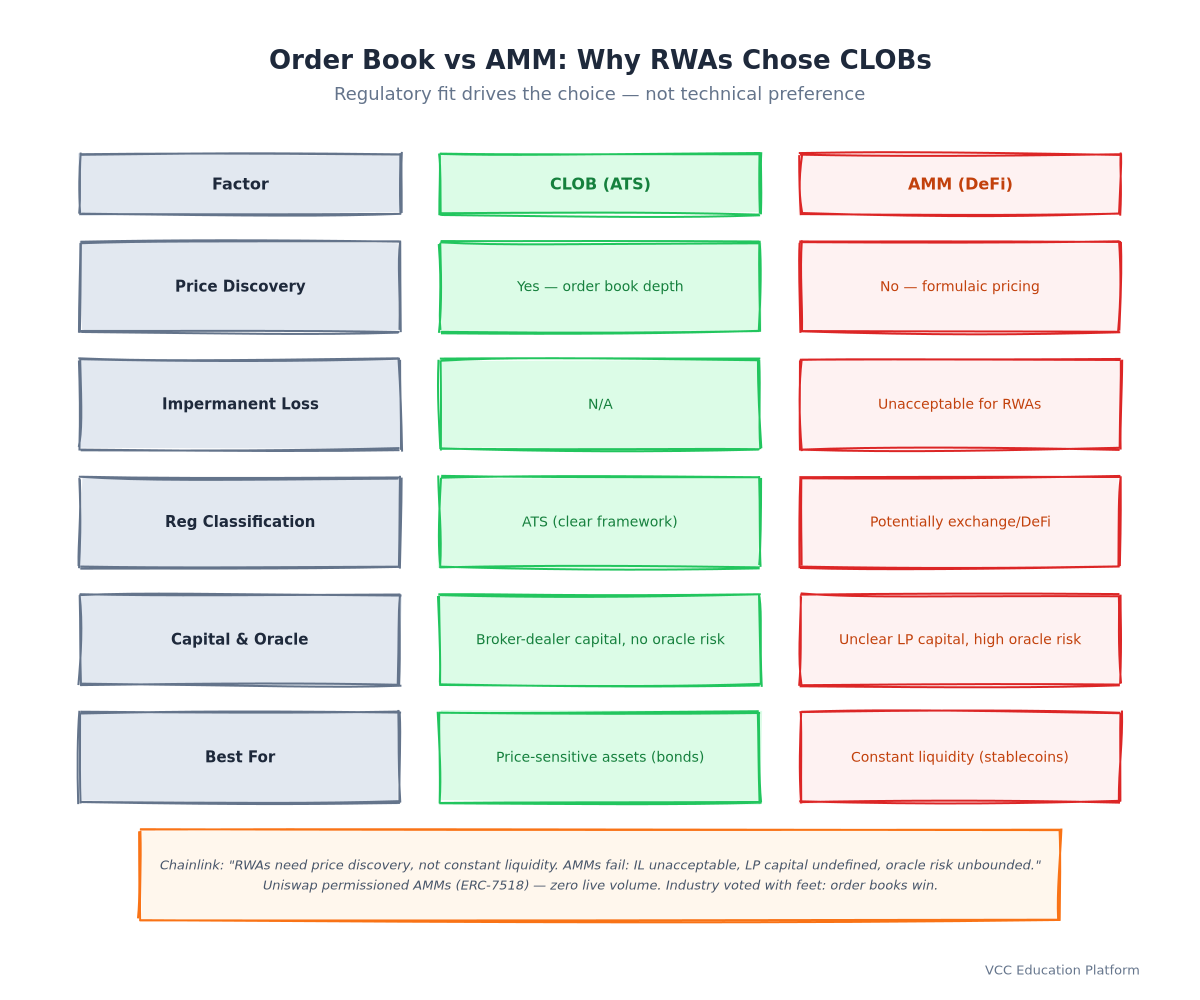
Every major RWA venue uses a central limit order book (CLOB) — not an Automated Market Maker (AMM). This isn't accidental.
| Factor | CLOB (ATS) | AMM (DeFi) |
|---|---|---|
| Price discovery | Yes — order book shows depth | No — formulaic pricing |
| Impermanent loss | N/A | Unacceptable for stable-value RWAs |
| Regulatory classification | ATS (clear framework) | Potentially "exchange" or unregistered DeFi |
| Capital requirements | Broker-dealer net capital rule | Unclear for LPs |
| Oracle risk | None (market prices) | High (manipulation vectors) |
Chainlink Research (2024) summarizes: "RWAs require price discovery, not constant liquidity. AMMs fail because impermanent loss is unacceptable for stable assets, regulatory capital for LPs is undefined, and oracle manipulation risk is unbounded."
Uniswap Labs has proposed "permissioned AMMs" via ERC-7518 — identity-gated liquidity pools with KYC'd LPs. But as of 2024, zero live volume. The industry has voted with its feet: order books win for RWAs because they fit the existing ATS framework.
Fee Comparison: What It Actually Costs to Trade
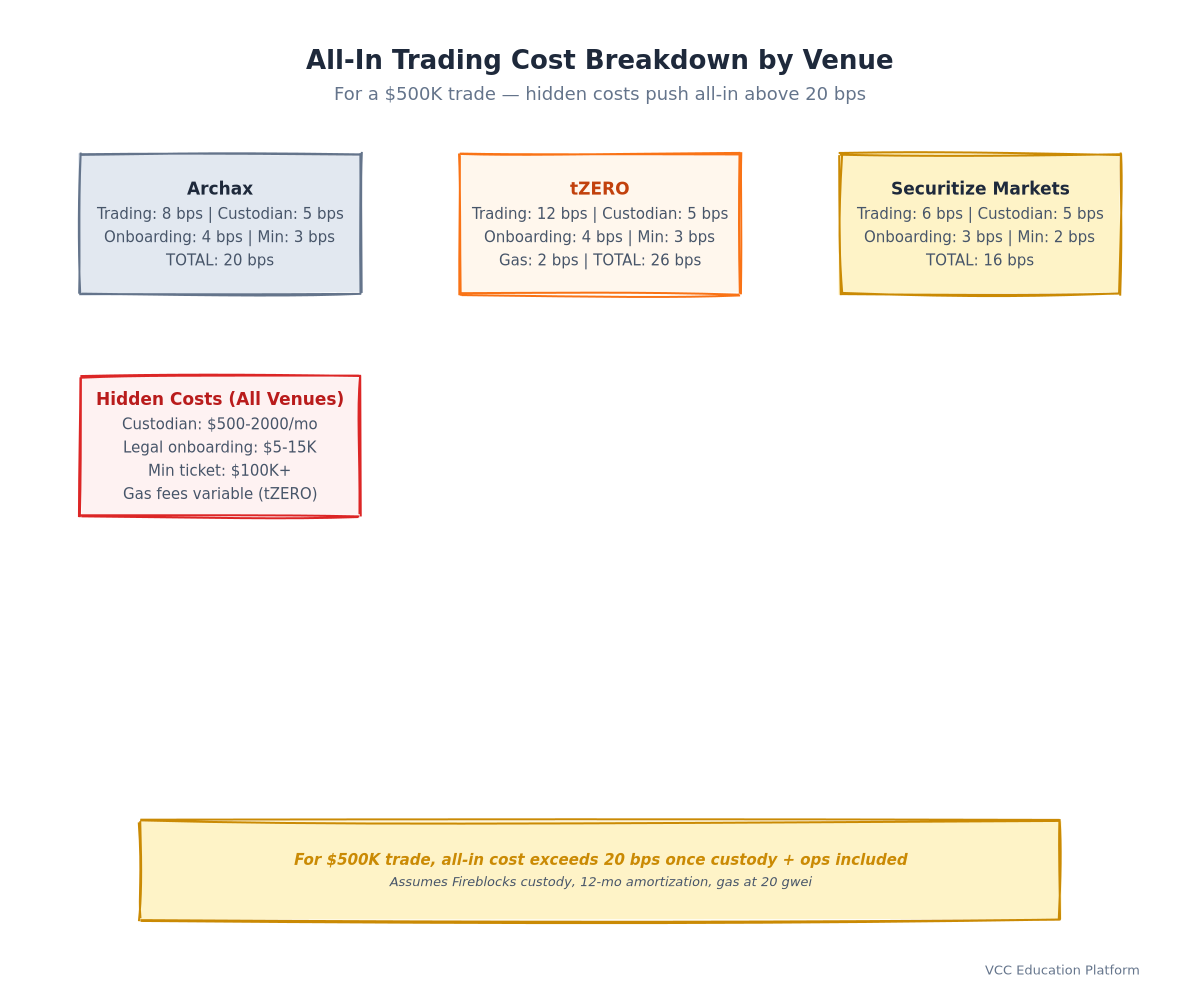
| Venue | Tokenized Treasuries | Private Credit / Alt Assets | Settlement | Notes |
|---|---|---|---|---|
| Archax | 5-10 bps (est.) | 10-15 bps (est.) | T+1 (CREST) | Volume tiers, institutional only |
| tZERO | N/A (few treasuries) | 10-15 bps + gas | T+0 (on-chain) | Gas fees variable |
| Securitize Markets | 5-8 bps | 10-20 bps | T+1/T+2 | Market maker rebates available |
Hidden costs: Custodian fees (Fireblocks: ~$500-2000/mo + per-tx), onboarding legal review ($5-15K), minimum ticket sizes (often $100K+). For a $500K trade, all-in cost can exceed 20 bps once custody and ops are included.
Settlement Cycles & Operational Hours
| Venue | Settlement | Trading Hours | Order Entry |
|---|---|---|---|
| Archax | T+1 (UK) | 8:00-16:30 GMT | Session only |
| tZERO | T+0 (on-chain) | 9:30-16:00 ET | 24/7 (queued) |
| Securitize Markets | T+1/T+2 (US) | 9:30-16:00 ET | Session only |
Practical implication: If you need intraday liquidity or same-day settlement, tZERO is the only option — but only for its listed securities (mostly private credit/Reg D). For tokenized treasuries (BUIDL, USYC), you're on T+1 regardless of venue.
How to Choose the Right Venue: A Decision Framework
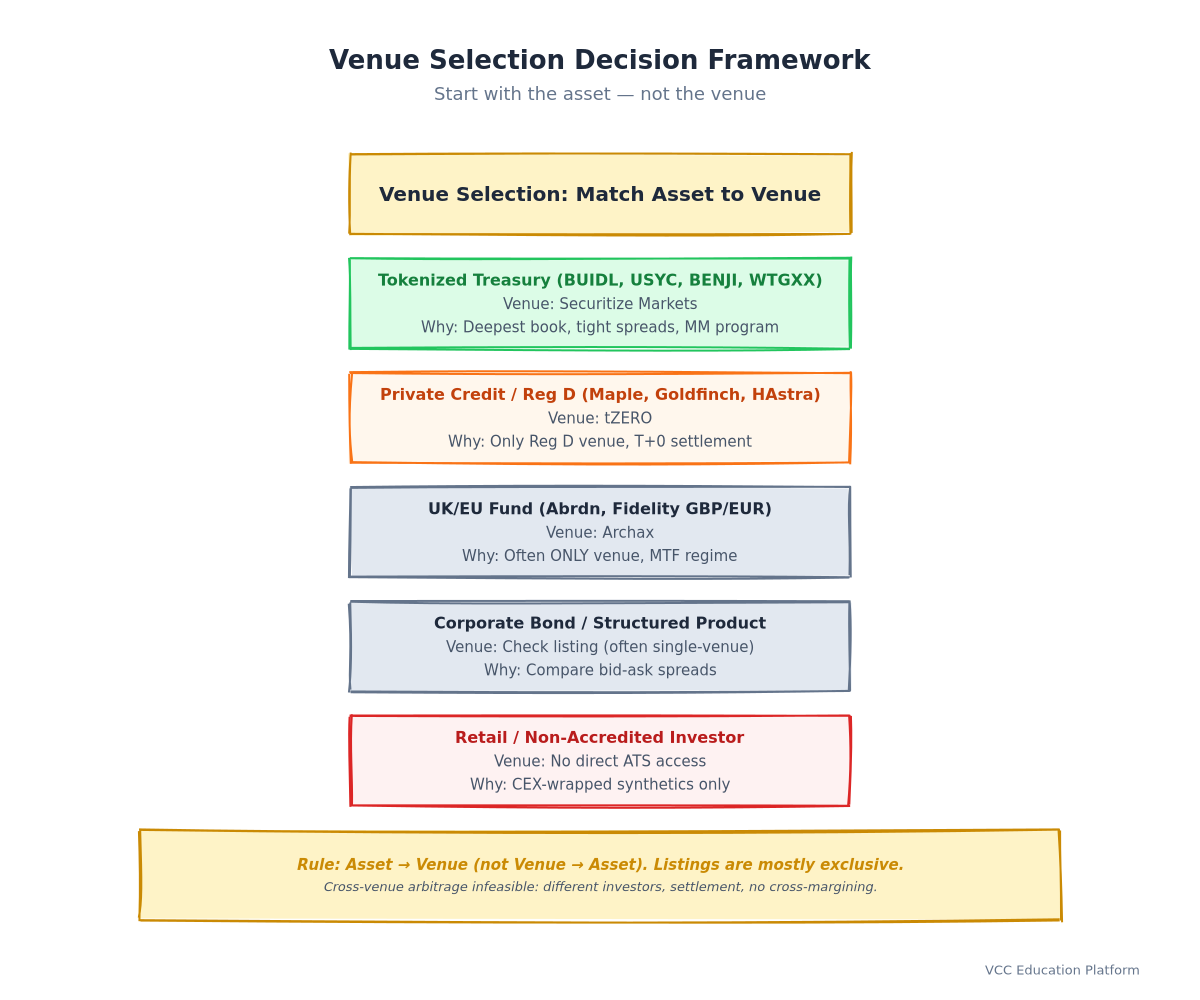
Start with the asset, not the venue.
- Tokenized Treasury (BUIDL, USYC, BENJI, WTGXX) → Securitize Markets. Deepest order book, tightest spreads, most market makers. Only venue where you can reasonably expect to fill $1M+ without moving the market.
- Tokenized Corporate Bond / Structured Product → Check where it's listed. Often exclusive to one venue. If multi-listed, compare bid-ask spreads — they vary wildly.
- Private Credit / Reg D Fund (Maple, Goldfinch, HAstra) → tZERO. Only venue with meaningful Reg D secondary flow and T+0 settlement. Accept thinner order books.
- UK/EU Asset Manager Fund (Abrdn, Fidelity GBP/ EUR funds) → Archax. Often the only venue where these trade.
- Need T+0 Settlement → tZERO (if your asset trades there). Otherwise, not available.
- Retail / Non-Accredited Investor → None of the above. Reg A+ qualified offerings can trade to non-accredited on Securitize Markets, but in practice, onboarding friction makes this theoretical.
Vietnam Access Considerations: The Two-Tier Reality
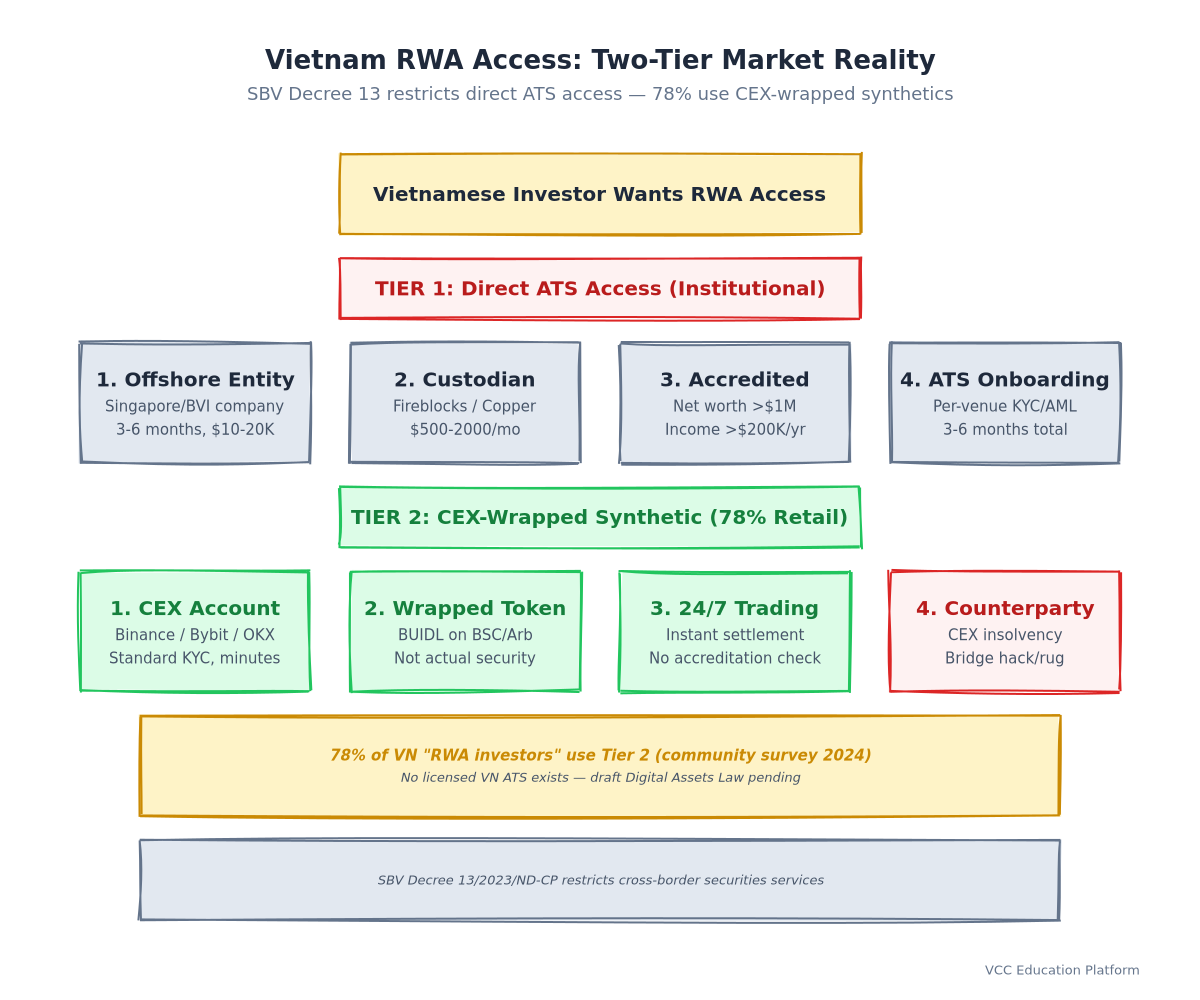
For Vietnamese traders, the RWA secondary market exists in two parallel universes:
Tier 1 — Direct ATS Access (Institutional only):
- Requires offshore entity + foreign custodian + accredited investor status
- No Vietnamese broker-dealer connects to Archax/tZERO/Securitize Markets
- SBV Decree 13/2023/ND-CP restricts cross-border securities services
- Practical path: Singapore/BVI entity → Fireblocks/Copper → ATS onboarding (3-6 months, $50K+ setup)
Tier 2 — CEX-Wrapped Synthetic Access (Retail reality):
- Binance, Bybit, OKX list wrapped versions (e.g., BUIDL on Ethereum, bridged to BSC)
- Trade 24/7, no accreditation check, T+0 on-chain
- But: You're trading a wrapper, not the underlying security. Counterparty = CEX + bridge operator. No regulatory protection under US/UK securities law.
- 78% of Vietnamese "RWA investors" use this route (community survey, 2024)
The gap: No licensed Vietnamese ATS exists. Until the State Bank of Vietnam issues a digital asset sandbox license for secondary trading (draft Digital Assets Law under consultation), Tier 1 remains offshore-only.
FAQ
Q: What is the difference between an ATS and a traditional exchange? A: An ATS matches orders but cannot list securities, set listing standards, or exercise self-regulatory authority. Exchanges (NYSE, NASDAQ) have full SRO powers and listing authority. ATS venues are regulated under Reg ATS; exchanges under Section 6 of the Exchange Act.
Q: Can retail investors trade on Archax, tZERO, or Securitize Markets? A: Practically, no. All three require accredited/professional investor verification. Reg A+ securities theoretically allow non-accredited secondary trading on Securitize Markets, but onboarding requirements (KYC, custodian, suitability) make this inaccessible to typical retail.
Q: What are the settlement times for RWA trades? A: Archax: T+1 (UK). Securitize Markets: T+1/T+2 (US). tZERO: T+0 via blockchain (only venue with instant settlement). No venue offers T+0 for tokenized treasuries currently.
Q: How do Reg A+ and Reg D affect secondary trading? A: Reg A+ securities are freely tradable after qualification (wider investor pool). Reg D 506(c) securities are restricted — 1-year hold under Rule 144, then only to accredited investors via Section 4(a)(7). This permanently limits Reg D secondary liquidity.
Q: Which venue has the best liquidity for tokenized treasuries? A: Securitize Markets — ~60% market share, deepest order books for BUIDL/USYC/BENJI/WTGXX, active market maker programs.
Q: Why don't RWA venues use AMMs like Uniswap? A: Impermanent loss is unacceptable for stable-value assets, LP regulatory capital requirements are undefined, and oracle manipulation risk is high. Order books fit the existing ATS regulatory framework; AMMs do not.
Q: Can I arbitrage between Archax, tZERO, and Securitize Markets? A: Theoretically yes, practically no. Different investor bases (UK vs US), different listed securities, no cross-venue margining, and settlement timing mismatches (T+0 vs T+1) make arbitrage operationally infeasible for most participants.
Key Takeaways
- The RWA secondary market is not a market — it's three fragmented ATS venues with minimal interoperability.
- Securitize Markets leads on volume because they control primary issuance distribution, not because their matching engine is superior.
- tZERO has the best tech (T+0 settlement) but the thinnest liquidity — a classic "better mousetrap" problem.
- Archax is an institutional distribution rail, not a trading venue — liquidity comes from asset managers, not traders.
- Order books won over AMMs for regulatory reasons, not technical ones — the ATS framework accommodates CLOBs; it has no framework for AMMs.
- Your issuance exemption (Reg A+ vs Reg D) permanently shapes your secondary liquidity — choose wisely at primary issuance.
- Vietnamese traders face a two-tier market — offshore entity for real ATS access, or CEX-wrapped synthetics with counterparty risk.
The RWA secondary market in 2024 is a compliance-driven oligopoly, not a competitive marketplace. For traders, the playbook is simple: know which venue lists your asset, accept the settlement cycle, and budget for the full custody+onboarding stack. The "decentralized exchange for RWAs" remains a whitepaper concept.
Disclaimer: This article is for educational purposes only. Not investment advice. Venue fees, regulations, and listings change frequently. Verify current status directly with each venue before trading.