
Real-world asset (RWA) tokenization has crossed a threshold. What started as "tokenized T-bills for institutions" has fractured into distinct yield archetypes — each with different risk profiles, mechanics, and user profiles. As of mid-2024, over $10 billion sits in on-chain RWA yield products across tokenized Treasuries, delta-neutral stablecoins, and yield derivatives.
For Vietnamese investors accessing these products via stablecoins (USDT/USDC), understanding the difference between OUSG's 5% Treasury yield, sUSDe's 15-20% basis trade, and Pendle's fixed vs leveraged yield isn't academic — it's the difference between preserving capital and blowing up.
This guide maps the four major RWA yield products, their mechanics, and what they mean for a yield-hungry user in Ho Chi Minh City or Hanoi.
The Three Yield Archetypes
Before diving into each product, recognize the fundamental distinction:
| Archetype | Example | Yield Source | Risk Profile |
|---|---|---|---|
| TradFi yield on-chain | Ondo OUSG | US T-bills + repo | Credit risk (US gov), custody risk |
| Delta-neutral basis trade | Ethena sUSDe | stETH staking + perp funding | Funding rate flip, custody concentration |
| Yield derivatives | Pendle PT/YT, Spectra | Implied yield vs realized yield | Smart contract, liquidity, rate risk |

These aren't interchangeable. OUSG is a money market fund. sUSDe is a structured product. Pendle/Spectra are interest rate derivatives. Treating them as "high-yield stables" is how you lose money.
Ondo OUSG: The Treasury Bill on Solana and Ethereum
What It Is
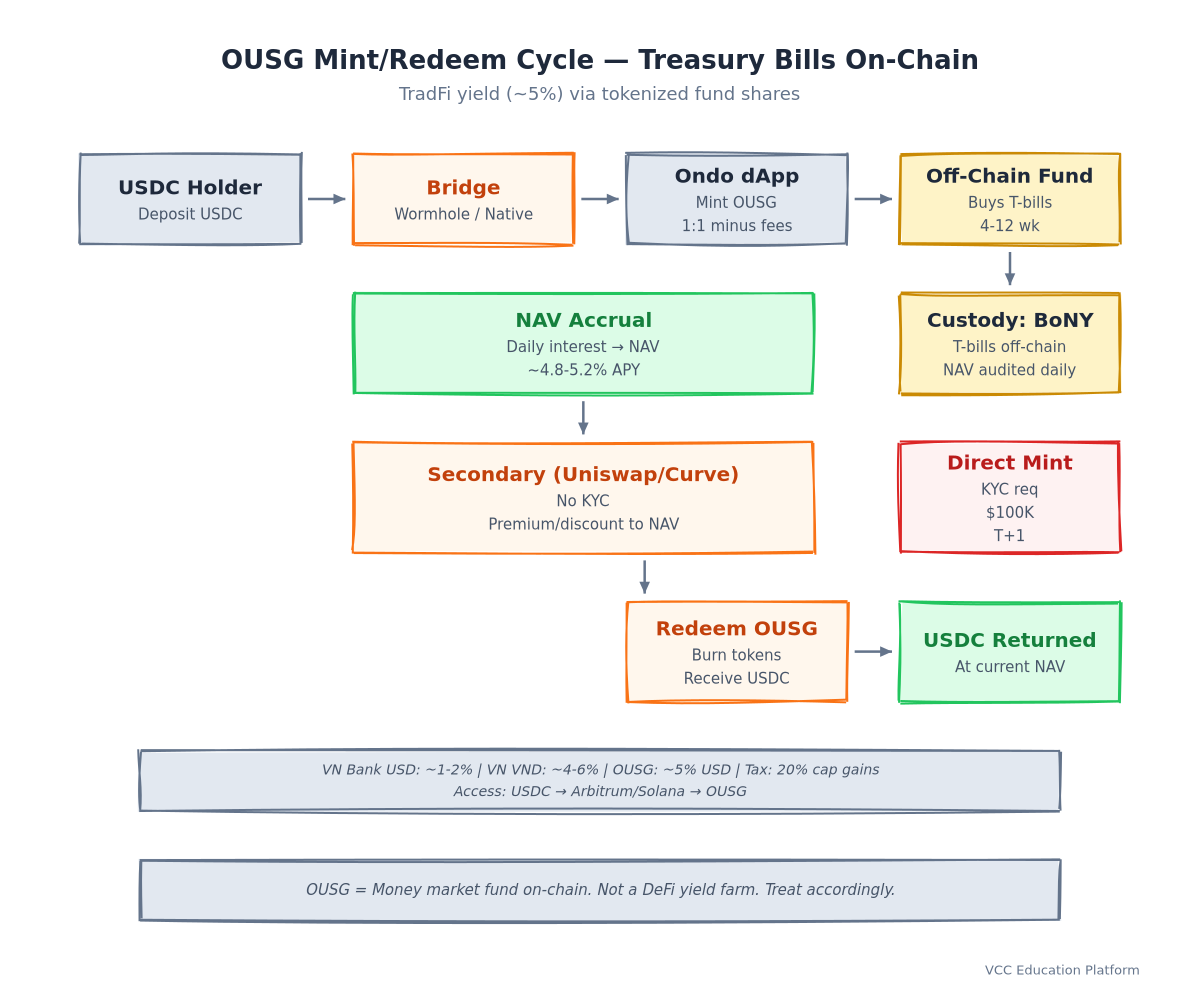
OUSG (Ondo Short-Term US Government Fund) is a tokenized share in a fund that holds US Treasury bills and repurchase agreements. Launched by Ondo Finance in 2023, it's the largest tokenized Treasury product with ~$500M+ AUM across Ethereum and Solana.
How It Works
- You mint OUSG with USDC (1:1, minus fees)
- Ondo's off-chain fund buys T-bills (4-12 week maturity) and repo
- Interest accrues daily, reflected in NAV (net asset value)
- Redeem OUSG → USDC at current NAV (T+1 settlement)
Current yield: ~4.8-5.2% APY — essentially the risk-free rate on-chain.
The Vietnamese Context
For a VN investor holding USDT on Tron or USDC on Ethereum:
- Access: Buy USDC → bridge to Ethereum/Solana → mint OUSG via Ondo dApp
- Yield comparison: VN bank USD deposits pay ~1-2%. VN VND deposits pay ~4-6%. OUSG gives you US-denominated 5% without a US bank account
- Minimum: $100K for direct mint (institutional), but secondary markets (Uniswap, Curve) allow smaller sizes with slippage
- KYC: Required for direct mint/redeem. Secondary market = no KYC but premium/discount to NAV
Risks You Can't Ignore
- Concentration: Top 10 addresses hold 80%+ of OUSG (Messari, 2024). Redemption pressure from whales could strain NAV
- Custody: T-bills held by Bank of New York Mellon. Not on-chain collateral
- Regulatory: Ondo settled with SEC in 2023. Future tokenized securities regulation could change the model
- Smart contract: Bridge risk (Wormhole for Solana), mint/redeem contract risk
Bottom line: OUSG is the closest thing to a "risk-free" USD yield on-chain. Treat it like a USD money market fund — not a DeFi yield farm.
Ethena sUSDe: The Delta-Neutral Basis Trade
What It Is
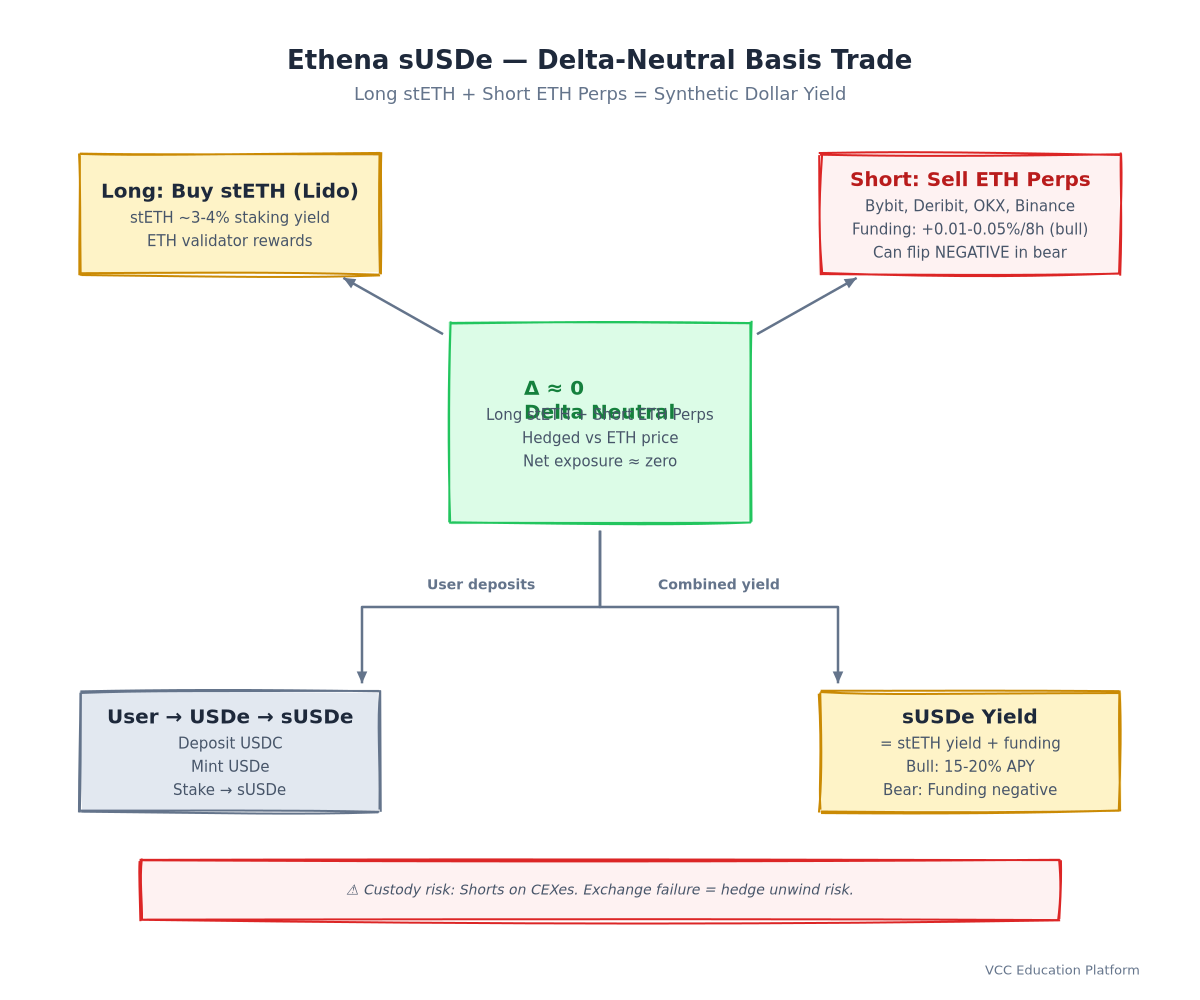
sUSDe (staked USDe) is the yield-bearing version of USDe, Ethena's synthetic dollar. USDe maintains its peg via a delta-neutral strategy: long stETH (staked ETH) + short ETH perpetual futures. The yield comes from stETH staking rewards (~3-4%) + perpetual funding rates (~10-20% annualized).
At its peak in 2024, sUSDe offered 15-20% APY with $3B+ TVL.
The Mechanics (Simplified)
` User deposits USDC → mints USDe Ethena buys stETH (long spot) + sells ETH perp futures (short) Net delta ≈ 0 (hedged against ETH price) Yield = stETH yield + funding rate received from shorts User stakes USDe → receives sUSDe (rebasing token, grows in wallet) `
Why the Yield Is High (And Why It Can Disappear)
Perpetual funding rates pay longs when shorts dominate, and shorts when longs dominate. In bull markets, traders long perps aggressively → funding positive → shorts (Ethena) collect. In bear markets, funding flips negative → Ethena pays funding.
Historical funding rate data (2023-2024):
- Bull market (Q4 2023 - Q1 2024): +0.01% to +0.05% per 8h = 10-40% annualized
- Sideways/correction (Q2 2024): Near zero or slightly negative
- Bear market: Can go -0.02% to -0.05% per 8h = -10-20% annualized
When funding turns negative, sUSDe yield collapses. The "20% APY" is not guaranteed — it's a market-dependent basis trade.
Custody Concentration Risk
Ethena's short perp positions sit on Bybit, Deribit, OKX, Binance — centralized exchanges. If an exchange halts withdrawals (FTX style), Ethena can't unwind hedges. The protocol has an insurance fund, but it's sized for normal volatility, not exchange insolvency.
Vietnamese Investor Takeaway
- High yield ≠ free lunch. sUSDe is a structured product, not a savings account
- Access: Buy USDe on Curve/Uniswap → stake for sUSDe. No KYC for secondary market
- Tax: 20% capital gains on crypto in VN. High yield = high taxable events if you exit
- Risk budget: Allocate only what you can afford to see drop 10-20% if funding flips negative
Bottom line: sUSDe is for traders who understand basis risk. Not for "park USD and earn."
Pendle Finance: Fixed Yield (PT) and Leveraged Yield (YT)
The Core Innovation: Yield Stripping
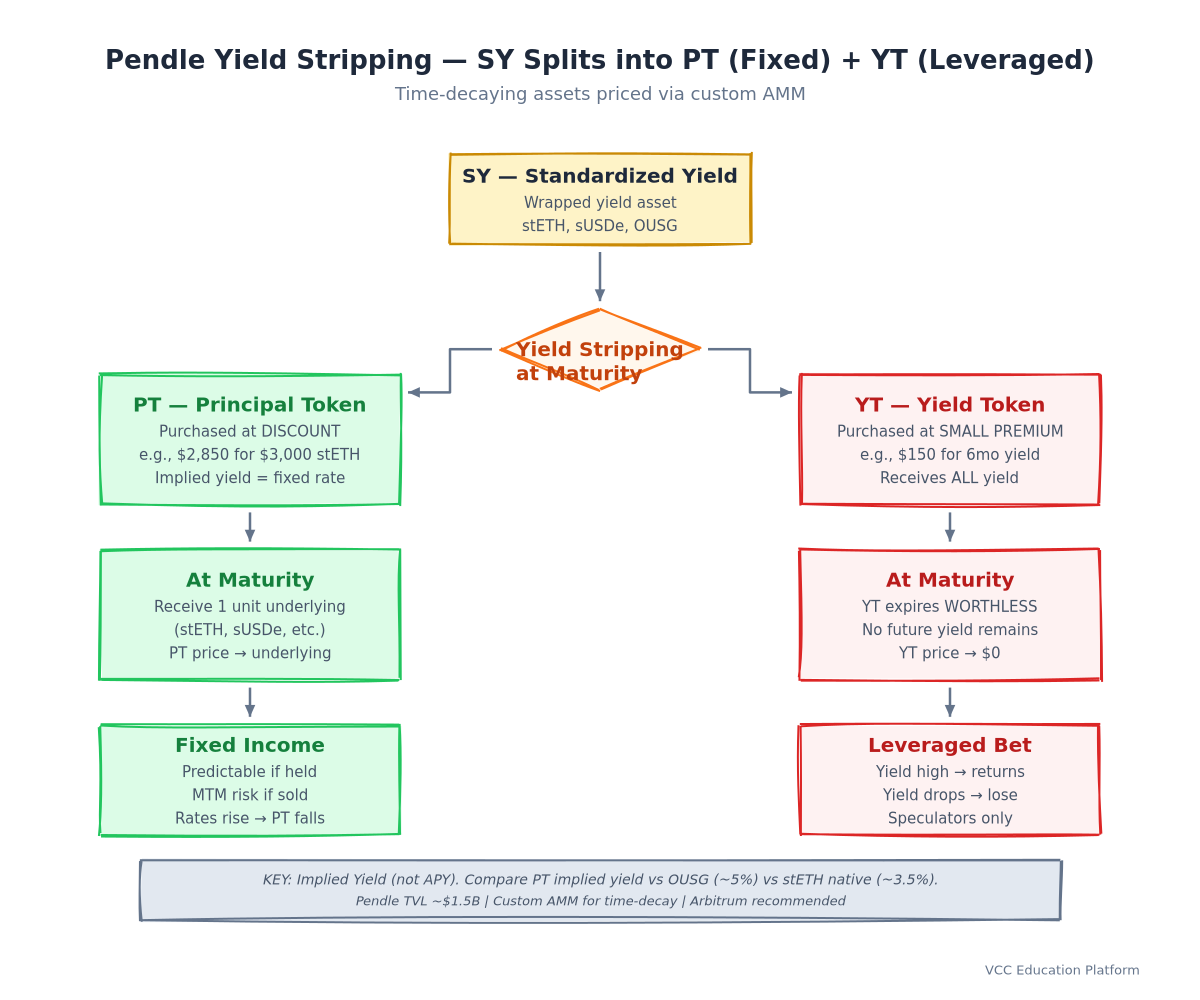
Pendle takes a yield-bearing asset (stETH, USDe, GLP, sUSDe, OUSG) and splits it into two tokens with a maturity date:
| Token | What You Get | Equivalent To |
|---|---|---|
| PT (Principal Token) | Principal returned at maturity | Zero-coupon bond |
| YT (Yield Token) | All yield until maturity | Leveraged yield exposure / interest rate swap receiver |
SY (Standardized Yield) = PT + YT (the wrapped yield-bearing asset).
Fixed Yield with PT: Buying a Bond
When you buy PT, you pay less than face value (discount). At maturity, you receive 1 unit of the underlying.
Example: stETH PT maturing Dec 2024
- Current stETH price: $3,000
- PT price: $2,850 (5% discount)
- Implied yield: ~5.3% fixed (if held to maturity)
- You receive $3,000 worth of stETH in December
Key metric: Implied Yield (not APY). This is the fixed rate locked in at purchase. Compare to:
- stETH native staking yield: ~3.5%
- OUSG: ~5%
- sUSDe: variable 5-20%
If implied yield > your alternative, PT wins. If rates rise after you buy, PT price drops (mark-to-market loss).
Leveraged Yield with YT: Long Gamma on Rates
YT gives you all the yield from 1 unit of underlying until maturity. You pay a small premium (YT price).
Example: stETH YT Dec 2024
- YT price: $150 (5% of stETH price)
- You receive ~$105 yield over 6 months (3.5% staking yield on $3,000)
- Return: 70% on capital in 6 months = ~140% annualized
But if stETH yield drops to 2%, you get $60 → 60% loss. YT is leveraged long yield exposure — like receiving fixed in an interest rate swap.
Pendle's AMM: Concentrated Liquidity for Yield Curves
Pendle uses a custom AMM (not Uniswap v3) designed for time-decaying assets. Liquidity concentrates near the implied yield level. As maturity approaches, PT → underlying price, YT → 0.
TVL: ~$1.5B across Ethereum, Arbitrum, BSC (DeFiLlama, 2024)
Vietnamese User Guide
| Strategy | Who It's For | VN Context |
|---|---|---|
| Buy PT (fixed yield) | Conservative, want predictable USD return | Lock in 5-8% vs VN bank 1-2% USD |
| Buy YT (leveraged yield) | Aggressive, bullish on yield staying high | High risk — only with risk capital |
| LP in Pendle pools | Earn fees + incentives, accept IL | Impermanent loss unique to time-decay |
Access: Bridge USDC to Arbitrum (cheap gas) → Pendle dApp → buy PT/YT or LP.
Bottom line: PT = fixed income. YT = yield speculation. Don't confuse them.
Spectra Finance: Fixed-Rate Lending via IR Swaps
What It Is
Spectra brings fixed-rate borrowing and lending to DeFi via interest rate swaps on an AMM. Unlike Pendle (which strips yield from existing assets), Spectra creates new fixed-rate markets where you can lend USDC at 6% fixed for 6 months, or borrow at 8% fixed.
How It Differs from Notional and Element
| Protocol | Mechanism | Liquidity Model |
|---|---|---|
| Notional | Orderbook (limit orders) | Deep for large sizes, thin for retail |
| Element | PT/YT (like Pendle) | Similar to Pendle |
| Spectra | AMM for IR swaps | Continuous, retail-friendly, higher slippage |
Spectra's AMM prices fixed rates based on utilization and time to maturity. You swap floating rate exposure for fixed rate exposure.
Use Cases for Vietnamese Users
- Fixed-rate lending: Deposit USDC → earn 6-8% fixed for 3-12 months. No yield fluctuation
- Fixed-rate borrowing: Borrow USDC against collateral at 8-10% fixed. Predictable cost
- Rate speculation: Receive fixed (bet rates fall) or pay fixed (bet rates rise)
Current Limitations
- TVL: ~$50M (smaller than Pendle/Notional)
- Assets: Mostly USDC, USDT, WETH, stETH
- Maturity: Fixed tenors (3M, 6M, 12M) — less flexible than Pendle's any-date
- Liquidity: AMM slippage >5% for sizes >$100K
Bottom line: Spectra solves "I want to lend USDC at 7% fixed for 6 months." It's the most TradFi-like fixed income experience on-chain — but liquidity is thin.
Comparative Risk Framework
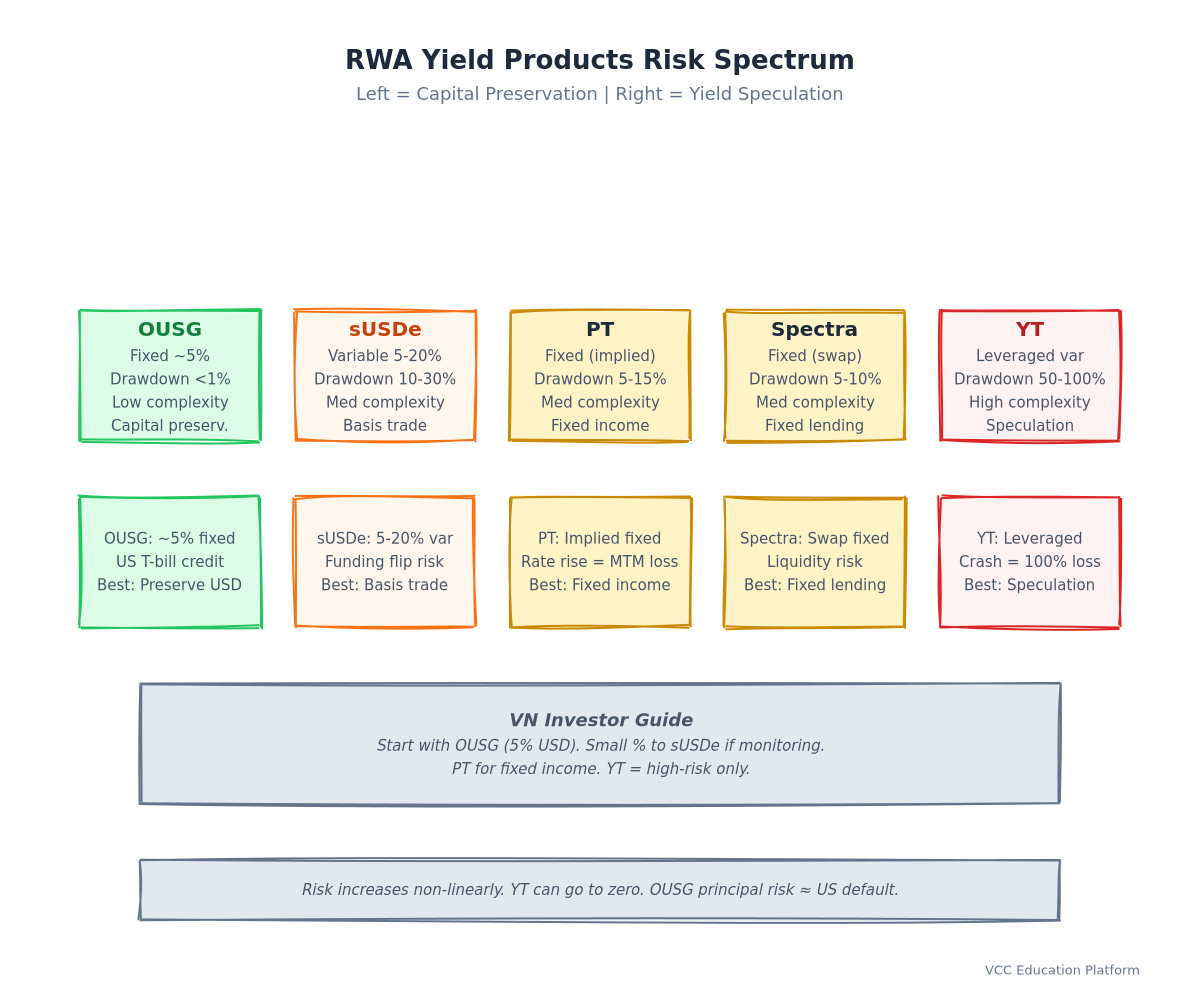
| Product | Yield Type | Max Drawdown Risk | Complexity | Best For |
|---|---|---|---|---|
| OUSG | Fixed ~5% | <1% (NAV fluctuation) | Low | Capital preservation |
| sUSDe | Variable 5-20% | 10-30% (funding flip + depeg) | Medium | Basis trade believers |
| PT | Fixed (implied) | 5-15% (rate rise = mark-to-market loss) | Medium | Fixed income allocation |
| YT | Leveraged variable | 50-100% (yield crash = total loss) | High | Yield speculation |
| Spectra | Fixed (swap rate) | 5-10% (smart contract + liquidity) | Medium | Fixed-rate lending/borrowing |
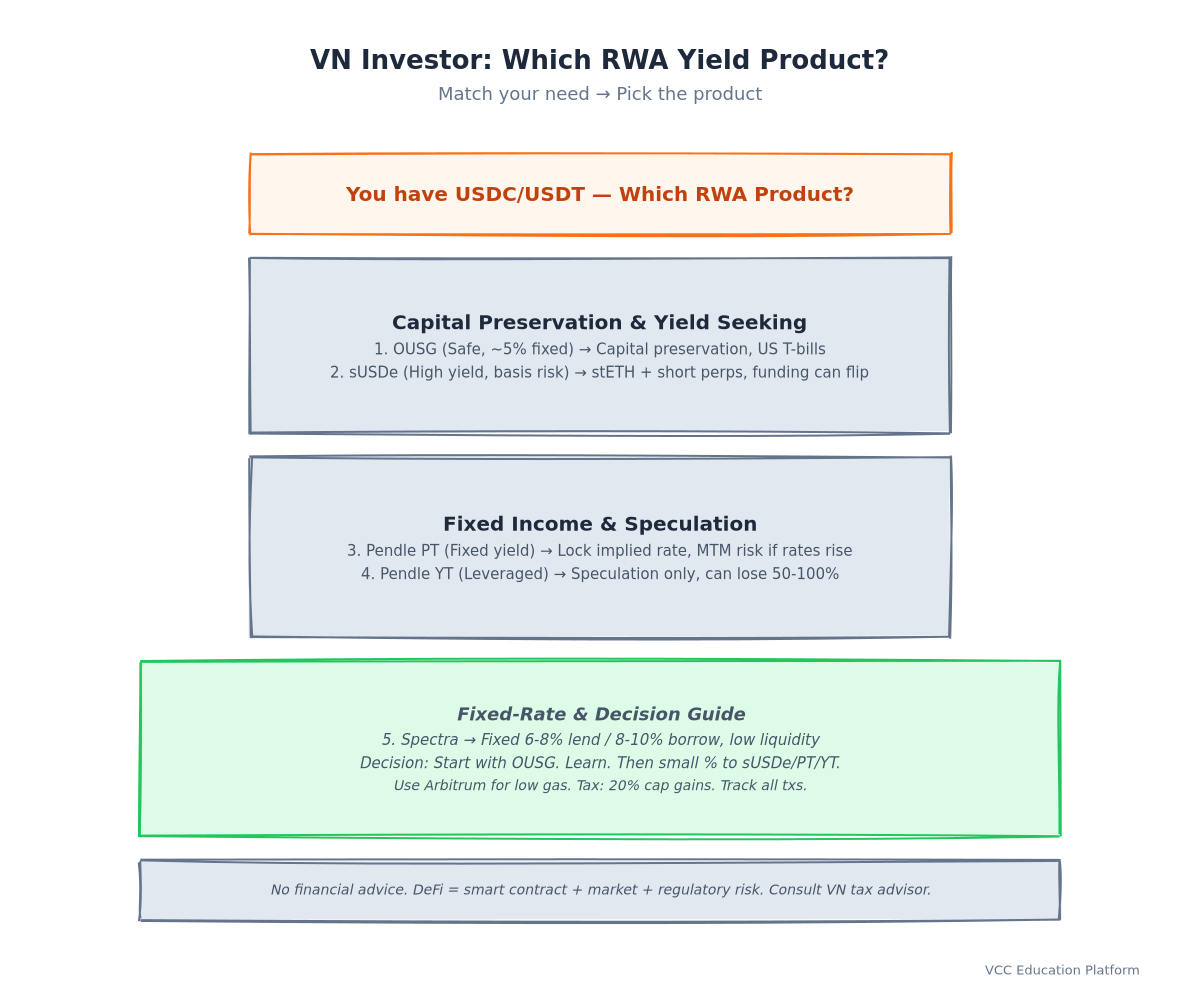
Vietnamese Investor Decision Tree
` START: You have USDC/USDT, want yield │ ├─ Want USD-denominated, near-risk-free, simple? │ └─→ OUSG (5% fixed, KYC for direct, secondary market OK) │ ├─ Want high yield, understand basis trade risk? │ └─→ sUSDe (15%+ but can go negative, no KYC secondary) │ ├─ Want fixed yield for 3-12 months, predictable? │ └─→ Pendle PT (check implied yield vs alternatives) │ ├─ Want to bet yield goes UP, high risk tolerance? │ └─→ Pendle YT (leveraged, can go to zero) │ ├─ Want fixed-rate lending/borrowing, TradFi UX? │ └─→ Spectra (lower liquidity, fixed tenors) │ └─ Not sure? → Start with OUSG. Learn. Then allocate small % to others. `
Practical Access Guide for Vietnam
Step 1: Get USDC on a Compatible Chain
- Cheapest: USDT on Tron → exchange to USDC on Arbitrum via CEX (Binance, Bybit, OKX) → withdraw to Arbitrum
- Direct: Buy USDC on Binance → withdraw to Arbitrum/Ethereum/Solana
- Avoid: High Ethereum mainnet gas for small amounts (<$5K). Use Arbitrum/Solana.
Step 2: Choose Your Product
| Product | Chain | Min Size | KYC | Gas Cost |
|---|---|---|---|---|
| OUSG | Ethereum, Solana | $100K (direct), any (secondary) | Yes (direct) | $5-50 (Eth), <$0.01 (Solana) |
| sUSDe | Ethereum, Arbitrum | Any | No (secondary) | $5-50 (Eth), <$1 (Arb) |
| Pendle PT/YT | Ethereum, Arbitrum, BSC | Any | No | <$1 (Arb/BSC) |
| Spectra | Ethereum, Arbitrum | Any | No | <$1 (Arb) |
Recommendation: Use Arbitrum for Pendle/Spectra/sUSDe. Low gas, deep liquidity.
Step 3: Tax & Compliance
- Vietnam: 20% capital gains tax on crypto profits (Circular 96/2015/TT-BTC, updated guidance 2024)
- DeFi yield: Treated as income → taxable when realized (swap/exit)
- Record-keeping: Track every mint, stake, swap, redeem. Use tools like CoinTracking, Koinly, or manual spreadsheet
- Stablecoin gains: USDC/USDT → VND conversion = taxable event
Step 4: Security Hygiene
- Hardware wallet (Ledger/Trezor) for amounts >$5K
- Revoke approvals after use (revoke.cash)
- Test with small amount first ($100)
- Bookmark official domains: ondo.finance, ethena.fi, pendle.finance, spectra.finance
FAQ
Q: Is OUSG safer than USDC in a savings account (e.g., Binance Earn 5%)?
A: Different risks. OUSG = T-bill credit risk + smart contract risk. Binance Earn = exchange counterparty risk + regulatory risk. OUSG is more transparent; Binance is more convenient.Q: Can sUSDe depeg like UST?
A: Different mechanism. UST was algorithmic (LUNA death spiral). sUSDe is delta-neutral (hedged). But: if funding turns deeply negative + stETH depeg + exchange custody failure simultaneously → possible. Low probability, high impact.Q: What happens to PT if I sell before maturity?
A: You sell at market price. If rates rose since you bought, PT price < your entry (loss). If rates fell, PT price > entry (gain). Mark-to-market risk exists.Q: Why does YT price go to zero at maturity?
A: YT only pays yield until maturity. At maturity, no future yield remains → value = 0. This is by design.Q: Can I use PT as collateral in lending protocols?
A: Some markets accept PT (e.g., Morpho, Euler). But liquidation risk: if PT price drops (rates rise), you get liquidated. Use with caution.Q: Are these products legal in Vietnam?
A: Gray zone. No explicit ban on holding/trading. But no legal protection either. SBV warns against crypto as payment. DeFi yield = unregulated. Proceed at own risk.Q: Which product has the best risk-adjusted return?
A: Depends on your rate view.- Rates falling → PT wins (lock in high implied yield)
- Rates rising → short PT / long YT / pay fixed on Spectra
- Uncertain → OUSG (lowest volatility)
- Bullish crypto → sUSDe (funding + stETH yield)
Key Takeaways
- RWA yield products are not a monolith — three distinct archetypes with different risk engines
- OUSG = TradFi yield on-chain. ~5% fixed. Closest to "risk-free" USD. Best for capital preservation
- sUSDe = Basis trade. 15-20% in bull, negative in bear. Not a savings account. Custody risk on CEXes
- Pendle PT = Fixed income bond. Lock in implied yield. Mark-to-market risk if rates move
- Pendle YT = Leveraged yield bet. High upside, can go to zero. For speculators only
- Spectra = Fixed-rate lending/borrowing. TradFi UX, thin liquidity. Good for predictable cash flows
- Vietnamese users: Start with OUSG on Arbitrum/Solana. Learn the mechanics. Allocate risk capital only to sUSDe/PT/YT
- Tax: 20% on gains. Track every transaction. Stablecoin → VND = taxable
Glossary
- AUM: Assets Under Management
- APY/APR: Annual Percentage Yield/Rate
- Basis trade: Long spot + short futures to capture funding rate
- Delta-neutral: Position insensitive to underlying price movement
- Funding rate: Periodic payment between long/short perp traders
- Implied yield: Fixed yield locked in when buying PT
- IR swap: Interest Rate Swap — exchange floating for fixed rate
- NAV: Net Asset Value
- PT/YT: Principal Token / Yield Token (Pendle)
- Repo: Repurchase agreement (short-term collateralized lending)
- RWA: Real-World Asset
- SY: Standardized Yield (wrapped yield-bearing asset in Pendle)
- TVL: Total Value Locked
- T-bill: US Treasury Bill (short-term government debt)
Disclaimer: This article is for educational purposes only. Not financial advice. DeFi involves smart contract risk, market risk, and regulatory risk. Vietnamese investors should consult a tax advisor. Past performance ≠ future results.