
The world of Real World Asset (RWA) tokenization moves fast. New protocols launch weekly. Regulators issue guidance monthly. And the terminology? It evolves daily. Whether you're a developer building on-chain infrastructure, an investor evaluating tokenized treasuries, or a compliance officer mapping legal frameworks, you need a shared vocabulary. This glossary gives you that foundation—fifty terms that appear in every serious conversation about bringing traditional assets on-chain.
Why This Glossary Exists
RWA tokenization sits at the intersection of TradFi, DeFi, and regulatory frameworks. Each domain brings its own jargon. A "custodian" means something different to a bank than to a DAO. "Settlement" carries distinct implications for T+2 equity markets versus instant blockchain finality. Misunderstanding a single term can lead to flawed architecture, compliance gaps, or costly legal mistakes.
We've organized these fifty terms into six conceptual clusters so you can learn them in context, not isolation.
Cluster 1: Legal & Structural Foundations
These terms define how off-chain assets acquire on-chain representation. Get these wrong, and the entire structure collapses.
1. SPV (Special Purpose Vehicle)
A bankruptcy-remote legal entity created to isolate specific assets and their associated risks from the originator's balance sheet. In RWA tokenization, the SPV holds title to the real-world asset (real estate, invoices, credit card receivables) and issues tokens representing fractional ownership or economic rights.
Why it matters: Without an SPV, token holders have no direct claim on the underlying asset—only a contractual claim against the issuer. The SPV creates the legal bridge.
2. Legal Wrapper
The jurisdictional and entity structure that gives tokens enforceable legal rights. Common wrappers include Delaware LLCs, Cayman Foundation Companies, Luxembourg Securitization Vehicles, and Singapore Variable Capital Companies. Each wrapper determines: token holder rights, tax treatment, regulatory classification, and bankruptcy remoteness.
Key distinction: A legal wrapper is not the same as a smart contract. The wrapper exists in meatspace law; the smart contract exists on-chain. They must be designed to mirror each other.
3. Bankruptcy Remote
A structural feature ensuring that if the originator or platform fails, the SPV's assets remain protected from creditors. Achieved through: independent directors, limited purpose clauses, non-petition covenants, and true sale opinions.
Reality check: "Bankruptcy remote" is a legal conclusion, not a marketing claim. It requires jurisdiction-specific structuring and ongoing compliance.
4. True Sale
A legal opinion confirming that asset transfer to the SPV constitutes a sale (not a secured loan). Critical for bankruptcy remoteness. If recharacterized as a financing, the SPV's assets enter the originator's bankruptcy estate.
Watch for: Jurisdictions where true sale opinions are unavailable or unreliable. Some emerging markets lack precedent.
5. Tokenization
The process of creating digital tokens that represent ownership, economic rights, or claims on real-world assets. Not merely "digitizing"—tokenization adds programmability, fractionalization, and 24/7 transferability.
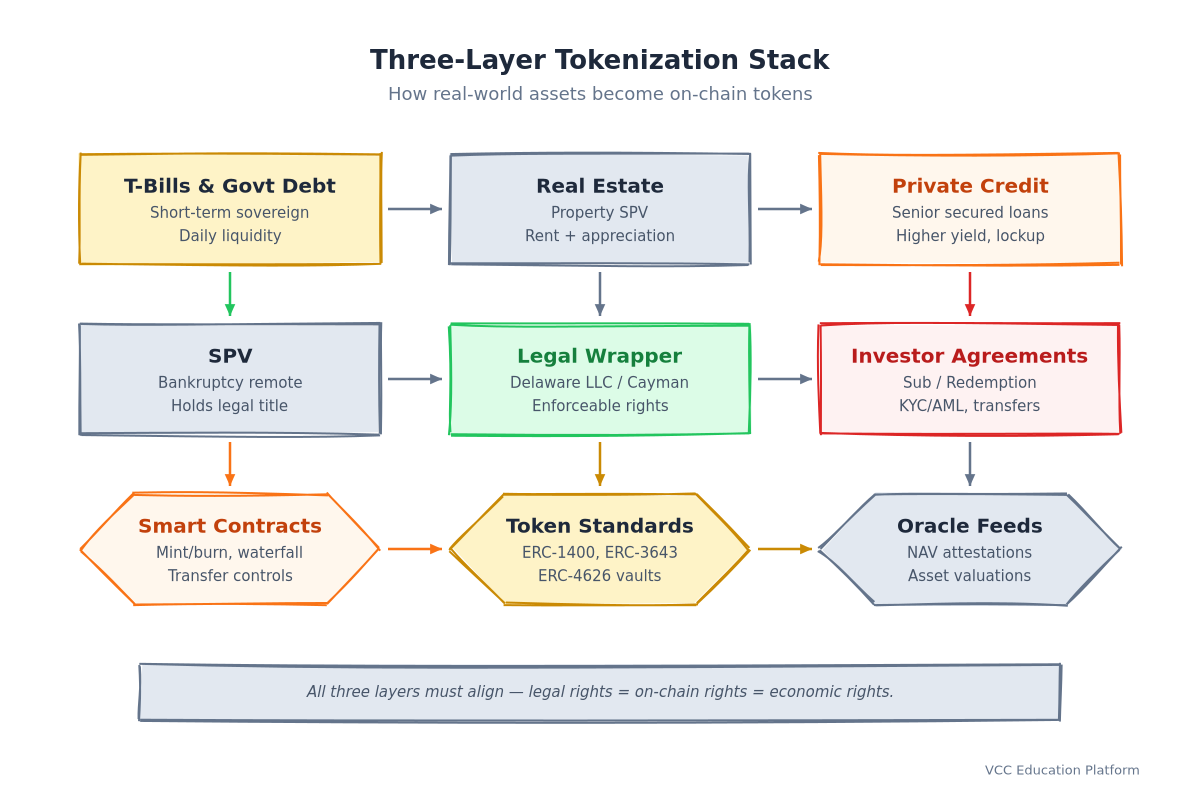
Three layers:
- Asset layer: The real-world asset (T-bills, real estate, carbon credits)
- Legal layer: SPV + legal wrapper + investor agreements
- Technical layer: Smart contracts, standards (ERC-20, ERC-1400, ERC-3643), oracle feeds
6. Security Token
A token that meets the Howey Test (US) or equivalent frameworks globally: investment of money, common enterprise, expectation of profit from others' efforts. Security tokens fall under securities regulation—registration, prospectus, KYC/AML, transfer restrictions.
Contrast: Utility tokens grant platform access. Payment tokens function as money. Security tokens represent investment contracts.
7. Regulation D / Reg S / Reg A+
US exemption frameworks for security token offerings:
- Reg D (506(c)): Accredited investors only, unlimited raise, general solicitation allowed
- Reg S: Offshore investors, no SEC registration
- Reg A+: Mini-IPO, $75M limit, non-accredited allowed, ongoing reporting
Practical impact: Most RWA protocols use Reg D + Reg S for institutional distribution. Reg A+ suits retail-facing products.
8. KYC/AML (Know Your Customer / Anti-Money Laundering)
Identity verification and transaction monitoring requirements. For RWA: investor onboarding, wallet screening, sanctions checks, source-of-funds verification, ongoing monitoring.
On-chain twist: KYC/AML can be enforced at the smart contract level (allowlists, transfer hooks) or off-chain (custodial platforms). Hybrid approaches dominate.
9. Accredited Investor
US definition: individual with $200K income ($300K joint) or $1M net worth (excl. primary residence). Entities: $5M assets. Many RWA offerings restrict to accredited investors to use Reg D exemptions.
Global equivalents: Sophisticated investor (UK), professional client (EU MiFID), wholesale client (Australia/Singapore).
Cluster 2: Asset Servicing & Operations
These terms govern how assets generate yield, how that yield reaches token holders, and what happens when things go wrong.
10. Custodian
The entity holding legal title or physical possession of the underlying asset. For financial assets: banks, prime brokers, CSDs (Central Securities Depositories). For physical assets: specialized vault operators, art storage facilities, warehouse receipt providers.
Critical question: Is the custodian also the SPV? If yes, concentration risk. If no, you need a tri-party agreement.
11. Oracle
The bridge bringing off-chain data on-chain. RWA oracles deliver: asset valuations, NAV (Net Asset Value), interest accruals, corporate actions, credit ratings, default notices.
Types:
- Push oracles: Data providers sign and broadcast (Chainlink, Pyth)
- Pull oracles: Contracts request data on-demand
- Consensus oracles: Multiple providers, median/aggregate (Chainlink Data Feeds)
- TEE oracles: Trusted Execution Environment attestations
RWA-specific need: Signed attestations from licensed valuers or auditors, not just exchange prices.
12. Attestation
A cryptographically signed statement from a trusted party verifying an off-chain fact. Examples: "NAV as of 2024-01-15 is $10.42M," "No default events occurred in Q4," "Asset custody confirmed at warehouse X."
Differs from oracle: Attestations are discrete, human-signed, legally binding statements. Oracles are automated, continuous data feeds. RWA needs both.
13. NAV (Net Asset Value)
Total asset value minus liabilities, divided by outstanding tokens. The per-token redemption price. Calculated daily, weekly, or per-epoch depending on asset liquidity.
Formula: NAV = (Σ Asset Values − Liabilities) / Total Tokens Outstanding
Nuance: NAV frequency must match asset liquidity. Daily NAV for T-bills. Monthly/quarterly for real estate. Mismatch creates arbitrage or runs.
14. Redemption
The process of exchanging tokens for underlying asset value (cash or in-kind). Can be:
- Continuous: Daily/weekly windows (money market funds)
- Periodic: Quarterly windows (real estate funds)
- Gated: Lockups, notice periods, queues
- Suspended: During market stress (contractual or regulatory)
Key terms: Notice period, settlement cycle (T+1, T+2), redemption fee, in-kind vs. cash.
15. Subscription
The inverse of redemption: minting new tokens by contributing capital. Subject to KYC/AML, accreditation checks, minimum investment, subscription windows.
Mechanics: Investor wires fiat → custodian confirms → oracle/attestation verifies → smart contract mints tokens to allowlisted wallet.
16. Distribution / Yield Payment
How asset income (coupons, dividends, rent, fee revenue) reaches token holders. Methods:
- Rebasing: Token balance increases (complex for DeFi composability)
- Dividend token: Separate claim token (gas-heavy)
- Accrual in NAV: Yield reflected in rising NAV (cleanest for secondary markets)
- Claim/withdraw: Holders call a function to pull accumulated yield
Tax note: Method affects tax treatment. Rebasing may trigger annual income. NAV accrual defers to redemption.
17. Servicer
The party managing the underlying asset: collecting loan payments, managing property, monitoring covenants, initiating workouts. In securitization, the servicer is distinct from the issuer/SPV.
Tokenization twist: Smart contracts can automate some servicing (waterfall calculations, distribution triggers), but physical asset servicing remains off-chain.
18. Waterfall
The priority-of-payments structure defining how cash flows are distributed. Senior tranches paid first, then mezzanine, then equity. Includes: servicing fees, custodian fees, trustee fees, interest, principal, residual to equity.
On-chain: Waterfall logic encoded in smart contracts. Immutable once deployed—upgradeability requires careful governance.
Cluster 3: Trading, Settlement & Market Structure
How tokenized RWAs trade, settle, and interact with traditional market infrastructure.
19. DvP (Delivery versus Payment)
Simultaneous exchange of asset for cash. Neither party bears settlement risk. Traditional markets: T+2 via CSDs. Blockchain: atomic swap in single transaction.
RWA challenge: True DvP requires both legs on-chain. If cash leg is off-chain (wire transfer), you have settlement risk. Solutions: tokenized cash (stablecoins, CBDCs, deposit tokens), atomic settlement layers.
20. Settlement Finality
The point at which a transfer becomes irrevocable. Blockchain: probabilistic finality (confirmations) or deterministic (instant finality chains). TradFi: legal finality upon CSD book-entry.
Gap: Legal finality ≠ blockchain finality. A transfer may be "final" on-chain but reversible by court order. RWA structures must address this mismatch.
21. Primary Issuance
Initial token creation and sale to investors. Includes: whitelist/allowlist management, subscription processing, KYC/AML, token minting, capital deployment to asset acquisition.
22. Secondary Trading
Post-issuance token transfers between investors. Requires: transfer restrictions enforcement (lockups, accredited-only), compliant ATS/DEX, market makers, price discovery.
Venues:
- ATS (Alternative Trading System): Regulated, order-book, accredited-only (tZERO, Securitize Markets)
- Permissioned DEX: Whitelisted pools, AMM or order book (Archax, Obligate)
- Public DEX: Uniswap-style, but security tokens typically restricted via token standards
23. Transfer Restrictions
Rules encoded in the token contract limiting who can hold/transfer. ERC-1400, ERC-3643 (T-REX), and proprietary standards implement:
- Allowlist/blocklist
- Jurisdiction blocks
- Accreditation verification
- Lockup periods
- Maximum holder limits
- Sanctions screening
24. Liquidity Provider / Market Maker
Entity providing bid/ask quotes. For RWA: often the issuer or designated market maker. Challenges: sparse order flow, NAV-based pricing vs. market pricing, inventory risk on illiquid assets.
25. ATS (Alternative Trading System)
SEC-regulated electronic trading venue for securities. Lower barriers than national exchange. Most security token "exchanges" are ATSs. Requirements: broker-dealer registration, ATS-N form, fair access, reporting.
26. Custody (Token Custody)
Holding private keys for tokenized assets. Distinct from asset custody. Models:
- Self-custody: Investor holds keys (hardware wallet, MPC)
- Qualified custodian: State-chartered trust company, Fed-member bank (Anchorage, Fireblocks, Coinbase Custody)
- Hybrid: MPC with policy engine, allowlist enforcement
Regulatory note: SEC custody rule requires qualified custodian for investment advisors. Self-custody generally insufficient for institutional RWA.
Cluster 4: Risk, Compliance & Governance
The guardrails that make RWA tokenization institutionally viable.
27. Concentration Risk
Overexposure to single asset, issuer, sector, geography, or counterparty. RWA pools mitigate via diversification rules encoded in smart contracts (max % per asset, sector caps).
28. Counterparty Risk
Risk that a party fails to perform: custodian defaults, servicer fails, oracle manipulates, issuer misrepresents. Mitigated by: overcollateralization, insurance, multiple custodians, decentralized oracles, legal recourse.
29. Operational Risk
Process failures: smart contract bugs, oracle downtime, custodian errors, KYC lapses, regulatory changes. Managed via: audits, bug bounties, insurance, operational resilience frameworks, incident response plans.
30. Regulatory Risk
Risk that laws change: token reclassification, new licensing requirements, cross-border restrictions, stablecoin regulation impacting settlement. Mitigated by: legal opinions, regulatory engagement, jurisdictional diversification, compliance-by-design.
31. Smart Contract Risk
Code vulnerabilities, upgradeability risks, oracle manipulation, governance attacks. Mitigated by: formal verification, multiple audits, timelocks, multisig governance, circuit breakers.
32. Governance
Decision-making for protocol parameters, asset onboarding, fee changes, emergency actions. Models:
- Token-weighted voting: One token = one vote (plutocracy risk)
- Reputation-weighted: Contribution-based
- Council/multisig: Fixed set of signers
- Hybrid: Token voting with council veto
RWA nuance: Governance often limited to operational parameters. Asset-level decisions (foreclosure, restructuring) typically require off-chain legal process.
33. Circuit Breaker
Automatic pause mechanism triggered by: NAV deviation > threshold, oracle failure, redemption queue overflow, regulatory notice. Protects against runs and cascading failures.
34. Insurance / Capital Protection
Products covering: smart contract hack, custodian insolvency, asset default, NAV shortfall. Providers: Nexus Mutual, InsurAce, traditional insurers entering crypto. Often required for institutional adoption.
Cluster 5: Asset-Specific Terminology
Terms that appear when tokenizing specific asset classes.
35. T-Bill / Treasury Tokenization
Short-term government debt tokenized. Examples: Ondo USDY, Franklin Templeton BENJI, Mountain Protocol USDM. Yield from T-bill interest, distributed via NAV accrual or rebasing.
Key metrics: WAM (Weighted Average Maturity), yield-to-maturity, expense ratio, redemption frequency.
36. Money Market Fund Tokenization
SEC Rule 2a-7 fund tokenized. Maintains $1 NAV, daily liquidity, high-quality short-term instruments. Examples: BlackRock BUIDL, Superstate.
Difference from T-bill token: MMF holds diversified portfolio (repos, commercial paper, CDs), not just T-bills. Subject to fund regulations.
37. Private Credit Tokenization
Tokenized loans to private companies: senior secured, mezzanine, venture debt. Platforms: Maple, Goldfinch, Clearpool, Credix. Higher yield, higher risk, longer lockups.
Structures: Borrower SPV → tokenized loan notes → lenders. Or: fund SPV → diversified loan portfolio → tokenized fund interests.
38. Real Estate Tokenization
Fractional ownership of property via SPV. Structures:
- Equity tokens: Direct ownership % (rental income + appreciation)
- Debt tokens: Mortgage-backed, fixed coupon
- Revenue-sharing: Cash flow rights only, no title
Challenges: Property management, local law compliance, tax complexity, illiquidity.
39. Invoice / Receivables Financing
Tokenized accounts receivable. Seller assigns invoices to SPV → SPV issues tokens → buyers pay SPV → SPV distributes. Platforms: Tinlake (Centrifuge), Credix.
Metrics: Advance rate (80-90%), discount rate, concentration limits, debtor credit quality.
40. Carbon Credit Tokenization
Tokenized verified emission reductions. Standards: Verra VCS, Gold Standard. Challenges: vintage risk, additionality, double-counting prevention, registry integration.
Models: Retirement tokens (burn to retire), tradable tokens (speculative), forward credits (pre-issuance).
41. Commodity Tokenization
Gold (PAXG, XAUt), silver, oil, agricultural. Backed by allocated/unallocated storage. Redemption: physical delivery or cash settlement. Vault audits critical.
42. Fund Tokenization
Tokenized LP interests in PE/VC/hedge funds. Challenges: transfer restrictions (fund docs), capital calls, NAV lag, tax opacity, secondary market illiquidity.
Innovation: Evergreen fund structures, automated capital calls, NAV oracles.
Cluster 6: Technical Standards & Infrastructure
The plumbing that makes it all work.
43. ERC-20
Fungible token standard. Baseline for most RWA tokens. Limitations: no transfer restrictions, no identity, no compliance hooks. Extended via wrapper contracts or newer standards.
44. ERC-1400 / ERC-1594
Security token standard with: partitions (tranches), transfer restrictions, forced transfers, document management, compliance hooks. Modular—implement only needed features.
45. ERC-3643 (T-REX)
Open standard for permissioned tokens. ONCHAINID identity framework, compliance rules engine, recovery mechanism, regulatory reporting hooks. Growing adoption in EU (MiCA-aligned).
46. ERC-4626
Tokenized vault standard. Standardizes yield-bearing vaults: deposit asset → receive share token → share token appreciates. Used for RWA lending vaults, T-bill vaults, strategy vaults.
47. Account Abstraction (ERC-4337)
Smart contract wallets enabling: gasless transactions, batched operations, social recovery, policy enforcement (spending limits, allowlists). Critical for institutional UX.
48. Cross-Chain Messaging / Interoperability
Moving RWA tokens across chains: LayerZero, Wormhole, Axelar, CCIP, Hyperlane. Challenges: security (bridge hacks), finality mismatches, liquidity fragmentation, regulatory consistency across chains.
49. Deposit Token / Tokenized Deposit
Commercial bank liability tokenized. JPM Coin, Fnality, Agorac. Settlement asset for on-chain transactions. Regulated, interest-bearing, 1:1 redeemable for central bank reserves.
50. CBDC (Central Bank Digital Currency)
Central bank liability in digital form. Wholesale (interbank) or retail. Future settlement layer for RWA. Projects: FedNow (not CBDC but instant rails), ECB digital euro, PBOC e-CNY, Project mBridge.
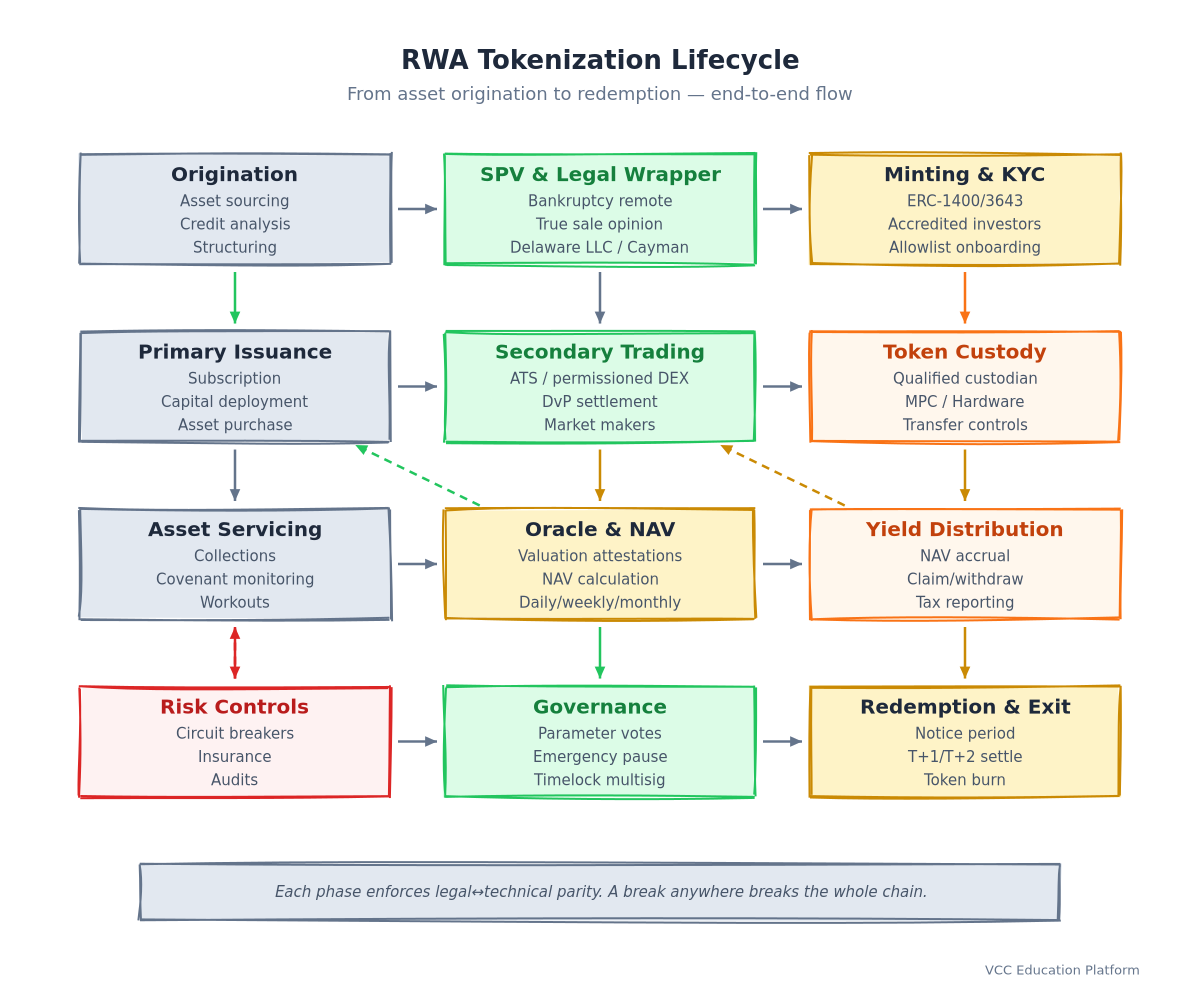
Visual Summary: The RWA Tokenization Lifecycle
FAQ
Q: What's the difference between a security token and a tokenized security? A: "Tokenized security" = traditional security wrapped in a token (same legal rights). "Security token" = native digital security issued on-chain. Practically used interchangeably, but the former emphasizes legal continuity, the latter technological novelty.
Q: Can I tokenize an asset without an SPV? A: Technically yes (direct token issuance by asset owner). Legally risky: no bankruptcy remoteness, token holders are unsecured creditors. Institutions require SPV structure.
Q: How do oracles handle illiquid assets (real estate, private credit)? A: Signed attestations from licensed appraisers/auditors at defined intervals, not real-time feeds. NAV updates monthly/quarterly. Smart contracts enforce update frequency and signer authorization.
Q: What happens if the issuer goes bankrupt? A: If properly structured (true sale + bankruptcy remote SPV), the SPV continues operating. Token holders' claims are on SPV assets, not issuer. Servicer continues collections. Trustee may appoint replacement administrator.
Q: Are RWA tokens compatible with DeFi? A: Yes, if standards align (ERC-20/4626) and compliance allows. Examples: BUIDL as collateral on Aave, USDY in lending markets. But transfer restrictions (allowlists) can break composability—permissioned DeFi pools emerging.
Q: How are taxes handled? A: Varies by jurisdiction and token structure. Generally: yield = income, redemption gain/loss = capital. Token rebasing may create annual taxable events. NAV accrual defers tax. Consult tax advisor—this is not tax advice.
Q: What's the minimum investment for RWA tokens? A: Institutional products: $100K-$1M+. Retail-accessible (Reg A+): $500-$5,000. Fractionalization enables lower minimums, but regulatory and operational costs create floors.
Closing Thought
The terminology will keep evolving. "RWA" itself may fade as tokenization becomes the default issuance format for all assets. But the concepts—legal wrapper, bankruptcy remoteness, oracle attestation, DvP settlement, transfer restrictions—will remain the grammar of this asset class. Master them now. Build on them next.
Disclaimer: This glossary is for educational purposes only. It does not constitute legal, tax, investment, or regulatory advice. Consult qualified professionals before engaging in RWA tokenization activities.