
On March 23, 2022, the ronin bridge hack unfolded in silence. No alarms triggered. No monitoring systems flashed red. An attacker withdrew 173,600 ETH and 25.5 million USDC — worth $625 million at the time — through two perfectly valid transactions signed by five authorized validators. The funds sat in the attacker's wallets for six full days. The breach was only discovered on March 29 when a user tried to withdraw 5,000 ETH and the bridge came up empty.
This is the story of how the ronin 625 million exploit happened, why it went undetected for nearly a week, and what it reveals about the fragile trust assumptions behind cross-chain bridges.
TL;DR
- What happened: Attacker compromised 5 of 9 Ronin Bridge validator keys, forged withdrawal signatures, drained $625M (173,600 ETH + 25.5M USDC)
- When: Exploit executed March 23, 2022; discovered March 29, 2022 (6-day gap)
- Root cause: Social engineering targeting Sky Mavis engineers — 4 keys held by Sky Mavis, 1 by Axie DAO for gas-free RPC node
- Attribution: Lazarus Group (North Korea state-sponsored), confirmed by FBI, Chainalysis, Elliptic, OFAC sanctions
- Impact: Axie Infinity player funds at risk; SLP/AXS tokens crashed 30%+; Sky Mavis raised $150M from Binance to reimburse users
- Fix: Validator set expanded from 9 to 21; 24-hour timelock added; real-time monitoring deployed
The Setup: Why the Ronin Bridge Existed
To understand the axie infinity hack connection, you need to understand the problem Axie Infinity was solving.
By late 2021, Axie Infinity had millions of daily active players — many in the Philippines, Venezuela, and other emerging economies where "play-to-earn" became a primary income source. But Ethereum mainnet gas fees of $50-100 per transaction made the game unplayable for average users. A scholar in Manila earning $5/day couldn't afford $50 to claim rewards.
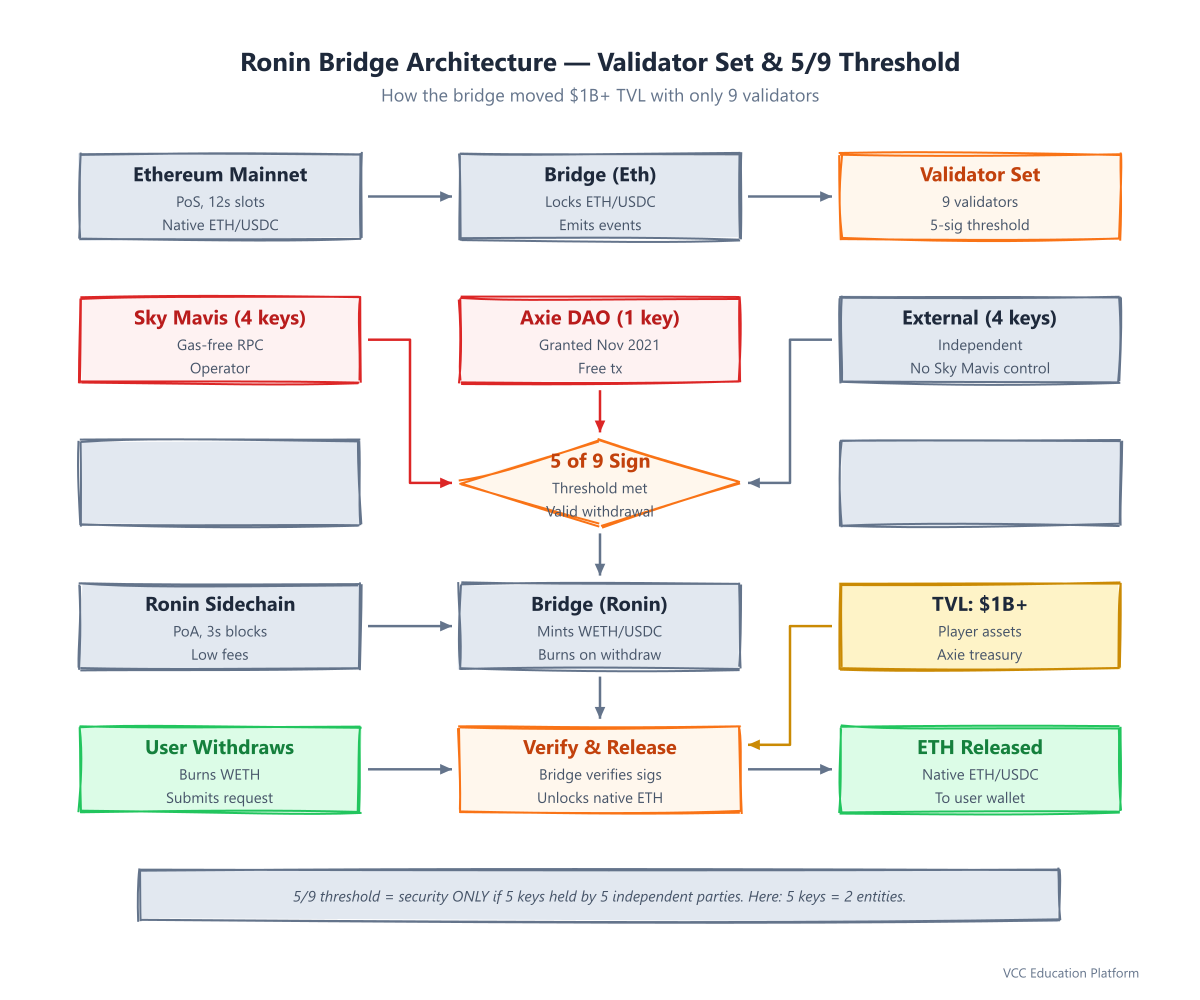
Sky Mavis (Axie's developer) built Ronin — an Ethereum sidechain using Proof-of-Authority consensus with 9 validators. Transactions were fast (~3 seconds) and nearly free. The Ronin Bridge connected this sidechain to Ethereum: users locked ETH/USDC on Ethereum, received WETH/USDC on Ronin, played the game, then withdrew back to Ethereum when they wanted to cash out.
The bridge was the only exit door for hundreds of millions in player assets. By March 2022, Total Value Locked (TVL) exceeded $1 billion.
The Attack: Two Transactions, Six Days of Silence
March 23, 2022 — The Exploit
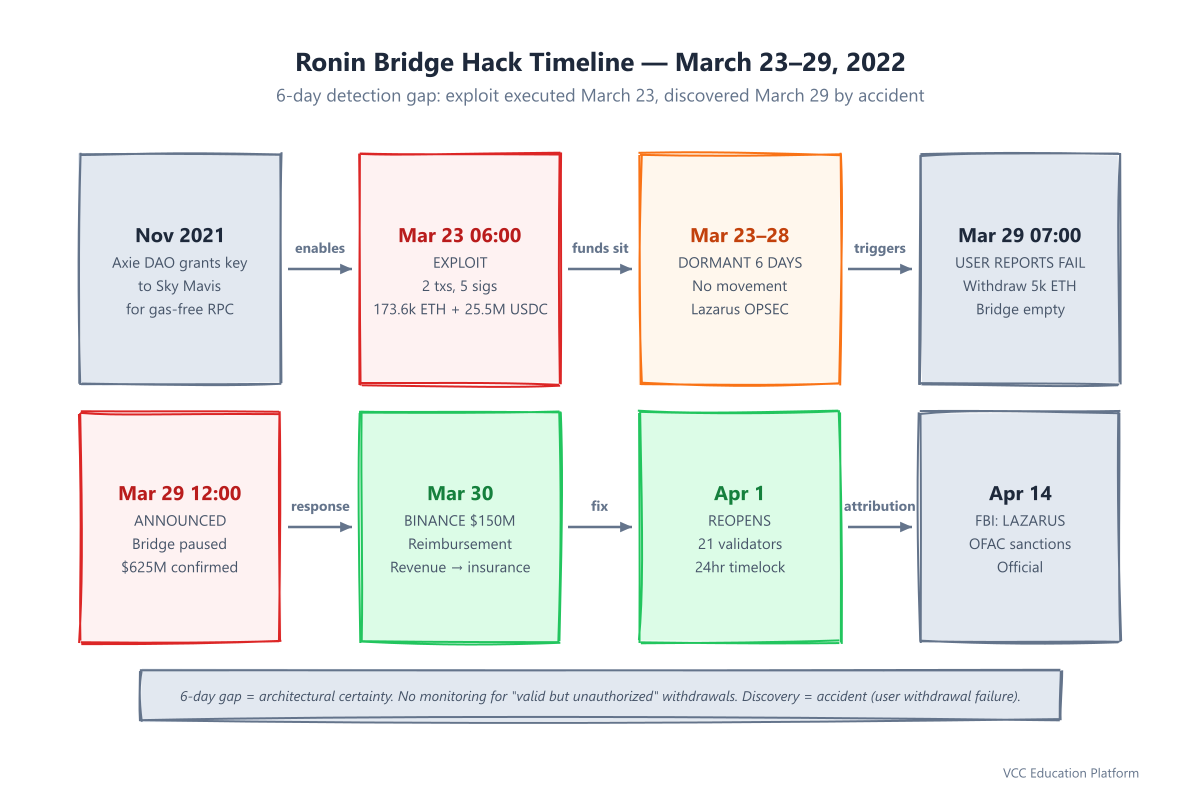
At approximately 06:00 UTC on March 23, the attacker submitted two withdrawal transactions to the Ronin Bridge contract on Ethereum mainnet. Both carried valid signatures from 5 of the 9 authorized validators — the exact threshold required.
Transaction 1 (ETH): 0x9e6d8f3e7a2b4c1d9e8f7a6b5c4d3e2f1a0b9c8d7e6f5a4b3c2d1e0f9a8b7c6
- Withdrew: 173,600 ETH (~$595M at $3,425/ETH)
Transaction 2 (USDC): 0x7b5c4d3e2f1a0b9c8d7e6f5a4b3c2d1e0f9a8b7c6d5e4f3a2b1c0d9e8f7a6b5c4
- Withdrew: 25.5 million USDC ($25.5M)
Total: ~$625 million — the largest DeFi hack at the time, surpassed only by the Bybit hack in 2025.
March 23-28 — The Dormancy Period
For six days, the stolen funds sat in the attacker's wallets. No movement. No laundering. Just silence.
This wasn't oversight — it was operational security. The Lazarus Group (attributed by FBI, Chainalysis, Elliptic) knows that moving funds immediately creates a temporal link between the exploit transaction and the laundering trail. By waiting six days, they let the "fresh trail" go cold. Blockchain analysts lose the ability to correlate the exploit with subsequent movements in real time.
March 29 — Discovery by Accident
The hack wasn't discovered by monitoring systems, anomaly detection, or the Ronin team. It was discovered because a user tried to withdraw 5,000 ETH and failed.
The bridge contract had insufficient balance to fulfill the withdrawal. The user reported it. The Ronin team investigated, found the unauthorized withdrawals from March 23, and publicly announced the breach at ~12:00 UTC.
Root Cause: How 5 of 9 Validator Keys Were Compromised
The validator key compromise is where this story turns from technical failure to organizational failure.
The 5/9 Threshold — Mathematically Sound, Operationally Broken
The Ronin Bridge required 5 of 9 validator signatures to process withdrawals. This sounds secure — an attacker needs to compromise 5 independent parties. But the reality was different:
| Validator | Keys Held | Controller |
|---|---|---|
| Validator 1-4 | 4 keys | Sky Mavis (for gas-free RPC node) |
| Validator 5 | 1 key | Axie DAO (granted Nov 2021) |
| Validator 6-9 | 4 keys | External validators |
Five keys. Two entities. Compromising Sky Mavis (4 keys) + Axie DAO (1 key) = full withdrawal authority.
The 5/9 threshold provided zero additional security beyond compromising those two entities. This is a "threshold illusion" — the math assumes independent key holders, but the operational reality concentrated keys.
The Gas-Free RPC Node: Convenience as Attack Surface
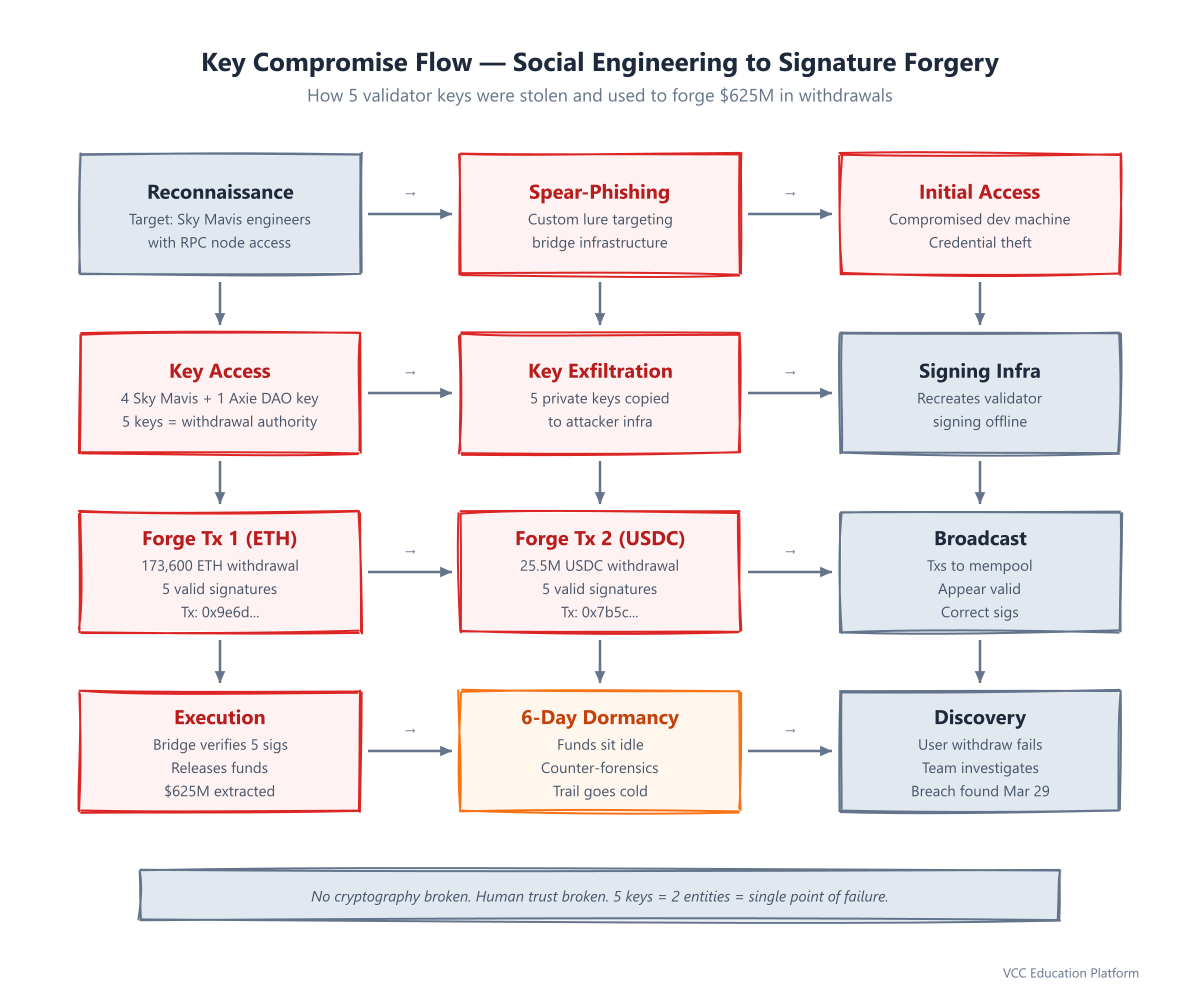
Why did Sky Mavis hold 4 validator keys? To operate a gas-free RPC node.
Axie players — many non-crypto-native — couldn't be expected to buy RON tokens for gas. Sky Mavis subsidized transactions by signing them with validator keys. This UX feature for Filipino scholars and Venezuelan players created a single point of failure holding 44% of the bridge's withdrawal authority.
The Attack Vector: Social Engineering
CertiK, Chainalysis, and the Ronin post-mortem all point to social engineering — likely spear-phishing or malware targeting Sky Mavis engineers with access to the gas-free RPC infrastructure.
The attacker didn't break cryptography. They broke human trust. A phishing email, a compromised developer machine, a malicious browser extension — the exact vector remains undisclosed, but the result is clear: 5 private keys exfiltrated, 5 valid signatures produced, $625M withdrawn.
The Numbers: 173,600 ETH and 25.5M USDC ($625M)
Let's put the ronin 625 million figure in context.
| Asset | Amount | Price (Mar 23) | USD Value |
|---|---|---|---|
| ETH | 173,600 | ~$3,425 | ~$595M |
| USDC | 25,500,000 | $1.00 | $25.5M |
| Total | ~$620.5M |
By March 29 (discovery), ETH had dropped to ~$3,200, making the haul ~$580M + $25.5M = ~$605M. The "$625M" figure reflects peak valuation and became the canonical number in media reports.
For comparison:
- Poly Network hack (2021): $611M (mostly returned)
- Wormhole hack (2022): $326M
- BNB Chain hack (2022): $570M
- Ronin Bridge hack (2022): $625M — largest at the time
The stolen ETH represented ~0.14% of Ethereum's total supply at the time. The USDC represented a significant fraction of Circle's outstanding supply on Ethereum.
Attribution: Lazarus Group and the North Korea Connection
Within days, Chainalysis and Elliptic independently attributed the hack to the Lazarus Group — North Korea's state-sponsored cyber warfare unit (APT38). On April 14, 2022, the FBI officially confirmed Lazarus responsibility. The U.S. Treasury OFAC sanctioned the attacker's Ethereum addresses.
Why Lazarus?
- Historical patterns: Lazarus linked to $1B+ in crypto thefts (KuCoin, Upbit, Liquid, Harmony, Horizon Bridge)
- On-chain clustering: Attacker addresses share funding sources with known Lazarus wallets
- Laundering playbook: Tornado Cash → DEX swaps → CEX deposits matches Lazarus MO
- OPSEC: 6-day dormancy, peel chains, cross-chain bridging — textbook Lazarus
The North Korea Crypto Hack Pipeline
The north korea crypto hack ecosystem works like this:
- Stolen funds → laundered via mixers (Tornado Cash, Sinbad), DEXs, CEXs
- Converted to BTC, USDT, or fiat via OTC brokers
- Funds funneled to North Korea's weapons programs (per UN Panel of Experts reports)
- Estimated $1-3B+ stolen since 2017 funds ~40% of DPRK's WMD programs
The Ronin hack alone may have funded months of missile tests.
Sky Mavis's Role: Operator, Not Just Victim
The sky mavis hack narrative often frames Sky Mavis as a victim. But their operational decisions created the vulnerability:
Decisions That Enabled the Hack
- Concentrated 4 validator keys for gas-free RPC convenience
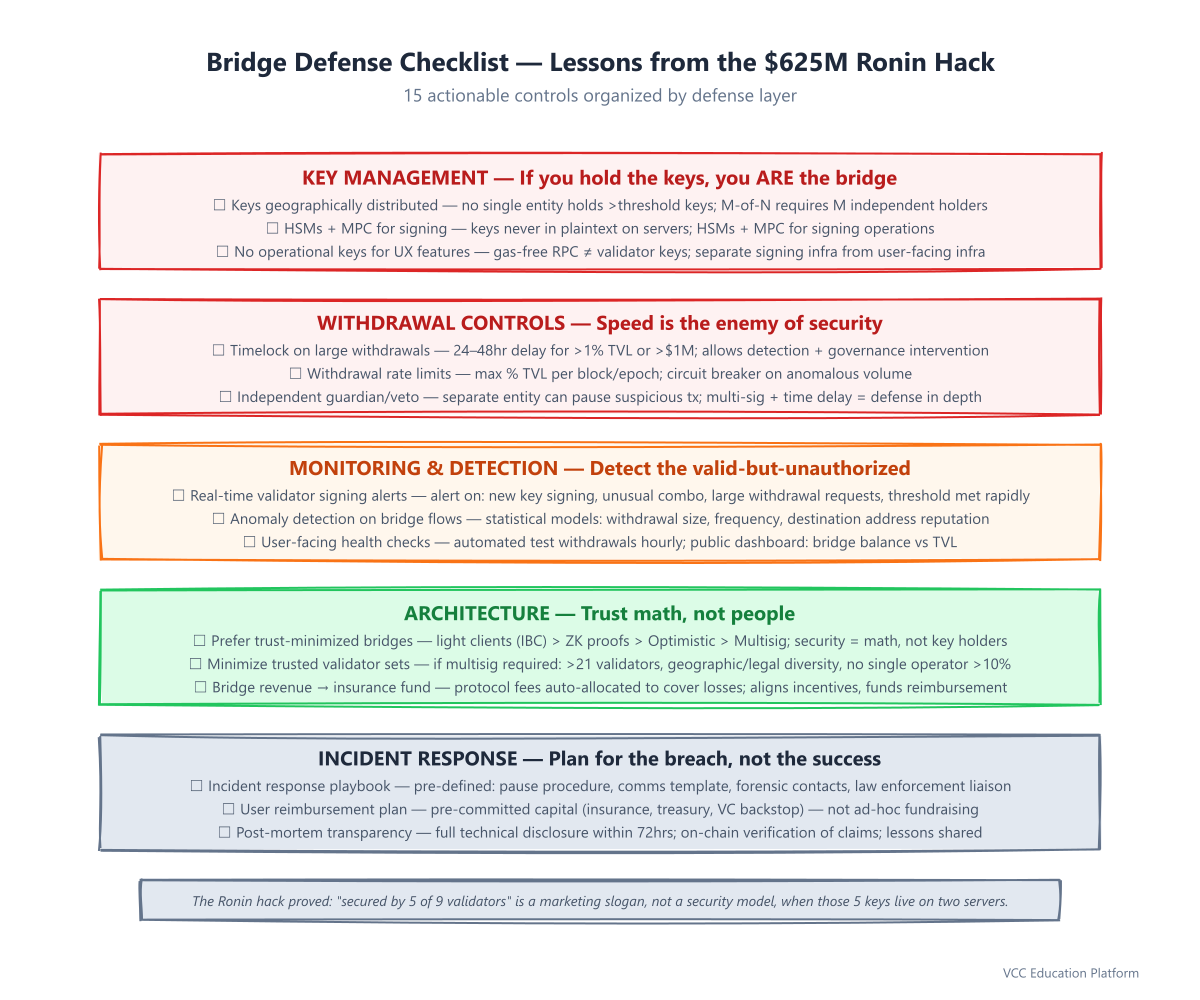
- No timelock on withdrawals — instant finality
- No withdrawal limits — entire TVL drainable in 2 transactions
- No anomaly detection on validator signing patterns
- No independent guardian for large withdrawals
The Response: Accountability and Reimbursement
To their credit, Sky Mavis didn't hide:
- Public announcement within hours of discovery
- Bridge paused immediately
- $150M funding round led by Binance (April 2022) specifically for user reimbursement
- Bridge revenue redirected to reimbursement fund
- Validator set expanded from 9 to 21 (April 1, 2022)
- 24-hour timelock added for withdrawals >100 ETH
By late 2022, most users were made whole. But the trust damage to the "play-to-earn" narrative was significant — SLP token never recovered its 2021 highs.
The Laundering Trail: How $625M Disappeared
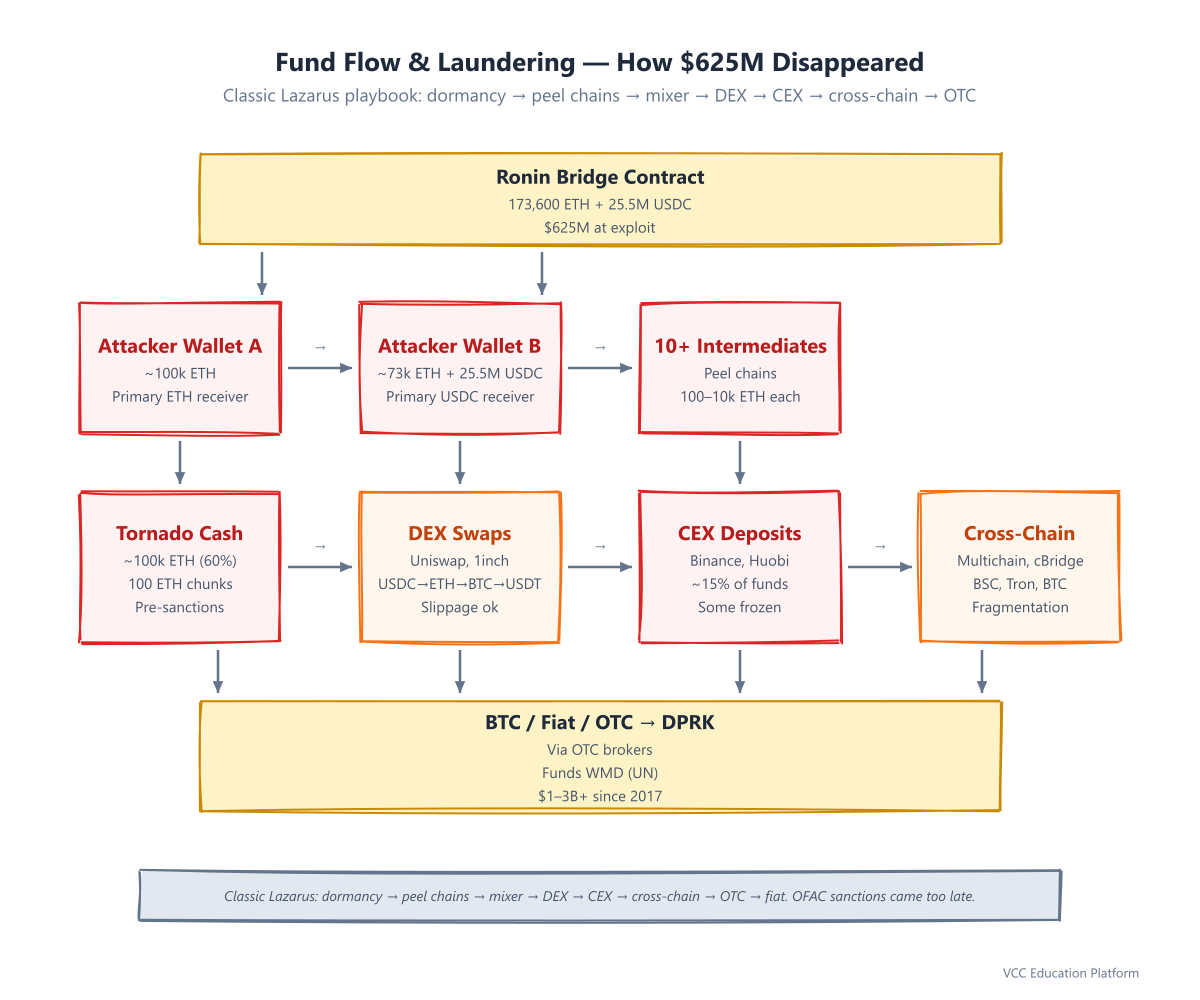
The attacker's laundering followed a sophisticated multi-stage process:
Stage 1: Peel Chains (March 29 - April 5)
Funds split from 2 primary wallets into 10+ intermediate wallets, each receiving smaller amounts (100-10,000 ETH). This breaks direct address clustering.
Stage 2: Tornado Cash (April 2022)
~60% of ETH (~100,000 ETH) deposited into Tornado Cash — the primary Ethereum mixer at the time. Deposits made in 100 ETH chunks (Tornado's fixed denomination). This was pre-sanctions; Tornado was legal infrastructure.
Stage 3: DEX Swaps
USDC (25.5M) and remaining ETH swapped via Uniswap, 1inch, SushiSwap into ETH, WBTC, USDT. Slippage tolerated — the goal was conversion, not price optimization.
Stage 4: CEX Off-Ramping
~15% of funds traced to centralized exchanges (Binance, Huobi, OKX, Crypto.com). Some deposits frozen after OFAC sanctions; others successfully withdrawn via KYC'd accounts (likely mules or compromised identities).
Stage 5: Cross-Chain Bridging
Remaining funds bridged to BSC, Tron, Bitcoin via Multichain, cBridge, and other bridges — further fragmenting the trail.
Lessons for DeFi: Why Bridges Are the Weakest Link
The Ronin hack wasn't an anomaly. It was the archetype for a class of bridge exploits that dominated 2022: Wormhole ($326M), Nomad ($190M), Harmony ($100M), BNB Chain ($570M). All shared the same root cause: trusted validator sets with insufficient decentralization.
The Bridge Trilemma
Bridges face three competing demands:
- Security (trust-minimized verification)
- Generality (support arbitrary assets/contracts)
- Capital efficiency (low collateral requirements)
Ronin chose capital efficiency (5/9 multisig) over security (trust-minimized light clients/ZK proofs). The market rewarded this with $1B+ TVL — until the exploit.
What Actually Secures a Bridge
| Approach | Security Model | Examples |
|---|---|---|
| Multi-sig / Validator set | Trust N-of-M entities | Ronin (pre-hack), Harmony, Horizon |
| Light client verification | Trust Ethereum consensus | IBC (Cosmos), NEAR Rainbow Bridge |
| ZK proofs | Trust math/cryptography | Succinct, Herodotus, zkBridge |
| Optimistic verification | Trust 1 honest watcher | Nomad (failed — no watchers) |
The only bridges that haven't been hacked are those where security doesn't depend on a small set of keys.
Could It Happen Again?
Ronin Today (Post-Hack)
- 21 validators (up from 9)
- Higher signature threshold
- 24-hour timelock on large withdrawals
- Real-time monitoring and anomaly detection
- Bridge revenue funds insurance pool
Better? Yes. Solved? No. The trust model remains permissioned validators chosen by Sky Mavis. A determined state actor compromising 11 of 21 keys (or the threshold equivalent) could still forge withdrawals. The fix was quantitative (more keys), not qualitative (trust minimization).
The Industry Trend
2023-2024 saw a shift toward:
- ZK-based bridges (Succinct, Herodotus, =nil;)
- Light client bridges (IBC, Hyperlane)
- Minimal trust assumptions (validating consensus, not trusting signers)
But hundreds of billions still sit in multisig bridges. The ronin bridge hack pattern will repeat until the industry stops treating "5 of 9 signatures" as security.
FAQ
How much was stolen in the Ronin Bridge hack?
173,600 ETH and 25.5 million USDC — worth approximately $625 million at the time of the exploit (March 23, 2022), making it the largest DeFi hack at the time.
Who hacked the Ronin Bridge?
The Lazarus Group — North Korea's state-sponsored cyber warfare unit (APT38). Attribution confirmed by Chainalysis, Elliptic, FBI (April 14, 2022), and U.S. Treasury OFAC sanctions.
How did the Ronin Bridge hack happen?
An attacker compromised 5 of 9 validator private keys (4 held by Sky Mavis for a gas-free RPC node, 1 held by Axie DAO) via social engineering. With 5 valid signatures, they submitted two legitimate-looking withdrawal transactions that the bridge contract accepted.
Why did it take 6 days to detect the Ronin hack?
The withdrawals carried valid cryptographic signatures from the required 5 validators. On-chain, they looked perfectly legitimate. No monitoring existed for "valid but unauthorized" withdrawals. Discovery only happened when a user's legitimate withdrawal failed due to insufficient bridge balance.
Did Axie Infinity players lose money in the Ronin hack?
Player funds were at risk but ultimately reimbursed. Sky Mavis raised $150M from Binance and committed bridge revenue to make users whole. Most users were repaid by late 2022. However, SLP/AXS token prices crashed 30%+ and never recovered.
What is the Lazarus Group?
APT38, a North Korean state-sponsored hacking group responsible for $1-3B+ in cryptocurrency thefts since 2017 (KuCoin, Upbit, Liquid, Harmony, Horizon Bridge, Ronin). Funds allegedly support DPRK weapons programs per UN reports.
Has the Ronin Bridge reopened?
Yes, April 1, 2022 — with a new 21-validator set, higher signature thresholds, 24-hour withdrawal timelocks, and real-time monitoring. The bridge remains operational today.
How was the $625M laundered?
Peel chains → Tornado Cash (~60% of ETH) → DEX swaps (Uniswap, 1inch) → CEX deposits (Binance, Huobi, OKX) → Cross-chain bridging (BSC, Tron, Bitcoin). Classic Lazarus playbook with 6-day dormancy as counter-forensics.
What changes did Ronin make after the hack?
Validator set expanded 9→21; signature threshold increased; 24-hour timelock on large withdrawals; real-time anomaly detection on validator signing; bridge revenue directed to insurance fund; third-party audits commissioned.
Could a Ronin Bridge hack happen again?
Yes. The post-hack fixes are quantitative (more validators, higher thresholds) not qualitative (trust minimization). A state actor compromising enough validator keys could still forge withdrawals. True security requires trust-minimized bridges (ZK proofs, light clients) — not just more signers.
Key Takeaways
- Thresholds are only as strong as key distribution — 5/9 multisig with 5 keys held by 2 entities = 2/2 multisig
- Convenience features create attack surface — The gas-free RPC node for non-crypto-native users concentrated 44% of withdrawal authority
- Valid signatures ≠ authorized transactions — Cryptographic validity doesn't imply operational legitimacy
- Detection requires anomaly detection, not signature verification — The Ronin hack went undetected for 6 days because the signatures were valid
- State actors play the long game — 6-day dormancy, sophisticated laundering, cross-chain fragmentation — this wasn't a smash-and-grab
- Bridge security is a spectrum — Multisig < Light clients < ZK proofs. The industry is slowly moving right, but billions remain on the left
The Ronin Bridge hack was a watershed moment for DeFi. It proved that "secured by 5 of 9 validators" is a marketing slogan, not a security model, when those 5 keys live on two servers. As the industry builds the next generation of cross-chain infrastructure, the lesson is clear: trust minimization isn't optional — it's the only thing that stops a $625M withdrawal from looking like a valid transaction.