
A recursive zk proof is the reason a zk rollup can grow forever without its proof getting bigger. Normal proofs answer one question. A recursive proof answers the question: "is that proof valid?" — and then wraps the answer inside another proof. Repeat, and a million computations compress into a single stamp-sized proof that a smartphone can verify.
Here's the one-sentence version: recursive zero-knowledge proofs let you verify a chain of computations by proving that each proof of the previous step was correct — so the total verification cost stays constant no matter how much computation happened.
If you've ever wondered why zk rollups can batch thousands of transactions yet the proof Ethereum checks stays small — or why new zkVMs like SP1 and RISC Zero can prove arbitrarily long programs — zk proof recursive composition is the mechanism behind all of it. This article explains what recursion is, why it matters, and how it works — with the analogy that makes it click.
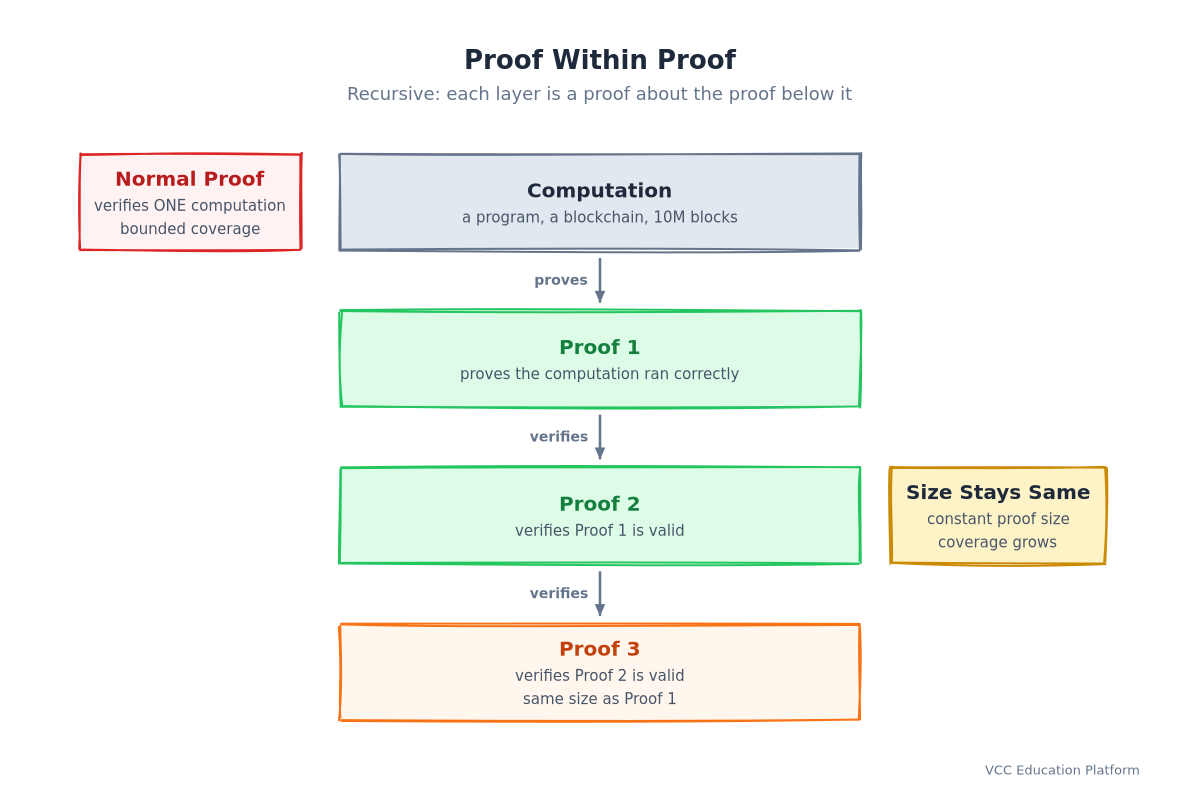
Figure 1: Proof Within Proof — each layer is a proof about the proof below it
The Problem Normal Proofs Can't Solve
A single zero-knowledge proof is already impressive: it lets a prover convince a verifier that a computation ran correctly without revealing the inputs. The proof is small and verification is fast.
But a normal proof has a hard limit: it can only cover one fixed computation. If your computation is a blockchain with 10 million blocks, a single proof covering all of it would be astronomically expensive to generate. And if you batch 10,000 transactions, the proof must touch all 10,000 — and the next batch needs a fresh proof from scratch.
Two consequences follow:
- Verification cost grows with computation size. Every new block, every new transaction, every new step means the verifier has to check more.
- Proofs can't be composed. You cannot take "proof A is valid" and "proof B is valid" and combine them into one proof that says "both are valid" — without a way for proofs to talk about other proofs.
Recursion removes both limits.
What Recursion Actually Means
Recursion is the same idea you met in programming class: a function that calls itself. In ZK, a recursive proof is a proof whose circuit verifies another proof.
Think about what a verifier does: it runs the verification algorithm on a proof. That algorithm is itself a computation. And computations can be encoded as circuits. So instead of a human — or an Ethereum node — running the verification, we can build a circuit that runs the verification, and prove that circuit executed correctly.
Now the trick: if the verification circuit runs correctly, then the proof it verified was valid. So a proof about the verification is a proof about the proof. One level of nesting. And since the verification circuit is itself just a computation, you can wrap it again — and again.
A zk proof recursive structure looks like this:
` Computation C → proof π1 = "C ran correctly" → proof π2 = "π1 is valid" (π2 verifies the verifier of π1) → proof π3 = "π2 is valid" (π3 verifies the verifier of π2) → ... indefinitely `
At every level, the proof stays the same size. A proof of a proof is no bigger than the proof it verifies. That is the miracle of recursion: size stays constant, coverage grows without bound.
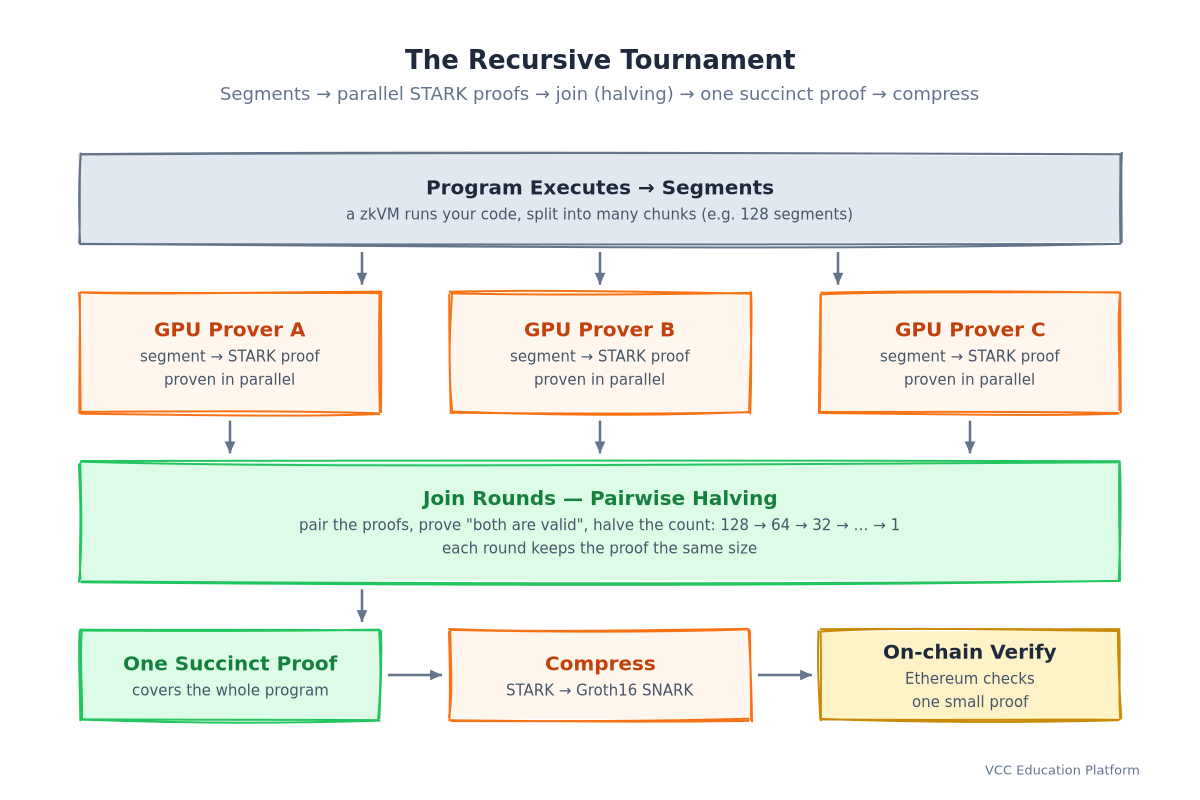
Figure 2: The Recursive Tournament — segments are proven in parallel, then joined like a knockout bracket
Why This Feels Impossible (and Isn't)
There's a natural objection: if proving a proof requires re-checking the entire proof inside a circuit, isn't that even more work? Yes — for the prover. Recursion doesn't make proving free. It makes verification constant.
The key insight is that the verifier of a good proof system is much cheaper than the prover. A proof might take hours to generate but only milliseconds to check. So when a circuit runs "verify proof π1," the circuit is executing the cheap verifier algorithm — not re-doing the expensive proving.
That's why recursion works at all: you repeatedly prove the cheap part (verification), never the expensive part (proving).
There's a second, deeper subtlety. A circuit operates over numbers in a finite field. The verification of proof π1 uses arithmetic in field F1. The proof π2 that verifies π1 must run in a field compatible with F1's arithmetic. If the fields don't match, you can't nest. The solution is cycles of elliptic curves — two curves where each curve's base field matches the other curve's scalar field, so a proof on curve A can be verified inside a circuit on curve B, and vice versa. Mina's Pasta curves (Tick and Tock) are the most famous pair.
The Tournament: How Recursion Joins Many Proofs
The most practical use of recursion is joining. Here's the "world cup knockout" structure used by zkVMs:
- Your program is executed, producing segments (chunks of computation).
- Each segment gets its own proof — these can be generated in parallel, spread across many machines or GPUs.
- Pair the proofs. For each pair, generate one proof that says "both of these proofs are valid." Now you have half as many proofs.
- Repeat: join pairs again, halving each round, until exactly one proof remains.
- That single proof covers the entire program.
With 128 segments, that's 7 rounds of joining (128 → 64 → 32 → 16 → 8 → 4 → 2 → 1). At the end, one proof attests to all 128 segments. This is exactly how RISC Zero's join and SP1's recursion work.
And if that final proof is too big for on-chain gas — STARK proofs are hundreds of kilobytes — there's a final compress step: a STARK-to-SNARK circuit wraps the recursive STARK proof into a compact Groth16 proof that Ethereum can verify cheaply.
This is why zkvm recursion makes "unbounded computation with constant-size proof" real: RISC Zero's docs describe recursive proving as enabling unbounded computation size, constant proof size, proof aggregation, and proof composition.
What Recursion Gives Rollups
Now connect recursion to the blockchain world you actually use.
A zk rollup batches thousands of transactions off-chain, generates one validity proof, and posts it to Ethereum. Recursion makes this dramatically cheaper in three ways:
- Amortized verification. Ethereum verifies one small proof per batch instead of thousands. The gas cost is fixed — so the per-transaction L1 cost approaches zero as the batch grows. StarkEx validity proofs have batched over a million transactions in a single proof.
- Proofs of proofs = rollups of rollups. A recursive proof can verify another rollup's proof. This lets an L2 prove its state, then an L3 (or another L2) verify that proof inside its own circuit. The result is a hierarchy of rollups where the base layer only checks the root.
- Parallel proving. Recursion lets teams throw more machines at the problem: split the batch into segments, prove each in parallel, join the results. Succinct's SP1 and RISC Zero both support this, with GPU acceleration pushing proving times down dramatically.
Without recursion, a rollup's proof would grow with its batch — and per-transaction posting costs would eventually bankrupt the economics. Recursion is the compression algorithm that makes zk rollup finality viable.
The Honest Tradeoff
Recursion is not free, and a good engineer knows where the cost went.
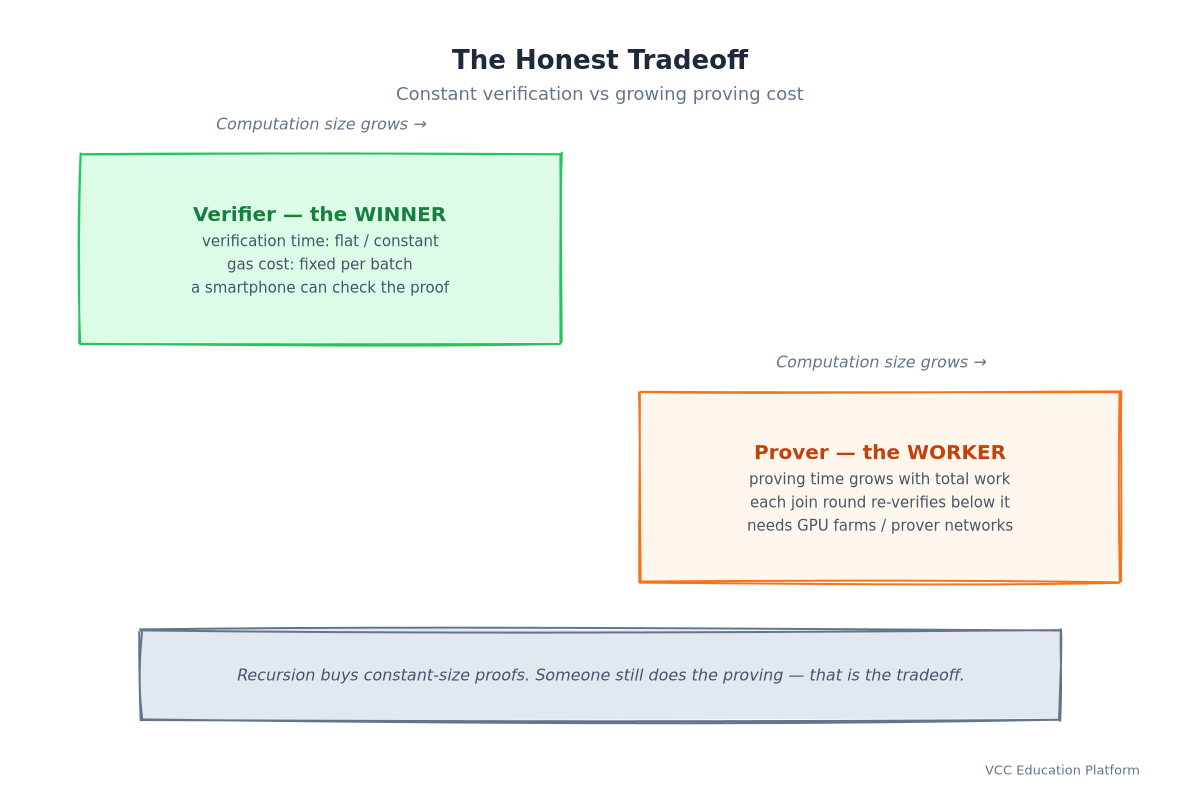
Figure 3: The Honest Tradeoff — verification stays constant while proving cost grows
- Prover cost grows with total work. Each join round re-verifies the proofs below it. The prover effectively does roughly the sum of all layers of verification. For small computations this is negligible; for huge ones it's why prover networks and GPU farms exist.
- The toolchain is complex. Recursion circuits are harder to build and audit than single-circuit proofs. Bugs in the recursive wrapper are a real attack surface.
- Field/curve constraints. You must pick curves that form a valid cycle (or use folding, which avoids the pairing cycle entirely). Nova's folding approach verifies the accumulated state algebraically instead of cryptographically, keeping each step cheap.
For the verifier, though, the cost is essentially constant — which is exactly the property blockchains need.
Common Questions About Recursive ZK Proofs
What is a recursive zk proof in simple terms?
A proof that says "this other proof is valid." Because verification is cheap, you can nest proofs to cover arbitrarily large computations with a constant-size final proof.How is a recursive proof different from a normal proof?
A normal proof verifies one computation. A recursive proof verifies another proof. That one difference unlocks composition, aggregation, and unbounded scaling.Why don't proofs get bigger when you nest them?
Because each layer proves the verification of the layer below — and verification is a small, fixed computation with a small, fixed proof. Size stays constant by construction.Does recursion make proving slower?
Proving is more expensive in total (all layers add up). But verification — what matters on-chain — stays fast and constant. This is the fundamental tradeoff of the design.Which zkVMs use recursive proofs?
RISC Zero (lift/join/compress), Succinct SP1 (STARK recursion + Groth16 wrapping), and Mina (Pickles, built on Pasta curves) are the leading examples. zkSync Era, Starknet, and Polygon zkEVM also rely on recursive aggregation at the proving layer.Can a recursive proof prove proofs from different systems?
Yes — a "wrapper" circuit can verify any proof system whose verifier is encodable as a circuit. That's how STARK-to-SNARK compression works, and it's how rollups can verify each other's proofs (cross-rollup composability).Is recursion secure?
Security reduces to the underlying proof systems plus the correctness of the recursive wrapper circuit. Formal verification of the wrapper (as projects like Jolt pursue) is the industry's answer to that risk.The Bottom Line
A recursive zk proof is proof within proof — a cryptographic matryoshka doll where each layer certifies the one below it. What seems like a curiosity turns out to be the engine of modern blockchain scaling:
- Verification stays constant no matter how much computation happened.
- Proofs can be joined, like a knockout tournament, to aggregate millions of transactions.
- Rollups can nest, so an entire scaling hierarchy rests on one small proof the base chain verifies.
When you send money through a zk rollup and Ethereum verifies the batch in milliseconds, zkvm recursion is the reason it's possible. The proof is small because every proof inside it is proving another proof — all the way down to the computation itself.
Quick Reference
| Property | Value |
|---|---|
| Core idea | A proof whose circuit verifies another proof |
| Proof size | Constant regardless of computation length |
| Verifier cost | ~Constant (amortized per transaction) |
| Prover cost | Grows with total work (all layers) |
| Key mechanism | Joining (pairwise halving), folding (Nova/IVC), curve cycles |
| Example zkVMs | RISC Zero (lift/join/compress), SP1 (STARK→Groth16), Mina (Pickles) |
| Rollup use | Amortize L1 verification; rollups of rollups; parallel proving |
| Batch scale | 1M+ transactions in a single validity proof (StarkEx) |
| Field trick | Cycles of curves (e.g., Pasta Tick/Tock) enable nesting |
| Tradeoff | Cheap verification, expensive proving, complex toolchain |