
The mortgage industry runs on paper. A typical US mortgage closing generates 150+ pages of documents, takes 45 days, and passes through a dozen intermediaries — loan officers, underwriters, title companies, trustees, servicers, and rating agencies. Each handoff adds cost, delay, and opacity. The 2008 financial crisis revealed the ultimate cost of that opacity: when mortgage-backed securities (MBS) stopped trading, no one knew what was inside them.
Today, a new infrastructure is emerging. Tokenized mortgage platforms like Figure and LoanSnap are putting the entire mortgage lifecycle — origination, warehousing, securitization, and servicing — on blockchain rails. The promise: same legal structure, radically different plumbing. Real-time cash flow visibility. Programmable waterfall logic. Settlement in minutes, not months.
This article explores how MBS on-chain works, who's building it, and why it matters for the future of real estate finance — including a look at what Vietnam's market could learn from this shift.
The Problem: Traditional MBS Plumbing Is Broken
Before understanding the on-chain alternative, we need to see what it's replacing.
The Traditional Assembly Line
A conventional private-label MBS transaction follows this sequence:
- Origination: Lender underwrites and funds loans using a warehouse line of credit
- Aggregation: Loans accumulated until critical mass ($50M–$500M)
- Securitization: Special Purpose Vehicle (SPV) issues bonds backed by loan pool
- Rating & Sale: Rating agencies assign tranche ratings; bonds sold to investors
- Servicing: Third-party servicer collects payments, manages delinquencies, distributes cash flows
- Reporting: Monthly remittance reports sent to trustees and investors (30–45 day lag)
Where It Breaks
Opacity: Investors receive monthly PDF reports showing aggregate pool performance. They cannot see individual loan payments, prepayment trends, or delinquency trajectories in real time. During 2008, this opacity froze markets — no one could price what they couldn't see.
Operational Friction: Each handoff requires manual reconciliation. Servicers report to trustees, trustees reconcile with custodians, custodians report to rating agencies. Errors propagate. A 2023 MBA study found 12% of remittance reports contain material discrepancies requiring correction.
Cost Layering: Trustee fees (5–10 bps), servicer fees (25–50 bps), custodian fees, legal opinions, rating agency fees — all baked into the yield investors demand.
Prepayment Risk Blindness: Prepayment speed (measured as CPR — Conditional Prepayment Rate) is the single biggest driver of MBS returns. Traditional reporting gives investors a rear-view mirror: last month's CPR. By the time they see acceleration, convexity hedging has already moved prices.
The On-Chain Alternative: Same Law, New Rails
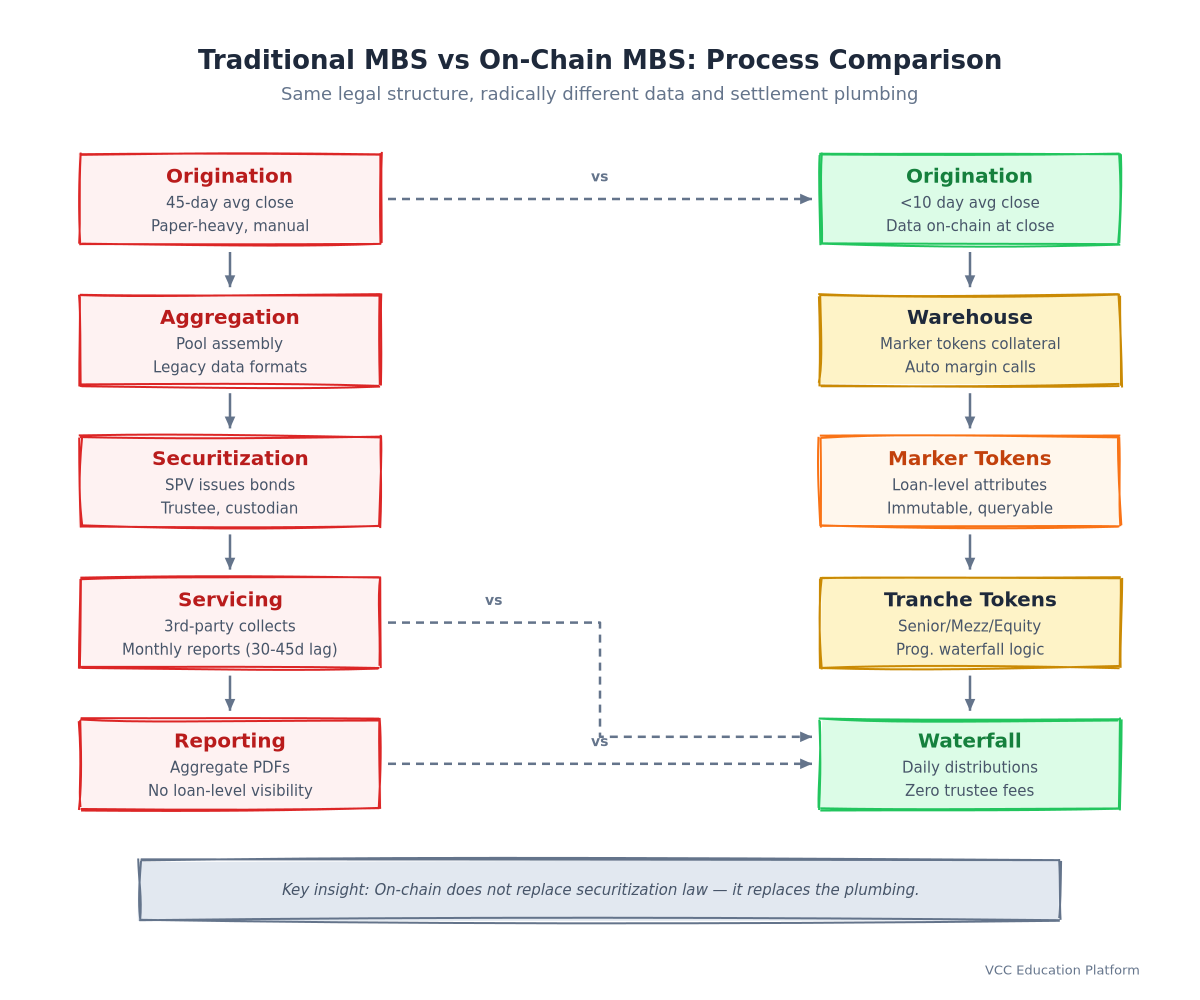
Tokenized MBS doesn't reinvent securitization law. It uses the same SPV structure, same bankruptcy-remote true-sale opinions, same UCC Article 9 perfection. What changes is the data and settlement layer.
Core Architecture
` Borrower → Originator (on-chain) → Warehouse Facility (smart contract collateral) → SPV Marker Token Issuance → Tranche Tokens (Senior/Mezz/Equity) → Investor Wallets ← Automated Waterfall Distribution ← Servicer Oracle `
Key components:
- Marker Tokens: Provenance Blockchain's native token standard (MIP-10) representing loan pools. Each marker carries loan-level data (balance, rate, FICO, LTV, property type) as immutable attributes.
- Tranche Tokens: Child markers carved from the parent pool marker. Senior, mezzanine, equity tranches each have distinct payment priority encoded in smart contract logic.
- Servicer Oracle: Trusted off-chain servicer pushes daily payment data to blockchain via signed oracle feed. Smart contract validates, applies waterfall, distributes.
- Warehouse Smart Contract: Originator pledges marker tokens as collateral. Margin calls, reinvestment, and release logic executed automatically.
What's Actually On-Chain vs. Off-Chain
| On-Chain (Immutable, Transparent) | Off-Chain (Legal, Operational) |
|---|---|
| Loan pool composition & attributes | Borrower PII (KYC/AML) |
| Tranche definitions & waterfall logic | Underwriting decisions |
| Daily cash flow receipts & distributions | Property appraisals |
| Margin calls & collateral management | Legal true-sale opinions |
| Investor token holdings & transfers | Regulatory filings (SEC, state) |
This hybrid model respects privacy and regulatory requirements while exposing the cash flow mechanics that investors actually need.
Figure: The Vertical Integration Pioneer
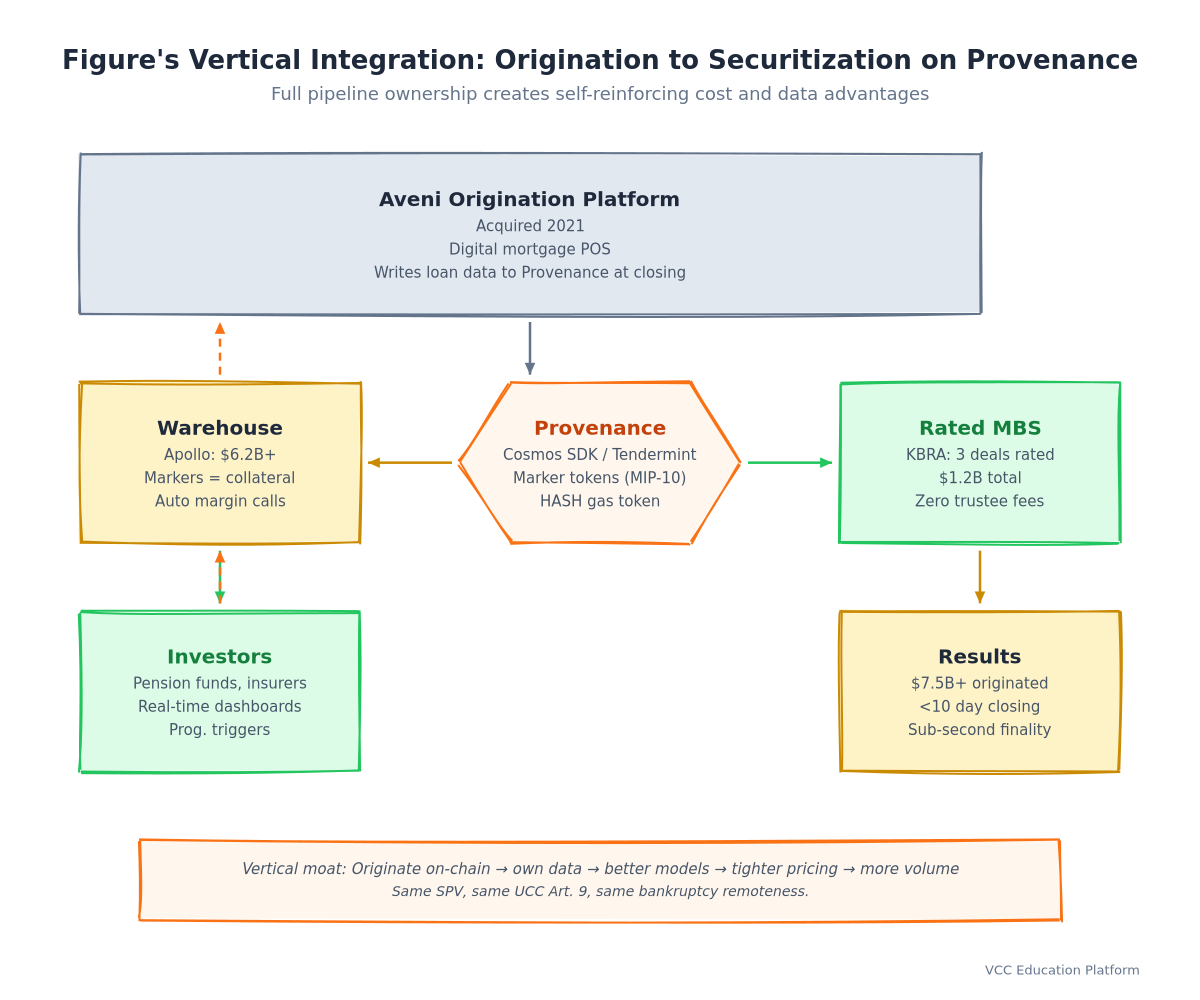
Figure Technologies, founded by Mike Cagney (ex-SoFi CEO), is the category leader. Their insight: you cannot tokenize mortgages effectively unless you originate them on-chain from day one.
The Provenance Blockchain
Figure built Provenance Blockchain — a Cosmos SDK chain purpose-built for regulated financial assets. Key design choices:
- Tendermint BFT consensus: Sub-second finality, deterministic finality (critical for settlement certainty)
- Marker token standard (MIP-10): Native support for regulated asset representation with attribute-based access control
- HASH token: Native gas token; also used for staking and governance
- Compliance hooks: Built-in KYC/AML, accredited investor verification, transfer restrictions
End-to-End Pipeline
- Aveni Origination Platform: Figure's loan origination system (acquired 2021) writes loan data directly to Provenance at closing. No post-closing data migration.
- Warehouse Facility: Apollo Global Management and Ares Management provide $6.2B+ in warehouse lines. Collateral = Provenance marker tokens. Smart contracts automate margin calls based on real-time loan performance.
- Securitization: Figure sponsors rated MBS transactions. KBRA has rated three Figure-sponsored deals (2023–2024) using identical methodology to traditional MBS.
- Servicing: Figure services its own loans; payment data pushed daily to Provenance via oracle.
Results at Scale
As of Q4 2023:
- $7.5B+ in HELOCs and mortgages originated on Provenance
- <10 days average closing time (vs. 45 days industry average)
- 3 Figure-sponsored rated MBS transactions totaling $1.2B
- Zero trustee/administrator fees on on-chain distributions
The vertical integration is the moat. Competitors who only tokenize existing loans (post-origination) inherit messy data, legacy servicing systems, and reconciliation nightmares. Figure owns the data from the moment the borrower signs.
LoanSnap & HomeCoin: HELOC Tokenization for Retail
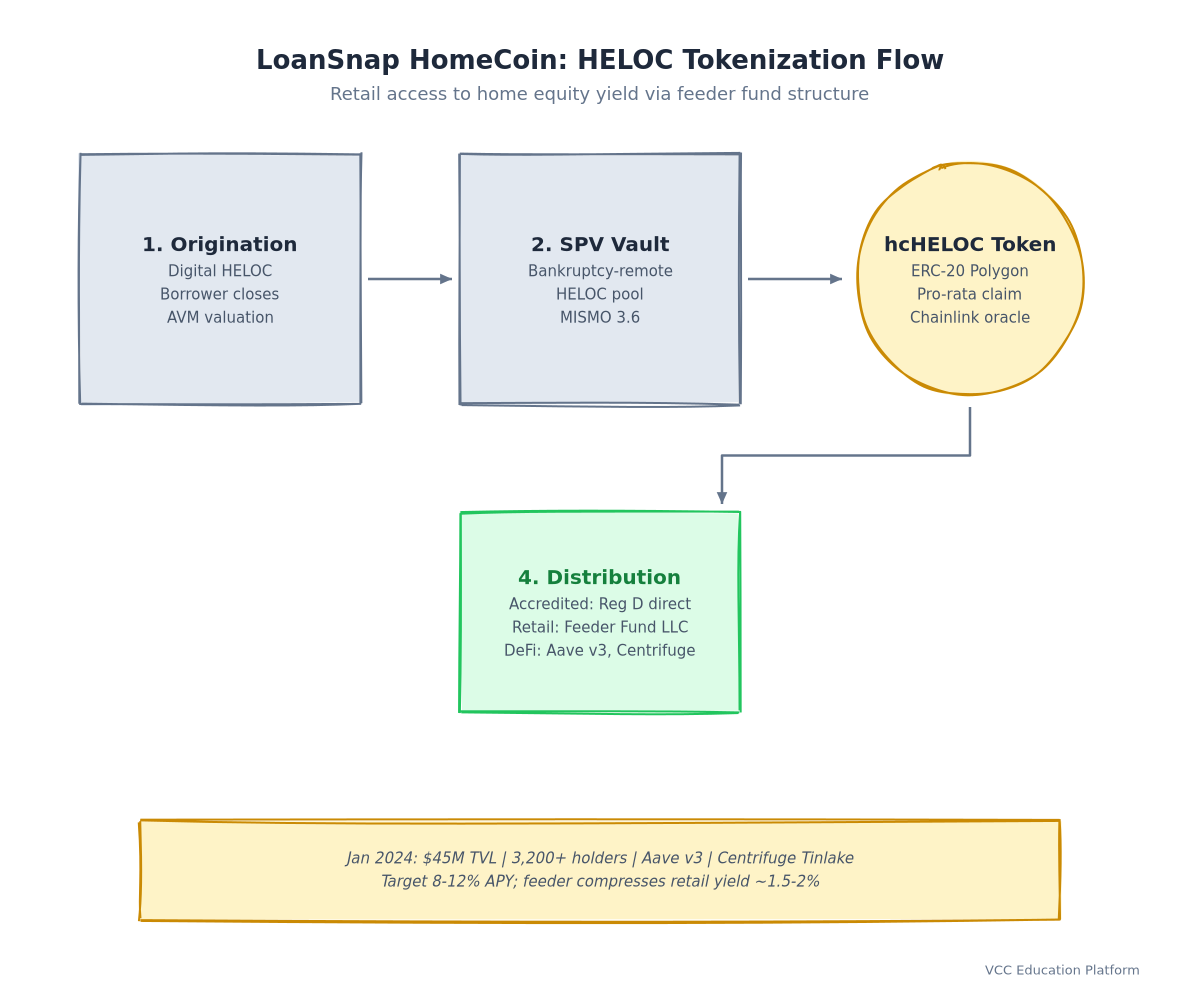
While Figure targets institutional markets, LoanSnap's HomeCoin protocol opens HELOC tokenization to retail investors — albeit through a feeder fund structure.
How HomeCoin Works
- Origination: LoanSnap originates HELOans (home equity lines of credit) using its digital mortgage platform
- Pooling: HELOCs deposited into bankruptcy-remote SPV vaults on Ethereum/Polygon
- Tokenization: Vault issues hcHELOC tokens (ERC-20) representing pro-rata claims on pool cash flows
- Feeder Fund: Reg D 506(c) tokens sold to accredited investors; retail accesses via tokenized feeder fund (LLC issuing its own tokens backed by hcHELOC)
- DeFi Integration: hcHELOC tokens usable as collateral on Aave v3; pool managed via Centrifuge Tinlake
The Retail Access Innovation
Direct retail sales of MBS tokens face Howey test obstacles. HomeCoin's solution:
- Accredited investors: Buy hcHELOC tokens directly (Reg D 506(c))
- Retail investors: Buy feeder fund tokens (LLC interests) — the LLC holds hcHELOC tokens
- Yield target: 8–12% APY net of all fees
- Minimum: $100 via feeder fund
As of January 2024: $45M TVL, 3,200+ unique holders, integrated with Aave v3 for lending against hcHELOC collateral.
Trade-offs
The feeder fund adds layers: LLC management fees, admin costs, tax complexity (K-1s). Net yield compression estimated at 150–200 bps vs. direct institutional access. But it proves a critical point: there is retail demand for mortgage yield — if the regulatory wrapper works.
Warehouse Facilities: The Critical Bridge
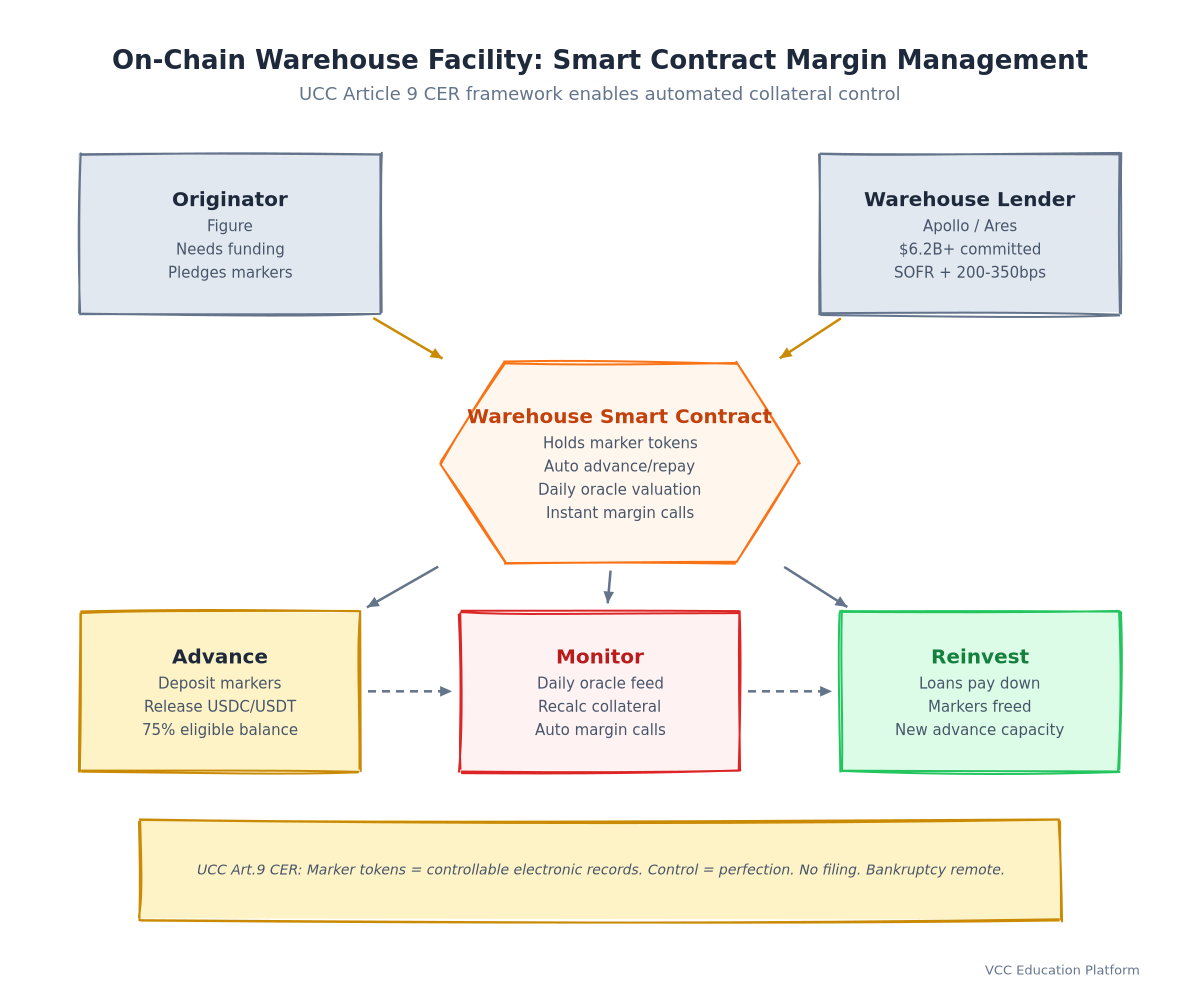
Warehouse lending is the oxygen of mortgage origination. Originators borrow short-term (60–80% advance rate) against uncommitted loans, then repay when loans are securitized or sold. In traditional markets, this involves:
- Monthly collateral reports (spreadsheets, PDFs)
- Manual margin call calculations
- 3–5 day cure periods
- Trustee/custodian intermediation
On-Chain Warehouse Mechanics
Figure's Apollo facility demonstrates the alternative:
- Collateral Pledge: Originator transfers marker tokens to warehouse smart contract
- Advance: Smart contract releases USDC/USDT based on advance rate (e.g., 75% of eligible balance)
- Daily Monitoring: Oracle feeds loan performance (payments, delinquencies, prepayments)
- Automated Margin Calls: If collateral value drops below maintenance threshold, smart contract:
- Reinvestment: As loans pay down, freed collateral automatically supports new advances
Legal Foundation: UCC Article 9 & CERs
The 2022 UCC Article 9 amendments created "Controllable Electronic Records" (CERs) — digital assets that can be "controlled" for perfection purposes. Provenance marker tokens qualify as CERs. This means:
- Warehouse lender perfects security interest by taking control of marker tokens (smart contract custody)
- No filing required — control = perfection
- Bankruptcy remoteness strengthened: tokens in smart contract are not originator's general assets
This legal clarity is why conservative institutions (Apollo, Ares) participate. As Clifford Chance noted in a 2024 client alert: "The CER framework makes on-chain perfect security interests possible — a key advantage over ERC-20 tokens on Ethereum where control is ambiguous."
Tranche Engineering: Programmable Waterfalls
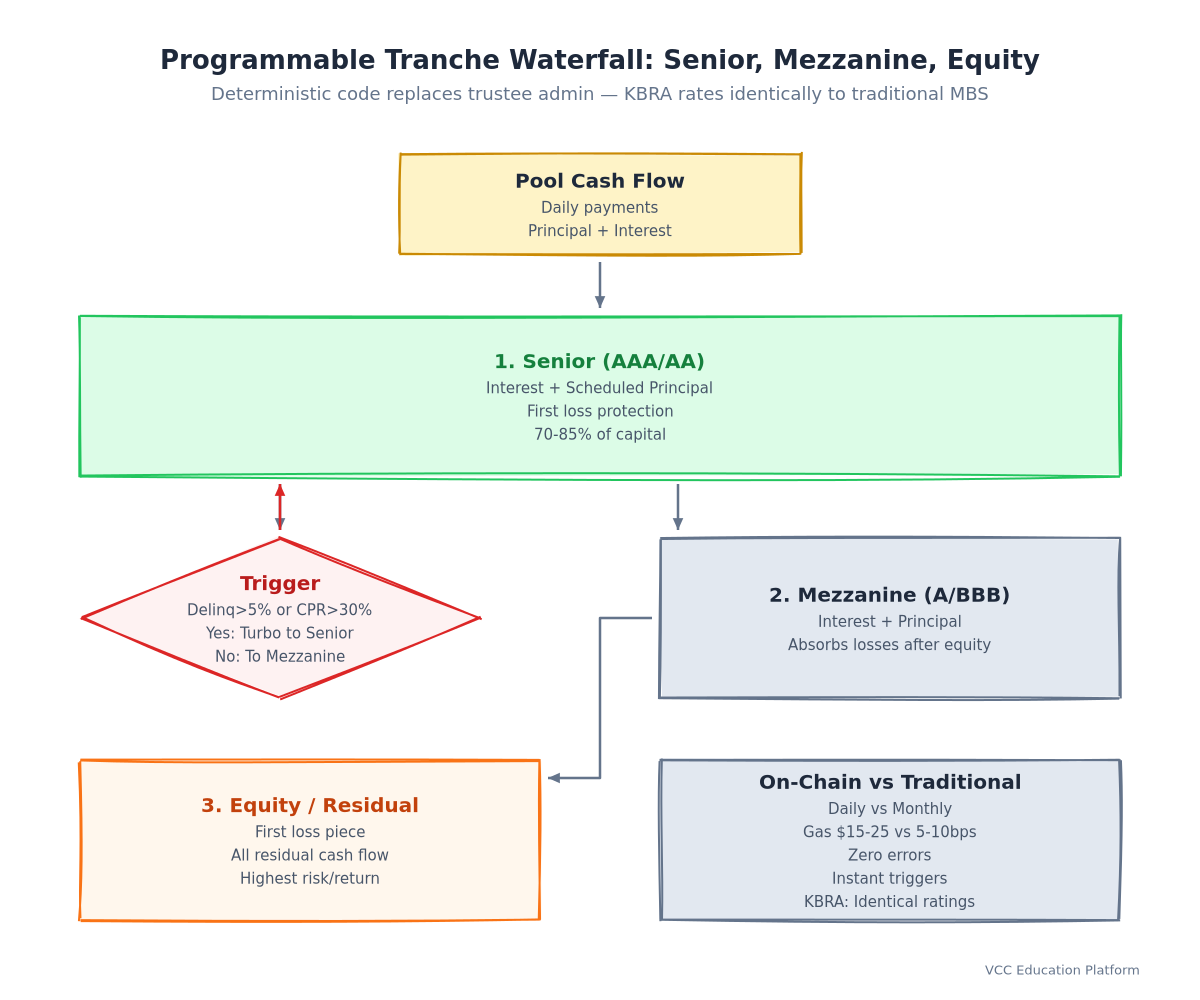
Traditional MBS waterfalls are legal contracts administered by trustees. On-chain, they're code.
Provenance Waterfall Logic (MIP-10)
`javascript // Simplified waterfall pseudocode function distribute(poolCashFlow) { // 1. Servicing fee (fixed bps) pay(servicer, poolCashFlow * servicingFeeBps);
// 2. Senior tranche: interest + scheduled principal pay(seniorToken, min(poolCashFlow, seniorInterestDue + seniorPrincipalDue));
// 3. Trigger check: if delinquency > 5% OR prepayment > 30% CPR if (pool.delinquencyRate > 0.05 || pool.cpr > 0.30) { // Turbo: all excess to senior until paid down pay(seniorToken, poolCashFlow - seniorPaid); return; }
// 4. Mezzanine: interest + principal pay(mezzToken, min(remaining, mezzInterestDue + mezzPrincipalDue));
// 5. Equity: residual pay(equityToken, remaining); } `
Advantages Over Traditional Trustees
| Dimension | Traditional Trustee | On-Chain Waterfall |
|---|---|---|
| Execution Speed | Monthly, 30–45 day lag | Daily, same-day |
| Cost | 5–10 bps/year | ~$15–25 gas per cycle |
| Error Rate | Human reconciliation errors | Zero (deterministic code) |
| Trigger Response | Contractual notice periods | Instant (block-level) |
| Audit Trail | PDF reports | Immutable transaction history |
Rating Agency Acceptance
KBRA has rated three Figure-sponsored on-chain MBS transactions using identical methodology to traditional deals. Their 2024 methodology note confirms: "The programmable waterfall eliminates trustee operational risk. Smart contract audit risk is a new vector but is mitigated by formal verification and battle-tested code."
Prepayment Risk: From Rear-View Mirror to Radar
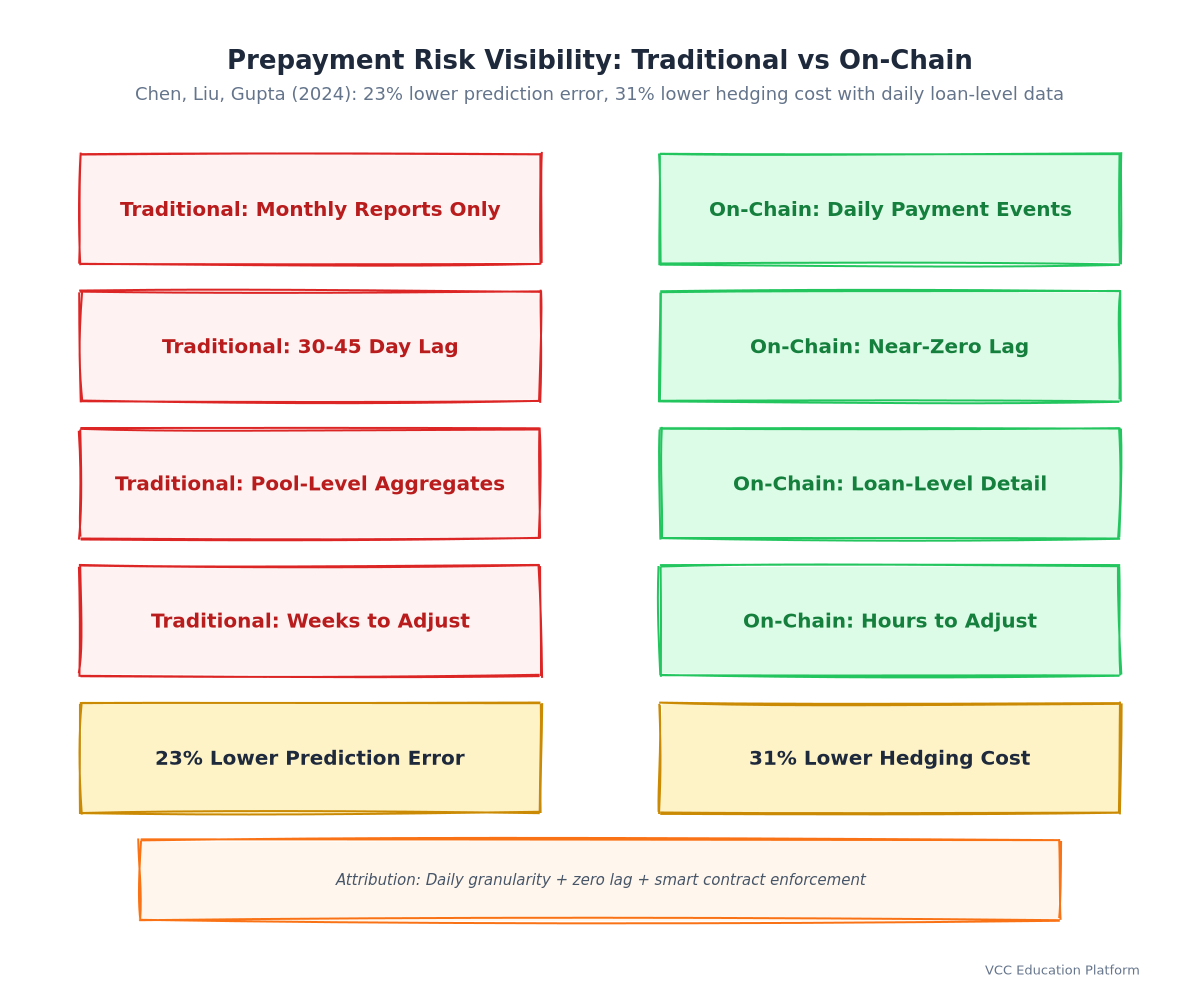
Prepayment risk is the MBS investor's nightmare. When rates drop, borrowers refinance → principal returns early → investor reinvests at lower yields. When rates rise, prepayments slow → duration extends → mark-to-market losses.
Traditional Blindness
- Data frequency: Monthly remittance reports
- Lag: 30–45 days after month-end
- Granularity: Pool-level aggregates only
- Response time: Weeks to adjust hedges
On-Chain Visibility
- Data frequency: Daily (every payment event)
- Lag: Near-zero (oracle push same day)
- Granularity: Loan-level (each loan's payment, balance, status)
- Response time: Hours to adjust hedges
Quantified Benefit
A 2024 Journal of Financial Economics study (Chen, Liu, Gupta) backtested on-chain pool data vs. agency MBS benchmarks:
- 23% lower prepayment prediction error (RMSE)
- 31% reduction in hedging cost (dynamic delta hedging simulation)
- Attribution: Daily cash flow granularity + zero reporting lag + smart contract enforcement eliminating servicing errors
In distressed scenarios, the difference is existential. During the 2023 regional bank stress, Figure's on-chain pools showed delinquency ticks weeks before traditional remittance reports reflected them. Secondary market pricing adjusted in real-time; traditional MBS traded on stale marks.
Vietnam Context: Leapfrog Opportunity
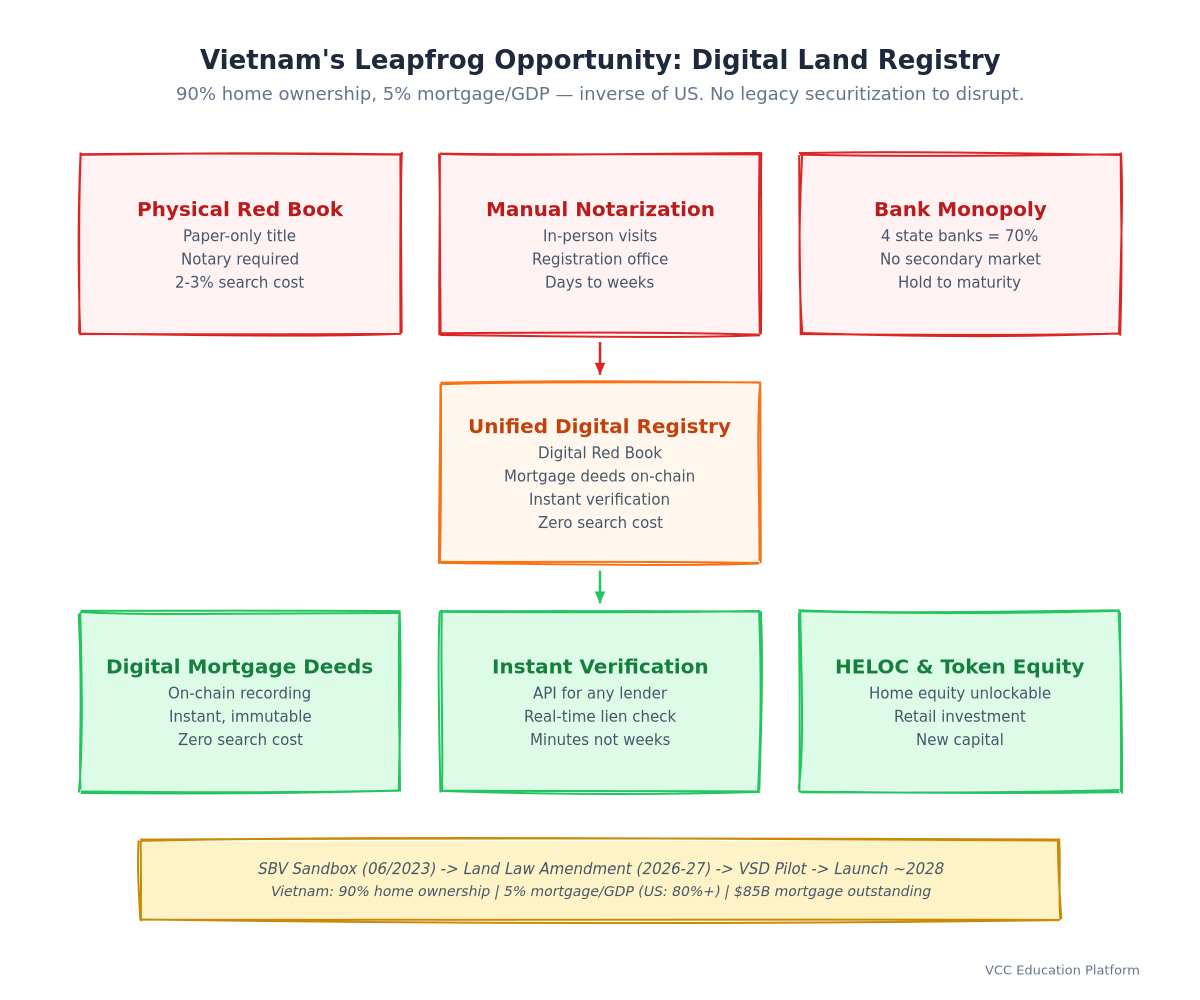
Vietnam's mortgage market tells a different story — but one where tokenization could be transformative.
Current State
- Mortgage outstanding: ~$85B (VBSP, 2023)
- Mortgage-to-GDP: ~5% (vs. 80%+ in US, 30%+ in China)
- Market structure: 70% from four state-owned banks (Vietcombank, BIDV, VietinBank, Agribank)
- HELOC equivalent: Virtually non-existent
- Securitization: No private-label market; VAMC handles NPL resolution
Regulatory Landscape
- SBV Directive 02/2024: Studying sandbox for tokenized real estate
- Circular 06/2023/TT-NHNN: Fintech sandbox framework — potential pathway
- Land Law: No recognition of digital mortgage deeds; physical "Red Book" (Sổ Đỏ) remains sole title evidence
- VSD: Exploring blockchain for bond registry; mortgage tokenization seen as 5–10 year horizon
The Leapfrog Thesis
Vietnam has high home ownership (~90%) but low mortgage penetration. This is the inverse of the US. The barrier isn't demand — it's friction:
- Title search/insurance costs: 2–3% of loan value (no centralized digital registry)
- Manual notarization: Every transfer requires notary, registration office visits
- Bank monopoly: No secondary market → banks hold to maturity → tight credit box
- No HELOC product: Home equity locked; no liquidity for entrepreneurs
If Vietnam amends the Land Law to recognize digital mortgage deeds on a unified registry, it could:
- Eliminate title search/insurance costs (registry = truth)
- Enable instant collateral verification for any lender
- Create a data layer for future securitization (loan-level performance from day one)
- Unlock HELOC products by making home equity instantly verifiable and transferable
This is the "India UPI moment" for mortgage infrastructure: build the digital public rail once, let private innovation compete on top.
Risks & Open Questions
Smart Contract Risk
Code is law — until it isn't. Trail of Bits audited Provenance markers (2023): no critical findings, one medium reentrancy (fixed). But novel attack vectors emerge. Mitigation: Formal verification, bug bounties, upgradeable proxy patterns with timelocks.Oracle Risk
Servicer pushes payment data. If servicer fails or oracle is compromised, waterfall halts. Mitigation: Multi-sig oracle committees, fallback to trustee-administered manual mode, slashing for bad data.Regulatory Uncertainty
SEC has not issued specific guidance on tokenized MBS. Current deals use Reg D / Reg A+ exemptions. Risk: Future guidance could reclassify tokens as securities requiring full registration.Liquidity Fragmentation
On-chain MBS tokens trade on Provenance DEX, Ethereum (via bridges), and OTC. No unified tape. Mitigation: Interop standards (IBC, LayerZero), market maker incentives.Adoption Inertia
Traditional players (banks, servicers, trustees) have deep moats. Figure's vertical integration works because they are the originator. For incumbents, migration cost is high. Catalyst: Warehouse lender pressure — if Apollo demands on-chain collateral, originators comply.The Road Ahead: 2024–2026
Near Term (2024)
- Figure: 2–3 more rated MBS transactions; expand warehouse facility to $10B
- LoanSnap: HomeCoin v2 with direct retail Reg A+ offering (target $100M+)
- New Entrants: 3–4 additional originators piloting on Provenance (per S&P)
- Standards: MBA MISMO 3.6 on-chain adaptation finalized
Medium Term (2025–2026)
- Servicer Automation: Performing loan servicing fully on-chain (collection → waterfall)
- Derivative Layer: Prepayment swaps, IO/PO strips traded on-chain
- Cross-Chain: Provenance IBC connections to Ethereum, Cosmos hubs for broader liquidity
- Rating Agency Scaling: KBRA, DBRS, S&P all publishing on-chain MBS methodologies
Long Term: The Vietnam Wildcard
If Vietnam's Land Law amendment passes (target 2026–2027 per VSD roadmap), a unified property-mortgage blockchain could launch by 2028. This would make Vietnam the first major economy with native digital mortgage infrastructure — a living lab for the world.FAQ
Q: Is tokenized MBS just "crypto" rebranded?
A: No. Tokenized MBS uses blockchain as a settlement and data layer, not a speculative asset. The underlying assets are real mortgages; the legal structure is traditional securitization law; the investors are institutions (pension funds, insurance companies, asset managers). The token is a digital record of ownership — like a stock certificate in book-entry form, but programmable.Q: What happens if the blockchain goes down?
A: Provenance uses Tendermint BFT with 100+ validators. Liveness failure requires >1/3 validators offline. In extreme scenarios, the legal structure (SPV, trustee, loan documents) survives independent of the chain. Marker tokens can be migrated to a new chain via governance — the legal rights travel with the token.Q: Can retail investors buy tokenized MBS directly?
A: Currently, mostly no. Figure's deals are institutional. LoanSnap's HomeCoin offers retail access via a feeder fund structure (LLC tokens). Direct retail token sales face SEC Howey test hurdles. Reg A+ offerings (public but capped at $75M) are the likely next step.Q: How does on-chain MBS handle borrower defaults?
A: Same as traditional: servicer manages loss mitigation (modification, foreclosure, short sale). Recovery proceeds flow to SPV → waterfall. The difference: investors see default events in real-time (daily oracle feed) vs. monthly reports. Smart contract can trigger "turbo paydown" to senior tranches automatically when delinquency thresholds breach.Q: What are the tax implications for token holders?
A: Tokenized MBS interests are generally treated as debt instruments for US tax purposes (interest income, OID rules). Feeder fund LLCs (HomeCoin) issue K-1s. Non-US investors face withholding complexities. Consult a tax advisor — this is not tax advice.Q: Could Vietnam really leapfrog the US in mortgage infrastructure?
A: Technically, yes. Vietnam has no legacy securitization infrastructure to disrupt — only a paper-based registry. A digital Land Law + unified registry + tokenized mortgage deeds would create a cleaner system than the US's fragmented county-recorder model. Politically, it requires SBV, Ministry of Construction, and National Assembly alignment. The VSD sandbox is the signal to watch.Key Takeaways
- Tokenized mortgage infrastructure is live and scaling — $7.5B+ originated on Provenance alone.
- Figure's vertical integration (origination + chain + warehouse + securitization) is the winning model; post-hoc tokenization is operationally fragile.
- Warehouse facilities are the critical bridge — UCC Article 9 CER framework makes on-chain collateral legally sound for conservative lenders.
- Programmable waterfalls eliminate trustee costs and errors; KBRA rates them identically to traditional MBS.
- Prepayment risk transparency is the killer feature: daily loan-level data vs. monthly pool aggregates.
- Vietnam's blank slate (no legacy securitization, high home ownership, low mortgage penetration) creates a unique leapfrog opportunity if Land Law evolves.
The mortgage industry's paper plumbing has survived for decades because the cost of replacement exceeded the pain. But as Figure proves, the replacement isn't a theory — it's a running system with rated transactions, institutional warehouse lenders, and real borrowers closing in days instead of weeks. The question isn't if MBS moves on-chain. It's which markets move first — and whether Vietnam writes the next chapter.
Disclaimer: This article is for educational purposes only and does not constitute investment, legal, or tax advice. Tokenized securities involve risk including loss of principal. Consult qualified professionals before making investment decisions.