
Nguyen's fintech startup has just closed a seed round. Their proprietary fraud-detection model, trained on two years of transaction data and refined through three grid-search iterations, is the company's only moat. A neobank wants to integrate the model via API. The State Bank of Vietnam has asked for evidence that the model in production is the model the compliance team approved. A potential Series A investor asks for a technical audit. Nguyen cannot show the weights -- they are 200MB of proprietary logic trained on sensitive customer behavior -- but needs to prove the model runs honestly. This is the specific problem zkml solves, and for Vietnamese AI startups building on a regulatory sandbox created on 1 July 2025 by Nghị định 94/2025/NĐ-CP, the timing is no accident.
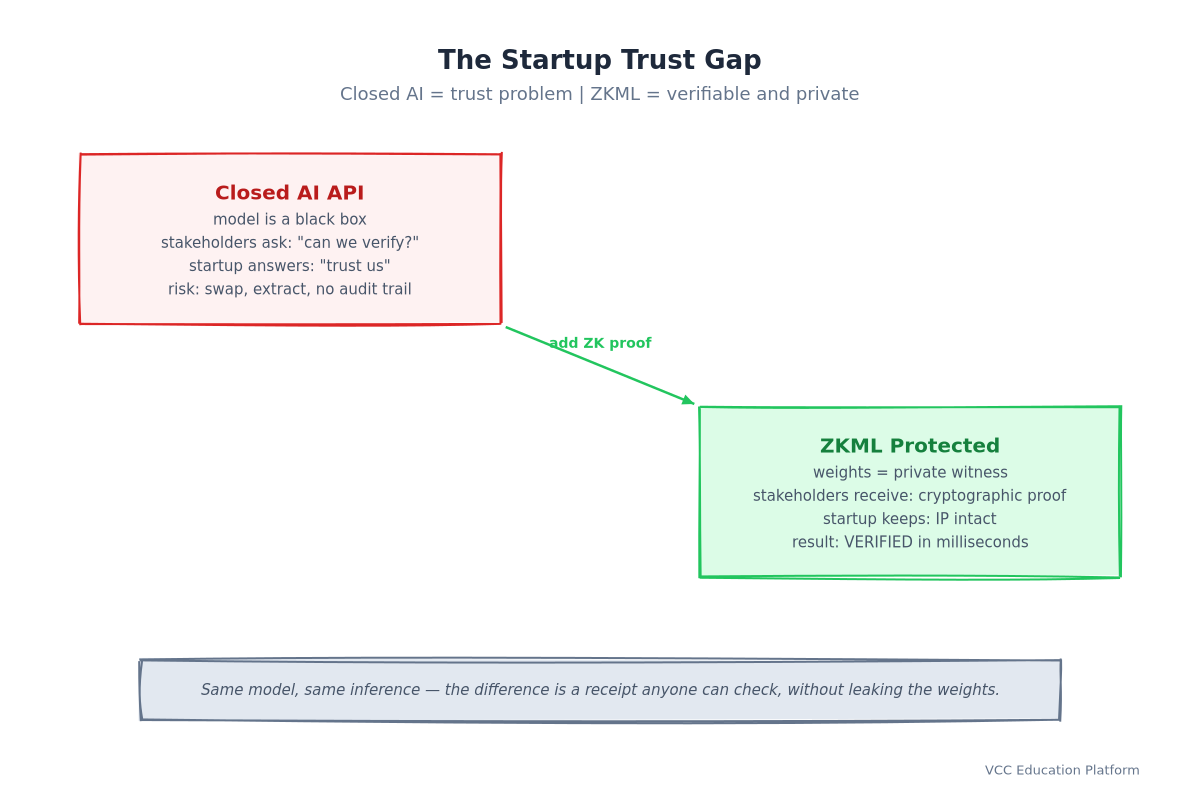
Zkml startup founders face a trust gap that looks like this: every stakeholder -- customers, regulators, investors, partners -- wants to verify that your AI does what you claim, but none of them should see the model that makes your company valuable. Traditional approaches force a tradeoff between transparency and secrecy. Zk model bảo mật -- the cryptographic protection of AI models through zero-knowledge proofs -- removes that tradeoff by letting the provider generate a short, independently verifiable receipt for every inference without transmitting the weights.
Why closed AI models need a new trust contract
A startup's model is not just code. It is the synthesis of proprietary training data, months of engineering work, and domain-specific tuning that competitors would pay to reverse-engineer. When a partner integrates your model via API, they receive outputs -- and over time, enough outputs allow model extraction attacks that reproduce a close approximation of your weights. When a regulator audits your AI-driven credit decision, they need proof the approved model ran, not a different model swapped in post-approval. When an investor conducts due diligence, they want evidence of fairness and consistency without seeing the recipe.
The old answer was "trust us." The new answer, powered by zero-knowledge proofs, is "check the proof yourself."
Zkml replaces trust-based contracts with cryptographic guarantees. The model's weights become the private witness in a zero-knowledge circuit: they participate in computing the proof but never appear in the output. The verifier checks the proof against the public input (customer features), the public output (the score or classification), and a model commitment -- a hash-like fingerprint of the exact weight file that was used. If someone swaps the model after approval, the commitment no longer matches and every subsequent proof fails verification. The startup keeps its IP, the regulator gets audit-grade evidence, and the investor gets mathematical proof of honest operation.
How the ZKML pipeline works for a startup
The path from a trained PyTorch or TensorFlow model to a production verifier has six stages. The good news: the first three are one-time setup; the remaining three run per inference.
- Export to ONNX. The standard interchange format for tensors. Most frameworks export in one line:
torch.onnx.export(model, ...). EZKL accepts ONNX directly. - Compile to a circuit. EZKL reads the ONNX graph, quantizes floating-point weights into fixed-point integers that live in a prime field, and generates a Halo2 circuit. The compiler also calibrates lookup tables for non-linear operations (ReLU, softmax) so the circuit's outputs match the original model within a tolerance you set. This step is the most sensitive: poor calibration silently degrades accuracy. A 1% drop in AUC for a credit-scoring model can mean both regulatory rejection and customer harm in a market like Vietnam where thin-file borrowers already face bias.
- Generate keys. One-time operation: EZKL produces a proving key (kept by the startup) and a verification key (published publicly or to the regulator). EZKL uses Halo2, which requires no trusted-setup ceremony -- a meaningful advantage for early-stage teams that cannot organize a multi-party computation.
- Prove. On each customer request, the inference server runs the model, then runs the prover to generate a proof. Current hardware (a Lambda Labs A100 or even a dedicated RTX 4090) produces a proof for a 50k-parameter credit-scoring model in 2--15 seconds. The proof is a few kilobytes.
- Verify. The verifier -- which can be your API server, a regulator's dashboard, or an on-chain smart contract -- checks the proof in milliseconds. On Ethereum-compatible chains, EZKL's
verify()costs roughly 200k--500k gas. - React. The smart contract or API gateway can branch on the verification result: release a loan, flag a transaction, or log an auditable receipt.
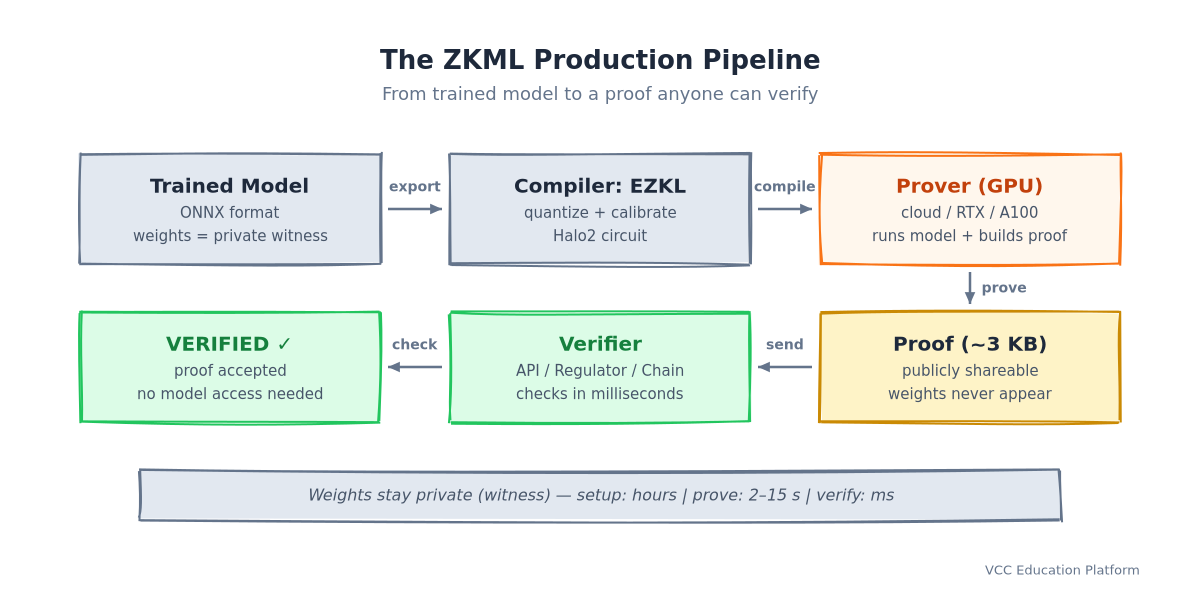
The design choices inside the compiler matter enormously. How the circuit lays out arithmetic operations changes proving speed by up to 24x. Non-linear activations -- softmax, GELU, LayerNorm -- cannot be expressed as raw arithmetic constraints; EZKL resolves them with Plookup-style lookup tables calibrated during the compile step. The latest systems, including NanoZK (2026), use 16-bit lookup-table approximations that achieve zero measurable accuracy loss on standard benchmarks. Before production, you should run your model's original test suite against the compiled circuit and confirm the AUC and F1 scores match within your business tolerance.
Three honest tradeoffs (and how startups can manage them)
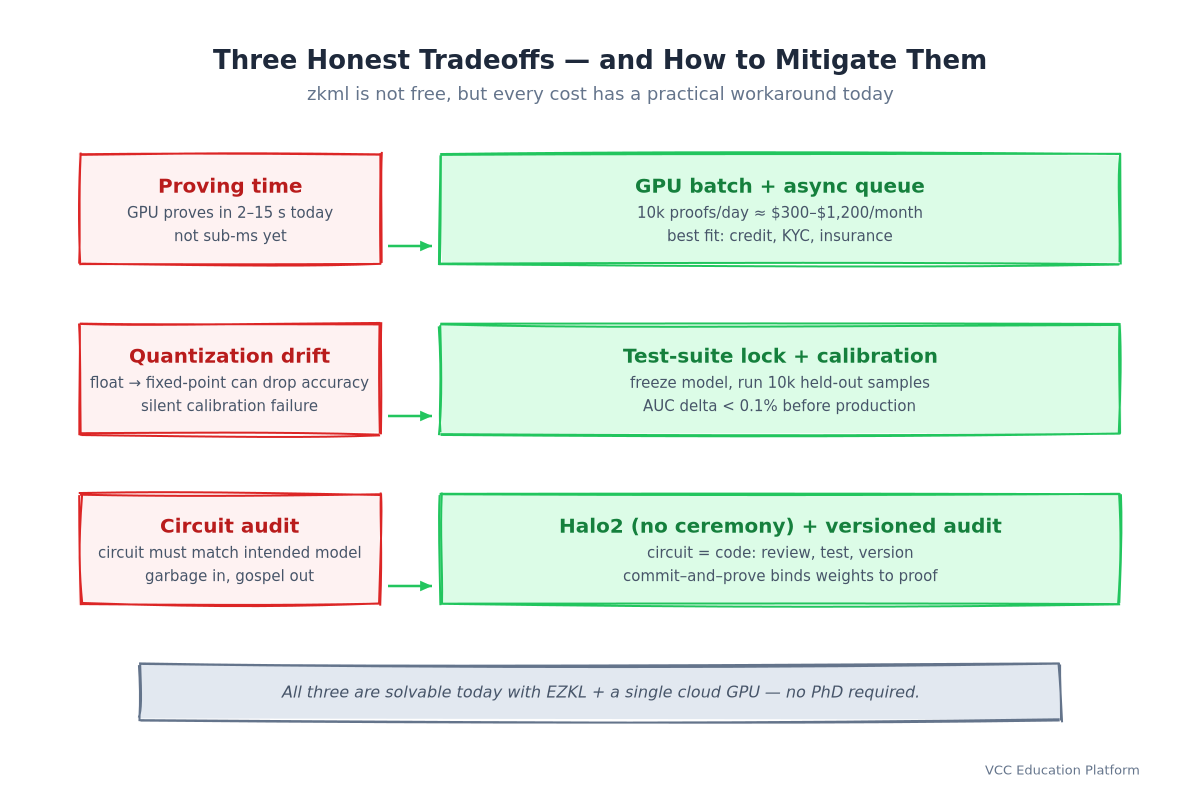
Zkml is not magic, and honest marketing requires explaining where it costs you today.
Tradeoff 1: Proving time is still seconds, not milliseconds
Running a GPU inference takes 5 milliseconds; generating the proof takes 2--15 seconds for a fraud-detection model with 50k parameters. That makes zkml unsuitable for real-time chat or high-frequency trading today. It is perfect, however, for the async decision paths that dominate Vietnamese fintech: credit decisions (minutes acceptable), insurance claims (hours acceptable), KYC verification (seconds if batched), and periodic regulatory reports. If your product requires sub-50ms latency on the proving step, you are not ready yet. If you can tolerate a 10-second proof window, you can ship tomorrow.
Tradeoff 2: Quantization accuracy requires discipline
Converting 32-bit floats to circuit-friendly integers introduces rounding. A well-calibrated EZKL pipeline preserves accuracy to within 0.1% on structured models like fraud detectors or credit scorers. The risk is silence: a bad calibration does not throw an error; it quietly shifts decision boundaries. For a startup whose model underpins lending decisions, that shift can create both customer harm and regulatory exposure under SBV's new sandbox rules. The mitigation is simple and non-negotiable: before compiling, freeze your model weights, run the original test suite (a labeled set of ~10k Vietnamese customer outcomes), and record the AUC. After compiling, run the same test suite through the circuit and diff the scores. If the delta is outside your tolerance, increase the quantization bit-width from 8 to 10 or tighten the calibration dataset.
Tradeoff 3: Circuit audit is a one-time cost that compounds
A zero-knowledge proof guarantees that the circuit ran honestly. It does not guarantee that the circuit represents the model you intended. A bug in the compiler, a misconfigured layer type, or a quantization mismatch can produce a circuit that proves a different computation than what your team reviewed. This is the "garbage in, gospel out" problem. Mitigation: audit the circuit against a reference implementation, publish the model commitment hash in a location the regulator can inspect, and treat the circuit as part of your codebase -- version it, test it, review it in pull requests. EZKL's Halo2 backend avoids the trusted-setup risk that haunts Groth16-based systems, which means you do not need to coordinate a multi-party ceremony and worry about whether a compromised participant could forge proofs later.
Getting started: a practical roadmap
For a Vietnamese AI startup with a production model, the first experiment can be completed in a single sprint.
Step 1: Export your model to ONNX. If you are in PyTorch, torch.onnx.export handles most common layer types. EZKL supports 40+ ONNX operators including convolutions, attention, LayerNorm, GELU, and SiLU -- the standard building blocks of modern fraud-detection and scoring models. If you have custom CUDA kernels, you may need to replace them with equivalent ONNX ops or write a custom EZKL operator.
Step 2: Install EZKL and generate a circuit. A minimal end-to-end run on a model with 50k parameters takes under an hour on an A100:
pip install ezkl
ezkl gen-settings --model model.onnx
ezkl calibrate-settings --model model.onnx --data input_data.json
ezkl setup --model model.onnx --pk proving_key.pk --vk verification_key.vk
Step 3: Confirm accuracy retention. Run your original model and the EZKL circuit on the same held-out test set. If the AUC matches to within 0.1%, proceed. If not, increase quantization bits or expand the calibration dataset.
Step 4: Prove and verify on a real customer sample. Generate a proof, verify it off-chain, and time the proving step. On an RTX 4090, a 50k-parameter fraud model typically runs in 5--12 seconds. Move to a cloud GPU (Lambda Labs, RunPod) for production throughput.
Step 5: Publish the model commitment and integrate. The commitment -- a Poseidon or Keccak hash of your serialized weights -- becomes the fingerprint customers and regulators check against. Integrate the prover into your inference server as a pre- or post-processing step, and expose the verification key through an API endpoint or a lightweight smart contract for on-chain use cases.
The realistic Vietnamese startup timeline: two weeks to first proof, four weeks to production integration, six weeks to regulator-ready audit trail. The cost is a GPU server (~$0.50--$2/hour on cloud) plus engineering time, not a proof-system PhD.
What this means for Vietnam's AI ecosystem
Zkml arrives in Vietnam at a regulatory inflection point. Nghị định 94/2025/NĐ-CP, effective 1 July 2025, created a State Bank of Vietnam sandbox for fintech credit-scoring pilots -- explicitly inviting the kind of auditable, innovative models that zkml enables. CIC (Trung tâm Thông tin Tín dụng Quốc gia) is modernizing its scoring infrastructure around AI with stated principles of explainability and stability. MoMo's AI-driven lending already serves millions of previously unbanked Vietnamese users. All three institutions need a better answer than "trust the model."
For startup founders, the calculus is concrete: zkml startup teams that can offer cryptographic proof of model integrity will close enterprise and regulatory deals faster than teams offering PDF white papers. The model commitment hash in your pitch deck signals technical maturity. The verifiable inference API signals that your product is audit-ready by design. For a three-person AI startup in HCMC competing with incumbents, that signal is worth more than a larger marketing budget.
The competitive moat is also sharper than most founders realize. Once your model is wrapped in a ZK circuit and your proving key is live, a competitor who extracts your API outputs cannot reconstruct the weights -- the proof is tied to the commitment, and the commitment is tied to your specific serialized model file. You can ship inference at scale without shipping the IP that makes it valuable.
Frequently asked questions
Is zkml ready for production credit scoring in Vietnam?
Yes. Fraud-detection and credit-scoring models with 20k--200k parameters compile and prove on consumer GPUs in under 15 seconds. EZKL's Halo2 backend is transparent (no trusted setup), the proof size is a few kilobytes, and verification is milliseconds. The regulatory question in Vietnam's sandbox is not whether the technology works -- it does -- but whether the SBV will accept a cryptographic proof as equivalent to a model card. Early sandbox participants will define that standard.
How much does a proving GPU cost, and can a seed-stage startup afford it?
A cloud GPU instance sufficient for production workloads costs $0.50--$2/hour on Lambda Labs or RunPod. At 10,000 proofs per day for a credit-scoring API with sub-15-second proving time, the proving infrastructure is roughly $300--$1,200 per month -- cheaper than most seed-stage engineer salaries. Async architectures (queue proofs, cache results) can cut this further.
What if regulators want to inspect the model weights anyway?
They cannot get them from a ZK proof. The commitment hash and verification key are public by design, but the weights remain the private witness inside the circuit. If a regulator wants to audit the model directly, the startup can share the model in a controlled environment (NDA, air-gapped room) -- the ZK proof handles the operational audit (is the approved model running in production?), separate from the design audit (what does the model actually compute?).
Will ZKML protect my model from my own employees leaking it?
It mitigates, but does not eliminate, insider risk. The proving key is required to generate proofs; if an employee exfiltrates the proving key, they can generate valid proofs on a stolen copy of the model. Treat the proving key like any other production secret: hardware security modules, access logging, key rotation. ZKML protects customer-facing inference integrity and IP during API distribution; it is one layer of a broader security architecture.
Conclusion
A Vietnamese AI startup's best asset is its model. The worst outcome is not that regulators see the model -- it is that competitors do, or that regulators do not trust the model because nobody can prove it runs honestly. Zkml startup teams who adopt verifiable inference today are not jumping on a hype cycle; they are buying insurance against the exact failure mode -- model substitution, extraction, and audit failure -- that kills AI-native companies in regulated markets. The proof costs seconds and a few dollars in GPU time. The competitive and regulatory returns are permanent.
Quick Reference
| Core benefit | Prove inference honesty without revealing model weights |
| Primary tool | EZKL (open-source, PyTorch/ONNX to Halo2 circuit) |
| Proving cost | $0.50--$2/hour on cloud GPU; 2--15s for fraud/credit models |
| Verification cost | Milliseconds; ~200--500k gas if on-chain |
| Proof size | 1--10 KB |
| What is public | Model commitment hash, verification key, input/output, proof |
| What stays private | Model weights (private witness), training data |
| Trusted setup needed | No -- EZKL uses Halo2 (transparent) |
| Vietnam fit | SBV Nghị định 94/2025/NĐ-CP sandbox; CIC modernization; MoMo-style AI lending |
| Time to first proof | 1--2 weeks for a production model |
| Startup-size deployable | Yes -- one engineer, one cloud GPU, EZKL pip install |