
Minh has traded on PancakeSwap for three years. He is not a beginner. Yet every time he buys a meaningful amount of a token, the price moves against him before his transaction confirms. Last month he bought $50k of a mid-cap token and paid 8% more than the quote in the UI. This article is the guide he needed: how an amm riêng tư -- a private AMM order flow built on zero-knowledge proofs -- lets a wallet enter a large order without slippage. Not zero slippage in a magical sense, but without the avoidable slippage: the part a public mempool and its sandwich bots force on you before your trade lands.
Slippage on an automated market maker is two costs wearing one name. One is honest price impact: buying a large amount against a shallow pool genuinely moves the price. The other is an extraction tax: bots read your order on the public mempool, front-run it, and profit from the price move you are about to cause. The first cost is physics. The second is surveillance. Zero-knowledge proofs remove the second cost by hiding your order's intent -- its size and limit price -- until the trade settles.
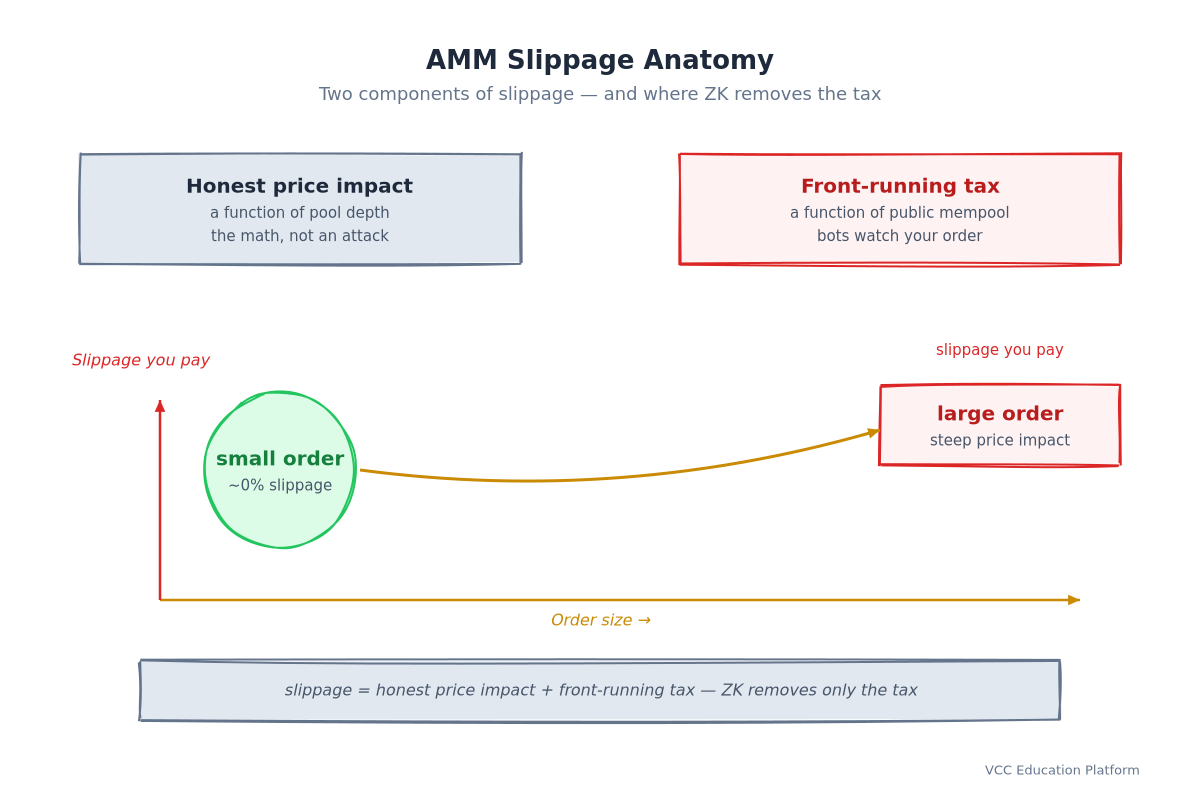
Figure 1: AMM Slippage Anatomy — slippage is honest price impact plus a front-running tax; zero-knowledge removes only the tax
How an AMM actually prices your order
A Uniswap-style pool holds two reserves -- x units of token A and y units of token B -- and maintains the constant-product invariant:
` x * y = k `
If you sell dx of token A, the pool now holds x + dx, so to keep the product constant it pays you out:
` dy = (dx * y) / (x + dx) `
units of token B. The price you get is the ratio dy / dx, and it is a changing ratio. Before your trade the pool prices token A at y / x; after adding dx to the reserve, it prices at y / (x + dx). The more you buy relative to the reserves, the further the marginal price moves from where you started. That movement is price impact, and on a constant-product AMM it is not a bug -- it is the mechanism that keeps the pool balanced.
A concrete feel for the numbers: a pool with x = 100,000 and y = 100,000 (price 1:1). Buying dx = 1,000 pays out dy = 990.1 -- about 1% impact. Buying dx = 50,000 pays out dy = 33,333 -- about 33% impact. Same pool, same formula, wildly different execution. Price impact is a curve, and it is steeper exactly where your order is bigger.
Two kinds of slippage -- and where trượt giá zk fits
Slippage in a swap UI is the maximum deviation from the quoted price you accept. It exists because between clicking "swap" and the transaction being mined, the price can move. A 2% tolerance means: execute only if the actual price is within 2% of the quote, otherwise revert. The reasons the actual price ends up worse split into two categories:
- Honest price impact. Your order is large relative to the pool, so the mechanical price movement costs you extra percentage points. This is the curve above. Deep pool, small order, negligible impact. Shallow pool, large order, significant impact. Nobody is attacking you; the math just is.
- Extraction on the public mempool. Every Ethereum transaction sits in a public queue before it is mined. Bots watch that queue. When a large buy appears, a sandwich bot front-runs it (buys ahead, pushing the price up), lets your order fill at the worsened price, then back-runs (sells what it bought at the inflated price). Your slippage tolerance is their budget.
The second category is what this article's title is really about. A private wallet entering a large order without slippage cannot stop honest price impact -- but it can stop the mempool tax, because that tax only exists if the market can see your order coming. Trượt giá zk -- zero-knowledge slippage protection -- hides the order's size and limit so the sandwich cannot be constructed.
The problem: your intent is public before your trade lands
A sandwich bot needs exactly two facts: that you intend to buy a large amount, and how much price deviation you will tolerate. Both are public the moment your transaction enters the mempool.
That asymmetry is the heart of the problem. The worsened fill you are trying to avoid is not caused by your trade; it is caused by announcing it. A trader buying $200k in small slices across an hour pays time and gas. A trader buying $200k in one order pays the sandwich tax. A whale buying via an OTC broker pays the broker's spread. Every large trader chooses between three expensive options, all because the fourth -- placing the order without revealing it -- did not exist.
This is where zero-knowledge proofs change the game. A ZK proof lets you demonstrate a statement about an order without revealing the values behind it: "this wallet has enough balance, I accept execution only above my limit price, and the expected output respects my slippage tolerance." It is a receipt you hand to a protocol that verifies it in milliseconds -- while the amount, limit, and tolerance stay private in the proof's witness.
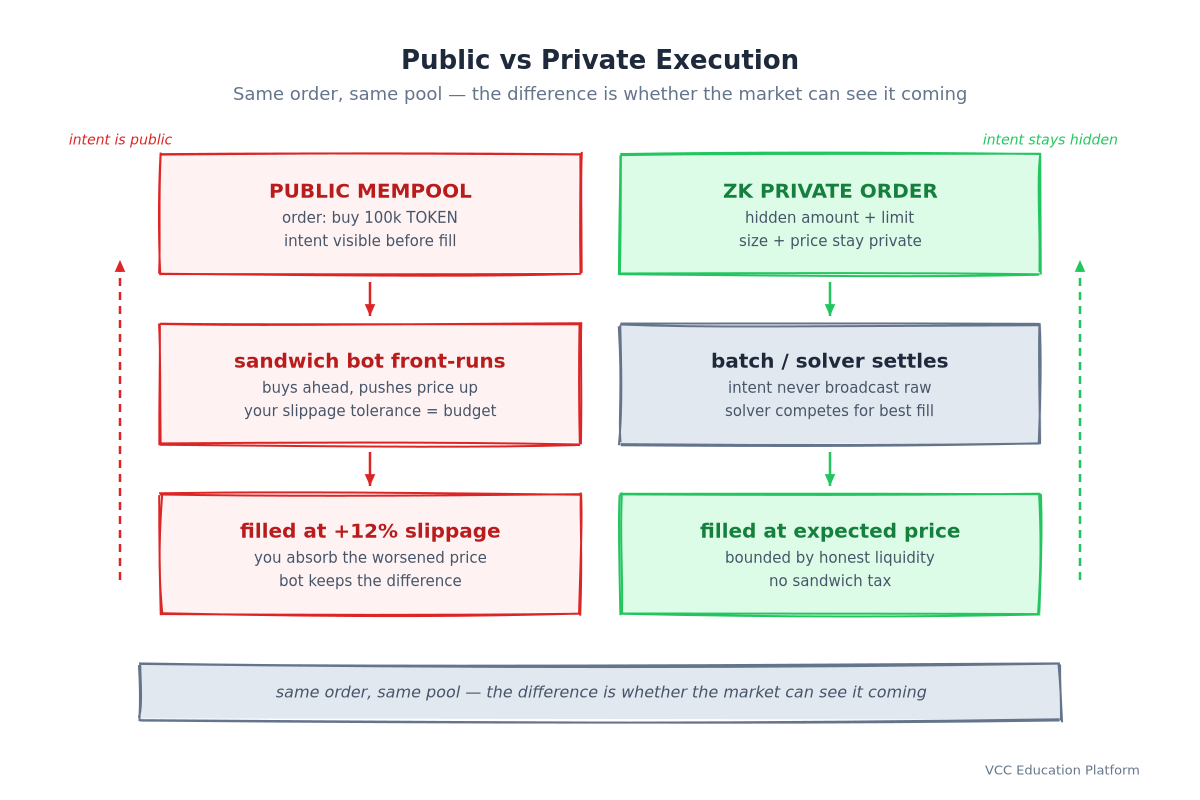
Figure 2: Public vs Private Execution — same order, same pool; the difference is whether the market can see it coming
How a ZK proof replaces "trust the pool"
A zero-knowledge proof has a standard shape: a prover (your wallet) proves a statement to a verifier (the pool contract, a settlement contract, or a matching engine) using a public input, a private witness, and a circuit that encodes the rules.
For a private AMM order, the circuit encodes the three facts the pool cares about:
- Balance. The wallet's committed balance covers the order amount. The circuit checks
balance >= amountwithout the verifier seeing either number. - Slippage tolerance. The order executes only if the realized price deviates from a reference by at most a bound the trader chose. The circuit computes the expected output from the pool's reserves and checks the deviation against that bound -- with the bound hidden.
- Correct pricing. The swap the protocol executes uses exactly the output the circuit committed to. The proof's public output binds the price and amount; if on-chain execution pays out less than the committed minimum, the proof check fails and the trade reverts.
The verifier learns only: there exists an order, consistent with this wallet's balance, whose execution respects a hidden bound, and whose settlement matches the committed output. A bot needs the specific numbers -- how much you are buying and how much deviation you will eat -- and those numbers never appear in the proof.
A key detail: "hidden amount" is not magic money. The wallet still needs balance to pay for the swap, and the protocol verifies it (via a commitment and an inclusion proof). What ZK adds is separation of concerns: the pool enforces the economic facts without learning the strategic facts.
Private order flow: from encrypted intent to settled swap
Hiding the intent is one thing; settling the trade is another. Private AMM orders run through a few execution families, often combined:
1. Commit-and-reveal with threshold decryption. Your order is encrypted and submitted to a mempool that only a distributed set of key-holders can decrypt -- and only after the block's ordering is sealed (Shutter-style). By the time anyone can read your order, no one can front-run it.
2. Intent-based protocols with solvers (CowSwap-style). You sign an intent: "I want token B for at most P per token, amount hidden." Solvers compete to find the best execution -- often netting your order against another user's opposite order, so no pool is touched at all. The winning solution settles as a single on-chain batch, and individual intents are never broadcast as raw swaps.
3. Shielded / ZK-native DeFi (Aztec, Elusiv-style). The wallet generates a ZK proof of order validity, and the protocol settles against shielded pools whose reserves are commitments. This is the most private family -- even the post-trade position can stay hidden -- at the cost of thinner liquidity and more proving overhead.
All three share one spine: intent hidden, settlement batched or sealed, price bounded by the honest market, and the sandwich's information advantage removed. Defi private trade is the umbrella term for these designs -- private order flow, MEV-resistant AMMs, ZK-verified settlement -- and interest in it has exploded since the "Dark Forest" era made front-running a mainstream concern.
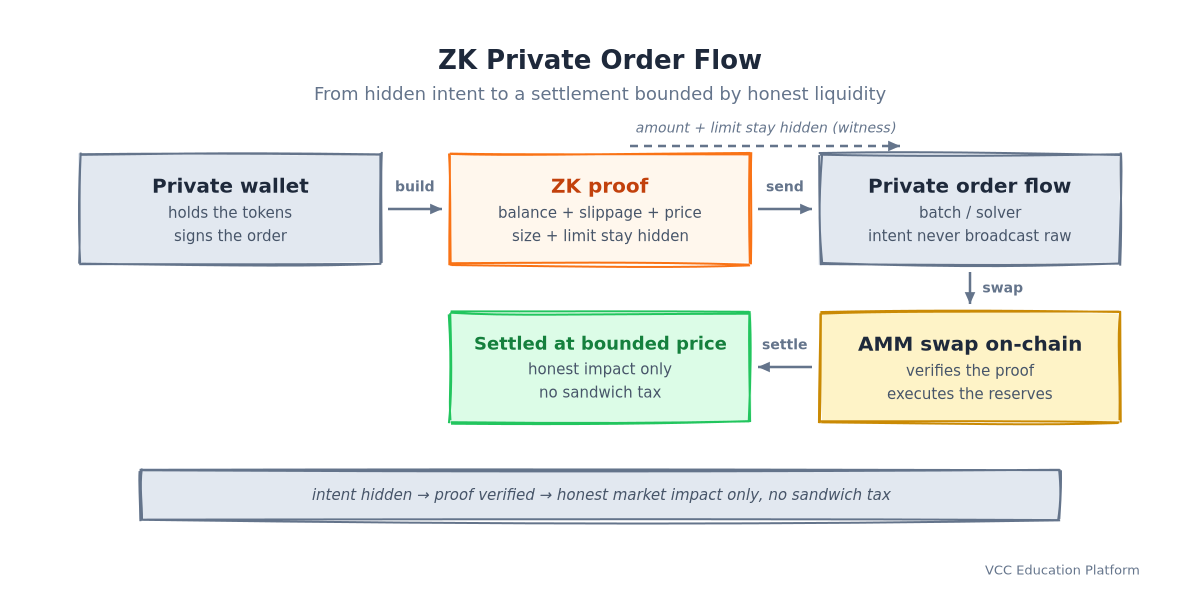
Figure 3: ZK Private Order Flow — intent hidden, proof verified, honest market impact only, no sandwich tax
The pipeline reads: your private wallet builds the proof (hiding amount and limit), a solver finds execution (batch-auctioning so the order never appears as a raw swap), the AMM contract executes the real reserves swap after verifying the proof, and settlement lands at the price the proof committed to -- bounded by the pool's liquidity, but free of the front-running leg.
Defi private trade in the wild: private and intent-based AMMs
- Cow Protocol settles orders as batch auctions where intents match each other before any pool is touched. It does not hide orders with ZK, but it removes the sandwich surface by construction: your signed intent is a limit, and the solver only fills it at or better.
- Shutter Network provides a threshold-encrypted mempool layer that plugs into an AMM or rollup, sealing block ordering before anyone decrypts orders.
- Aztec (Noir-based) is the flagship ZK-native private layer: orders as circuits, balances as commitments, swaps verifiable without revealing amounts. Noir is purpose-built for "prove my order is valid without showing it."
- Elusiv offers a shielded transfer layer with ZK privacy that wraps AMM interactions for the retail end of the spectrum.
The trend is clear: the industry is converging on intent-based settlement (orders as private intents, not public swaps) with ZK or threshold encryption as the privacy mechanism, and solver/batch competition as the execution engine. The "amm riêng tư" concept maps directly onto these designs.
The honest limits: what ZK cannot do
A good article on avoiding slippage must say what the technique cannot deliver.
- ZK does not create liquidity. Honest price impact is a function of pool depth. A $500k order on a $2m pool pays significant impact no matter how private the flow is. Privacy hides intent; it does not deepen the pool.
- Post-trade, the position is usually visible. Unless you are on a fully shielded protocol, the settled swap and your balance appear on-chain afterwards. What you hide is the intent window -- exactly the window a sandwich bot needs. Traders needing ongoing privacy (accumulation, position secrecy) need the shielded family.
- The proof costs time and gas. Generating a ZK proof takes seconds to minutes depending on circuit and hardware; on-chain verification adds gas. For a small retail swap, the overhead can exceed the slippage saved.
- Slippage tolerance cuts both ways. The hidden bound that protects you is also a commitment: if the market moves against you inside that bound, you still fill at the worse price. Privacy prevents malicious extraction; it does not prevent honest adverse moves.
- Thin shielded pools. The most private designs often have the thinnest liquidity, so the honest impact can be higher than a deep public pool. Private execution is protection technology, not price-improvement technology.
What this means for Vietnamese DeFi traders
Vietnamese DeFi activity is heavily concentrated in PancakeSwap on BNB Chain for retail and Uniswap/Ethereum (increasingly L2s) for larger trades. The two behaviors look different:
- Retail traders tolerate slippage settings of 1-12% (PancakeSwap's UI defaults encourage loose tolerances) and routinely lose to sandwich bots. For them, private order flow is a fair-pricing story: removing the mempool tax on every swap is a consumer-protection win.
- Whales and OTC-style buyers face the strategic problem. A Vietnamese buyer moving $50k-200k into a mid-cap token typically slices the order across hours (slow, gas-heavy) or uses an OTC broker who charges a spread. A ZK private order collapses both costs: one order, hidden limit, settled at the honest bounded price. The defi private trade flow is, for this user, the difference between paying 8% extra and paying ~1-2%.
There is also a timing argument unique to an emerging market. Large Vietnamese purchases often arrive in waves (news-driven FOMO, institutional accumulation after regulatory clarity) -- exactly when the mempool is most hostile. A private wallet that enters a large order before the wave is visible to the market -- while everyone else is still slicing -- buys at the honest price instead of the panic price. No public-order trader can replicate that edge.
Frequently asked questions
Does a ZK private order guarantee zero slippage?
No. ZK removes the avoidable part of slippage -- the front-running/sandwich tax -- by hiding your order's intent until settlement. Honest price impact from buying against a finite pool remains, bounded by liquidity, not by the proof. You still pay the market's real price, but you stop paying the tax on top of it.How does the pool verify my balance without seeing my amount?
Through commitments and ZK circuits. Your balance exists as a cryptographic commitment; the circuit provesbalance >= amount by computing on the commitment and the hidden amount, and the verifier checks the proof, not the numbers. The same machinery verifies that the executed price respects your hidden limit.
Is my trade visible after it settles?
Usually yes, on standard AMMs: the swap and resulting balance appear on-chain once settled. What stays hidden is the pre-trade intent window -- the amount and limit before execution -- which is the window sandwich bots exploit. If you also need post-trade privacy, you need a fully shielded protocol where balances are commitments too.Is this only for whales?
No. The sandwich tax is regressive and hits small traders hardest relative to their capital. Retail traders on PancakeSwap with loose slippage settings lose a larger percentage of each trade than whales who execute carefully. The defi private trade flow removes the tax for every order size; the proof overhead currently makes it most attractive from a few thousand dollars upward.Do I need a new wallet or a new token to use this?
Neither. You need a wallet that can build the proof (or a relayer that builds it for you) and a protocol that accepts private orders. The assets, the pool, and your existing balances stay as they are. This is the key difference from privacy coins: private AMM order flow is a layering technology on top of existing DeFi, not a separate currency.Conclusion
A large order on a public AMM pays a hidden double tax: honest price impact plus a front-running sandwich. The first is the price of liquidity; the second is the price of a public mempool that announces your intent before your trade lands. Zero-knowledge proofs remove the second. A private wallet builds a proof that its order is valid -- sufficient balance, hidden slippage bound, committed pricing -- and the protocol settles it through batch solvers or threshold-encrypted mempools, so the market cannot react before the swap executes. The amm riêng tư flow does not magically deepen pools, nor does it hide your position forever, but for the Vietnamese whale slicing orders into PancakeSwap and the retail trader losing 8% to bots, it is the difference between trading at the market's real price and trading at the market's surveillance price.
Quick Reference
| Property | Public AMM order | ZK private order flow |
|---|---|---|
| Order intent (amount + limit) | Visible in the mempool | Hidden in a ZK proof / encryption |
| Front-running / sandwich risk | High (bots watch the queue) | Removed (intent unreadable pre-settlement) |
| Honest price impact | Bounded by pool liquidity | Bounded by pool liquidity (unchanged) |
| Slippage you actually pay | Price impact + extraction tax | Price impact only |
| Balance verification | Raw transaction | ZK proof: balance >= amount, hidden |
| Slippage enforcement | UI tolerance (public) | Circuit constraint (hidden bound) |
| Post-trade visibility | On-chain, visible | Usually visible (fully shielded only in ZK-native protocols) |
| Extra cost | None | Proof generation + verification gas |
| Execution family | Direct pool swap | Batch solver / threshold decryption / shielded pool |
| Best fit | Small orders, deep pools | Medium-to-large orders, hostile mempools, OTC-style buys |
| Vietnam fit | PancakeSwap retail defaults | Whale accumulation; retail fair-pricing; pre-wave entries |