
Every day, millions of crypto payments move around the world — but on most blockchains, every single one is an open book. The sender, the receiver, and the amount are visible to anyone who cares to look. Anonymous transactions (giao dịch ẩn danh) are the opposite: a payment that is verifiably real and secure while keeping the details hidden. If blockchain privacy (quyền riêng tư blockchain) feels abstract, picture the iconic covered boats of Cai Rang floating market in Cần Thơ.
A covered boat at Cai Rang tells you a lot: it is a boat, it is in the market, it is carrying cargo toward a buyer. What you cannot see is what is under the tarp — exactly what goods, exactly how much, and exactly who is trading with whom. That is the perfect image for a private transaction. The blockchain is the river; the transaction is the boat; the tarp is the privacy layer. The payment happened, the ledger confirms it, but the sensitive details stay covered until the owner chooses to unwrap them.
This guide explains what anonymous transactions are, what blockchain privacy really protects, how the technology works, and why the trade-offs matter — in plain language, with Vietnamese examples.
Why most blockchains are "uncovered boats"
Bitcoin and Cardano are designed to be transparent. The ledger is public and permanent: every transaction's sender, receiver, and amount are recorded for everyone to verify. This transparency is a feature, not a bug — it is what lets anyone audit the money supply, confirm their own balance, and trust the network without a central bank.
But the same property that makes the system auditable also makes it a fishbowl. If your wallet address is ever linked to your identity — through an exchange, an invoice, a QR code you published — then strangers, advertisers, and thieves can watch your entire financial history: who paid you, who you paid, how much, how often, and to whom.
For a Vietnamese reader this is very familiar. When you use Momo, ZaloPay, or a bank transfer, the payment record sits with the company. When you use a transparent blockchain, the record sits in public, forever, visible to anyone with an internet connection. Neither gives you the financial privacy that cash provides — the ability to hand someone money without a third party, or a curious observer, recording it.
That is what anonymous transactions restore: not secrecy from the law, but privacy from strangers.
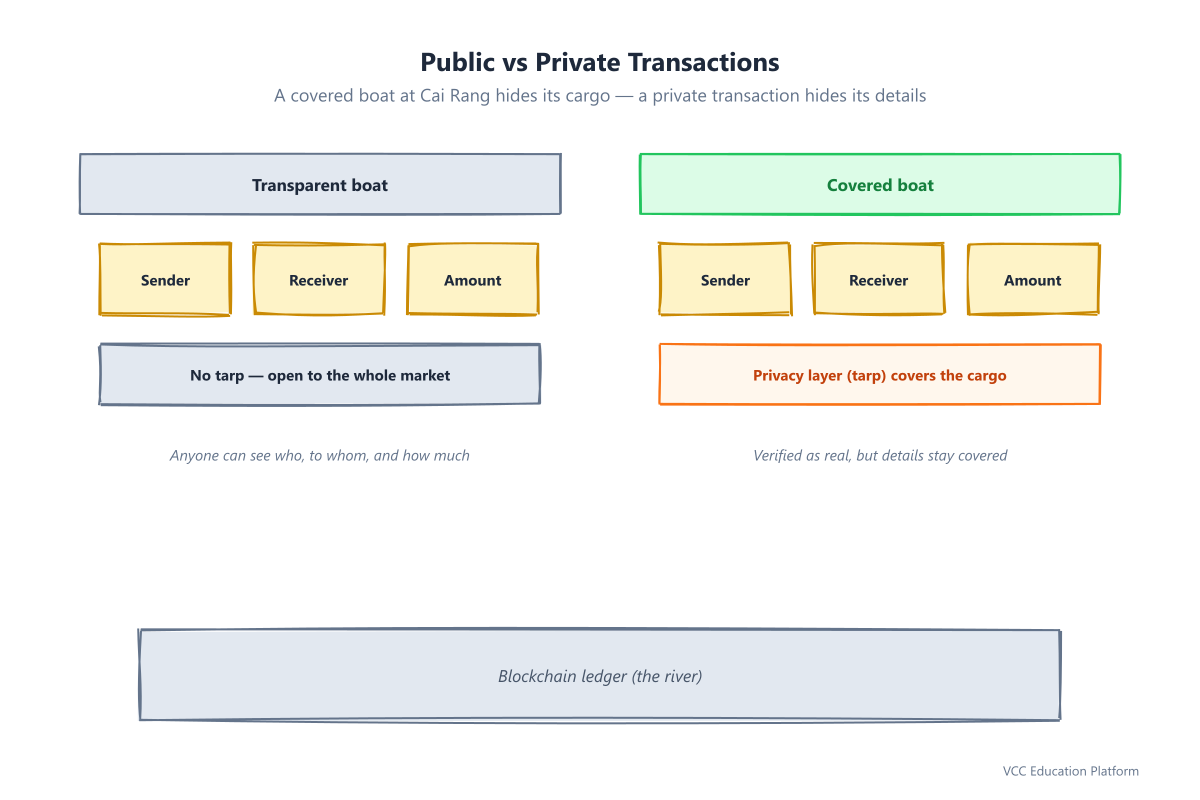
Figure 1: On the same river, some boats show their cargo and some are covered
What an anonymous transaction actually hides
Before we look at the technology, settle three questions in your head. Every privacy method on a blockchain is answering one (or more) of these:
- Who sent it? (the sender)
- To whom? (the receiver)
- How much? (the amount)
A normal Bitcoin or Cardano transaction answers all three publicly. An anonymous transaction hides at least one of them — sometimes all three — while still letting the network confirm the payment is valid and the money was not double-spent.
Think of it as a boat with three cargo compartments. Some privacy tools cover the "who sent" compartment, some cover the "to whom" compartment, and some cover the "how much" compartment. A covered boat at Cai Rang can hide just the expensive goods, or everything under a single tarp.
This is why the word "anonymous" gets used loosely. True anonymity hides the link between you and the transaction. But what most everyday users actually want is closer to blockchain privacy: control over what others can see. A vendor at Cai Rang does not want to be anonymous — they want to choose what to show. The same logic applies on-chain.
How a private transaction is verified without revealing itself
The trick behind modern anonymous transactions is a tool called a zero-knowledge proof (ZK proof). A zero-knowledge proof lets one party convince another that a statement is true without revealing any information beyond the fact that it is true.
A ZK proof is like a market official who inspects your covered boat at Cai Rang, weighs it, checks the registration, and stamps a seal saying "this boat is legal and carries exactly what it declares" — without ever lifting the tarp for the crowd. The proof is convincing, but it reveals nothing about the cargo itself.
On a blockchain it works like this: a private transaction is accompanied by a compact cryptographic proof. The network checks the proof and confirms three things — the sender owns the money, the payment does not exceed the balance, and the same money was not spent twice. But the proof never reveals who the sender is, who the receiver is, or the exact amount. The ledger records that a valid transaction happened; the proof vouches for it; the tarp stays down.
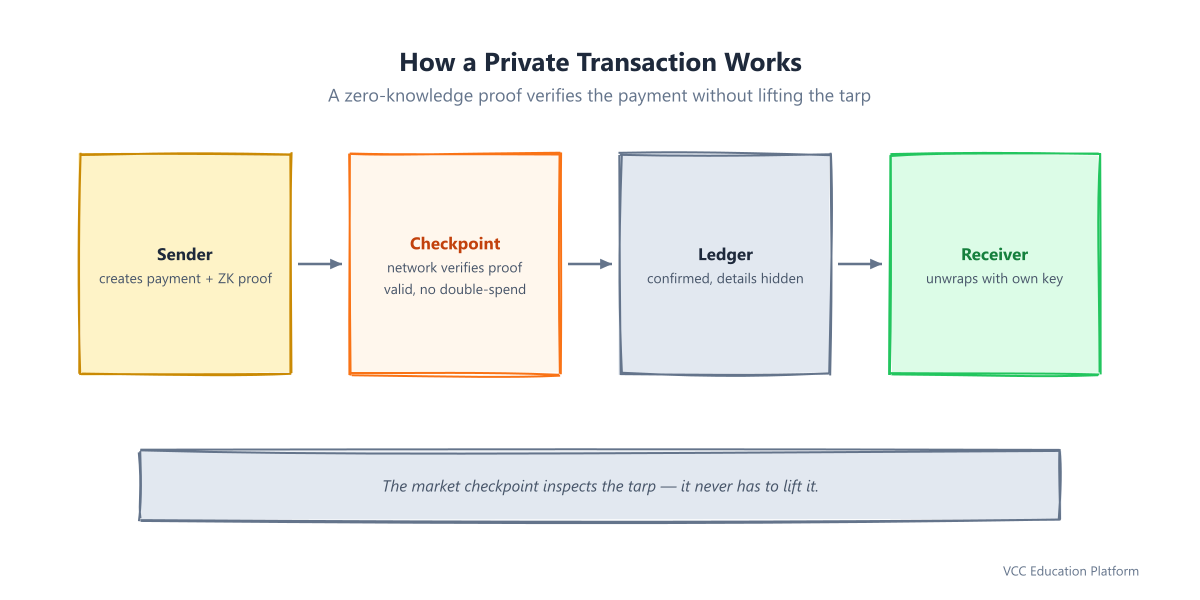
Figure 2: The checkpoint proves the boat is not smuggling, without opening the cargo
The toolbox: ways to hide what the boat carries
Different privacy designs cover different compartments, and it helps to know which is which.
1. Zero-knowledge proofs (shielded transactions)
The strongest and most complete approach. Coins like Zcash let you send from a "shielded" address where sender, receiver, and amount are all hidden behind a ZK proof. Anyone can still verify the transaction is valid — the tarp is inspected by the checkpoint, never lifted for the market. This is the technology that privacy-focused blockchains in the Cardano ecosystem, like Midnight, are also built around.
2. CoinJoin and mixers (breaking the sender-receiver link)
A mixer is like a cooperative storage shed on the riverbank. Many boat owners bring their cargo in, the shed mixes the goods around, and everyone walks out with equivalent goods — but nobody in the crowd can tell which boat's cargo went to which owner. CoinJoin works on-chain: many users combine their transactions into one, so outsiders cannot match a specific sender to a specific receiver. The amount is usually still visible; what breaks is the link.
3. Ring signatures and stealth addresses
Used by privacy coins like Monero. A ring signature mixes your signature with several unrelated ones, so an observer cannot tell which member of the group actually signed — hiding who sent it. A stealth address generates a fresh, one-time destination for every payment, so no two payments to you can be linked — hiding who received it and how much they receive in total.
4. Privacy from strangers, accountability to yourself
Here is the nuance most explainers skip. Privacy coins are not designed to let criminals vanish. They are designed to give you the same discretion you have with cash. A vendor at Cai Rang will happily show you the goods if you are a real buyer — they simply will not broadcast the details to the whole market. The tarp is for strangers, not for legitimate inspection.
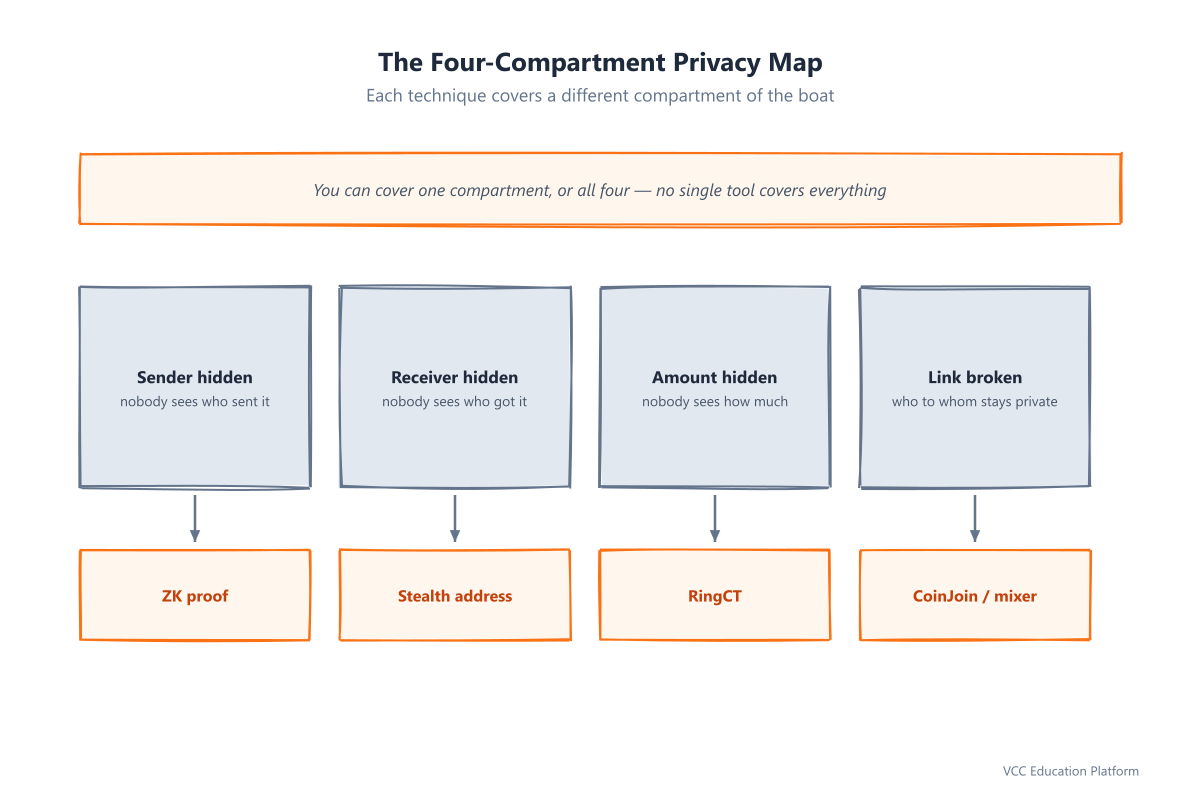
Figure 3: Which technique hides which part of a transaction
Transparent vs private: two ways to run the same market
It is worth being precise about what each kind of ledger gives up.
| Property | Transparent (Bitcoin, Cardano) | Private (ZK coins, Midnight) |
|---|---|---|
| Sender visible | Yes | No (or opt-in) |
| Receiver visible | Yes | No (or opt-in) |
| Amount visible | Yes | No (or opt-in) |
| Auditable by anyone | Yes | No — auditability needs your key |
| Fraud / double-spend prevented | Yes | Yes (via ZK proof) |
| Needs trust in a third party | No | No |
Both are valid markets. The transparent boat is easier to inspect — useful for public treasuries, donations, and accountability. The covered boat is better for personal finances, business negotiations, and people who simply do not want their spending studied by advertisers.
The trade-off is honest: privacy and external auditability are opposite ends of one spectrum. You cannot have a fully public, fully private ledger at the same time. What you can do — and what many networks now offer — is choice: keep some transactions open and wrap others in a tarp.
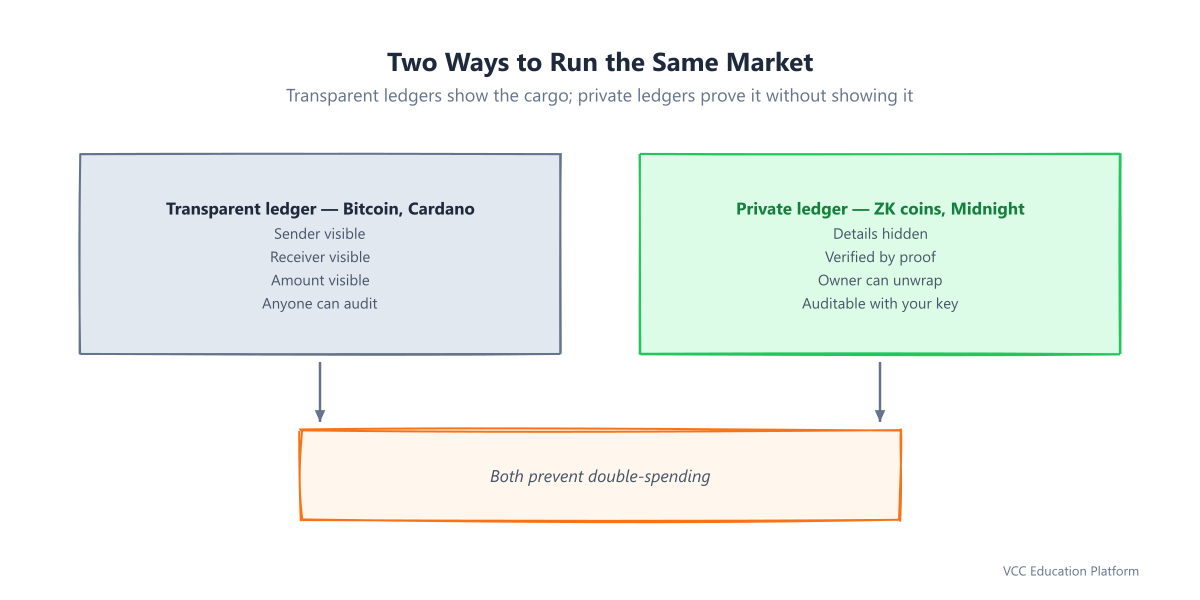
Figure 4: Transparent vs private ledger — both stop double-spending
Why blockchain privacy matters for Vietnamese readers
Cai Rang is a useful anchor because the Mekong Delta runs on small, trust-based commerce — and trust is exactly what privacy protects.
- Remittances. Millions of Vietnamese receive money from relatives overseas. A transparent blockchain lets the whole world see how much arrives and when. A private transaction keeps that family matter private, the way handing over cash at the market would.
- Business negotiations. If you pay suppliers in crypto, a public ledger reveals your prices, volume, and partners to every competitor. Business owners legitimately want to keep terms of trade covered until a deal closes.
- Financial habits. Bank statements and e-wallet history already sit with companies. Blockchain privacy is the first chance many people have to hold money the way a market vendor holds cash — without a third party logging every move.
- Safety against profiling. Public data on who holds what, and who pays whom, can be used for targeted scams — a growing concern as crypto adoption rises in Vietnam.
None of this requires hiding from the law. It requires what a covered boat at Cai Rang demonstrates every day: the ability to trade without the whole market watching.
Frequently asked questions
What is an anonymous transaction?
An anonymous transaction (giao dịch ẩn danh) is a blockchain payment whose details — sender, receiver, amount, or the link between them — are hidden from public view, while the network still cryptographically verifies that it is valid and not double-spent. In simple terms, it is blockchain privacy applied to a single payment.Is privacy the same as anonymity?
No. Anonymity means no one knows who you are. Privacy means you control who sees what. Most privacy tools give selective disclosure: strangers see nothing, but you can prove facts about your transactions when you choose.How does a private transaction get verified if nobody can see it?
Through a zero-knowledge proof: a compact cryptographic certificate that proves the sender owns the funds, the amount is within balance, and the funds were not double-spent — without revealing who, whom, or how much. The network checks the proof, not the details.Are anonymous transactions illegal?
No. Privacy technology is legal; using it to commit crimes is not — just as carrying cash is legal. Regulators (such as via the FATF Travel Rule) impose compliance duties on exchanges and transfers, but the technology itself is ordinary financial privacy.Does Bitcoin or Cardano have private transactions by default?
No. Both use transparent public ledgers by default. Privacy is available through layer-2 tools (mixers), specific privacy coins, or privacy-focused networks in the ecosystem — for example the Cardano-adjacent privacy chain Midnight, which is built around zero-knowledge proofs.If a transaction is hidden, can it still be checked for fraud?
Yes. The proof guarantees the three key rules — valid ownership, correct balance, no double-spend — without exposing details. The market checkpoint inspects the tarp; it does not need to lift it.What are the downsides of privacy?
The main trade-offs are external auditability (publicly visible ledgers are easier for regulators and researchers to study) and misuse risk. Private systems also put more responsibility on you: if you lose your key, no one else can help unwrap the boat.Quick reference
| Concept | What it means | Everyday image |
|---|---|---|
| Anonymous transaction | Payment with hidden details, still verified | A covered boat crossing the market |
| Blockchain privacy | Your choice of what others can see on-chain | Tarp you control |
| Zero-knowledge proof | Prove true without revealing how | Checkpoint seal without lifting the tarp |
| Ring signature | Hides which member of a group signed | One of many boats, indistinguishable |
| Stealth address | Fresh address per payment, hard to link | Unlabelled boat each trip |
| CoinJoin / mixer | Breaks the sender-receiver link | Cooperative storage shed mixing cargo |
| Transparent ledger | Everyone sees everything | Open boat, goods in plain view |
The river of a public blockchain carries enormous value — and until recently, every boat on it sailed uncovered. Anonymous transactions change that by letting you wrap a tarp around what matters, seal it with mathematics, and prove to the market that your boat is sound without showing the whole world your cargo. Next time you watch the boats at Cai Rang, you will already understand how a private blockchain works.