
When Kien released LP tokens from a newly audited AMM pool one morning in March 2026, his wallet had $18,000 in assets spread across six DeFi positions. Minutes after he unstaked, a reentrancy exploit drained the pool. Kien filed a claim with his DeFi insurance protocol — and discovered that the assessors reviewing his claim could see the full public history of his wallet: every position, every token, every profit. A $3,800 payout had just cost him his financial privacy. Bảo hiểm defi riêng tư — private DeFi insurance that uses zero-knowledge proofs to verify a loss without exposing the rest of your portfolio — fixes this: the protocol verifies that you lost money without learning where you kept it.
The privacy paradox of DeFi insurance claims
DeFi insurance protocols work on a simple pledge: pay a premium for a promise that if the covered smart contract gets hacked, you receive a payout. The most prominent protocols — Nexus Mutual, InsurAce, Etherisc, Amulet, and Neon — collectively underwrote over $4B in cover across Ethereum, BNB Chain, Avalanche, and Polygon by early 2026. On-chain claims data shows roughly 15–25% of filed claims lead to a payout, depending on the incident category.
The claims process is inherently invasive. To evaluate a claim, assessors — often compensated with the protocol's native token — review the claimant's full on-chain history: wallet balance at the time of the incident, all active positions across protocols, and transaction patterns that reveal income sources. A cover that protects against a protocol exploit should not become a side-door into the policyholder's overall financial picture.
For Vietnamese DeFi users, this matters disproportionately. Wallet analysis tools like Arkham and DeBank already aggregate cross-protocol portfolio data. After a hack, victims are already traumatized; public assessor reviews turn a claims process into a second exposure.
How a normal claim leaks your portfolio
Imagine you bought cover for a yield-farming pool. The exploit fires. You file a claim. The assessors see:
- At-protocol balance: how much you had staked at the time of the exploit.
- Wallet balance: your current holdings reveal total net worth and risk profile.
- Related positions: if you also used the same protocol for isolated lending, the assessor now knows about it.
- Transaction history: your addresses in other protocols, income sources, and airdrop eligibility.
For a protocol paying out $3,800, this information asymmetry is disproportionate. A claimant who proved eligibility once — by holding a policy NFT or staking the protocol token — now exposes their entire on-chain footprint.
The extra risk is reputational. In Vietnam's conservative financial culture, exposing that you held significant DeFi positions can attract scrutiny from peer networks, family, or — worst case — tax authorities evaluating undeclared digital-asset activity.
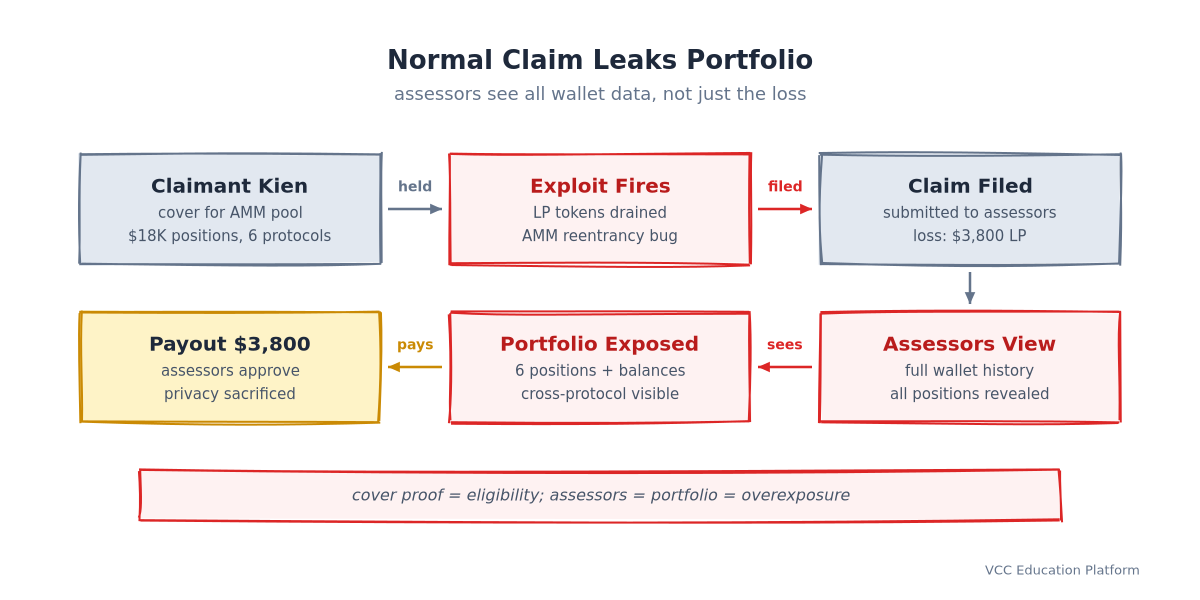
Figure 1: The normal claims flow — assessing a $3,800 loss hands assessors your entire wallet
How ZK verifies a loss without reading your portfolio
The zero-knowledge approach splits what the claimant proves into two separate proofs — one for eligibility, one for the loss — and only publishes the minimum information the verifier needs.
Proof of eligibility (private). The claimant proves locally: (a) they held a valid cover policy NFT at the block before the exploit, confirmed via a Merkle tree of policy holders; (b) the covered contract address matches the exploit event. The public output is a nullifier + a valid vote hash. No wallet addresses, balances, or portfolio data appear on-chain.
Proof of loss (public oracle). The exploit itself is a public on-chain event — a transaction to a blacklisted address, a price oracle update, a contract pause, or a Verifiable Delay Function (VDF) timestamp. The verifier contract checks the oracle's public data (was there an exploit? did it affect the covered contract?) against the claimant's proof without reading the claimant's other positions.
Payout. Once both proofs verify, the payout executes automatically to the claimant's address. The protocol knows: a valid loss occurred; the claimant was covered; the payout amount is correct. It does NOT know: the claimant's total portfolio, other DeFi positions, or any details beyond what the cover was for.
This is the same pattern as ZKML verification: the private data (portfolio, positions, income) is the witness that never leaves the claimant's device. The proof is the only thing that travels on-chain. The verifier runs the same computation with public inputs only.
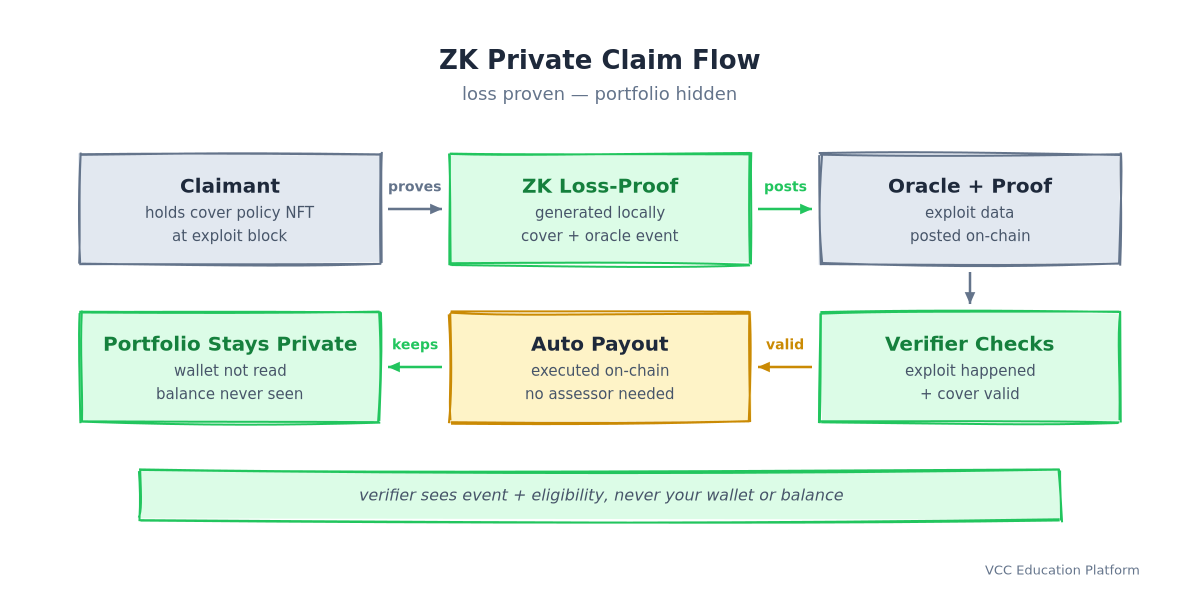
Figure 2: The ZK private claim flow — the verifier sees the exploit event and eligibility, never your wallet
What the protocol learns — and what it does not
A ZK claims design is not zero information. The verifier contract learns:
- A covered event occurred (oracle confirms).
- The claimant's policy was active (Merkle membership proof).
- The payout amount is correct (proof constrains it to the cover formula).
- The nullifier has not been used before (no double-claim).
It never learns:
- The claimant's wallet address beyond the payout destination (which is already public in the transaction).
- Holdings in other protocols.
- Transaction history before the exploit block.
- Airdrop eligibility or token balances.
- Identity beyond the address that holds the cover NFT.
For the protocol, this is a compliance advantage too: privacy-preserving claims reduce regulatory risk around KYC/AML data collection in jurisdictions where claims are considered financial-services activity.
Production examples and open problems
ZK insurance is early but not hypothetical. Nexus Mutual's 2025–2026 research track explored incorporating ZKML for delayed incident detection (proving a hack occurred without waiting for a human assessor vote). Amulet's governance trialed ZK-based cover staking where stakers proved they had no conflict of interest in an incident without revealing which protocols they underwrote.
The hardest problems are still open. Defining "loss" in a circuit requires encoding exploit criteria as verifiable constraints — feasible for contract hacks, harder for oracle-price crashes or governance attacks. The oracle remains a trust point: a ZK proof that a loss happened is only as good as the data feeding the oracle. Coordination cost: claims assessors in current protocols provide speed (human judgment) that pure automated verifiers cannot match; removing assessors requires richer circuit specifications.
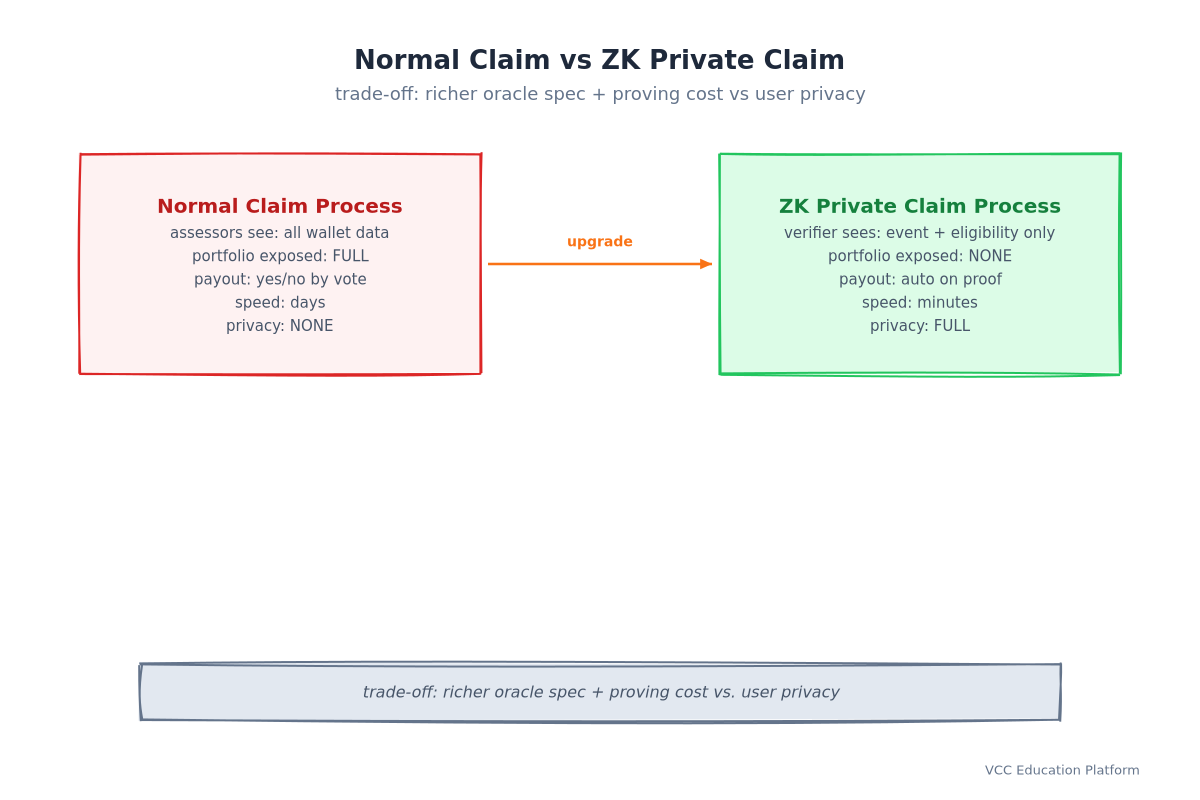
Figure 3: Normal vs ZK private claims — the difference is who can read your portfolio
What this means for Vietnamese DeFi users
Vietnamese retail users already concentrate significant capital across a small set of yield protocols despite regulatory ambiguity. A hack or exploit affecting a protocol they use forces a choice: file the claim and publicly link their entire DeFi portfolio to the assessors, or stay silent and absorb the loss. Private ZK claims remove this false choice.
Three practical steps. First, choose a protocol with a clear privacy policy. Nexus Mutual and Amulet both publish assessor-selection rules; prioritize protocols with automated oracles over human-voted claims when loss definition is unambiguous. Second, use dedicated cover wallets. If ZK claims are unavailable today, at least hold cover in a separate wallet so the cover NFT itself does not link your positions elsewhere. Third, track oracle coverage. Ensure your covered protocol appears on a verifiable oracle list; a ZK proof that the covered contract is blacklisted is only as strong as the oracle's blacklist.
Frequently asked questions
Does a ZK claim cost more than a normal claim?
The proving cost is roughly $0.01–0.05 in L2 gas or a few cents in L1 gas, plus 1–3 seconds of laptop computation. For a $3,000+ claim, this is negligible. As ZK systems mature and proving moves to mobile wallets, the cost will fall further.Can the protocol still reject a fraudulent claim?
Yes. The verifier circuit encodes the cover terms: which contract is covered, for how long, for how much. A proof submitted for a contract not on the blacklist fails verification automatically. Fraudulent oracle data is the remaining risk — the same risk any insurance oracle faces.What if the insurer learns my address from the payout transaction?
The payout address is already public in any DeFi transaction. What ZK claims prevent is the supplementary portfolio exposure that assessors and community reviewers demand today. The payout does not leak anything beyond what on-chain transactions already reveal.Can I file a ZK claim today?
Not yet on a major production protocol. The infrastructure exists (Groth16 circuits, on-chain verifiers, oracle feeds); integrating them into an existing claims flow requires a protocol upgrade. Amulet and Nexus Mutual are the most likely near-term candidates given their public R&D interest in ZKML and private cover staking.Why not just use an off-chain insurance company?
Off-chain insurance avoids on-chain exposure but requires KYC, claims forms, and subjective adjusters. ZK DeFi insurance keeps claims non-custodial, borderless, and governed by code — aligned with the original DeFi promise.Is ZK overkill for a small cover?
For covers under $500, the friction of proving may not be worth it today. For treasury-level protocols, DAO treasury covers, and high-net-worth DeFi users, the privacy premium is rational. As circuits and proving infrastructure improve, the threshold will fall.Conclusion
Kien's $3,800 payout cost him more than money: it exposed his full DeFi footprint to a committee of assessors he never agreed to trust. Bảo hiểm defi riêng tư with zero-knowledge claims restores the right boundary between loss verification and financial privacy. The protocol proves eligibility and confirms the exploit event; the claimant proves what happened without revealing what they hold. For Vietnamese DeFi users navigating a fast-growing but regulation-uncertain ecosystem, privacy-preserving claims are not paranoia — they are the next step in making DeFi insurance actually trustworthy.
Quick Reference
| Property | Normal DeFi Claim | ZK Private Claim |
|---|---|---|
| Assessor sees | Full wallet + portfolio + positions | Oracle event + eligibility nullifier |
| Payout mechanics | Human assessor vote | Auto-execute on proof |
| Claim speed | Days to weeks | Minutes |
| Fraud protection | Human review + social slashing | Verifier circuit + oracle integrity |
| Privacy | None — full audit trail | Full — portfolio stays on device |
| Per-claim cost | Gas + assessor fees | Proving cost + gas |
| Oracle requirement | Yes — incident data | Yes — exploit event must be verifiable |
| Best fit | Small covers, low-fraud environments | DAO treasury, high-value personal cover |