
Imagine you are a serious borrower on Ethereum. You have held a meaningful position for years — enough collateral to support a six-figure loan. You want to borrow USDC from Aave, deposit your collateral, and get the liquidity you need without giving the whole internet a tour of your wallet.
Now the reality check: on a public blockchain, every wallet balance, every borrow, every position is visible to anyone. The moment your address borrows, an on-chain observer can read how much you posted, how deep your reserves run, and how exposed you are. Cho vay thế chấp defi riêng tư — private collateralized lending on DeFi — is the technology that lets you prove "my collateral covers this loan with room to spare" while your wallet balances stay sealed.
One sentence: a zero-knowledge (ZK) proof lets a borrower demonstrate to a lending protocol that their collateral safely covers a loan, and the verifier learns only a yes/no — never the size of the position underneath.
This article walks through how collateralized lending works today, why the public ledger makes borrowing feel like broadcasting your finances, and how ZK proofs enable private defi lending where the collateral is real but the balance is invisible. If you have wondered what a zk collateral proof is, or whether Vietnam's wealth-conscious DeFi users can borrow without exposing their net worth, this is the breakdown for you.
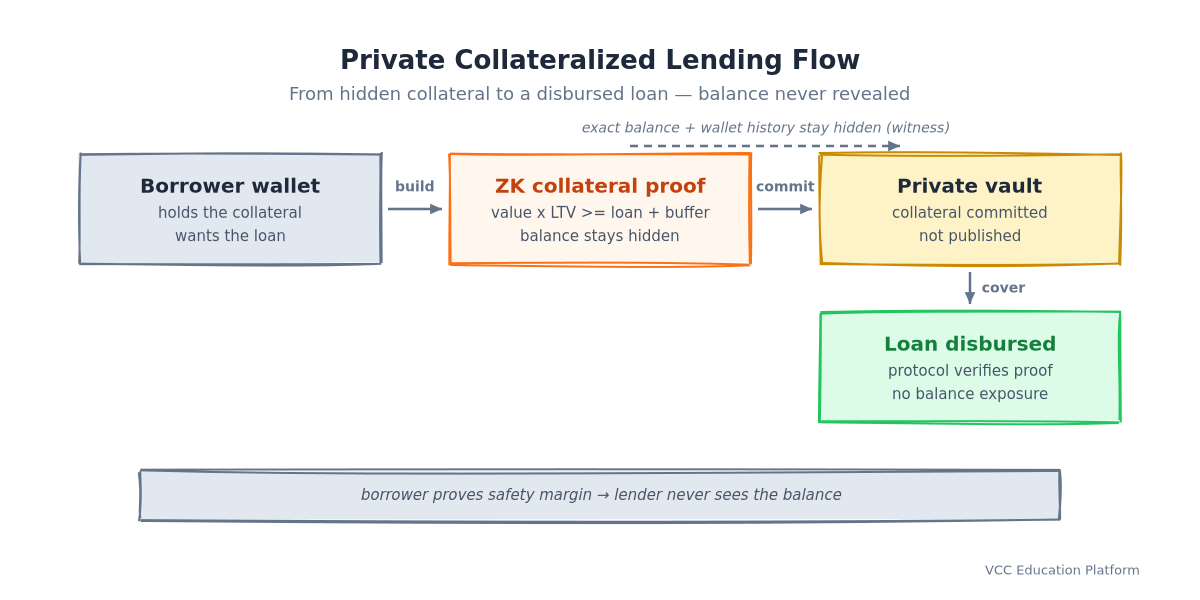
Figure 1: Private Collateralized Lending Flow — borrower proves a safety margin, the lender never sees the balance
How Collateralized Lending Works Today
The collateral rule
DeFi solved "stranger lends to stranger" by taking a very old idea — collateral — and automating it. On Aave or Compound, you supply an asset (say ETH) as collateral, and the protocol lets you borrow against it, up to a loan-to-value (LTV) ratio. If ETH is worth $100 and the LTV cap is 80%, you can borrow up to $80 worth of stablecoins.
Because crypto prices move, the protocol needs a safety cushion. It tracks a health factor: the value of your collateral divided by your borrowed amount adjusted for the LTV cap. If ETH drops and your health factor falls below 1, anyone can liquidate your position — sell your collateral at a discount to repay your debt. Liquidation is the mechanism that guarantees lenders get repaid, and it runs automatically, with no banker required.
The economics are sound, the privacy is zero
The mechanism is proven. Aave and Compound have moved hundreds of billions of dollars this way. But every step of that process is fully public:
- Your borrow transaction announces the size of your position to everyone.
- Your collateral deposit reveals how much you hold — or at least how much of it you are willing to show.
- Your health factor, your repayment schedule, your liquidation events — all on the ledger forever.
For a retail user borrowing $200, that is an inconvenience. For a whale, a Vietnamese business, or anyone who values financial privacy, it is a serious problem. Your loan tells the world how much you have, how much you owe, and how much risk you carry — and it does so permanently.
The Privacy Problem: Borrowing Is Broadcasting
Your wallet is a glass house
On Ethereum, an address is a pseudonym, but not a private one. The moment anyone links an address to you — through a CEX withdrawal, a purchase, an airdrop claim, a social post, a MoonPay widget — every historical transaction becomes your financial biography. Borrowing makes it worse: it telegraphs your current net worth in a way buying a coffee never does.
A lender-friendly DeFi user who posts $500,000 of collateral is effectively announcing: this address holds at least $500,000. Bots, researchers, and attackers read this data constantly. The follow-on risks are real:
- Targeting. A whale whose collateral and holdings are public becomes a target for phishing, dusting, and social engineering. Scammers know exactly what to pretend to be.
- Theft and extortion. If an attacker can see your largest position, they can aim their best effort at that specific wallet — the one with the most to lose.
- Negotiation damage. In OTC-style deals or institutional arrangements, the counterparty knows exactly how much skin you have in the game. Bargaining power evaporates.
- Tax and compliance friction. In countries like Vietnam where the tax treatment of crypto is still settling, a permanent, public ledger of your borrowing and collateral is not a comfortable record to have attached to your identity.
The whale's dilemma
Here is the cruel logic at the center of the problem: the more you can afford to borrow, the more you expose by borrowing. A small borrower loses almost nothing by being public — their position is too small to matter. A large borrower, the exact person who could benefit from a big loan, cannot borrow without announcing a big position. The very act of taking a large secured loan is a disclosure that most wealthy people would prefer to avoid.
This is the gap that private defi lending is designed to close: keep the economic security of collateralized lending, remove the disclosure that comes with it.
What Private Collateralized Lending Means
Private collateralized lending is not about hiding the loan — the loan itself can be public. It is about hiding the collateral position: the exact balances, the wallet history, the total net worth that supports the loan.
The borrower keeps a position (or a set of positions) that the protocol can cryptographically verify, but the verification is done through a zero-knowledge proof. The protocol learns one thing: this borrower's collateral, priced honestly, covers the loan with the required margin. It does not learn the balance, the composition, the address, or the history.
Think of it like showing a bank a vault, not its contents. You open the vault door to a camera with a sensor that reads "enough value present," and the bank approves the loan — without you counting the bills on camera. Or, in a way a Vietnamese reader will recognize instantly: you show the lender your sổ đỏ to prove you own land, without letting them read the full land registry — indeed, without letting them see exactly how much land you own beyond what's needed to secure the loan.
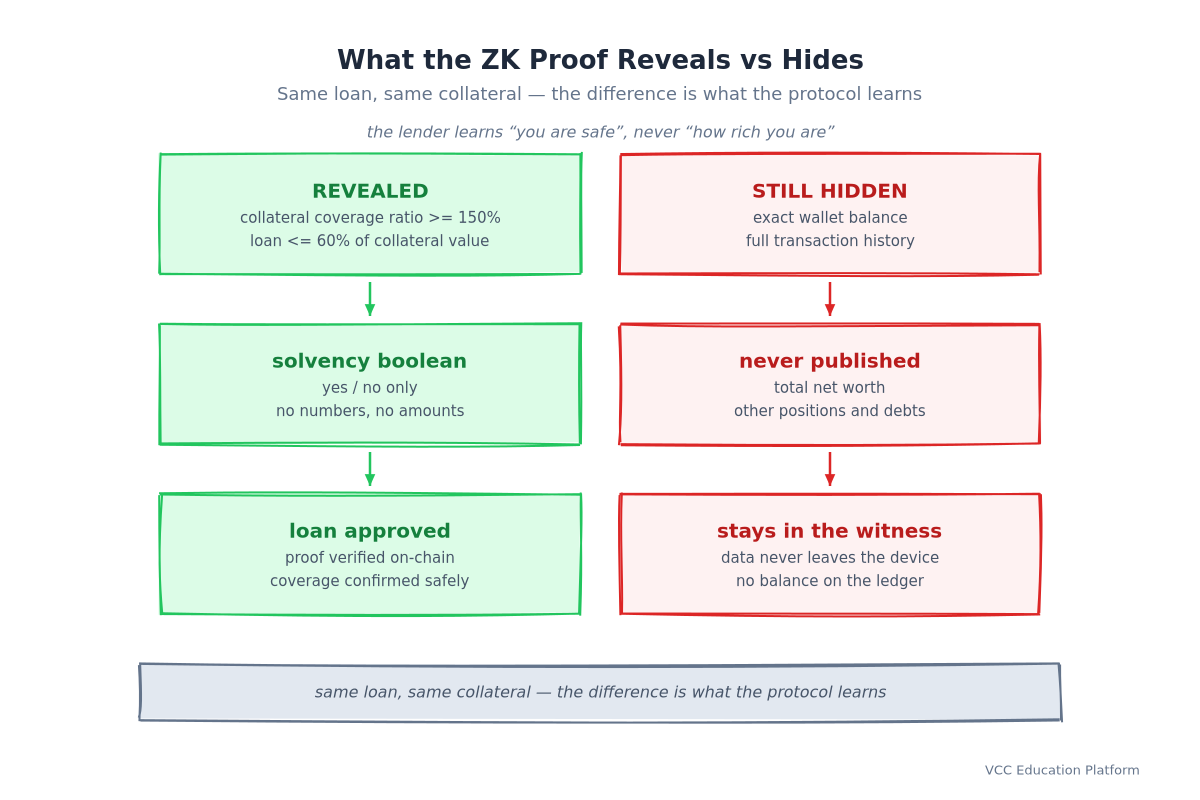
Figure 2: What the ZK Proof Reveals vs Hides — the lender learns "you are safe", never "how rich you are"
The ZK Collateral Proof: Math That Says "Enough" Without Showing How Much
The circuit: what the proof actually proves
A zero-knowledge proof is a cryptographic statement that can be verified without revealing the private inputs. For collateralized lending, the circuit encodes the protocol's own safety rule:
` public claim: collateralValue × LTV ≥ loan + buffer private inputs (witness): the collateral positions, their quantities public outputs: the boolean result — yes, covered; or no, not covered `
The borrower holds the private inputs. The protocol, running the verifier, learns only that the inequality holds. It never sees:
- the exact balance in each position,
- the total value of the wallet,
- any other holdings or debts,
- the wallet's transaction history.
Where prices come from
A ZK proof works over numbers, and numbers need a source of truth. The circuit takes the price of each collateral asset as an input — and here price oracles enter the picture. The protocol and the borrower agree on a price source (Chainlink-style decentralized oracles are the norm). The proof then says: given these agreed prices, my collateral times the LTV cap is at least this loan plus a safety buffer.
This is an important nuance: the proof proves a relationship between collateral and loan at agreed prices, not a claim that the collateral is worth X forever. The price feed is the shared reality both sides rely on. The ZK layer's job is to prove the balance of the position without revealing the amount — not to invent prices.
The commitment: tying the proof to the actual collateral
A skeptic might ask: what stops a borrower from proving "I have $1 million of ETH" while actually holding $100? The answer is the commitment. When collateral is deposited, the protocol records a cryptographic commitment — a hash, or a shielded position on a private asset ledger — that binds the borrower to specific units of collateral without revealing how many. The ZK proof then demonstrates: the committed collateral satisfies the coverage inequality. Because the commitment is binding and the proof is sound, the borrower cannot prove more collateral than they actually locked. The proof is a claim about the committed position, and the position is real.
Liquidations Without Public Balances
Liquidation is where collateralized lending gets real — and where privacy gets hard. If nobody can see the collateral, who knows when to liquidate?
The modern answer is a keeper network. Keepers are independent actors who watch for unhealthy positions and liquidate them for a reward. With ZK private collateral:
- The protocol can publish a commitment-based health check: a borrower proves periodically (or when asked) that the committed collateral still covers the loan at current oracle prices.
- Keepers monitor the public side of this — the loan itself, the oracle price feed, and the borrower's proofs of health. If a borrower stops proving coverage, or proves less than required, the position is flagged as unhealthy.
- Liquidation then happens against the committed collateral — the protocol can sell the shielded position's underlying assets — without ever posting the full balance to the ledger.
The key shift: the safety threshold is proven, not shown. The system learns "this position is healthy" or "this position is not," never "this position contains 312.7 ETH." Liquidation still works — the economics of the protocol still protect lenders — but the granular details stay sealed. This is the hard engineering problem of private lending, and the reason it is still maturing.
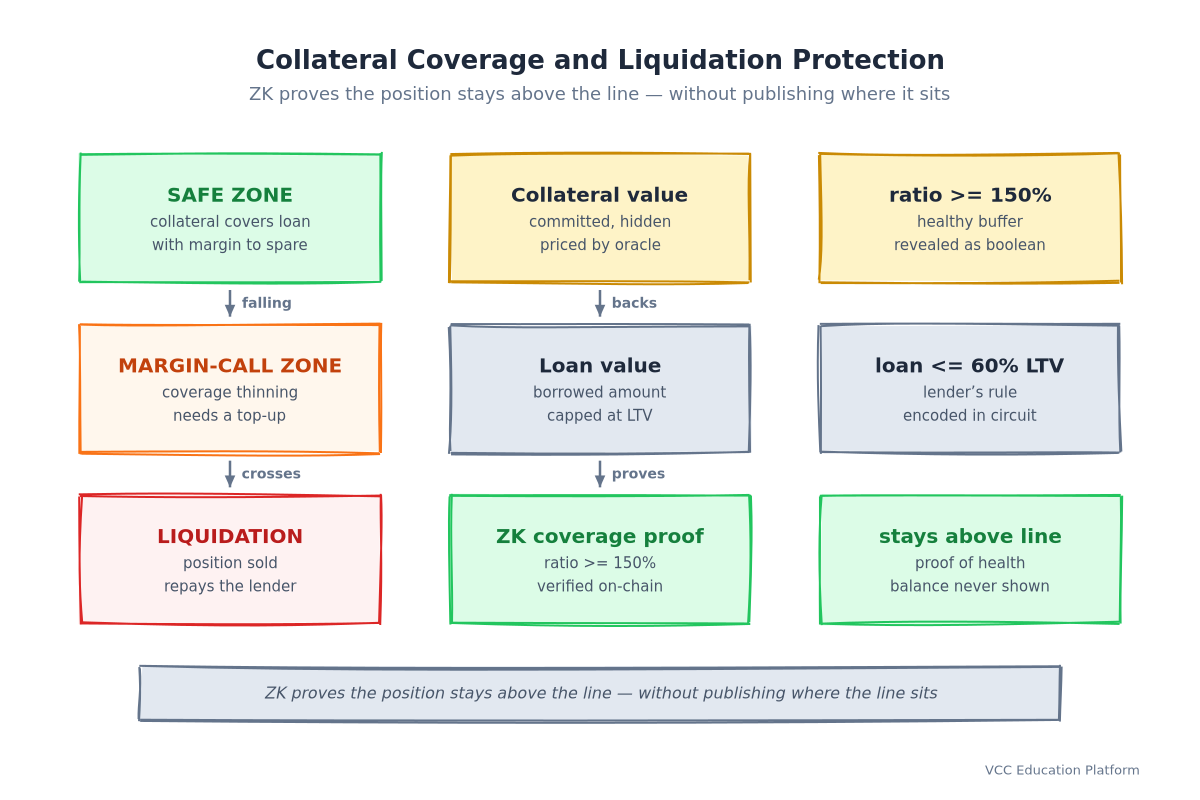
Figure 3: Collateral Coverage and Liquidation Protection — ZK proves the position stays above the line without publishing where the line sits
What Exists Today
This is not a paper dream; the pieces are being built in public.
- Aztec Network (now Aztec Labs) pioneered private DeFi on Ethereum with its encrypted state model — private balances, private borrowing, and Noir as the ZK language. Its approaches to shielded collateral and private positions are the reference design for the space.
- Aave Arc / permissioned pools point the other direction: institutions get compliance-friendly lending by restricting who participates rather than hiding balances. Useful, but not privacy for the borrower.
- Term Finance builds auction-based, fixed-rate lending with privacy-aware settlement — interest rates and some position details handled privately.
- Private vaults and intent-based designs in the ZK ecosystem (including Noir-based experiments and research on encrypted state, verifiable dark pools, and shielded AMMs) keep proving the pattern: commit, prove, settle — with the balance hidden at every step.
- L2s with private-by-design infrastructure (such as research lines from Scroll, Polygon/zkEVM's encrypted state research, and the Zcash-derived architecture that inspired shielded tokens on Ethereum L2s) are the rails these vaults will eventually run on.
None of these is a production-grade, whale-scale private lending protocol yet. They are a strong proof of the pattern — and the pattern is exactly the one this article describes: real collateral, sound liquidations, private balances.
The Honest Tradeoffs
Oracle dependence
A ZK collateral proof is only as honest as the price feed it consumes. If oracles are manipulated or stale, the proof certifies a wrong price relationship. The protocol must choose robust, decentralized feeds and define how price disputes are handled in the circuit.
Volatility and the buffer
The buffer in the coverage inequality (loan + buffer) exists because prices move. A very tight buffer means frequent proof re-issuance; a generous buffer means borrowers tie up more collateral than economically necessary. Designing the buffer is a real protocol decision, not a detail.
Liquidity and fragmentation
Private collateral is harder to lend against. If the collateral is a shielded position, lending it out means the lender trusts the proof plus the protocol's ability to liquidate it. Early protocols will likely be under-collateralized to start, or restricted to specific asset types, until the mechanics are battle-tested.
Audit and complexity
Any ZK lending circuit is an order of magnitude harder to audit than a plain smart contract. The circuit and the commitment scheme and the liquidation keeper logic all need to be correct together. Mistakes are catastrophic — a broken coverage proof could let the protocol lend against nothing.
Vietnam: Wealth You Don't Need to Announce
The Vietnamese angle here is not exotic — it is practical and cultural.
Wealth-display risk is real. In Vietnam, as in much of Asia, financial privacy is closely tied to personal safety and social standing. Announcing large holdings — which a public DeFi borrow does automatically — exposes people to theft attempts, family and social pressure, and unwanted attention. A discreet borrower who posts $200,000 of collateral today is, in effect, wearing a sign. Private defi lending removes the sign.
The sổ đỏ instinct. Vietnamese credit culture is collateral-first: the red book for land, the house, the motorbike. Lenders ask what you own. The cultural reflex is already there — what is missing is the ability to prove ownership without displaying the full extent of it. A ZK collateral proof is exactly that: chứng minh tài sản mà không phô bày.
Regulatory comfort is building. Nghi định 13/2023 created Vietnam's legal framework for eKYC and personal data protection — and its guiding principle is data minimization: process only what is necessary, nothing more. A lending architecture that reveals a yes/no instead of a full financial picture is architecturally aligned with that principle. It is the kind of design a compliant institution can point to.
Institutional lending on-chain. As Vietnamese institutions and licensed platforms explore tokenized assets and on-chain lending, the privacy question becomes a selling point rather than a feature request: "We can lend against your assets without your balance sheet becoming public." For an enterprise or a high-net-worth client, that is the difference between using the system and being unable to use it.
Frequently Asked Questions
What does "cho vay thế chấp defi riêng tư" actually mean?
It means borrowing on a DeFi protocol where your collateral secures the loan, but the exact balance, composition, and history of your collateral are hidden behind a zero-knowledge proof. The protocol verifies "your collateral safely covers this loan" without ever seeing the numbers.
How can the protocol liquidate me if it can't see my collateral?
Through a commitment and a keeper network. Your collateral is bound to the protocol by a cryptographic commitment, and keepers monitor proofs of health — whether your committed collateral still covers the loan at current oracle prices. If coverage drops, liquidation executes against the committed collateral. The protocol learns healthy/unhealthy, not the balance.
Doesn't a ZK collateral proof require trusting the oracle?
Yes, and this is one of the honest tradeoffs. The proof certifies a relationship between collateral and loan at agreed prices. The price feed is the shared source of truth. Robust, decentralized oracles (Chainlink-style) are the standard defense, and price-dispute handling is a core protocol design decision.
Can I be more privacy-preserving than this?
Private collateralized lending hides the balance. A further step — hiding the loan itself — is the domain of fully shielded DeFi (encrypted state, private positions), which is earlier-stage and still solving liquidity and compliance problems. The collateral proof is the realistic, near-term privacy win.
Is private borrowing legal in Vietnam?
DeFi sits in a regulatory grey zone globally, and Vietnam is still developing its framework — including fintech sandbox discussions and ND 13/2023 data protection rules. The technology is aligned with the data-minimization principle those rules emphasize: prove what is needed, reveal nothing extra. Specific lending activity still requires professional legal review.
The Bottom Line
Collateralized lending works because it is boring: post more than you borrow, let a health factor watch over you, and let liquidation protect the lender. The only flaw is the display — every borrow broadcasts your finances to the whole world, permanently.
Cho vay thế chấp defi riêng tư keeps the boring economics and removes the display. A ZK collateral proof lets the protocol know the same thing a banker wants to know — is this loan covered? — without the borrower having to count their money in public. The proof answers the question "are you safe?" and never has to answer "how rich are you?"
For Vietnam's wealth-conscious users, institutions, and builders, that is not a small feature. It is the difference between a system that demands you show your hand, and one that trusts you — with math — when you say the hand is good.