
Parametric insurance pays out automatically when predefined data triggers — rainfall below 50mm, wind speed above 120km/h, flight delay over 3 hours — are verified by an oracle. No claims adjusters, no paperwork, no disputes. Smart contracts on blockchain execute the payout in minutes once the oracle confirms the trigger.
Why This Matters Now
Traditional indemnity insurance relies on loss assessment: an adjuster visits your farm, inspects damage, negotiates with the insurer, and pays out 30 to 90 days later. Parametric insurance flips the model. The contract encodes a measurable index — satellite rainfall, airport departure data, river gauge readings. When an oracle network fetches and verifies that data, a smart contract executes the payout automatically.
Three forces converge in 2024: climate volatility (398 natural disasters, $380B losses, 69% protection gap per AON), blockchain oracle maturity (Chainlink Weather, NOAA, satellite feeds), and DeFi capital pools seeking uncorrelated yield. For Vietnam — where 70% of the workforce depends on agriculture but crop insurance penetration sits at 2% — parametric insurance isn't innovation. It's infrastructure.
How Parametric Insurance Works: The Trigger → Verify → Execute Loop
- Trigger definition: The contract encodes a measurable index — cumulative rainfall during vegetative phase, maximum sustained wind at landfall, flight departure timestamp vs scheduled.
- Oracle fetch: A decentralized oracle network (Chainlink Weather, Pyth, RedStone) pulls data from NOAA, ECMWF, airline APIs, government meteorological agencies.
- Verification: Multiple oracle nodes reach consensus; cryptographic proof is posted on-chain.
- Smart contract execution: Solidity or Rust code validates the proof and transfers USDC or stablecoin to the beneficiary wallet.
- Settlement: On-chain transaction finality — Ethereum ~12 seconds, Polygon ~2 seconds, Solana ~400 milliseconds.
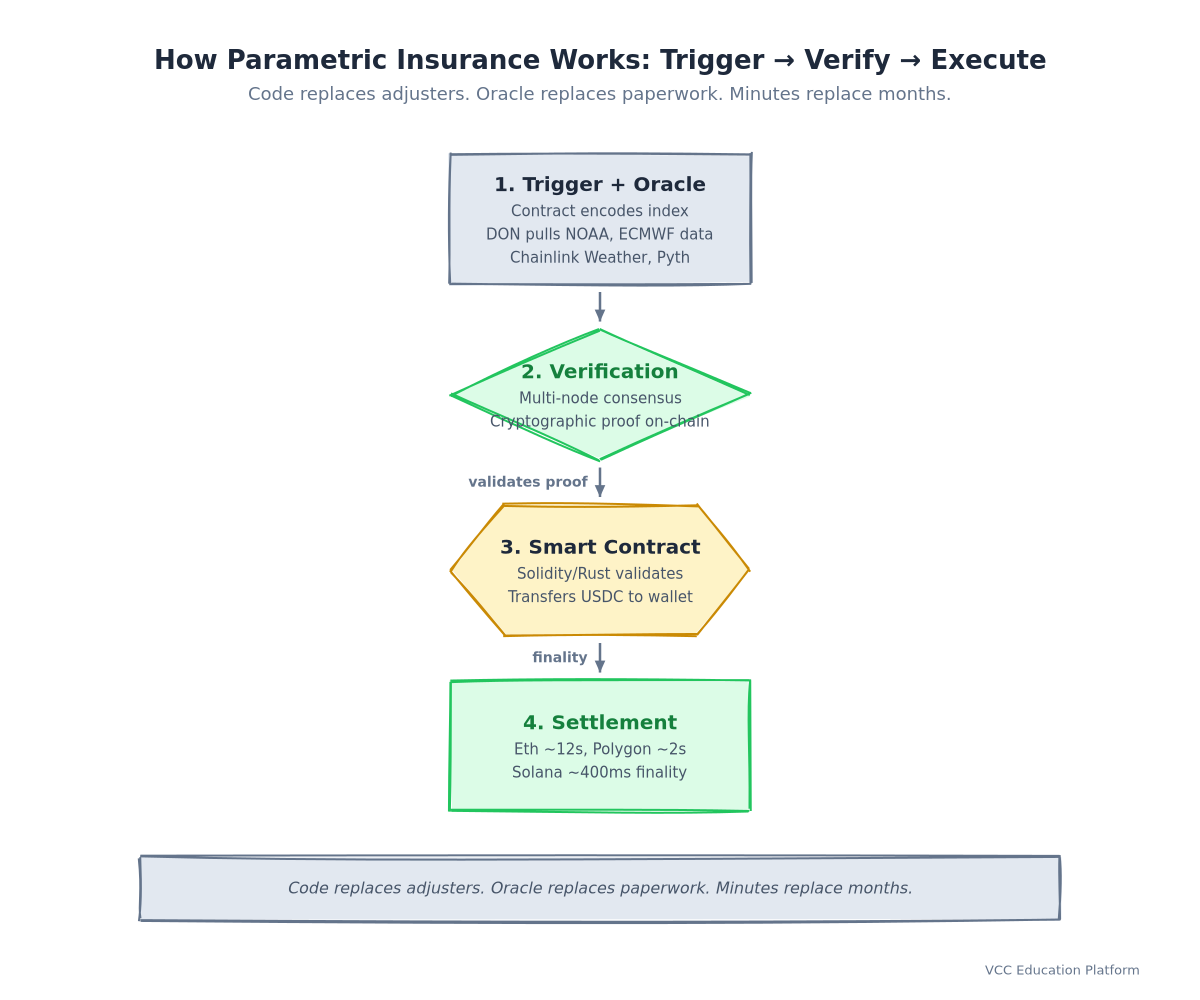
Figure 1: Parametric insurance trigger → verify → execute loop — code replaces adjusters, oracle replaces paperwork
Traditional vs Parametric: Side-by-Side Comparison
| Dimension | Traditional Indemnity | Parametric (Smart Contract) |
|---|---|---|
| Trigger | Actual loss assessment | Predefined data threshold |
| Verification | Human adjuster | Oracle network consensus |
| Payout speed | 30-90 days | Minutes to hours |
| Basis risk | None (covers actual loss) | Present (index ≠ individual loss) |
| Admin cost | 30-40% of premium | 5-15% (code execution) |
| Disputes | Frequent | Near-zero (code is law) |
| Transparency | Opaque | Fully auditable on-chain |
The trade-off is explicit: parametric eliminates moral hazard and admin bloat but introduces basis risk — the index may trigger while your specific loss is small, or vice versa. Smart contract claims automation removes the human bottleneck; the oracle becomes the trusted party.
Three Platforms Compared: Arbol vs Etherisc vs Chainlink Weather
Arbol — Climate Risk Marketplace
Focus: Agriculture, energy, parametric reinsurance Oracle: Proprietary + NOAA/ECMWF; chain-agnostic (Ethereum, Polygon, Avalanche) Products: Drought index, hurricane wind, freeze protection, wildfire Differentiator: Two-sided marketplace connecting capacity providers (reinsurers, ILS funds) with buyers. $2B+ notional risk transferred. 50% of clients previously had no access to climate risk products. Vietnam relevance: Pilots in Philippines/Indonesia; Mekong Delta rice farmers on 2025 roadmap. ADB partnership discussions underway.Etherisc — Open-Source Parametric Protocol
Focus: Flight delay, crop insurance, hurricane, crypto wallet protection Oracle: Chainlink Weather + custom adapters; Ethereum mainnet + Gnosis Chain Products: FlightDelay (live), CropCover (Kenya/India pilots), HurricaneGuard Differentiator: Generic Insurance Framework (GIF) — open-source, white-labelable. DIP token governance. 17,000+ Kenyan farmers covered via ACRE Africa partnership. Vietnam relevance: Open-source means local insurers (Bảo Việt, PVI, Pjico) can deploy parametric products without building from scratch. Low barrier to entry.Chainlink Weather — Oracle Infrastructure Layer
Focus: Not an insurer — provides tamper-proof weather data to ANY parametric product Data sources: NOAA, Met Norway, DWD, ECMWF, satellite (Climacell/Tomorrow.io) Coverage: Global hyperlocal 1km grid; historical backfill for backtesting Differentiator: Cryptographic proofs (DECO, VRF); works across 15+ chains. Decentralized Oracle Networks (DONs) with 10+ node operators, median aggregation. Vietnam relevance: NOAA/ECMWF cover Southeast Asia comprehensively. Any Vietnamese insurtech can integrate in days.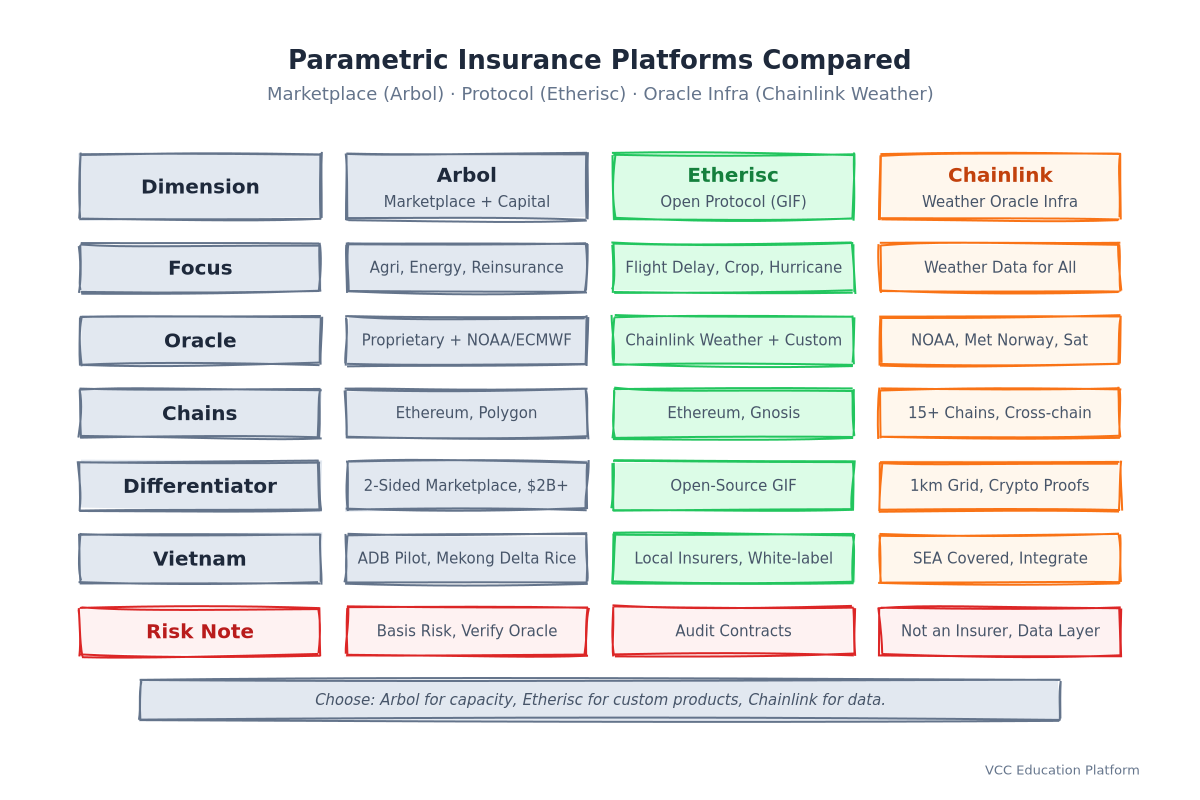
Figure 2: Three platforms compared — Arbol (marketplace + capital), Etherisc (open protocol), Chainlink Weather (oracle infra)
Real-World Use Cases: Flight Delay, Drought Agriculture, Microinsurance
Flight Delay — Etherisc FlightDelay
A traveler buys coverage pre-flight. The smart contract monitors airline API and airport data feeds. Trigger: departure delay > 2 hours (configurable). Payout: automatic USDC to wallet, average 3 minutes after wheels-up confirmation. Stats: 98% payout accuracy, zero disputes in 10,000+ policies (2023-2024).Drought Agriculture — Arbol Crop Cover / World Bank Pilots
Kenya and India: 50,000+ farmers covered using satellite rainfall index (CHIRPS). Vietnam pilot (2024): Mekong Delta rice — 1,200 farmers, 40% premium subsidy via ADB. Trigger: cumulative rainfall < 300mm in vegetative phase, validated by Vietnam Meteorological Agency + satellite. Payout: 72 hours after season end via MoMo/ZaloPay or bank transfer.Microinsurance — B3i / BlueOrbit Flood Parametric
Urban flood parametric for SMEs in Jakarta, Manila, Ho Chi Minh City. Trigger: radar rainfall > 100mm/hour AND river gauge > danger level (dual trigger reduces basis risk). Capital: reinsurance pools via blockchain (B3i consortium). Result: $2.3M paid in 2023 floods; 94% recipient satisfaction vs 61% traditional.The Oracle Problem & Basis Risk: What Can Go Wrong
Oracle manipulation: Single-source data feeds are vulnerable. Solution: Chainlink DON (Decentralized Oracle Network) with 10+ node operators, median aggregation. A single faulty node is outvoted.
Data latency: Weather station reporting delays. Solution: Multi-source hierarchy — satellite + ground radar + official agency — with automatic fallback.
Basis risk (index ≠ your loss): Your farm 20km from the weather station gets different rain. Solution: Hyperlocal 1km grids (Chainlink Weather), dual-trigger designs (rainfall + river gauge), area-yield index using government crop statistics.
Smart contract bugs: Code is immutable. Solution: Formal verification (Certora, OpenZeppelin), upgradeable proxy patterns, bug bounties ($1M+ on Immunefi).
How to Buy Parametric Coverage in Vietnam
- Identify your risk: Drought (rice), flood (SME), typhoon (aquaculture), flight delay (business travel).
- Check available platforms: Arbol (via broker), Etherisc (white-label partners), local insurtechs (Miya, VNI partnerships).
- Verify oracle source: Ask "Which weather data feed?" — require NOAA/ECMWF + satellite redundancy.
- Read the trigger logic: Exact threshold, measurement window, payout formula — all in contract code.
- Wallet setup: MetaMask (Polygon) or custodial wallet (MoMo crypto pilot) for auto-receipt.
- Premium payment: USDC/VND stablecoin or card; policy NFT minted as proof of coverage.
Common Mistakes When Evaluating Parametric Products
- Confusing parametric with indemnity — expecting full loss reimbursement; parametric pays fixed amount per trigger.
- Ignoring basis risk — buying drought cover when your farm's microclimate differs from the index grid.
- Overlooking oracle centralization — single API = single point of failure; demand decentralized oracle proof.
- Assuming "instant" means real-time — blockchain finality + oracle consensus = 2 minutes to 2 hours depending on chain.
- Skipping code audit review — unaudited contracts = uninsured risk; verify Certora/OpenZeppelin reports.
FAQ
What is parametric insurance and how does it differ from traditional insurance? Parametric insurance pays a pre-agreed amount when an objective index (rainfall, wind, flight status) hits a threshold — no loss assessment, no adjusters, no disputes. Traditional indemnity covers actual loss but requires claims processing.
How do smart contract claims work in parametric insurance? Smart contract claims execute automatically: an oracle (e.g., Chainlink Weather) feeds verified data to a blockchain contract, which validates the trigger and transfers stablecoins to the beneficiary wallet in minutes — no human intervention.
Is Arbol or Etherisc better for farmers in Vietnam? Arbol offers a managed marketplace with reinsurance capacity; Etherisc provides open-source infrastructure local insurers can white-label. For Vietnamese rice farmers, Arbol's ADB-backed pilot currently has the clearest on-ramp.
What happens if the oracle data is wrong? Decentralized oracle networks (Chainlink DON) use 10+ independent nodes; the median value is used. A single faulty node is outvoted. Contracts can include challenge periods and fallback data sources.
Can I buy parametric insurance with VND or do I need crypto? Emerging Vietnamese platforms (Miya, VNI partnerships) accept VND via card/bank and custody the stablecoin settlement. Pure DeFi routes (Arbol direct, Etherisc) require USDC on Polygon/Ethereum.
Next Steps
- Explore Arbol's marketplace for agriculture/energy parametric products
- Review Etherisc's GIF framework if you're an insurer building parametric products
- Integrate Chainlink Weather oracle for tamper-proof data in your own parametric app
- Vietnamese farmers: Contact local insurtech partners for ADB-subsidized pilot programs