
Building a serious NFT collection is easy. Keeping track of it is hard. Your assets sit across multiple wallets, on different blockchains, listed on marketplaces that come and go. Floor prices shift hourly, rarity rankings change when collections mint new tokens, and the tax implications of a single mint can follow you for years. This is where NFT collector tools come in — a category of software built to aggregate, value, analyze, and organize non-fungible assets in ways that generic crypto trackers simply cannot.
Whether you hold five NFTs or five hundred, the right nft tracking tools turn a scattered pile of tokens into a managed portfolio. This guide breaks down the four functional categories every collector should understand, explains how to evaluate tools against your own needs, and covers the Cardano-specific ecosystem that most generic guides ignore entirely.
Why NFT Tracking Tools Matter
The fundamental problem is non-fungibility. A fungible-token portfolio tracker can sum your balances — 100 ADA here, 50 ETH there — and give you a total. An NFT tracker cannot. Each token is unique, with its own mint cost, gas paid, marketplace fees, royalty obligations, current floor value, trait rarity, and sale history. Treating NFTs like fungible tokens — which is what most tax software does, according to Kryptos — produces wrong numbers, because "each tokenId has its own basis, history, and tax fate."
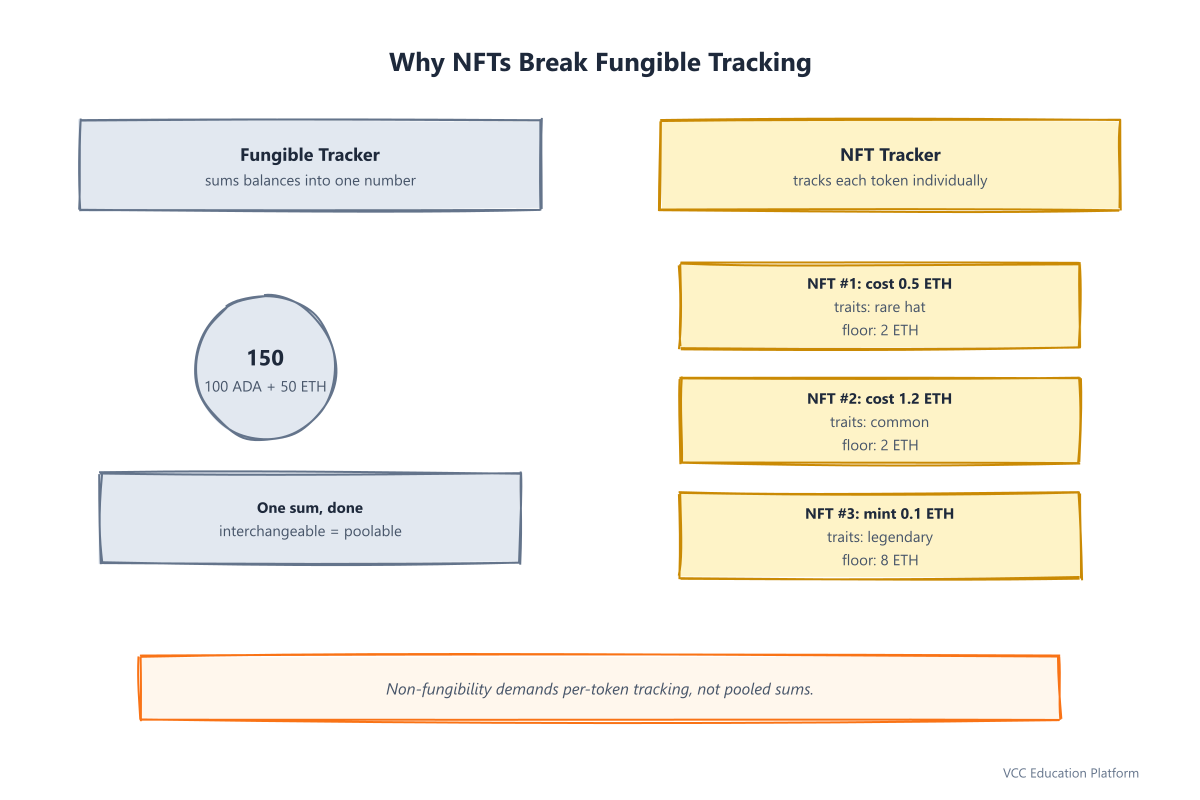
Figure 1: Fungible trackers sum balances into one number; NFT trackers must follow each token individually.
This is why a separate category of tools exists rather than NFTs being absorbed into general crypto portfolio apps. The tools fall into four clusters, each addressing a different facet of the problem:
- Portfolio trackers aggregate holdings across wallets and estimate total value.
- Market analytics platforms provide collection-level data — floor price, volume, holder distribution.
- Rarity and valuation tools score individual tokens within a collection.
- Tax and compliance tools track per-token cost basis for reporting.
A serious collector typically uses at least one tool from each cluster. A casual collector might get away with a single portfolio tracker. The key is understanding what each cluster does and where the gaps are in your own setup.
NFT Portfolio Tracker Essentials
A portfolio tracker connects one or more wallet addresses and displays all NFT holdings with estimated values. The simplest tools — like NFTHUD — let you paste a wallet address and see holdings with floor-value estimates. That is a useful starting point, but the category has evolved well beyond it.
Modern nft portfolio tracker tools add layers of functionality:
- Multi-wallet aggregation: Track holdings across every wallet you own in one dashboard. TapTools on Cardano supports adding multiple wallets for free, consolidating tokens, NFTs, and LP positions.
- Real-time floor pricing: Holdings valued at current floor price in both native token and fiat. Dr0x updates floor prices in real time across Ethereum, Base, Polygon, Arbitrum, and Optimism.
- Profit and loss tracking: Unrealized PnL per NFT based on current floor vs. your cost basis. This requires the tool to know or infer what you paid — mint price, secondary purchase price, gas.
- Smart alerts: Floor price notifications when a collection crosses a target, so you can act on market movements without constantly checking.
- Wallet profiling: The ability to inspect other wallets' trading performance. TapTools' Wallet Profiler shows any wallet's profit/loss summary, top holdings, and recent activity — turning the tracker into a research tool, not just a personal dashboard.
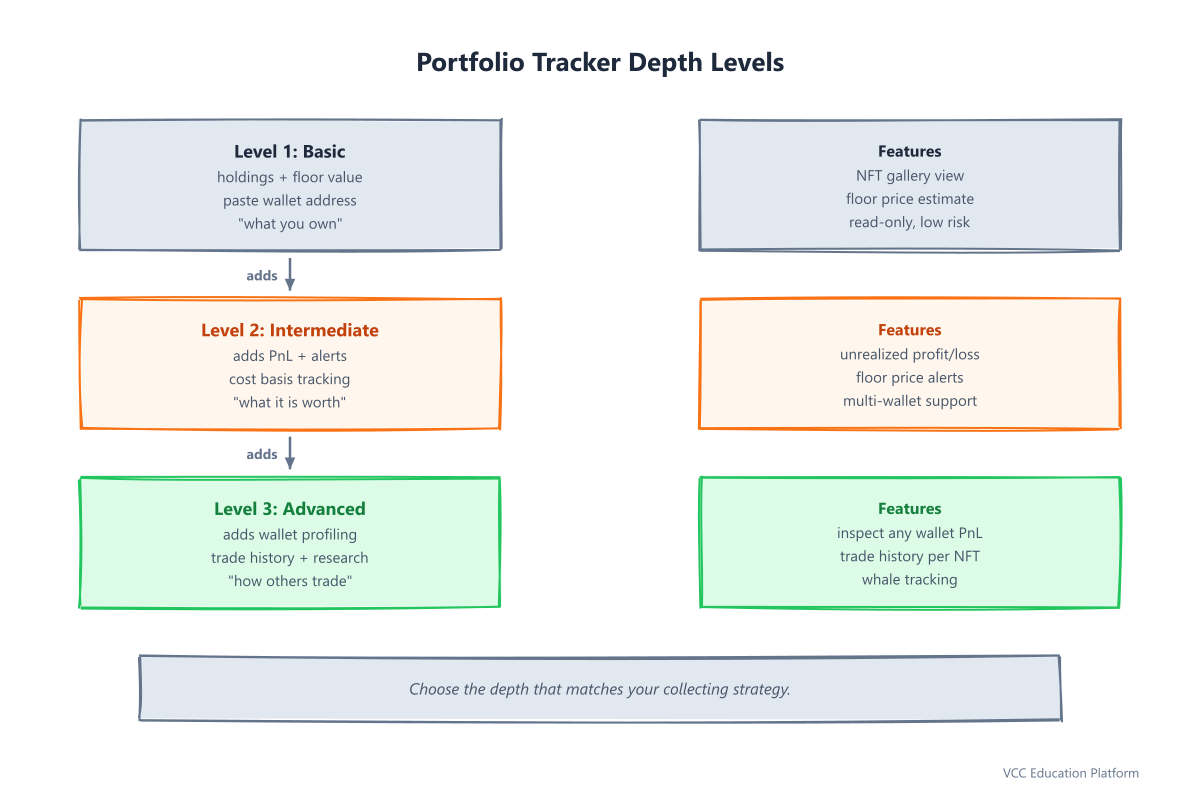
Figure 2: Portfolio trackers range from basic holdings views to advanced wallet-profiling research tools.
The depth distinction matters. A basic tracker tells you what you own. An intermediate tracker tells you what it is worth and how it has performed. An advanced tracker lets you learn from what successful collectors own and how they trade. If you are evaluating a portfolio tracker, ask which level it operates at, and whether that matches your needs.
NFT Analytics Tools: Reading the Market
While portfolio trackers focus on your holdings, nft analytics tools focus on the market — collection-level data that helps you decide what to buy, when to sell, and which collections are healthy.
The core metrics every analytics platform should provide:
- Floor price: The lowest listed price in a collection. The primary valuation metric, but with well-known limitations (covered below).
- Trading volume: How much is being traded over 24h, 7d, 30d. Volume with a rising floor indicates organic demand; volume with a flat floor may indicate wash trading.
- Number of owners vs. total supply: Holder concentration. A collection where 5 wallets hold 80% of supply is riskier than one with broad distribution.
- Market cap: Floor price multiplied by total supply. Useful for comparing collection scale, but inflated by illiquid floors.
- Sales count: Number of individual sales, not just volume. High volume from one whale sale looks different from high volume across many small sales.
Coverage is the critical differentiator. NFTPriceFloor tracks 1,799 collections across OpenSea, Blur, Magic Eden, NFTx, and others with sub-second latency. CoinGecko ranks top NFT collections by market cap across Ethereum, Solana, Bitcoin, Polygon, and Base. But both are Ethereum-centric — a Cardano collector using only these tools would be blind to their own ecosystem. TapTools fills the Cardano gap with floor price charts, live trade feeds, and trending collection tickers.
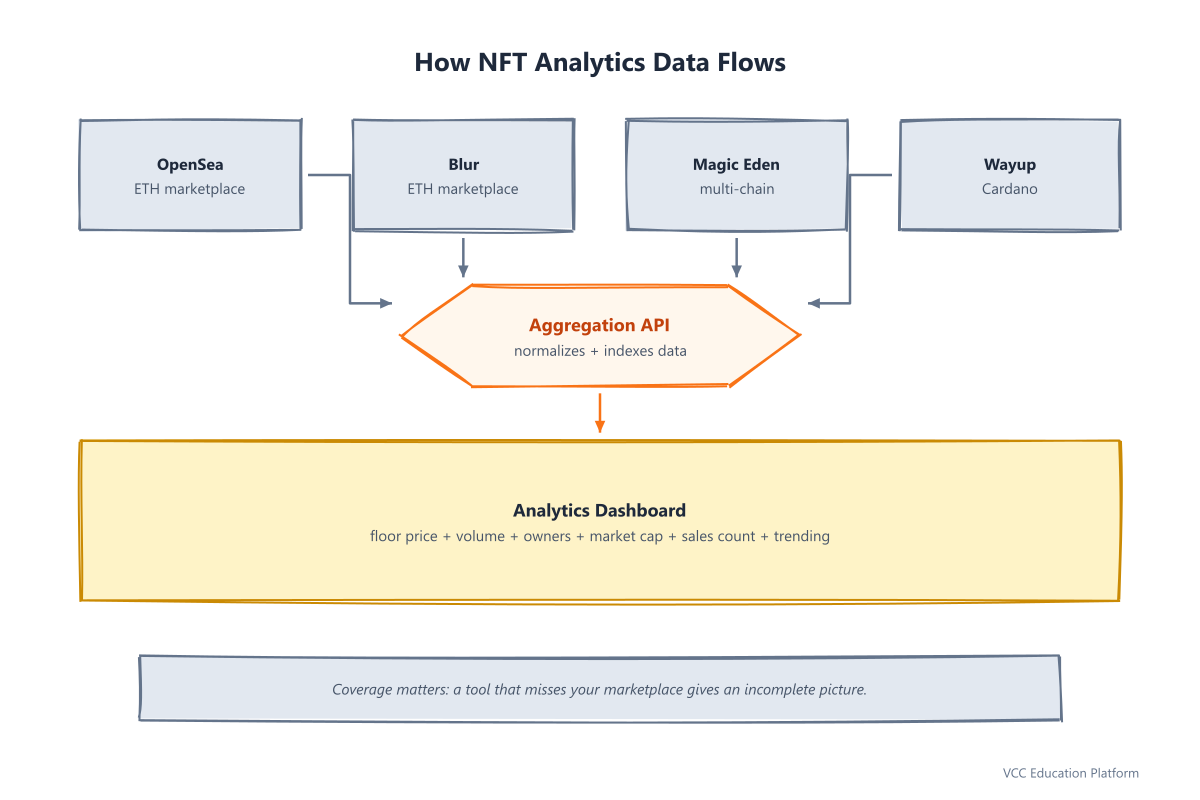
Figure 3: Marketplaces feed into aggregation APIs, which power analytics dashboards with floor price, volume, and holder data.
The lesson: check which marketplaces and blockchains a tool covers before relying on it. A tool that does not track the marketplace where you trade is giving you an incomplete picture.
NFT Collection Management: Organizing Your Holdings
NFT collection management goes beyond tracking value — it is about organizing, categorizing, and maintaining records of your assets for practical use. This is where portfolio trackers and tax tools overlap.
Key management features:
- Per-token cost basis tracking: Every NFT has its own cost basis — mint price plus gas plus marketplace fees plus any royalties paid. Kryptos tracks this per token across mints, secondary buys, transfers, and gifts, noting that "gas vs price, royalty paid, each component recorded so future sales calculate correctly."
- Watchlists: Add collections you are monitoring but do not yet own. NFTfolio and similar tools let you track trending collections separately from your holdings.
- Gallery views: Visual browsing of your NFTs, often with trait and rarity overlays. Useful for appreciating your collection and for showing it to others.
- Trade history: A complete log of your buys, sells, mints, and transfers. TapTools' NFT Trades view shows trade type, collection, asset name, price, and marketplace for every transaction.
- Multi-marketplace coverage: Your trades may span OpenSea, Blur, Magic Eden, Tensor, and niche marketplaces. A management tool that only reads one marketplace misses transactions on the others.
The management layer is what separates a collector from a speculator. A speculator checks floor prices and sells. A collector maintains records, understands what they own and why, and can reconstruct their portfolio history years later — which is exactly what tax authorities may ask for.
Rarity and Valuation Tools
Rarity is the dimension of NFT value that floor price cannot capture. Two NFTs in the same collection may have the same floor value but wildly different actual worth because one has rare traits and the other does not. Rarity tools score and rank individual tokens within a collection based on trait scarcity.
The OpenRarity Approach
The most significant development in rarity tooling is OpenRarity, an open-source protocol backed by Curio, icy.tools (QuickNode), OpenSea, and PROOF. It exists because rarity rankings historically diverged across platforms — each used closed-source algorithms, so the same NFT might rank #50 on one tool and #200 on another.
OpenRarity uses information content (Shannon entropy, or "surprisal") rather than summing raw probabilities. The formula: I(x) = Σ -log₂(P(trait_i)), normalized by expected information content. The intuition is elegant:
- A trait present in 100% of tokens conveys zero information — it is not rare at all, so it adds zero to the score.
- As a trait's probability approaches zero (it becomes rarer), its information content rises without bound.
- Information content is mathematically valid for linear operations (addition, averaging), while raw probabilities are not.
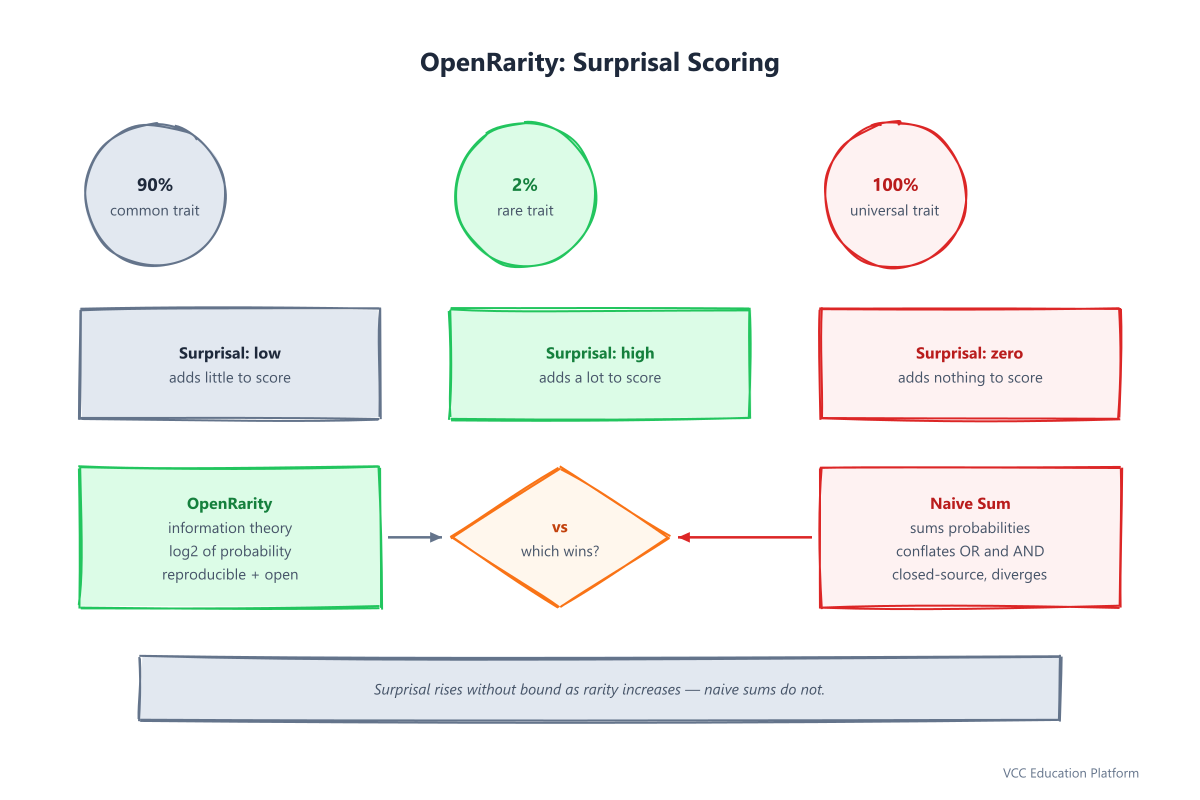
Figure 4: OpenRarity uses information content (surprisal) — rare traits add more to the score than common ones, universal traits add zero.
This matters because the older "sum of trait probabilities" approach conflates "having a green hat OR a blue hat" with "having a green hat AND a blue hat" — mathematically different statements that produce different rarity scores. OpenRarity's information-theory approach is more principled and, critically, reproducible: anyone can run the open-source code and get the same rank.
Trait-Floor Divergence
Even with good rarity scoring, floor price alone undervalues rare items. A collection with a 5 ETH floor may have rare-trait NFTs worth 25 ETH. Tools like FLOLiO address this with "Trait Floor and FMV" (fair market value) pricing — valuing each NFT at its trait-specific floor rather than the collection floor. Recap goes further, using Upshot for "AI-powered appraisals" that provide near-real-time valuations beyond floor price.
For collectors, the practical takeaway: know whether your portfolio tracker values your NFTs at collection floor or trait floor. If it uses collection floor, your rare items are being undervalued in your dashboard — and you may be making sell decisions based on incomplete information.
Tax and Compliance Tools
The most overlooked category, and the most consequential when it goes wrong. NFT tax tools track per-token cost basis and calculate gains, losses, and income for reporting.
Why NFTs Break Tax Software
Most tax software treats NFTs like fungible tokens — averaging cost basis across a pool. This is wrong for NFTs because each token is individually identifiable and has its own cost basis. If you mint 50 NFTs at 0.1 ETH each and sell 10 of them, you cannot average across all 50 — you need to know which 10 you sold and what each one cost.
Kryptos addresses this with per-token basis tracking: "Mint vs secondary, gas vs price, royalty paid. Each component recorded at the event so the sale calculates correctly." The components that matter:
- Mint cost: What you paid to mint, plus gas.
- Secondary purchase price: What you paid on a marketplace, plus gas and marketplace fees.
- Royalties paid: If you bought on a marketplace that charges creator royalties, that is part of your cost basis.
- Gas on sale: The transaction fee when you sell reduces your proceeds.
Jurisdiction Matters
Tax treatment varies: the US may treat NFTs as "collectibles" (28% long-term capital gains rate rather than the standard 20%), while the EU may apply art VAT rules. Koinly supports Cardano alongside Ethereum, Solana, and BSC — notable because Cardano NFT tax tooling is sparse. Kryptos detects wash-sale patterns (same wallet on both sides of a trade, same NFT within 30 days) and surfaces them for review, since wash-sale rules differ by jurisdiction.
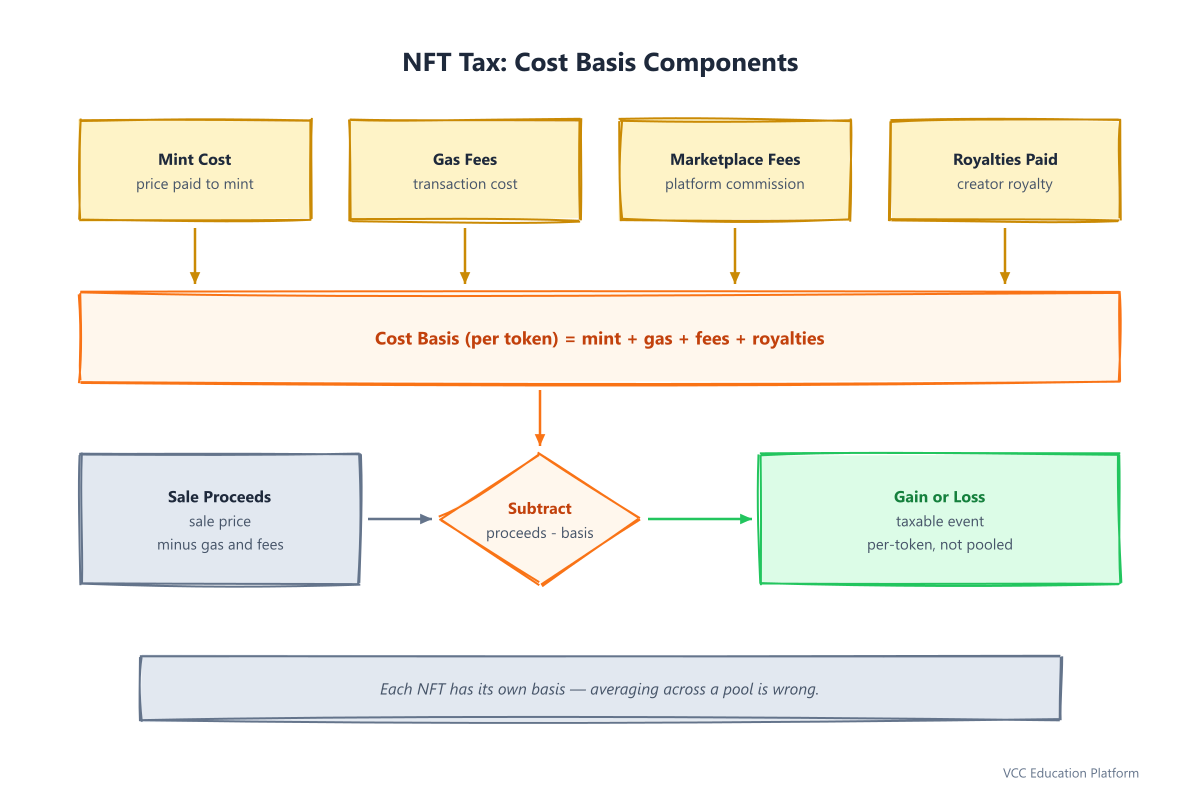
Figure 5: Cost basis = mint + gas + fees + royalties. Gain or loss = sale proceeds minus cost basis, calculated per token.
For Vietnamese collectors, the guidance is practical: use global tools but maintain meticulous personal records, since automated tools may not handle Vietnamese regulatory specifics and the tax framework for digital assets is still evolving.
Cardano-Specific NFT Collection Tools
Cardano's NFT ecosystem has distinct tooling needs. Its token standards (CIP-25, CIP-68), wallet infrastructure (Eternl, Nami, Yoroi), and marketplace landscape differ from EVM chains, and most Ethereum-centric tools provide zero Cardano coverage.
TapTools: The Dominant Platform
TapTools is effectively the only comprehensive Cardano analytics and portfolio platform. It uses Cardano-db-sync to extract on-chain data and aggregates across DEXs and marketplaces including Minswap, Sundaeswap, WingRiders, and MuesliSwap. For NFT collectors specifically, it offers:
- Real-time floor price charts with selectable time intervals
- Collection stats: floor in ADA, daily volume, owners, total supply, market cap
- Live trade history feed with rarity rank and wallet profiler per trade
- Portfolio view with NFT holdings, floor price, and active listings
- Wallet Profiler showing any wallet's P&L, top holdings, and recent activity
The JPG Store Shutdown and Marketplace Fragmentation
The Cardano NFT ecosystem underwent a major shift when JPG Store — the largest Cardano NFT marketplace, handling over 60% of trading volume — announced shutdown in April 2025, with full closure by May 2026. The platform cited sustainability constraints after the prolonged NFT market downturn.
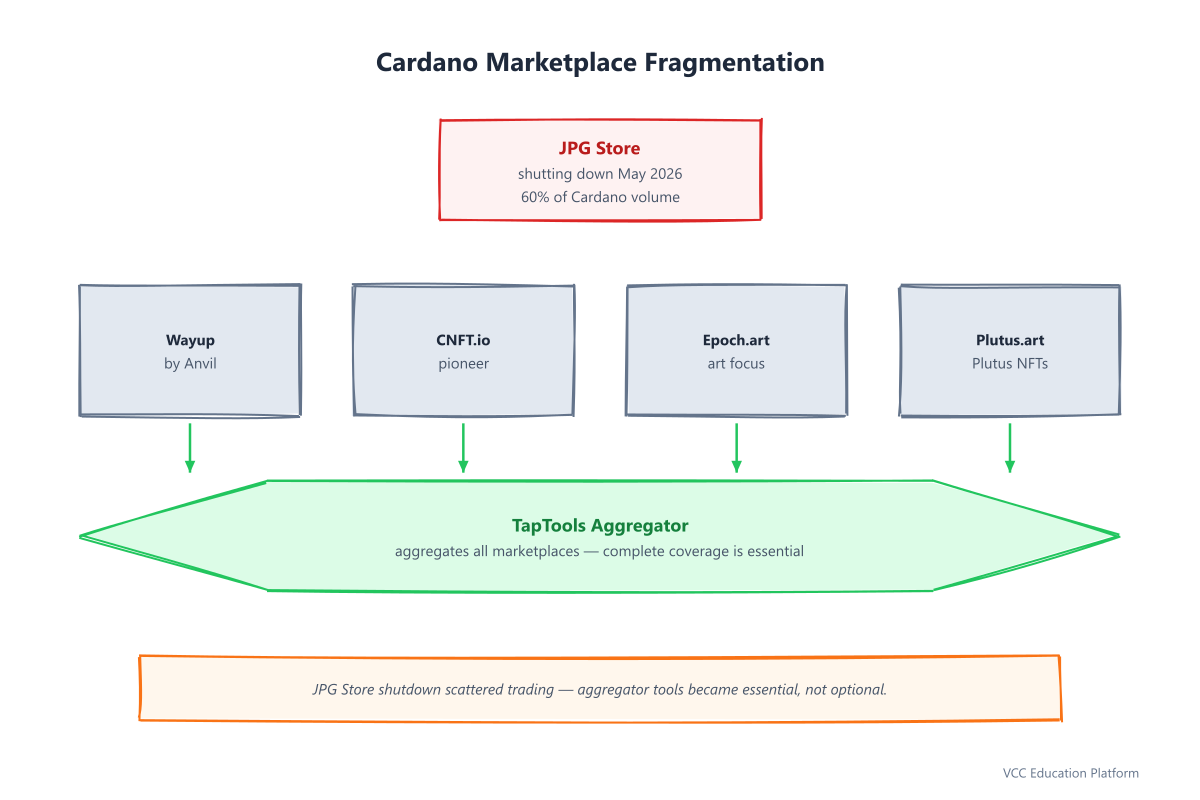
Figure 6: After JPG Store shutdown, trading scattered across multiple marketplaces, making aggregator tools essential.
This fragmentation is actually an argument for using aggregator tools. When trading concentrates on one marketplace, a collector can check that marketplace directly. When trading scatters across five marketplaces — Wayup, CNFT.io, Epoch.art, Plutus.art, CardaHub — manual tracking becomes impractical. TapTools responded by integrating Wayup data within weeks of the shutdown announcement, recognizing that "NFT market data depends on coverage. When trading activity moves across platforms, analytics tools need to follow that movement or the market picture becomes fragmented."
The Cardano collector's toolkit in 2026: TapTools for analytics and portfolio, a marketplace (Wayup or CNFT.io), a wallet (Eternl or Nami), and ideally a tax tool with Cardano support (Koinly). NMKR remains the primary minting platform for creators, supporting CIP-25 and CIP-68 standards.
Security Best Practices for Tool Usage
NFT collector tools introduce their own security considerations. Most are low-risk, but the differences matter.
Read-Only vs. Wallet-Connect
The safest tools are read-only — you paste a public wallet address and the tool reads on-chain data. Dr0x explicitly states it "is a read-only portfolio viewer. It does not facilitate any cryptocurrency transactions, NFT purchases, or sales." This is a security feature. A public address is, by definition, public — sharing it reveals nothing an attacker could use.
Higher risk enters when a tool requests a wallet connection (signing capability) or installs a browser extension that interacts with marketplace pages. FLOLiO's extension, for instance, is designed to help users "move faster and make more money on OpenSea" — but extensions with marketplace-interaction permissions require broader access and should be scrutinized.
The Risk Hierarchy
- Paste-address tools (lowest risk) — only need a public address
- Wallet-connect read-only (low risk) — requires trusting the dApp, but read-only connections cannot move assets
- Browser extensions (medium risk) — modify marketplace pages, broader permissions
- Any tool asking for a seed phrase (never) — this is always a scam; no legitimate tool needs your seed phrase
Practical Rules
- Never type your seed phrase or private key into any tool. No legitimate collector tool requires it.
- Prefer read-only tools that only need a public wallet address.
- Before connecting a wallet, verify the tool's reputation — check for community reviews, audit history, and how long it has operated.
- Treat wallet-connection requests with the same scrutiny as DeFi interactions. A malicious dApp can request a transaction that drains your wallet.
- Use a dedicated wallet for tool connections — keep your main holdings in a separate wallet that you never connect to third-party tools.
For a deeper treatment of NFT security, see our guide on NFT security considerations.
Frequently Asked Questions
What are NFT collector tools?
NFT collector tools are software applications designed to help collectors track, value, analyze, and manage their NFT holdings. They fall into four categories: portfolio trackers (aggregate holdings across wallets), market analytics platforms (collection-level data like floor price and volume), rarity and valuation tools (score individual tokens), and tax and compliance tools (track per-token cost basis). Unlike generic crypto trackers, NFT tools account for the non-fungible nature of each token.
How do I track my NFT portfolio across multiple wallets?
Use an nft portfolio tracker that supports multi-wallet aggregation. You paste your public wallet addresses (one per wallet you own), and the tool reads on-chain data to display all holdings in one dashboard. TapTools on Cardano and Dr0x on Ethereum both support adding multiple wallets. The tool estimates total value using current floor prices and may track profit and loss if it can infer your cost basis.
Are NFT tracking tools safe to use?
Most are safe if you use read-only tools that only require a public wallet address. Public addresses are not secret — sharing them reveals your holdings but cannot be used to steal assets. The risk increases when a tool requests a wallet connection (signing capability) or installs a browser extension. Never enter your seed phrase or private key into any tool. No legitimate collector tool requires it.
What is the best NFT analytics tool for Cardano?
TapTools is the dominant Cardano analytics platform, offering floor price charts, trade history, wallet profiling, and portfolio tracking. It aggregates data across Cardano marketplaces and uses Cardano-db-sync for on-chain data. After the JPG Store shutdown, TapTools integrated Wayup data to maintain coverage as trading fragmented across multiple marketplaces.
How do NFT tax tools calculate cost basis?
NFT tax tools track cost basis per individual token, not as a pooled average. For each NFT, they record the mint cost or purchase price, plus gas, marketplace fees, and royalties paid. When you sell, they calculate gain or loss as sale proceeds (sale price minus gas and fees) minus cost basis. This per-token approach is necessary because NFTs are non-fungible — averaging across a pool would produce incorrect figures.
Can I use NFT collection tools for free?
Many nft collection tools offer free tiers. TapTools provides portfolio tracking and NFT charts for free, with paid tiers for advanced features. NFTHUD and CryptoLens offer free portfolio tracking by wallet address. Tax tools like Koinly and Kryptos typically offer free import but charge for generating tax reports. Start with free tiers to evaluate whether a tool fits your workflow before paying for premium features.
Conclusion
The NFT collector's toolkit is not optional once your collection grows beyond a handful of tokens. The fragmentation of assets across wallets, marketplaces, and blockchains — accelerated on Cardano by the JPG Store shutdown — makes manual tracking impractical. The right combination of portfolio tracker, analytics platform, rarity tool, and tax software turns a chaotic pile of tokens into a managed portfolio you can understand, value accurately, and report correctly.
Start with a read-only portfolio tracker to see what you own. Add an analytics platform to understand the market context. Use a rarity tool to know whether your holdings are floor items or rare gems. And set up tax tracking early — reconstructing cost basis years after the fact is far harder than recording it at the time of each transaction. The tools exist to do the bookkeeping that non-fungibility demands; the question is whether you use them before you need them or after you wish you had.