
NFT authentication methods have become the backbone of Web3 access control, identity verification, and digital ownership proof. As NFTs evolved from collectibles into functional primitives, the question shifted from "who owns this JPEG" to "how do we cryptographically prove that ownership and use it to grant access." Whether you are building a token-gated community, implementing wallet-based login, or designing a soulbound identity system, understanding the full authentication stack — from cryptographic signatures through smart contract verification to soulbound token attestation — is the difference between a secure system and one that collapses under its first replay attack.
What Is NFT Authentication?
NFT authentication is the process of cryptographically proving that a specific wallet controls a specific non-fungible token, then using that proof to grant access, establish identity, or authorize an action. Unlike traditional authentication — where a username and password are stored in a centralized database and checked on every login — NFT authentication puts the credential in the user's wallet and the verification logic on the blockchain or in a service that queries it.
The fundamental shift is ownership of the credential. In a traditional system, the service owns your account. They can lock you out, delete your data, or be breached. In an NFT authentication system, you hold the credential in a self-custody wallet. The service cannot revoke your token — it can only stop recognizing it. The verification is permissionless: anyone can check the blockchain to confirm that wallet 0x1a2b... holds token #42 from collection 0x3c4d... without asking permission from the token issuer.
This model has three properties that traditional authentication cannot replicate. First, portability — the same NFT can authenticate you across multiple services without each service needing a separate account. Second, composability — the authentication logic lives in a smart contract that any developer can integrate. Third, auditability — every authentication event is either recorded on-chain or verifiable from a signature, creating a transparent trail that no centralized provider can alter.
The tradeoff is key management. If you lose your private key, you lose access to every service that token authenticates. There is no password reset. This makes wallet security inseparable from authentication security — a theme that runs through every method discussed below.
The NFT Verification Stack: Four Layers
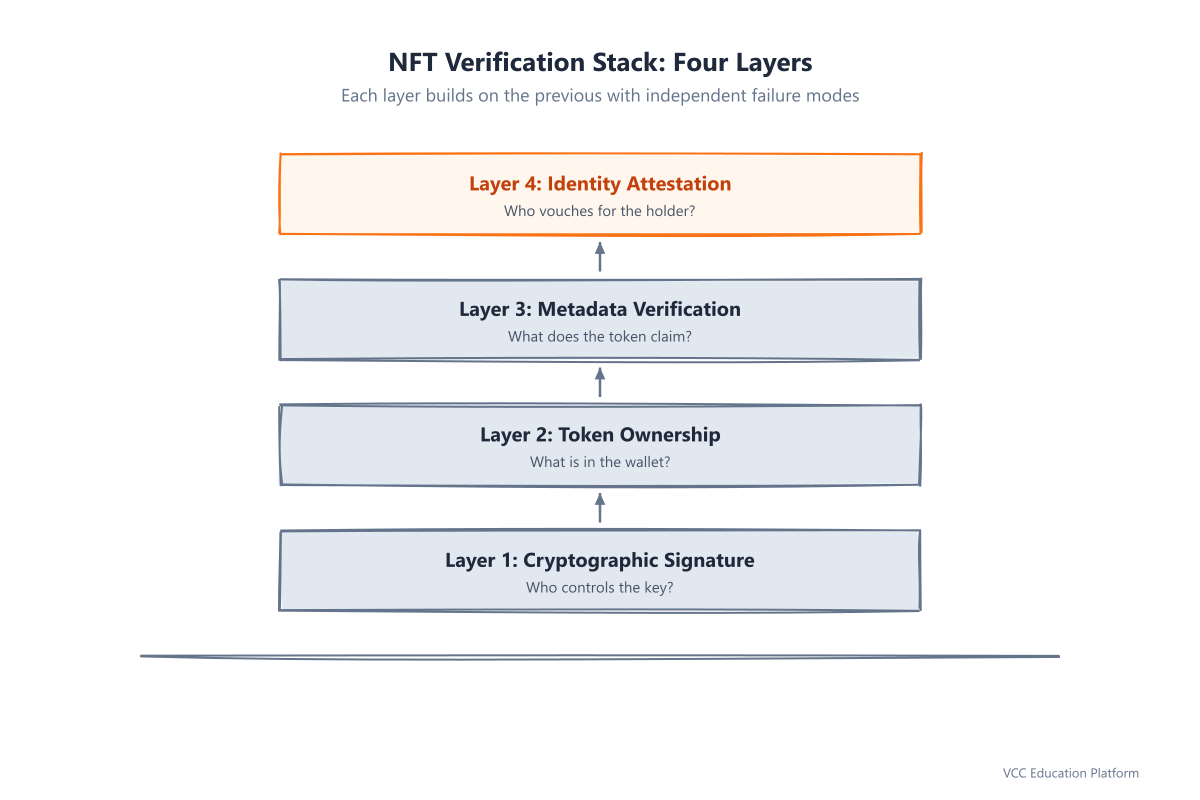
NFT verification is not one technique — it is a stack of four layers, each building on the previous but with independent failure modes. Understanding the full stack is essential because a vulnerability in any layer compromises the authentication above it.
Layer 1: Cryptographic Signature (Who Controls the Key?)
The foundation is the cryptographic signature. When a user connects their wallet to a dApp, the dApp asks the wallet to sign a message. The signature proves the user controls the private key associated with their wallet address — without the private key ever leaving the wallet. This is the same mechanism that authorizes blockchain transactions, but applied to off-chain authentication. The signature alone does not prove anything about NFTs; it only proves control of an address.
Layer 2: Token Ownership (What Is in the Wallet?)
Once the signature proves control of the address, the next layer checks what tokens that address holds. A smart contract can call balanceOf(address) on an ERC-721 or ERC-1155 contract, or an off-chain service can query an RPC provider. If the balance is greater than zero for the target collection, the user is authenticated as a holder. This is the core of token gating — but it only proves current ownership, not permanent association.
Layer 3: Metadata Verification (What Does the Token Claim?)
The token's metadata can carry authentication-relevant claims. An NFT might encode a membership tier, a role, or an expiration date in its metadata URI. The verification layer fetches and parses this metadata to determine not just whether the user holds the token, but what the token entitles them to. This layer is vulnerable to metadata manipulation — if the metadata is hosted on a mutable server, the issuer can change the claims after the fact.
Layer 4: Identity Attestation (Who Vouches for the Holder?)
The top layer connects the token to a real-world or on-chain identity. Soulbound tokens, POAPs, and attestation services like EAS issue tokens that represent verified credentials — a diploma, an attendance proof, a reputation score. The verification at this layer checks not just the token but the issuer's credibility and the binding between the token and the holder. This is where NFT authentication intersects with decentralized identity.
Signature-Based Authentication
The signature is the atomic unit of NFT authentication. Every method above it — token gating, identity verification, access control — depends on a valid signature proving the user controls the wallet being checked. Getting signatures right is therefore the single most important security decision in any NFT authentication system.
The Challenge-Response Protocol
NFT authentication uses a challenge-response protocol. The relying party (the dApp or backend) generates a random nonce — a single-use cryptographic challenge. The user's wallet signs the nonce (plus contextual information) with their private key. The relying party recovers the signer address from the signature using ecrecover and compares it to the claimed address. If they match, the user has proven control of the wallet without revealing the private key.
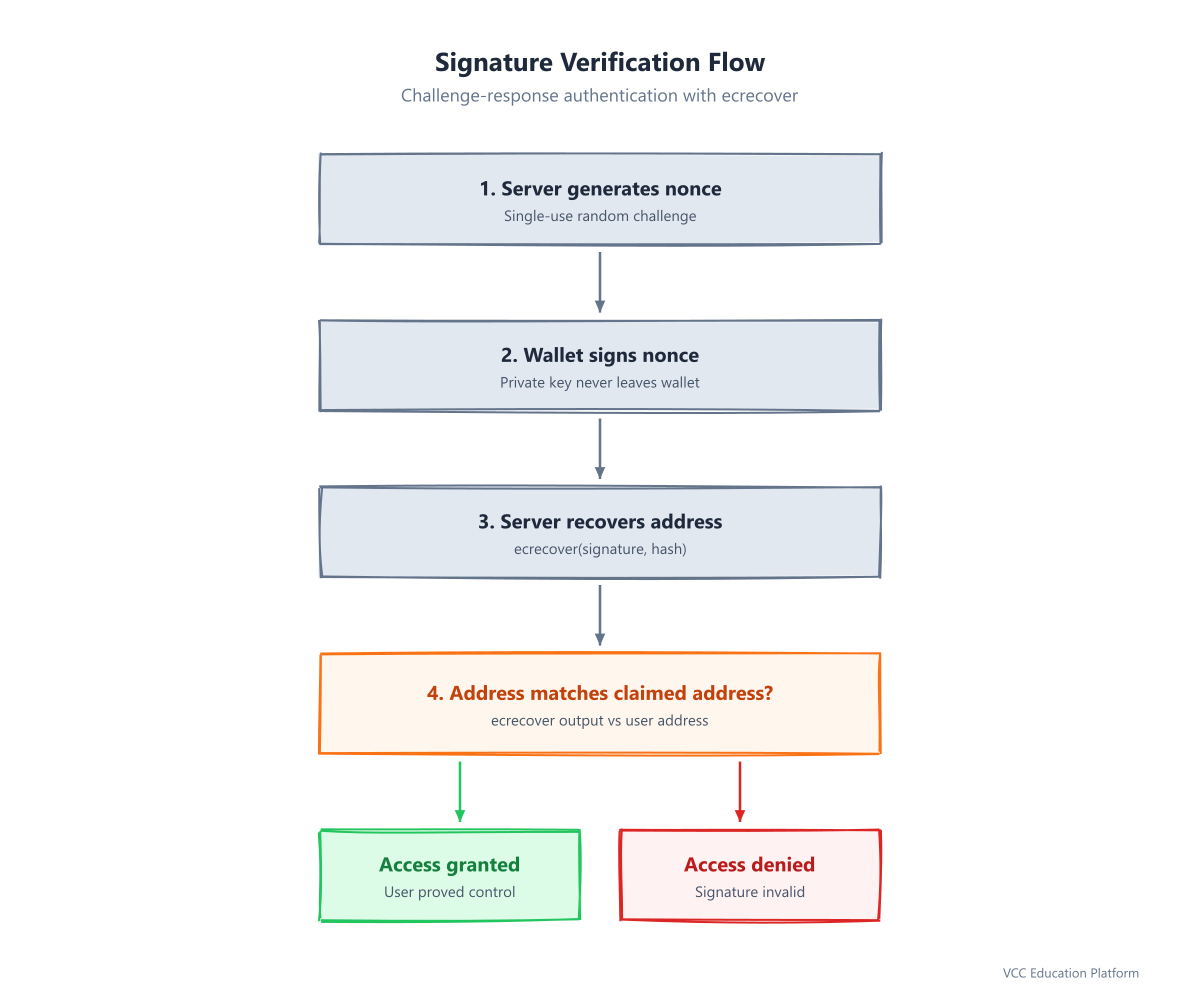
The nonce must be unique and single-use. If the same nonce is issued twice, an attacker who captured the first signature can replay it to authenticate as the original user. The nonce must also be scoped to a specific domain and session — a signature valid for example.com should not be accepted by evil-lookalike.com.
Sign-In with Ethereum (EIP-4361)
Sign-In with Ethereum (SIWE), formalized in EIP-4361 and reaching Final status in August 2025, standardizes the challenge-response message format. Instead of asking the user to sign an arbitrary string (which wallets display as a hex blob), SIWE defines a structured plaintext message that wallets can parse and display in a human-readable interface.
A SIWE message includes:
- Domain — the site requesting authentication, preventing cross-site signature theft
- Address — the user's Ethereum address (EIP-55 checksummed)
- URI — the full URI of the login request
- Chain ID — the network the signature is valid on
- Nonce — a single-use random value preventing replay
- Issued At — timestamp for validity window calculation
- Expiration Time (optional) — when the signature expires
- Resources (optional) — URIs for scoped access
The domain binding is the critical anti-phishing measure. When a site asks a user to sign a SIWE message, MetaMask checks whether the domain in the message matches the site the user is on. If they mismatch, MetaMask displays a prominent warning. This does not block the signature — the user can still proceed — but it makes lookalike phishing sites far less effective because the wallet itself flags the inconsistency.
EIP-712 Typed Data Signing
For more complex authentication payloads — allowlist proofs, mint authorizations, permit signatures — EIP-712 defines a standard for signing typed structured data. Instead of signing a raw bytestring, the user signs a hash of structured data that includes a domain separator binding the signature to a specific contract, chain, and version.
The domain separator is the primary replay defense. It typically includes:
name— the protocol name (e.g., "MyNFTCollection")version— the contract version (e.g., "1")chainId— the EIP-155 chain ID (e.g., 1 for mainnet)verifyingContract— the specific contract address that will verify the signature
A signature bound to this domain separator is invalid on any other contract, any other chain, or any other version. This is not optional — omitting the contract address from the domain separator creates a cross-collection replay vulnerability where a signature valid for Collection A can be replayed on Collection B.
Token-Gating and NFT Access Control
Token gating is the most visible application of NFT authentication. The concept is simple: if a user holds a specific NFT in their wallet, they get access. The implementation has two variants with fundamentally different trust models.
On-Chain Gating: Trustless but Expensive
On-chain gating embeds the access check directly in a smart contract. The contract calls balanceOf(user, tokenId) on the NFT contract and reverts the transaction if the user holds zero tokens. This is trustless — no intermediary can bypass the check — but it costs gas for every verification.
`solidity // On-chain token gating: only holders can call this function contract GatedAction { IERC721 public membershipNFT;
function premiumAction() external { require( membershipNFT.balanceOf(msg.sender) > 0, "Not a member" ); // ... gated logic } } `
This pattern is appropriate when the gated action is itself a blockchain transaction — minting a derivative token, claiming a reward, voting in a DAO. The gas cost is paid by the user, who has a direct incentive to hold the token.
Off-Chain Gating: Cheap but Trusted
Off-chain gating moves the verification to a backend server. The server authenticates the user via SIWE, then queries the blockchain through an RPC provider (Alchemy, Moralis, Infura) to check NFT ownership. If the check passes, the server grants access — a Discord role, a website session, an API token.
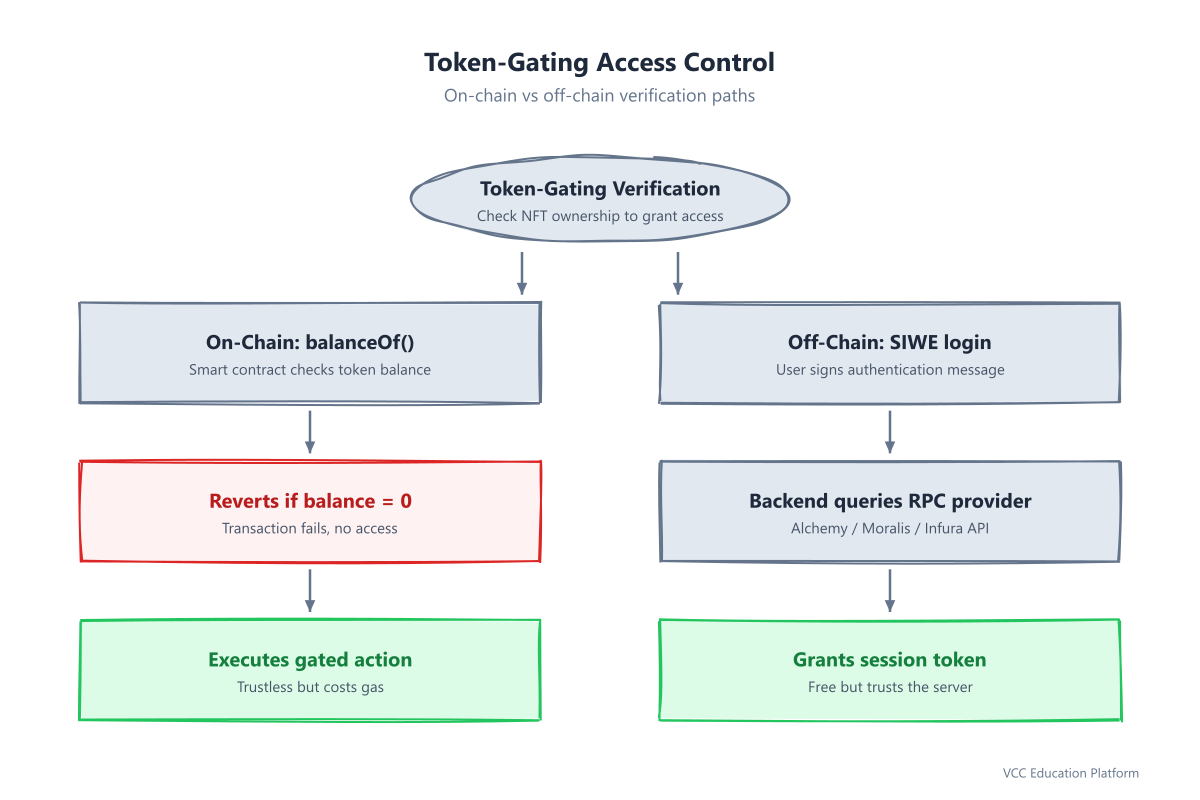
This is the dominant pattern for content access because it is free for the user and fast for the server. But it introduces a trusted intermediary: the backend server. If the server is compromised, it can grant access to non-holders or deny access to legitimate holders. The blockchain guarantees the data (the ownership record is immutable) but not the decision (the server can ignore the data).
The production pattern combines both: SIWE for authentication (proving wallet control), off-chain ownership check for authorization (proving token holding), and a short-lived signed session token for subsequent requests (avoiding repeated blockchain queries). Tools like Collab.Land and Guild.xyz implement this pattern for Discord role assignment — the bot verifies wallet ownership on join, assigns the role, and periodically re-verifies to handle token sales.
The Stale Access Problem
A subtle vulnerability in token gating is stale access. If a user sells their NFT after being authenticated, they may retain access until the next verification cycle. Discord bots handle this by periodically re-checking wallet balances and removing roles from users who no longer hold the token. But if the re-check interval is too long — say, once a day — a user can sell their NFT and retain access for up to 24 hours.
The defense is to make the re-check interval proportional to the value of the access. A free Discord channel can tolerate daily checks. A high-value token-gated drop or a financial action should verify ownership at the moment of action, not rely on a cached session.
NFT Identity Verification with Soulbound Tokens
Token gating proves current ownership. But ownership is transferable — if you sell your NFT, the buyer inherits your access. This is fine for membership passes but broken for identity verification. You cannot sell your diploma, your attendance record, or your reputation score. This is the problem soulbound tokens solve.
What Makes a Token Soulbound?
A soulbound token (SBT) is an NFT that cannot be transferred after it is minted. The concept was formalized in Vitalik Buterin, Glen Weyl, and Puja Ohlhaver's May 2022 paper "Decentralized Society: Finding Web3's Soul." The token standards that implement this — primarily ERC-5192 and EIP-4973 — lock the token to the receiving wallet by overriding or removing the transferFrom function.
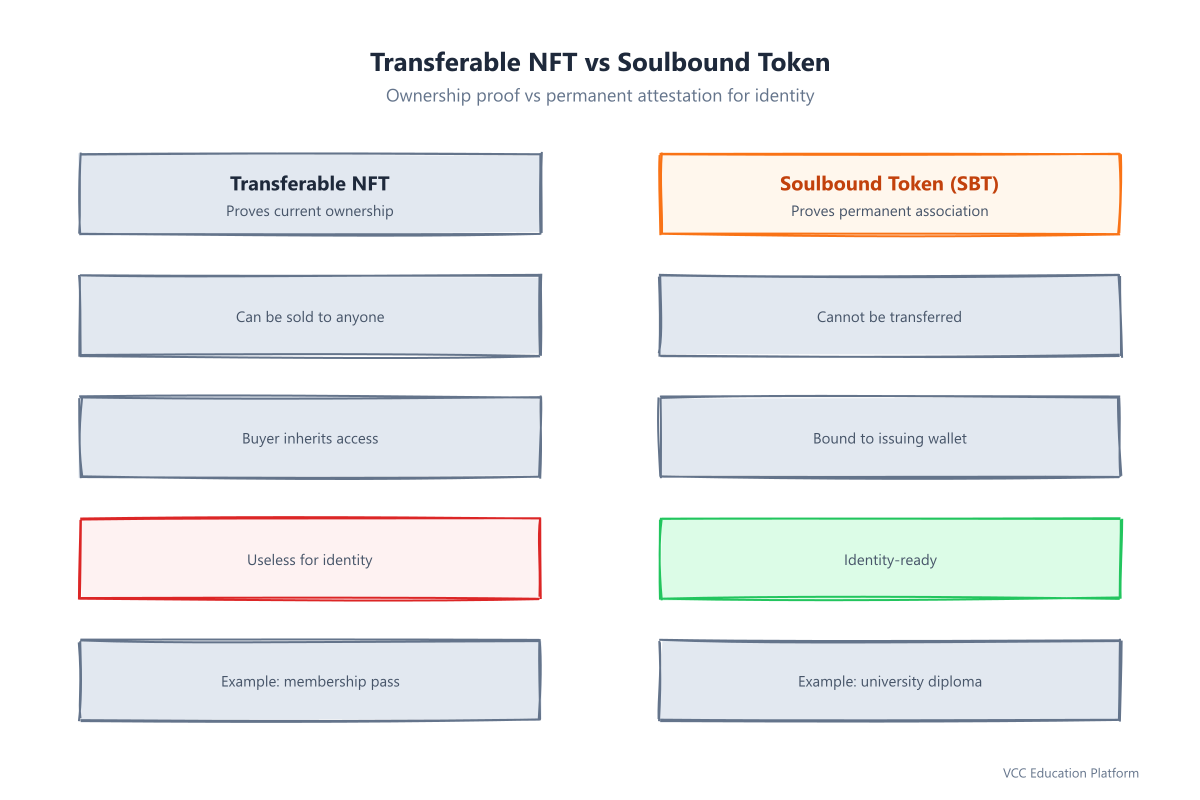
The distinction matters for authentication because a transferable NFT proves who currently holds the token while a soulbound token proves who the token was issued to. If a university issues diplomas as regular NFTs, anyone who buys the diploma NFT can claim the degree. If the university issues diplomas as SBTs, the credential is permanently bound to the graduate's wallet and cannot be transferred to a buyer.
ERC-7574: Authentication SBTs with Zero-Knowledge Proofs
ERC-7574 extends the SBT concept with a privacy-preserving authentication flow. Instead of putting the credential data on-chain (which would expose personal information), the protocol uses zero-knowledge proofs to verify a decentralized identity (DID) credential off-chain, then mints an SBT as the on-chain proof that verification occurred.
The flow is: the user holds a verifiable credential (e.g., a degree from a university). A smart contract verifies the credential using a ZK proof — checking that the credential is valid and belongs to the user without revealing the credential contents. If verification succeeds, the contract mints an SBT to the user's address. Relying services can then check for the SBT's existence to confirm the user holds the verified credential, without ever seeing the credential itself.
This separates the private credential data (off-chain, ZK-protected) from the public verification signal (on-chain SBT). The SBT metadata includes the issuer address and a credential number — enough to trace the verification back to the issuer if needed, but not enough to reconstruct the personal data.
POAPs and Attendance Verification
Proof of Attendance Protocol (POAP) tokens are the most widely deployed SBT-like primitive, with over 8 million minted. A POAP is an NFT issued to attendees of an event — a conference, a hackathon, a DAO governance vote. While POAPs are technically transferable (they use standard ERC-721), the social convention is that they are non-transferable, and many communities treat transferred POAPs as invalid for verification purposes.
POAPs are used for authentication in practice: communities unlock private Discord channels for POAP holders, raffles require POAP ownership to enter, and governance systems weight votes by POAP-based attendance records. The authentication is social rather than cryptographic — the community trusts the POAP issuer and the non-transferability norm, not a smart contract enforcement.
Smart Contract Signature Verification
Standard signature verification using ecrecover works for externally owned accounts (EOAs) — wallets with a private key. But smart contract accounts, including multisig wallets and account abstraction wallets, do not have a private key. They cannot sign messages the way EOAs do. EIP-1271 solves this by letting the contract define its own signature validation logic.
EIP-1271: Contract Signatures
EIP-1271 defines a isValidSignature(hash, signature) function that smart contracts implement to validate signatures. The function returns a magic value (0x1626ba7e) if the signature is valid. The implementation is up to the contract — it might check that the signature was produced by an authorized signer, verify a multisig threshold, or use any custom logic.
This enables contract-based authentication: a DAO treasury, a multisig wallet, or an account abstraction wallet can authenticate with off-chain services using the same SIWE flow as EOAs. The relying party calls isValidSignature on the contract address instead of using ecrecover.
ERC-6066: NFT-Bound Signatures
ERC-6066 extends signature validation to NFTs themselves. The standard defines isValidSignature(tokenId, hash, data) — a way to verify that a signature was made by an NFT, not by an EOA or a contract. The use case is role-based signing where the signing authority follows the token, not the wallet.
Consider a DAO that uses NFTs to represent administrative offices — a "COO badge" NFT held by the current Chief Operating Officer. When the COO is replaced through a quarterly election, the NFT transfers to the new COO's wallet. With ERC-6066, signatures made by the COO badge NFT are valid only while the current holder possesses the token. Past signatures stay with the EOA who made them, but future authority follows the NFT to the new holder. This creates a clean separation between the person and the office.
NFT Security Authentication: Vulnerabilities and Defenses
Every authentication method has failure modes. The security of an NFT authentication system depends on understanding these failure modes and building defenses at each layer of the stack.
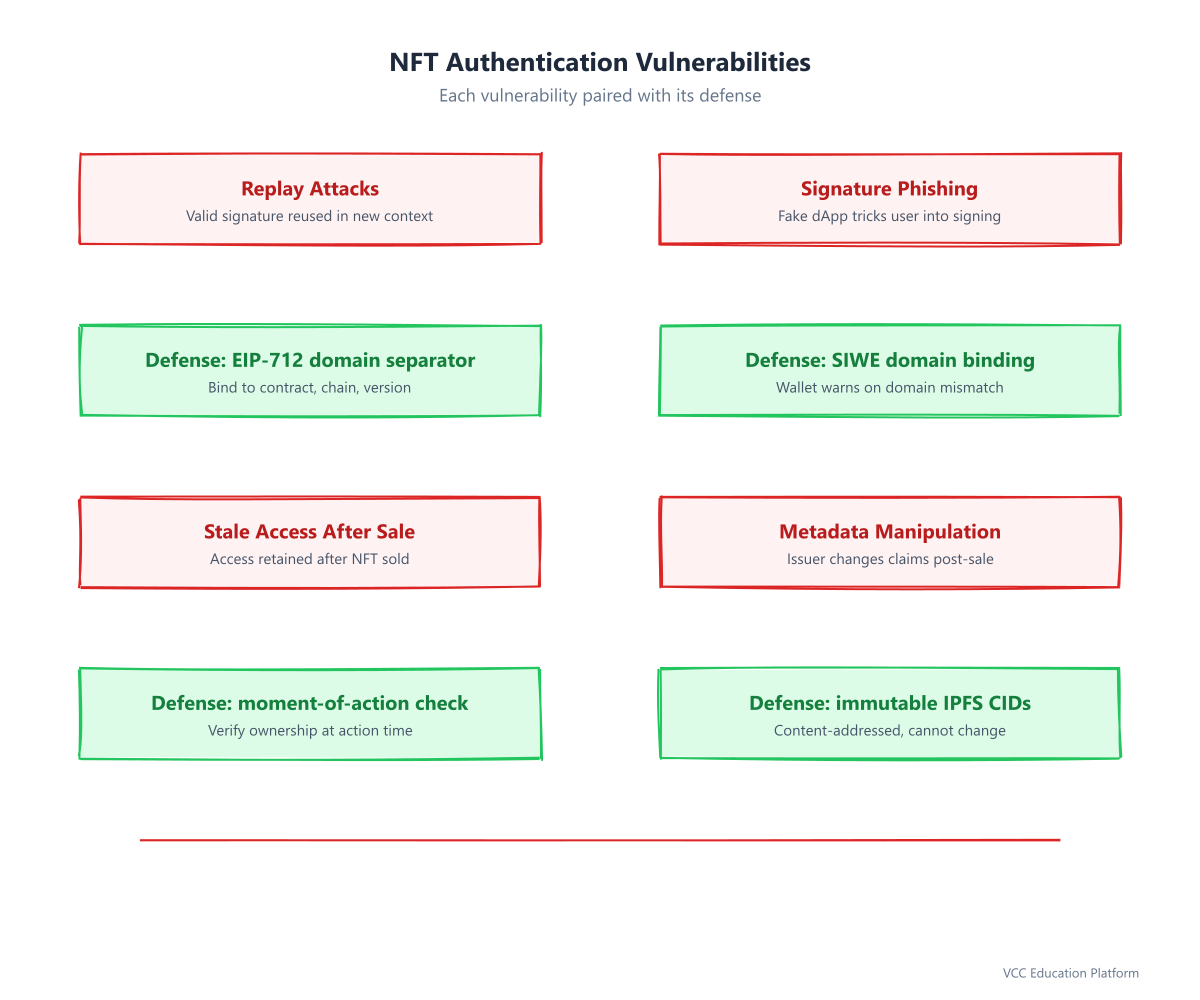
Signature Replay Attacks
A replay attack reuses a valid signature in an unintended context. The root cause is always missing context binding — the signature does not include enough information to restrict where it can be used.
Cross-chain replay: A signature valid on Ethereum mainnet is replayed on a testnet or fork. Defense: include chainId in the domain separator (EIP-712) or message (SIWE).
Cross-contract replay: A signature valid for Contract A is replayed on Contract B. A real-world example from an Immunefi report: AccessToken::mintStaticPrice omitted address(this) from the signed digest, allowing a signature for Collection A to mint tokens on Collection B. Defense: include verifyingContract in the EIP-712 domain separator.
Cross-collection replay: A signature valid for one NFT collection's allowlist is replayed on another collection using the same signer. Defense: include a unique collection identifier in the signed payload, not just the signer address.
Temporal replay: An old signature is reused after it should have expired. Defense: include an expiration timestamp and enforce it on verification. SIWE includes Issued At and optional Expiration Time for exactly this purpose.
Signature Phishing
Signature phishing is the dominant user-facing attack. The attacker creates a fake dApp that prompts the user to sign a message that looks benign but authorizes a malicious action. MetaMask documents this pattern extensively: the user thinks they are signing to list an NFT or claim an airdrop, but the signature grants the attacker unlimited token approval or setApprovalForAll on an NFT collection.
The defense is SIWE domain binding. When a SIWE message's domain does not match the site the user is on, MetaMask displays a warning. This does not prevent all phishing — the user can ignore the warning — but it makes lookalike domains far less effective. For non-SIWE signatures (raw personal_sign or eth_sign), there is no domain binding, and the wallet displays the message as raw hex — making phishing trivial.
The practical defense for users: never sign messages from untrusted sites. Use bookmarks for dApp URLs. If a wallet prompt shows setApprovalForAll or approve unlimited and you are not explicitly listing on a marketplace, cancel immediately.
Stale Access After Token Sale
As discussed in the token-gating section, a user who sells their NFT may retain access until the next verification cycle. The defense is to verify ownership at the moment of action for high-value access, not rely on cached sessions. For Discord roles, set the re-check interval to match the access value — hourly for high-value channels, daily for low-value ones.
Metadata Manipulation
If NFT metadata is hosted on a mutable server, the issuer can change the claims encoded in the metadata after the token is sold. A membership NFT that initially grants "premium tier" access might have its metadata changed to "basic tier" after the holder pays a premium price. The defense is immutable metadata — host metadata on IPFS with content-addressed CIDs, or encode claims directly in the smart contract rather than in an off-chain URI.
Centralized Signer Compromise
Many NFT mints use a centralized backend server that signs allowlist vouchers. If the signer's private key is compromised, the attacker can mint unlimited tokens. The Bored Ape Yacht Club incident demonstrated this — a compromised API key allowed unauthorized minting. The defense is key rotation, multisig signers, and ideally moving to on-chain allowlist verification (Merkle proofs) rather than off-chain signatures.
Building an Authentication Checklist
Security is not a feature you add at the end — it is a discipline you practice throughout the design. Here is a practical checklist for building and evaluating NFT authentication systems.
Developer Checklist
- Use SIWE (EIP-4361) for wallet login — never ask users to sign raw strings. The structured message format enables domain binding and wallet-level phishing warnings.
- Include a nonce in every authentication challenge — single-use, server-generated, scoped to the session. Without a nonce, signatures are replayable.
- Bind signatures with EIP-712 domain separators — include
name,version,chainId, andverifyingContract. Omitting the contract address enables cross-contract replay. - Enforce expiration times — every signature should have a validity window. Reject signatures older than the window, even if the nonce is unused.
- Verify ownership at the moment of action for high-value access — do not rely on cached sessions for financial actions or token-gated drops.
- Use immutable metadata for access-relevant claims — IPFS CIDs or on-chain storage, not mutable HTTP URIs.
- Rotate signer keys regularly if using off-chain signature minting — and use a multisig, not a single key.
- Implement EIP-1271 for contract-account authentication — do not assume all users are EOAs.
- Test replay attacks explicitly — write tests that attempt cross-chain, cross-contract, and temporal replay. If any test passes, you have a vulnerability.
- Audit the full stack — signature, ownership, metadata, and attestation layers each have independent failure modes.
User Checklist
- Use SIWE-compatible wallets — MetaMask, Rainbow, and other modern wallets parse SIWE messages and warn on domain mismatches.
- Never sign messages from untrusted sites — bookmark dApp URLs and verify the domain in the wallet prompt.
- Cancel immediately if the wallet shows
setApprovalForAllorapprove unlimited— unless you are explicitly listing on a marketplace. - Use a hardware wallet for high-value NFTs — the private key never leaves the device, making key theft far harder.
- Revoke unused approvals — use revoke.cash to audit and remove token approvals you no longer need.
- Understand that selling your NFT may not immediately revoke access — check the re-verification policy of token-gated communities.
Frequently Asked Questions
What are the main NFT authentication methods?
The main NFT authentication methods fall into four categories: signature-based authentication (proving wallet control via cryptographic signatures, standardized by SIWE/EIP-4361), token-gating (checking NFT ownership to grant access, either on-chain via balanceOf or off-chain via API queries), identity verification with soulbound tokens (using non-transferable NFTs as permanent credentials), and smart contract signature verification (EIP-1271 for contract accounts, ERC-6066 for NFT-bound signatures). Most production systems combine multiple methods — SIWE for login, token-gating for access control, and SBTs for identity attestation.
How does NFT verification work?
NFT verification works through a four-layer stack. First, a cryptographic signature proves the user controls the wallet address. Second, a token ownership check (on-chain balanceOf or off-chain API query) confirms the address holds the required NFT. Third, metadata verification reads the token's claims — membership tier, role, expiration. Fourth, identity attestation checks the issuer's credibility and the binding between the token and the holder. Each layer has independent failure modes: signatures can be replayed, ownership can be stale, metadata can be manipulated, and attestations can be forged.
What is the difference between on-chain and off-chain token gating?
On-chain token gating embeds the ownership check in a smart contract that calls balanceOf and reverts if the user holds zero tokens. It is trustless — no intermediary can bypass the check — but costs gas for every verification. Off-chain token gating moves the check to a backend server that queries the blockchain via an RPC provider. It is free for the user and fast, but trusts the server to make the correct decision. Production systems typically use off-chain gating for content access (Discord roles, website content) and on-chain gating only when the gated action is itself a blockchain transaction.
How do soulbound tokens improve NFT identity verification?
Soulbound tokens (SBTs) are non-transferable NFTs that solve a fundamental problem with using regular NFTs for identity: if the credential is transferable, it can be bought, defeating the purpose of verification. SBTs lock the token to the issuing wallet, making the credential permanently bound to the holder. Standards like ERC-7574 add zero-knowledge proof verification — the credential data stays private while the SBT serves as a public, on-chain proof that verification occurred. This separates private credential data from public verification signals.
What are the most common NFT authentication vulnerabilities?
The most common vulnerabilities are signature replay attacks (reusing valid signatures in unintended contexts due to missing domain binding), signature phishing (tricking users into signing malicious messages via fake dApps), stale access after token sale (retaining access after selling the authenticating NFT), metadata manipulation (changing access-relevant claims in mutable off-chain metadata), and centralized signer compromise (stealing the backend signing key to forge unlimited signatures). Each vulnerability has a specific defense: EIP-712 domain separators for replay, SIWE domain binding for phishing, moment-of-action verification for stale access, immutable IPFS metadata for manipulation, and multisig key rotation for signer compromise.