
NFT artist platforms have fundamentally changed the way digital creators distribute, sell, and monetize their work. Unlike traditional art markets where exhibitors and agents control access rights, NFT art platforms integrate direct distribution mechanisms into smart contracts – allowing artists to reach a global audience without intermediaries. However, the rapid growth of NFT creator platforms has created a new problem: the choice between dozens of exchanges, printing tools, and blockchains, each with different fee structures, copyright policies, and object models. This guide categorizes the platform space into actionable buckets, explains the gaps in copyright enforcement that determine your actual income, and provides a decision framework for building a sustainable NFT art business.
Understanding NFT Art Platforms: Classification Map
NFT art platforms are not interchangeable. They differ in terms of their level of management, support for artistic genres, fee models, and the degree of control artists retain over their works. Understanding these differences is the first step in choosing where to post.
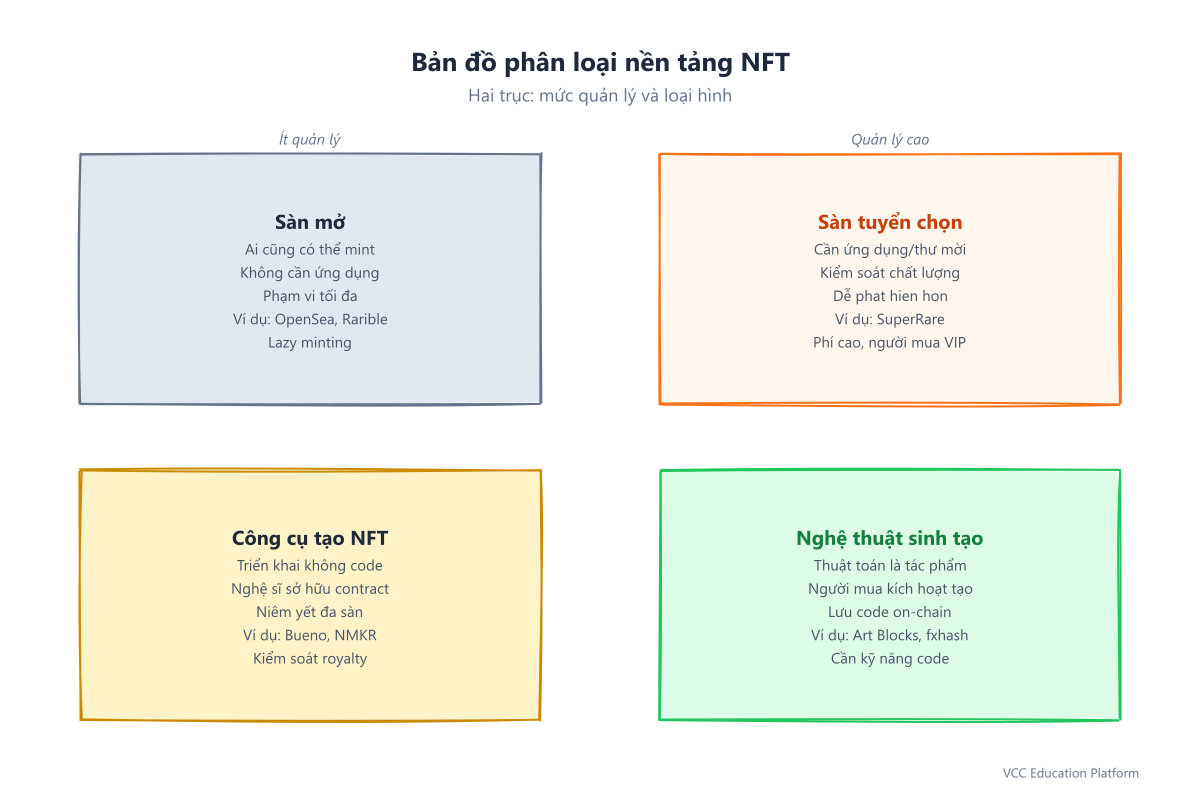
The platform’s landscape can be categorized along two axes: level of management (from fully open to invitation-only) and art form (from static images to generated code). This creates four distinct categories that cater to the needs of different artists.
Open trading center: maximum accessibility, minimum management
Open-source exchanges like OpenSea and Rarible allow any creator to create and list NFTs without going through an application or evaluation process. OpenSea, founded in 2017, remains the largest NFT exchange by catalogue size, supporting Ethereum, Polygon, Solana, Base, Arbitrum, and other chains. Rarible offers a similar open model with a tiered fee structure, incentivizing high-value transactions.
The advantage is accessibility: your work can be instantly accessed by the largest possible collection of people. The disadvantage is recognition: with millions of listings and no choice, individual artworks can get lost in the crowd. Artists in open markets have to invest heavily in self-promotion, social media presence, and community building to stand out. OpenSea’s non-custodial (lazy minting) token program lowers the barrier to entry, but it also means that the market holds the contract – not the artist.
Selected platforms: selection as a signal
Managed platforms such as SuperRare, Foundation, and KnownOrigin allow users to sign up through artists’ apps or invitation systems. SuperRare describes itself as “Instagram meets Christie’s” – a managed art platform where acceptance requires a substantial portfolio and a strong social media presence. Foundation operates on an invitation system, in which current artists invite new artists, creating a quality network effect.
The tradeoff is clear: higher barriers, but significantly better acceptance for artists. The chosen platforms also tend to attract more serious collectors willing to pay higher prices. SuperRare charges 15% fees for exhibitors and 3% for the marketplace – significantly higher than open markets – but the selection has proven its value by eliminating low-quality works, which undermines collectors’ confidence. For artists who can participate, the chosen platforms offer the opportunity to build a reputation that open markets cannot.
Artistic platforms create: Code as a canvas
Art platforms create representations of a completely different model. On Art Blocks, artists write an algorithm; a purchase by a collector activates the creation of a unique work of art from that algorithm using a random seed taken from the blockchain. The algorithm itself is the work of art – the NFT stores code, not a static image.
Art Blocks pioneered this model on Ethereum, with 90% of their collection entirely residing on the chain, including JavaScript-based (p5.js, Three.js). fxhash, originally on Tezos and now expanding to other chains, pushes the concept of “open-source art” further – artworks that can evolve over time through mechanisms like looping and evolution, supported by art tokens (ERC-20 tokens attached to the artwork).
These platforms require programming skills or collaboration with a developer, making them a separate market. However, for artists working with code, the platforms they create offer something that no static image market can: the collector is involved in the creation process. Each factory produces a unique version, and the existence of the work is guaranteed as long as the blockchain exists – no CDN, no servers, no dependence on the platform.
NFTs for artists: The fee environment and copyright
Understanding fees is crucial because they directly determine your revenue. Fees on NFT platforms consist of three tiers: market fees (paid to the platform), creator royalties (paid to you when reselling), and gas fees (paid to the blockchain network). The competition between these tiers determines your actual revenue.
Marketplace fee structure
The fee models vary widely across platforms. Blur does not charge market fees, having revolutionized the market at the end of 2022 by prioritizing traders’ transaction volume over payments to content creators. OpenSea charges a 1% fee for sellers. Foundation charges 5%. Both SuperRare’s marketplace and storefront fees are 18%. Rarible uses a tiered structure: 0.5% per side for transactions over $4,000, rising to 7.5% per side for transactions under $100 – meaning smaller transactions have correspondingly higher fees.
The fees that a platform charges reflect its business model. Platforms that put traders first use low fees to attract trading volume and make money through other mechanisms (token rewards, premium features). Managed platforms use high fees to fund quality control and attract serious collectors. Platforms that put creators first, like Rarible, offer fee reductions through token lock-ins – the $RARI lock removes transaction fees entirely.
The distance in the exercise of property rights
Royalties – ongoing payments to creators when their work is resold – are one of the original promises of NFTs. The technical details behind them are EIP-2981, which was finalized in 2020. It defines a royaltyInfo() function that any exchange can call to ask the contract two questions: who gets paid, and how much. That’s the whole job of this standard. It expresses intent. It has no bearing on actual money transfers.
The EIP-2981 specification clearly states that "royalties must be voluntary." Exchanges can read the royalty signal and honor it — or completely ignore it. Nothing in the token's code prevents a transaction from being completed without paying royalties. In the 18 months since the standard was implemented, most major exchanges have honored royalties by default, and royalties from creators have generated hundreds of millions of dollars in revenue for digital artists.
Then, the market shifted. In October 2022, Blur launched with no fees on the market and optional commissions – buyers could choose whether to pay them or not. Blur’s transaction volume skyrocketed as traders moved to cheaper platforms. In response, other markets followed suit. As a result, total commission revenue for creators dropped by around 40-50% as transactions shifted to platforms with the option to not pay commissions.
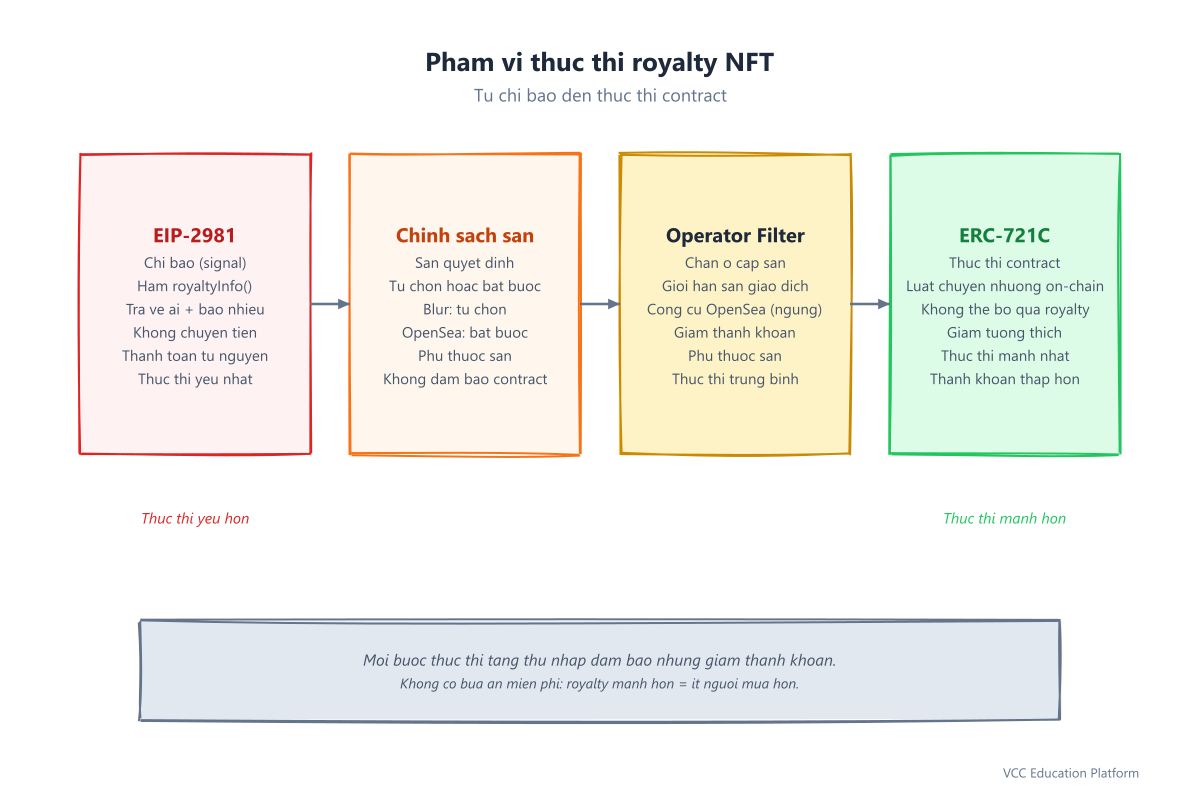
The community response was ERC-721C, the creator token standard. Unlike EIP-2981, which provides an indicator, ERC-721C adds transfer restrictions on the chain that can enforce copyright at the contract level. OpenSea supports the implementation of ERC-721C through its Seaport protocol. However, the implementation comes at a cost: the transfer restrictions reduce the liquidity and compatibility of the market. An artist who enforces copyright at the contract level may find that their work cannot be listed on platforms that do not support the standard.
This creates a structural tension that every NFT artist must face: strong enforcement of copyright means higher guaranteed revenue per sale, but fewer potential buyers. Weaker enforcement means more liquidity, but uncertain fees. There is no free lunch – the gap in copyright enforcement is a design feature of the NFT ecosystem, not a flaw to be fixed.
Calculate the actual amount received
An artist who sells a work for 1 ETH on a platform with a 2.5% market fee, a 10% royalty fee, and an optional copyright enforcement right can expect to retain 0.975 ETH in primary sales and earn 0.1 ETH in each secondary sale. However, if the secondary sale takes place on a platform that does not require the royalty fee to be applied, and the buyer opts out of the royalty, the artist will earn nothing from the resale. The expected royalty income is not a contractual percentage – it is the contractual percentage multiplied by the enforcement probability, and it varies depending on the platform and market conditions.
Distributing NFT Art: Choosing Your Blockchain
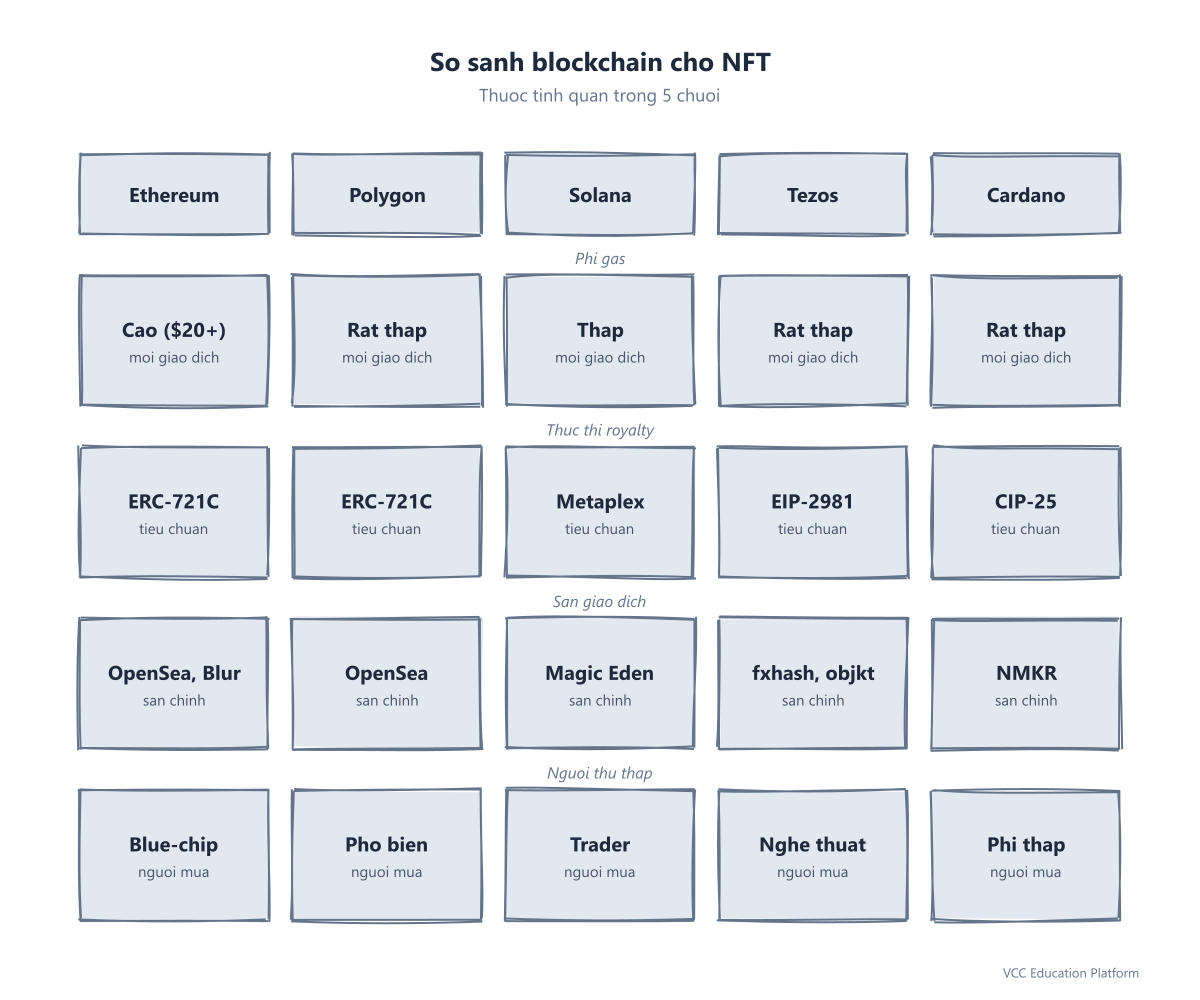
The blockchain you choose for distributing NFT art is not just a technical decision – it determines your collection’s foundation, transaction costs, and author rights enforcement options. Each chain has developed its own NFT ecosystem with unique characteristics.
Ethereum: Blue-Chip Liquidity
Ethereum remains the dominant chain in the high-value NFT art space. Major collectors, the oldest established exchanges, and the deepest pools of liquidity are all on Ethereum. However, gas fees on the Ethereum mainnet can make creation and trading expensive – sometimes costing more than the value of the artwork for low-priced pieces. Artists targeting prestigious collectors and able to command high prices will find an audience that is not available on Ethereum. The ERC-721 and ERC-1155 standards originated here, and the most advanced copyright enforcement tools (ERC-721C, Seaport) are developed on Ethereum.
Low-cost options: Polygon, Solana, Tezos
Polygon offers Ethereum-compatible NFT creation services with near-zero gas fees, making them accessible to artists at all price points. Solana has developed its own NFT ecosystem with exchanges like Magic Eden and Tensor, attracting high-frequency traders and art related to gaming. Tezos has become a home for art creation and low environmental impact, with fxhash and objkt as the main platforms. Tezos’ low cost and energy efficiency have attracted artists who prioritize accessibility and sustainability.
Cardano: Low fees and independent infrastructure
Cardano’s NFT ecosystem is developed independently from Ethereum. NMKR, founded in 2021, has issued over 2 million NFTs and serves as the primary issuance infrastructure on Cardano. NMKR Studio provides non-custodial tools for mass issuance, data description verification (CIP-25 standards), and pre-sale mechanisms. The network has expanded to support multi-chain issuance including Cardano, Bitcoin, Solana, and Aptos.
JPG Store was the leading Cardano NFT marketplace, but it announced it would shut down in 2026, citing sustainability limitations. This event illustrates an important principle: markets are temporary, but NFTs on the chain are permanent. When JPG Store closed, its smart contracts continued to operate on Cardano – NFTs and assets remained accessible. Artists who used contracts they owned (instead of relying on lazy marketplaces to create NFTs) were protected from the platform’s failure. This is a form of platform risk that many artists ignore until a marketplace closes.
Content creation tools: From no coding to custom contracts
The platform for NFT creators has evolved significantly. What was once a requirement for knowledge of Solidity and manual deployment of smart contracts can now be done through code-free platforms that handle contract creation, data description standards, IPFS storage, and print page creation.
NFT creation platforms do not require code
Platforms such as Bueno, NFTs2Me, NFT-Inator, and RAPIT allow artists to deploy custom ERC-721 or ERC-1155 smart contracts through intuitive interfaces – without the need for programming. These platforms generate audited smart contracts from configuration settings, handle the IPFS metadata data upload, and provide printable pages or printable nodes that can be attached. The key difference is contract ownership: the artist owns the deployed contract, not the marketplace. This means that the NFT collection exists independently of any platform and can be listed on multiple markets at the same time.
NMKR Studio on Cardano offers similar features without code, with the ability to create batches, escrow mechanisms to prevent repurchases, and built-in author rights configurations. For artists who want to maintain maximum independence, non-coded content creation platforms that use contracts owned by the artist are a better option than lazy NFT creation on exchanges, where NFTs are linked to the exchange’s contract.
Lazy Minting vs. Artist Owned Contracts
The lazy minting format, provided by OpenSea and other exchanges, allows artists to register NFTs without paying gas fees in advance – the NFT is minted at the time of purchase, with the buyer responsible for paying the gas fees. This lowers the barrier to entry into the market but creates a dependency: the NFT exists on the exchange’s contract, not the artist’s. If the exchange changes its policies, increases fees, or shuts down, the artist’s work will be affected.
Contracts owned by artists, implemented through non-coded or custom-developed tools, give artists full control. The collection can be deployed to any market that supports the standard, and artists can automatically update the database, set copyright permissions, and control access rights. However, the initial gas costs for the deployment process can be quite high – typically a few dollars on L2 networks like Polygon or Base, and more on the main Ethereum network.
The artistic tools that create
For creators, the tools work differently. Art Blocks provides a platform where artists submit algorithmic code that runs on the chain. fxhash offers similar functionality on Tezos with additional development mechanisms. These platforms address the unique requirements of generative art: performing determinism from random seeds, storing the generated code on the chain, and a display infrastructure that can reproduce artistic works solely from blockchain data.
Build a multi-platform strategy
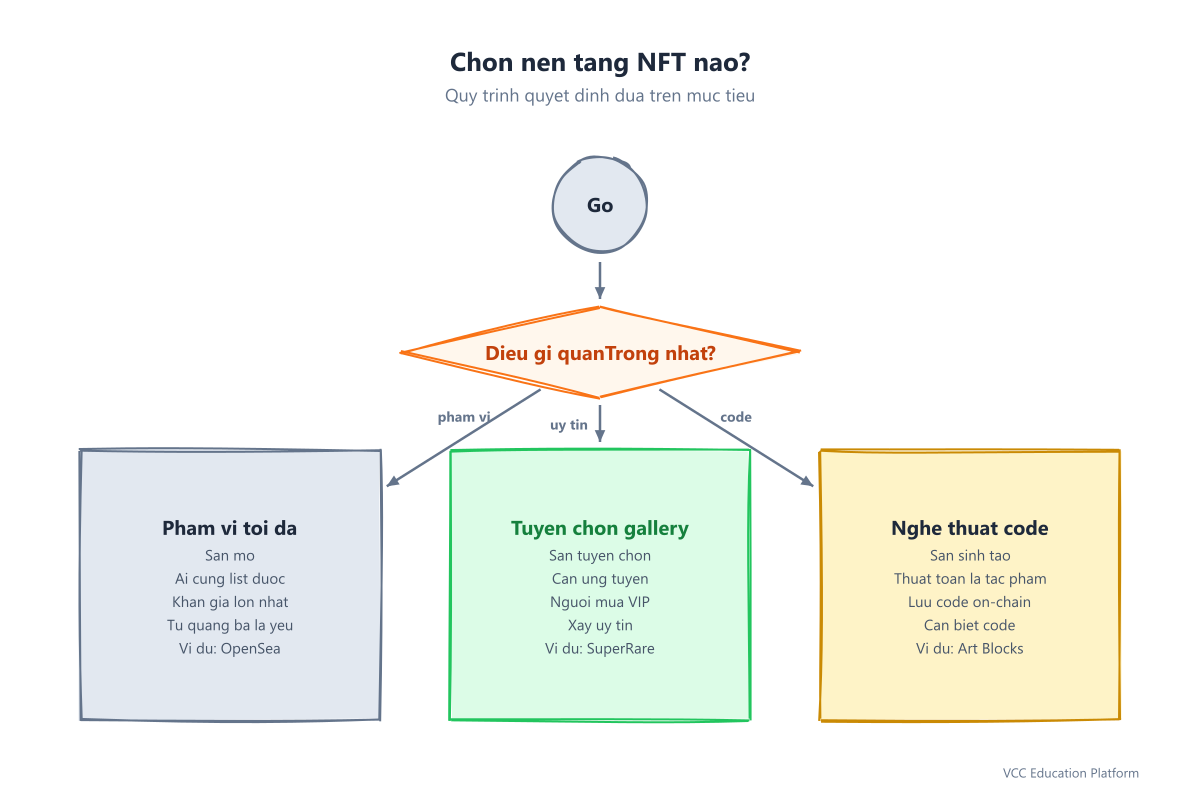
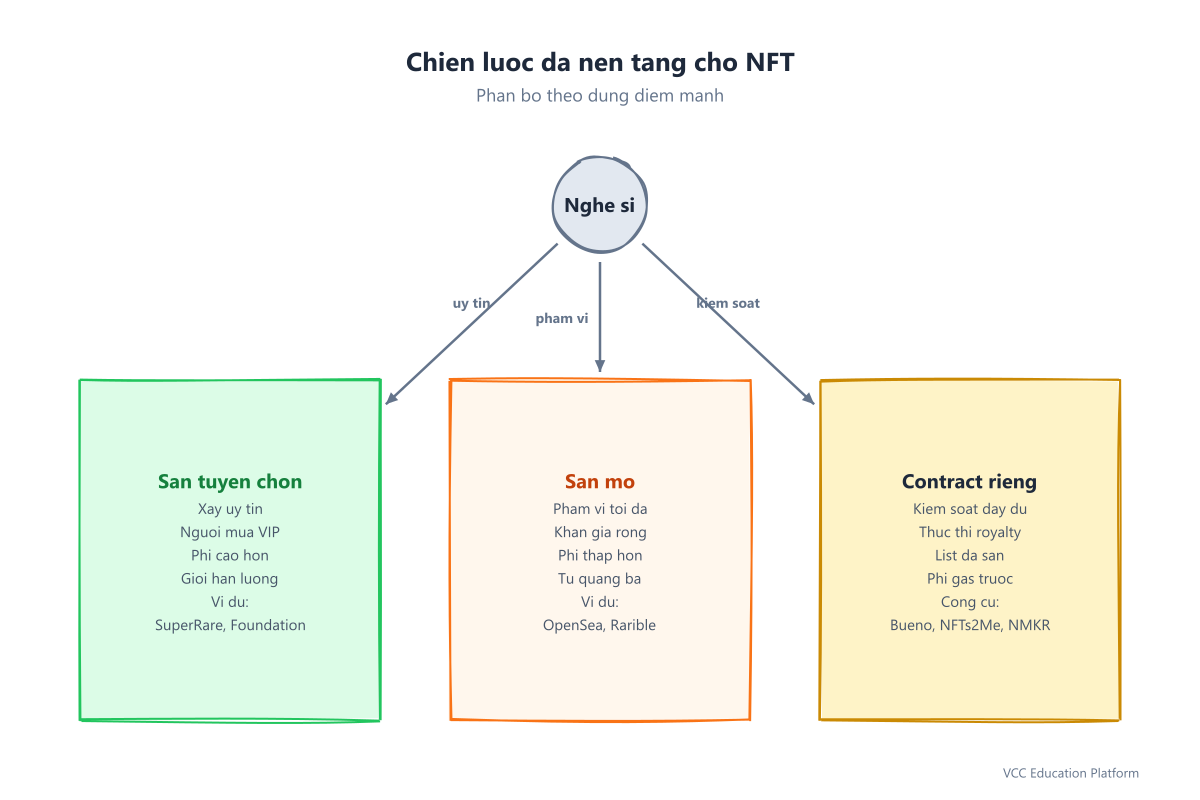
There is no single NFT market that is optimized for every artist’s goals. The most successful NFT artists use a multi-platform strategy, distributing their works across platforms based on what each one does best.
The Platform Trilemma
Artists must balance three dimensions: reach, reputation, and revenue retention. Open markets maximize reach but reduce recognition and often have weak enforcement of copyright. Selected platforms build reputation but limit traffic and are expensive. Low-cost platforms with strong enforcement attract fewer buyers. No single platform addresses all three of these tensions – the solution is to use multiple platforms strategically.
In practice, use managed platforms for featured works to build reputation, open exchanges for wider distribution and liquidity, and artist-owned contracts deployed through non-codified tools for collections where you want maximum control over copyright and metadata. List the same collection on multiple exchanges if possible – standard contract interfaces (ERC-721, ERC-1155) make this technically simple, but some platforms may limit multi-exchange listings.
Base information and standards
Regardless of the platform choice, the data description standard is still very important. On Ethereum, ERC-721 and ERC-1155 define the token interface; EIP-2981 defines the copyright signal. On Cardano, CIP-25 defines the NFT data structure. Proper data descriptions ensure that your NFT can be found, displayed correctly across platforms, and carry copyright information that exchanges can read. Non-code tools often handle data descriptions automatically, but artists implementing custom contracts should verify that the data descriptions comply with the exact standards for their chain.
Community and distribution networks
Building an NFT art distribution is not a purely technical decision – it’s a community decision. Each platform and chain has its own community with different expectations, price points, and aesthetic preferences. Collectors on Ethereum often value provenance and top-tier status. Collectors on Tezos value art creation and low environmental impact. Collectors on Cardano value low fees and loyalty to the ecosystem. Understanding the community you’re joining is just as important as understanding the fee structure.
Frequently Asked Questions
What is the best NFT exchange for artists who are just starting out?
For emerging artists, OpenSea offers the lowest barrier to entry with gas-free NFT creation and the largest collection base available. However, for artists who want to own their contracts and maintain independence, non-tokenized content creation platforms like Bueno or NFTs2Me, which use artist-owned ERC-721 contracts, are a better long-term option. The best NFT market for artists depends on whether you prioritize immediate accessibility or long-term control.
How do NFT royalties actually work?
The NFT royalty is implemented through EIP-2981, which provides the royaltyInfo() function to let exchanges know how much to pay the creator and where to send it. However, EIP-2981 only specifies the royalty rate – it does not enforce the payment. Whether you actually receive the royalty depends on the exchange’s policy. Some exchanges enforce royalties; others allow buyers to opt out. ERC-721C adds contract enforcement but reduces liquidity.
Can I sell the same NFT on multiple platforms?
Yes, if you own a smart contract. NFTs created on artist-owned contracts can be listed on any exchange that supports the token standard (ERC-721, ERC-1155). However, if you use the slow NFT creation method (where the NFT exists on the exchange’s contract), you will be limited to that exchange. This is why artist-owned contracts are recommended for artists who want flexibility in distribution across multiple platforms.
Which blockchain is best for NFT art?
There is no single best blockchain – the choice depends on your goals. Ethereum offers the deepest liquidity and the most complete authoring tools, but has high gas fees. Polygon and Solana offer low fees and a growing community. Tezos is popular with creators due to its low fees and energy efficiency. Cardano offers low fees and a decentralized ecosystem through the NMKR. Consider your target audience, price point, and technical requirements when making your choice.
What are the differences between managed NFT platforms and open NFT platforms?
Open platforms such as OpenSea allow anyone to create and list NFTs without undergoing censorship. Selected platforms such as SuperRare and Foundation require applications or invitations from artists. Open platforms increase accessibility but require self-promotion to stand out. Selected platforms restrict access but provide better discoverability and reputation-building opportunities for accepted artists. Selected platforms often charge higher fees to fund the selection process.
How much does it cost to create an NFT collection?
Costs vary depending on the platform and blockchain. On OpenSea, creating an NFT is free (buyers pay gas fees when purchasing). Setting up a contract on Polygon or Base costs a few dollars. On the main Ethereum network, setting up a contract can cost anywhere from $50 to $500, depending on the level of complexity. Non-codable platforms like Bueno and NFTs2Me offer free or low-cost contract setup. NMKR on Cardano offers low-cost NFT creation and no upfront gas fees for artists. When planning your budget, include both setup costs and ongoing market fees.