
In July 2023, the crypto world watched as $230 million vanished from Multichain — the self-described "decentralized cross-chain router" — in a matter of hours. The culprit wasn't a sophisticated smart contract bug or a zero-day exploit. It was something far simpler and far more damning: the CEO held the only keys, and he was gone.
This is the story of how a protocol managing billions in user funds operated with the security model of a piggy bank — and what every DeFi user needs to understand about "fake decentralization."
The Morning the Money Stopped Moving
July 6, 2023, 06:00 UTC. On-chain monitors lit up. Large, unusual transfers began draining from Multichain's Fantom router contract. USDC, USDT, WETH, WBTC — over $126 million in minutes.
By noon, the bleed had spread: Moonriver ($66M), Dogechain ($6.8M), BNB Chain ($2.6M), Arbitrum ($1.1M). Bridges don't just "have issues" across five chains simultaneously. This was systematic.
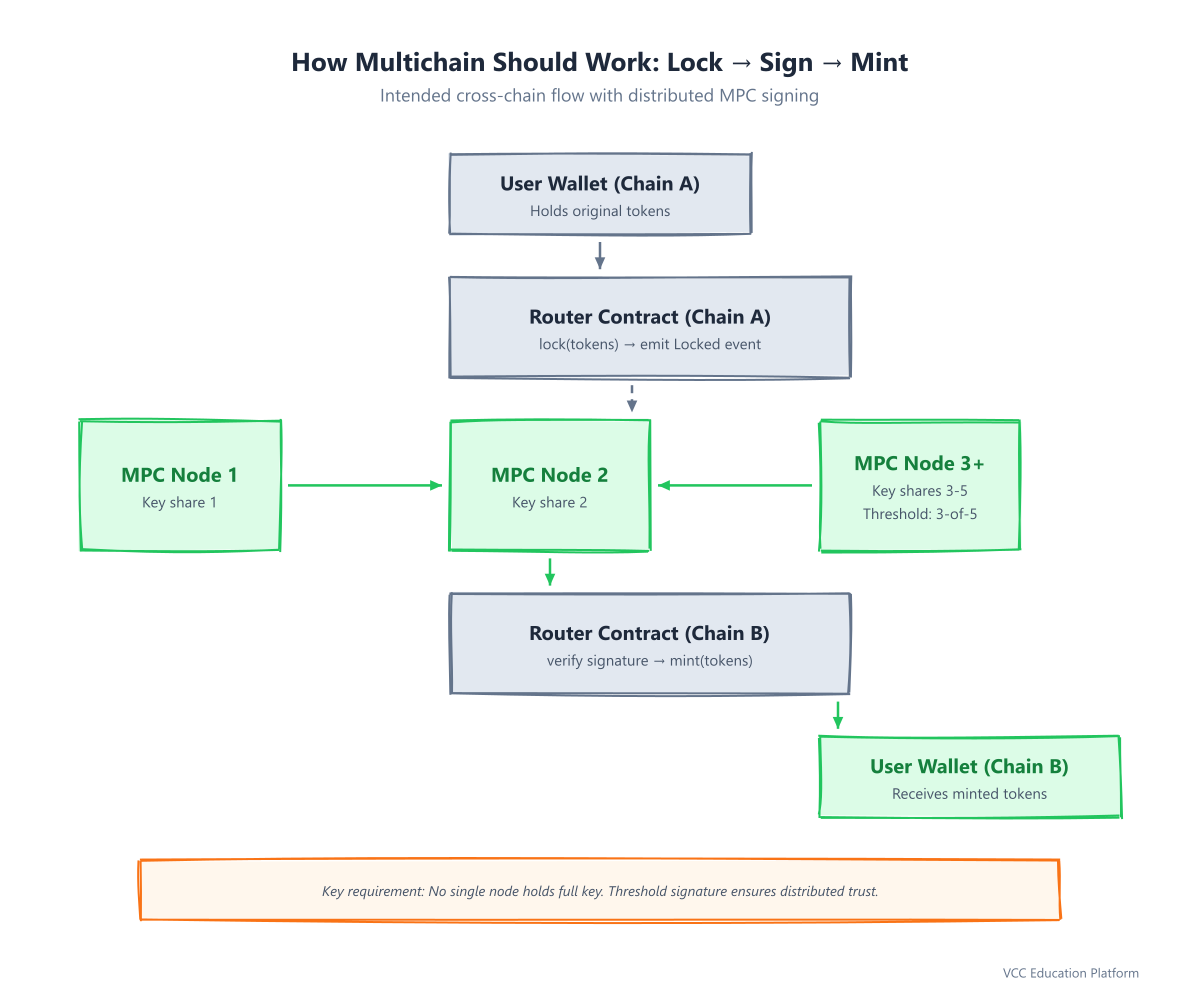
How Multichain should work: lock, threshold-sign, mint — no single node holds the full key
The Multichain team went silent for hours. When they finally spoke, the explanation was staggering: CEO Zhaojun (赵军) had been detained by Chinese authorities on May 21. His phones, laptops — and the private keys controlling Multichain's MPC nodes — were seized.
For 46 days, the team had no access to the infrastructure securing hundreds of millions in user funds. They kept the protocol running on hope. The market ran on ignorance.
What Is Multichain? (And What It Wasn't)
Multichain (formerly Anyswap) launched in 2020 as a cross-chain bridge. By 2023, it connected 80+ chains and processed billions in volume. It marketed itself as "decentralized" using MPC — Multi-Party Computation.
Here's what MPC should mean: A private key is split into shares. Multiple independent parties each hold one share. To sign a transaction, a threshold (e.g., 3 of 5) must cooperate. No single party can move funds alone.
Here's what Multichain actually did: For critical chains — Fantom, Moonriver, Dogechain — Zhaojun held ALL the key shares himself.
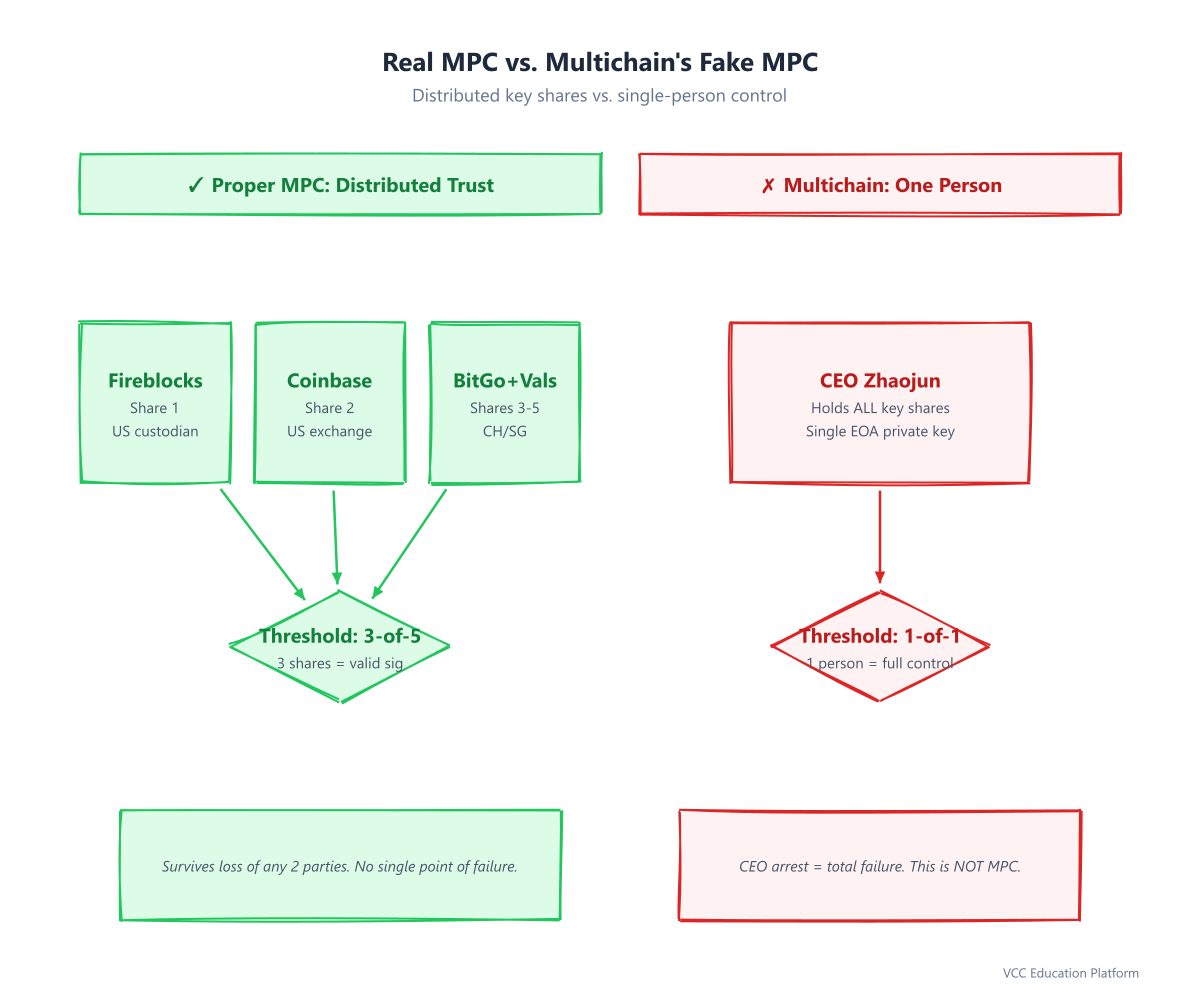
Real MPC vs. Multichain’s fake MPC — threshold 3-of-5 vs 1-of-1
This isn't MPC. It's a single-signature wallet wearing a costume.
The MPC Illusion: How Terminology Masks Centralization
This is the central lesson of the Multichain hack, and it applies far beyond one protocol.
DeFi is full of bridges claiming "MPC security," "threshold signatures," "decentralized custody." But the implementation matters more than the terminology. Ask three questions:
| Question | Multichain's Answer | What You Should Demand |
|---|---|---|
| Who holds the key shares? | One person (CEO) | Independent entities in different jurisdictions |
| What's the threshold? | 1-of-1 (effectively) | 3-of-5, 4-of-7, or higher |
| Can the protocol survive a key holder disappearing? | No | Yes — that's the whole point |
The "MPC" label became a marketing shield. Users saw "MPC" and assumed decentralization. Auditors saw "MPC" and checked a box. No one verified the actual key distribution.
How the Exploit Worked: A Step-by-Step Breakdown
The attack wasn't a "hack" in the traditional sense. It was an authorized withdrawal — signed by the only key that mattered.
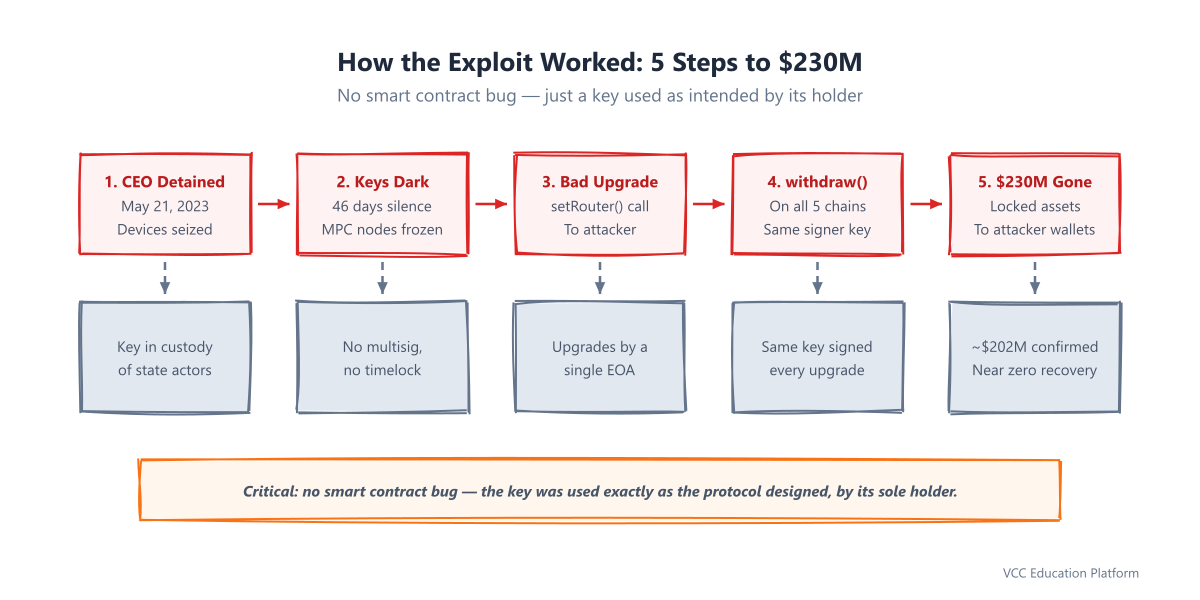
The exploit in 5 steps — no smart contract bug, just a key used as intended
Step 1: Router Contracts Were Upgradeable
Each chain's Router contract had an owner address with onlyOwner privileges. The owner could call setRouter(newAddress) to point the bridge to a new contract.
Step 2: The Owner Was Zhaojun's Personal EOA
Not a multisig. Not a DAO. Not an MPC threshold signature. One Ethereum address. One private key. Held by one person.
Step 3: May 21 — Keys Go Dark
Chinese authorities detain Zhaojun. Devices seized. The private key is now in the hands of state actors — or lost entirely.
Step 4: July 6 — The Withdrawal
Someone with that private key (Zhaojun? Authorities? An insider?) calls setRouter() on Fantom, Moonriver, Dogechain, BNB Chain, Arbitrum — pointing each to a malicious contract with a withdraw() function that sends all locked tokens to the attacker.
Step 5: Funds Gone
Users' locked assets — deposited in good faith, believing in "MPC security" — drain to attacker wallets. No smart contract vulnerability exploited. No cryptographic break. Just a key used as intended by its holder.
The Numbers: Where $230M Went
| Chain | Confirmed Loss | Primary Assets |
|---|---|---|
| Fantom | ~$126M | USDC, USDT, WETH, WBTC, ANY |
| Moonriver | ~$66M | USDC, USDT, WETH, MOVR |
| Dogechain | ~$6.8M | USDC, USDT, DOGE |
| BNB Chain | ~$2.6M | USDC, USDT, BNB |
| Arbitrum | ~$1.1M | USDC, USDT |
| Total Confirmed | ~$202M | |
| Reported (incl. unreported chains) | Up to $230M+ |
Sources: BlockSec, PeckShield, Dune Analytics, Multichain team statements. Media reports cite up to $230M including smaller chains and untraced outflows.
Comparison: Multichain in the Hall of Bridge Shame
Multichain wasn't the first bridge hack. But it was the most avoidable.
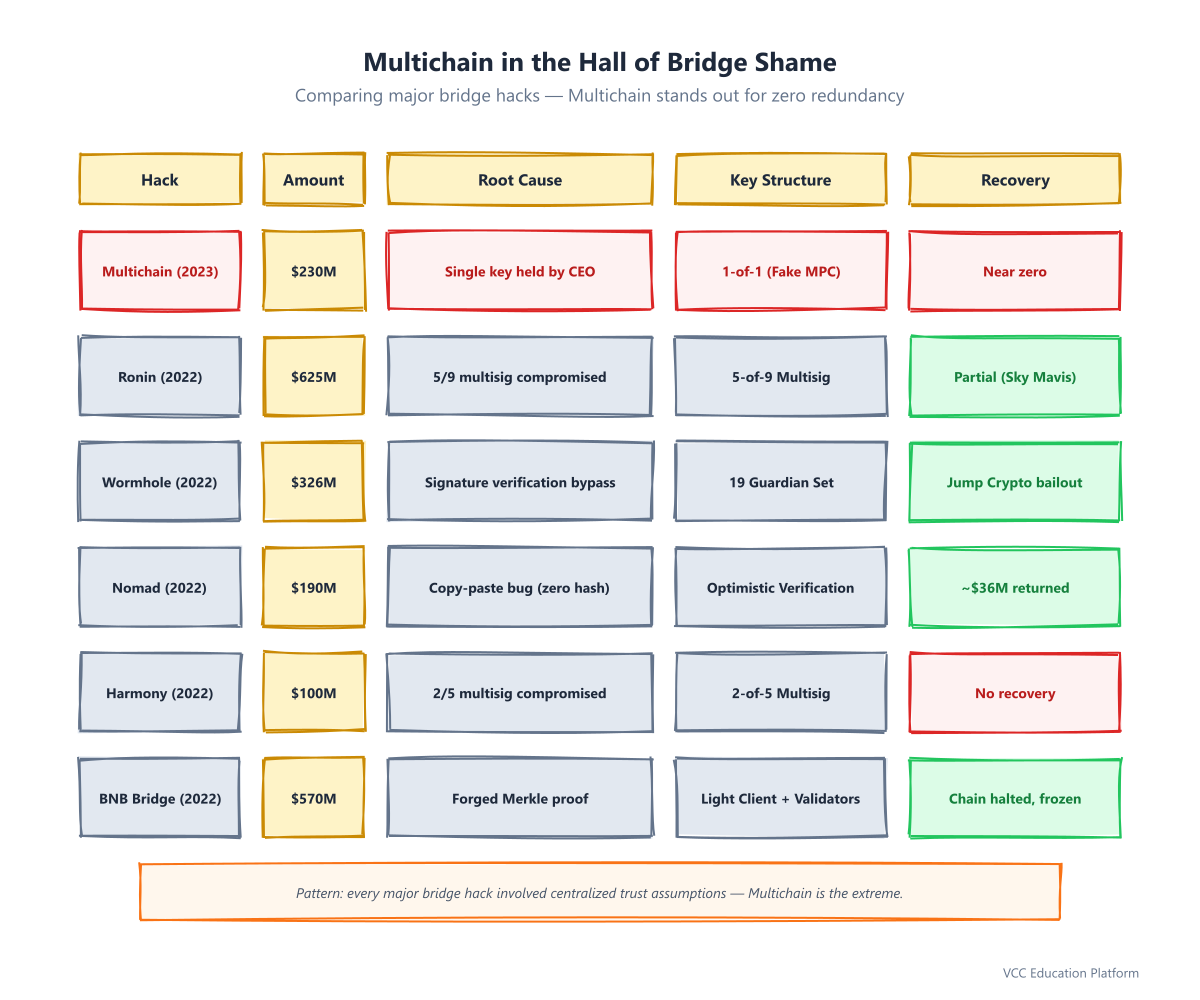
Multichain in the hall of bridge shame — zero redundancy
| Hack | Amount | Root Cause | Key Structure | Recovery |
|---|---|---|---|---|
| Multichain (2023) | $230M | Single key held by CEO | 1-of-1 (fake MPC) | Near zero |
| Ronin (2022) | $625M | 5/9 multisig compromised | 5-of-9 multisig | Partial (Sky Mavis reimbursed) |
| Wormhole (2022) | $326M | Signature verification bypass | Guardian set (19 validators) | Jump Crypto bailed out |
| Nomad (2022) | $190M | Copy-paste bug (zero hash trusted) | Optimistic verification | ~$36M returned by white hats |
| Harmony (2022) | $100M | 2/5 multisig compromised | 2-of-5 multisig | No recovery |
| BNB Chain Bridge (2022) | $570M | Forged Merkle proof | Light client + validators | Chain halted, funds frozen |
The pattern: Every major bridge hack involved some form of centralized trust assumption. Multichain is the extreme — zero redundancy, zero distribution, zero survival capability.
Vietnamese Context: The Impact on VN DeFi Users
Vietnam's DeFi community was heavily exposed. Multichain was the dominant bridge for BSC ↔ Fantom — the primary route for VN yield farmers moving USDT/USDC into Fantom's high-APR farms.
Community estimates: $10-15M in losses for Vietnamese users alone (based on Telegram/Discord surveys across 5 major VN DeFi groups, July 2023).
Local media response: Coin68, BitcoinVN, 247BTC ran front-page warnings. The State Bank of Vietnam (SBV) cited the hack in subsequent DeFi risk advisories.
The lesson for VN users: "Cầu" (bridge) protocols with Vietnamese-language interfaces and local marketing are not inherently safer. The code doesn't care what language the website is in.
Analogy: Using Multichain was like sending money via Momo — but the Momo CEO holds the only master key to all user balances, and if he disappears, your money is gone. Real DeFi should be more like Bitcoin — no CEO, no master key, no single point of failure.
The "Fake Decentralization" Checklist: How to Evaluate Any Bridge
Before bridging funds, run this checklist. If the answer to ANY question is "no" or "unknown," do not use the bridge for significant amounts.
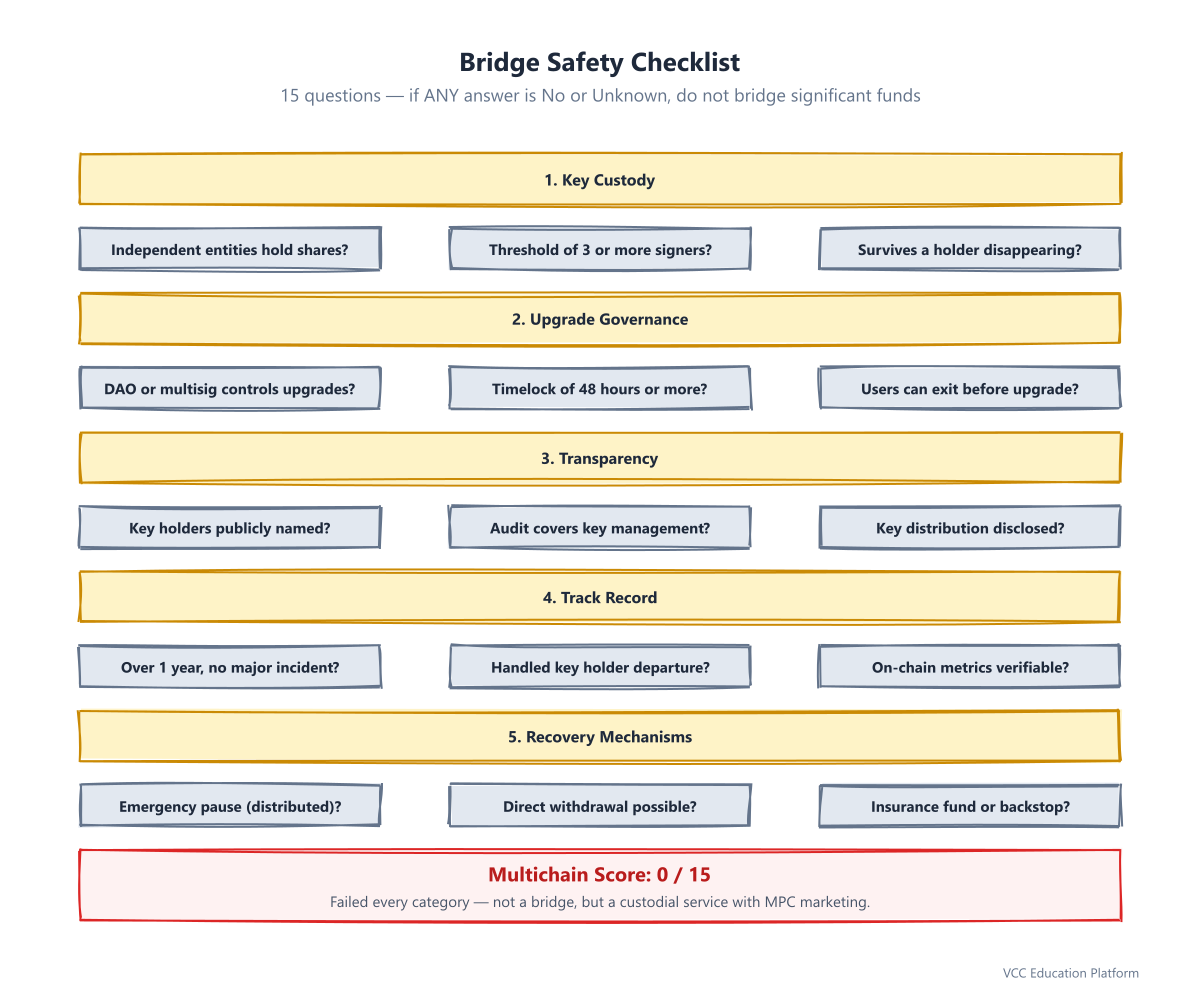
Bridge safety checklist — Multichain scored 0/15
1. Key Custody
- [ ] Are key shares held by independent entities (different companies, jurisdictions, legal structures)?
- [ ] Is the threshold ≥ 3 (requiring at least 3 parties to sign)?
- [ ] Can the protocol operate if one key holder disappears?
2. Upgrade Governance
- [ ] Are contract upgrades controlled by a DAO or multisig (not a single EOA)?
- [ ] Is there a timelock (48+ hours) on upgrades?
- [ ] Can users exit before an upgrade takes effect?
3. Transparency
- [ ] Are the key holders publicly named (not "trusted partners")?
- [ ] Is there a public security audit covering key management (not just smart contracts)?
- [ ] Has the team disclosed key distribution in writing?
4. Track Record
- [ ] Has the bridge operated >1 year without major incident?
- [ ] Has it handled a key holder departure gracefully?
- [ ] Are on-chain metrics (TVL, volume, signer activity) publicly verifiable?
5. Recovery Mechanisms
- [ ] Is there an emergency pause controlled by distributed parties?
- [ ] Can users withdraw directly from the source chain if the bridge fails?
- [ ] Is there an insurance fund or backstop?
Multichain scored 0/15 on this checklist. Most users never checked.
What This Means for DeFi's Future
The Multichain hack forced a reckoning. Three shifts are underway:
1. From "Trust the Team" to "Verify the Cryptography"
Projects like Polygon zkEVM Bridge, Arbitrum Bridge, and Optimism Portal use validity proofs (ZK) or fraud proofs — not MPC, not multisig. The security rests on mathematics, not key holders.
2. From "Bridge" to "Interoperability Layer"
The industry is moving toward shared sequencing, interoperability standards (ERC-7683), and intent-based architectures (like Across, Socket) that minimize trusted bridges entirely.
3. From "Audit the Code" to "Audit the Operations"
Smart contract audits are necessary but insufficient. Operational security audits — key management, signer distribution, incident response — are becoming mandatory for serious protocols.
FAQ
Could Multichain users have protected themselves?
Partially. Users who kept funds on the source chain (didn't bridge) lost nothing. Users who bridged to chains where Multichain used proper MPC (Ethereum, Polygon, Arbitrum — where key shares were distributed) were unaffected. The exploit only hit chains where Zhaojun held all keys.
How do I know if a bridge uses real MPC?
Ask for the signer list. Real MPC: "Key shares held by Fireblocks, Coinbase Custody, BitGo, and two independent validators in Switzerland and Singapore." Fake MPC: "Our MPC network is decentralized" (no names, no threshold, no geography).
Is MPC inherently bad?
No. MPC is excellent cryptography. The problem is MPC-washing — using the term while centralizing the shares. Proper MPC (e.g., Fireblocks, Qredo, Lit Protocol) distributes shares across independent parties.
What happened to the stolen funds?
~$10M frozen by exchanges (Binance, Huobi). Remainder traced through Tornado Cash, cross-chain swaps, and CEX deposits. No meaningful recovery for users.
Will Multichain return?
No. The team announced shutdown July 10, 2023. The protocol is dead. The ANY token collapsed >95%.
Key Takeaways
- "MPC" ≠ Decentralized. Verify who holds the shares and what the threshold is.
- Single-person key custody is a ticking time bomb. Arrest, death, coercion, or simple loss = total protocol failure.
- Bridge security is only as strong as its weakest chain. Multichain was secure on Ethereum (distributed MPC) but catastrophic on Fantom (single key).
- Users must do their own bridge due diligence. No regulator, auditor, or influencer will do it for you.
- The future is trust-minimized, not trusted. ZK bridges, light clients, and intent-based systems remove the need to trust any key holder.
Final Thought
The Multichain hack didn't reveal a new attack vector. It revealed an old failure mode — centralized trust — dressed in new cryptographic clothing.
Zhaojun didn't "lose" the keys. The protocol designed a system where one person holding the keys was the only way it worked. That's not a bug. That's the architecture.
The next time a bridge tells you "we use MPC," ask: "Show me the signer list." If they can't, don't bridge. Your funds depend on it.
This article is part of the DeFi Hacks series examining the most instructive exploits in crypto history. For more, see: [Ronin Bridge Hack: How $625M Vanished for Six Days], [Wormhole Bridge Hack: $326M Signature Verification Bypass], [Nomad Bridge Hack: $190M Copy-Paste Exploit].