
Introduction: The Supermarket of Crypto
Imagine walking into a traditional Vietnamese market. You want to buy rice, but first you need to find a seller who has rice and is willing to sell it at your price. You might haggle, wait, or even leave empty-handed if no one matches your needs. This is how traditional exchanges work – buyers and sellers must find each other through order books.
Now, imagine walking into a modern supermarket. The shelves are always stocked with rice at a set price. You don't need to find another customer to trade with – you simply take what you need and pay the marked price. The supermarket ensures there's always inventory available.
In the world of cryptocurrency, Liquidity Pools are the supermarkets of decentralized finance (DeFi). They eliminate the need for buyers and sellers to find each other, enabling instant, 24/7 trading through smart contracts.
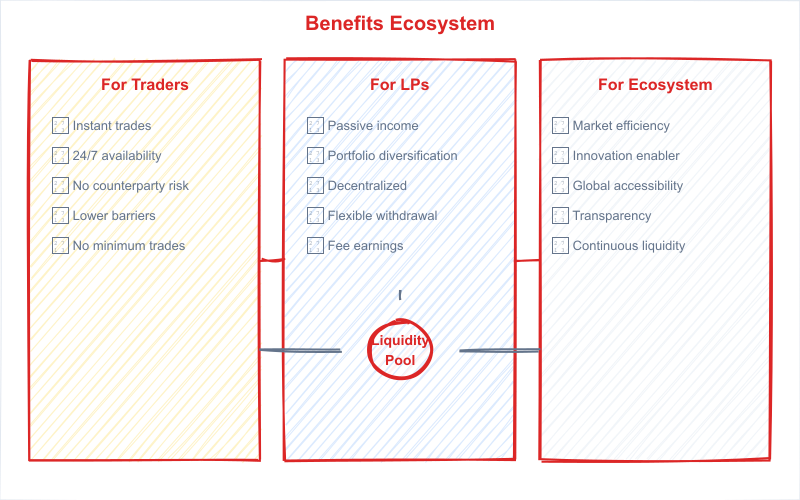
Diagram - Traditional market vs. Liquidity Pool comparison
What is a Liquidity Pool?
A liquidity pool is a collection of cryptocurrency tokens locked in a smart contract. These pools serve as the foundation for decentralized exchanges (DEXs), allowing users to trade tokens without relying on traditional order books or centralized intermediaries.
Think of it as a community-funded reservoir. Users called Liquidity Providers (LPs) deposit pairs of tokens into the pool – for example, Ethereum (ETH) and Tether (USDT). In return, they receive a share of the trading fees generated when other users swap tokens through the pool.
Flowchart - How users become Liquidity Providers
How Liquidity Pools Work: The Magic of AMM
The Automated Market Maker (AMM)
Unlike traditional exchanges that use order books to match buyers and sellers, liquidity pools use Automated Market Makers (AMMs) – mathematical algorithms that determine prices based on the ratio of tokens in the pool.
The most common AMM formula is the Constant Product Market Maker (CPMM):
` x × y = k `
Where:
- x = amount of Token A in the pool
- y = amount of Token B in the pool
- k = constant (never changes)
This formula ensures that the total value of the pool remains constant during trades. When someone buys Token A, they add Token B to the pool, changing the ratio and thus the price.
Diagram - CPMM formula visualization with token pairs
A Simple Example
Let's say a liquidity pool contains:
- 100 ETH
- 200,000 USDT
The constant k = 100 × 200,000 = 20,000,000
If a trader wants to buy 10 ETH:
- They must deposit enough USDT to maintain the constant
- New ETH amount = 90
- New USDT amount = 20,000,000 ÷ 90 ≈ 222,222
- Trader pays ≈ 22,222 USDT for 10 ETH
The price automatically adjusts based on supply and demand within the pool.
Sequence - Step-by-step trading process in liquidity pool
The Role of Liquidity Providers
Becoming a Liquidity Provider
Anyone can become a liquidity provider by depositing tokens into a pool. Here's how it works:
- Choose a pool: Select a token pair you want to provide liquidity for
- Deposit tokens: Add both tokens in equal value (e.g., $1000 worth of ETH and $1000 worth of USDT)
- Receive LP tokens: Get tokens representing your share of the pool
- Earn fees: Collect a portion (usually 0.3%) of every trade that happens in the pool
Diagram - Liquidity Provider journey and rewards
Earning Passive Income
Liquidity providers earn passive income through:
- Trading fees: A small percentage of each swap (typically 0.2-0.3%)
- Yield farming: Additional token rewards from platforms
- Staking: Locking LP tokens to earn more rewards
This makes liquidity pools an attractive option for crypto holders looking to earn returns on their idle assets.
Benefits of Liquidity Pools
For Traders
- Instant trades: No waiting for order matching
- 24/7 availability: Trade anytime, anywhere
- No counterparty risk: Trading against smart contracts, not other users
- Lower barriers: No minimum trade requirements
For Liquidity Providers
- Passive income: Earn fees without active trading
- Portfolio diversification: Exposure to multiple tokens
- Decentralized: No centralized authority needed
- Flexible: Can withdraw liquidity anytime
For the DeFi Ecosystem
- Efficiency: Continuous liquidity enables smooth markets
- Innovation: Enables complex financial products
- Accessibility: Anyone can participate globally
- Transparency: All transactions visible on blockchain
Diagram - Benefits ecosystem for all participants
Understanding the Risks
Impermanent Loss
The most significant risk for liquidity providers is impermanent loss. This occurs when the price of deposited tokens changes compared to when they were deposited.
Example:
- You deposit 1 ETH ($2000) and 2000 USDT
- ETH price doubles to $4000
- If you had held: 1 ETH + 2000 USDT = $6000
- In the pool: Your share is now worth less due to AMM mechanics
- The difference is your impermanent loss
It's called "impermanent" because if prices return to their original ratio, the loss disappears. However, if you withdraw during the price divergence, the loss becomes permanent.
Graph - Impermanent loss visualization over time
Other Risks
- Smart contract vulnerabilities: Bugs or hacks in the pool code
- Price slippage: Large trades can significantly impact prices
- LP token devaluation: Pool share value can decrease
- Regulatory uncertainty: Legal status of DeFi activities
Popular Liquidity Pool Platforms
Uniswap (Ethereum)
The pioneer of AMM-based DEXs, Uniswap popularized the liquidity pool model and remains one of the largest DeFi platforms.
PancakeSwap (Binance Smart Chain)
Known for lower fees and faster transactions, PancakeSwap brings liquidity pools to the BSC ecosystem.
Curve Finance (Stablecoins)
Specialized in stablecoin pools with minimal slippage, ideal for trading tokens pegged to the same value.
SushiSwap (Multi-chain)
Offers additional features like yield farming and lending across multiple blockchains.
Comparison table - Major liquidity pool platforms
Getting Started with Liquidity Pools
Step 1: Choose a Platform
Select a DEX that supports the tokens you want to trade or provide liquidity for. Consider:
- Supported blockchain
- Trading fees
- Pool size and liquidity
- Security track record
Step 2: Connect Your Wallet
Use a Web3 wallet like MetaMask to connect to the platform. Ensure you have sufficient tokens for gas fees.
Step 3: Select a Pool
Browse available pools and choose one with adequate liquidity. Higher liquidity generally means less slippage.
Step 4: Add Liquidity (Optional)
If you want to become a liquidity provider, deposit both tokens in the required ratio and receive LP tokens.
Step 5: Trade or Earn
Execute trades or let your liquidity generate passive income through fees.
Flowchart - User onboarding process for liquidity pools
The Future of Liquidity Pools
Liquidity pools continue to evolve with innovations like:
- Concentrated liquidity: Providers can allocate capital to specific price ranges
- Multi-asset pools: Supporting more than two tokens
- Dynamic fees: Adjusting fees based on volatility
- Cross-chain pools: Enabling liquidity across different blockchains
These advancements aim to improve capital efficiency, reduce risks, and expand the possibilities of decentralized finance.
Conclusion: Empowering Decentralized Finance
Liquidity pools represent a fundamental shift in how we think about trading and market making. By removing intermediaries and enabling peer-to-contract transactions, they've democratized access to financial markets.
Whether you're a trader seeking instant execution or an investor looking for passive income opportunities, understanding liquidity pools is essential for navigating the DeFi landscape. As the ecosystem continues to mature, these pools will likely play an increasingly important role in the future of finance.
Remember, while liquidity pools offer exciting opportunities, they also come with risks. Always do your own research, start with small amounts, and never invest more than you can afford to lose.
The world of DeFi is open 24/7 – and liquidity pools ensure there's always someone (or something) ready to trade.