
Liquidity mining strategies have evolved from the wild west of 2020's "DeFi Summer" into a sophisticated toolkit for earning yield on idle crypto assets. Whether you're a Vietnamese trader moving USDT from Momo to PancakeSwap or a global investor allocating across Ethereum, Arbitrum, and Cardano, understanding how to match your risk tolerance to the right strategy separates sustainable returns from expensive lessons. This guide walks you through the mechanics, strategies, risks, and practical steps to build a liquidity mining approach that fits your goals — not the hype cycle.
What Is Liquidity Mining?
Imagine you're a market maker in a traditional financial exchange. You provide buy and sell orders so others can trade instantly. In return, you earn the spread. Liquidity mining is the DeFi equivalent: you deposit token pairs into an automated market maker (AMM) like Uniswap or PancakeSwap, receive liquidity provider (LP) tokens representing your share, and earn rewards — typically the protocol's native token — on top of trading fees.
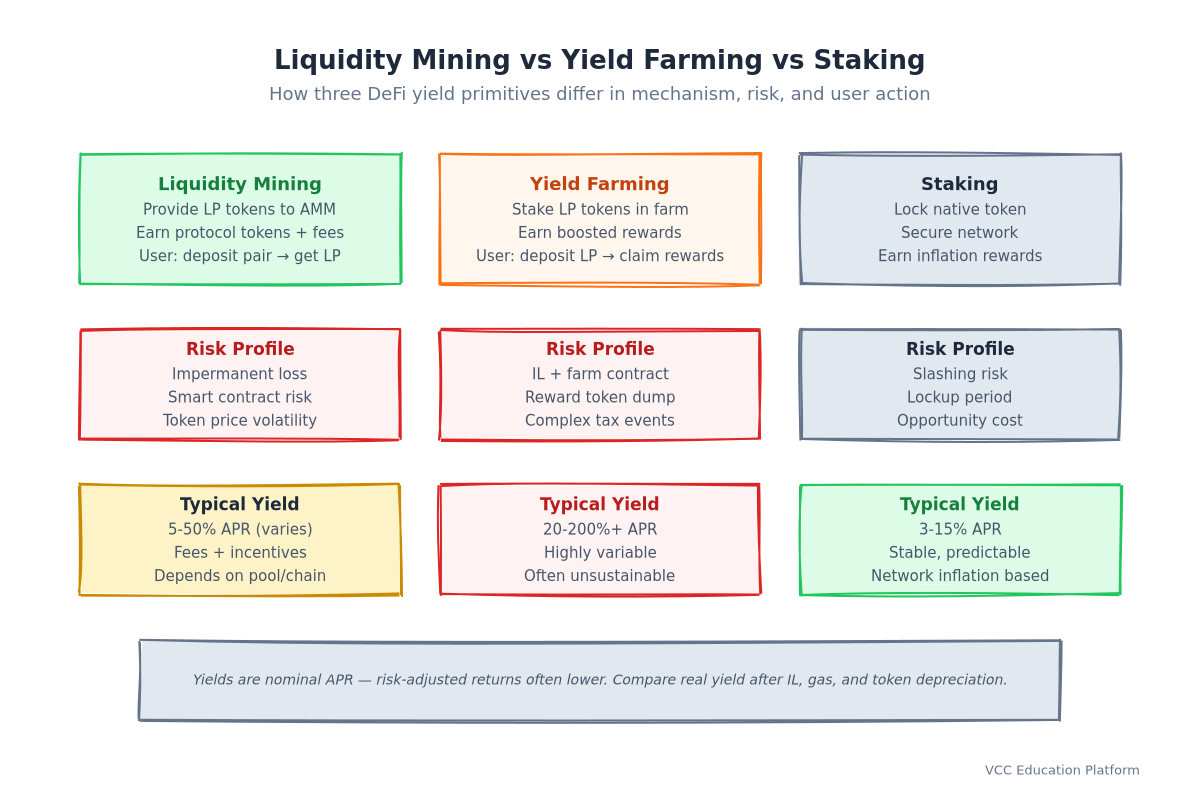
The concept traces back to Compound's COMP distribution in June 2020, but the term "liquidity mining" stuck after SushiSwap's vampire attack on Uniswap later that summer. Here's how the three main yield primitives differ:
| Aspect | Liquidity Mining | Yield Farming | Staking |
|---|---|---|---|
| Mechanism | Provide LP tokens to AMM, earn protocol tokens | Stake LP tokens in farm contract for boosted rewards | Lock native token to secure network, earn inflation |
| User Action | Deposit pair → receive LP tokens → optional: stake LP | Deposit LP tokens → lock in gauge/farm → claim rewards | Delegate or run validator → lock tokens → earn |
| Risk Profile | Impermanent loss + smart contract + token price | IL + farm contract + reward token dump risk | Slashing + lockup + opportunity cost |
| Typical Yield | 5-50% APR (varies by pool & incentives) | 20-200%+ APR (highly variable, often unsustainable) | 3-15% APR (stable, predictable) |
Key distinction: Yield farming is a layer on top of liquidity mining — you stake your LP tokens in a separate contract for extra rewards. Liquidity mining is the base layer: providing the liquidity itself. Many protocols blur this line (e.g., Aerodrome lets you vote on gauges directly from your LP position), but the risk stack remains: base LM risk + farm risk = compounded exposure.
For Vietnamese users, the typical entry path looks like: Momo/ZaloPay → P2P USDT on Binance/Bybit → withdraw to BSC → PancakeSwap V3 → provide liquidity → optional: stake LP on Thena or Meridian for veTHE/veMER rewards. Gas costs on BSC (~$0.02) make this 50x cheaper than Ethereum mainnet for small positions.
Core Mechanics: LP Tokens, Rewards, and APR vs APY
When you deposit Token A and Token B into an AMM pool, you receive LP tokens — a receipt proving your proportional ownership of the pool's reserves. These tokens are your claim ticket. If the pool holds 100 ETH and 200,000 USDC, and you own 1% of LP tokens, you can redeem them for 1 ETH + 2,000 USDC (minus fees).
Reward Distribution
Most liquidity mining programs distribute rewards pro-rata per block or per second based on your LP token balance. The formula:
` Your Reward Rate = (Your LP Tokens / Total LP Tokens) × Emission Rate `
If a pool emits 1,000 TOKEN/day and you hold 5% of LP supply, you earn 50 TOKEN/day. Simple — but three complications change the math:
- Emission schedules decay. Most protocols halve emissions yearly (Bitcoin-style) or follow a vesting curve. Today's 50 TOKEN/day might be 25 TOKEN/day in six months.
- Token price volatility. 50 TOKEN at $10 = $500/day. At $2 = $100/day. Your real yield depends on whether you sell immediately or hold.
- Compounding frequency. APR (Annual Percentage Rate) assumes simple interest. APY (Annual Percentage Yield) assumes reinvestment. At 100% APR with daily compounding: APY = (1 + 1/365)^365 - 1 ≈ 171%. Most DeFi dashboards show APR; auto-compounders (Beefy, Yearn, AutoShark) deliver APY.
Practical rule: Compare positions on risk-adjusted real yield, not headline APR. A 200% APR farm paying a token that drops 80% in a month yields -60% real return. A 15% APR stablecoin pool on Curve holding value yields +15% real.
Strategy Types: Matching Risk to Reward
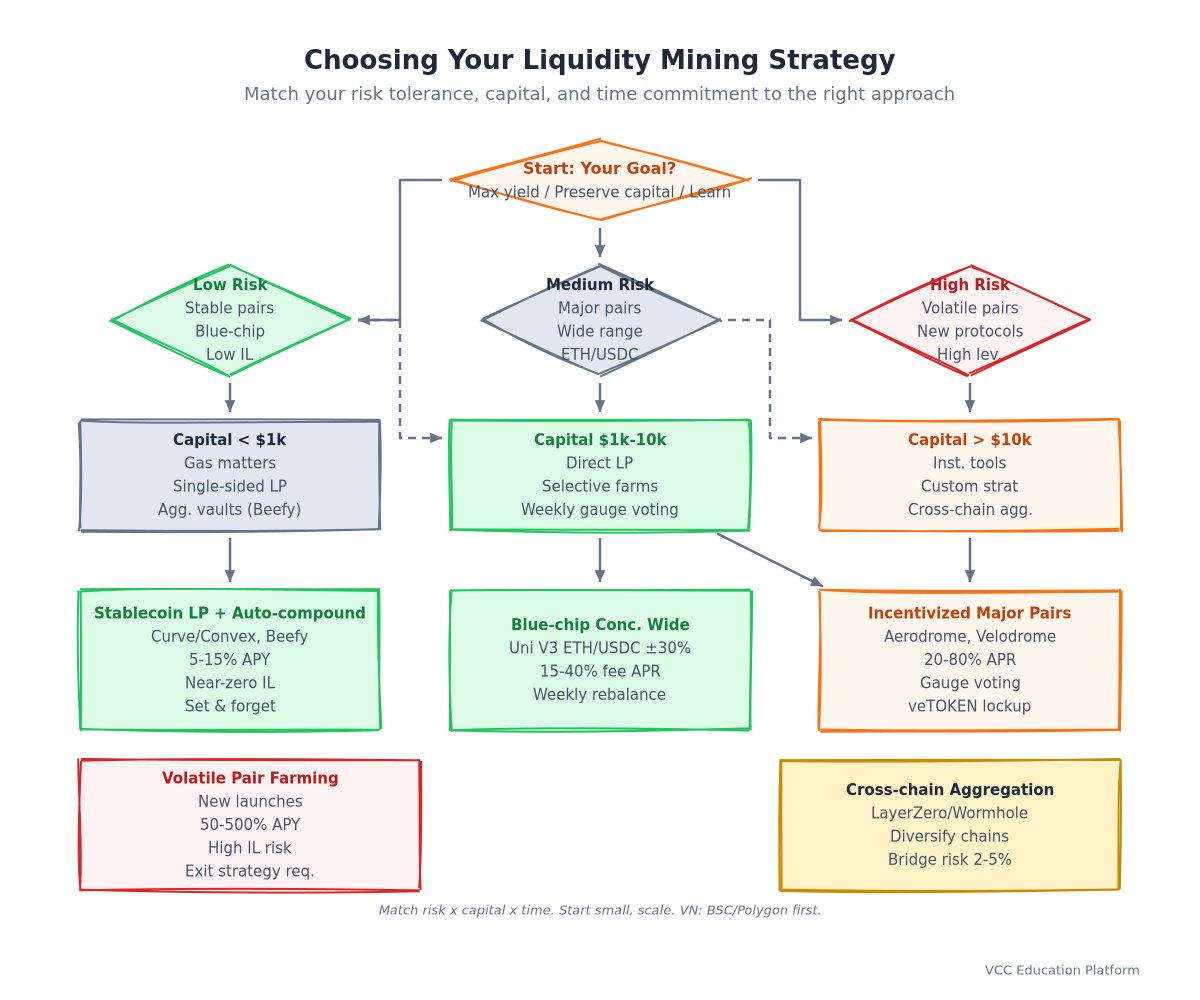
Not all liquidity mining is created equal. Your strategy should align with three variables: risk tolerance, capital size, and time commitment. The framework below maps these to four strategic quadrants.
Quadrant 1: Stablecoin Pairs (Low Risk, Passive)
Protocols: Curve (3pool, tricrypto), PancakeSwap StableSwap, Uniswap V3 0.01% fee tier Typical Yield: 3-15% base + 5-20% gauge rewards (CRV, CAKE, veTHE) IL Risk: Near-zero (StableSwap invariant keeps prices pegged) Management: Set and forget. Auto-compound via Convex, Beefy, or Yearn.
Vietnam context: USDT/USDC on PancakeSwap V3 0.01% tier is the most popular "sleep well" position for VN users. Gas is negligible, IL is virtually zero, and you earn CAKE + trading fees. The catch: depeg risk. If USDT loses peg (as happened briefly in 2022-2023), the pool rebalances into the depegged asset. Mitigation: diversify across fiat-backed (USDC), overcollateralized (DAI), and algorithmic (FRAX) stables.
Quadrant 2: Blue-Chip Concentrated Liquidity (Medium Risk, Active)
Protocols: Uniswap V3 (Ethereum, Arbitrum, Polygon), PancakeSwap V3 (BSC), Ambient (Base), Trader Joe (Avalanche) Typical Yield: 15-60% fee APR + 0-30% incentives IL Risk: Moderate to high depending on range width Management: Weekly rebalancing for wide ranges (±30-50%), daily for narrow (±5-10%)
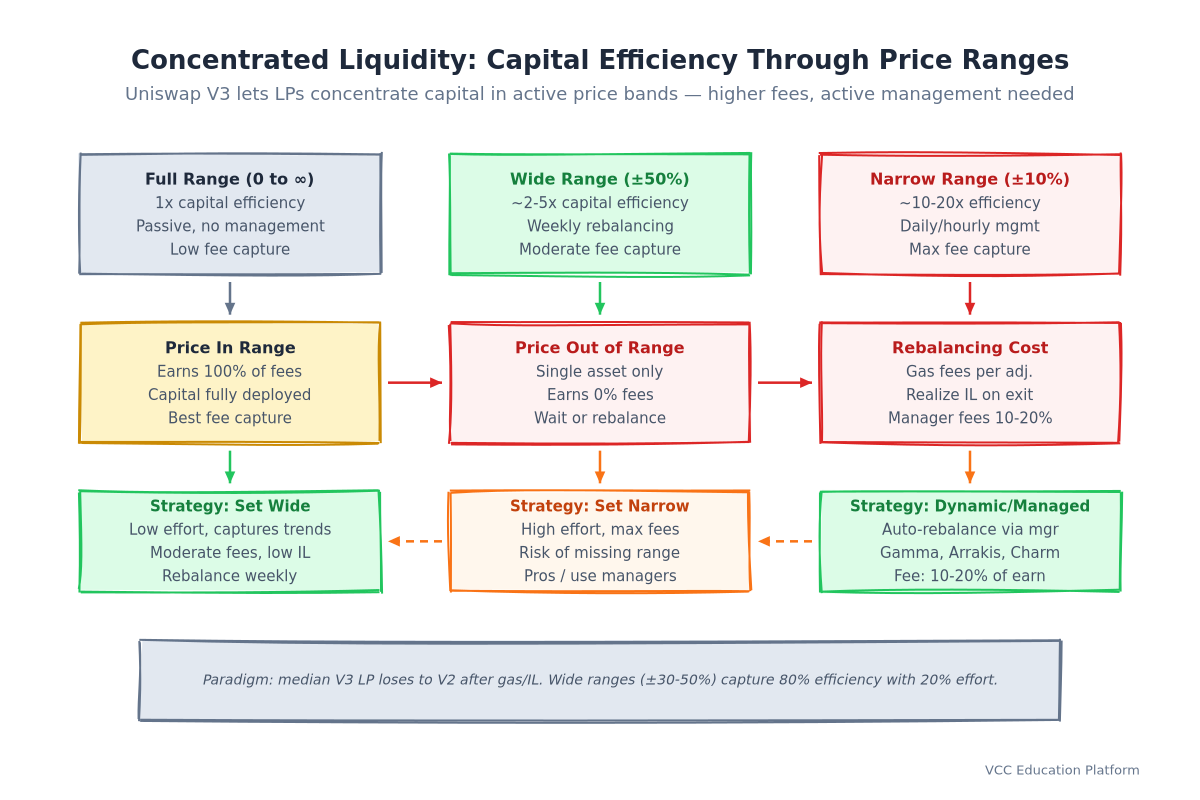
Uniswap V3 introduced concentrated liquidity: instead of providing liquidity across 0 to ∞ (V2), you pick a price range. Capital efficiency scales inversely with range width:
- Full range (0 to ∞): 1x efficiency — passive, low fees
- Wide range (±50%): ~2-5x efficiency — weekly rebalance
- Narrow range (±10%): ~10-20x efficiency — daily/hourly management
The trap: Narrow ranges earn massive fees while in range. The moment price exits, you hold 100% of one asset, earn 0 fees, and face maximum IL. Paradigm research shows median V3 LP loses to V2 after gas and IL because they fail to rebalance. Professional managers (Gamma, Arrakis, Charm, Visor) automate this — but take 10-20% of fees.
Strategy: For most users, wide-range concentrated positions (±30-50% around current price) on blue-chip pairs (ETH/USDC, BTC/USDC, BNB/USDC) capture 80% of the efficiency gain with 20% of the management burden. Rebalance weekly or use a manager.
Quadrant 3: Incentivized Major Pairs (Medium-High Risk, Semi-Active)
Protocols: Aerodrome (Base), Velodrome (Optimism), Thena (BSC), Meridian (BSC), Ramses (Arbitrum) Typical Yield: 20-100%+ APR (fees + gauge rewards + bribes) IL Risk: Moderate (volatile pairs like ETH/USDC, BTC/ETH) Management: Gauge voting weekly, bribe collection, position monitoring
These "ve(3,3)" protocols combine Curve's vote-escrow tokenomics with Uniswap V3 concentrated liquidity. You provide LP → receive veTOKEN (by locking) → vote on gauges → direct emissions to your pool → earn bribes from protocols buying votes. The yield stack:
- Trading fees (0.01-1%)
- Protocol emissions (AERO, VEL, THE, MER)
- Bribe revenue (Votium, Hidden Hand, Paladin)
- veTOKEN appreciation (if protocol grows)
Risk: Emission sustainability. If TVL grows slower than emissions, APR dilutes. If bribe market dries up, yield collapses. Check: emission rate / TVL trend — rising ratio = sustainable; falling = dilutive.
Quadrant 4: Volatile Pair Farming (High Risk, Active)
Protocols: New DEX launches, meme coin pools, high-leverage farms Typical Yield: 50-500%+ APR (often short-lived) IL Risk: Severe (50-90%+ drawdowns common) Management: Hourly monitoring, exit strategy mandatory
This is speculation, not investing. Examples: New token launch on PancakeSwap with 1000% APR for 2 weeks, then rug pull or emission cliff. If you enter early and exit before the crash, you profit. Most don't. Only allocate capital you can afford to lose entirely.
Risk Management Framework
Liquidity mining has three risk layers. Managing each requires different tools.
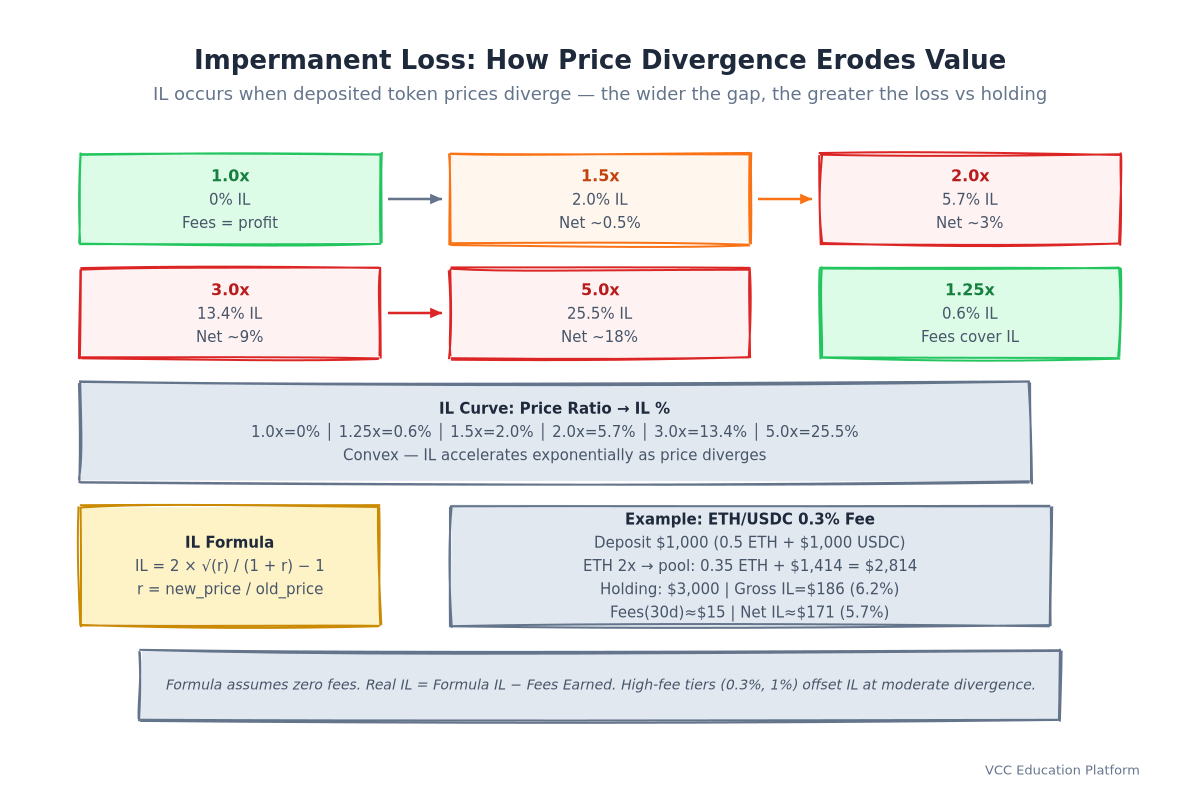
Impermanent Loss: Quantified
Impermanent loss (IL) occurs when deposited token prices diverge. The constant product formula (x × y = k) means the pool rebalances by selling the appreciating asset for the depreciating one. You end up with more of the loser, less of the winner.
IL Formula (no fees): ` IL = 2 × √(price_ratio) / (1 + price_ratio) - 1 `
| Price Ratio | IL (No Fees) | IL Net of 0.3% Fees (30 days) |
|---|---|---|
| 1.0x | 0% | 0% |
| 1.25x | 0.6% | ~0% (fees cover) |
| 1.5x | 2.0% | ~0.5% |
| 2.0x | 5.7% | ~3% |
| 3.0x | 13.4% | ~9% |
| 5.0x | 25.5% | ~18% |
Worked example: You deposit $1,000 ETH/USDC (0.5 ETH + $1,000 USDC) at 0.3% fee tier. ETH doubles from $2,000 to $4,000. Pool rebalances to 0.35 ETH + $1,414 USDC = $2,814. Holding would be 0.5 ETH + $1,000 USDC = $3,000. IL = $186 (6.2%). Fees earned in 30 days at $200M TVL, 0.3% fee, your $1k share ≈ $15. Net IL ≈ $171.
Protection strategies:
- Stablecoin pairs: Near-zero IL (use Curve StableSwap)
- Correlated pairs: ETH/BTC, BNB/ETH — lower divergence
- Wide ranges: Concentrated liquidity ±50% reduces IL vs full range at same price move
- Hedging: Short perpetual futures on the volatile asset (advanced)
- Single-sided LP: Some protocols (Bancor, Kyber Elastic) let you deposit one asset — but carry protocol risk
Smart Contract & Protocol Risk
Every protocol you interact with is a potential failure point. Assessment checklist:
| Check | Green Flag | Yellow Flag | Red Flag |
|---|---|---|---|
| Audit | Multiple top-tier (Trail of Bits, OpenZeppelin, Spearbit) | Single audit or mid-tier firm | No audit / unaudited fork |
| Bug Bounty | >$100K on Immunefi | $10-100K | None / <$10K |
| TVL History | >$100M, stable/growing 6+ months | $10-100M, volatile | <$10M or recent launch |
| Admin Keys | Timelock + multisig (4/7+) | Multisig (2/3) | Single EOA / no timelock |
| Upgradeability | Immutable or 48h+ timelock | Proxy with short timelock | Upgradeable anytime |
| Incident History | None / minor, handled transparently | Past exploit, fixed, audited post-mortem | Repeated exploits |
Vietnam note: Popular VN protocols (PancakeSwap, Minswap, WingRiders) have varying audit depth. PancakeSwap V3 is a fork of Uniswap V3 (heavily audited) but the CAKE tokenomics and farm contracts are separate. Minswap V2 on Cardano has been audited by TxPipe and MLabs. Always verify the specific contract you're interacting with, not just the brand.
Tokenomics & Emission Risk
Reward tokens are not free money — they're dilution. Key metrics:
- Fully Diluted Valuation (FDV) / Market Cap ratio: >10x = massive future unlock pressure
- Emission schedule: Linear decay? Cliff unlocks? Team/VC vesting?
- Utility vs speculation: Does the token have real use (governance, fees, utility) or pure farm-and-dump?
- Buyback/burn mechanisms: Protocol revenue → token buyback creates natural bid
Red flag example: Protocol launches with 10% circulating, 90% unlocked over 12 months to team/investors. Every month, millions of tokens hit market. LP rewards are paid in this token. You're farming your own exit liquidity.
Advanced Yield Optimization Tactics
Once you've mastered the quadrants above, these tactics can boost risk-adjusted returns.
Auto-Compounding
Manual harvesting costs gas and time. Auto-compounders (Beefy, Yearn, AutoShark, PancakeSwap Auto) harvest rewards, swap to LP tokens, and redeposit — typically daily. Boost: 15-30% over manual at same gas cost. Cost: 3-5% performance fee + smart contract risk of the vault.
Cross-Chain Liquidity Aggregation
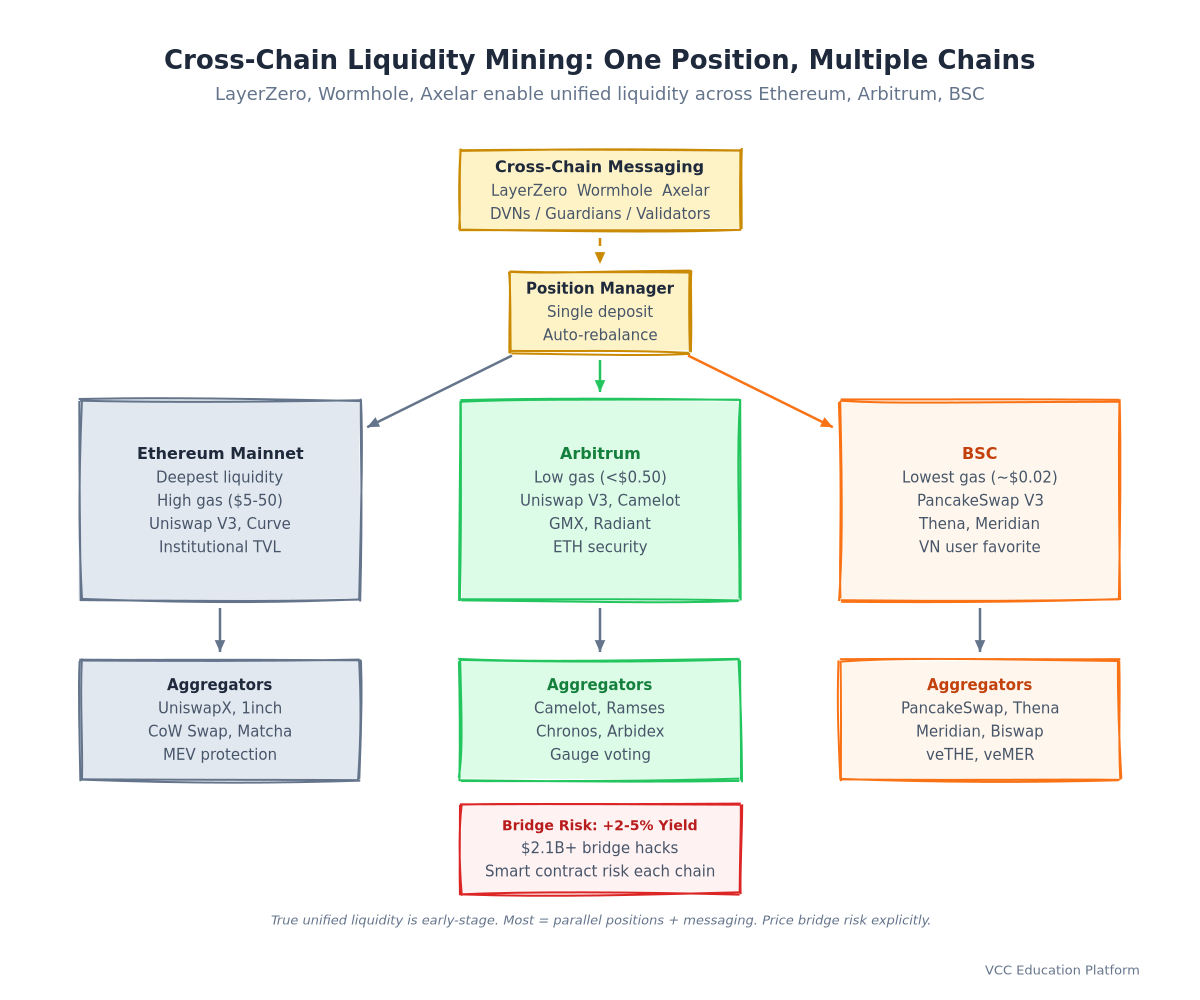
LayerZero, Wormhole, and Axelar enable protocols to deploy unified liquidity across chains. Examples:
- Stargate (LayerZero): Unified USDC/USDT pools across Ethereum, Arbitrum, BSC, Polygon, Avalanche — single deposit, multi-chain yield
- Radiant Capital: Cross-chain lending + LM, deposit on Arbitrum, borrow on BSC
- Trader Joe (Avalanche) + Joepegs: NFT-backed LP positions
Bridge risk premium: Add 2-5% to your required yield for any cross-chain position. The 2022-2023 bridge hacks (Wormhole $320M, Nomad $190M, Multichain $126M) prove this isn't theoretical. Only use bridges with:
- Proven track record >18 months
- $1B+ secured value
- Multiple independent audits
- Active bug bounty >$500K
MEV-Aware Positioning
On Ethereum mainnet, MEV bots sandwich LP orders and extract value from concentrated positions. Mitigation:
- Use CoW Swap or UniswapX for order flow protection
- Avoid narrow ranges during high volatility (MEV bots target them)
- Consider Arbitrum/Base/Optimism where MEV is lower (sequencer-based)
Portfolio Allocation Framework
Don't put all capital in one strategy. A balanced LM portfolio:
| Bucket | Allocation | Strategies | Rebalance |
|---|---|---|---|
| Core (60%) | Stablecoin LP + blue-chip concentrated wide | Curve 3pool + Convex, Uniswap V3 ETH/USDC ±40% | Quarterly |
| Satellite (30%) | Incentivized major pairs + gauge voting | Aerodrome, Velodrome, Thena | Monthly |
| Speculative (10%) | New protocol farms, volatile pairs | High-APR launches, meme pools | Weekly / exit triggers |
Rebalancing rule: When any bucket drifts >5% from target, trim winners, add to losers. This forces buying low, selling high — the opposite of momentum chasing.
Getting Started: Your 7-Step Checklist
- Define your parameters: Risk tolerance (low/med/high), capital ($100/$1k/$10k+), time (passive/active/pro)
- Choose your chain: BSC (cheapest gas), Polygon/Arbitrum (low gas + Ethereum security), Ethereum (highest yield but high gas), Cardano (eUTXO model, Minswap/WingRiders)
- Select protocol & pool: Use the quadrant framework. Start with Core bucket.
- Acquire tokens: For VN users — Momo → P2P USDT on Binance → withdraw to chain → swap half for pair token
- Provide liquidity: Connect wallet (Coin98, MetaMask, Trust) → approve tokens → deposit → confirm LP tokens received
- Stake LP (optional): For gauge rewards, stake LP on protocol's farm/voter page. Lock veTOKEN if committing long-term.
- Monitor & manage: Set price alerts (CoinGecko, DexScreener). Rebalance per your strategy. Track real yield monthly.
Gas budgeting: On Ethereum, a single LM position (approve + deposit + stake) can cost $20-80. On BSC/Polygon/Arbitrum: $0.01-0.50. Factor this into position sizing — a $100 position on Ethereum loses 20-80% to gas immediately.
FAQ
Is liquidity mining still profitable in 2024?
Yes, but selectively. The "free money" era of 1000% APR farms is gone. Sustainable yields come from: trading fees on high-volume pairs (Uniswap V3 ETH/USDC 0.05% tier ≈ 15-25% fee APR), gauge rewards on ve(3,3) protocols (Aerodrome ≈ 20-60% AERO), and stablecoin base yield (Curve 3pool ≈ 5-15%). The key is risk-adjusted real yield after IL, gas, and token depreciation.
What's the difference between liquidity mining and yield farming?
Liquidity mining = providing capital to an AMM pool, earning fees + protocol tokens. Yield farming = staking those LP tokens in a separate contract for additional rewards. All yield farming requires liquidity mining first, but not all liquidity mining involves yield farming. Think: LM is the foundation, YF is the penthouse.
How much can you lose from impermanent loss?
Theoretically up to 100% if one token goes to zero. Practically, for blue-chip pairs (ETH/USDC) with 0.3% fees: a 2x price move = ~5.7% IL before fees, ~3% net. A 5x move = ~25% IL before fees, ~18% net. Stablecoin pairs: <1% IL unless depeg. Always calculate: Net IL = Formula IL - Fees Earned.
Which blockchain has the best liquidity mining rewards?
Depends on your capital.
- <$1,000: BSC (PancakeSwap, Thena) or Polygon (QuickSwap, Ambient) — gas negligible, yields competitive
- $1,000-$10,000: Arbitrum (Camelot, Ramses) or Base (Aerodrome) — low gas, Ethereum security, strong incentives
- >$10,000: Ethereum mainnet (Uniswap V3, Curve) — deepest liquidity, lowest slippage, institutional tooling
- Cardano: Minswap, WingRiders, DexHunter — unique eUTXO model, growing ecosystem, lower competition
Do you pay taxes on liquidity mining rewards in Vietnam?
Current guidance (GDT): Crypto is "property." Disposal events (sell, swap, use for goods) trigger 20% capital gains tax on profit. LP token receipt = acquisition (cost basis = fair value). Reward tokens = ordinary income at fair value when received. LP exit = disposition (capital gain/loss). No official DeFi-specific ruling exists. Consult a VN tax advisor. Track every transaction with cost basis (CoinTracker, Koinly, or spreadsheet).
What is concentrated liquidity and should I use it?
Concentrated liquidity (Uniswap V3+) lets you choose a price range for your capital. Narrower range = higher fee share = higher capital efficiency. Use it if: you can rebalance weekly (wide range) or use a manager (Gamma, Arrakis). Avoid if: you want passive exposure — full-range V2-style or stablecoin pools are better. Most retail LPs lose to professionals on narrow ranges.
How do I protect against rug pulls in liquidity mining?
Pre-flight checklist:
- Verify contract address on official docs (not search results)
- Check audit reports (Trail of Bits, OpenZeppelin, CertiK, Spearbit)
- Confirm admin keys: timelock + multisig (4/7+)
- Review TVL history: >$50M, 6+ months stable
- Check tokenomics: reasonable FDV/MC, no massive near-term unlocks
- Test with small amount first ($50-100)
- Use revoke.cash to remove approvals after exiting
Never connect wallet to unverified links, "airdrop claim" sites, or DM-sent interfaces. The #1 VN user loss vector is phishing, not protocol failure.
Disclaimer: This article is for educational purposes only and does not constitute financial advice. DeFi involves significant risk including total loss of principal. Always do your own research (DYOR) and consult qualified professionals before making investment decisions. Past performance does not guarantee future results.