
Every Vietnamese business owner knows the chứng minh doanh thu dilemma: the tax authority needs to see your numbers, the bank needs them for a loan, investors want traction proof — but the moment those numbers leave your MISA or FastAccount export, competitors can buy the filing and reverse-engineer your pricing, customer count, and margins. In Vietnam's tight markets, bảo vệ dữ liệu kinh doanh isn't optional — it's survival.
Here's the one-sentence version: Zero-knowledge proofs let you prove "revenue > X" or "profit margin > Y" without revealing a single invoice, customer name, or price — the verifier learns the answer, not the witness.
If you've ever wished you could hand the tax office a sealed envelope they could verify without opening, or show a bank you're profitable without exposing your client list, zk business privacy is the cryptographic primitive that makes it possible.
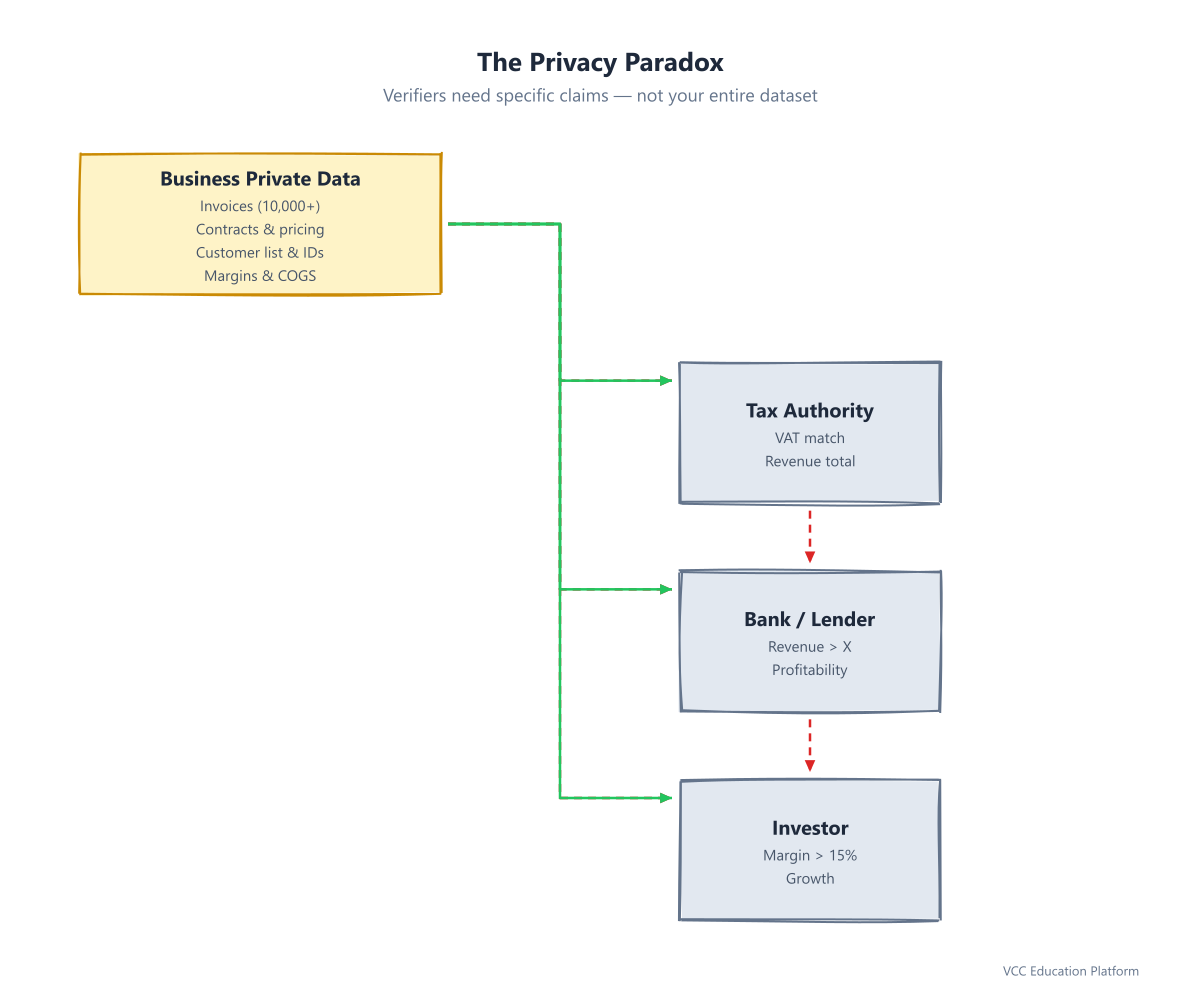
Figure 1: The Privacy Paradox — each verifier gets a tailored proof revealing only their required claim
Why Vietnamese SMEs Leak Data Every Quarter
File your quarterly tax declaration via MISA or FastAccount, and you've just handed the Tổng cục Thuế a complete revenue breakdown. In theory, that data is confidential. In practice, data brokers aggregate filings, and your đối thủ can buy a report showing your estimated quarterly revenue, average order value, even customer concentration.
The bí mật kinh doanh (trade secret) protection in Vietnam's Law on Intellectual Property is reactive — you sue after the leak. But the leak happens the moment you export that Excel file. The current system forces a false choice: comply and expose, or hide and risk penalties.
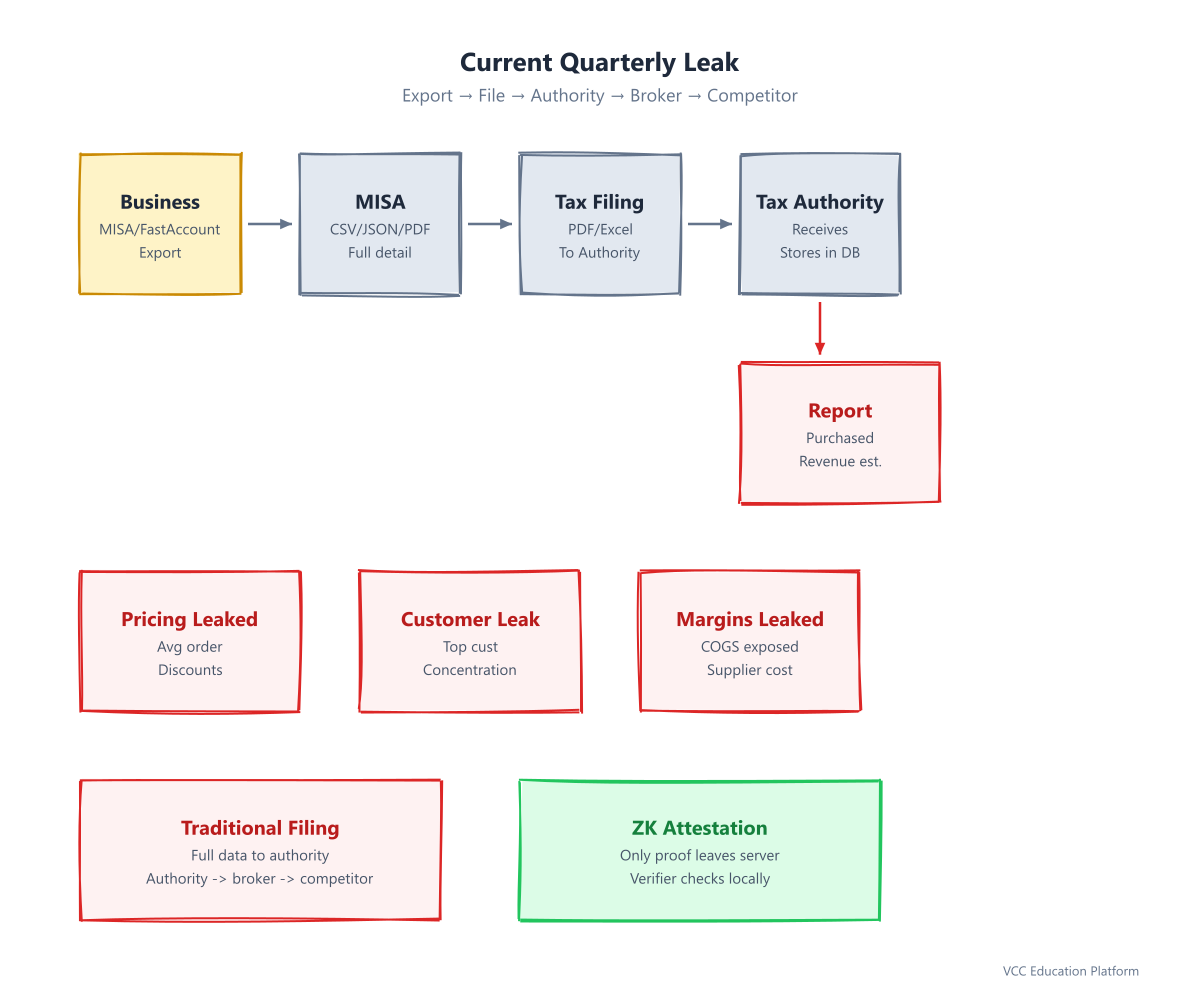
Figure 2: Current Quarterly Leak — export data flows to competitors via data brokers
Zero-Knowledge Proofs: The "Sealed Envelope" You Can Verify
A zero-knowledge proof (ZKP) is a cryptographic protocol where a prover convinces a verifier that a statement is true — without revealing the secret inputs that make it true.
Think of it as a sealed envelope: you put your full invoice ledger inside, the envelope runs the calculation (sum > 50B VND?), and the verifier only sees the result: "TRUE" or "FALSE". They learn the answer. They learn nothing about the invoices.
Technically, the prover executes a circuit (think: sum(invoices) > threshold) and generates a proof that the execution was correct. The verifier checks the proof — a few kilobytes, milliseconds to verify. The witness (the invoices) never leaves the prover's machine.
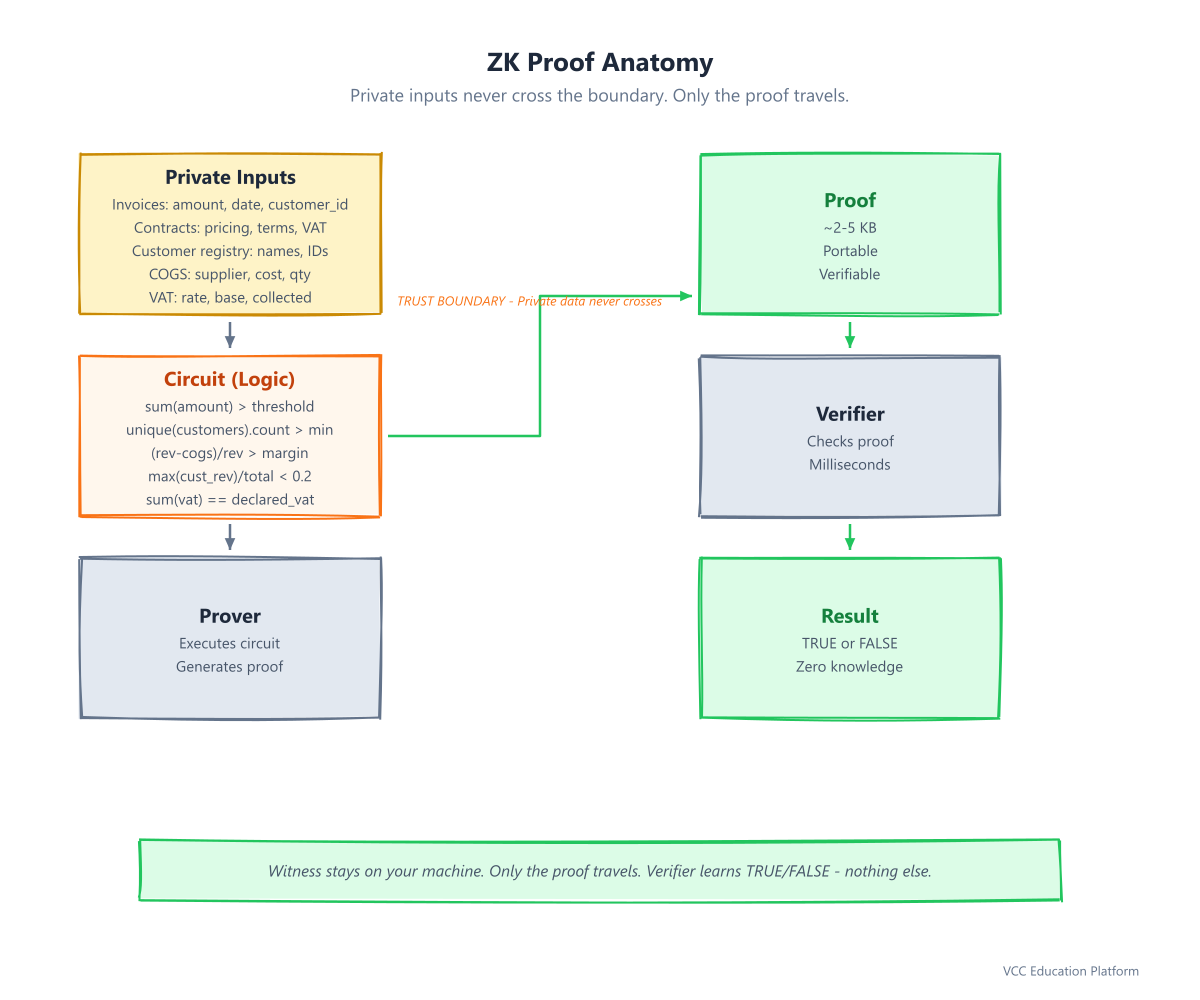
Figure 3: ZK Proof Anatomy — private inputs never cross the boundary, only the proof travels
Revenue Attestation: What You Can Prove Today
With current ZK tooling (RISC Zero, SP1, Cairo, or custom circuits on zkSync/Midnight), a Vietnamese business can generate attestations for:
| Claim | Circuit Logic | Verifier Learns | Witness Stays Hidden |
|---|---|---|---|
| Quarterly revenue > 50B VND | sum(invoice.amount) > 50_000_000_000 | TRUE/FALSE | Every invoice amount, customer, date |
| Profit margin > 15% | (revenue - cogs) / revenue > 0.15 | TRUE/FALSE | Individual COGS lines, supplier prices |
| Customer count > 500 | unique(invoice.customer_id).count > 500 | TRUE/FALSE | Customer identities, purchase history |
| No single customer > 20% revenue | max(customer_revenue) / total_revenue < 0.2 | TRUE/FALSE | Per-customer revenue breakdown |
| VAT collected matches declared | sum(invoice.vat) == declared_vat | TRUE/FALSE | Line-item VAT, product categories |
Each attestation is a separate proof. The bank gets the revenue proof. The investor gets the margin proof. The tax authority gets the VAT proof. No verifier sees more than they need.
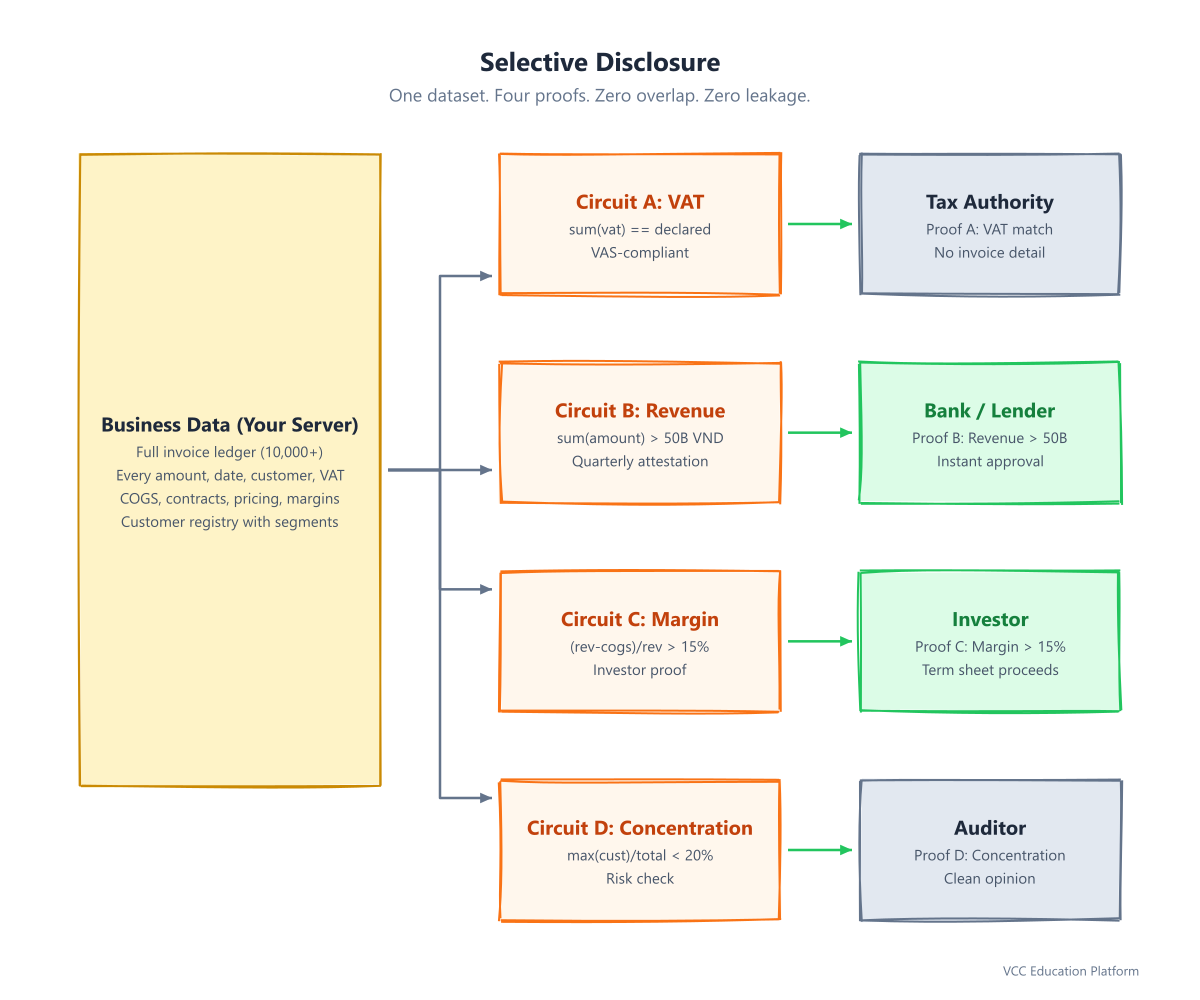
Figure 4: Selective Disclosure — one dataset, four tailored proofs, zero overlap
How the Audit Changes: From "Show Me Everything" to "Verify the Proof"
Traditional kiểm toán (audit): auditor receives full ledger, samples transactions, requests supporting documents, builds opinion. Time: weeks. Cost: high. Risk: data exposure.
ZK audit: business runs the accounting circuit over full dataset, generates proof that rules were followed (double-entry balances, revenue recognition policy applied, no deleted entries). Auditor verifies proof. Time: minutes. Cost: near zero. Risk: zero data exposure.
The auditor learns "the books balance and policies were followed" — not "Customer A bought 50 units at 20% discount."
For Vietnamese SMEs using MISA or FastAccount: the accounting software already has structured data. A ZK circuit can encode Vietnamese Accounting Standards (VAS) rules. The proof says "VAS-compliant" without exporting the trial balance.
The Vietnamese SME Workflow: From MISA to ZK Attestation
- Export structured data from MISA/FastAccount (CSV, JSON, or API) — stays on your server.
- Run the ZK circuit locally (or via a trusted prover service) — inputs never leave.
- Generate proofs for each verifier's required claims.
- Send proofs (small files, email/API) — verifier checks in seconds.
- Done. No PDF attachments. No Excel files. No data broker feed.
This is not theoretical. Midnight Network, zkSync, and RISC Zero already support this pattern. The missing piece is Vietnamese-accounting-standard circuits — a solvable engineering task.
Comparison: Traditional Filing vs ZK Attestation
| Dimension | Traditional (MISA → Tax Filing) | ZK Attestation |
|---|---|---|
| Data shared | Full ledger (all invoices, customers, prices) | Only the proven claim (TRUE/FALSE) |
| Competitor risk | High — filings aggregated and sold | Zero — no data leaves your server |
| Verifier effort | Manual review, sampling, weeks | Automated verification, milliseconds |
| GDPR / PDPD Vietnam | Personal data in filings — compliance burden | Data never shared — compliant by design |
| Audit cost | Auditor hours × hourly rate | Near-zero (compute only) |
| Selective disclosure | Impossible — all or nothing | Native — one proof per claim |
Common Questions About ZK Business Privacy
What is a zero-knowledge proof in business terms?
A mathematical receipt that a calculation ran correctly on your private data, without revealing the data. Like a calculator that shows you the answer but burns the inputs.Can the tax authority (Tổng cục Thuế) accept ZK proofs?
Technically yes — they verify the proof like any digital signature. Legally, Vietnam's Law on Electronic Transactions (2023) recognizes electronic evidence. Policy adoption follows technical feasibility.Does this work with MISA / FastAccount?
Yes. Export structured data (JSON/CSV) from your accounting software, feed it to the ZK circuit. The circuit encodes Vietnamese Accounting Standards rules. No software change needed — only a prover integration.What if the prover is compromised?
The prover only sees your data locally. If you run it on your own server (RISC Zero, SP1), no third party sees anything. If you use a proving service, they see inputs — choose a trusted provider or self-host.How much does it cost?
Proof generation: seconds to minutes on modern hardware (or cloud prover ~$0.10–$1 per proof). Verification: milliseconds, near-zero cost. Compared to auditor fees — negligible.Is this only for big companies?
No. SMEs benefit most — they can't afford full audits but need credibility with banks/investors. A ZK revenue attestation costs less than a coffee and takes minutes.What about "bí mật kinh doanh" legal protection?
ZK makes protection proactive (data never leaves) rather than reactive (sue after leak). It doesn't replace legal remedies — it makes them unnecessary for this vector.The Bottom Line
Vietnamese businesses have been forced to choose: comply and expose, or hide and risk. Zero-knowledge proofs eliminate the trade-off.
You keep your invoices, customer list, pricing, and margins on your server. The tax authority gets a verified "VAT matches" proof. The bank gets a verified "revenue > 50B VND" proof. The investor gets a verified "margin > 15%" proof. Your đối thủ gets nothing.
This is chứng minh doanh thu without the leak. This is bảo vệ dữ liệu kinh doanh by design. This is zk business privacy — and it's ready to deploy today.
Quick Reference
| Property | Value |
|---|---|
| Core primitive | Zero-knowledge proof (ZK-SNARK / ZK-STARK / RISC Zero) |
| Private inputs | Invoices, contracts, customer data, pricing |
| Public outputs | TRUE/FALSE per claim (revenue, margin, count, VAT) |
| Verifier cost | Milliseconds, few KB proof |
| Prover cost | Seconds–minutes, runs locally or cloud |
| Data leaves server | Never |
| Vietnamese standards fit | VAS rules encodable as circuits |
| Accounting software | MISA, FastAccount, Bravo — export → prove |
| Legal basis | Law on Electronic Transactions 2023, Decree 13/2023 (PDPD) |
| Key benefit | Selective disclosure: each verifier sees only their claim |