
Thanh buys PEPE on PancakeSwap in small increments -- ten $100 swaps over an hour -- to avoid moving the price. On his fourth swap the pool price jumps 1.8% the moment his transaction lands in the mempool, then snaps back: a bot bought the token seconds before his trade and sold seconds after, pocketing the difference from his slippage tolerance. He did nothing wrong. Chống front running zk -- zero-knowledge protection that hides order details -- fixes the root cause: keep the order secret from submission until settlement, so the network validates it with a proof without ever seeing what is inside.
The chain-level fix matters more than individual wallet settings. Bảo vệ lệnh giao dịch defi today means squeezing slippage lower and hoping no bot notices your size. The architectural fix hides the order itself, so the attacker has nothing to react to. This article explains how the public mempool creates the attack, why older hiding tricks like commit-reveal fall short, and how a zk mempool privacy design -- encrypted orders plus a validity proof -- protects the order from submission to settlement, with a look at what works in production today.
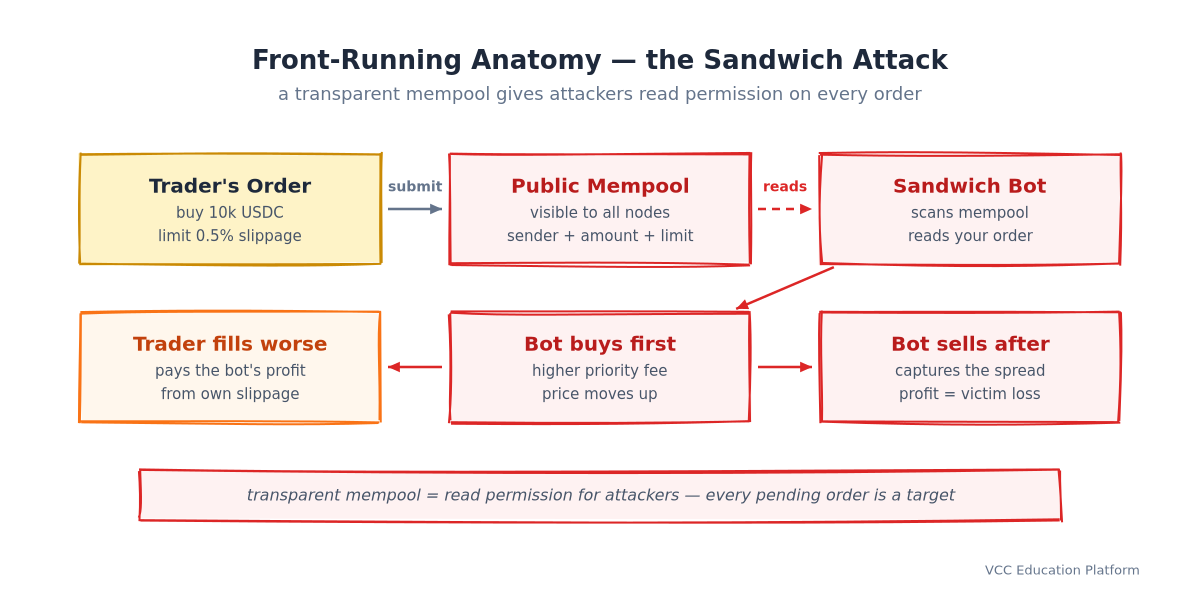
Figure 1: The sandwich attack — a transparent mempool hands attackers read permission on every pending order
The public mempool is a read-permission for attackers
Every Ethereum-compatible chain has a mempool: a waiting room of transactions that have been broadcast but not yet included in a block. Its design is transparent by default. Any node operator, MEV bot, or analytics service can read a pending transaction in full -- the sender, the target contract, the function call, and every argument including the exact amount and the slippage limit. This transparency is not a bug; it is how the ecosystem achieved open, permissionless inclusion. It is also precisely what makes front-running profitable.
The attack depends on two facts. First, AMM pricing is deterministic: a constant-product pool follows x * y = k, so a swap of a given size moves the price by a predictable amount. Second, the attacker can order their transaction ahead of yours by paying a slightly higher priority fee. Put them together and you get the sandwich: the bot buys just before your transaction, your trade executes at the inflated price, and the bot sells right after to capture the difference. You still get your tokens -- you simply pay the bot's profit from your own slippage allowance.
The scale is not theoretical. An ETH Zurich study measured 480,276 sandwich attacks on Ethereum over 12 months, extracting 64,217 ETH (~$189M) in attacker profit; victims could have saved 30,525 ETH (~$90M) by splitting orders. On Binance Smart Chain, where Vietnamese retail volume is concentrated and pool liquidity is thinner, bots execute thousands of attacks per day. During meme-coin pumps, EigenPhi data shows 15-25% of new Uniswap V2 pool transactions are sandwiched; for swaps over $5,000 with more than 3% slippage tolerance, the rate reaches 40-60%. A single Uniswap V3 trade in March 2025 lost over $215,000 to a liquidity-withdrawal attack. For a retail trader swapping $100-$500 at a time, the typical damage is 0.3-3% of each swap -- an invisible tax compounded across hundreds of transactions a month.
Why is front-running legal when it would be prosecuted in traditional markets? Because in DeFi the information is public and the ordering mechanism is a normal fee market. Cornell professor Maureen O'Hara has argued that regulators should treat MEV bots as parasitic but legal. That means traders cannot rely on regulation to save them -- the fix has to be architectural.
Why commit-reveal is not enough
The simplest idea is commit-reveal: submit a hash of your order, wait for it to be scheduled, then reveal the actual payload. The bot cannot tailor a front-run because it cannot see the order contents during the waiting period. EIP-8209, a 2026 Ethereum proposal, builds exactly this as protocol-level commit-reveal transaction frames with a penalty for failed reveals.
Commit-reveal has three structural gaps. First, speculative front-running remains possible: an attacker can post many candidate front-runs in advance and only execute the profitable one after observing the reveal. Second, back-running is untouched: once your trade executes, the state transition is public, so bots can still extract value from the aftermath. Third, liveness risk shifts to the user: a failed reveal is penalized, and every waiting period adds latency and gas. Commit-reveal hides the order but gives the network nothing useful to do with it -- it cannot be validated, priced, or included meaningfully until the reveal lands. That is the core difference from a ZK approach, where the network validates the hidden order immediately and includes it in a batch fixed before anything is decrypted.
How ZKP hides order details until settlement
The ZK design reverses the sequence: the trader submits an encrypted order (price and size hidden) together with a zero-knowledge validity proof that the order is honest. The proof vouches for facts the network cares about -- the order is signed by a funded account, the price limit is respected, and the fee is sufficient -- without revealing the price, size, or identity. The network validates the proof, orders the hidden transaction, and only decrypts and executes it after the ordering decision is committed. By then the attacker's window is closed: the pre-trade state the bot would have targeted is already settled.
This is the same client-side proving pattern used by ZKML: the private data lives in the user's device, and only a proof travels. On Aztec -- the privacy-first zkRollup -- every private transaction is proven on the user's machine in the Aztec PXE, and the sequencer verifies the proof without ever seeing the private inputs. In Aztec's Alpha V5, a fully private transfer proves in about 2.5 seconds on a consumer laptop and costs under $0.05, with no operator, sequencer, or intermediary able to see the data. The user's order is the private witness; the proof is the only thing that enters the network.
Hiding identity-critical metadata needs the same treatment. GhostPool, a 2026 design on ethresear.ch, replaces the public (sender, nonce) admission checks that leak who is transacting with a root-bound zero-knowledge admission proof: the wallet proves authorization, nonce validity, and that the balance covers value plus fee -- all against a fixed state root, without revealing sender or nonce. The proof is the admission ticket that makes a hidden order includable.
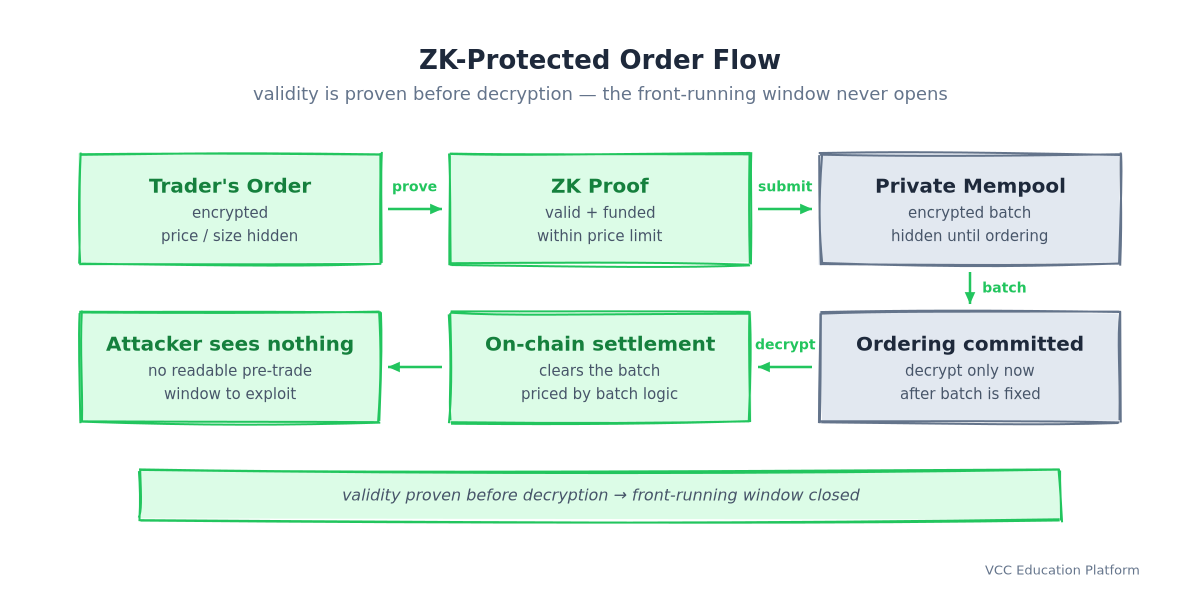
Figure 2: The ZK-protected order flow — validity is proven before decryption, so the front-running window never opens
How settlement works without revealing the order
For this to be practical, the on-chain verifier must check the proof against public inputs only. It reads the pool or contract address, the commitment to the price limit, and the fee payment -- and checks that the order's ciphertext is well-formed and bound to a funded account. It never needs the actual size or price, because what it verifies is the constraint: "this order, whatever its contents, respects its own limit and has the funds to settle." The plaintext is decrypted only after ordering is fixed, and settlement executes against a disclosed batch whose clearing logic prices the trades -- the attacker has no readable window into the pre-trade state.
Threshold decryption makes this work without a single trusted party. The decryption key is split across a committee, and no member can decrypt early. In F3B's per-transaction encryption design, the committee stakes and faces slashing for premature decryption, proving their decryption shares with NIZKs (non-interactive zero-knowledge proofs). DecryptChain goes further: a permissionless committee derived from proof-of-work reconstructs keys per batch, so there is no long-lived key to compromise. LUCID, proposed as EIP-8184 in March 2026, carries sealed transactions through Ethereum's existing public inclusion pipeline, hiding contents until after the scheduling decision is fixed, and deliberately leaves the encryption scheme open rather than enshrining one.
The honest engineering tradeoff: this protects pre-trade MEV -- front-running and sandwiching the pending order -- which is the attack retail traders actually face. It does not eliminate post-trade back-running on the revealed state, and a 2026 survey from Flashbots and Imperial College ("SoK: Encrypted Mempools") found that blind ordering can also suppress the auctions that return value to users, such as backrun rebates. Encryption also adds latency and cost: batching decryption mitigates but does not remove the overhead. The architecture deliberately trades a little throughput for the removal of the reading window -- not a free lunch.
What works in production today: privacy RPCs and intent auctions
Until an encrypted mempool ships on a mainstream chain, traders already have a trust-based on-ramp. Privacy RPCs (Flashbots Protect, MEV-Blocker, bloXroute, Blink, Polygon Private Mempool) route your transaction directly to a curated set of builders instead of the public mempool. Change one endpoint in your wallet and your swaps are front-running protected, with MEV-Blocker returning about 90% of backrun value as a rebate; in 2026, roughly 80% of DeFi transactions already bypass the public mempool. The catch is trust: you must trust the RPC operator and its builders not to leak or misroute your order.
Think of it as a three-generation privacy stack. Generation 1, private RPC: trust me -- a company promises not to leak your order. Generation 2, TEE builders: trust the chip -- Flashbots' BuilderNet (successor to the SUAVE chain, archived in May 2025) encrypts order flow at the hardware level using remote attestation. Generation 3, encrypted / ZK mempool: trust the math -- your order is hidden by cryptography regardless of which operator handles it. Vietnamese traders using MetaMask with PancakeSwap today are on generation 0 (fully public); a one-minute RPC switch moves them to generation 1. Large traders with whale-size orders should wait for generation 3, where even the operator cannot see the order.
Intent-based venues are the second production option. CoW Swap, 1inch Fusion, and UniswapX let you sign an intent (a goal, not a transaction) that solvers compete to execute off the public mempool. You never broadcast a pending order with your size and limit; the solver executes your intent with its own capital, so there is no pre-trade window for a sandwich bot. This is the closest mainstream UX to a ZK private order today, though the solver that sees your intent is itself a concentration point -- the debate SUAVE was designed to address.
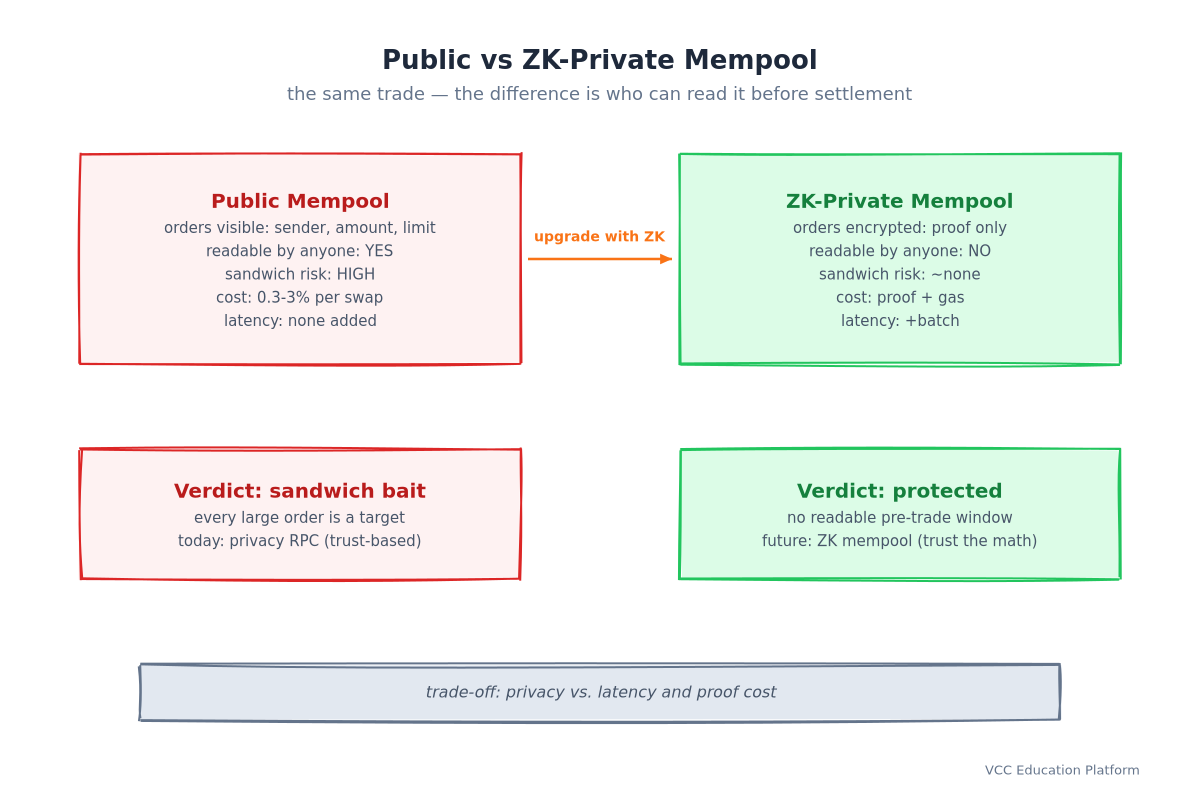
Figure 3: Public vs ZK-private mempool — the same trade, the difference is who can read it before settlement
What this means for Vietnamese traders
Vietnamese retail traders are concentrated exactly where the bots hunt: PancakeSwap on BSC and Uniswap on Ethereum, both accessed through wallets with default slippage settings of 3-5%. That default slippage is the attack surface -- sandwich bots size their front-run to sit just inside your minOut (minimum output), so your slippage tolerance literally sets their profit cap. Most Vietnamese users set high slippage to avoid failed swaps without knowing they are advertising how much damage a sandwich can do. When meme trading heats up, 15-25% of new pool transactions get sandwiched, and BSC's fast block times and thin liquidity make per-trade damage proportionally larger than on Ethereum.
Three practical protections every Vietnamese trader can apply today, in order of impact. First, use a protected RPC. In MetaMask, switch the network RPC to https://rpc.mevblocker.io or Flashbots Protect's https://rpc.flashbots.net/fast; the change is one setting and requires no code. Second, tighten slippage and split orders. A 0.5-1% slippage cap plus splitting large swaps into several smaller ones removes the profitability threshold most sandwich bots filter for. Third, route through an intent venue (CoW Swap, UniswapX) for orders over a few thousand dollars. Together these eliminate the majority of sandwich attacks a retail wallet experiences, at zero monetary cost.
The architectural fix changes the economics for everyone. Bảo vệ lệnh giao dịch defi via an encrypted mempool removes the need for individual vigilance: the order is hidden by default, so a novice trader setting 3% slippage is no longer an advertisement. Vietnam's regulatory conversation is currently about a fintech sandbox (Nghị định 94/2025/NĐ-CP) and investor protection, but private order flow is a technical protection layer that works regardless of regulation.
The road to an encrypted mempool on mainstream chains
Where does this land? The pieces exist and are moving in parallel. At the protocol level, EIP-8184 (LUCID) proposes a public encrypted-mempool pipeline that protects MEV-sensitive order flow while remaining compatible with FOCIL (EIP-7805). At the application level, Aztec runs fully private orders in production on its testnet, and intent venues already hide order details from the mempool today. At the trust level, privacy RPCs and TEE builders buy time while cryptographic designs mature. The 2026 SoK concludes that threshold-encrypted mempools have converged on four design axes -- batched decryption, silent setup, epochless encryption, and collision-free encoding -- and that the remaining open problems are incentive design, not basic cryptography.
The honest timeline: mainstream chains will likely ship a hybrid first -- private RPC or TEE-built blocks as the default for standard wallets, with an encrypted mempool for whale orders and MEV-sensitive applications. Full, default-on encrypted mempools face open questions about how blind ordering interacts with value-returning auctions, and how committees handle liveness without the public fallback reintroducing MEV. But the direction is clear: the reading window that made sandwich attacks possible is a design choice, not a law of physics, and ZK proofs can close it without sacrificing permissionless inclusion.
Frequently asked questions
Does hiding my order details eliminate front-running completely?
It eliminates pre-trade front-running and sandwiching -- the attack that targets the pending order itself -- because no one can read the order until after the ordering decision is committed. It does not eliminate post-trade back-running on the revealed state, nor MEV from other sources like liquidations. For a retail swap, pre-trade protection is the fix that matters; sophisticated traders still face post-trade exposure.Is a privacy RPC the same as a ZK encrypted mempool?
No. A privacy RPC (Flashbots Protect, MEV-Blocker) is a trust-based private channel: you trust the operator and its builders not to leak your order. A ZK encrypted mempool is a cryptographic private channel: the operator cannot read the order even if it wanted to, because price and size never leave your device until the batch is committed. Privacy RPCs are the on-ramp available today; encrypted mempools are the destination.How expensive is proving a private order?
On Aztec's Alpha V5, a fully private transfer proves in about 2.5 seconds on a consumer laptop and costs under $0.05. The proving cost is a per-transaction computation on your device plus an on-chain verification cost -- cheaper than the 0.3-3% sandwich tax most retail traders pay today. As proof systems improve (folding schemes, recursive proofs), both time and cost fall.What should I do as a Vietnamese trader right now?
Three things, in order: (1) switch your wallet RPC torpc.mevblocker.io or rpc.flashbots.net/fast; (2) cap slippage at 0.5-1% and split large orders; (3) route orders over a few thousand dollars through an intent venue like CoW Swap or UniswapX. These cost nothing, require no code, and remove the majority of sandwich attacks before any encrypted mempool ships.
How do privacy RPCs and ZK mempools relate to MEV-Blocker's rebates?
MEV-Blocker auctions your backrun value to searchers and returns about 90% of it as a rebate. That works because the operator can see and price your order -- a value-returning auction built on a private channel. A fully encrypted mempool suppresses such auctions along with toxic MEV, exactly the tradeoff the 2026 SoK highlights. You cannot have both invisible orders and backrun rebates from the same channel; the ecosystem will likely offer both, and traders will choose per trade.Will an encrypted mempool hurt decentralization?
It depends on the design. Committee-based decryption adds a layer that must stay censorship-resistant, and private order flow concentrates power in whoever can see it pre-inclusion (the concern SUAVE was designed to address). Designs like LUCID deliberately keep the pipeline public and permissionless and only hide contents, preserving inclusion guarantees. The open problem is incentive design -- ensuring the hidden-order layer does not become a new gatekeeper.Conclusion
Thanh's sandwich attack was not his fault and not his crypto wallet's fault: it was a property of the public mempool, where order contents are read permission granted to everyone. Chống front running zk reframes the problem. Instead of asking the trader to trade smaller and hope, it hides the order itself -- an encrypted order plus a zero-knowledge proof that lets the network validate, order, and settle the trade without ever seeing what is inside. The pre-trade reading window closes, and the attacker has nothing to react to. Commit-reveal was hide-and-hope; ZK mempool privacy is hide-and-prove. The technology runs in production on Aztec, the research has converged on concrete design axes, and the on-ramp -- privacy RPCs and intent venues -- already exists. Vietnamese traders do not need to wait for the final protocol upgrade: the fix for the invisible tax is one RPC setting, one slippage cap, and an honest explanation of what the mempool actually is. The reading window is closing, and the sandwich tax is a design choice that ZK proofs are well positioned to retire.
Quick Reference
| Property | Public Mempool | ZK-Private Mempool |
|---|---|---|
| Order contents | Visible to all nodes and bots | Encrypted; price/size hidden until batch commit |
| Read permission | Any node operator | None until decryption |
| Sandwich risk | 0.3-3% per swap (up to 40-60% during meme pumps) | ~none pre-trade |
| Validity check | None needed (public) | ZK proof: funded + within limit |
| Extra latency | None | +batching delay |
| Extra cost | None (the tax is the attack) | Prover time (~2.5s on a laptop) + gas |
| Trust model | None (open) | Cryptographic + decryption committee |
| Today's proxy | Standard wallet RPC | Privacy RPC (generation 1), TEE builders (2), encrypted mempool (3) |
| Key standard | Mempool default | EIP-8184 (LUCID), EIP-8209 (commit-reveal), Aztec |
| Best fit | Small orders, low MEV sensitivity | Whale orders, MEV-sensitive DeFi, full privacy |