
Flash loan mechanisms represent the most radical departure from traditional finance in all of DeFi. In TradFi, an unsecured loan of $100 million requires months of due diligence, credit committees, legal contracts, and collateral — or it simply doesn't exist. In DeFi, you can borrow $100 million with zero collateral, zero credit check, and zero KYC — provided you repay it within the same blockchain transaction. If you don't, the entire transaction rewinds as if it never happened. This is not a bug. It's the defining feature of flash loan mechanisms: atomic, single-transaction, unsecured lending that exists only for the ~12 seconds of an Ethereum block.
This article dissects the technical machinery behind flash loans, maps the economic boundaries that make them profitable (or not), catalogs the attack vectors they enable, and provides defense patterns for protocol builders — all with Vietnamese DeFi context woven throughout.
What Makes a Flash Loan "Flash": Atomic Execution Guarantees
The word "flash" doesn't refer to speed — it refers to atomicity. In computer science, an atomic operation either completes fully or not at all; there is no intermediate state. Flash loans leverage the EVM's transaction semantics: every state change in a transaction is tentative until the transaction commits. If any operation reverts, the EVM rolls back all state changes — including token transfers that happened at the start of the transaction.
The Callback Pattern
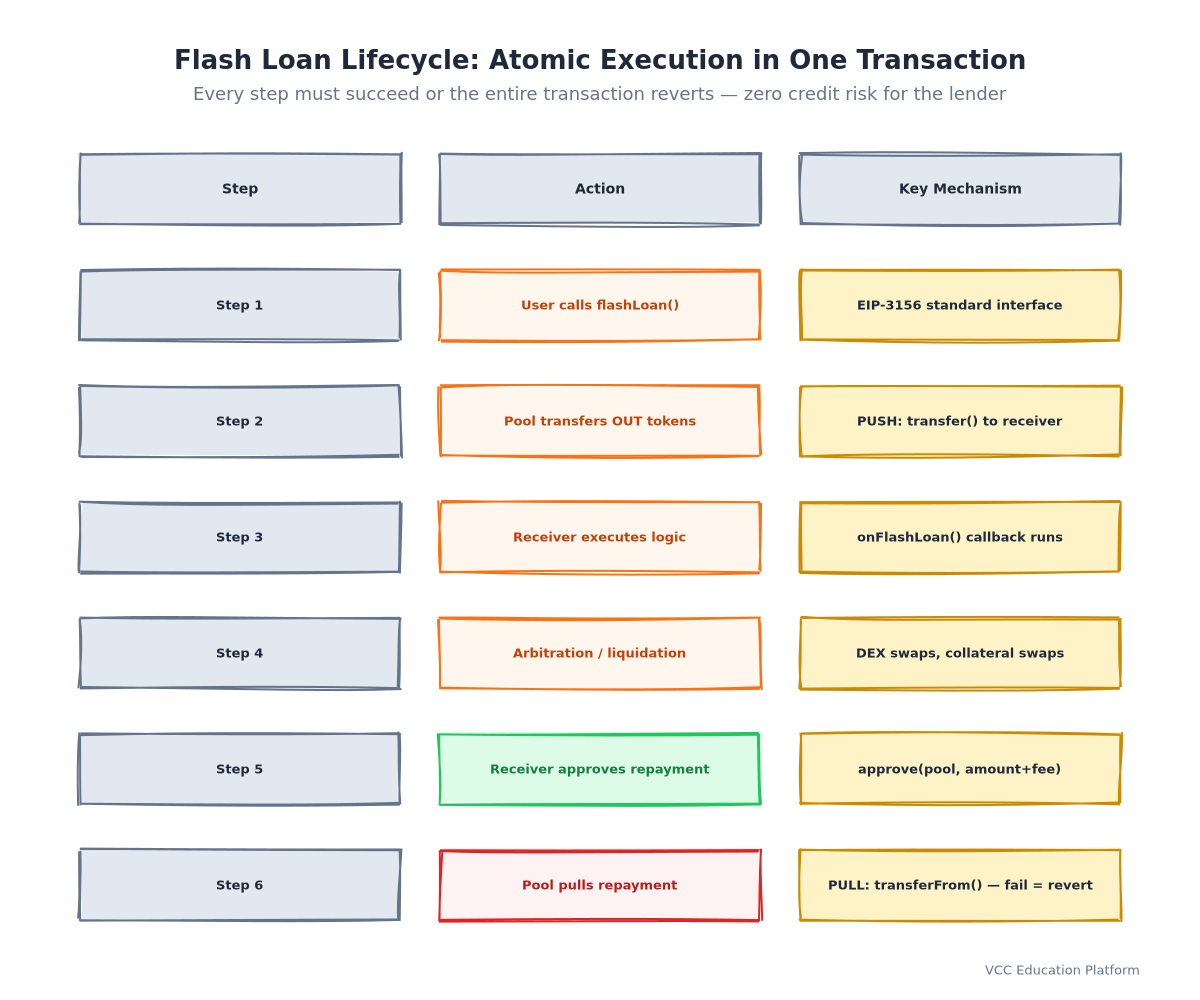
Every flash loan provider implements the same core pattern:
- Validation: Verify receiver implements the callback interface, check loan limits
- Transfer Out: Send borrowed tokens to the receiver contract (state: receiver balance +loan)
- Callback: Call
receiver.onFlashLoan(...)— this executes the borrower's arbitrary logic - Verification: After callback returns, check that receiver approved repayment + fee
- Pull Repayment: Transfer tokens back from receiver to pool (state: receiver balance -loan-fee)
- Finalize: Update reserves, emit events
`solidity // Simplified Aave v3 Pool.flashLoan logic function flashLoan( address receiver, address[] calldata assets, uint256[] calldata amounts, // ... other params ) external nonReentrant { // 1. Transfer assets TO receiver for (uint i = 0; i < assets.length; i++) { IERC20(assets[i]).safeTransfer(receiver, amounts[i]); }
// 2. Execute borrower logic via callback IFlashLoanReceiver(receiver).onFlashLoan( assets, amounts, premiums, initiator, params );
// 3. Verify and PULL repayment + fee FROM receiver for (uint i = 0; i < assets.length; i++) { uint256 totalDue = amounts[i] + premiums[i]; IERC20(assets[i]).safeTransferFrom(receiver, address(this), totalDue); } } `
Critical insight: The protocol pushes tokens out (step 1) but pulls them back (step 3). The push uses transfer (no approval needed). The pull uses transferFrom — which requires the receiver to have approved the pool during the callback. If the receiver doesn't approve, step 3 reverts, triggering a full rollback. The lender never trusts the borrower; the smart contract enforces repayment.
EIP-3156: The Flash Loan Standard
EIP-3156 standardized this interface across protocols. Any contract implementing IERC3156FlashBorrower can borrow from any IERC3156FlashLender:
`solidity interface IERC3156FlashBorrower { function onFlashLoan( address initiator, address token, uint256 amount, uint256 fee, bytes calldata data ) external returns (bytes32); // Must return keccak256("ERC3156FlashBorrower.onFlashLoan") } `
Adopters: Aave v3, Balancer Vault, Uniswap V3 (via wrapper), Radiant Capital, Morpho Blue, Euler v2. This standardization enables flash loan aggregators that route to the cheapest provider per asset.
The Economics of Zero-Collateral Borrowing
Why would a protocol lend millions with zero collateral? Because the lender's risk is mathematically near-zero. The only ways the lender loses:
- Smart contract bug in the pool itself (audit surface)
- Oracle failure during the transaction causing bad debt accounting
- Reentrancy in the pool's own callback handling (mitigated by
nonReentrant)
There is no credit risk because the borrower cannot walk away with the money — the EVM prevents it.
Fee Structure Across Providers
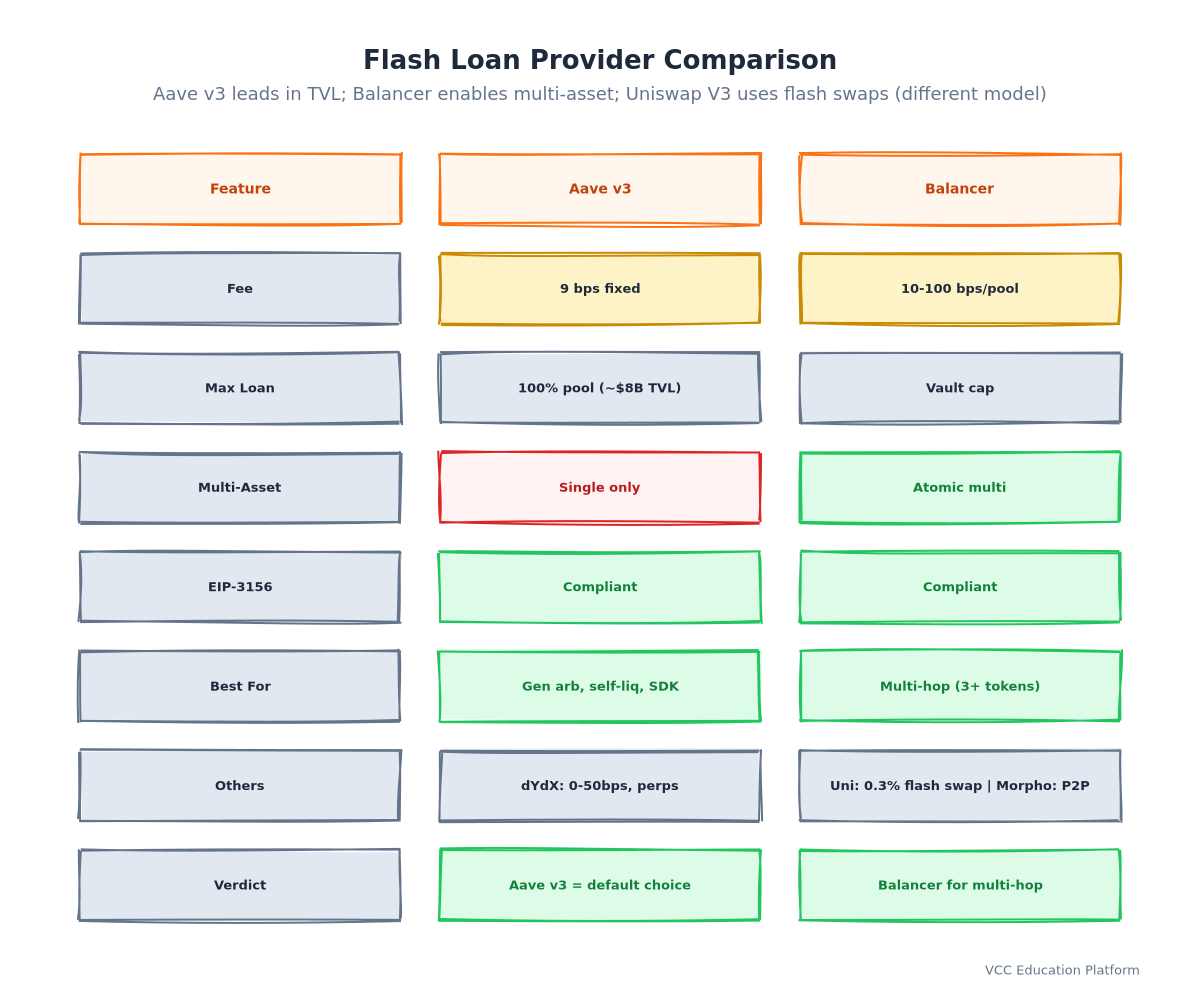
| Provider | Fee Model | Typical Rate | Notes |
|---|---|---|---|
| Aave v3 | Fixed bps on principal | 9 bps (0.09%) | Governance adjustable; was 0% at launch |
| dYdX Solo | Variable per market | 0-50 bps | Depends on utilization; isolated margin |
| Balancer Vault | Fixed per pool | 0-100 bps | Set at pool creation; multi-asset loans |
| Uniswap V3 | Flash swap fee | 0.3% on output | Not a pure loan — you pay fee on output token |
| Morpho Blue | Peer-to-peer | Market-determined | Flash loan from P2P lenders, not pool |
Profitability Boundary
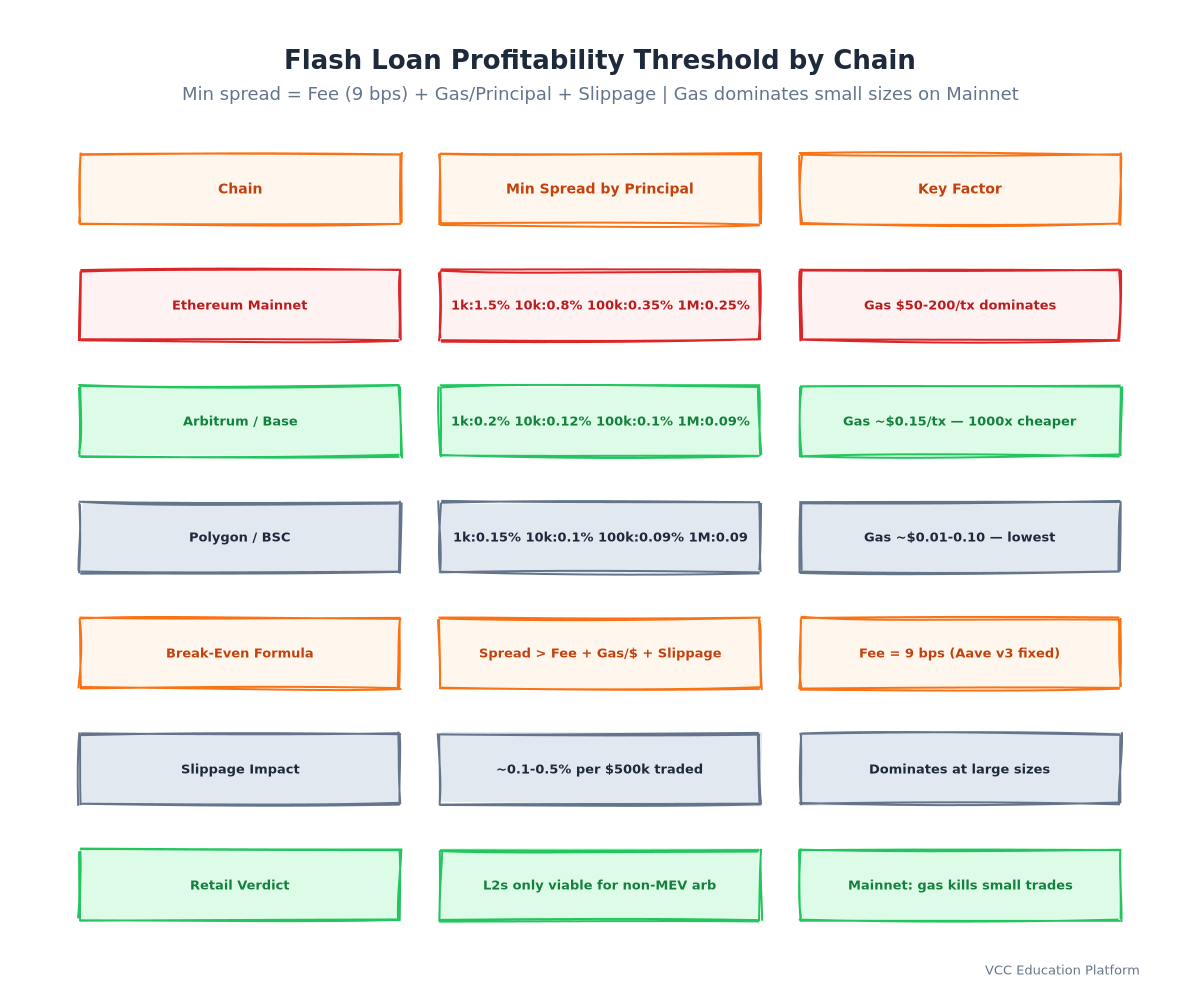
A flash loan is profitable iff:
` Revenue_from_Strategy > Fee + Gas_Cost + Slippage_Impact `
Concrete Example — DEX Arbitrage on Arbitrum:
- Flash loan: $500,000 USDC
- Aave fee (9 bps): $450
- Gas (Arbitrum): ~$0.15
- Slippage on $500k trade (0.2%): $1,000
- Total cost: ~$1,450
- Required spread: > 0.29%
On Ethereum mainnet, gas alone ($50-200) pushes the threshold to >0.3-0.4%. This is why L2 flash loans (Arbitrum, Optimism, Base, Polygon) are the only viable venue for non-MEV retail arbitrage.
Major Flash Loan Providers Compared
Aave v3 — The Market Leader
- TVL: ~$8B+ across networks (Ethereum, Arbitrum, Optimism, Polygon, Base, Avalanche)
- Fee: 9 bps fixed (governance adjustable)
- Features:
- Efficiency Mode (eMode): Higher LTV for correlated assets (e.g., stablecoins, ETH/LSTs)
- Isolation Mode: New assets with capped borrow limits
- Portal: Cross-chain flash loans via CCIP (experimental)
- Max Loan: Up to 100% of pool liquidity per asset
- Integration: EIP-3156 compliant, extensive SDK support
dYdX Solo Margin — Order Book Native
- Model: Not a pool — uses dYdX's order book + isolated margin
- Fee: Dynamic based on market utilization
- Unique: Flash loans can interact with perpetuals positions (basis trading)
- Limitation: Only on dYdX Chain (formerly Ethereum via StarkEx)
Balancer Vault — Multi-Asset Flash Loans
- Unique Feature: Borrow multiple tokens in a single flash loan
- Use Case: Multi-hop arb requiring 3+ tokens simultaneously
- Fee: Per-pool, set at creation (typically 10-100 bps)
- Math: Vault calculates proportional exit amounts for multi-token loans
Uniswap V3 Flash Swaps — Not Quite Flash Loans
- Mechanism: Receive output tokens first, pay input tokens after callback
- Fee: 0.3% (or pool tier fee) on output amount
- Difference: You don't specify input amount — you specify output wanted
- Best For: Exact-output scenarios (repay exact debt amount)
Core Use Cases: Arbitrage, Liquidation, Refinancing
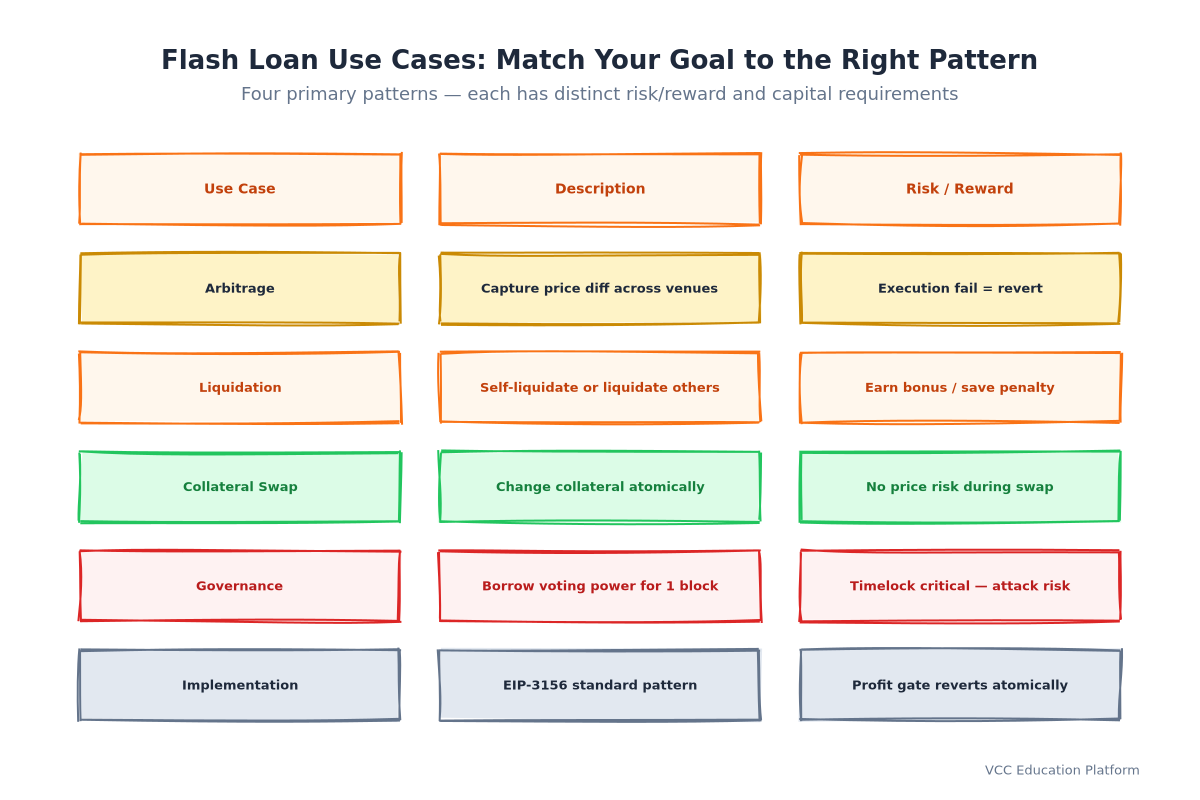
1. DEX Arbitrage (The Original Use Case)
Triangular Arb: Token A → Token B → Token C → Token A (all in one tx) Cross-DEX Arb: Buy on Uniswap, sell on SushiSwap (or Curve, Balancer) Cross-Chain Arb: Requires atomic cross-chain execution (not yet production-ready)
`solidity // Minimal triangular arb callback function onFlashLoan( address initiator, address token, uint256 amount, uint256 fee, bytes calldata data ) external returns (bytes32) { // Decode path: [USDC, WETH, DAI, USDC] address[] memory path = abi.decode(data, (address[]));
// Execute swaps uint256 balanceBefore = IERC20(token).balanceOf(address(this)); for (uint i = 0; i < path.length - 1; i++) { ISwapRouter(router).exactInputSingle({ tokenIn: path[i], tokenOut: path[i+1], fee: 3000, recipient: address(this), amountIn: (i == 0) ? amount : IERC20(path[i]).balanceOf(address(this)), amountOutMinimum: 0, sqrtPriceLimitX96: 0 }); }
// Approve repayment uint256 profit = IERC20(token).balanceOf(address(this)) - balanceBefore; require(profit >= fee, "Unprofitable"); IERC20(token).approve(address(msg.sender), amount + fee);
return keccak256("ERC3156FlashBorrower.onFlashLoan"); } `
2. Self-Liquidation (Avoid Liquidation Penalty)
Scenario: Your Aave position has health factor 1.02 — close to liquidation. Liquidation penalty = 5-10% of collateral.
Flash Loan Solution:
- Flash loan the debt asset (e.g., $100k USDC)
- Repay your borrow → position health factor → ∞ (no debt)
- Withdraw collateral (e.g., $150k WETH)
- Sell $100k WETH for USDC on DEX
- Repay flash loan + fee
- Keep remaining collateral — saved 5-10% penalty
Math: If penalty = 7.5% on $150k collateral = $11,250 saved. Flash loan fee (9 bps on $100k) = $90. Gas = $50. Net savings: ~$11,110.
3. Collateral Swap (Change Collateral Without Closing)
Scenario: You borrowed USDC against WETH. You want to switch to WBTC collateral (e.g., for yield farming on another protocol).
Traditional Way: Repay USDC → withdraw WETH → sell WETH for WBTC → deposit WBTC → reborrow USDC. 4-5 transactions, 4-5x gas, price risk between steps.
Flash Loan Way: Single transaction:
- Flash loan USDC (debt amount)
- Repay borrow → withdraw WETH
- Swap WETH → WBTC
- Deposit WBTC → reborrow USDC
- Repay flash loan
Result: Atomic, no price risk, 1x gas.
4. Governance Voting Power (The Beanstalk Vector)
Mechanism: Flash loan governance tokens → delegate to self → vote on proposal → undelegate → repay.
Legitimate Use: DAO treasury management — borrow voting power to pass emergency proposal. Attack Vector: Borrow 2/3 voting power → pass malicious proposal (drain treasury) → repay.
Defense: Governance timelocks (voting power snapshot at proposal creation), vote delegation cooldowns, flash loan detection in governance modules.
Attack Vectors: When Flash Loans Become Weapons
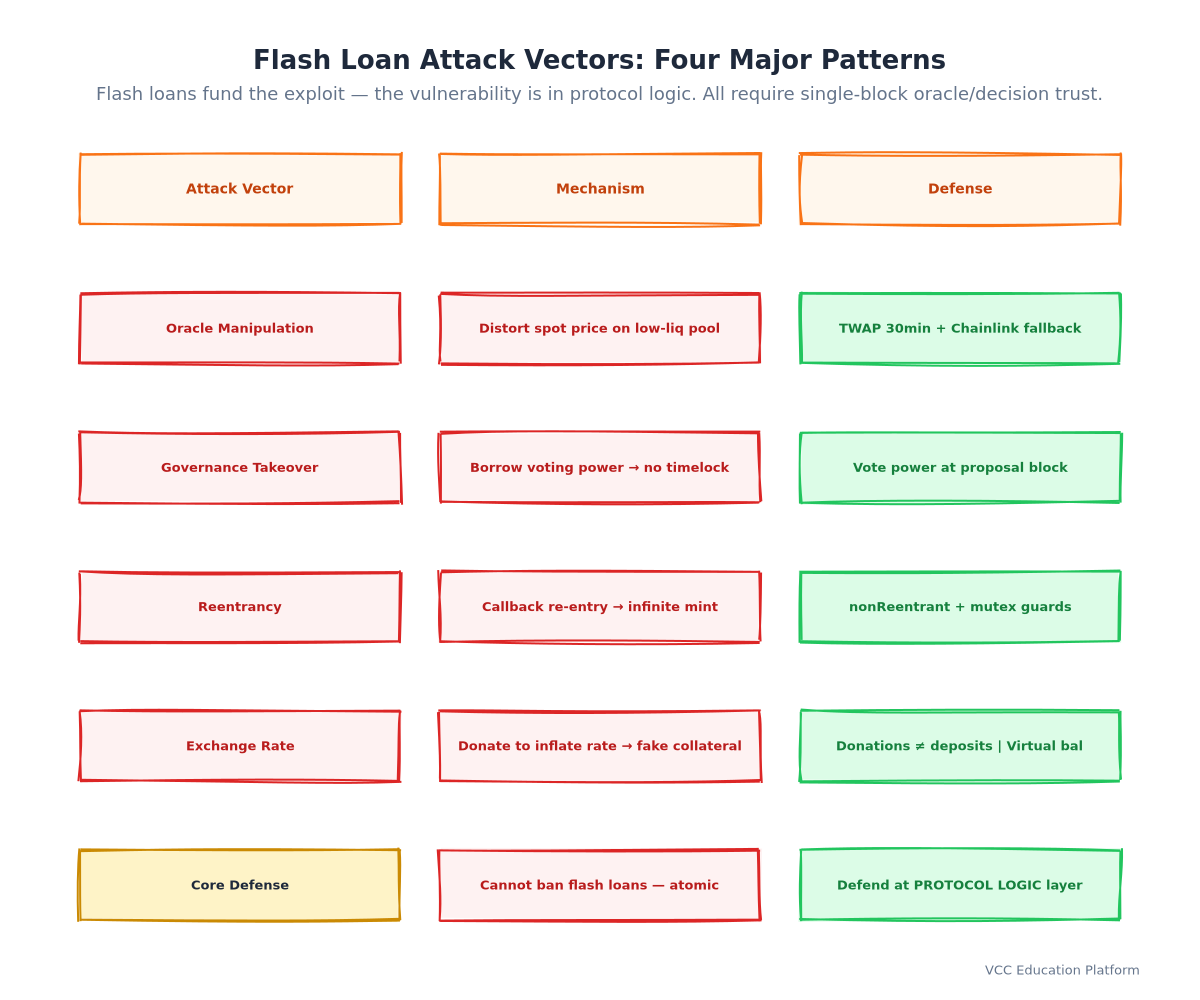
Flash loans don't create vulnerabilities — they fund them. Every major "flash loan attack" is actually a protocol vulnerability that existed before; the flash loan just provided the capital to exploit it profitably.
1. Price Oracle Manipulation (The #1 Vector)
Pattern: Flash loan → manipulate spot price on low-liquidity pool → protocol reads manipulated price → exploit.
bZx (Feb 2020) — The First Major Attack:
- Borrowed 10,000 ETH via dYdX flash loan
- 5,500 ETH → short ETH on bZx (using Kyber/Uniswap as oracle)
- 4,500 ETH → dump ETH on Uniswap → crash ETH price 30% on-chain
- bZx oracle reads crashed price → allows undercollateralized WBTC borrow
- Attacker profits ~$350k (after repaying flash loan)
Lesson: Never use spot price as oracle. Use TWAP with window > 30 minutes, or Chainlink + TWAP hybrid.
2. Governance Takeover (Beanstalk, April 2022)
- Flash loan $1B+ BEAN/ETH/USDC
- Deposit into Beanstalk Silo → receive 2/3+ voting power (Stalk)
- Propose BIP-18: "Transfer all protocol assets to attacker"
- Vote yes with flash-loaned stake → passes (no timelock!)
- Execute → drain ~$76M → repay flash loan
Lesson: Governance must snapshot voting power at proposal creation, not execution. Timelocks are non-negotiable.
3. Reentrancy via Callback (PancakeBunny, May 2021)
- Flash loan $200M BNB
- Manipulate BUNNY/USDT pool price via massive swap
- Call
getReward()on Bunny minter → mints BUNNY at inflated price - Reenter via flash loan callback → repeat
- Dump BUNNY → price crashes 95% → protocol insolvent
Lesson: ReentrancyGuard on the borrower's callback, not just the lender. Checks-Effects-Interactions in all reward logic.
4. Exchange Rate Manipulation (Euler, March 2023)
- Flash loan ~$200M DAI/USDC
- "Donate" to Euler markets → inflate
exchangeRate(totalAssets/totalShares) - Borrow against inflated collateral value
- Drain ~$197M → repay flash loan
Lesson: Donations must not affect exchange rate. Use totalAssets() excluding donations, or virtual balance accounting.
5. Cascading Liquidations
Flash loan → trigger liquidation of large position → liquidator sells collateral → price drops → triggers more liquidations → protocol bad debt. The flash loan funds the initial liquidation that starts the cascade.
Defense Patterns: Building Flash-Loan-Resistant Protocols
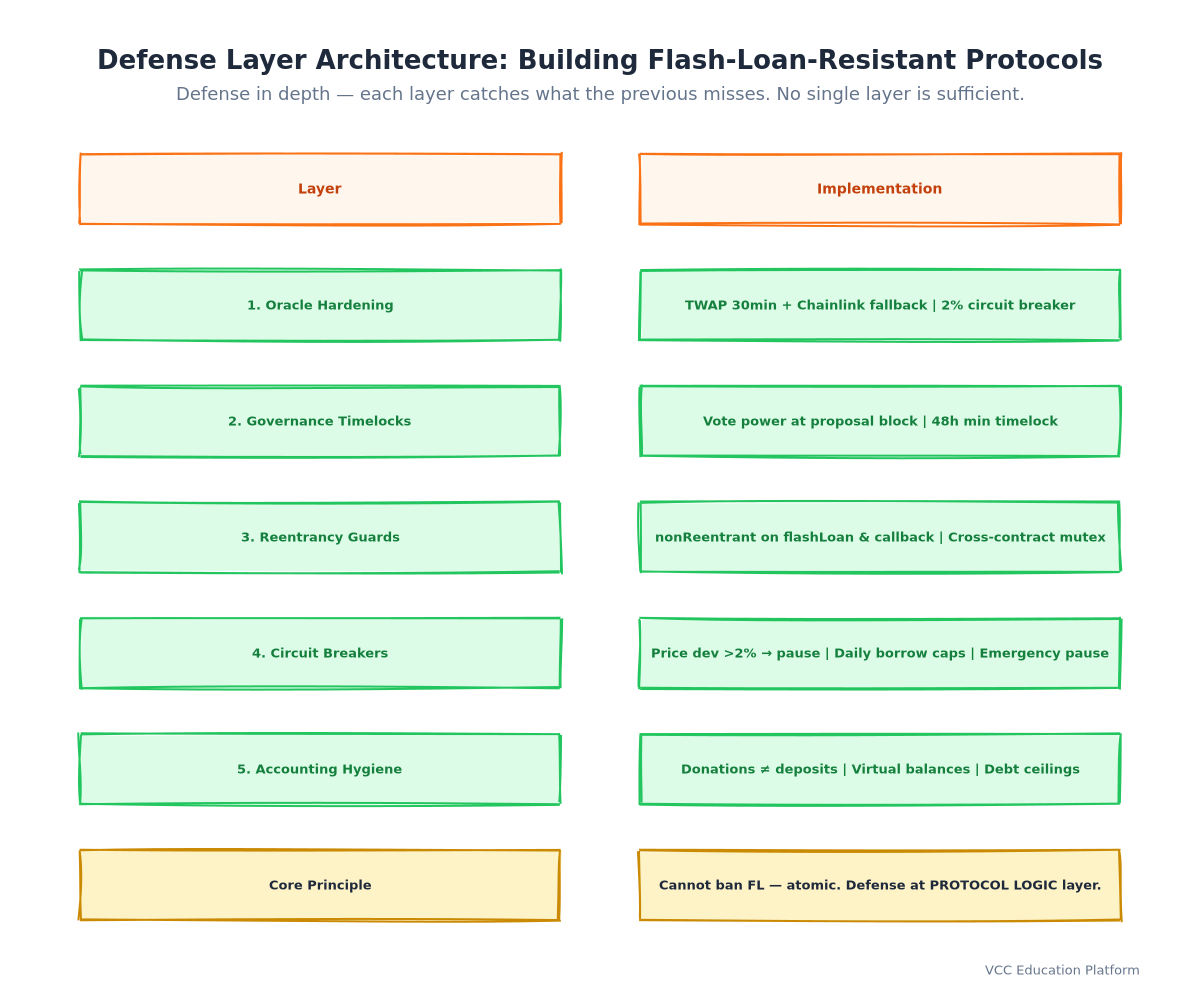
You cannot prevent flash loans. You can make your protocol unprofitable to attack with them.
Layer 1: Oracle Hardening
`solidity // ❌ VULNERABLE: Spot price function getPrice() external view returns (uint256) { return IUniswapV3Pool(pool).slot0().sqrtPriceX96; }
// ✅ ROBUST: TWAP with 30-min window + Chainlink fallback function getPrice() external view returns (uint256) { (uint256 twap, ) = OracleLibrary.getTWAP(pool, 30 minutes); uint256 chainlink = ChainlinkFeed.latestAnswer();
// Deviation check: if TWAP deviates > 2% from Chainlink, use Chainlink if (Math.abs(twap - chainlink) > chainlink * 2 / 100) { return chainlink; } return twap; } `
Rule: Any price used for collateral valuation, liquidation, or minting must be manipulation-resistant. Minimum 30-min TWAP. Maximum 2% deviation from trusted feed triggers circuit breaker.
Layer 2: Governance Timelocks & Snapshots
`solidity // Proposal creation snapshots voting power function propose(...) external { uint256 snapshotBlock = block.number; // or block.timestamp proposal.votingPowerSnapshot = snapshotBlock; // ... }
// Vote execution checks snapshot function execute(...) external { require(block.number > proposal.votingPowerSnapshot + VOTING_DELAY); // Voting power = balanceAt(snapshotBlock), NOT balanceAt(now) } `
Rule: Voting power = token balance at proposal creation block. No flash loan can change history.
Layer 3: Reentrancy Protection (Both Sides)
`solidity // Lender side (Aave pattern) function flashLoan(...) external nonReentrant { ... }
// Borrower side — YOUR callback contract MyFlashLoanReceiver is ReentrancyGuard { function onFlashLoan(...) external nonReentrant returns (bytes32) { // All external calls here are protected // But: nonReentrant only protects THIS contract! // Cross-contract reentrancy still possible. } } `
Advanced: For cross-contract reentrancy, use a global mutex (e.g., ReentrancyGuard on a shared library) or pull payments only — never make external calls while holding unlocked state.
Layer 4: Circuit Breakers & Pause Mechanisms
`solidity contract CircuitBreaker { uint256 public constant MAX_PRICE_DEVIATION_BPS = 200; // 2% uint256 public constant MAX_DAILY_BORROW = 1000000 * 1e18; // $1M
mapping(address => uint256) dailyBorrowed;
modifier notPaused() { require(!paused, "Paused"); _; }
modifier priceCheck(uint256 newPrice, uint256 referencePrice) { uint256 deviation = (newPrice > referencePrice) ? newPrice - referencePrice : referencePrice - newPrice; require(deviation 10000 <= referencePrice MAX_PRICE_DEVIATION_BPS, "Price deviation"); _; } } `
Layer 5: Accounting Hygiene
- Donations ≠ Deposits: Track external balance increases separately from user deposits
- Virtual Balances: For share-based accounting (Aave aTokens, Compound cTokens), compute exchange rate from protocol-owned assets only
- Debt Ceilings: Per-asset borrow caps limit maximum flash loan size
Building with Flash Loans: Developer Patterns
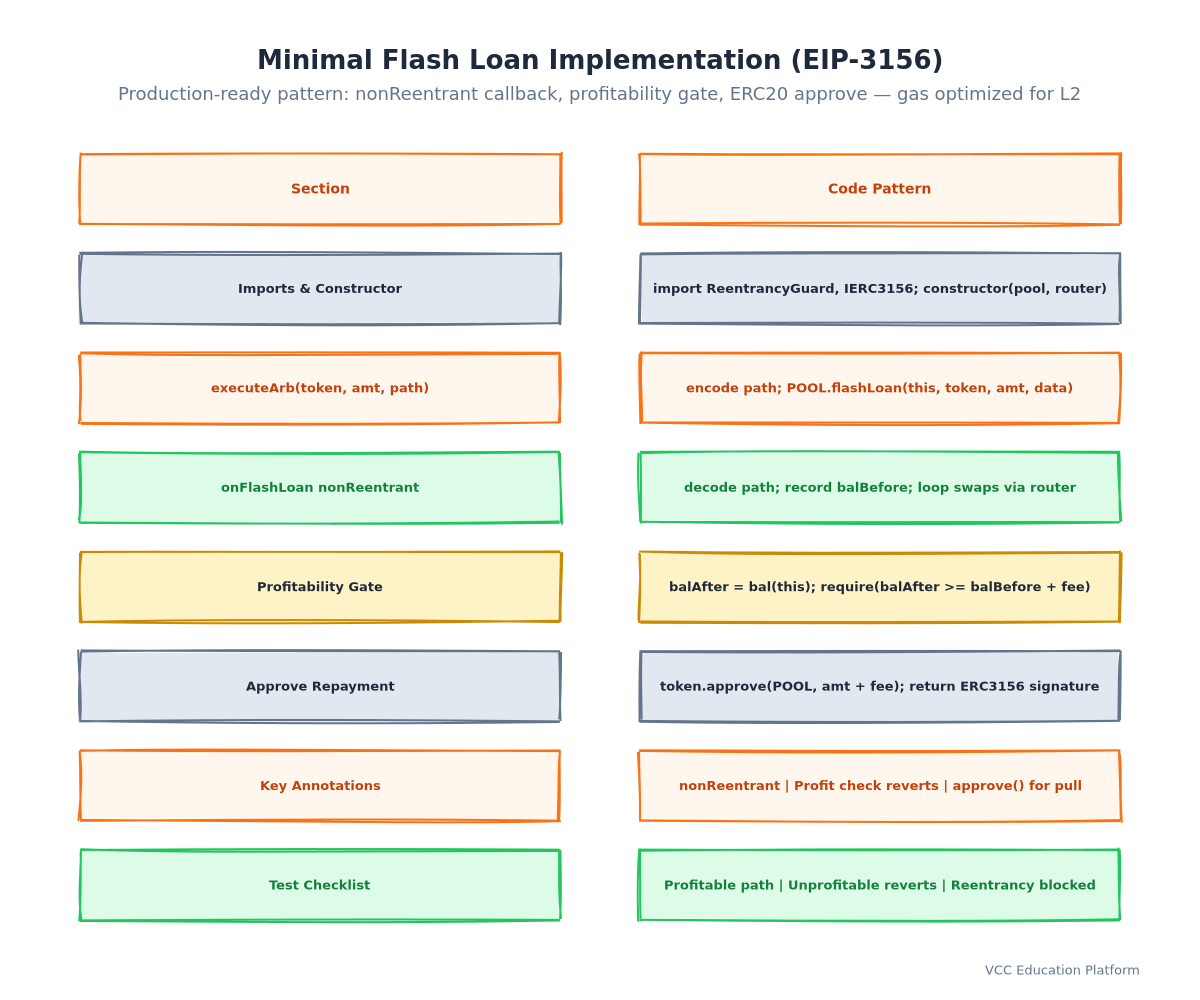
Minimal EIP-3156 Implementation
`solidity // SPDX-License-Identifier: MIT pragma solidity ^0.8.20;
import "@openzeppelin/contracts/security/ReentrancyGuard.sol"; import "./IERC3156FlashBorrower.sol";
contract FlashLoanArb is ReentrancyGuard, IERC3156FlashBorrower { address public immutable POOL; address public immutable ROUTER;
constructor(address _pool, address _router) { POOL = _pool; ROUTER = _router; }
function executeArb( address token, uint256 amount, address[] calldata path ) external { bytes memory data = abi.encode(path); IERC3156FlashLender(POOL).flashLoan(address(this), token, amount, data); }
function onFlashLoan( address initiator, address token, uint256 amount, uint256 fee, bytes calldata data ) external nonReentrant returns (bytes32) { address[] memory path = abi.decode(data, (address[]));
// Execute swaps uint256 balanceBefore = IERC20(token).balanceOf(address(this)); for (uint i = 0; i < path.length - 1; i++) { uint256 amountIn = (i == 0) ? amount : IERC20(path[i]).balanceOf(address(this)); ISwapRouter(ROUTER).exactInputSingle({ tokenIn: path[i], tokenOut: path[i+1], fee: 3000, recipient: address(this), amountIn: amountIn, amountOutMinimum: 0, sqrtPriceLimitX96: 0 }); }
// Verify profitability uint256 balanceAfter = IERC20(token).balanceOf(address(this)); require(balanceAfter >= balanceBefore + fee, "Unprofitable");
// Approve repayment IERC20(token).approve(POOL, amount + fee);
return keccak256("ERC3156FlashBorrower.onFlashLoan"); } } `
Gas Optimization Tips
- Minimize callback logic — every opcode costs gas. Do heavy math off-chain, pass parameters in
data. - Use
exactInputSinglenotexactOutputSingle— cheaper for known-input arb. - Batch approvals — approve max once in constructor, not per flash loan.
- Avoid storage writes in callback — use memory/stack only. Storage writes = 20k gas each.
- Test on fork —
forge test --fork-url $MAINNET_RPC --match-test testFlashLoanArb
Testing Checklist
- [ ] Profitable path: arb executes, repays, keeps profit
- [ ] Unprofitable path: reverts, no state change, gas wasted
- [ ] Reentrancy attempt: callback reenters pool → blocked by
nonReentrant - [ ] Cross-contract reentrancy: callback calls malicious contract → malicious calls back → blocked?
- [ ] Fee change: governance changes fee → contract still works (fee passed in callback)
- [ ] Token with fee-on-transfer: USDT, PAXG → use
balanceOfdelta notamount
Vietnamese Context: VND Arbitrage & Regulatory View
The VND/USDT Spread Opportunity
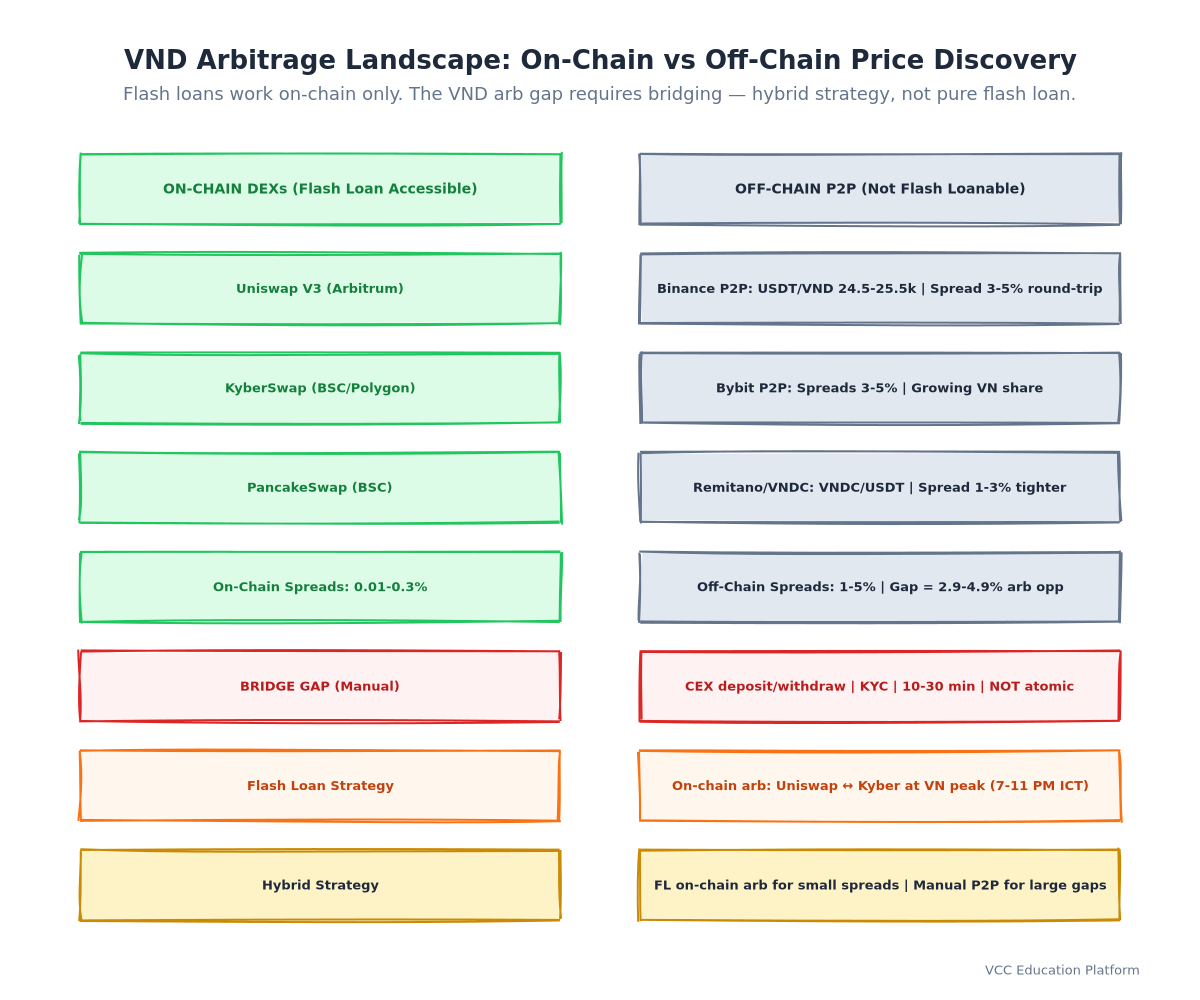
Vietnam's P2P markets create persistent spreads:
| Platform | Buy Spread (USDT→VND) | Sell Spread (VND→USDT) | Round-Trip |
|---|---|---|---|
| Binance P2P | 1.5-2.5% | 1.5-2.5% | 3-5% |
| Bybit P2P | 1.5-2.5% | 1.5-2.5% | 3-5% |
| Remitano (VNDC) | 0.5-1.5% | 0.5-1.5% | 1-3% |
| Local OTC (HCMC/Hanoi) | 2-3% | 2-3% | 4-6% |
The Arb: On-chain DEX (Uniswap V3, KyberSwap) USDT/USDC ≈ 1:1. Off-chain P2P USDT/VND = 24,500-25,500. If you can bridge on-chain USDT → off-chain VND → on-chain USDT in one atomic loop, you capture the spread.
Problem: P2P is off-chain. Flash loans are on-chain. You cannot flash loan into Binance P2P.
Real Opportunity: Cross-DEX arb on Vietnamese on-chain liquidity:
- KyberSwap (BSC/Polygon) has VNDC/USDT pools
- Uniswap V3 (Arbitrum) has USDC/USDT pools
- Price discrepancy between VN-focused DEXs and global DEXs during high VN trading hours (7-11 PM ICT)
Regulatory Landscape
Current Status (2026):
- SBV Circular 03/2024: Crypto = not legal tender. Banks = prohibited from crypto services.
- DeFi Usage: Not explicitly regulated. Users operate in legal grey zone.
- Flash Loans Specifically: No specific guidance. Treated as "smart contract interaction."
Tax Implications (Unsettled):
- View A (Capital Gains, 20% flat): Flash loan arb = investment. Profit taxed at 20% on VND gain. Favors low-frequency, high-conviction trades.
- View B (Business Income, 5-35% progressive): High-frequency flash loan arb = "business." Every profitable tx = taxable event. Compliance nightmare.
Practical Approach for VN Users:
- Document everything: Tx hash, timestamps, USD/VND values, gas costs
- Use vaults/aggregators (Yearn, Beefy) — fewer taxable events (internal harvests)
- Separate wallets: "Investment" (long-hold) vs "Trading" (flash loan arb)
- Consult crypto-literate tax advisor — standard VN accountants don't know DeFi
Tết Seasonality & Flash Loans
- Pre-Tết (2-3 weeks): Massive USDT sell pressure → P2P spreads widen to 5-8%. On-chain VN DEX liquidity drops (users withdraw to cash). Flash loan arb margins ↑ but slippage ↑↑
- Tết Week: Markets quiet. Some protocols pause incentives. Gas lowest.
- Post-Tết: Cash returns. Spreads normalize. New capital enters.
Strategy: Avoid locking flash loan strategies with long-vesting components (e.g., governance voting) pre-Tết. Keep dry powder (USDC on Arbitrum) for post-Tết deployments.
FAQ: Flash Loan Mechanisms
Q1: Can I lose money on a flash loan if my strategy fails? No — if your strategy fails (doesn't generate enough to repay principal + fee), the transaction reverts. You only lose the gas fee for the failed transaction. On Ethereum mainnet: $50-200. On Arbitrum: ~$0.15. The flash loan principal is never at risk.
Q2: Why don't flash loan providers require collateral? Because the EVM guarantees atomic rollback. The provider transfers tokens conditionally — the condition is "you repay within this same transaction." If you don't, the transfer never happened. It's not trust; it's enforcement by the execution environment.
Q3: What's the difference between a flash loan and a flash swap?
- Flash Loan (Aave, dYdX): You specify input (borrow 1000 USDC), repay same token + fee.
- Flash Swap (Uniswap V3): You specify output (receive 1 WETH), pay input token + fee after callback. More flexible for exact-output needs (e.g., repay exact debt).
Q4: Can I use flash loans on Bitcoin? Not natively — Bitcoin lacks smart contract callbacks. However, BitVM and RGB protocols are researching trust-minimized bridges that could enable BTC-locked flash loans on sidechains. On Lightning Network: no, because Lightning payments are not atomic with complex logic.
Q5: Are flash loans only for whales? Capital-wise: no minimum (you can flash loan $10). Gas-wise: on Ethereum mainnet, gas costs make sub-$10k loans unprofitable for most strategies. On Arbitrum/Polygon/Base: viable from $500-1,000. The barrier is technical (writing the callback contract), not financial.
Q6: How do I protect my protocol from flash loan attacks?
- Use TWAP oracles (30+ min window) for all valuation
- Snapshot governance voting power at proposal creation
- Apply ReentrancyGuard to ALL external-facing functions
- Implement circuit breakers (max price deviation, daily caps, pause)
- Audit donation accounting — donations must not inflate exchange rates
- Assume attacker has infinite capital for one transaction
Q7: What's the largest flash loan ever executed? Beanstalk (April 2022): ~$1B+ in BEAN/ETH/USDC to acquire 2/3 voting power. Euler (March 2023): ~$200M DAI/USDC for exchange rate manipulation. Typical MEV arb: $1-50M range. Retail: usually <$100k.
Q8: Can flash loans be used for money laundering? Theoretically yes — atomic transactions leave no on-chain trace of the intermediate steps (only the net result). However: (a) flash loan providers emit events logging loan amounts, (b) the callback contract is visible, (c) MEV relays see all bundles. Regulators treat flash loan transactions as any other DeFi interaction — traceable via standard chain analysis.
Conclusion: The Atomic Primitive That Changed DeFi
Flash loan mechanisms didn't just add a new lending product — they changed the threat model of every DeFi protocol. Before flash loans, protocol designers assumed "attacker needs capital." After flash loans, that assumption is false: anyone has access to effectively infinite capital for exactly one transaction.
This forces a fundamental shift in protocol design:
- Oracles must be manipulation-resistant by design, not by obscurity
- Governance must assume voting power can be rented for one block
- Accounting must distinguish protocol-owned vs. donated assets
- Reentrancy is not a "bug" — it's an expected interaction pattern
For Vietnamese DeFi users, flash loans remain a high-barrier, high-reward tool. The technical complexity (Solidity, gas optimization, MEV competition) filters out most retail users. But on L2s (Arbitrum, Base, Polygon), the economics work for $1,000+ positions. The VND arb opportunity exists but requires bridging on-chain/off-chain — a hybrid strategy, not pure flash loan.
The future: Cross-chain flash loans (ERC-7683 + CCIP/LayerZero), standardized attack detection (FlashLoanShield), and flash-loan-native protocol designs (Morpho Blue's P2P model). The primitive is here to stay; the question is whether your protocol survives it.
Diagram - Flash Loan Ecosystem Map: Center = "Flash Loan Primitive (Atomic Execution)". 4 quadrants:
This article is for educational purposes only and does not constitute financial, tax, or legal advice. Flash loan strategies involve smart contract risk, market risk, gas risk, and regulatory risk. Past performance does not indicate future results. Always do your own research and consult qualified professionals for your specific situation. The author holds no position in mentioned protocols at time of writing.