
A flash loan attack defi scenario begins with a simple premise: borrow millions of dollars without collateral, manipulate a market, and repay the loan—all in the span of a single blockchain transaction. In traditional finance, this is impossible. In DeFi, it happens weekly. Since 2020, flash loan exploits have drained over $1.2 billion from protocols, with the largest single attack (Euler Finance, March 2023) netting $197 million. If you build, invest in, or govern DeFi protocols, understanding this attack vector is not optional—it is survival.
This article dissects the mechanics, the most damaging real-world cases, and the defense strategies that actually work. We write for developers, auditors, and protocol designers who need actionable depth, not surface-level summaries.
What Is a Flash Loan?
A flash loan is an uncollateralized loan that must be borrowed and repaid within a single transaction. If the borrower cannot repay the full amount plus fees by the end of that transaction, the entire operation reverts—as if it never happened.
Key properties:
- No collateral required — The protocol only checks that liquidity returns before the transaction ends
- Atomic execution — Borrow, manipulate, repay all happen in one block; no intermediate state persists
- Massive scale — Attackers routinely borrow $50M–$500M+ from lending pools like Aave, dYdX, or Uniswap
- Low barrier — Only gas fees (~$50–$500 on Ethereum; pennies on BSC, Polygon, Arbitrum) are at risk
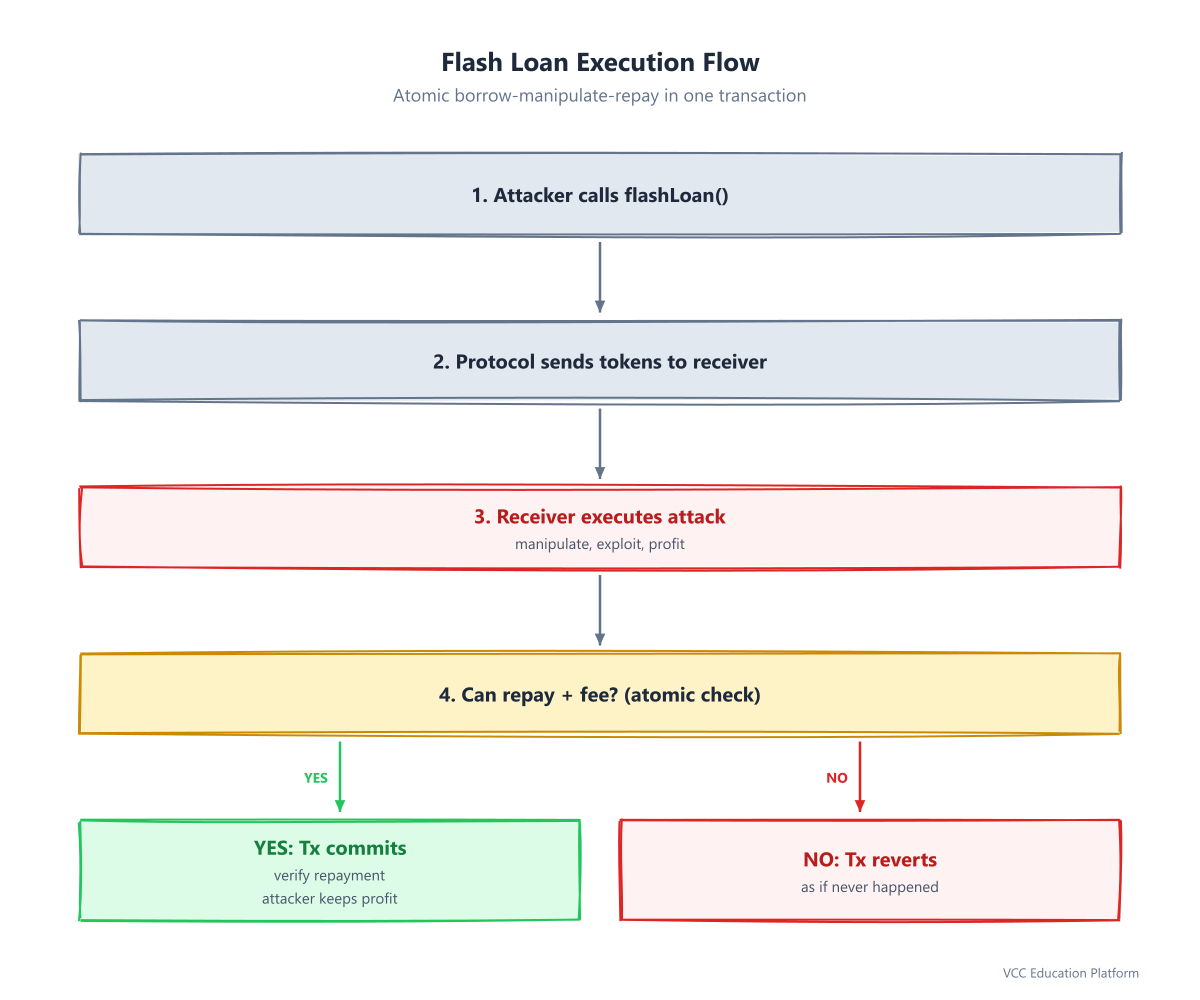 The concept originated with Marble Protocol (2018) and was popularized by Aave (2020) and dYdX. Legitimate uses include arbitrage, collateral swapping, and liquidation protection. But the same properties that make flash loans useful for DeFi efficiency also make them devastating attack weapons.
Why Flash Loans Change the Economics of Attacks
In traditional finance, attacking a market requires capital. To manipulate a stock price, you need millions to buy shares. To corner a commodity market, you need physical inventory or futures contracts. The capital requirement creates a natural filter: only well-funded actors can attempt large-scale manipulation.
Flash loans remove this filter entirely.
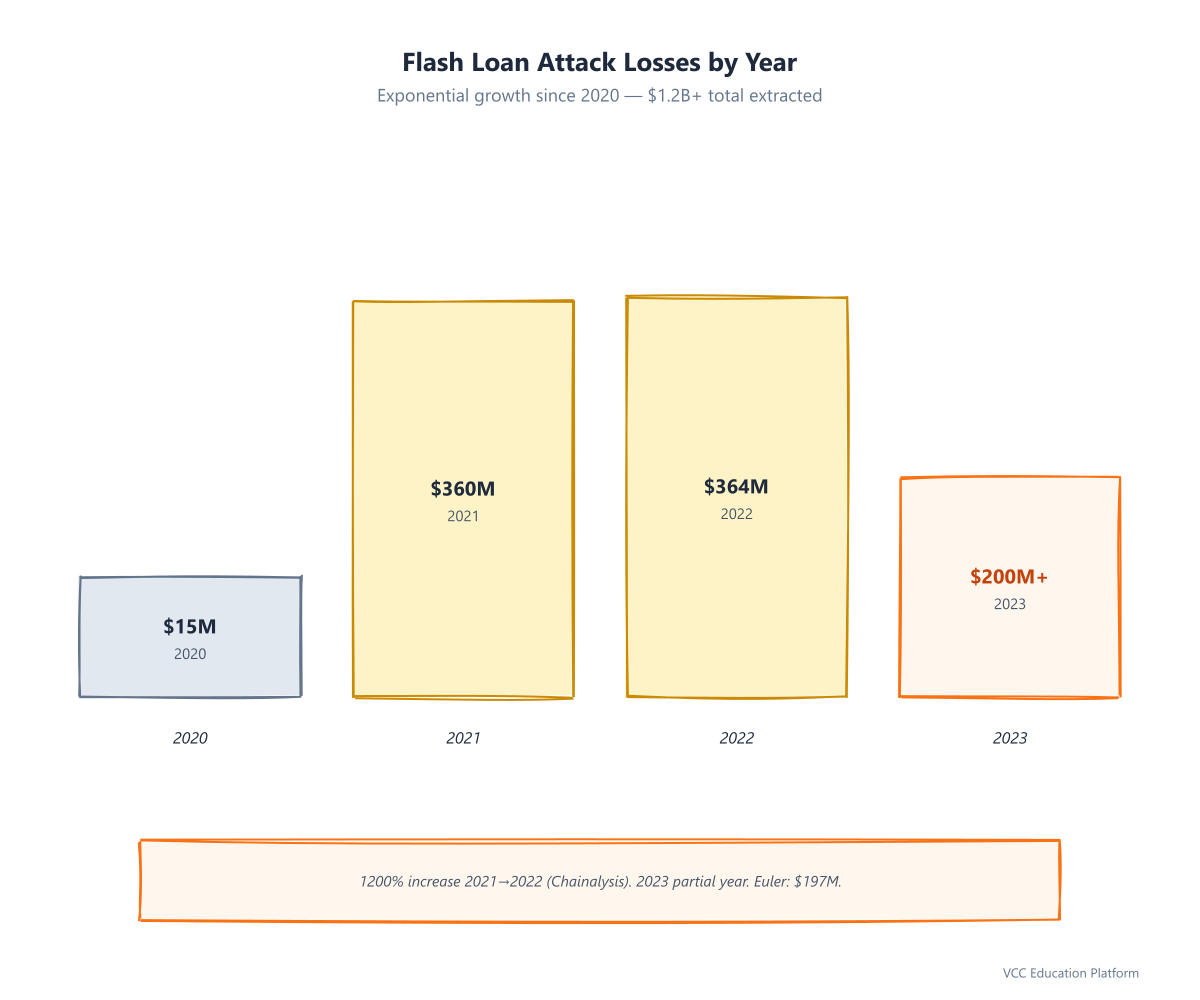
An attacker with $100 in gas money can temporarily control $500 million in liquidity. The risk is asymmetric: lose $100 in gas if the attack fails; gain millions if it succeeds. This asymmetry has triggered an explosion of attacks:
| Year | Flash Loan Attack Losses | Notable Incidents |
|---|---|---|
| 2020 | ~$15M | bZx (Feb), Harvest Finance (Oct) |
| 2021 | ~$360M | PancakeBunny (May), Cream Finance (Oct), Alpha Finance (Feb) |
| 2022 | ~$364M | Beanstalk (Apr), Mango Markets (Oct), Euler (pre-exploit activity) |
| 2023 | ~$200M+ | Euler Finance (Mar), hundreds of smaller exploits |
Source: Chainalysis Crypto Crime Reports 2021–2023, CertiK quarterly reports
The Three Primary Attack Vectors
Through analysis of 47 major flash loan attacks (CertiK 2023 dataset), three patterns account for over 85% of incidents:
1. Oracle Manipulation (66% of attacks)
The most common vector. Protocols rely on price oracles to value collateral, calculate rewards, or trigger liquidations. If an oracle reads a price that can be manipulated in a single block, a flash loan attacker can distort that price, exploit the protocol's logic, and profit.
How it works:
- Identify a protocol using a vulnerable oracle (typically a single-DEX TWAP with a short window, or a spot price from a low-liquidity pool)
- Flash loan a large amount of Token A
- Swap Token A → Token B on the DEX that feeds the oracle, drastically shifting the reported price
- The protocol reads the manipulated price
- Attacker exploits the protocol: borrows against inflated collateral, mints excessive rewards, or triggers bad-debt liquidations
- Reverse the swap (or abandon the position if unprofitable), repay the flash loan, keep the profit
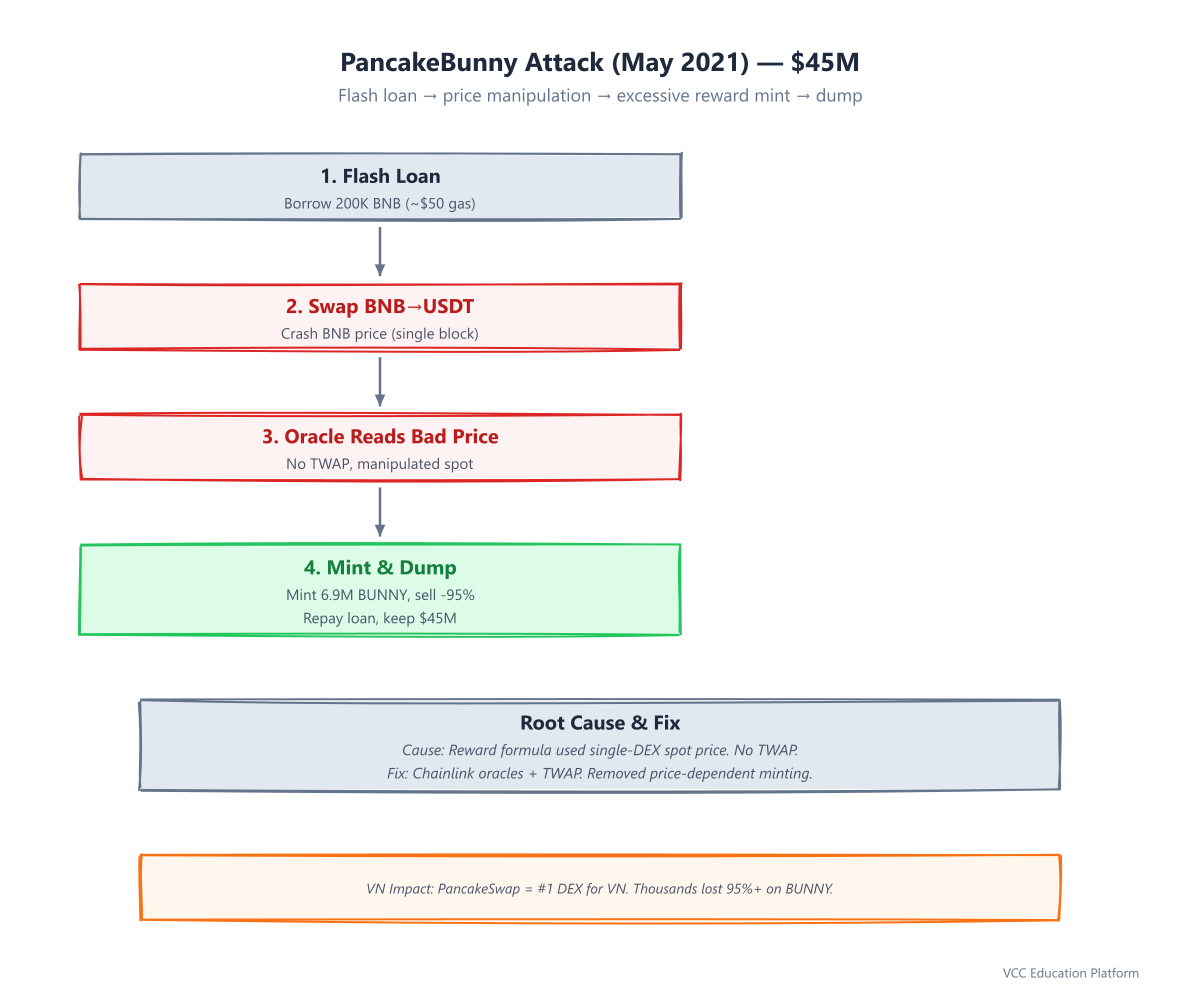
Real example — PancakeBunny (May 2021, $45M): The protocol calculated BUNNY token rewards based on the BNB/USDT price from PancakeSwap V2. The attacker flash-loaned 200,000 BNB, swapped it to USDT on PancakeSwap V2 (crashing BNB price), then used the artificially low BNB price to mint 6.9M BUNNY tokens as "rewards." They dumped the BUNNY, repaid the loan, and walked away with $45M.
2. Governance Takeover (Emerging, High Impact)
Governance tokens represent voting power. If voting power can be acquired instantly via flash loan, an attacker can propose and execute malicious changes in a single block.
How it works:
- Flash loan the governance token (or the underlying asset to mint it)
- Delegate voting power to the attacker's address
- Submit a malicious proposal (e.g., "transfer all protocol funds to attacker")
- Vote "yes" with the flash-loaned voting power
- If no timelock exists, execute immediately
- Return tokens, repay flash loan
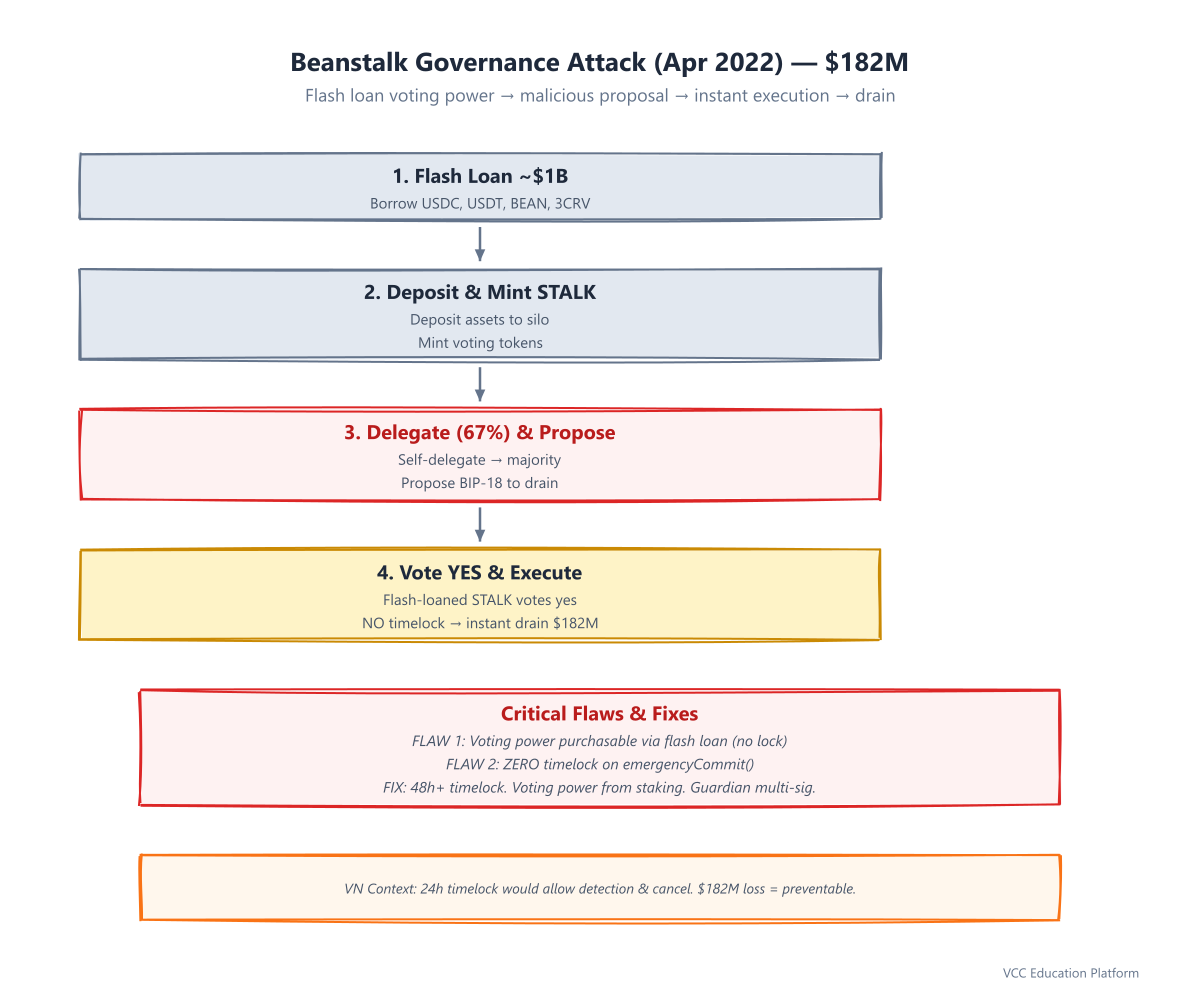
Real example — Beanstalk Farms (April 2022, $182M): Beanstalk's governance token (STALK) was earned by depositing assets. The attacker flash-loaned ~$1B in assets (USDC, USDT, BEAN, etc.), deposited them to mint STALK, delegated to themselves, proposed BIP-18 (a malicious "emergency commit" that drained the protocol), voted yes with 67% of voting power, and executed. The protocol had no timelock on emergency proposals. Total loss: $182M.
3. Logic Exploits Amplified by Flash Loans (Not Pure Oracle Manipulation)
Some attacks exploit smart contract logic bugs that require large capital to trigger. Flash loans provide that capital instantly.
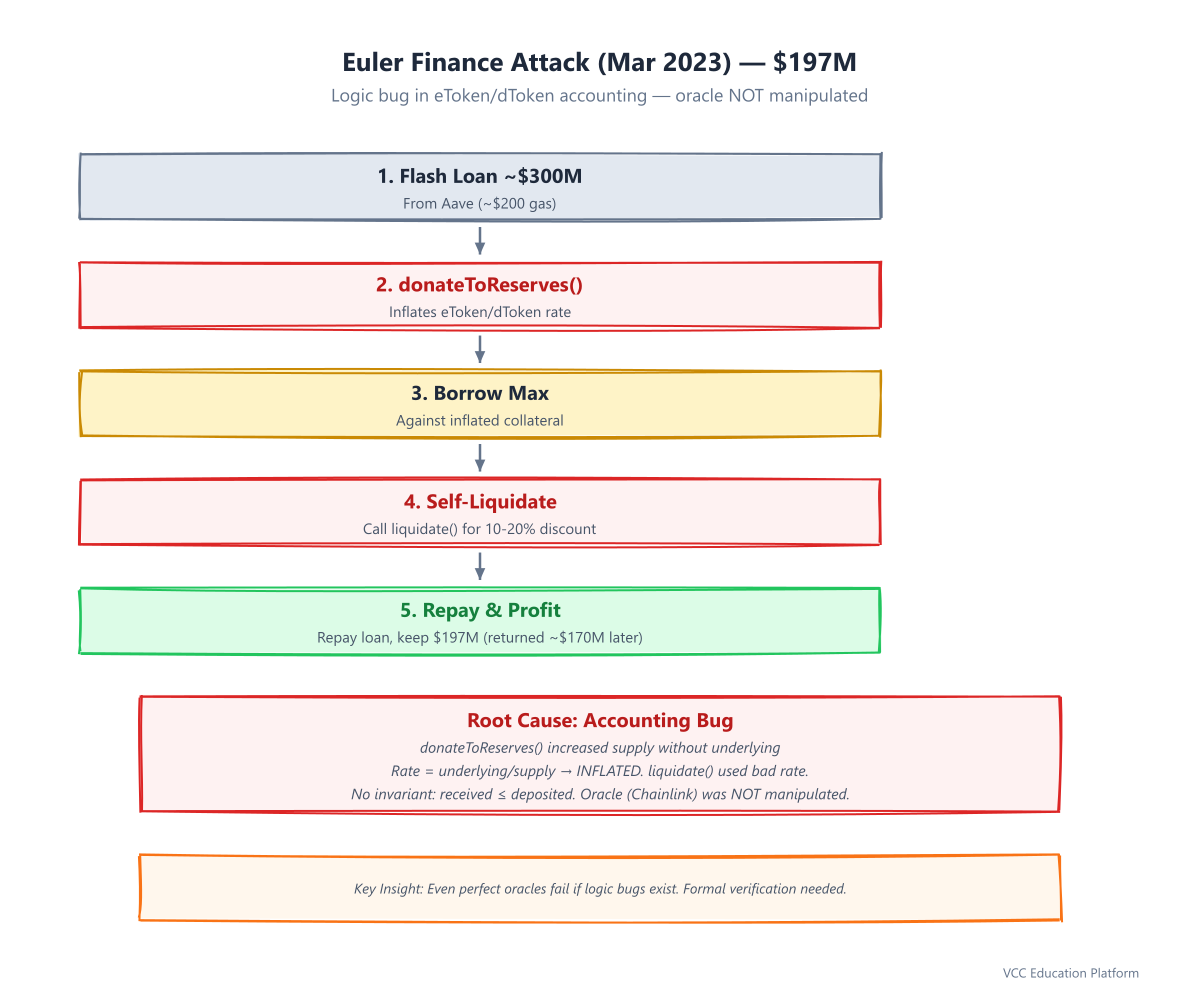
Real example — Euler Finance (March 2023, $197M): Euler used a dual-token system (eTokens for deposits, dTokens for borrows). A logic error in donateToReserves allowed an attacker to manipulate the eToken/dToken exchange rate. The attacker flash-loaned ~$300M, donated to reserves to inflate the exchange rate, then triggered liquidations at the manipulated rate to claim discounted collateral. The oracle was not the primary vulnerability—the token accounting logic was.
Case Study Deep Dives
PancakeBunny (BSC, May 2021) — $45M
| Aspect | Detail |
|---|---|
| Vulnerable Component | Reward calculation using PancakeSwap V2 spot price |
| Oracle Type | Single DEX pair (BNB/USDT), no TWAP |
| Attacker Capital at Risk | ~$50 gas (BSC fees) |
| Profit | ~$45M (BUNNY tokens dumped) |
| Root Cause | Reward formula used instantaneous price; no manipulation resistance |
| Fix Applied | Migrated to Chainlink oracles; added TWAP for reward calculations |
Vietnam Context: PancakeSwap is the dominant DEX for Vietnamese DeFi users on BSC. This attack directly impacted thousands of local yield farmers. Coin98 Wallet users holding BUNNY saw 95%+ value loss in hours.
Cream Finance (Ethereum, Oct 2021 & Feb 2022) — $164M Combined
| Attack | Vector | Loss |
|---|---|---|
| Oct 2021 | yUSD price manipulation on Curve → inflated collateral → borrow | $130M |
| Feb 2022 | AMPL rebase manipulation → exploit lending market accounting | $34M |
Key Lesson: Cream listed low-liquidity assets (yUSD, AMPL) as collateral with oracles tied to single DEX pools. The protocol failed to enforce asset-specific oracle requirements or collateral caps.
Beanstalk Farms (Ethereum, April 2022) — $182M
| Aspect | Detail |
|---|---|
| Vulnerable Component | Governance voting + emergency execution |
| Governance Token | STALK (earned via deposits) |
| Attacker Capital at Risk | ~$50 gas (Ethereum mainnet) |
| Profit | $182M (entire protocol treasury) |
| Root Cause | 1) Voting power purchasable via flash loan 2) No timelock on emergencyCommit |
| Fix Applied | Protocol paused; funds partially recovered via negotiation; redesign required |
Vietnam Context: Beanstalk had Vietnamese community members farming BEAN/3CRV. The attack highlighted risks of "yield farming governance tokens" without understanding governance attack vectors.
Euler Finance (Ethereum, March 2023) — $197M
| Aspect | Detail |
|---|---|
| Vulnerable Component | donateToReserves + liquidate interaction |
| Oracle | Chainlink (not manipulated) |
| Attacker Capital at Risk | ~$200 gas |
| Profit | $197M (various assets) |
| Root Cause | Accounting logic error in dual-token system; insufficient invariant testing |
| Fix Applied | Protocol paused; attacker returned ~$170M after negotiation; full rewrite |
Unique Insight: Euler proves that even with robust oracles, flash loans can amplify logic bugs. The attack did not manipulate prices—it manipulated internal accounting state. This expands the threat model beyond oracle defense.
Defense Strategies: What Actually Works
Defenses operate at three layers. No single layer is sufficient; defense-in-depth is mandatory.
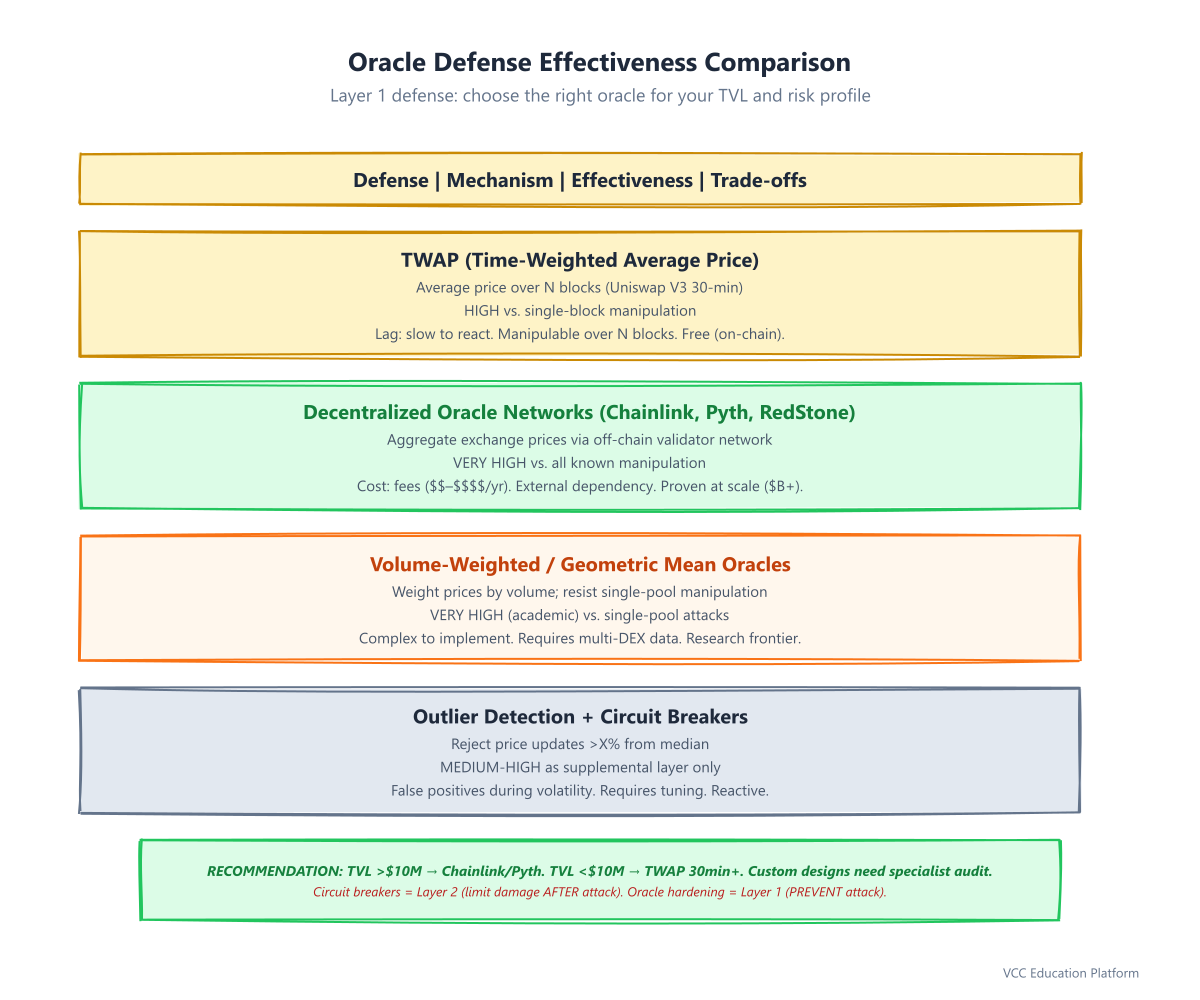
Layer 1: Oracle Hardening (Most Critical)
| Defense | Mechanism | Effectiveness | Trade-offs |
|---|---|---|---|
| TWAP (Time-Weighted Average Price) | Average price over N blocks (e.g., Uniswap V3 30-min TWAP) | High vs. single-block manipulation | Lag: reacts slowly to genuine price moves; manipulable over N blocks if attacker sustains |
| Decentralized Oracle Networks | Chainlink, Pyth, RedStone — aggregate multiple sources | Very High | Cost: subscription fees; dependency on external network |
| Volume-Weighted / Geometric Mean | Weight prices by volume; resist single-pool manipulation | Very High (academic) | Complex to implement; requires multi-DEX data |
| Outlier Detection / Circuit Breakers | Reject price updates deviating >X% from median | Medium-High | False positives during genuine volatility; requires tuning |
Recommendation: For any protocol securing >$10M TVL, decentralized oracle networks (Chainlink/Pyth) are the baseline. TWAP is a minimum for smaller protocols. Custom oracle designs (geometric mean, volume-weighted) should be audited by specialists.
Layer 2: Protocol-Level Circuit Breakers
| Mechanism | Description | Implementation |
|---|---|---|
| Pause Guardian | Multi-sig or governance can pause deposits/borrows/withdrawals | OpenZeppelin Pausable; 2-of-3 or 3-of-5 multi-sig |
| Position/Exposure Limits | Cap max borrow per asset, per user, per block | Dynamic limits based on liquidity depth |
| Rate Limiting | Max $X borrowed per block per user | Prevents single-block drain even if oracle fails |
| Emergency Shutdown | MakerDAO-style: freeze protocol, allow orderly exit | Governance vote required; nuclear option |
Critical: Circuit breakers are reactive. They limit damage after an attack starts. They do not prevent the attack. Oracle hardening (Layer 1) is preventative.
Layer 3: Governance Attack Prevention
| Defense | Why It Works |
|---|---|
| Timelocks (48h+) | Attacker cannot execute immediately; community can detect and respond |
| Non-Financial Voting Power | Voting power from reputation, staking duration, or contributions—not just token balance |
| Quorum + Supermajority | Require broad participation; flash loan voters alone cannot pass |
| Proposal Cancellation | Guardian multi-sig can cancel malicious proposals during timelock |
Beanstalk Lesson: A 24-hour timelock on emergencyCommit would have allowed the community to detect BIP-18 and cancel it. The $182M loss was entirely preventable with a basic governance timelock.
Layer 4: Economic Defenses (Emerging)
These make attacks unprofitable rather than impossible:
- Dynamic Borrow Fees: Fee scales with utilization and position size. A $100M flash loan pays $500k+ in fees—exceeding most attack profits.
- MEV-Protected Execution: Commit-reveal or threshold encryption for sensitive operations (liquidations, governance votes).
- Profit-Sharing with Protocol: Redirect a portion of flash loan fees to an insurance fund that covers attack losses.
Research Gap: Economic defenses are theoretically sound but battle-tested implementations are rare. This is the frontier of flash loan defense.
Building a Flash Loan Resistant Protocol: Checklist
If you are designing or auditing a DeFi protocol, run through this checklist:
Oracle & Pricing
- [ ] No protocol logic depends on a single-DEX spot price
- [ ] All collateral assets priced via decentralized oracle network (Chainlink/Pyth) OR battle-tested TWAP (30min+ window)
- [ ] Low-liquidity assets have custom oracle solutions or are rejected as collateral
- [ ] Price updates have sanity checks (max % change per block, circuit breakers)
Governance
- [ ] All critical functions (fund movement, parameter changes, upgrades) behind 48h+ timelock
- [ ] Voting power not instantly acquirable via flash loan (staking locks, reputation, or delegated voting)
- [ ] Emergency guardian multi-sig can cancel proposals during timelock
- [ ] Quorum requirements prevent low-participation attacks
Protocol Limits
- [ ] Per-asset borrow caps based on on-chain liquidity depth
- [ ] Per-user position limits (dynamic, not static)
- [ ] Per-block action limits (max liquidations, max borrows)
- [ ] Pause mechanism controlled by reputable multi-sig
Testing & Monitoring
- [ ] Flash loan attack simulations in CI/CD (fork mainnet, simulate attacks)
- [ ] Invariant testing: "Total assets ≥ total liabilities" holds under all flash loan scenarios
- [ ] Real-time monitoring: large flash loans, oracle deviations, governance proposals
- [ ] Incident response plan: who pauses, how to communicate, recovery procedures
Vietnamese DeFi Context: What Local Users Need to Know
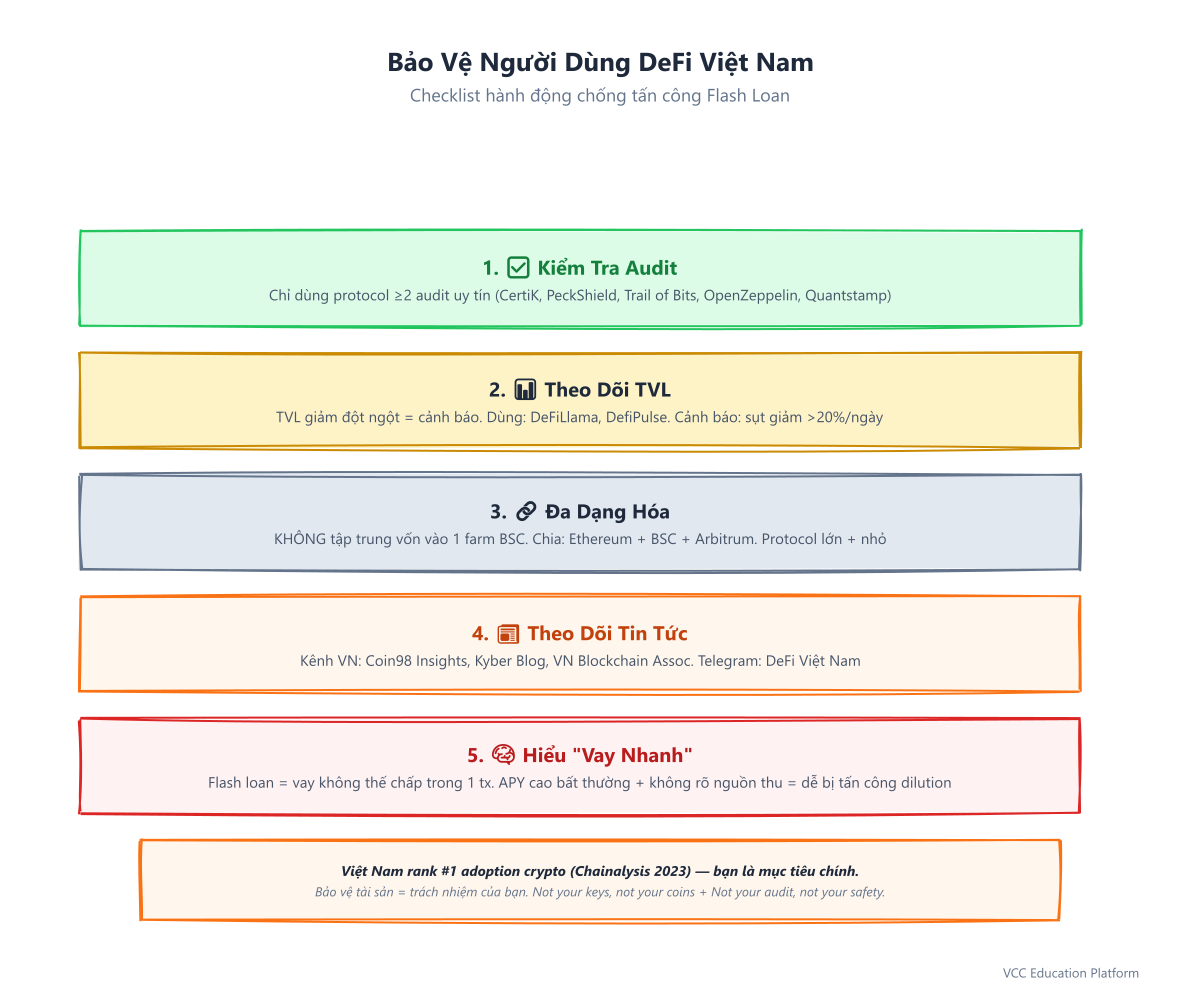
Vietnam ranks #1 globally in crypto adoption (Chainalysis 2023). Millions of Vietnamese users interact with DeFi daily via PancakeSwap, Uniswap, Trader Joe, and local projects like Coin98, Kyber Network, and TomoChain.
Specific Risks for Vietnamese Users:
- BSC/Polygon dominance — Lower fees make flash loan attacks cheaper to execute on these chains. Attackers target BSC protocols more frequently.
- Yield farming culture — High APY chasing leads users into unaudited "fork" protocols with copied code and inherited vulnerabilities.
- Language barrier — Audit reports, post-mortems, and security advisories are primarily in English. Critical warnings reach Vietnamese users late or not at all.
- Wallet security — Coin98, MetaMask, and Trust Wallet are standard. Users must verify contract addresses before interacting (phishing + flash loan drain combos exist).
Protective Actions for Vietnamese DeFi Users:
- Check audit status: Only use protocols with ≥2 reputable audits (CertiK, PeckShield, Trail of Bits, OpenZeppelin, Quantstamp)
- Monitor TVL trends: Sudden TVL drops often precede exploit announcements. Tools: DeFiLlama, DefiPulse
- Diversify across chains/protocols: Don't concentrate funds in one BSC yield farm
- Follow Vietnamese security channels: Coin98 Insights, Kyber Network Blog, Vietnam Blockchain Association alerts
- Understand "vay nhanh" (flash loan) risks: If a protocol offers unusually high yields with no clear revenue source, it may be vulnerable to flash loan dilution attacks
The Future: Where Attacks Are Heading
1. Cross-Chain Flash Loans
Bridges (Wormhole, LayerZero, Axelar) enable flash loans across chains. An attacker could borrow on Ethereum, manipulate an oracle on BSC, and repay on Arbitrum—all atomically via cross-chain messaging. No major cross-chain flash loan attack has occurred yet, but the infrastructure exists.2. MEV-Flash Loan Fusion
MEV bots already front-run large swaps. A flash loan attacker could bribe validators (via MEV-Boost) to include their attack transaction in a specific block position, guaranteeing oracle reads happen at the manipulated price. This turns probabilistic attacks into deterministic ones.3. AI-Generated Attack Vectors
LLMs can now write Solidity exploits from vulnerability descriptions. The barrier to creating flash loan attacks is dropping from "expert Solidity developer" to "anyone with API access." Defense must shift from "hard to exploit" to "unprofitable to exploit."4. Regulatory Scrutiny
The SEC and CFTC have signaled that market manipulation via flash loans may violate commodities/securities laws. The Mango Markets attacker (Avraham Eisenberg) was criminally charged in 2023—the first such case. Protocol teams may face legal liability for insufficient defenses.FAQ
Q: Can flash loans be banned or restricted?
A: No. Flash loans are a fundamental feature of composable DeFi. Banning them would break legitimate arbitrage, liquidations, and collateral swaps. The solution is protocol-level defense, not protocol-level prohibition.Q: Are flash loans only an Ethereum problem?
A: No. Flash loans exist on every chain with DeFi: BSC, Polygon, Arbitrum, Optimism, Avalanche, Fantom, Solana (via Solend, Mango). Lower fees on L2s and alt-L1s actually *increase* attack frequency by lowering the gas cost barrier.Q: Does using Chainlink guarantee safety from flash loan attacks?
A: Chainlink price feeds are highly resistant to single-block manipulation because they aggregate multiple exchange prices off-chain. However, they are not a silver bullet: (1) stale prices during extreme volatility can still cause issues, (2) if your protocol uses Chainlink *incorrectly* (e.g., reading the wrong feed, ignoring heartbeat), you remain vulnerable, (3) governance and logic bugs are unrelated to oracles.Q: How do I know if my protocol is vulnerable?
A: Commission a flash loan-specific audit from a firm with DeFi attack experience (Trail of Bits, OpenZeppelin, PeckShield, CertiK, Sigma Prime). Standard audits often miss flash loan vectors because they require simulating multi-step atomic transactions with mainnet forks.Q: What should I do if my protocol is attacked?
A: 1) Pause immediately if pause guardian exists. 2) Communicate transparently (Discord, Twitter, forum). 3) Engage blockchain forensics (Chainalysis, TRM Labs, PeckShield) to trace funds. 4) Negotiate with attacker (white hat return) if funds are traceable. 5) Conduct root-cause analysis and publish post-mortem. 6) Upgrade with fixes before resuming.Conclusion
Flash loan attacks are not a bug in DeFi—they are a consequence of its core innovation: permissionless, composable, atomic financial primitives. The same properties that enable efficient markets also enable capital-free exploitation.
The defense landscape is maturing. Oracle hardening (Layer 1) is now table stakes. Protocol-level circuit breakers (Layer 2) are widely adopted. Governance protections (Layer 3) are improving after Beanstalk. Economic defenses (Layer 4) are the next frontier.
For Vietnamese DeFi builders and users: the threat is real, local, and growing. The protocols you use today may be the case studies of tomorrow. Demand audits. Verify oracle designs. Understand governance mechanics. And never assume "it can't happen here"—in DeFi, it happens everywhere, all the time.
The best defense is not a single tool. It is a culture of security: assume attackers have infinite capital for one block, and design every component to withstand that assumption.
Further Reading:
- Aave Flash Loan Documentation:
docs.aave.com/developers/flash-loans - OpenZeppelin Flash Loan Defense Guide:
blog.openzeppelin.com/flash-loan-attacks - Chainlink Price Feeds Best Practices:
blog.chain.link/best-practices-for-using-chainlink-price-feeds - CertiK Quarterly DeFi Security Reports:
certik.com/resources/reports - Rekt.news Leaderboard:
rekt.news/leaderboard - "SoK: Decentralized Finance (DeFi) Attacks" — Qin, Zhou, Gervais (FC 2021)