
Summary
"Dust" refers to units of value that are too small to be economically efficient or technically feasible to use. Good dust control helps reduce transaction costs, improve system performance, and the "usability" of balances. However, this is a difficult problem because the dust threshold depends on network conditions and data patterns, and conflicts with goals such as privacy, optimal transaction size, and stable user experience.
1) Conceptualizing "dust" in a quantitative model
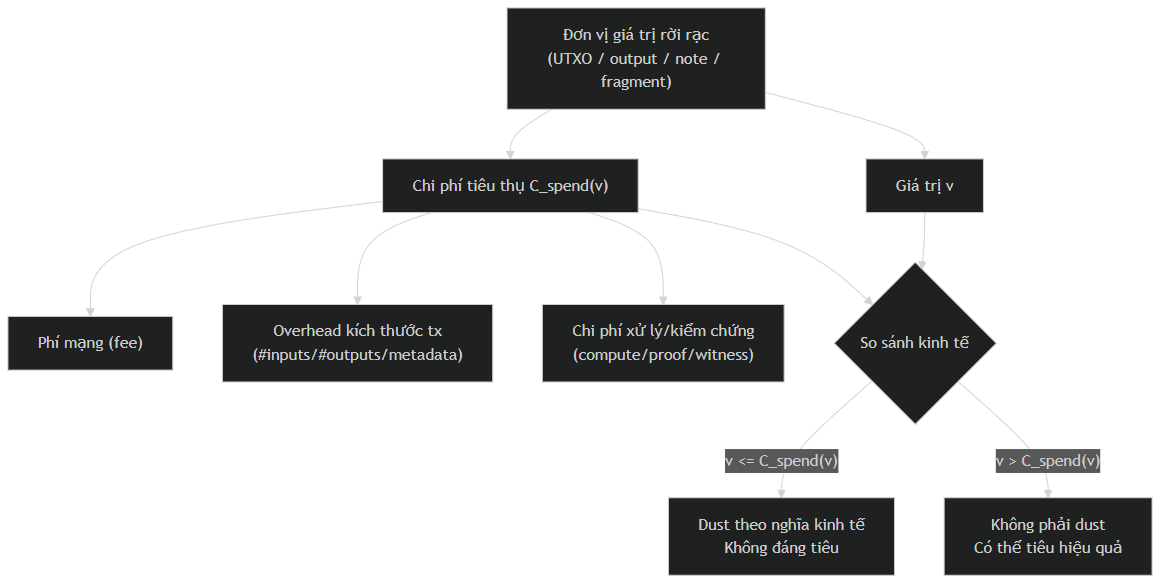
A technical view is to consider dust as "discrete units of value" (coins/UTXO/notes/outputs, etc.) whose cost of consumption approaches or exceeds the benefits derived from them.
This can be described by the inequality "dust in economic terms":
- Let
vbe the small unit value to be consumed. - LetC_spend(v)be the marginal cost of including that unit in a transaction (fixed size fees, overhead, computational/verification costs). - A unit becomes dust when: -v <= C_spend(v)(not worth consuming) - orvis small enough to significantly inflate the transaction, leading to a sharp increase in total cost.
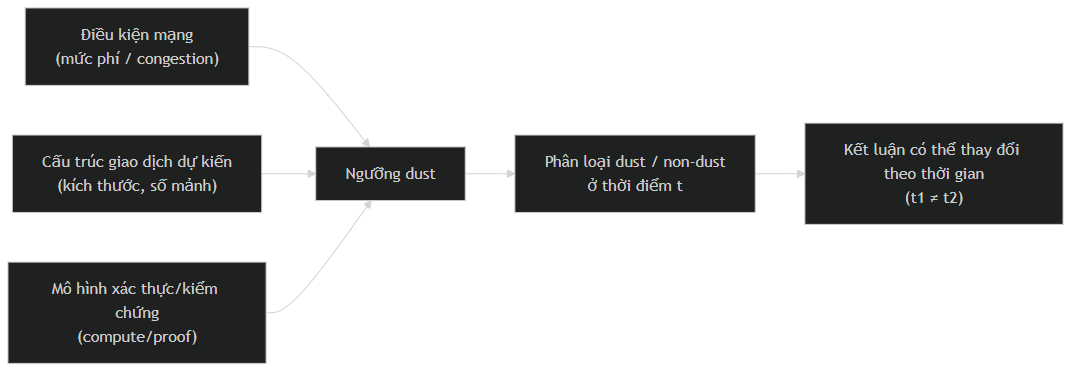
Importantly, C_spend(v) is not a constant. It depends on:
2) Advantages of effective dust control
2.1. Reduce transaction costs and processing fees
Dust increases the number of "pieces" that must be aggregated to reach a payment value. When the number of pieces increases:
Good dust control helps to: - reduce the average number of inputs per transaction, - reduce the probability of "dropping many pieces", - reduce the cost per unit of value transferred.
2.2. Increasing the spendability of the balance
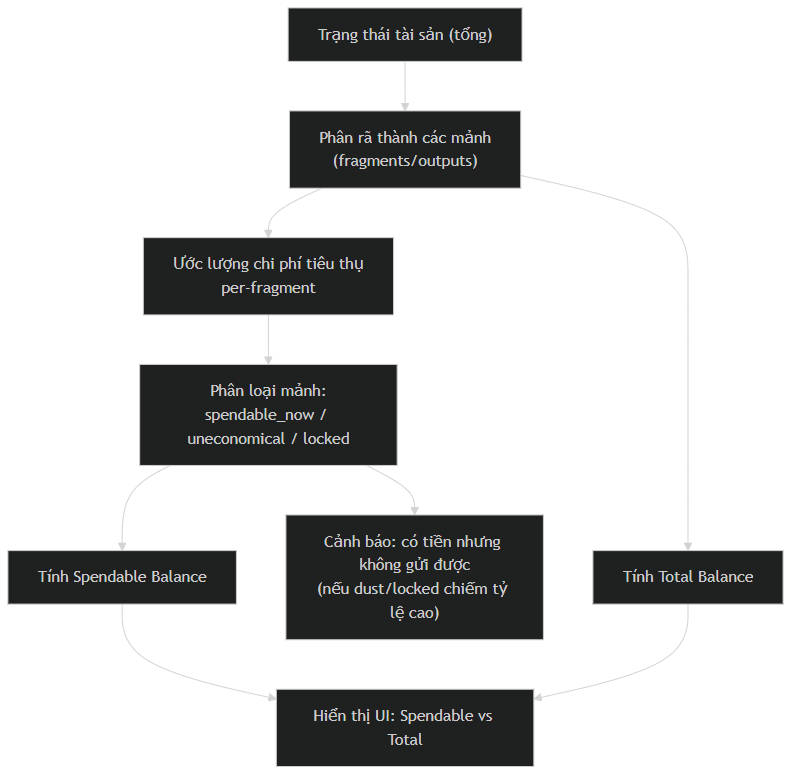
A wallet may show a large total balance, but the "spendable" portion is low because:
Good dust control helps to clearly distinguish between: - 'Total balance' - 'Spendable balance' (available under current conditions)
and reduce the problem of "having money but not being able to send it."
2.3. Improving storage performance and state synchronization
When the asset state is represented by multiple discrete units, dust increases: the number of elements to track, the indexing/scan costs, and the "planning" costs when creating transactions.
Good dust control makes the system "leaner": - fewer state elements, - faster queries/synchronization, - better suited to resource-constrained environments (mobile devices, light clients).
2.4. Stability of the statistical characteristics of trading behavior
Dust typically creates behavioral signals such as:
In systems that aim to reduce the ability to infer behavior, limiting dust helps reduce "anomalous" trading patterns and distributes transactions more evenly.
3) Challenges in dust control
3.1. The dust threshold is a dynamic quantity
If fees change over time, the "spendable" threshold also changes. A unit today might be dust, but tomorrow it might no longer be dust (because the fee has decreased), and vice versa.
Technical implications: - Any dust control strategy must be based on estimation, - incorrect estimation leads to: - creating new dust, - burning value into unnecessary fees, - or failing to execute a transaction (insufficient/underestimated fee).
3.2. Goal conflicts: cost optimization vs. transaction structure optimization vs. privacy goals
An intuitive "gom dust" strategy would be:
However, consolidation can: - cause large, sudden transactions, - create recurring behavioral patterns, - increase the likelihood of time-based inference (timing/pattern leakage), or - significantly increase processing costs at the aggregation point.
This is a multi-objective optimization problem, with no global optimal solution for all conditions.
3.3. The coin selection problem becomes a heuristic problem
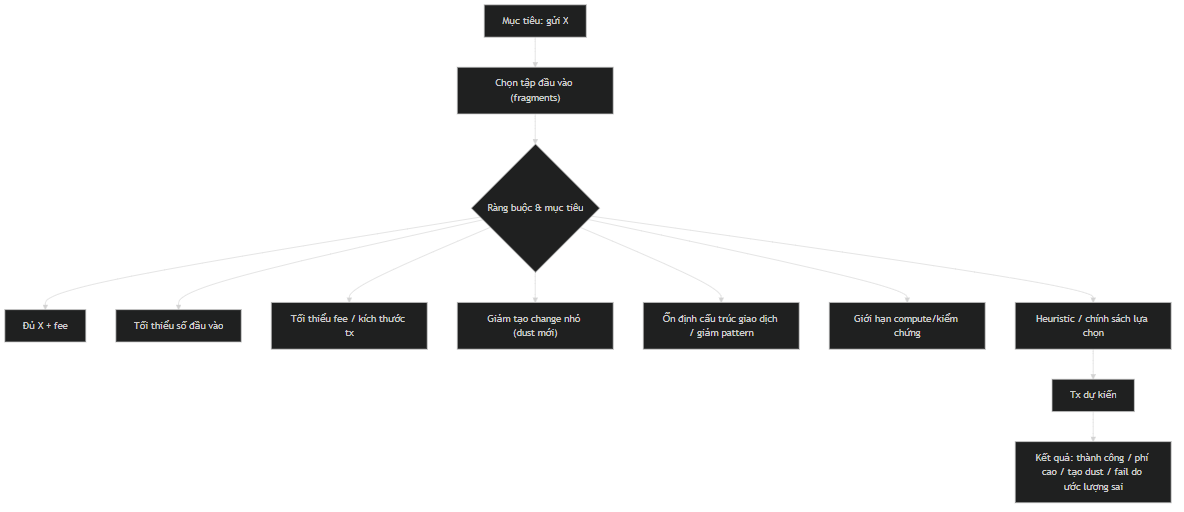
Choosing the input set to achieve amount + fee while: - minimizing the number of inputs, - minimizing the fee, - limiting the creation of too small change, and - maintaining a "balanced" transaction structure according to some criterion is a difficult problem, often solved heuristically.
Common heuristics include: - largest-first: reduces the number of inputs but can make large changes - smallest-first: easy to collect dust but makes large transactions - knapsack/branch-and-bound: better but computationally expensive - randomized selection: supports "hard reasoning" but may be suboptimal in terms of cost
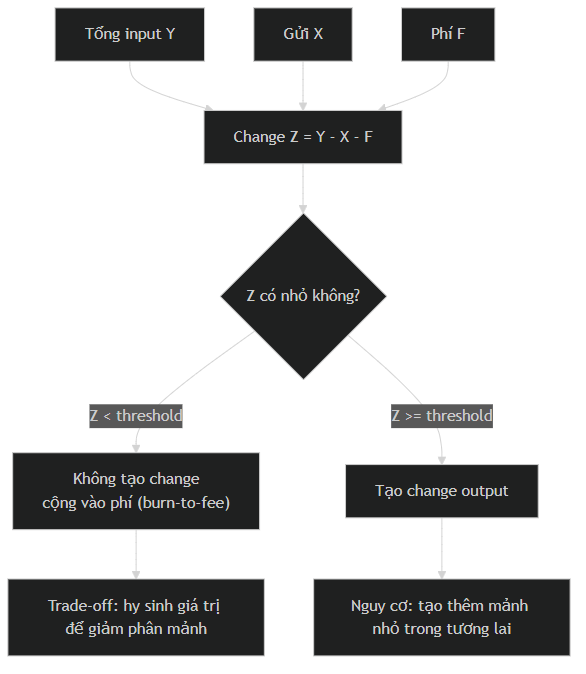
3.4. "Change output" is the primary source of dust generation
Dust does not occur naturally, but is created when:
If the system always creates a new Z unit, then the dust increases over time.
Reducing dust in changes entails difficult choices: - suppression: if Z is too small, add a fee (sacrificing some value) - rounding/denomination: adjust the output structure so that Z falls into a "reasonable range" - batching: group multiple payments to reduce the probability of small changes
All of them have trade-offs in terms of cost, transaction structure, and user experience.
3.5. Measuring the "dust problem" is not just the total value of dust
A system may have a small total value of dust, but it can be very damaging if:
Therefore, more technical indicators are needed: - the number of state units (count) - size/value distribution - the ratio of spendable to total under the current fee conditions - the estimated cost of "consolidating" dust
4) Technical approach (fundamental in nature)
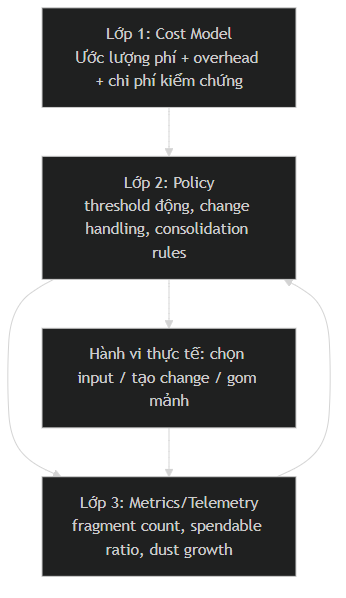
A robust dust control design typically has three critical layers:
4.1. Cost model
- Estimate fees based on the expected transaction size
4.2. Policy layer
- dynamic dust threshold based on cost model
4.3. Telemetry/metrics
- monitor the number of coins, spendable ratio, and consolidation frequency
Conclusion
Dust control offers clear benefits in terms of cost, performance, and liquidity availability, and contributes to the stability of the trading structure over time. However, it is a difficult problem because the dust threshold depends on fees and trading structure, and it is a multi-objective optimization problem with unavoidable trade-offs. A good technical approach requires a clear cost model, flexible policies, and metrics to control the fragmentation of the asset state over time.