
Imagine you're standing in front of a currency exchange counter at the airport. You want to convert 100 USD to Euros. The teller quotes a price and executes the trade on the spot. Simple, fast — but you have to trust the bank behind that counter. Now, imagine a world with no teller, no bank behind the counter — just a "smart machine" that automatically exchanges money for you, 24/7, never sleeping. That's exactly what DEX AMM does in the world of cryptocurrency.
What Is a DEX? — When the Bank Disappears
DEX stands for Decentralized Exchange. Unlike centralized exchanges (CEX) such as Binance or Coinbase, where you must deposit funds into the exchange's wallet and trust them to manage it, a DEX works in a fundamentally different way.
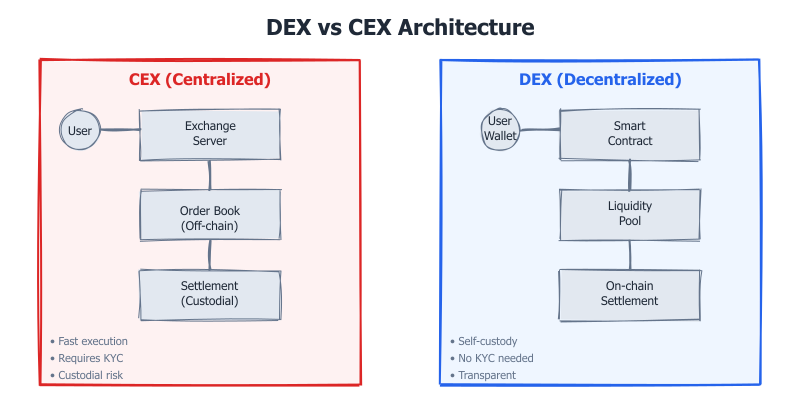
On a DEX, you never lose control of your assets. Trades happen directly from your wallet to someone else's wallet through a smart contract. No account registration, no KYC, and no company standing in between.
Key Characteristics of DEX:
- Self-custody: You hold your own private key; no one can freeze your wallet
- No middleman: Peer-to-peer (P2P) transactions through smart contracts
- Transparency: Every transaction is recorded on-chain and can be verified by anyone
- Censorship resistance: No central authority can block your transactions
What Is an AMM? — The "Smart" Pricing Machine
AMM stands for Automated Market Maker. It is the "brain" behind most modern DEX platforms.
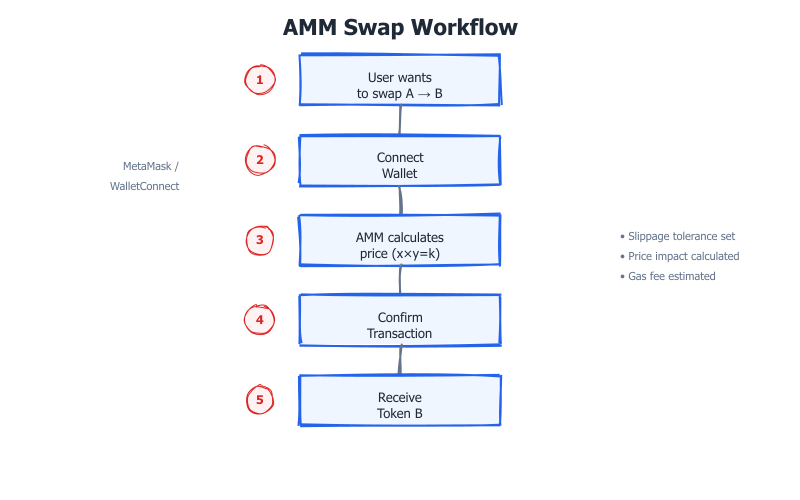
In traditional finance, market makers are large institutions that continuously place buy and sell orders to provide liquidity. They profit from the bid-ask spread. An AMM replaces these institutions with a mathematical algorithm and a liquidity pool.
The Magic Formula: x × y = k
x × y = k
This formula may sound simple, but it is the foundation of most modern AMMs like Uniswap.
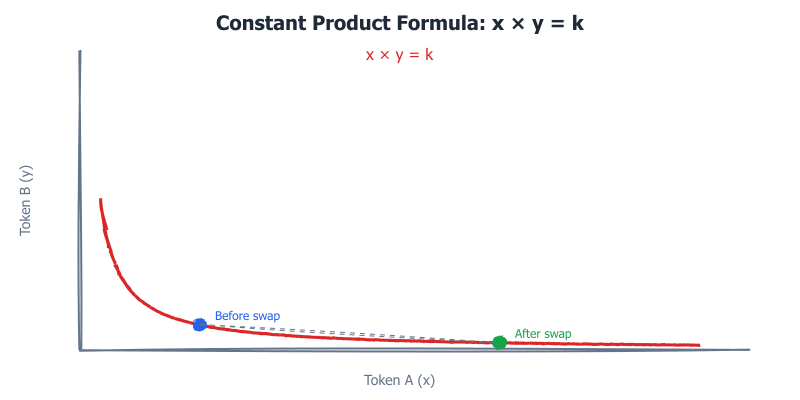
- x: The amount of token A in the pool
- y: The amount of token B in the pool
- k: A constant that never changes (the constant product)
When someone wants to swap token A for token B, they add token A to the pool and withdraw token B from it. Because the product x × y must always equal k, the price of token B automatically adjusts. The more people buy token B, the higher its price rises — following the law of supply and demand.
Liquidity Pool: The Community's Asset "Pool"
A liquidity pool is where people contribute their assets to create market liquidity.
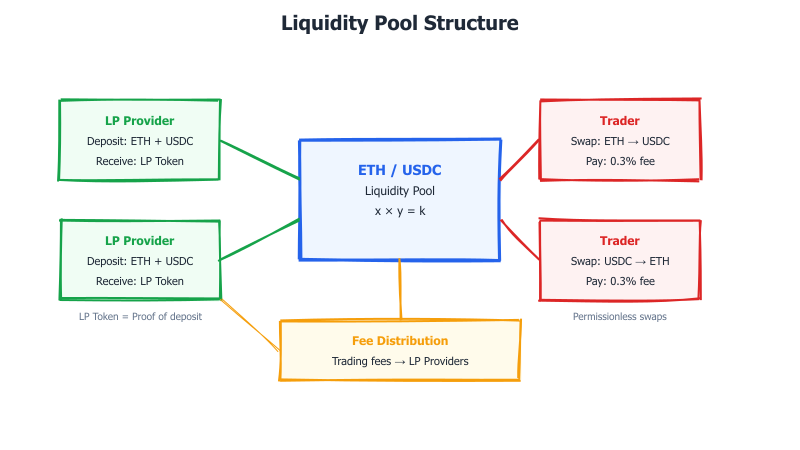
Suppose there's an ETH/USDC pool. To provide liquidity, you must contribute both tokens at the current price ratio — for example, 1 ETH and 2,000 USDC. In return, you receive LP tokens as proof of your contribution.
When a trader swaps ETH for USDC (or vice versa), they pay a transaction fee (typically 0.3%). This fee is distributed proportionally among all liquidity providers based on their share of the pool. That's how you earn "passive income" from providing liquidity.
Real-World Example: Minh has 10,000 USDT and wants to invest in DeFi. He decides to provide liquidity to the ETH/USDT pool on Uniswap with a 50/50 ratio: contributing 5,000 USDT + ETH worth 5,000 USDT. Income: A percentage of the transaction fees from the pool.
Impermanent Loss: The Hidden "Demon"
This is the most important risk that every liquidity provider needs to understand.
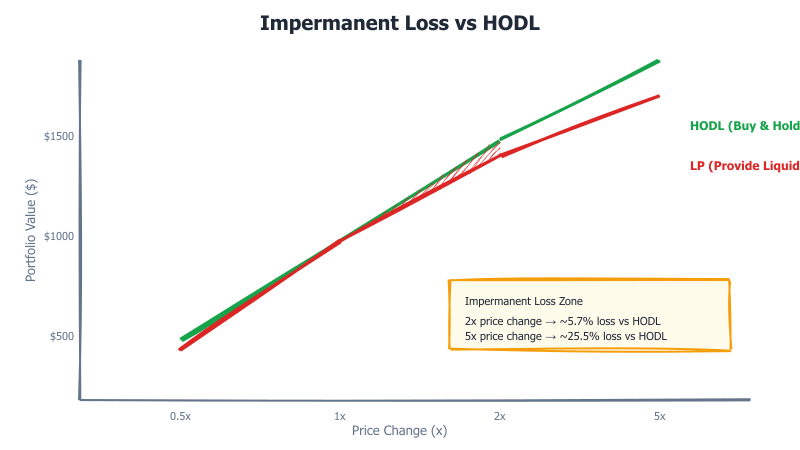
Impermanent Loss occurs when the price of a token in the pool changes relative to when you contributed. The x × y = k formula forces the pool to maintain balance, so when the price of token A rises sharply, the pool gradually sells token A (which is appreciating) and buys more of token B.
Illustrative Example: You contribute 1 ETH + 100 USDC (assuming 1 ETH = 100 USDC). ETH rises to 200 USDC. If you withdraw, you receive approximately 0.7 ETH + 140 USDC (total ~280 USDC). If you had simply HODL'd, the value would be ~300 USDC. Impermanent Loss: ~20 USDC (~6.7%).
This risk is called "impermanent" because if the price returns to its original level, the loss disappears. However, if the price doesn't return, the loss becomes "permanent."
DEX vs CEX: Which Side Do You Choose?
| Criteria | DEX (AMM) | CEX (Binance, Coinbase) |
|---|---|---|
| Asset control | You hold it yourself | The exchange holds it |
| KYC/AML | Not required | Mandatory |
| Transaction speed | Slower (on-chain) | Fast (off-chain) |
| Transaction fees | Gas fees + swap fees | Exchange trading fees |
| Liquidity | Depends on LPs | High, centralized liquidity |
| Token variety | Any token can be listed | Only approved tokens |
| Risks | Smart contract bugs | Exchange hacks, exchange bankruptcy |
When to Use a DEX?
- You want to trade new tokens not yet listed on CEXs
- You don't want to share personal information
- You want full control over your assets
- You want to participate in DeFi yield farming
When to Use a CEX?
- Trading large volumes (requires deep liquidity)
- You need customer support
- You want to trade with leverage (futures/margin)
- You're a beginner and need a user-friendly interface
Notable DEX AMM Platforms
1. Uniswap (Ethereum)
The "pioneer" of AMMs. Launched in 2018, Uniswap proved that the AMM model works efficiently. Version V3 introduced concentrated liquidity, allowing LPs to choose the price range in which they provide liquidity, boosting capital efficiency by up to 4,000x.
2. PancakeSwap (BNB Chain)
The largest DEX on BNB Chain with low transaction fees (0.25%). Known for additional features such as a lottery, NFT marketplace, and launchpad.
3. SundaeSwap (Cardano)
The first DEX on Cardano using the AMM model. Notably, it integrates with Cardano's staking mechanism, allowing users to earn diverse rewards.
4. Curve Finance (Multi-chain)
Specialized in swapping stablecoins with extremely low slippage. It uses the StableSwap formula instead of x × y = k to keep stablecoin prices more stable.
Yield Farming: "Cultivating" Returns on DEX
Yield farming is the practice of providing liquidity to a pool to earn additional governance token rewards on top of transaction fees.
For example: You provide liquidity to the CAKE/BNB pool on PancakeSwap. You receive: 1. Transaction fees from the pool (0.17%), 2. CAKE token rewards, 3. The ability to stake CAKE in a Syrup Pool to earn additional tokens.
Note: High returns come with high risk. Many new farming pools can be scams (rug pulls), or the reward tokens may rapidly lose value.
Risks and How to Protect Yourself
1. Rug Pull
This happens when developers disappear after raising funds. How to avoid it: check audit reports from security firms (Certik, SlowMist), verify whether the liquidity is locked, and research the team behind the project.
2. Smart Contract Bugs
Flaws in the smart contract code can be exploited. How to avoid it: only use DEXs that have been audited multiple times, don't invest too much in any single new pool, and monitor security alerts on Twitter and Rekt News.
3. Impermanent Loss
As mentioned, this is an unavoidable risk. Minimize it by: providing liquidity to stablecoin pools (USDC/USDT) where IL is nearly zero, using Uniswap V3 to set narrow price ranges if you understand it well, and only contributing to token pairs with stable price correlations.
The Future of DEX AMM
The DeFi industry is growing at breakneck speed. Some notable trends:
- Concentrated Liquidity: More and more DEXs are adopting this model to boost capital efficiency
- Cross-chain DEX: Trading across chains without needing a bridge
- Account Abstraction: Lowering the barrier for new users
- MEV Protection: Protecting users from transaction-exploiting bots
- Regulatory Compliance DEX: DEXs that comply with regulations in preparation for mass adoption
Conclusion: Financial Freedom at Your Fingertips
DEX AMM has opened a new chapter in the history of finance — one where you don't need anyone's permission to trade, don't need to trust a middleman, and can participate in the market from anywhere with just a phone.
However, freedom comes with responsibility. There's no customer support team to help you recover funds sent to the wrong address. There's no regulatory body to protect you from scam projects.
So, before jumping into the world of DEX AMM:
- Learn: Understand how liquidity pools and impermanent loss work
- Experiment: Start with small amounts on a testnet
- Research: Only use platforms that have been audited and have a solid reputation
- Secure: Always protect your private key and use a hardware wallet for large amounts
The future of finance is decentralized. And that future is being built right now, one swap at a time.
Difficulty: Intermediate | Read time: ~15 minutes | Suitable for: Readers with basic blockchain knowledge who want to learn about DeFi