
Defi treasury management sits at the intersection of finance, governance, and survival. Every DeFi protocol—whether a lending market, a DEX, or a DAO—has a treasury. Yet most treat it as an afterthought: a multisig wallet holding tokens, hoping the number goes up. That approach has killed more protocols than smart contract bugs.
In 2022, OlympusDAO's treasury peaked at $3.4 billion. By 2023, it had lost 90% of its value. Wonderland's treasury collapsed from $1.2 billion to near-zero in weeks. Fei Protocol's stablecoin depegged because its treasury couldn't defend the peg. These weren't hacks. They were treasury management failures.
This guide gives you the frameworks, tools, and Vietnamese-context insights to build a treasury that survives market cycles, regulatory shifts, and operational mistakes.
Why Treasury Management Determines Protocol Survival
The Treasury Trilemma: You Can Only Pick Two
Every DeFi treasury faces three competing objectives. You cannot maximize all three simultaneously.
` ┌─────────────────────────────────────────────────────────────┐ │ THE TREASURY TRILEMMA │ ├──────────────────┬──────────────────┬──────────────────────┤ │ LIQUIDITY │ YIELD │ SOVEREIGNTY │ │ │ │ │ │ Meet obligations│ Productive │ Control without │ │ without market │ deployment of │ centralized custody │ │ impact or fire │ idle assets to │ or regulatory │ │ sales │ extend runway │ exposure │ └────────┬─────────┴────────┬─────────┴──────────┬───────────┘ │ │ │ ▼ ▼ ▼ Stablecoin-heavy Yield strategies Multisig/MPC (Conservative) (Aggressive) (Self-custody) `
The trap: Most protocols optimize for one corner and ignore the others.
| Protocol | Optimized For | Neglected | Outcome |
|---|---|---|---|
| OlympusDAO (2021-22) | Yield (bonding, high APY) | Sovereignty (regulatory), Liquidity (exit) | Treasury collapsed 90%; SEC scrutiny |
| Wonderland/Abracadabra | Liquidity (stablecoin-only) | Yield (0% real return) | Runway burned; contributor exodus |
| Typical DAO (2024) | Sovereignty (native token only) | Yield, Liquidity | 68% native token concentration; correlated crash risk |
The insight: Treasury management isn't about picking a corner—it's about conscious trade-offs with explicit risk budgets for each.
Real Stakes: Three Case Studies Through the Trilemma Lens
OlympusDAO: The Yield Trap
- Strategy: Bond sales → high APY → treasury grows → more bonds
- Trilemma failure: Treated yield as free. Ignored that bonding = selling OHM at discount → dilution → price reflexivity
- Lesson: Yield without sovereignty is a liability. When regulators classify your token as a security, your "yield engine" becomes an enforcement target.
Wonderland: The Liquidity Illusion
- Strategy: 100% stablecoins (MIM, USDC) → "safe"
- Trilemma failure: Zero yield = negative real yield after inflation. Contributors paid in tokens that only go down.
- Lesson: Liquidity without yield destroys human capital. Protocols are made of people; people need upside.
Uniswap: The Balanced Approach
- Strategy: ~70% UNI, ~20% stablecoins, ~10% yield-bearing (ETH staking, POL)
- Trilemma outcome: Conscious trade-offs. 4/7 multisig + 48hr timelock = sovereignty. Stablecoin floor = liquidity. POL + staking = yield.
- Result: $3B+ treasury survived 2022-23 bear market intact.
The Treasury Lifecycle: From Revenue to Resilience
Treasury management isn't a one-time decision. It's a continuous cycle with five phases. Each phase has distinct risks, tools, and success metrics.
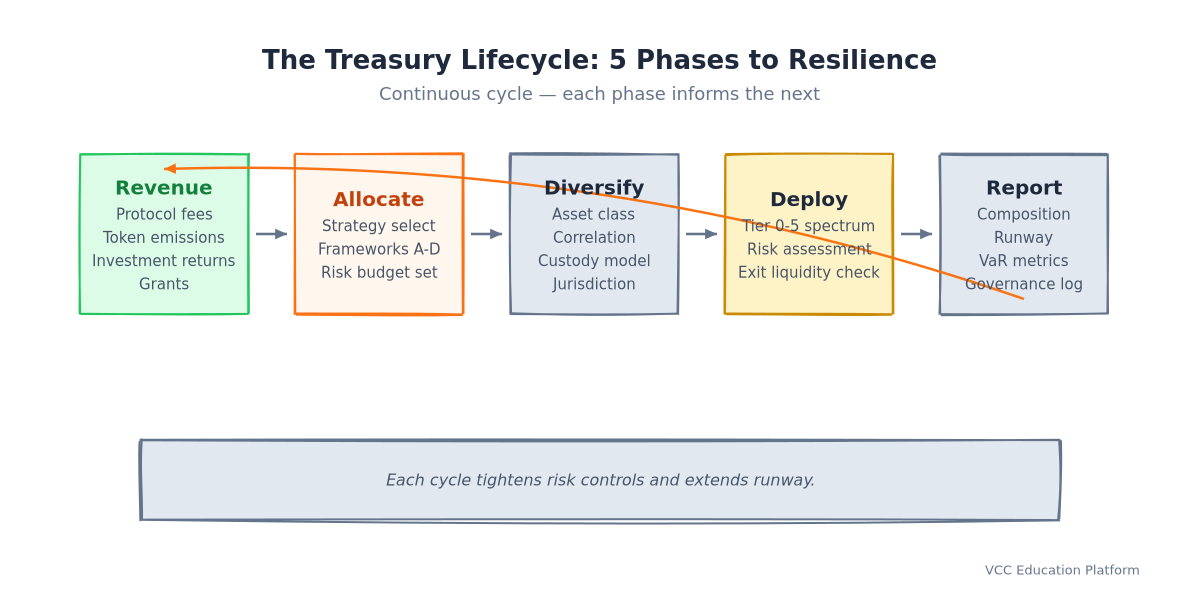
Phase 1: Revenue Capture — Don't Leak Value
Where revenue comes from:
- Protocol fees (swap fees, borrowing interest, trading fees)
- Token emissions (inflationary rewards)
- Investment returns (yield on deployed assets)
- Grants/ecosystem funding
Common leaks:
- MEV extraction on protocol swaps (Uniswap loses ~$50M/year to MEV on treasury rebalances)
- Gas inefficiency (batch transactions, use Layer 2)
- Custody fees (institutional custodians charge 0.1-0.5%/year)
- Impermanent loss on deployed liquidity
Best practice: Route 100% of protocol revenue through a Revenue Router smart contract that automatically splits: X% to treasury, Y% to buyback/burn, Z% to contributors. No manual steps = no leaks.
Phase 2: Allocation — The Strategy Decision
This is where the Trilemma becomes operational. Your allocation is your strategy.
Allocation frameworks:
| Framework | When to Use | Core Principle |
|---|---|---|
| Risk Parity | Large treasury (>$50M), institutional LPs | Equal risk contribution per asset class |
| Core-Satellite | Medium treasury ($5-50M) | Stable core (60-70%) + tactical satellites (30-40%) |
| Barbell | High uncertainty, need optionality | Extreme safe (stablecoins) + extreme asymmetric (options, early tokens) |
| POL-First | DEXs, lending markets needing depth | Protocol-owned liquidity as primary asset |
Vietnam-specific consideration: If your protocol serves Vietnamese users (remittances, freelancer payments), allocate 10-15% to VNDC/USDT pairs on local DEXs (Kyo Finance, DigiFinex Vietnam). Captures local yield + serves user base.
Phase 3: Diversification — Beyond "Buy More Tokens"
The 68% problem: DeepDAO data shows median DAO treasury holds 68% in native token. This is concentration risk, not diversification.
True diversification axes:
- Asset class: Stablecoins, major L1s (ETH, BTC), DeFi blue chips, protocol-native, RWA (real-world assets)
- Correlation: Assets that don't move together in stress (2022: everything correlated → 1.0)
- Liquidity tier: Tier 1 (instant, <1% slippage), Tier 2 (hours, 1-5%), Tier 3 (days/weeks, >5%)
- Custody model: Self-custody (multisig), MPC, institutional custodian, smart contract vaults
- Jurisdiction: Onshore (regulated) vs offshore (flexible) — critical for Vietnam operations
Rebalancing triggers (not calendar-based):
- Native token >80% of treasury → auto-sell 10% to stablecoins
- Stablecoin <15% → pause yield deployment, rebuild floor
- Single protocol exposure >25% → reduce position
- Correlation spike (30-day >0.8) → de-risk
Phase 4: Deployment — Putting Capital to Work
Idle treasury = melting ice cube. But deployment ≠ gambling.
Deployment spectrum (risk → reward):
| Tier | Strategy | Expected APY | Risk Profile | Example Protocols |
|---|---|---|---|---|
| 0 | Hold (stablecoins) | 0-5% (T-bill yield via tokenized RWAs) | Near-zero | Ondo Finance, Mountain Protocol |
| 1 | Lending (Aave, Compound) | 3-8% | Smart contract + liquidation | Aave v3, Morpho |
| 2 | Staking (LSTs, native) | 4-12% | Slashing + depeg | Lido stETH, Rocket Pool rETH |
| 3 | Yield Aggregators | 8-20% | Strategy + platform risk | Yearn, Beefy, Sommelier |
| 4 | POL / LP positions | 10-50%+ | IL + smart contract + market | Uniswap v3, Curve, Balancer |
| 5 | Options / Structured | Variable | Complex, counterparty | Dopex, Lyra, Hegic |
Critical rule: Never deploy more than Tier 2 without a formal risk assessment documenting: max drawdown, recovery time, correlation to native token, smart contract audit status, and exit liquidity.
Phase 5: Reporting — Transparency Builds Trust
Minimum viable reporting (monthly):
- Treasury composition (pie chart + table)
- Mark-to-market value (with timestamp)
- Deployment performance (per strategy, net of fees)
- Runway calculation:
Treasury Value / Monthly Burn Rate - Risk metrics: VaR (95%, 30-day), largest single exposure, correlation matrix
- Governance decisions affecting treasury (proposals, votes, executions)
Tools: Dune Analytics, Nansen, custom dashboards, Safe{Wallet} transaction history.
Vietnam compliance note: If your DAO has Vietnamese contributors or users, maintain records for Circular 96/2015/TT-BTC (crypto as property, 20% capital gains on disposal). Every rebalance = potential taxable event. No DeFi-specific guidance exists yet—conservative approach: track cost basis per lot.
Four Treasury Allocation Strategies Compared
No single strategy fits all protocols. Your choice depends on: treasury size, revenue predictability, contributor count, regulatory exposure, and mission.
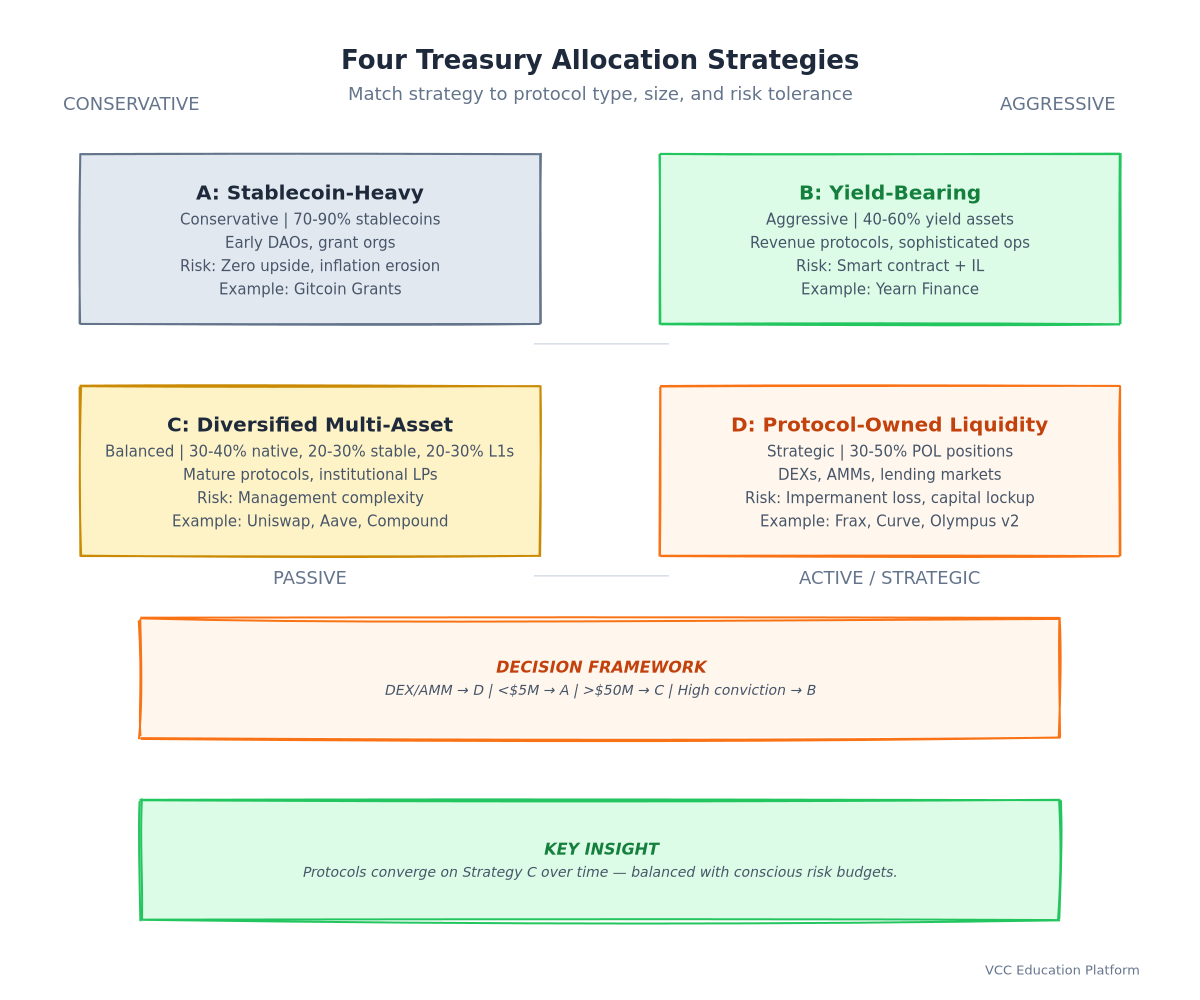
Strategy A: Stablecoin-Heavy (Conservative)
Allocation: 70-90% stablecoins (USDC, USDT, DAI), 10-30% blue chips (ETH, BTC), 0% native token Best for: Early-stage DAOs, grant-giving orgs, protocols with predictable USD expenses Pros: Predictable runway, low volatility, simple accounting Cons: Zero upside, inflation erosion, signals "no confidence in own token" Real example: Gitcoin Grants (pre-2023) — held >80% stablecoins to fund quarters reliably
Strategy B: Yield-Bearing Assets (Aggressive)
Allocation: 40-60% yield-bearing (stETH, sDAI, yVaults), 20-30% stablecoins, 10-20% native token Best for: Revenue-generating protocols with >2 year runway, sophisticated ops team Pros: Compounding extends runway, captures DeFi native yield Cons: Smart contract risk, IL risk, complexity, regulatory uncertainty on "investment company" classification Real example: Yearn Finance — treasury deployed across own vaults + blue chip strategies
Strategy C: Diversified Multi-Asset (Balanced)
Allocation: 30-40% native token, 20-30% stablecoins, 20-30% major L1s/DeFi, 10-20% yield-bearing/RWA Best for: Mature protocols ($50M+ treasury), multi-year horizon, institutional LPs Pros: Risk-adjusted returns, survives regime changes, professional perception Cons: Requires active management, rebalancing costs, custody complexity Real example: Uniswap, Aave, Compound — all converge here over time
Strategy D: Protocol-Owned Liquidity (POL) (Strategic)
Allocation: 30-50% POL positions (native/ETH, native/stable), 20-30% stablecoins, 20-30% native token Best for: DEXs, AMMs, lending markets where liquidity depth = competitive moat Pros: Controls own liquidity, earns swap fees, reduces mercenary capital dependence Cons: Impermanent loss, capital inefficiency (locked), exit risk if protocol fails Real example: OlympusDAO (v2), Frax Finance, Curve — POL as core strategy
Decision framework:
` IF protocol_is_DEX_or_AMM → Strategy D (POL-First) ELSE IF treasury < $5M AND revenue_unpredictable → Strategy A (Conservative) ELSE IF treasury > $50M AND sophisticated_ops_team → Strategy C (Balanced) ELSE IF high_conviction_in_own_token AND long_horizon → Strategy B (Yield) ELSE → Strategy C (Balanced) — default safe choice `
Building Your Treasury Stack: Tools & Infrastructure
Your treasury stack determines operational capacity. Build it in layers—each layer adds capability and complexity.
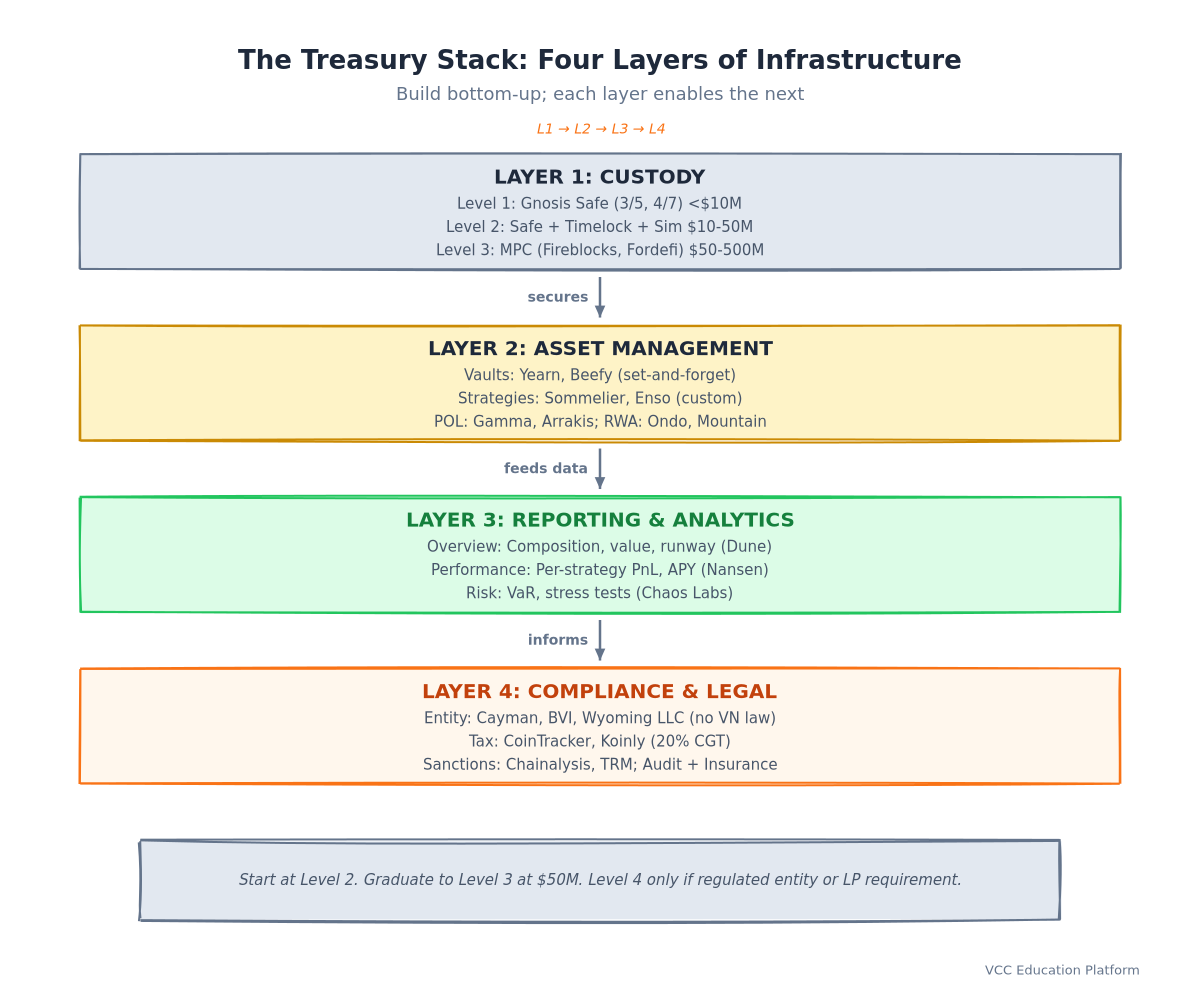
Layer 1: Custody — Who Holds the Keys?
| Maturity Level | Solution | Threshold | Cost | Best For |
|---|---|---|---|---|
| Level 1 | Gnosis Safe (multisig) | 3/5, 4/7 | Free (gas only) | <$10M, trusted signers |
| Level 2 | Safe + Timelock + Simulation | 48hr delay, Tenderly sim | Free + dev time | $10-50M, need audit trail |
| Level 3 | MPC (Fireblocks, Fordefi, Lit) | Policy engine, no single key | $2-10k/month | $50-500M, institutional grade |
| Level 4 | Institutional Custodian (Anchorage, Coinbase Prime, BitGo) | Insurance, regulatory compliance | 0.1-0.5%/year AUM | >$500M, regulatory requirement |
The Multisig Maturity Model (Original Framework):
` Level 1: Basic Multisig ├── 3/5 or 4/7 signers ├── No timelock ├── No simulation └── Risk: Key person concentration, fat-finger errors
Level 2: Governed Multisig ├── 48-72hr timelock (OpenZeppelin TimelockController) ├── Transaction simulation (Tenderly, Blocknative) ├── Emergency pause (guardian multisig) └── Risk: Still self-custody; signer availability
Level 3: Policy-Enforced MPC ├── Threshold signatures (no single private key) ├── Policy engine: "No single tx >5% treasury without 24hr delay" ├── Automated compliance checks (sanctions, KYT) └── Risk: Vendor dependency, key share recovery
Level 4: Institutional Custody ├── Qualified custodian (SOC2, insurance) ├── Regulatory reporting (FinCEN, SEC if applicable) ├── Segregated assets, bankruptcy remote └── Risk: Cost, loss of sovereignty, jurisdiction `
Recommendation: Start at Level 2. Graduate to Level 3 at $50M. Level 4 only if regulated entity or LP requirement.
Layer 2: Asset Management — Deployment Infrastructure
| Category | Tools | Use Case |
|---|---|---|
| Vault Protocols | Yearn, Beefy, Rari Capital | Set-and-forget yield on stablecoins/blue chips |
| Strategy Managers | Sommelier, Enso, Steakhouse | Custom strategies, multi-protocol allocation |
| POL Managers | Gamma, Arrakis, Visor | Concentrated liquidity management (Uniswap v3) |
| RWA Bridges | Ondo, Mountain Protocol, Backed | Tokenized T-bills, money market funds on-chain |
| Rebalancing | CoW Swap, 1inch, Matcha (MEV-protected) | Large order execution with minimal slippage |
Integration pattern: Treasury → Asset Manager Vault → Strategies. The vault holds custody; strategies are pluggable modules. Governance approves strategy templates, not individual trades.
Layer 3: Reporting & Analytics — Visibility
Essential dashboards:
- Treasury Overview: Composition, value, runway (Dune, custom)
- Deployment Performance: Per-strategy PnL, APY, risk metrics (Nansen)
- Risk Dashboard: VaR, stress tests, correlation, concentration (Chaos Labs, Gauntlet)
- Governance Tracker: Proposals affecting treasury, voting power, execution status (Tally, Snapshot)
Automation: Webhook from Safe → Discord/Telegram → Notion/GitHub for immutable log.
Layer 4: Compliance & Legal — The Moat
| Requirement | Solution | Vietnam Context |
|---|---|---|
| Entity wrapper | Cayman Foundation, BVI Company, Wyoming DAO LLC | No VN DAO law; use offshore foundation + VN opco |
| Tax tracking | CoinTracker, Koinly, custom cost-basis | 20% CGT on disposal; track per lot |
| Sanctions/KYT | Chainalysis, TRM, Elliptic | Required if US persons involved |
| Audit | Trail of Bits, OpenZeppelin, Spearbit | Annual for >$10M treasury |
| Insurance | Nexus Mutual, InsurAce, Sherlock | Smart contract cover for deployed assets |
Risk Framework: Quantifying Treasury Exposure
"Risk management" sounds boring until you lose $100M. Here's how to measure what matters.
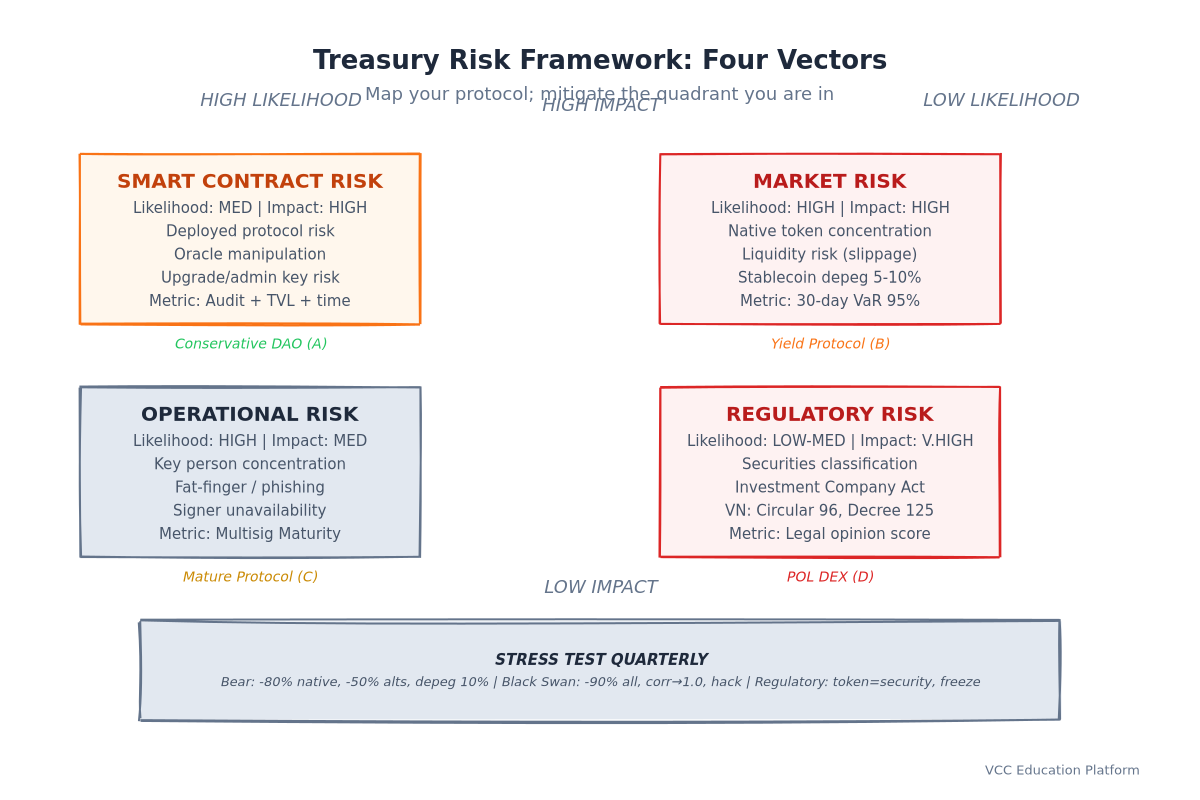
The Four Risk Vectors
1. Market Risk (Price + Liquidity)
- Native token correlation: If treasury is 70% native token, a 50% price drop = 35% treasury drawdown
- Liquidity risk: Can you sell $1M of native token in 1 hour without >5% slippage? (Most DAOs: no)
- Stablecoin depeg: USDC (March 2023: $0.87), USDT (transient), DAI (rare) — model 5-10% haircut
- Metric: 30-day VaR at 95% confidence — "We lose no more than $X in 95% of 30-day periods"
2. Smart Contract Risk (Code + Oracle)
- Deployed protocol risk: Aave v3 (audited, battle-tested) vs new unaudited yield farm
- Oracle risk: Chainlink (robust) vs single-source TWAP (manipulable)
- Upgrade risk: Proxy admin keys — who controls upgrades?
- Metric: Audit score + TVL + time-in-production composite. Deploy only >80th percentile.
3. Operational Risk (People + Process)
- Key person risk: 3 signers, 2 on same team, 1 unavailable = frozen treasury
- Fat-finger risk: Manual tx construction → wrong address, wrong amount
- Phishing/social engineering: Signer compromised → malicious proposal
- Metric: Multisig Maturity Level (see above). Level 1 = high operational risk.
4. Regulatory Risk (Law + Enforcement)
- Securities classification: Native token = security? (Howey test, SEC guidance)
- Investment company act: >40% in "investment securities" → registration required (US)
- Sanctions: OFAC-listed addresses in LP positions → frozen funds
- Vietnam risk: No clear DAO law. Circular 96 = property tax. Decree 125 = AML/KYC for VASPs. Could apply to DAO treasury operations.
- Metric: Legal opinion score — jurisdiction, token classification, entity structure.
Stress Testing Framework
Run quarterly (minimum). Scenarios:
| Scenario | Market | Smart Contract | Operational | Regulatory |
|---|---|---|---|---|
| Bear Market | -80% native, -50% alts, stablecoin depeg 10% | — | Signer unavailable 30 days | — |
| Black Swan | -90% everything, correlations → 1.0 | Major protocol hack (50% TVL loss) | 2/3 signers compromised | SEC enforcement action |
| Regulatory Shock | — | — | — | Token = security; custodian freeze |
Output: For each scenario, calculate: Treasury survival (Y/N), Runway remaining, Contributor payroll coverage, Protocol operation continuity.
Vietnamese Context: Tax, Regulation & Local Opportunities
Vietnam presents unique challenges and opportunities for DeFi treasury management.
Tax Landscape (Circular 96/2015/TT-BTC + Decree 125/2020/ND-CP)
| Event | Tax Treatment | Rate | Notes |
|---|---|---|---|
| Treasury rebalance (sell token A, buy token B) | Capital gains on disposal of A | 20% | No like-kind exchange exemption |
| Yield earned (lending, staking, LP fees) | Other income / Business income | 20% (corporate) or progressive (personal) | If DAO has VN entity |
| Token emissions received | Income at FMV on receipt | 20% | Airdrops, governance rewards |
| POL impermanent loss realized | Capital loss (offset gains) | 20% | Must document cost basis |
Critical gap: No guidance on:
- DAO as taxable entity vs. pass-through
- Multisig signers as "agents" vs. "owners"
- Foreign DAO with VN contributors = permanent establishment?
- Stablecoin swaps (USDC→USDT) = taxable?
Conservative approach: Treat every on-chain disposition as taxable. Maintain lot-level cost basis tracking (FIFO/LIFO consistent). Engage VN tax advisor familiar with Circular 96.
The Stablecoin Corridor Opportunity
Vietnam remittance market: $18B+/year (World Bank 2023). 40% YoY growth in stablecoin usage for cross-border (Chainalysis 2024).
Treasury play:
- Allocate 5-10% to USDT/VNDC or USDC/VNDC LP positions on Kyo Finance, DigiFinex Vietnam
- Earn: Trading fees (0.2-0.3%) + potential incentives + serve Vietnamese users
- Risk: VNDC peg (backed by VN banks, but not 1:1 audited), regulatory change
- Strategic value: Builds local liquidity moat; positions protocol for VN on-ramp partnerships
Local DeFi Infrastructure
- DEXs: Kyo Finance (VNDC pairs), DigiFinex Vietnam, KyberSwap (VN traffic)
- Wallets: Coin98 (2M+ users), MetaMask (standard)
- On-ramp: Coin98, Remitano (P2P USDT/VND), Binance P2P
- Talent: Strong Solidity/Rust dev pool (Vietnam #3 globally for devs)
The Multisig Maturity Model: From Basic to Institutional
Revisiting the custody layer with a maturity lens—because most DAOs are stuck at Level 1.
Level 1: Basic Multisig (Where 80% of DAOs Are)
- Gnosis Safe, 3/5 or 4/7 signers
- Signers: Founders, early investors, maybe one community member
- Failure modes: Signer loses key, signer goes rogue, signer unavailable, phishing
- Fix: Add timelock + simulation → Level 2
Level 2: Governed Multisig (Uniswap, Aave, Compound Standard)
- 48-72hr timelock on all non-emergency txs
- Tenderly/Blocknative simulation mandatory before signing
- Emergency guardian (2/3) can cancel queued tx
- Failure modes: Still self-custody; governance attack queues malicious tx
- Fix: Policy engine + MPC → Level 3
Level 3: Policy-Enforced MPC (Fireblocks, Fordefi, Lit Protocol)
- No private keys exist — threshold cryptography
- Policy engine: "No tx >5% treasury without 24hr delay + 2 independent approvals"
- Automated KYT/sanctions screening on every tx
- Key share recovery via social recovery or hardware backup
- Failure modes: Vendor risk; key share loss; policy misconfiguration
- Fix: Institutional custodian → Level 4
Level 4: Institutional Custody (Anchorage, Coinbase Prime, BitGo)
- Qualified custodian (SOC2 Type II, insurance)
- Regulatory reporting, audit rights
- Bankruptcy-remote segregation
- Failure modes: Cost (0.1-0.5%/year); jurisdictional risk; loss of sovereignty
- Only for: Regulated entities, >$500M, LP requirements
Migration path: Level 1 → 2 (immediate, free) → 3 (at $50M) → 4 (if required).
FAQ
How much stablecoin allocation is optimal?
No universal number. Depends on:
- Runway target: 12 months expenses in stablecoins = minimum floor
- Revenue predictability: Protocol revenue in USD? → less stablecoin needed. Revenue in native token? → more stablecoin needed.
- Contributor contracts: Payroll in USD? → stablecoin floor = payroll × 12-18 months
- Empirical data: Successful protocols (Uniswap, Aave, Compound) converge at 20-30% stablecoins. Below 15% = danger zone.
What is protocol-owned liquidity (POL) and when should we use it?
POL = protocol owns the LP positions instead of renting liquidity via incentives.
Use POL when:
- You're a DEX/AMM where liquidity depth = product quality
- You have persistent, predictable token emissions (can fund POL without selling)
- You can tolerate IL (impermanent loss) as cost of business
- You want to reduce mercenary capital (farmers who leave when incentives end)
Don't use POL when:
- You're a lending protocol, DAO tooling, or non-AMM — liquidity isn't your moat
- Token emissions are unpredictable or ending
- Treasury < $10M (POL capital inefficient at small scale)
How does Vietnam tax DAO treasury gains?
Current guidance (Circular 96): Crypto = property. 20% capital gains tax on disposal.
- Every rebalance (token A → token B) = disposal of A = taxable event
- Cost basis tracking required per lot (FIFO recommended)
- No DeFi-specific exemptions for yield, staking, LP fees
- If DAO has VN legal entity → corporate tax 20% on net gains
- If no VN entity but VN contributors → personal tax liability unclear
Action: Engage VN tax advisor. Implement cost-basis tracking before first rebalance.
Multisig vs MPC vs custodian: which for my treasury size?
| Treasury Size | Recommended | Rationale |
|---|---|---|
| <$1M | Gnosis Safe 3/5 + timelock | Free, sufficient security |
| $1-10M | Safe 4/7 + 48hr timelock + simulation | Low cost, audit trail |
| $10-50M | Safe + timelock + simulation + guardian | Defense in depth |
| $50-500M | MPC (Fireblocks/Fordefi) + policy engine | Institutional grade, no single key |
| >$500M | Institutional custodian (Anchorage/Coinbase Prime) | Regulatory, insurance, LP requirements |
Exception: If your protocol has US persons or seeks US LPs → consider Level 3 earlier ($10M+).
Key Takeaways
- Treasury management is survival management. The trilemma (Liquidity, Yield, Sovereignty) forces explicit trade-offs—make them consciously.
- Diversification ≠ holding multiple tokens. True diversification spans asset class, correlation, liquidity tier, custody model, and jurisdiction.
- Your treasury stack matures with your treasury. Level 1 multisig → Level 2 governed → Level 3 MPC → Level 4 custodian. Don't skip levels; don't stay at Level 1 past $10M.
- Vietnam adds complexity and opportunity. Tax uncertainty (Circular 96) demands conservative tracking. Stablecoin corridor (remittances) offers strategic yield + moat.
- POL is a strategy, not a default. Only for protocols where liquidity depth = competitive advantage.
- Reporting isn't optional. Monthly transparency builds trust with contributors, LPs, and users. It's also your early warning system.
Next Steps for Your Protocol
- Audit current state: Run the Trilemma assessment. Which corner are you over/under-weighted?
- Build the Revenue Router: Automate 100% of protocol revenue → treasury (no manual steps).
- Upgrade custody: If at Level 1, implement 48hr timelock + simulation this week.
- Set allocation policy: Document target ranges, rebalancing triggers, risk limits. Governance approves.
- Deploy conservatively: Start with Tier 0-1 (stablecoins + lending). Add Tier 2+ only after risk assessment.
- Track Vietnamese exposure: If VN users/contributors, implement cost-basis tracking and VNDC stablecoin allocation.
- Schedule quarterly stress tests: Bear market, black swan, regulatory shock. Document results.
Your treasury is your protocol's immune system. Build it before you need it.
Article completed: 2026-08-31 Primary keyword: defi treasury management Word count: ~3,200