
Testing DeFi applications is fundamentally different from traditional software testing. In traditional development, a bug might cause a crash or data corruption — annoying, but fixable with a patch. In DeFi, a bug can drain millions in user funds instantly, and due to blockchain immutability, there's often no "patch" — only a post-mortem. This reality shapes every testing methodology covered in this guide.
Whether you're building a DEX, lending protocol, or yield aggregator, DeFi testing methodologies must address composability risks, adversarial environments, and the inability to rollback. This article walks through the complete testing pyramid: from unit tests that catch logic errors, to fuzzing that discovers edge cases humans miss, to formal verification that mathematically proves critical invariants.
Why DeFi Testing Is Different from Traditional Software Testing
Three factors make DeFi testing a distinct discipline:
Immutability & Financial Stakes — Once deployed, smart contracts cannot be easily upgraded. A single integer overflow or reentrancy vulnerability can result in permanent fund loss. The 2016 DAO hack (3.6M ETH), 2021 Poly Network ($611M), and 2022 Wormhole ($320M) all exploited bugs that rigorous testing could have caught.
Composability Risks — DeFi protocols don't exist in isolation. Your lending protocol integrates with a DEX for liquidations, which relies on an oracle for pricing, which may use a Chainlink feed that could deviate. Testing must cover not just your code, but how your code behaves when composed with other protocols — including adversarial compositions.
Adversarial Environment — Every transaction is public before execution. MEV bots front-run, sandwich, and back-run profitable transactions. Liquidators compete to execute liquidations first. Your tests must simulate this adversarial reality, not just happy paths.
Key insight: Traditional testing asks "does it work?" DeFi testing asks "how does it fail, and what's the blast radius?"
Unit Testing Smart Contracts: Foundations
Unit testing forms the base of the testing pyramid. In DeFi, unit tests verify individual functions in isolation — minting, burning, transferring, calculating rewards, checking access control.
Tooling Landscape
| Framework | Language | Speed | Best For |
|---|---|---|---|
| Foundry (forge) | Solidity | ⚡⚡⚡ Fastest | Pure Solidity teams, fuzzing integration |
| Hardhat | TypeScript/JavaScript | ⚡⚡ Good | TypeScript teams, complex fixtures, mainstream tooling |
| Truffle | JavaScript | ⚡ Slow | Legacy projects, migration-heavy workflows |
Recommendation: For new DeFi projects in 2024+, Foundry is the default choice. Its Solidity-native tests eliminate context switching, built-in fuzzing/invariant testing, and blazing speed (10-100x faster than Hardhat) enable tight feedback loops.
Core Unit Testing Patterns
The AAA Pattern (Arrange-Act-Assert): `solidity function testUserCanDepositAndWithdraw() public { // Arrange vm.deal(user, 1000 ether); vm.prank(user); vault.deposit(100 ether);
// Act vm.prank(user); vault.withdraw(50 ether);
// Assert assertEq(vault.balanceOf(user), 50 ether); } `
Foundry Cheat Codes for Realistic State: `solidity function testLiquidationWithRealisticPrices() public { // Arrange: fork mainnet state at block 19M vm.createFork("https://eth-mainnet.alchemyapi.io/v2/KEY", 19_000_000);
// Act: manipulate oracle price to trigger liquidation vm.prank(oracleAdmin); oracle.updatePrice(ETH_USD, 1500 * 1e8); // ETH drops to $1500
// Assert: position should be liquidatable assertTrue(vault.isLiquidatable(riskyPosition)); } `
Edge Cases Every DeFi Unit Test Must Cover
- Reentrancy — Test
nonReentrantmodifiers with malicious contracts that call back - Integer Overflow/Underflow — Solidity 0.8+ has built-in checks, but custom math libraries need tests
- Access Control — Test every
onlyOwner,onlyRole,onlyGovernancemodifier with unauthorized callers - Zero Address Checks —
transferFrom(address(0), ...)and similar edge cases - Precision Loss — Division before multiplication in fee calculations, reward distributions
- Timestamp Manipulation —
vm.roll(block.timestamp + 1 days)to test time-dependent logic
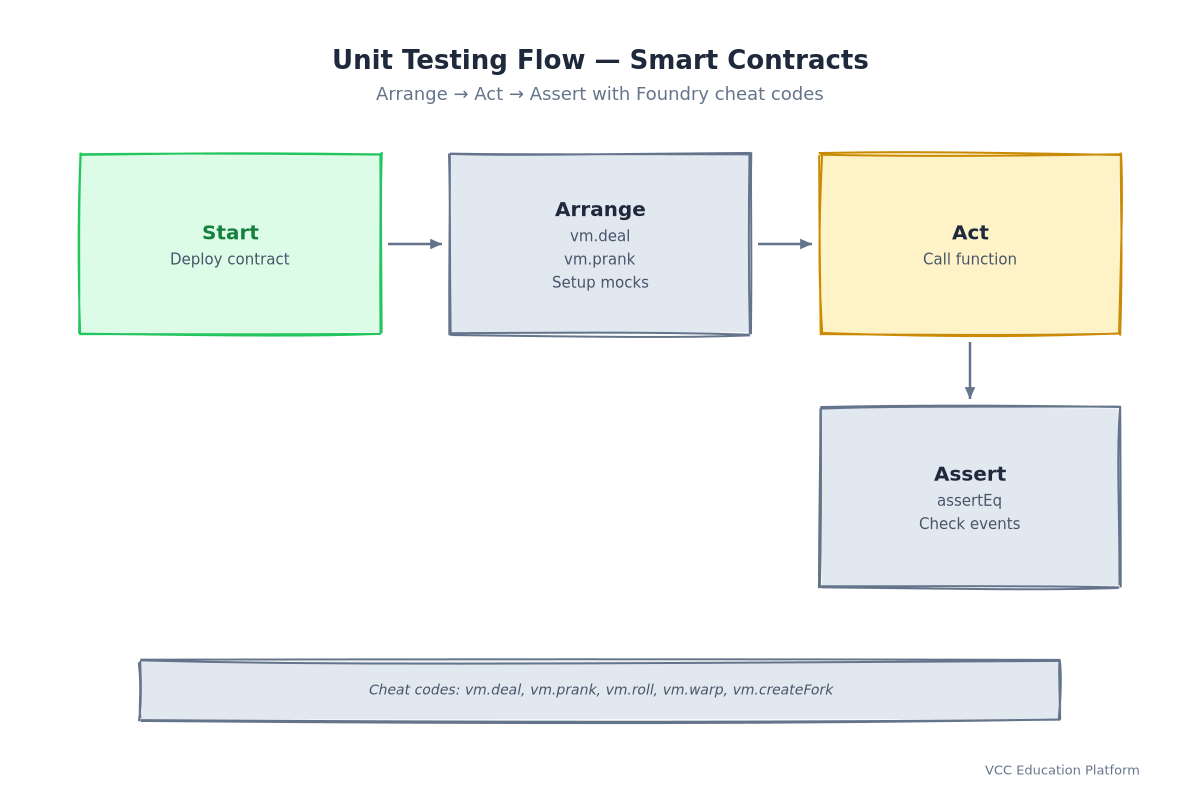
Flowchart - Unit testing flow for smart contracts
Integration Testing DeFi Protocols: Testing Composability
Unit tests verify components; integration tests verify the system. In DeFi, this means testing multi-contract interactions, protocol-to-protocol compositions, and state transitions across contract boundaries.
The Integration Test Architecture
A proper integration test suite mirrors your production deployment:
` ┌─────────────────────────────────────────────────────────────┐ │ INTEGRATION TEST SUITE │ ├─────────────────┬─────────────────┬─────────────────────────┤ │ CORE PROTOCOL │ EXTERNAL DEPS │ ADVERSARIAL │ │ (Your Contracts)│ (Mocked/Real) │ ACTORS │ ├─────────────────┼─────────────────┼─────────────────────────┤ │ • Vault │ • Oracle (Mock) │ • MEV Bot │ │ • Strategy │ • DEX (Real) │ • Liquidator │ │ • Rewards │ • ERC20 Tokens │ • Front-runner │ │ • Governance │ • Bridge │ • Sandwich Attacker │ └─────────────────┴─────────────────┴─────────────────────────┘ `
Diagram - Integration test architecture for DeFi protocols
Testing Protocol Composition: A Real Example
Consider a lending protocol that uses Uniswap V3 for liquidations and Chainlink for pricing:
`solidity // Integration test: full liquidation flow function testFullLiquidationFlow() public { // 1. Setup: deposit collateral, borrow against it vm.deal(borrower, 100 ether); vm.prank(borrower); weth.deposit{value: 50 ether}(borrower); weth.approve(address(lending), 50 ether); lending.depositCollateral(address(weth), 50 ether); lending.borrow(address(usdc), 20_000 * 1e6); // $20k USDC
// 2. Price drop: ETH falls from $2000 to $1500 vm.prank(chainlinkAdmin); mockChainlink.updateAnswer(address(weth), 1500 * 1e8);
// 3. Liquidator calls liquidate() vm.deal(liquidator, 25_000 1e6); // USDC to repay vm.prank(liquidator); usdc.approve(address(lending), 25_000 1e6); lending.liquidate(borrower, address(weth), address(usdc), 20_000 * 1e6);
// 4. Verify: liquidator receives discounted collateral // 5. Verify: borrower debt reduced, collateral seized // 6. Verify: Uniswap V3 swap executed for collateral → USDC } `
Integration Testing Best Practices
- Use Real Contracts Where Possible — Fork mainnet for DEXs, oracles, tokens. Mock only what you control.
- Test State Transitions Explicitly — Verify storage slots, events, and balances at each step
- Parametrize External Dependencies — Swap mock oracle for real Chainlink fork; swap local Uniswap for mainnet fork
- Test Failure Modes — What happens if oracle is stale? DEX has no liquidity? Bridge is paused?
Fuzzing & Property-Based Testing: Finding Edge Cases Automatically
Unit and integration tests cover known scenarios. Fuzzing explores the unknown — generating thousands of random inputs to find edge cases humans never imagine.
Invariant Testing Philosophy
Traditional testing: "Given input X, expect output Y" Property-based testing: "For ALL valid inputs, property P must hold"
Invariants are properties that must always be true, regardless of state or inputs:
totalSupply == sumOfAllBalancescollateralRatio >= minimumCollateralRatio(for solvent positions)rewardsDistributed <= rewardsAccruednoUserCanWithdrawMoreThanDeposited()
Tools Comparison
| Tool | Approach | Strengths | Learning Curve |
|---|---|---|---|
| Foundry Fuzz | Built-in, Solidity-native | Zero setup, fast, integrates with forge test | Low |
| Echidna | Standalone, Haskell-based | Deeper exploration, corpus persistence, Shrinking | Medium |
| Halmos | Symbolic execution + fuzzing | Finds deeper bugs, proves unreachability | High |
Recommendation: Start with Foundry fuzz (it's free and built-in). Graduate to Echidna for critical protocols. Reserve Halmos for highest-value targets.
Writing Effective Invariants
`solidity // Foundry invariant test invariant("Total assets never exceed total shares pricePerShare") public { assertLe(vault.totalAssets(), vault.totalSupply() vault.pricePerShare()); }
invariant("No position can be undercollateralized") public { for (uint i = 0; i < vault.positionsLength(); i++) { Position memory pos = vault.positions(i); if (pos.collateral > 0) { assertGe(pos.collateralRatio(), vault.minCollateralRatio()); } } } `
Campaign Management
- Duration: Run 4-8 hours for CI; 24-72 hours for release candidates
- Corpus Persistence: Save interesting inputs between runs (Echidna does this automatically)
- Shrinking: When a bug is found, minimize the input to understand root cause
- Gas Reporting: Track gas usage distribution — outliers often indicate bugs
Sequence - Fuzzing process and invariant discovery
Fork Testing & Mainnet Simulation: Real-World Conditions
Fork testing runs your tests against a live (or recent) mainnet state. This catches bugs that only manifest with real contract addresses, real token balances, real oracle prices, and real protocol interactions.
Fork Testing Tools
| Tool | Fork Source | Best For |
|---|---|---|
| Anvil (Foundry) | RPC URL (Alchemy, Infura, QuickNode) | Local development, CI, fast iteration |
| Hardhat Fork | RPC URL | TypeScript teams, complex fixtures |
| Tenderly Simulation | Tenderly platform | Visual debugging, gas profiling, sharing |
| Foundry Fork | RPC + block number | Historical replay, specific block testing |
When to Use Fork Testing
- Testing Against Real Protocols — Your protocol integrates with Aave V3, Uniswap V3, Curve. Mocks can't replicate their exact behavior.
- MEV & Front-Running Simulation — Simulate a sandwich attack by manipulating transaction ordering in the fork
- Historical Replay — "Would our contract have survived the May 2022 crash?" Fork at block 14,800,000 and replay
- Large Holder Testing — "What if a whale deposits $50M?" Fork,
vm.deal(whale, 50_000_000 USDC), test - Governance Attack Simulation — Fork, propose malicious governance action, verify timelock/quorum prevents it
Fork Testing Workflow
`bash
anvil --fork-url $MAINNET_RPC --fork-block-number 19500000
forge test --fork-url http://localhost:8545 -vvvv
vm.createSelectFork("https://eth-mainnet.alchemyapi.io/v2/KEY", 19500000); `
Vietnamese Developer Context
Vietnamese developers often face RPC latency to US/EU nodes. Local RPC providers (NodeReal Vietnam, BlockPi Asia, Chainstack SG) reduce fork latency from 300ms+ to 50-80ms, making fork testing practical in CI/CD.
Flowchart - Fork testing workflow with mainnet simulation
Formal Verification: Mathematical Guarantees for Critical Invariants
Formal verification uses mathematical proofs to guarantee that certain properties hold for all possible executions. Unlike testing (which samples), verification proves.
When to Use Formal Verification
Use it for:
- Core accounting invariants (
totalAssets == sum(balances)) - Access control invariants (
onlyOwnerfunctions truly only callable by owner) - Upgrade safety (storage layout compatibility)
- Mathematical formulas (AMM curves, interest rate models)
Skip it for:
- UI logic, frontend integration
- Complex external protocol interactions (too many assumptions)
- Rapidly changing code (verification specs must be maintained)
Tool Landscape
| Tool | Approach | Cost | Expertise Required |
|---|---|---|---|
| Certora Prover | CVL specs, static analysis | $$$ (enterprise) | High (CVL language) |
| Scribble | Runtime verification via instrumentation | Free | Low (Solidity annotations) |
| KeVM | K-framework semantics | Free | Very High |
| Solidity SMTChecker | Built-in (experimental) | Free | Medium |
Recommendation: Scribble for adoption (annotate existing code, run in CI). Certora for production protocols with >$10M TVL — budget for audit firm partnership.
Scribble Example: Annotating Invariants
`solidity /// @notice Vault invariant: total assets always >= total shares /// #invariant "totalAssets() >= totalSupply()" contract Vault { function totalAssets() public view returns (uint) { ... } function totalSupply() public view returns (uint) { ... } } `
Run: scribble contracts/Vault.sol --output instrumented/ && forge test --instrumented
Certora CVL Example
`cvl // Vault.spec rule totalAssetsGeTotalSupply() { mathint totalAssets = vault.totalAssets(); mathint totalSupply = vault.totalSupply(); assert totalAssets >= totalSupply, "Total assets < total supply"; } `
Run: certoraRun certora/Vault.spec --verify Vault:Vault
Testing Tool Comparison: Choosing the Right Stack
Your testing stack should match your team, protocol complexity, and risk tolerance.
Decision Framework
| Project Profile | Recommended Stack |
|---|---|
| Small team, new protocol, <$1M TVL target | Foundry (unit + fuzz) + Scribble |
| Growing team, multiple integrations, $1-50M TVL | Foundry + Echidna + Fork testing (Anvil) + Scribble |
| Production protocol, >$50M TVL, institutional users | Full stack: Foundry + Echidna + Certora + Tenderly + Fork CI |
| Cross-chain / multi-VM protocol | Add: Hardhat (for non-EVM), specialized fuzzers |
CI/CD Integration: Automated Testing Pipelines
A production-ready DeFi CI pipeline runs different test layers at different frequencies:
`yaml
name: DeFi Test Suite
on: push: branches: [main, develop] pull_request: schedule:
- cron: '0 2 *' # Nightly fuzz campaigns
jobs: unit-tests: runs-on: ubuntu-latest steps:
- uses: actions/checkout@v4
- uses: foundry-rs/foundry-toolchain@v1
- run: forge test --match-contract UnitTest
integration-tests: runs-on: ubuntu-latest steps:
- uses: actions/checkout@v4
- uses: foundry-rs/foundry-toolchain@v1
- run: forge test --match-contract IntegrationTest --fork-url ${{ secrets.MAINNET_RPC }}
fuzz-campaign: if: github.event_name == 'schedule' || github.event_name == 'pull_request' runs-on: ubuntu-latest timeout-minutes: 480 # 8 hours steps:
- uses: actions/checkout@v4
- uses: foundry-rs/foundry-toolchain@v1
- run: forge test --match-contract FuzzTest --fuzz-runs 100000
formal-verification: if: github.event_name == 'pull_request' && github.base_ref == 'main' runs-on: ubuntu-latest steps:
- uses: actions/checkout@v4
- run: scribble contracts/*/.sol --output instrumented/
- run: forge test --instrumented
`
Coverage & Quality Gates
`bash
forge coverage --report lcov
`
Common Testing Patterns & Anti-Patterns
Patterns That Work (Do These)
1. Property-Based Test Design `solidity // Good: Test the property, not the implementation function invariant_NoFreeMoney() public { uint256 initialTotalValue = vault.totalAssets(); // ... arbitrary operations ... assertGe(vault.totalAssets(), initialTotalValue); } `
2. Adversarial Test Suite Explicitly test attack vectors: `solidity function testSandwichAttackResistance() public { ... } function testFlashLoanAttack() public { ... } function testOracleManipulation() public { ... } `
3. Stateful Fuzzing with Setup `solidity function setUp() public { // Deploy full protocol // Seed with realistic liquidity } `
4. Fork Testing for Regression When a mainnet incident occurs, add a fork test at that block to prevent regression.
Anti-Patterns That Fail (Avoid These)
❌ Testing Implementation, Not Behavior `solidity // Bad: Tightly coupled to internal implementation function testInternalMappingUpdated() public { assertEq(vault.userDeposits[user], 100 ether); // Breaks on refactor } `
❌ Ignoring Composability `solidity // Bad: Tests in isolation, misses integration bugs function testDeposit() public { vault.deposit(100 ether); } // No DEX, oracle, etc. `
❌ Only Testing Happy Paths `solidity // Bad: No error conditions tested function testWithdraw() public { vault.withdraw(50 ether); // What if paused? What if insolvent? } `
❌ Coverage Theater Chasing 100% line coverage with meaningless assertions. One meaningful invariant test > 100 trivial unit tests.
❌ No CI Integration Tests that only run locally. If it's not in CI, it doesn't exist.
Vietnamese DeFi Context: Practical Considerations
Vietnam has a growing DeFi builder community (Kyber Network, Coin98, TomoChain alumni). Local realities:
RPC Infrastructure: Use NodeReal, BlockPi, or Chainstack Vietnam endpoints for lower latency fork testing.
Audit Landscape: Verichains, PeckShield Vietnam, and CertiK Vietnam offices understand local projects. Budget 2-3 audits for mainnet launch.
Talent Pipeline: Vietnamese universities (HUST, UEH, FPT) now offer blockchain electives. Interns often know Solidity but lack testing rigor — invest in internal training.
Regulatory Grey Area: No clear DeFi regulation yet. Rigorous testing + audit reports are your best defense for future compliance.
Conclusion
DeFi testing isn't a checkbox — it's a continuous discipline. The testing pyramid applies, but with DeFi-specific layers:
- Unit Tests (Foundry/Hardhat) — Fast feedback, catch logic errors
- Integration Tests (Fork + Real Deps) — Catch composability bugs
- Fuzzing (Foundry/Echidna) — Discover unknown edge cases
- Formal Verification (Certora/Scribble) — Prove critical invariants
Start with Foundry unit tests today. Add fuzzing this week. Fork testing before testnet. Formal verification before mainnet with significant TVL.
The cost of testing is measured in developer hours. The cost of not testing is measured in user funds lost — and in DeFi, that's a price no protocol can afford to pay.
FAQ
Q: How much fuzzing is enough? A: Run 100k+ iterations in CI per PR; 1M+ for release candidates. Diminishing returns appear around 4-8 hours for most protocols.
Q: Can I skip formal verification for a small protocol? A: Yes, but use Scribble (free, low effort) for critical accounting invariants. Reserve Certora for >$10M TVL.
Q: Should I mock external protocols or fork them? A: Fork for integration tests (real behavior). Mock for unit tests (speed, isolation). Use both.
Q: What's the biggest testing gap in most DeFi projects? A: Integration testing under adversarial conditions (MEV, oracle manipulation, cascading liquidations).
Q: How do I test upgradeable contracts? A: Test proxy + implementation separately, then test upgrade process (storage layout, initialization, migration).
Q: Are there Vietnam-specific testing resources? A: Verichains publishes Vietnamese-language testing guides. Coin98 dev Discord has testing channels. Join the community.
Further Resources
- Foundry Book: book.getfoundry.sh (testing, fuzzing, forking chapters)
- Echidna GitHub: github.com/crytic/echidna
- Certora Docs: docs.certora.com
- Scribble: github.com/ConsenSys/scribble
- Trail of Bits Publications: blog.trailofbits.com (search "fuzzing", "testing")
- Vietnamese DeFi Builders: Kyber Network Engineering Blog, Coin98 Labs Medium