
DeFi smart contract patterns have evolved from experimental curiosities into the backbone of billions in Total Value Locked (TVL). When Uniswap V3 deployed over 4,000 pools using factory patterns, and Aave V3 adopted diamond architecture for modular risk management, these patterns proved they're not academic exercises—they're production infrastructure. Yet every upgradeable contract carries a hidden tax: ~400-800 gas per delegatecall, cognitive overhead for developers, and a new trust assumption for users. This guide cuts through the complexity to help you choose the right pattern for your DeFi protocol.
The Upgradeability Problem in DeFi
Smart contracts are immutable by default. Once deployed, their code cannot change—a feature, not a bug, for trust minimization. But DeFi protocols face a dilemma: bugs exist, regulations evolve, and markets demand new features. The 2022 Wormhole hack ($320M) exploited a signature verification bug that a timely upgrade could have prevented. The 2023 Euler Finance hack ($197M) involved a donation logic flaw patched post-exploit. These incidents didn't just cost money—they reshaped how protocols think about upgradeability.
Immutability vs Upgradeability Tradeoff
| Dimension | Immutable | Upgradeable |
|---|---|---|
| Trust | Code is law | Admin can change logic |
| Gas | Direct calls | ~400-800 gas/delegatecall |
| Audit | Single audit | Re-audit on every upgrade |
| Governance | None needed | Timelock/multisig/DAO required |
| Bug Response | Deploy new, migrate | Patch in place |
The "Proxy Tax" goes beyond gas. Every proxy adds cognitive overhead: developers must understand delegatecall semantics, storage layout rules, and initializer patterns. Debuggers and tracers often struggle with proxy call stacks. Auditors charge 30-50% premiums for proxy codebases. Governance introduces latency—timelocks delay critical fixes by 24-72 hours.
Original insight: Frame proxy adoption as "technical debt with interest." Only proxy contracts with >50% probability of needing upgrades within 2 years. Simple ERC20 tokens, basic vaults, and one-time deployment contracts rarely justify the tax.
Real-World Incidents Driving Pattern Adoption
The shift toward upgradeable patterns correlates with major DeFi incidents:
- bZx (2020): Oracle manipulation → upgraded price feed logic via proxy
- Harvest Finance (2020): Arbitrage exploit → emergency upgrade to pause contracts
- Poly Network (2021): Cross-chain exploit → proxy-enabled recovery
- Wormhole (2022): Signature verification → upgradeable guardian set
- Euler (2023): Donation logic → post-hack upgrade to prevent recurrence
Each incident reinforced a pattern: protocols with upgradeability recovered faster. But they also revealed governance risks—admin keys become high-value targets.

Proxy Patterns Deep Dive
Proxy patterns use delegatecall to separate contract logic (implementation) from state (proxy storage). The proxy holds user funds and state; the implementation contains business logic. When the implementation needs updating, the proxy's implementation address changes—state persists.
Standard Proxy (Delegatecall Forwarding)
The simplest proxy forwards all calls to an implementation address:
`solidity // Minimal proxy - NOT for production (no upgrade mechanism) contract SimpleProxy { address public implementation;
constructor(address _impl) { implementation = _impl; }
fallback() external payable { address impl = implementation; assembly { calldatacopy(0, 0, calldatasize()) let result := delegatecall(gas(), impl, 0, calldatasize(), 0, 0) returndatacopy(0, 0, returndatasize()) if iszero(result) { revert(0, returndatasize()) } return(0, returndatasize()) } } } `
Problem: No upgrade mechanism. Once deployed, implementation is fixed.
Transparent Proxy (OpenZeppelin)
The Transparent Proxy (EIP-1967 compliant) solves the "function selector clash" by routing admin calls differently than user calls:
`solidity // Simplified TransparentUpgradeableProxy logic contract TransparentProxy { // Admin functions: upgradeTo, changeAdmin, admin() // User functions: delegated to implementation // Selector check: if msg.sender == admin → admin logic, else delegatecall } `
Storage slots (EIP-1967):
- Implementation:
0x360894a13ba1a3210667c828492db98dca3e2076cc3735a920a3ca505d382bbc - Admin:
0xb53127684a568b3173ae13b9f8a6016e243e63b6e8ee1178d6a717850b5d6103
Tradeoff: Every user call pays gas for the msg.sender == admin check (~200 gas). Admin cannot call implementation functions directly.
UUPS (Universal Upgradeable Proxy Standard - EIP-1822)
UUPS moves upgrade logic into the implementation itself, saving gas on user calls:
`solidity // ERC1822Proxiable interface interface IERC1822Proxiable { function proxiableUUID() external view returns (bytes32); }
// Implementation must implement upgrade logic contract UUPSImplementation is IERC1822Proxiable, Initializable { function proxiableUUID() external view override returns (bytes32) { return type(IERC1822Proxiable).interfaceId; }
function upgradeTo(address newImpl) external { // Access control: onlyAuthorized() // Validate newImpl implements proxiableUUID() // Update implementation slot }
// Storage gap for future upgrades uint256[50] private __gap; } `
Advantages: No admin check on user calls. Implementation controls its own upgrades. ~200 gas cheaper per call than Transparent Proxy.
Risk: If upgradeTo has a bug, the contract bricks permanently. No admin fallback.
Beacon Proxy (EIP-1967 Beacon)
For deploying many proxies pointing to the same implementation:
`solidity contract BeaconProxy { // Points to Beacon contract // Beacon stores implementation address // Upgrade beacon → all proxies update simultaneously } `
Used by: Lido (stETH), Rocket Pool—dozens of validators sharing logic.
Proxy Comparison: Gas, Storage, Governance
| Pattern | User Call Gas | Upgrade Gas | Storage Collision Risk | Admin Fallback | Best For |
|---|---|---|---|---|---|
| Transparent | +600-800 | ~50k | Low (EIP-1967 slots) | Yes | General purpose |
| UUPS | +400-600 | ~40k | Medium (impl controls) | No | Gas-sensitive |
| Beacon | +400-600 | ~30k (beacon) | Low | Yes | Many clones |
| Standard | +400-600 | N/A | High (no standard) | N/A | One-time deploy |

Diamond Pattern (EIP-2535): Modular DeFi Architecture
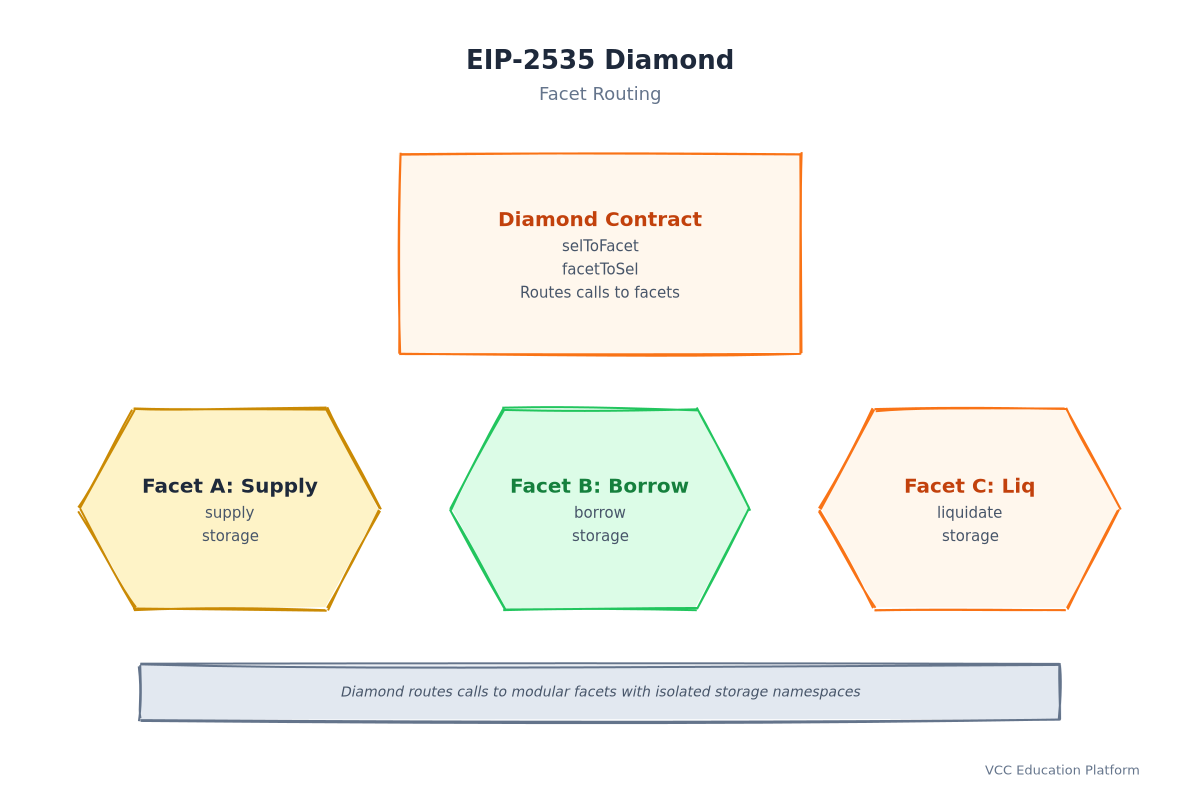
If proxies are "single inheritance," diamonds are "composition over inheritance." The Diamond Standard (EIP-2535) lets a single contract expose multiple "facets"—independent contracts sharing the same address and storage. Think of it as microservices for smart contracts: facets = services, diamond storage = shared database with namespaces, loupe functions = service discovery.
Facet Routing and Function Selectors
The diamond's fallback function routes calls to the correct facet:
`solidity contract Diamond { // mapping(bytes4 => FacetAddress) selectorToFacet // mapping(address => bytes4[]) facetToSelectors
fallback() external payable { bytes4 selector = msg.sig; address facet = selectorToFacet[selector]; require(facet != address(0), "Function not found");
assembly { calldatacopy(0, 0, calldatasize()) let result := delegatecall(gas(), facet, 0, calldatasize(), 0, 0) returndatacopy(0, 0, returndatastize()) if iszero(result) { revert(0, returndatasize()) } return(0, returndatasize()) } } } `
Each facet owns a set of function selectors. No two facets can share a selector. Adding/replacing/removing facets uses diamondCut:
`solidity struct FacetCut { address facetAddress; bytes4[] functionSelectors; bool isReplacement; // true = replace, false = add }
function diamondCut(FacetCut[] calldata cuts) external { // Validate: no selector conflicts, facet implements functions // Apply cuts atomically // Emit DiamondCut event } `
Diamond Storage vs AppStorage
Two approaches to shared state:
AppStorage (Single Struct): `solidity struct AppStorage { uint256 totalSupply; mapping(address => uint256) balances; // All state in one struct } AppStorage internal s; // Slot 0 ` Pros: Simple, familiar. Cons: All facets share same namespace—collision risk.
Diamond Storage (Namespaced): `solidity // Facet A storage bytes32 constant FACET_A_STORAGE = keccak256("diamond.storage.facetA"); struct FacetAStorage { uint256 a; } FacetAStorage storage a = FacetAStorage(FACET_A_STORAGE);
// Facet B storage bytes32 constant FACET_B_STORAGE = keccak256("diamond.storage.facetB"); struct FacetBStorage { uint256 b; } FacetBStorage storage b = FacetBStorage(FACET_B_STORAGE); ` Pros: Zero collision risk, facets truly independent. Cons: More verbose, multiple storage reads.
Aave V3 uses Diamond Storage for risk management modules—each market configuration isolated in its own namespace.
Loupe Functions for Introspection
EIP-2535 requires four "loupe" functions for on-chain introspection:
`solidity interface IDiamondLoupe { function facets() external view returns (Facet[] memory); function facetFunctionSelectors(address facet) external view returns (bytes4[] memory); function facetAddresses() external view returns (address[] memory); function facetAddress(bytes4 selector) external view returns (address); } `
These enable:
- Frontends to discover available functions
- Auditors to verify facet deployment
- Governance to audit proposed cuts
Adding/Replacing/Removing Facets
The diamondCut function handles all modifications atomically:
`solidity // Add new facet with 3 functions FacetCut({ facetAddress: address(newFacet), functionSelectors: [selector1, selector2, selector3], isReplacement: false })
// Replace facet (migrate logic) FacetCut({ facetAddress: address(newFacetV2), functionSelectors: [selector1, selector2], // Same selectors isReplacement: true })
// Remove facet FacetCut({ facetAddress: address(0), functionSelectors: [selector1, selector2], isReplacement: false }) `
Critical: diamondCut must be access-controlled (timelock + multisig). A malicious cut can drain all diamond storage.
Factory Pattern (EIP-1167): Scaling DeFi Deployments
Factory patterns deploy many clones of a template contract. EIP-1167 (Minimal Proxy) reduces deployment gas from ~500k to ~45k—a 10x savings. Uniswap V3's factory created ~4,000 pools. At 20 gwei: 4,000 × 500k gas = 2B gas ($500k) vs 4,000 × 45k = 180M gas ($45k). Factory patterns make permissionless deployment economically viable.
Minimal Proxy (Clone Factory)
`solidity // EIP-1167 Minimal Proxy bytecode (45 bytes) contract CloneFactory { bytes20 internal constant MINIMAL_PROXY_BYTECODE = 0x363d3d373d3d3d363d730000000000000000000000005af43d82803e903d91602b57fd5bf3;
function createClone(address template) external returns (address clone) { bytes memory bytecode = bytes(MINIMAL_PROXY_BYTECODE); // Insert template address at offset 10 bytecode[10:30] = abi.encodePacked(template);
assembly { clone := create(0, add(bytecode, 32), mload(bytecode)) if iszero(extcodesize(clone)) { revert(0, 0) } } // Initialize clone IInitializable(clone).initialize(msg.sender); return clone; } } `
How it works: The clone's runtime code is just a delegatecall to the template. State lives in the clone; logic in the template. Template must be Initializable (no constructor).
CREATE2 Deterministic Addresses
CREATE2 enables computing clone addresses before deployment:
`solidity function createCloneCREATE2(address template, bytes32 salt) external returns (address clone) { bytes memory bytecode = bytes(MINIMAL_PROXY_BYTECODE); bytecode[10:30] = abi.encodePacked(template);
assembly { clone := create2(0, add(bytecode, 32), mload(bytecode), salt) if iszero(extcodesize(clone)) { revert(0, 0) } } IInitializable(clone).initialize(msg.sender); return clone; }
// Address prediction (off-chain or on-chain) function predictAddress(address template, bytes32 salt) public view returns (address) { return address(uint160(uint256(keccak256(abi.encodePacked( bytes1(0xff), address(this), salt, keccak256(bytecode) ))))); } `
Uniswap V3 uses CREATE2 for pool addresses: salt = keccak256(abi.encodePacked(tokenA, tokenB, fee)). Anyone can compute a pool address before it exists.
Factory with Initialization Parameters
Clones often need per-instance configuration:
`solidity interface IInitializable { function initialize(address owner, uint256 param1, string calldata param2) external; }
contract ConfigurableCloneFactory { function createClone( address template, address owner, uint256 param1, string calldata param2 ) external returns (address clone) { clone = createClone(template); IInitializable(clone).initialize(owner, param1, param2); return clone; } } `
Front-running risk: Between create and initialize, the clone is uninitialized. Mitigation: atomic create+initialize via create2 with initialization data in bytecode, or use ERC1167 with initialize in constructor (not possible with minimal proxy).
Pattern Comparison & Selection Framework
Choosing the right pattern depends on your protocol's constraints. Here's a decision framework:
Gas Cost Comparison Table
| Operation | Direct Call | Transparent Proxy | UUPS | Diamond | Minimal Proxy Deploy |
|---|---|---|---|---|---|
| Function call | Baseline | +600-800 | +400-600 | +600-1000 | N/A |
| Deploy new logic | ~500k+ | ~50k (proxy) | ~40k (impl) | ~60k (facet) | ~45k (clone) |
| Upgrade | Redeploy | ~50k | ~40k | ~50k (cut) | Redeploy template |
| Storage read | Baseline | Baseline | Baseline | +100 (namespace) | Baseline |
Complexity vs Flexibility Matrix
| Pattern | Complexity | Flexibility | Upgrade Granularity | Audit Burden |
|---|---|---|---|---|
| Transparent Proxy | Low | Medium | Whole contract | Medium |
| UUPS | Medium | Medium | Whole contract | Medium |
| Beacon | Medium | Low | All clones at once | Medium |
| Diamond | High | High | Per facet | High |
| Factory | Low | Low | Template only | Low |
Decision Flowchart: Which Pattern to Choose?
` START: Need upgradeability? │ ├─ NO → Deploy immutable contract (lowest gas, highest trust) │ └─ YES → Multiple independent modules needing separate upgrades? │ ├─ YES → Diamond Pattern (EIP-2535) │ ├─ Need on-chain introspection? → Loupe functions │ └─ Team has diamond expertise? → If no, reconsider │ └─ NO → Many similar contracts (pools, vaults, positions)? │ ├─ YES → Factory + Minimal Proxy (EIP-1167) │ ├─ Need deterministic addresses? → CREATE2 │ └─ Template rarely changes? → Good fit │ └─ NO → Single contract, occasional upgrades? │ ├─ Gas critical? → UUPS (EIP-1822) ├─ Need admin fallback? → Transparent Proxy └─ Many proxies same logic? → Beacon Proxy `
Real-World DeFi Protocol Case Studies
Uniswap V3: Factory + Pool Deployment
Uniswap V3's architecture demonstrates factory pattern mastery:
`solidity // UniswapV3Factory.sol (simplified) contract UniswapV3Factory { address public poolTemplate; // Minimal proxy template
function createPool(address tokenA, address tokenB, uint24 fee) external returns (address pool) { (tokenA, tokenB) = sortTokens(tokenA, tokenB); bytes32 salt = keccak256(abi.encodePacked(tokenA, tokenB, fee)); pool = createPoolByCREATE2(tokenA, tokenB, fee, salt); }
function createPoolByCREATE2(...) internal returns (address pool) { // CREATE2 deployment with fee-specific initialization } } `
Key decisions:
- CREATE2 for deterministic pool addresses (enables off-chain routing)
- Fee tiers (0.01%, 0.05%, 0.3%, 1%) as separate pools
- Pool template immutable—upgrades via new factory version
- ~45k gas per pool vs ~500k+ for full deployment
Aave V3: Proxy + Diamond Module System
Aave V3 combines patterns: Transparent Proxy for core protocol, Diamond for risk modules:
` AaveV3Pool (Transparent Proxy) └── PoolLogic (Implementation) └── Diamond (Risk Management) ├── Facet: SupplyLogic ├── Facet: BorrowLogic ├── Facet: LiquidationLogic ├── Facet: EmissionLogic └── Facet: ConfigurationLogic `
Why this composition?
- Pool logic upgrades rarely (Transparent Proxy sufficient)
- Risk parameters change frequently (Diamond enables per-facet upgrades)
- Loupe functions let frontends discover active risk modules
- Isolation: liquidation logic bug doesn't affect supply logic
OpenZeppelin Contracts Wizard: Pattern Composition
The OpenZeppelin Wizard generates starter code combining patterns:
`solidity // Wizard output: UUPS + Ownable + ERC20 + AccessControl contract MyToken is ERC20Upgradeable, ERC20PermitUpgradeable, OwnableUpgradeable, AccessControlUpgradeable, UUPSUpgradeable { function initialize(...) public initializer { ... }
function _authorizeUpgrade(address newImpl) internal override onlyRole(UPGRADER_ROLE) { } } `
Lesson: Real protocols compose patterns. Aave uses Proxy + Diamond. Uniswap uses Factory + Immutable Pools. Compound uses Transparent Proxy + Timelock.
Anti-Patterns & Common Mistakes
Storage Collision Vulnerabilities
The #1 upgrade vulnerability: new implementation writes to wrong storage slot.
`solidity // V1: Single variable contract V1 { uint256 public value; }
// V2: Added variable BEFORE existing one - COLLISION! contract V2 { uint256 public newValue; // Slot 0 - OVERWRITES value! uint256 public value; // Slot 1 } `
Fix: Storage gaps (OpenZeppelin pattern):
`solidity contract V1 { uint256 public value; uint256[50] private __gap; // Reserve 50 slots }
contract V2 { uint256 public value; uint256 public newValue; // Uses gap slot uint256[49] private __gap; // 49 remaining } `
Diamond storage eliminates this via namespaced keccak256 keys.
Initializer vs Constructor Pitfalls
Constructors don't run in proxy context. Use initializer modifier:
`solidity // WRONG: Constructor runs at deploy, not in proxy contract BadImplementation { constructor() { owner = msg.sender; } // Runs on implementation deploy! }
// CORRECT: Initializer runs when proxy calls initialize() contract GoodImplementation is Initializable, OwnableUpgradeable { function initialize(address _owner) public initializer { __Ownable_init(_owner); } } `
Common bug: Forgetting initializer modifier → reinitialization attack.
Governance Attack Vectors
| Vector | Impact | Mitigation |
|---|---|---|
| Single admin key | Full control theft | Multisig (Gnosis Safe) |
| No timelock | Instant malicious upgrade | 48-72h timelock |
| Upgrade to malicious impl | Drain all funds | DAO approval + audit |
| Beacon upgrade | All clones compromised | Separate beacons per risk tier |
| Diamond cut | Selective facet replacement | Loupe verification pre-execution |
Testing & Deployment Strategies
Unit Testing Proxy Upgrades
`javascript // Hardhat test for UUPS upgrade const { upgrades, ethers } = require("hardhat");
describe("UUPS Upgrade", function() { let proxy, v1, v2;
beforeEach(async () => { const V1 = await ethers.getContractFactory("MyContractV1"); proxy = await upgrades.deployProxy(V1, [initArgs], { kind: "uups" }); v1 = await ethers.getContractAt("MyContractV1", proxy.address); });
it("should upgrade to V2 preserving state", async () => { await v1.setValue(42); expect(await v1.value()).to.equal(42);
const V2 = await ethers.getContractFactory("MyContractV2"); const upgraded = await upgrades.upgradeProxy(proxy.address, V2);
// State preserved expect(await upgraded.value()).to.equal(42); // New function works await upgraded.newFunction(); }); }); `
Integration Testing Diamond Facets
`javascript // Test diamond facet interactions describe("Diamond Facet Integration", function() { it("should route calls to correct facet", async () => { const diamond = await deployDiamond();
// Add facet A await diamond.diamondCut([{ facetAddress: facetA.address, functionSelectors: [facetA.interface.getFunction("funcA").selector], isReplacement: false }]);
// Call via diamond await expect(diamond.funcA()).to.emit(facetA, "FuncACalled");
// Replace facet A with V2 await diamond.diamondCut([{ facetAddress: facetAV2.address, functionSelectors: [facetA.interface.getFunction("funcA").selector], isReplacement: true }]);
// New logic executes await expect(diamond.funcA()).to.emit(facetAV2, "FuncACalledV2"); }); }); `
Mainnet Deployment Checklist
- [ ] All contracts compiled with same Solidity version
- [ ] Storage layout verified:
forge inspectstorage - [ ] Initializer called exactly once (reinitializer for upgrades)
- [ ] Timelock configured (min 48h, max 7d)
- [ ] Multisig signers verified (3/5 or 4/7 threshold)
- [ ] Diamond loupe functions return expected facets
- [ ] Factory clone initialization atomic (or front-run protected)
- [ ] Emergency pause mechanism tested
- [ ] Upgrade simulation on forked mainnet
- [ ] Audit report for new implementation/facet
- [ ] Monitoring: implementation address changes, diamond cuts, factory creates
FAQ
Q: What is the difference between Transparent Proxy and UUPS? A: Transparent Proxy routes admin/user calls in the proxy (~200 gas overhead). UUPS moves upgrade logic to implementation, saving gas on user calls but removing admin fallback. UUPS is preferred for gas-sensitive protocols.
Q: When should I use Diamond pattern vs Proxy pattern? A: Use Diamond when you have multiple independent modules needing separate upgrades (e.g., Aave's risk modules). Use Proxy for single-contract upgradeability. Diamond adds significant complexity—only adopt if you need per-module upgrades.
Q: How does EIP-1167 minimal proxy save gas? A: The clone's runtime bytecode is only 45 bytes (a delegatecall stub). Deployment costs ~45k gas vs ~500k+ for full contract. State lives in the clone; logic in the shared template.
Q: Can I upgrade a diamond facet without affecting other facets? A: Yes. diamondCut with isReplacement: true replaces only the specified facet's function selectors. Other facets remain unchanged. This is Diamond's key advantage.
Q: What are the storage collision risks in upgradeable contracts? A: If V2 declares a new state variable before V1's variables, it overwrites V1's storage slots. Always append new variables and use storage gaps (uint256[50] private __gap). Diamond storage avoids this via namespaced keys.
Q: How do I test proxy upgrades locally before mainnet? A: Use Hardhat/Foundry with OpenZeppelin Upgrades plugin. Deploy proxy, verify state, upgrade, verify state preserved + new functions work. Fork mainnet for integration testing.
Q: Which DeFi protocols use diamond pattern in production? A: Aave V3 (risk management modules), Uniswap V4 (hooks architecture), Morpho Blue (modular lending). Few others—diamond is still niche due to complexity.
Q: What is the gas cost of a proxy call vs direct call? A: Transparent Proxy: +600-800 gas. UUPS: +400-600 gas. Diamond: +600-1000 gas (additional selector lookup). Direct call: baseline.
Q: How does CREATE2 enable deterministic factory deployment? A: CREATE2 address = keccak256(0xff + deployer + salt + keccak256(bytecode)). Salt can encode parameters (token pair, fee). Anyone can compute the address off-chain before deployment.
Q: What governance mechanisms protect upgradeable contracts? A: Minimum: Timelock (48h+) + Multisig (3/5). Better: DAO voting + timelock + emergency council. Best: DAO + timelock + audit requirement + bug bounty + pause mechanism.
Conclusion & Next Steps
DeFi smart contract patterns aren't one-size-fits-all. The "Proxy Tax" is real—every delegatecall costs gas, every proxy adds trust assumptions, every upgrade mechanism expands attack surface. But for protocols managing billions, upgradeability isn't optional—it's survival.
Selection heuristic:
- Simple protocol, rare upgrades → Transparent Proxy or UUPS
- Many similar contracts (pools, vaults) → Factory + Minimal Proxy (EIP-1167)
- Modular architecture, frequent module updates → Diamond (EIP-2535)
- Need all three → Compose patterns (Aave: Proxy + Diamond)
Your next steps:
- Audit your current contracts: Which are upgradeable? Which should be?
- Choose one pattern for your next deployment—don't over-engineer
- Implement storage gaps in all upgradeable contracts today
- Set up timelock + multisig before deploying any proxy
- Test upgrades on forked mainnet before every production upgrade
The patterns are tools. The discipline—storage discipline, governance discipline, testing discipline—is what keeps funds safe.
This article provides educational content only, not financial or technical advice. Always audit your contracts and consult security professionals before deploying to mainnet.