
A DeFi security audit is not a checkbox—it is a rigorous, multi-week process where expert reviewers hunt for vulnerabilities that could drain millions from your protocol. In 2023, DeFi exploits caused over $1.8 billion in losses. The protocols that survived shared one trait: they invested in thorough, repeated audits before deploying user funds.
This tutorial teaches you the complete audit lifecycle: how to select the right audit firm, prepare your codebase, interpret audit reports, and verify remediation. Whether you are a Vietnamese founder launching a lending protocol on Arbitrum, a developer contributing to a DEX, or an investor evaluating protocol safety, you will learn to distinguish meaningful security work from "audit theater."
What Is a DeFi Security Audit?
A DeFi security audit is a systematic review of smart contract code by independent security experts to identify vulnerabilities, logic errors, and design flaws before deployment. Unlike traditional software audits, DeFi audits must account for:
- Immutability: Once deployed, code cannot be easily patched
- Composability: Your protocol interacts with unknown future contracts
- Economic incentives: Attackers profit directly from exploits (MEV, flash loans, oracle manipulation)
- Public mempool: All transactions visible before execution, enabling frontrunning
Comparison - Traditional software audit vs DeFi audit: Traditional (patchable, closed system, known
Audit vs. Bug Bounty vs. Formal Verification
| Method | Scope | Timing | Cost | Finds |
|---|---|---|---|---|
| Traditional Audit | Full codebase (2-4 weeks) | Pre-deployment | $50K-$500K | Logic errors, access control, reentrancy, integration risks |
| Competitive Audit (Code4rena, Sherlock) | Full codebase (1-2 weeks) | Pre-deployment | $25K-$200K (prize pool) | Novel attack vectors, economic exploits, edge cases |
| Bug Bounty (Immunefi) | Ongoing | Post-deployment | Pay-per-bug | Zero-days, configuration errors, novel vectors |
| Formal Verification (Certora, K) | Critical invariants | Pre/post-deployment | $100K+ | Mathematical proofs of correctness for core properties |
Key insight: These methods are complementary, not substitutes. The most secure protocols (Aave, Uniswap, Lido) use ALL four.
The Audit Lifecycle: Step by Step
Phase 1: Pre-Audit Preparation (2-4 Weeks Before Audit)
Most audit failures begin here. Auditors cannot audit what they cannot understand.
Flowchart - Pre-audit checklist: 1. Code freeze & version pin → 2. Documentation package (specs, arc
1.1 Code Freeze & Version Pinning
`bash
[profile.default] solc_version = "0.8.23" # Exact version, not ^0.8.23
git tag audit-2024.01.15 abc123def456 ` Rule: The audited commit MUST match the deployed bytecode. Any post-audit change requires re-audit.
1.2 Documentation Package (The "Audit Spec")
Auditors charge for reading time. Give them:
- Architecture diagram: Contract interactions, external dependencies, upgrade paths
- Threat model: What you're defending against (oracle manipulation? MEV? governance attacks?)
- Invariant list: "Total supply never exceeds X", "User funds never leave protocol without signature"
- Integration contracts: Oracle addresses, bridge contracts, token lists with decimals
- Deployment parameters: Constructor args, initializer values, timelock delays
1.3 Test Suite Readiness
Auditors run your tests to understand expected behavior.
- Coverage target: >90% line coverage, >80% branch coverage
- Fuzzing: Echidna/Foundry property tests for core invariants
- Integration tests: Fork mainnet, test against real Uniswap/Aave/Chainlink
1.4 Vietnamese Project Specifics
- Translate ALL docs to English before auditor kickoff
- Prepare Vietnamese-English glossary for domain terms (e.g., "lãi suất" = interest rate, "thanh khoản" = liquidity)
- Assign bilingual technical lead for daily standups with audit team
- Budget 20-30% extra for communication overhead with global firms
Phase 2: Audit Execution (2-4 Weeks)
2.1 Auditor Onboarding (Days 1-2)
- Kickoff call: Walk through architecture, threat model, invariants
- Repository access: Private GitHub repo with audit commit tagged
- Communication channel: Shared Slack/Discord + scheduled sync calls
- Tooling setup: Auditors configure Slither, Echidna, Foundry, custom scripts
2.2 Automated Analysis (Days 2-5)
Auditors run static analysis and fuzzing as triage: `bash
slither . --detect reentrancy,unchecked-lowlevel-calls,tx-origin --json slither-output.json
echidna-test . --contract MyContract --config echidna.yaml
forge test --fuzz-runs 10000 --match-contract InvariantTest ` Output: Prioritized list of code locations for manual review. Tools find ~30-40% of issues but with 60%+ false positives.
2.3 Manual Review (Days 5-20)
This is where expert auditors earn their fees. They trace:
- Entry points: Every
external/publicfunction - State transitions: Storage reads/writes, balance changes
- External calls: Who is called? What can they do? Reentrancy paths?
- Access control: Who can call privileged functions? Timelocks? Multi-sig?
- Economic invariants: Can attacker profit by breaking assumptions?
- Integration risks: Oracle staleness, bridge censorship, MEV exposure
2.4 Finding Classification
Every finding gets a severity rating:
| Severity | Definition | Example |
|---|---|---|
| Critical | Direct loss of user funds, protocol insolvency | Unchecked reentrancy draining vault |
| High | Significant fund loss, protocol dysfunction | Oracle manipulation enabling bad debt |
| Medium | Limited fund loss, griefing, DoS | Frontrunnable liquidation, gas griefing |
| Low | Best practice violations, gas optimization | Unused variables, missing events |
| Informational | Code quality, documentation | NatSpec missing, naming convention |
Phase 3: Report Delivery & Remediation (1-2 Weeks)
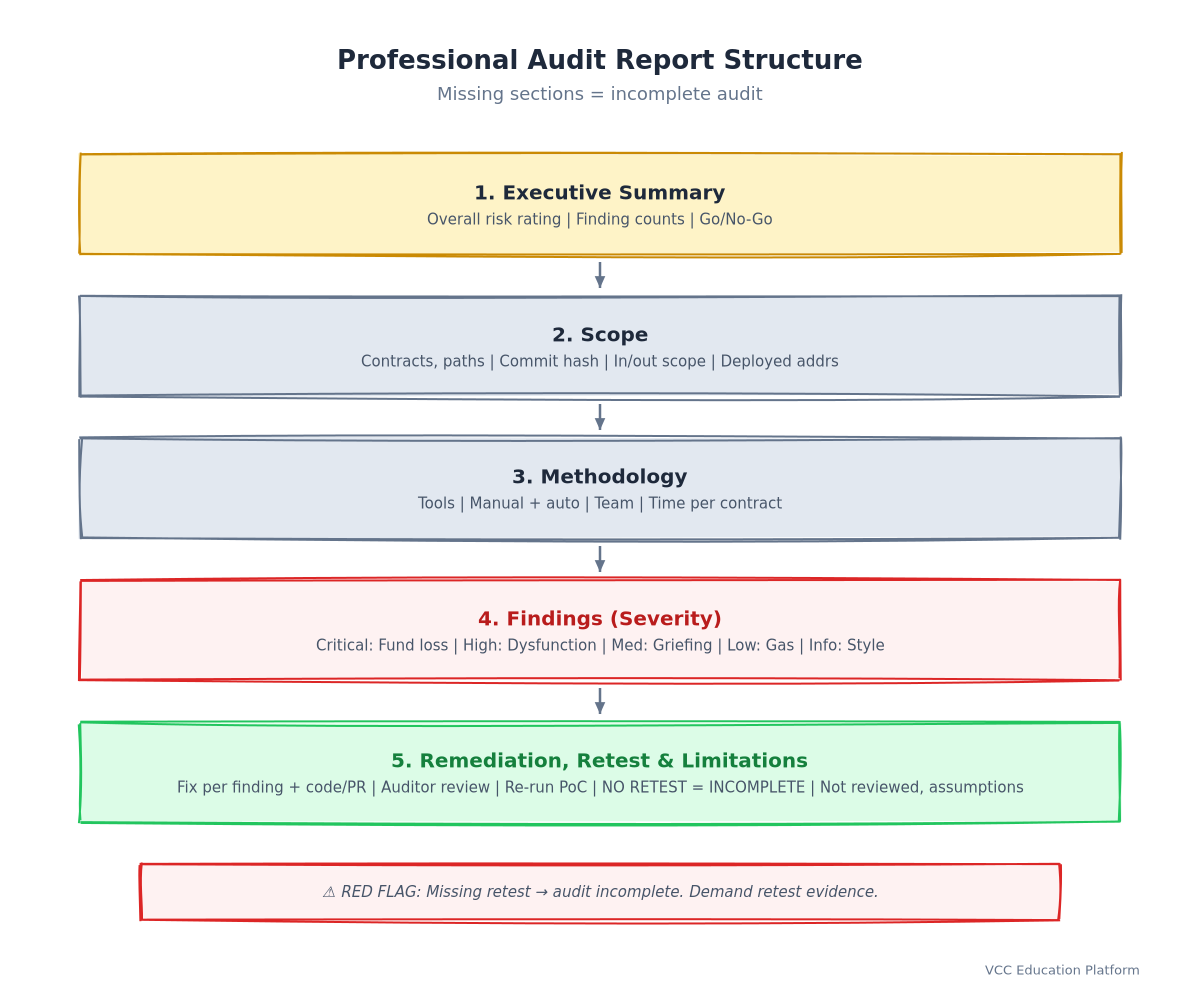
3.1 Audit Report Structure
A professional report includes:
- Executive Summary: Overall risk rating, key findings count
- Scope: Exact contracts, commit hash, files in/out of scope
- Methodology: Tools used, review approach, team composition
- Findings: Each with severity, location, impact, proof-of-concept, recommendation
- Remediation Plan: Protocol team's fix for each finding
- Retest Results: Verification that fixes work (CRITICAL - many skip this)
Diagram - Audit report anatomy: Executive Summary → Scope → Methodology → Findings (Critical/High/Me
3.2 Reading an Audit Report: Red Flags Checklist
Use this when evaluating ANY protocol's audit:
- [ ] Scope clarity: Exact contract names, addresses, commit hashes listed?
- [ ] Severity calibration: Critical findings actually critical? (Some firms inflate)
- [ ] Proof-of-concept: Every Critical/High finding has runnable PoC?
- [ ] Remediation verification: Retest performed and documented?
- [ ] Known limitations: Auditor explicitly states what was NOT reviewed?
- [ ] Multiple firms: At least 2 independent audits? (Single audit = incomplete)
- [ ] Competitive audit: Code4rena/Sherlock run? (Finds different bug classes)
- [ ] Bug bounty active: Immunefi/Sherlock program running post-launch?
- [ ] Audit age: <12 months for actively developed protocols?
- [ ] Firm reputation: Top-tier (Trail of Bits, OpenZeppelin, ConsenSys, Spearbit)?
3.3 The "Audit Theater" Detection Guide
Watch for these patterns indicating performative security:
- Scope exclusion: Core vault/contract NOT audited, only periphery
- No retest: Findings "fixed" but no verification evidence
- Single unknown firm: No track record, no public reports
- Marketing-first language: "Audited by X" badge everywhere, report hard to find
- Stale audit: >18 months old, protocol significantly changed since
Checklist - Audit theater red flags: 5 warning signs of performative security vs real security indic
How to Choose the Right Audit Firm
Firm Specialization Matrix
Match your protocol type to auditor expertise:
| Protocol Type | Best-Fit Firms | Why |
|---|---|---|
| Lending/AMM | Trail of Bits, OpenZeppelin, ConsenSys Diligence | Deep DeFi primitive expertise, economic exploit experience |
| Derivatives/Options | Spearbit, Pashov Audit Group, Sigma Prime | Complex math, oracle risk, liquidation logic |
| Cross-chain/Bridge | Trail of Bits, Zellic, Veridise | Light client verification, consensus faults |
| Upgradeable/Proxy Systems | OpenZeppelin, ConsenSys Diligence | Storage layout, initialization, timelock patterns |
| Novel Mechanisms | Spearbit, Code4rena (competitive), Cantina | Economic game theory, incentive alignment |
| ZK/Privacy | Trail of Bits, Veridise, zkSecurity | Circuit constraints, trusted setup, proving systems |
| New Team / Budget-Conscious | Pashov Audit Group, Hats Finance, local researchers | Cost-effective, high velocity, good for first audit |
Diagram - Firm specialization matrix: Protocol types matched to best-fit audit firms with reasoning
Due Diligence on Firms
Before signing:
- Read 3+ recent public reports - Assess clarity, PoC quality, retest rigor
- Check team composition - Senior researchers leading, not just juniors
- Verify specialization - Ask for similar protocol references
- Negotiate retest inclusion - Must be in contract, not extra cost
- Clarify communication - Daily updates? Shared channel? English proficiency?
Preparing for Audit: A Developer's Checklist
Code-Level Preparation
`solidity // 1. Use latest Solidity with built-in overflow protection // solc 0.8.0+ has checked arithmetic by default // Still: avoid unchecked { } unless mathematically proven safe
// 2. Follow Checks-Effects-Interactions religiously function withdraw(uint256 amount) external nonReentrant { require(balances[msg.sender] >= amount, "Insufficient balance"); balances[msg.sender] -= amount; // Effects FIRST (bool success, ) = msg.sender.call{value: amount}(""); // Interactions LAST require(success, "Transfer failed"); }
// 3. Use OpenZeppelin battle-tested contracts import "@openzeppelin/contracts/security/ReentrancyGuard.sol"; import "@openzeppelin/contracts/access/AccessControl.sol"; import "@openzeppelin/contracts/utils/math/SafeMath.sol"; // Pre-0.8 only
// 4. Explicit visibility & mutability function publicFunction() external pure returns (uint256) { } // Not 'public' function internalHelper() internal view returns (uint256) { }
// 5. NatSpec documentation for EVERY external function /// @notice Withdraws user's deposited funds /// @param amount Amount of shares to withdraw /// @dev ReentrancyGuard prevents reentry; follows CEI pattern function withdraw(uint256 amount) external nonReentrant { ... } `
Testing Preparation
`solidity // Foundry invariant test example contract InvariantTest is Test { MyProtocol protocol; address user = makeAddr("user");
function setUp() public { protocol = new MyProtocol(); // ... setup ... }
// Invariant: totalAssets >= totalShares sharePrice function invariant_totalAssetsGeTotalShares() public { uint256 totalAssets = protocol.totalAssets(); uint256 totalShares = protocol.totalSupply(); uint256 sharePrice = protocol.pricePerShare(); assertGe(totalAssets, totalShares sharePrice / 1e18); }
// Fuzz test: random withdrawals never break accounting function testFuzz_Withdraw(uint256 amount) public { vm.assume(amount <= protocol.balanceOf(user)); protocol.deposit(amount, user); protocol.withdraw(amount, user, user); assertEq(protocol.balanceOf(user), 0); } } `
Documentation Preparation
Create AUDIT_SPEC.md in repo root: `markdown
Scope
- Contracts:
src/Vault.sol,src/Strategy.sol,src/Oracle.sol - Commit:
abc123def456(taggedaudit-2024.01.15) - Out of scope:
src/interfaces/,script/,test/
Architecture
[Mermaid diagram or image link]
External Dependencies
- Oracle: Chainlink ETH/USD (0x5f4eC3Df9cbd43714FE2740f5E3616155c5b8419)
- Tokens: WETH (0xC02aaA39b223FE8D0A0e5C4F27eAD9083C756Cc2), USDC (0xA0b86a33E6441b8C4C8C0C0C0C0C0C0C0C0C0C0C)
- Bridge: Wormhole (if applicable)
Invariants (Must Hold Always)
- totalAssets() >= totalSupply() * pricePerShare()
- No single address can drain > 10% of TVL in one tx
- Emergency pause activates within 1 block of detection
- Upgrade timelock >= 48 hours
Threat Model
- Oracle manipulation (primary)
- MEV sandwich on liquidations
- Governance attack (flash loan voting)
- Upgrade key compromise
Deployment Parameters
- Constructor:
admin=0xMultiSig,timelock=48 hours - Initializer:
setOracle(chainlink),setTokens(weth, usdc)
`
Vietnamese Context: Audit Preparation for VN Teams
Local Challenges & Solutions
| Challenge | Solution |
|---|---|
| Language barrier | Hire bilingual technical lead; translate specs upfront; budget extra communication time |
| No local audit firms | Engage global firms directly; use VN developers at those firms as liaisons |
| Regulatory uncertainty | Audit for TECHNICAL security only; don't expect regulatory compliance certification |
| Talent gap | Send developers to global audit firm internships; sponsor CTF participation |
| Cost sensitivity | Start with competitive audit (Code4rena) + 1 traditional firm; add bug bounty post-launch |
Vietnam-Specific Audit Budget (Estimates 2024)
| Audit Type | Cost Range | Timeline | Notes |
|---|---|---|---|
| Competitive (Code4rena) | $25K-$75K | 2-3 weeks | Prize pool; finds novel vectors |
| Traditional (mid-tier firm) | $50K-$150K | 3-4 weeks | Pashov, Hats, local researchers |
| Top-tier firm | $150K-$500K | 4-6 weeks | Trail of Bits, OpenZeppelin, ConsenSys |
| Formal verification | $100K+ | 8-12 weeks | Certora, Runtime Verification; core only |
| Bug bounty (Immunefi) | $10K-$100K+ | Ongoing | Pay per bug; budget for critical payouts |
Total recommended first-year budget: $200K-$500K for serious DeFi protocol
Local Resources
- Vietnam DeFi Builders (Telegram/Discord) - Peer review, auditor recommendations
- Coin98 Academy - Security workshops, audit preparation guides (VN language)
- KiemTienOnline Forum - Legacy but active; scam warnings, project vetting
- Vietnam Blockchain Association - Regulatory updates, industry connections
Case Studies: Audit Successes & Failures
Success: Aave V3 (2022-2023)
- Audits: 3 traditional (OpenZeppelin, Certora, Sigma Prime) + competitive (Code4rena) + formal verification (Certora)
- Bug bounty: $1M+ on Immunefi
- Result: Zero critical exploits since launch; ~$10B TVL secured
- Lesson: Defense in depth works. Multiple methodologies catch different bug classes.
Failure: Euler Finance (2023) - $197M Exploit
- Audits: 2 traditional firms (pre-launch)
- Gap: Read-only reentrancy in
donateToReservesnot in scope; TWAP oracle manipulation path not fully modeled - Post-mortem: Auditors focused on classic reentrancy; missed cross-contract read-only variant
- Lesson: Audit scope must include ALL external call paths; economic attacks need explicit modeling.
Failure: Mango Markets (2022) - $117M Oracle Manipulation
- Audits: Multiple firms
- Gap: Oracle deviation thresholds not enforced; low-liquidity market used as price source
- Lesson: Oracle security requires runtime enforcement, not just code review. Multi-source + TWAP + circuit breakers mandatory.
Post-Audit: Continuous Security
Flow - Continuous security loop: Audit → Bug Bounty → Monitoring → Re-audit → Repeat
An audit is a snapshot. Security is a process.
Ongoing Practices
- Bug Bounty: Launch on Immunefi Day 1. Minimum $100K for critical.
- Monitoring: Tenderly/Forta alerts for anomalous transactions, oracle deviations, pause events
- Incident Response Plan: Documented, tested, team trained (see our DeFi Security Best Practices guide)
- Regular Re-audits: Every major upgrade, or annually for stable protocols
- Audit Competition: Annual Code4rena/Sherlock competition for fresh eyes
For Investors: Using Audits for Due Diligence
Before depositing, check:
- Which contracts hold MY funds? Verify those specific contracts were audited
- Critical findings remediated + retested? Demand evidence
- Active bug bounty? Check Immunefi/Sherlock for program status
- Audit recency? >1 year = stale for active development
- Multiple methodologies? Traditional + competitive + bug bounty = gold standard
FAQ
How much does a DeFi audit cost?
$25K (competitive) to $500K+ (top-tier formal verification). Most serious protocols spend $200K-$500K first year across multiple audits + bug bounty.
How long does an audit take?
2-6 weeks for traditional audit. Competitive audits: 1-2 weeks. Formal verification: 8-12 weeks. Plan 3-4 months for full audit cycle (prep + audit + remediation + retest).
Can I audit my own code?
No. You have blind spots. At minimum: internal review + automated tools + external audit. "Self-audit" is not an audit.
What's the difference between audit and formal verification?
Audit: Human experts review code for vulnerabilities (probabilistic, finds unknown unknowns). Formal verification: Mathematical proofs that specific invariants hold (deterministic, only proves what you specify). Use BOTH.
Do I need an audit for a fork of Uniswap/Aave?
YES. Your deployment parameters, integrations, oracle choices, admin keys, and any modifications introduce new risks. Fork ≠ free security.
How do I verify an audit actually happened?
- Check auditor's website for public report
- Verify commit hash matches deployed bytecode (Etherscan "Verify & Publish")
- Check Immunefi/Code4rena for competitive audit results
- Ask protocol team for retest evidence
What if a protocol has NO audit?
Do not deposit significant funds. Unaudited protocols are experiments. If you must interact: use minimal amounts, revoke approvals immediately after, monitor for exploit news hourly.
Summary: Your Audit Action Plan
| Role | Immediate Actions |
|---|---|
| Protocol Founder | Budget $200K+; prepare AUDIT_SPEC.md; engage 2 firms + competitive; launch bug bounty |
| Developer | Write invariant tests; document all external calls; prepare for auditor questions |
| Investor | Check audit scope covers YOUR funds; verify retest; confirm active bug bounty; check audit age |
| VN Team Lead | Translate docs; assign bilingual lead; join Vietnam DeFi Builders for peer support |
Next Steps
- Read: [DeFi Security Best Practices](/defi-security-best-practices) - User-level defense
- Practice: Submit findings to Immunefi/Code4rena to learn audit mindset
- Tool: Set up Slither + Echidna + Foundry invariant testing on your project
- Community: Join Vietnam DeFi Builders, ask about auditor experiences
Disclaimer: This tutorial is educational, not professional security advice. Audit requirements vary by protocol complexity, TVL, and risk tolerance. Consult qualified security professionals for your specific situation. DeFi carries inherent risk including total loss of principal.