
DeFi security auditing has become the critical infrastructure protecting billions in user funds. In 2022 alone, $3.8 billion was stolen from DeFi protocols — a figure that exceeds the GDP of many small nations. By 2023, cumulative losses since 2020 surpassed $10 billion, with cross-chain bridges accounting for nearly 70% of stolen funds. Behind every major hack lies a failure of process: unaudited code, skipped audit phases, or findings ignored.
This guide provides a comprehensive, practitioner-level walkthrough of DeFi security auditing — from the five-phase methodology used by top firms to the vulnerability taxonomy that maps DeFi-specific attack vectors, the tooling landscape with practical trade-offs, and the post-audit operational security that separates resilient protocols from headlines.
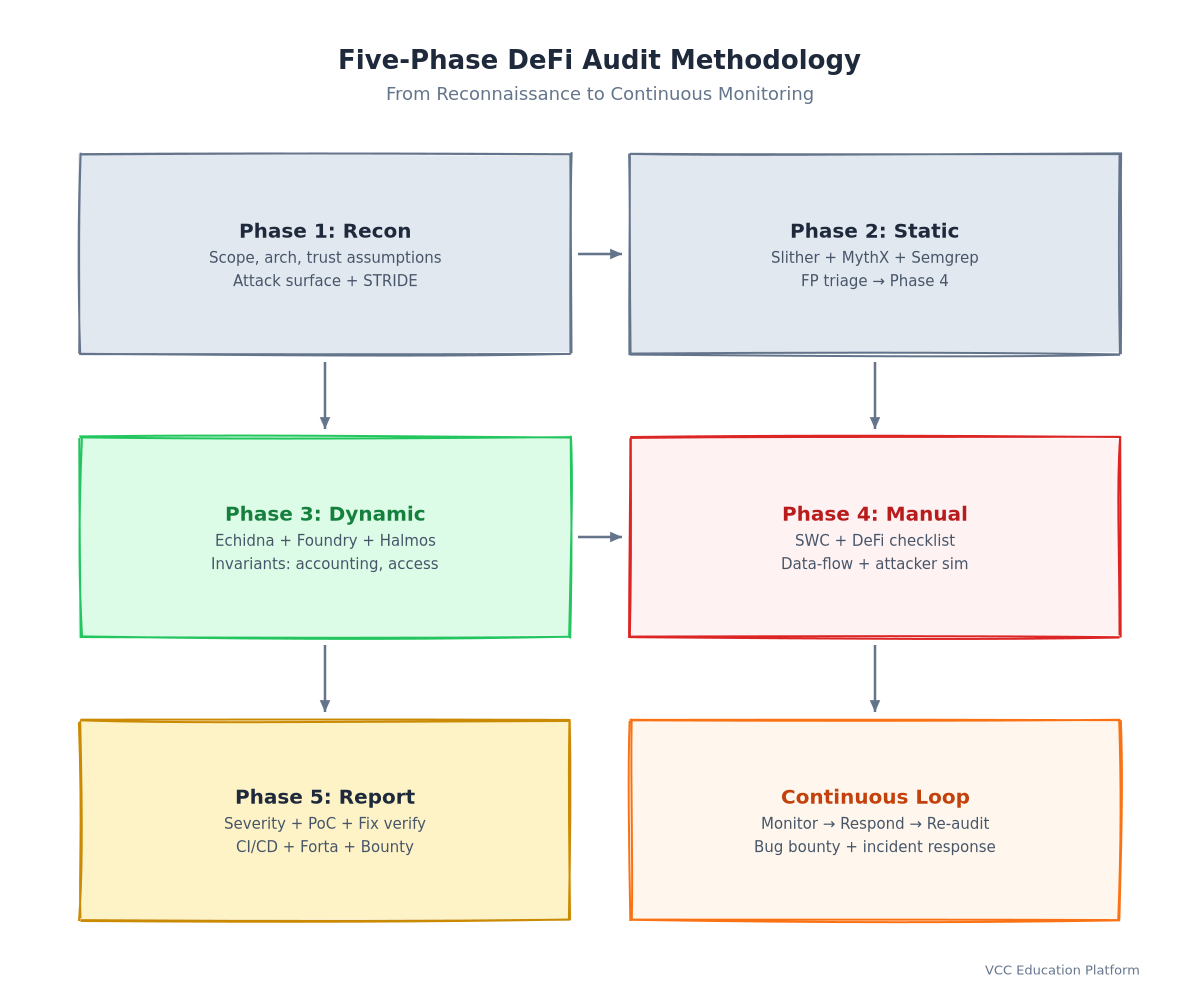
Flowchart - Five-phase DeFi audit methodology from reconnaissance to continuous monitoring
Why DeFi Security Auditing Differs from Traditional Software Audits
Traditional software security follows a familiar pattern: penetration testing, code review, patch deployment, monitoring. DeFi breaks every assumption.
Immutability as Default Smart contracts, once deployed, cannot be patched. Upgrade mechanisms (proxies, diamonds) are themselves attack surface — the Nomad bridge lost $190M due to an initialization flaw in its upgrade logic. An audit must verify not just current code, but the entire upgrade pathway.
Financial Adversarial Environment Every bug has a price tag. Attackers are rational economic actors who calculate ROI: gas cost + capital requirement + risk vs. expected extraction. The 2022 Beanstalk exploit ($182M) used a flash loan to acquire voting power, pass a malicious proposal, and drain the protocol — all in one transaction. No Web2 bug bounty offers that ROI.
Public Mempool Transparency Transactions are visible before execution. This enables MEV (Maximal Extractable Value) — front-running, sandwich attacks, liquidation racing. An audit must model the mempool as an adversarial environment where any state-changing function can be observed and exploited before confirmation.
Composability = Shared Fate Protocol A integrates Protocol B's oracle. Protocol B's oracle is manipulated. Protocol A liquidates users based on bad prices. The 2022 Mango Markets exploit ($117M) manipulated an oracle on Mango, which cascaded to dependent protocols. Audits must trace trust assumptions across protocol boundaries.
No Realistic Staging Environment Testnets lack mainnet liquidity, MEV competition, and real user behavior. A protocol behaving perfectly on Goerli can collapse on mainnet when a whale interacts with it. Audit methodology must compensate with economic modeling and adversarial simulation.
Diagram - DeFi vs Traditional Software Audit comparison: immutability, financial stakes, mempool, co
Five-Phase DeFi Audit Methodology: From Recon to Reporting
Top audit firms (Trail of Bits, OpenZeppelin, ConsenSys Diligence, Spearbit) converge on a five-phase methodology. Each phase has specific entry/exit criteria, tooling, and deliverables.
Phase 1 — Reconnaissance & Threat Modeling (3-5 Days)
Objective: Define scope, map architecture, enumerate attack surface, model threats.
Activities:
- Scope Confirmation: Contract addresses, dependencies (libraries, interfaces), off-chain components (relayers, indexers, frontends), governance contracts, upgrade admin keys.
- Architecture Documentation: If the protocol lacks architecture docs, the audit team creates them — component diagrams, data flows, trust boundaries.
- Trust Assumption Mapping: Explicitly document every trusted party: admin keys (multisig? timelock?), oracle sources (Chainlink? TWAP? custom?), governance parameters, emergency pause authorities.
- Attack Surface Enumeration: Every
external/publicfunction, every state-changing entry point, every cross-contract call, every delegatecall target. - Threat Modeling: Apply STRIDE (Spoofing, Tampering, Repudiation, Information Disclosure, Denial of Service, Elevation of Privilege) or attack trees per component.
Deliverables: Scope document, architecture diagram, trust assumption register, threat model, audit plan with phase estimates.
Entry Criteria: Signed engagement letter, repository access, deployment addresses. Exit Criteria: Stakeholder sign-off on scope and threat model.
Phase 2 — Static Analysis & Automated Scanning (2-3 Days)
Objective: Broad, fast detection of known vulnerability patterns; custom rule development for protocol-specific logic.
Tool Orchestration: `bash
slither . --detect reentrancy,unchecked-transfer,arbitrary-send,delegatecall,unused-state --json slither-output.json
mythx analyze --mode deep --timeout 3600
semgrep --config=p/solidity --config=custom-rules.yaml
solhint --formatter checkstyle `
Custom Rules Development: Protocol-specific patterns that generic tools miss:
- "All fee calculations use
mulDivfrom PRBMath" (precision loss prevention) - "No
transfer/send— onlycallwith reentrancy guard" (reentrancy hygiene) - "Governance functions require
onlyTimelockmodifier" (governance attack prevention)
Triage Workflow:
- Automated severity filter (keep High/Medium only)
- Manual review of each finding — classify as True Positive, False Positive, or Informational
- False positive documentation with reasoning (prevents re-review in Phase 4)
- Remaining findings → Phase 4 manual review queue with context
Key Insight: Static analysis catches ~30-35% of critical findings (Trail of Bits data). Its value is breadth and speed — it ensures the manual review phase doesn't waste time on known patterns.
Phase 3 — Dynamic Analysis & Fuzzing (5-10 Days)
Objective: Discover bugs requiring stateful execution, complex invariants, or deep path exploration.
Tool Selection by Need:
| Tool | Type | Best For | Learning Curve |
|---|---|---|---|
| Echidna | Property-based fuzzing | Complex stateful invariants, corpus reuse | High (Haskell DSL) |
| Foundry Forge | Coverage-guided fuzzing | Fast iteration, developer workflow, cheatcodes | Low (Solidity-native) |
| Halmos | Bounded symbolic | Critical functions, mathematical correctness, counterexamples | Medium |
| Medusa | Parallel fuzzing | Large codebases, high-throughput campaigns | Medium (Go-based) |
Invariant Categories to Encode:
`solidity // Accounting invariants function invariant_totalSupplyEqualsBalances() public view returns (bool) { return totalSupply() == sum(accountBalances); }
// Access control invariants function invariant_onlyTimelockCanExecute() public view returns (bool) { return governance.timelock() == address(this); // Simplified }
// Oracle integrity function invariant_oracleNotStale() public view returns (bool) { return block.timestamp - oracle.lastUpdate() < STALE_THRESHOLD; }
// Protocol-specific function invariant_liquidationRatioSafe() public view returns (bool) { return getLiquidationRatio() >= MIN_LIQUIDATION_RATIO; } `
Campaign Execution:
- Run 24-72 hours per campaign with multiple seeds
- Corpus minimization and seeding from previous runs
- Coverage analysis: line, branch, and mutation coverage (did tests kill mutants?)
- Crash triage: deduplicate, minimize test cases, classify severity
Pro Tip: Echidna's corpus reuse allows incremental campaigns. Foundry's vm.warp, vm.prank, vm.deal cheatcodes enable complex scenario setup impossible in pure Solidity tests.
Phase 4 — Manual Code Review (10-20 Days)
Objective: Deep, adversarial review of business logic, access control, upgrade safety, and cross-contract interactions.
Review Approaches (Combine All):
- Checklist-Driven: SWC Registry + DeFi-specific checklist (see Vulnerability Taxonomy below)
- Vulnerability-Class-Driven: Deep dive per class — all reentrancy paths, all access control checks, all oracle integrations
- Data-Flow-Driven: Trace user funds from deposit → strategy → withdrawal; trace admin powers from deployment → upgrade → emergency action
- Attacker-Simulation: "How would I drain this protocol with $10M capital and flash loan access?"
Focus Areas with DeFi-Specific Lens:
| Area | Traditional Check | DeFi Audit Check |
|---|---|---|
| Business Logic | Correct calculations | Fee math under manipulation; reward accounting under flash loan; slippage bounds |
| Access Control | onlyOwner / RBAC | Timelock enforcement; multisig threshold; governance delay; emergency pause scope |
| Upgradability | Storage layout | Diamond pattern collisions; UUPS initialization; proxy admin compromise; initializer misuse |
| Oracle Integration | Input validation | Staleness checks; manipulation resistance (TWAP vs spot); fallback sources; cross-chain proof validation |
| Cross-Contract | Interface compliance | Callback safety (reentrancy guards); trust assumptions on callee; immutable vs upgradeable dependencies |
| Governance | Proposal execution | Vote buying resistance; flash loan voting; proposal validation; execution delay; veto mechanisms |
Documentation During Review: Every finding recorded with: location (file:line), vulnerability class, severity, proof of concept (code or transaction trace), impact assessment, recommended fix, references (SWC, CWE, prior art).
Phase 5 — Reporting, Mitigation Review & Continuous Monitoring (3-5 Days + Ongoing)
Objective: Deliver actionable report, verify fixes, establish ongoing security posture.
Report Structure:
- Executive Summary — Non-technical risk overview for leadership
- Methodology & Scope — What was audited, what was not, tool versions, dates
- Findings by Severity — Critical / High / Medium / Low / Informational
- Per-Finding Detail: Description, Impact, Proof of Concept, Recommendation, References
- Appendices: Tool output summaries, coverage reports, threat model, custom rules
Severity Classification (Industry Standard):
- Critical: Direct fund loss, protocol insolvency, governance takeover
- High: Significant fund risk, major functionality break, privilege escalation
- Medium: Limited fund risk, DoS, information leakage, griefing
- Low: Gas optimization, code quality, missing events, style
- Informational: Best practice deviations, future-proofing suggestions
Mitigation Review Process:
- Protocol team submits fixes (PR or new deployment)
- Auditor verifies each fix — not just "fixed" but correctly fixed
- Regression testing: Did the fix introduce new issues?
- Scope of re-audit: Targeted (only fixed functions) vs. Full (if architectural changes)
- Monitoring Recommendations: Forta alerts for critical functions, Tenderly notifications for admin actions, custom bots for invariant violations
Continuous Security: The audit report is a snapshot. Resilient protocols implement:
- CI/CD Gates: Slither + Semgrep + Foundry tests on every PR
- Invariant Monitoring: Echidna/Halmos campaigns on release candidates
- On-Chain Monitoring: Forta, Tenderly, or custom bots watching for anomaly patterns
- Incident Response Runbook: Defined roles, communication channels, pause procedures, post-mortem process
- Bug Bounty Transition: Immunefi/equivalent program with scope matching audit findings
Sequence - Code review workflow: static analysis → fuzzing → manual review → finding documentation →
DeFi Vulnerability Classification: Beyond the SWC Registry
The Smart Contract Weakness Classification (SWC Registry) provides a foundation, but DeFi demands a taxonomy reflecting its unique mechanics. Below is a DeFi-specific vulnerability classification mapping to SWC where applicable.
1. Access Control Failures
SWC Mapping: SWC-104 (Unchecked Call), SWC-121 (Missing Protection), SWC-131 (Float Pragma) DeFi Context: Admin keys, multisig thresholds, timelock bypass, role confusion, privilege escalation through governance. Notable Incidents: Beanstalk ($182M, 2022) — flash loan voting to pass malicious proposal; Tornado Cash governance attack (2023) — proposer exploited voting delay. Audit Checks: All state-changing functions have appropriate modifiers; timelock delays enforced on-chain; multisig thresholds require >50% honest signers; no owner-only functions without timelock.
2. Reentrancy (All Variants)
SWC Mapping: SWC-107 (Reentrancy) DeFi Variants:
- Single-function: Classic
call→ callback → re-enter same function - Cross-function:
call→ callback → re-enter different state-changing function - Read-only:
viewfunction re-entered during state change (breaksnonReentrantguards) - Cross-chain: Callback on destination chain re-enters source chain logic (Wormhole-style)
Notable Incidents: Curve Finance ($570k, 2023) — read-only reentrancy in Vyper; Fei/Rari ($80M, 2022) — cross-function reentrancy. Audit Checks: ReentrancyGuard on all external calls; checks-effects-interactions pattern; no view functions reading state modified by unguarded functions; cross-chain callback validation.
3. Oracle Manipulation
SWC Mapping: SWC-126 (Manipulable Oracle) — but DeFi requires deeper classification DeFi Variants:
- Spot Price Manipulation: Large swap moves pool price; protocol uses spot price for liquidation/pricing
- TWAP Manipulation: Sustained manipulation over TWAP window (expensive but possible on low-liquidity pools)
- Multi-Source Aggregation Failure: Median/mean of corrupted sources; outlier removal bypassed
- Cross-Chain Price Feed: Relayer compromise; merkle proof validation gaps; finality assumption violations
Notable Incidents: Mango Markets ($117M, 2022) — spot price manipulation on low-liquidity market; Eisenberg's "highly profitable trading strategy." Audit Checks: TWAP with sufficient window; manipulation cost modeling; multiple independent sources; staleness checks; circuit breakers on price deviation.
4. Mathematical Errors
SWC Mapping: SWC-101 (Integer Overflow/Underflow) — largely solved by Solidity 0.8+, but precision/rounding remains DeFi Variants:
- Precision Loss:
a / b cvsa c / b— order of operations loses precision - Rounding Direction: Floor vs ceiling rounding favors protocol or user incorrectly
- Accumulator Drift: Reward accrual over thousands of blocks drifts from mathematical ideal
- Fixed-Point Library Bugs: PRBMath, ABDKMath, Solmate — audit the library usage, not just the library
Audit Checks: All math uses audited libraries (PRBMath, Solmate); multiplication before division; rounding direction documented and tested; invariant tests for accumulator correctness.
5. Governance Attacks
SWC Mapping: SWC-104, SWC-121, SWC-133 (Hash Collision) — but governance is a meta-layer DeFi Variants:
- Flash Loan Voting: Borrow governance tokens, vote, return in same transaction
- Proposal Manipulation: Malicious calldata in proposal; executor validates differently than proposer
- Timelock Bypass: Direct execution via emergency path; timelock admin compromise
- Delegation Abuse: Delegated votes used against delegator's interest; vote buying markets
Notable Incidents: Beanstalk ($182M); Build Finance ($470k, 2022) — attacker seized governance via proposal. Audit Checks: Vote snapshot before execution; timelock on all governance actions; proposal validation on-chain; emergency multisig separate from governance; delegation with expiry.
6. MEV & Front-Running
SWC Mapping: SWC-114 (Transaction Order Dependence), SWC-115 (Authorization via tx.origin) DeFi Variants:
- Sandwich Attacks: Victim swap front-run and back-run; protocol fees extracted
- JIT Liquidity: Liquidity added moments before large swap, removed after — extracts fees without impermanent loss risk
- Liquidation Racing: Bots compete to liquidate underwater positions; gas wars, missed liquidations
- Atomic Bundles: Flashbots bundles execute multiple dependent transactions atomically
Audit Checks: MEV-aware design (commit-reveal, batch auctions, Dutch auctions); liquidation incentives aligned; no user-fund extraction via ordering; tx.origin never used for authorization.
7. Upgradability Risks
SWC Mapping: SWC-112 (Delegatecall), SWC-113 (Storage Collision) DeFi Variants:
- Storage Collision: Diamond pattern / UUPS — new implementation writes to wrong slot
- Initialization Flaw:
initializernot called, or called multiple times; uninitialized implementation - Proxy Admin Compromise: Admin key controls upgrade; single point of failure
- Function Selector Clash: Diamond — two facets with same selector
Notable Incidents: Nomad ($190M, 2022) — initialization flaw allowed arbitrary message verification; Parity Wallet (2017) — library self-destruct. Audit Checks: Storage layout verification (Foundry forge inspect storage-layout); initializer modifier on all implementations; timelocked proxy admin; diamond facet selector uniqueness; upgrade integration tests.
8. Cross-Chain / Bridge Vulnerabilities
SWC Mapping: New category — bridges introduce off-chain trust assumptions DeFi Variants:
- Merkle Proof Validation: Incomplete verification (Wormhole $325M — missing signature verification)
- Relayer Compromise: Off-chain relayer signs malicious messages; threshold not enforced
- Finality Assumptions: Protocol assumes source chain finality; reorg invalidates proof
- Replay Protection: Nonce/sequence gaps; chain ID validation missing
- Upgrade Mismatch: Source chain upgrades; destination chain verification logic outdated
Notable Incidents: Wormhole ($325M), Ronin ($625M), Nomad ($190M), Harmony ($100M), Multichain ($126M) — total >$1.3B top 5 alone. Audit Checks: On-chain verification of all proof components; relayer threshold enforcement on-chain; finality depth configurable; replay protection with strict nonce; upgrade coordination procedure documented.
Diagram - Vulnerability classification taxonomy: 8 DeFi-specific categories with sub-classes, SWC ma
Audit Tooling Landscape: Practical Comparison
No single tool suffices. Effective auditing combines tools strategically across phases.
Comparison Matrix
| Tool | Type | Strengths | Weaknesses | Best For | Cost |
|---|---|---|---|---|---|
| Slither | Static (AST) | 100+ detectors, printers, Python API, fast (<30s) | No cross-contract, false positives, no symbolic exec | Phase 2 baseline, custom detectors | Free (OSS) |
| MythX | Symbolic + Fuzzing | Deep path exploration, CI/CD API, Vyper support | Cost per scan, latency, black-box | CI/CD gate, release candidates | Paid |
| Echidna | Property-based fuzzing | Stateful, corpus reuse, minimizes cases, powerful DSL | Haskell barrier, setup time, slower | Complex invariant testing | Free (OSS) |
| Foundry Forge | Coverage-guided fuzzing | Extremely fast, cheatcodes, integrated tests | Immature invariant DSL, manual corpus | Developer fuzzing, CI integration | Free (OSS) |
| Halmos | Bounded symbolic | Counterexamples, Solidity subset, Foundry integration | Bounded depth (default 3), subset limits | Critical function verification | Free (OSS) |
| Medusa | Parallel fuzzing | Multi-core, high throughput, Go-based | Younger ecosystem, less docs | Large codebases, CI scale | Free (OSS) |
| Semgrep | Pattern matching | YAML rules, multi-language, fast, custom rules | No semantic understanding | Custom protocol patterns | Free (OSS) |
| Certora Prover | Formal verification | Full verification, CVL specs, used by Uniswap/Aave | Expert-intensive, CVL learning curve, cost | Core accounting, governance, bridges | Paid |
When to Use What: Decision Framework
Phase 2 (Static):
- Always: Slither (broad coverage, custom detectors via Python)
- CI/CD Gate: MythX deep mode on release branches
- Custom Patterns: Semgrep for protocol-specific rules (e.g., "all
mintfunctions requireonlyMinter")
Phase 3 (Dynamic):
- Invariant-Rich Protocols: Echidna (best property DSL, corpus reuse)
- Developer Velocity: Foundry Forge (cheatcodes, fast, same language as tests)
- Critical Math Functions: Halmos (bounded proofs for accounting, fee math)
- Large Codebases: Medusa (parallel cores, high throughput)
Phase 4 (Manual):
- Tool findings guide manual review — they don't replace it
- Use Slither printers (
call-graph,inheritance,storage-layout) for code comprehension - Custom Slither detectors encode protocol-specific invariants for automated checking
CI/CD Integration Pattern (Production-Ready)
`yaml
name: Security Checks on: [push, pull_request] jobs: static-analysis: runs-on: ubuntu-latest steps:
- uses: actions/checkout@v4
- name: Slither
uses: crytic/slither-action@v1 with: args: --detect reentrancy,unchecked-transfer,arbitrary-send,delegatecall
- name: Semgrep
uses: returntocorp/semgrep-action@v1 with: config: p/solidity config: .semgrep-rules.yaml
- name: Solhint
run: solhint contracts/*/.sol
fuzzing: runs-on: ubuntu-latest timeout-minutes: 120 steps:
- uses: actions/checkout@v4
- uses: foundry-rs/foundry-toolchain@v1
- name: Forge Fuzz
run: forge test --fuzz-runs 50000
- name: Echidna
run: | docker run --rm -v $(pwd):/src trailofbits/echidna \ /src/contracts/Invariants.sol --contract InvariantSuite \ --corpus-dir /src/echidna-corpus --test-mode assertion
formal-verification: if: github.ref == 'refs/heads/main' # Only on main branch runs-on: ubuntu-latest steps:
- uses: actions/checkout@v4
- name: Halmos
run: halmos verify --function "verifyMinting()" --bound 5 `
When and How to Apply Formal Verification in Audits
Formal verification is not academic theater — it's a practical tool for critical paths where bugs are catastrophic and testing cannot cover the state space.
The Verification Spectrum
| Approach | Scope | Cost | Time | Use Case |
|---|---|---|---|---|
| Bounded Model Checking (Halmos) | Single function, depth ≤ 10 | Low | Hours | Fee math, mint/burn, liquidation |
| Deductive Verification (Certora, CVL) | Contract/module, full state space | High | Weeks | Core accounting, governance, bridges |
| Theorem Proving (K Framework, Coq, Isabelle) | Full protocol, mathematical proof | Very High | Months | Consensus, VM correctness, ZK circuits |
Practical Integration in Audit Workflow
- Identify Verification Targets: Functions where any bug = protocol death (mint, burn, liquidate, governance execute, bridge verify)
- Specify Invariants in CVL/Halmos: Not "does it work?" but "what must always be true?"
- Run in Phase 3 Parallel: Formal verification campaigns run alongside fuzzing
- Counterexample → Finding: Every counterexample is a potential Critical/High finding
- Proof → Confidence: Verified properties reduce manual review scope for those functions
Case Study: Uniswap v4 Hooks Uniswap v4 introduced hooks — custom logic at swap points. The team used Certora to verify:
- Hook cannot drain pool reserves
- Hook cannot manipulate swap accounting
- Hook reentrancy guarded by pool's
nonReentrant
Result: Mathematical confidence before mainnet deployment.
ROI Calculation: If a function controls $100M+ TVL and has complex logic, $50k-200k verification cost is <0.2% of protected value. For a $1M TVL protocol, bounded checking (Halmos) at near-zero cost is the right choice.
Cross-Chain Audit Challenges: Bridges, Messaging, and Finality
Bridges are the most attacked DeFi primitive. Auditing them requires a fundamentally different threat model.
Unique Bridge Threat Model
` Traditional DeFi: On-chain only → Audit smart contracts Bridge: On-chain + Off-chain → Audit contracts + relayers + consensus + cryptography `
Trust Assumptions to Validate:
- Relayer/Validator Set: Who signs messages? Threshold? Rotation? Slashing?
- Finality Source: What confirms source chain state? Light client? MPC? Trusted committee?
- Proof Verification: Merkle proofs? ZK proofs? Optimistic challenges? All verified on-chain?
- Replay Protection: Nonces? Timestamps? Chain IDs? Enforced on both chains?
- Upgrade Coordination: How do both sides upgrade simultaneously without gap?
Bridge Pattern Audit Checklist
| Pattern | Example | Key Audit Focus |
|---|---|---|
| Lock/Mint | Wormhole, Multichain | Custody contract security; mint/burn authorization; relayer threshold |
| Burn/Mint | LayerZero, Axelar | Message verification; endpoint security; DVN/Executor trust model |
| Lock/Unlock (Native) | Native bridges (Polygon, Arbitrum) | L1 contract security; exit game validity; challenge period |
| Liquidity Network | Synapse, Celer | Liquidity pool accounting; router security; fee management |
Wormhole Post-Mortem Lessons (Applied to Audit)
The $325M Wormhole exploit (2022) exploited a missing signature verification in verifySignatures. Audit lessons:
- Verify every cryptographic check — not just "calls the library"
- Test negative cases — what happens with 0 signatures? 1 of N? Wrong guardian set?
- Audit off-chain relayer code — guardian set updates, signature aggregation
- Finality depth — Wormhole used 1-block finality on Solana; reorg risk
Post-Audit: Mitigation Review and Ongoing Security
The audit report is not the end — it's the beginning of operational security.
Fix Verification Protocol
For every finding:
- Reproduce — Confirm the PoC works on audited commit
- Review Fix — Read the diff; does it address root cause or symptom?
- Test Fix — Run PoC against fixed code; must fail
- Regression — Run full test suite; run Slither/Echidna on fixed code
- Scope Re-audit — Architectural changes → full re-audit; localized fixes → targeted
Monitoring Stack (Production)
| Layer | Tool | What It Catches |
|---|---|---|
| Function-Level | Forta / Tenderly Alerts | Admin calls, pause/unpause, parameter changes, large transfers |
| Invariant-Level | Custom Bots / Hypernative | Accounting drift, oracle staleness, liquidation ratio breach |
| Mempool-Level | Flashbots / MEV-Share | Attack txs targeting protocol; front-running detection |
| Governance | Tally / Boardroom / Custom | Proposal creation, voting anomalies, execution monitoring |
Incident Response Runbook (Minimum)
- Detection → Triage (5 min): Automated alert → on-call confirms
- Containment (15 min): Pause contract? Upgrade? Emergency multisig?
- Communication (30 min): Discord/Twitter/Telegram templates ready
- Investigation (Hours): Root cause, blast radius, fund tracking
- Recovery: User compensation plan; post-mortem publication timeline
Choosing an Audit Firm vs Building Internal Capability
Audit Firm Selection Criteria
| Criterion | How to Verify |
|---|---|
| Track Record | Published reports (not just client logos); find 3+ similar complexity audits |
| Methodology Transparency | Ask for their audit playbook; refuse "proprietary methodology" opacity |
| Team Composition | Named auditors (not "senior team"); check their GitHub, CTF, publications |
| Communication | Weekly syncs? Dedicated Slack? Finding triage calls? |
| Re-audit Policy | Free targeted re-audit? Time window? Scope definition? |
| Tooling | Custom detectors? Formal verification capability? Fuzzing infrastructure? |
Red Flags: No public reports; "we use proprietary tools we can't show"; single-auditor engagements for complex protocols; no mitigation review included.
Internal Security Team: When and How
Build Internal When:
- Protocol complexity > 50 contracts / frequent releases (monthly+)
- TVL > $50M (audit cost > internal team cost)
- Unique domain knowledge (novel primitive, custom VM, ZK circuits)
Hybrid Model (Recommended):
- Internal: Continuous CI/CD security, invariant maintenance, monitoring, incident response
- External: Major release audits, novel primitive review, formal verification, red team exercises
Budget Framework:
- Annual audit budget = 0.5-1% of TVL (industry benchmark)
- Split: 60% external audits, 30% tooling/infrastructure, 10% bug bounty
- Bug bounty: Start at $50k max reward; scale with TVL
Frequently Asked Questions About DeFi Security Auditing
How much does a DeFi audit cost?
Range: $25,000 — $500,000+ based on complexity (contract count, loc, novelty, off-chain components), not lines of code. A 500-line novel bridge costs more than a 5,000-line standard ERC-20. Top firms: $50k-$150k for typical DeFi protocol; $200k+ for bridges, L2s, novel cryptography.
How long does an audit take?
Typical: 2-8 weeks calendar time. Phase 1: 1 week. Phase 2-3: 1-2 weeks parallel. Phase 4: 2-3 weeks. Phase 5: 1 week + mitigation. Rush engagements (1-2 weeks) incur 50-100% premium and reduced scope.
Can automated tools replace manual review?
No. Tools find ~30-40% of critical issues (reentrancy, access control, basic math). They cannot find: business logic errors, oracle manipulation vectors, governance attack paths, cross-protocol composability failures, economic exploits. Manual review by experienced auditors is irreplaceable.
What certifications matter for auditors?
No industry standard exists. Look for: published audit reports (not summaries), CTF wins (Paradigm CTF, Damn Vulnerable DeFi), conference presentations (Devcon, EthCC, Security summits), open-source contributions (Slither detectors, Foundry, Echidna), academic publications. Firm brand ≠ auditor quality.
Should I audit before or after testnet?
Before mainnet; testnet for integration. Audit the mainnet-bound code on a feature-complete testnet deployment. Testnet validates integration (frontends, indexers, relayers); audit validates contract security. Both needed.
How do I verify an audit report is genuine?
- Check auditor's website — legitimate firms publish reports (or client-approved summaries)
- On-chain verification — some firms publish report hashes on-chain (EAS, Arweave)
- Contact past clients — ask about process, communication, finding quality
- Beware: "Audit certificates" from unknown firms are marketing, not security
Building a Security-First DeFi Culture
DeFi security auditing is not a checkbox — it's a continuous investment. The protocols that survive are those that treat security as product infrastructure, not compliance overhead.
Security as Continuous Process:
- Design Phase: Threat modeling before code; formal specs for critical modules
- Development Phase: CI/CD security gates; invariant tests as documentation; code review with security lens
- Pre-Launch: Full audit + formal verification for core + public testnet + bug bounty
- Post-Launch: Monitoring, incident response, regular re-audits, upgrade audits
- Ecosystem: Share findings (anonymized); contribute to tooling; mentor next generation
The $10B+ lost to DeFi hacks is not inevitable. It's the cost of treating security as an afterthought. Every protocol that integrates security from design phase, audits continuously, and operates with monitoring and incident response reduces the attack surface for the entire ecosystem.
Your protocol's security is only as strong as your weakest dependency — audit accordingly.
Comparison - Audit tools comparison matrix: Slither, MythX, Echidna, Foundry, Halmos, Medusa, Semgre
Flowchart - Post-audit continuous security loop: audit → fix verification → monitoring → incident re
Last Updated: 2026-09-02 | Author: Technical Writer (Cardano Specialist) | Methodology based on Trail of Bits, OpenZeppelin, ConsenSys Diligence, Spearbit practices