
DeFi scalability solutions have become the defining challenge for decentralized finance as it pushes against the hard limits of Layer 1 blockchains. When Uniswap V3 launched on Ethereum mainnet in 2021, a single swap transaction could cost $50-100 in gas fees during peak congestion. Today, that same swap on Arbitrum or zkSync Era costs pennies and confirms in seconds. This transformation didn't happen by accident—it's the result of years of research, engineering, and a fundamental rethinking of how blockchains scale.
The core problem is simple: Ethereum L1 processes roughly 15-30 transactions per second (TPS) in practice, while a single DeFi interaction—say, providing liquidity to a concentrated position on Uniswap V3—can generate multiple internal transactions (approval, mint, position NFT creation). Compose this with thousands of users, and the bottleneck becomes existential. Gas fees spike, transactions fail, and users—especially those with smaller capital—get priced out entirely.
This article provides a comprehensive technical comparison of the major DeFi scalability solutions available today: Layer 2 rollups (optimistic and ZK), sidechains, state channels, and sharding. We'll examine architecture, security models, real-world performance, composability trade-offs, and decision frameworks for builders and users. We'll also include Vietnamese market context where local adoption patterns reveal practical preferences.
Why DeFi Needs Scaling Now
The Throughput Ceiling
Ethereum's ~15-30 TPS theoretical maximum translates to far less for complex DeFi operations. A 2023 analysis by L2Beat showed that during peak DeFi activity (e.g., major token launches, market volatility), the effective throughput for successful user transactions drops further due to reverts and MEV competition.
Real-world example: A single concentrated liquidity position on Uniswap V3 requires:
- Token approval (if first time)
Mintcall with tick range parameters- Position NFT minting
- Potential multicall batching
That's 3-4 transactions for one user action. At 15 TPS, Ethereum L1 can support roughly 4-5 such operations per second globally. With 500,000+ daily active DeFi addresses (per Dune Analytics 2024), the math simply doesn't work.
The Cost Crisis
Gas fees operate on a first-price auction mechanism. When demand exceeds block space, users bid up fees. During the 2021 bull run and 2022-2023 volatility events, median gas prices regularly exceeded 100 gwei, making a simple ERC-20 transfer cost $5-10 and a DEX swap $50+.
Impact on financial inclusion: A user in Vietnam with $100 to invest loses 5-10% to fees immediately on L1. On Arbitrum or Base, that same user pays <$0.05. The difference determines whether DeFi is accessible to the global majority or remains a playground for whales.
The UX Barrier
Beyond cost, confirmation latency degrades user experience. Ethereum's ~12 second block time plus 2-3 blocks for probabilistic finality means 30-60 seconds minimum wait. During congestion, transactions can sit in the mempool for minutes or hours.
Failed transaction rates compound the problem. When gas prices spike mid-transaction, users face reverts with no refund on gas spent. MEV bots front-run and sandwich trades, extracting value from regular users. These UX frictions are why centralized exchanges still dominate onboarding—they abstract away all of this complexity.
Scaling Architecture Categories
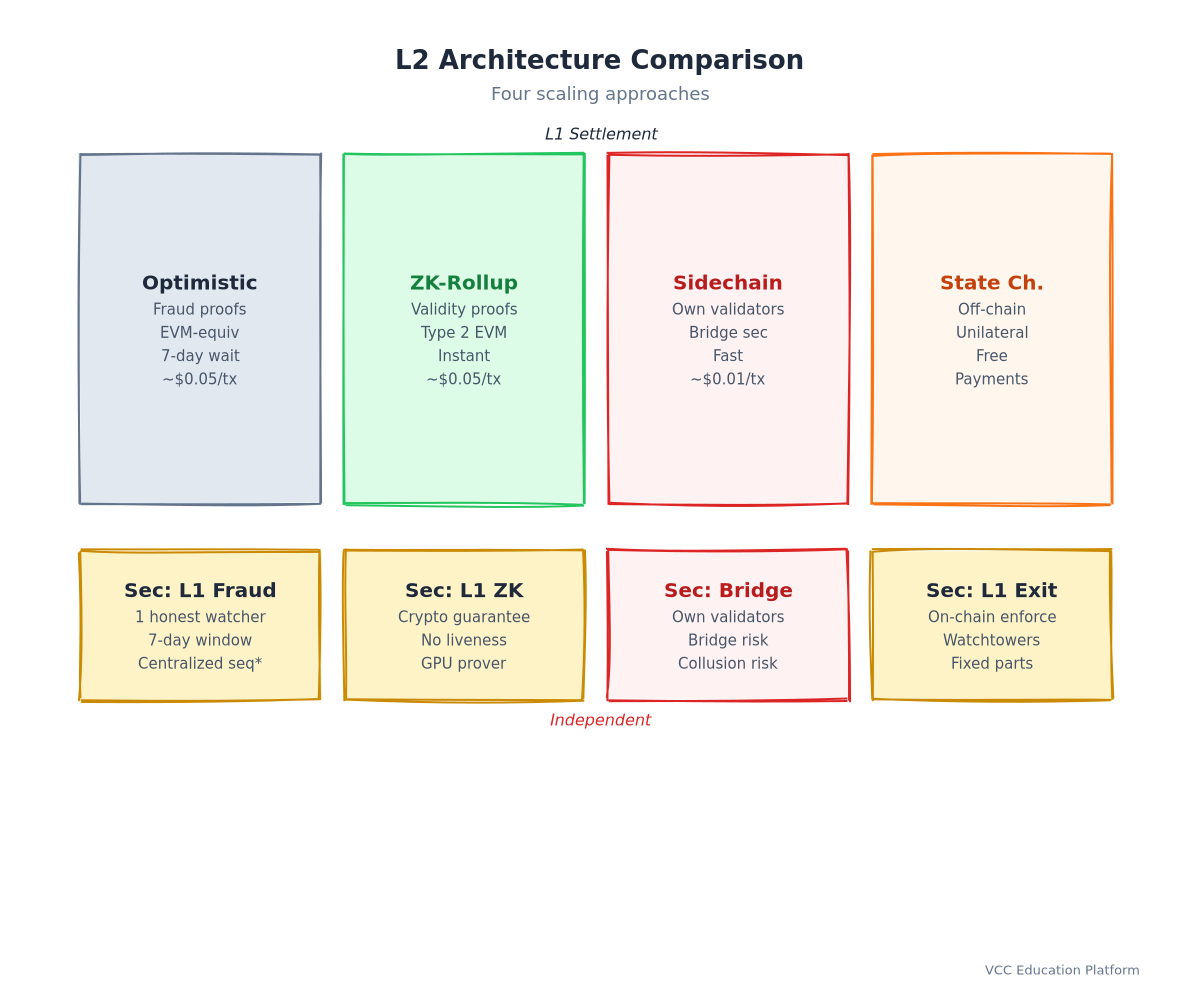
Before diving into specific solutions, we need a taxonomy. Scaling approaches differ fundamentally in where execution happens, where settlement happens, and what security assumptions they make.
Layer 2 (L2) — Inheriting L1 Security
Definition: Execution occurs off-chain (on the L2), but settlement—final verification and dispute resolution—occurs on L1. The L2 posts transaction data or proofs to L1, allowing anyone to verify correctness or challenge fraud.
Security model: Two paradigms:
- Fraud proofs (Optimistic): Assume honesty by default; allow challenges within a window
- Validity proofs (ZK): Cryptographically prove correctness before L1 acceptance
Composability: Synchronous (atomic) within the same L2; asynchronous across L2s.
Sidechains — Independent Security
Definition: Separate blockchain with its own validator set and consensus. Assets move via bridges—smart contracts on both chains with a validator committee attesting to cross-chain events.
Security model: Honest majority of sidechain validators + bridge committee. No L1 security inheritance.
Composability: None natively. Cross-chain calls require bridging + waiting for finality on both chains.
State Channels — Off-Chain Agreement
Definition: Participants lock funds on-chain, then exchange signed off-chain messages updating the state. Either party can unilaterally exit by submitting the latest state to the chain, with a challenge period for the counterparty to dispute.
Security model: L1-enforced exit guarantees. Requires participants (or watchtowers) to be online.
Composability: Limited to predefined participant sets. No general DeFi composability.
Sharding — L1 Horizontal Scaling
Definition: Partitioning state and execution across multiple "shards" that process transactions in parallel, with cross-shard communication protocols.
Security model: L1 validator set secures all shards (in Ethereum's design).
Status: Ethereum's danksharding roadmap (EIP-4844 → full danksharding) is the primary live implementation effort.
Deep Dive: Rollups — The Dominant L2 Paradigm
Rollups have emerged as the dominant scaling architecture for Ethereum-aligned DeFi. They batch hundreds of transactions off-chain, compress the data, and post either calldata (optimistic) or proofs + calldata (ZK) to L1.
Optimistic Rollups
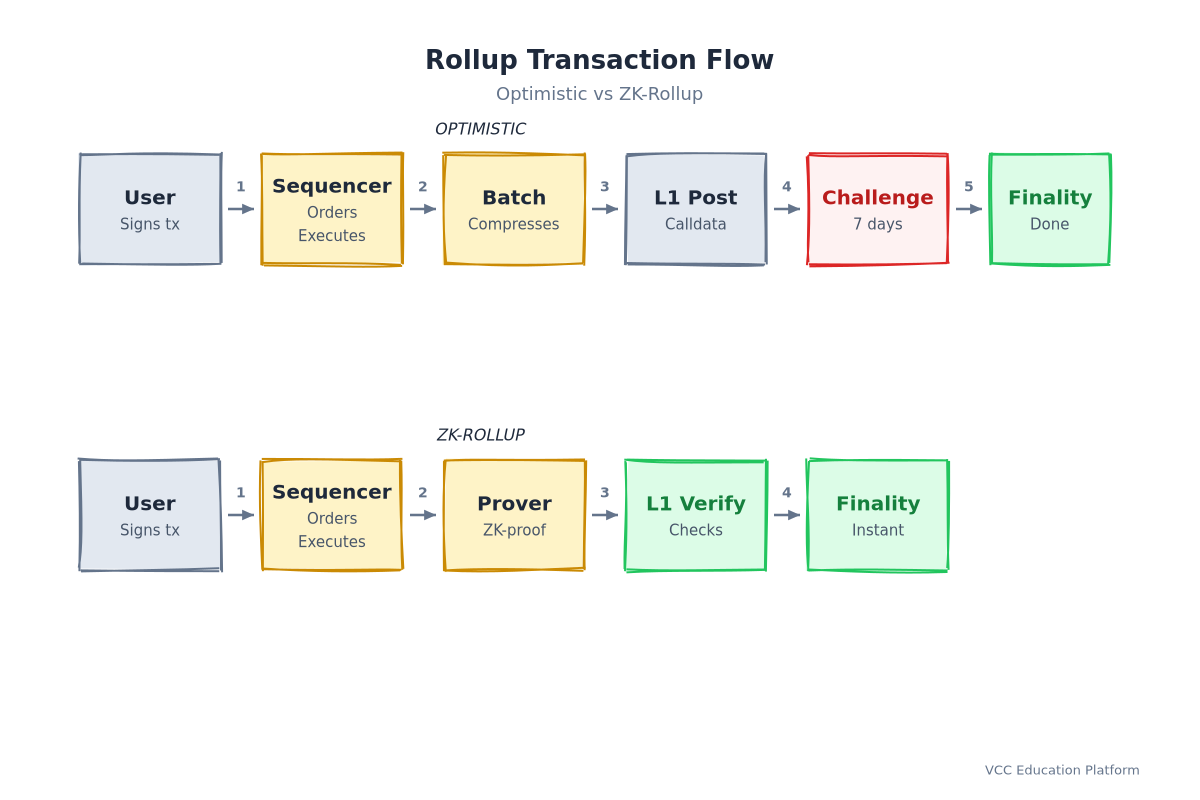
Architecture: ` User → Sequencer → Batch → L1 Calldata (via batcher) → Challenge Window (7 days) → Finality `
The sequencer orders transactions, executes them locally, and posts the batch to L1 as calldata. Anyone can download the calldata, re-execute, and if they detect an invalid state transition, submit a fraud proof during the challenge window.
Key projects (2024 TVL ranking per L2Beat):
| L2 | TVL | Stage | EVM Compatibility |
|---|---|---|---|
| Arbitrum One | ~$15B | Stage 1 | Equivalent (Type 2) |
| OP Mainnet | ~$6B | Stage 1 | Equivalent (Type 2) |
| Base | ~$3B | Stage 0 | Equivalent (Type 2) |
| Mantle | ~$1B | Stage 0 | Equivalent (Type 2) |
Pros:
- EVM-equivalent: Existing contracts deploy with minimal changes
- Simpler implementation: No complex cryptographic proving system
- Lower hardware requirements: Standard servers for sequencers/validators
- Battle-tested: Arbitrum and Optimism running since 2021
Cons:
- 7-day withdrawal delay: Funds locked during challenge window (mitigated by liquidity providers/third-party bridges for ~0.1-0.5% fee)
- Fraud proof liveness: Requires at least one honest watcher online
- Sequencer centralization: Most L2s currently run centralized sequencers (decentralization roadmaps exist)
ZK-Rollups
Architecture: ` User → Sequencer/Prover → Batch → Validity Proof → L1 Verification → Finality (minutes) `
Every batch includes a validity proof (ZK-proof) that cryptographically attests to correct execution. The L1 verifier contract checks the proof—no challenge window needed. Finality arrives when the proof is verified on L1.
Proof systems in production:
- SNARKs (Groth16, Plonk): zkSync Era, Polygon zkEVM, Linea, Scroll
- STARKs: StarkNet (Cairo VM, not EVM)
EVM Compatibility Spectrum (Vitalik's Type 1-4):
| Type | Description | Projects |
|---|---|---|
| Type 1 | Ethereum-equivalent (identical opcodes, gas, precompiles) | None fully yet (RISC Zero targeting) |
| Type 2 | EVM-equivalent (minor gas/opcode differences) | zkSync Era, Polygon zkEVM, Scroll, Linea |
| Type 3 | EVM-compatible (some opcodes unsupported, different precompiles) | - |
| Type 4 | High-level language compatible (compile Solidity to custom VM) | StarkNet (Cairo) |
Key projects (2024):
| L2 | TVL | Proof System | Type |
|---|---|---|---|
| zkSync Era | ~$600M | Boojum (Plonk) | Type 2 |
| Polygon zkEVM | ~$400M | Plonky2 | Type 2 |
| StarkNet | ~$300M | STARK (Cairo) | Type 4 |
| Scroll | ~$200M | Halo2 (KZG) | Type 2 |
| Linea | ~$150M | Vortex (Plonk) | Type 2 |
Pros:
- Instant finality: Minutes after proof verification (no 7-day wait)
- Stronger security: Cryptographic guarantee, no liveness assumption
- Capital efficiency: Faster withdrawals = less bridged liquidity needed
- Privacy potential: ZK proofs can hide transaction details (future)
Cons:
- Proving cost: Every batch requires proof generation (GPU/FPGA clusters)
- EVM compatibility trade-offs: Type 2-4 have varying degrees of divergence
- Hardware centralization risk: Proving requires specialized hardware
- Newer, less battle-tested: Mainnet launches 2023-2024
Rollup Comparison Matrix
| Dimension | Optimistic (Arbitrum/Optimism) | ZK-Rollup (zkSync/Scroll) |
|---|---|---|
| Finality | ~7 days (challenge period) | Minutes (post-proof) |
| EVM Compatibility | Equivalent (Type 2) | Type 2 (varies) |
| Proving Cost | None (fraud proofs rare) | High (every batch) |
| Hardware Reqs | Standard servers | GPU/FPGA clusters |
| Trust Assumptions | 1 honest watcher | Cryptographic only |
| Withdrawal Latency | 7 days (or bridge fee) | Minutes-hours |
| Composability | Sync (same L2) | Sync (same L2) |
| Sequencer | Centralized (roadmap to decentralize) | Centralized (roadmap) |
| TVL (2024) | ~$21B combined | ~$1.6B combined |
| Mainnet Since | 2021 | 2023-2024 |
Sidechains: Independent Chains with Bridges
Architecture
Sidechains run independent consensus (typically PoS with 20-100 validators). A two-way peg bridge locks assets on L1 and mints representations on the sidechain. The bridge validator committee (often overlapping with chain validators) attests to deposit/withdrawal events.
` L1: Lock → Event → Bridge Committee Attests → Sidechain: Mint Sidechain: Burn → Event → Bridge Committee Attests → L1: Unlock `
Major Examples
| Sidechain | Consensus | Validators | Bridge Model | TVL (2024) |
|---|---|---|---|---|
| Polygon PoS | PoS (Heimdall/Bor) | 100+ | 5/8 multisig + checkpoint | ~$900M |
| BNB Smart Chain | PoSA | 21 active | 11/21 multisig | ~$5B |
| Gnosis Chain | PoS | 100+ | 5/7 multisig + GNO staking | ~$500M |
Security Analysis
The bridge is the attack surface. Major exploits:
- Ronin Bridge (2022): $625M stolen — 5/9 validator keys compromised
- Wormhole (2022): $320M — signature verification bypass
- Nomad (2022): $190M — chaotic exploit after root verification bug
- Multichain (2023): $126M+ — private key compromise
Validator collusion risk: If >2/3 or threshold of bridge validators collude, they can mint arbitrary assets on the sidechain or steal locked L1 funds. This is fundamentally different from L2s where L1 verifies execution.
When to Use Sidechains
- Application-specific chains: Custom VM, gas token, governance (e.g., dYdX v4 on Cosmos, Hyperliquid L1)
- Lower security requirements: Gaming, social, high-throughput apps tolerating bridge risk
- EVM-alternative execution: Solana VM, Move VM, Wasm environments
State Channels: Micropayments & High-Frequency Interaction
How They Work
`
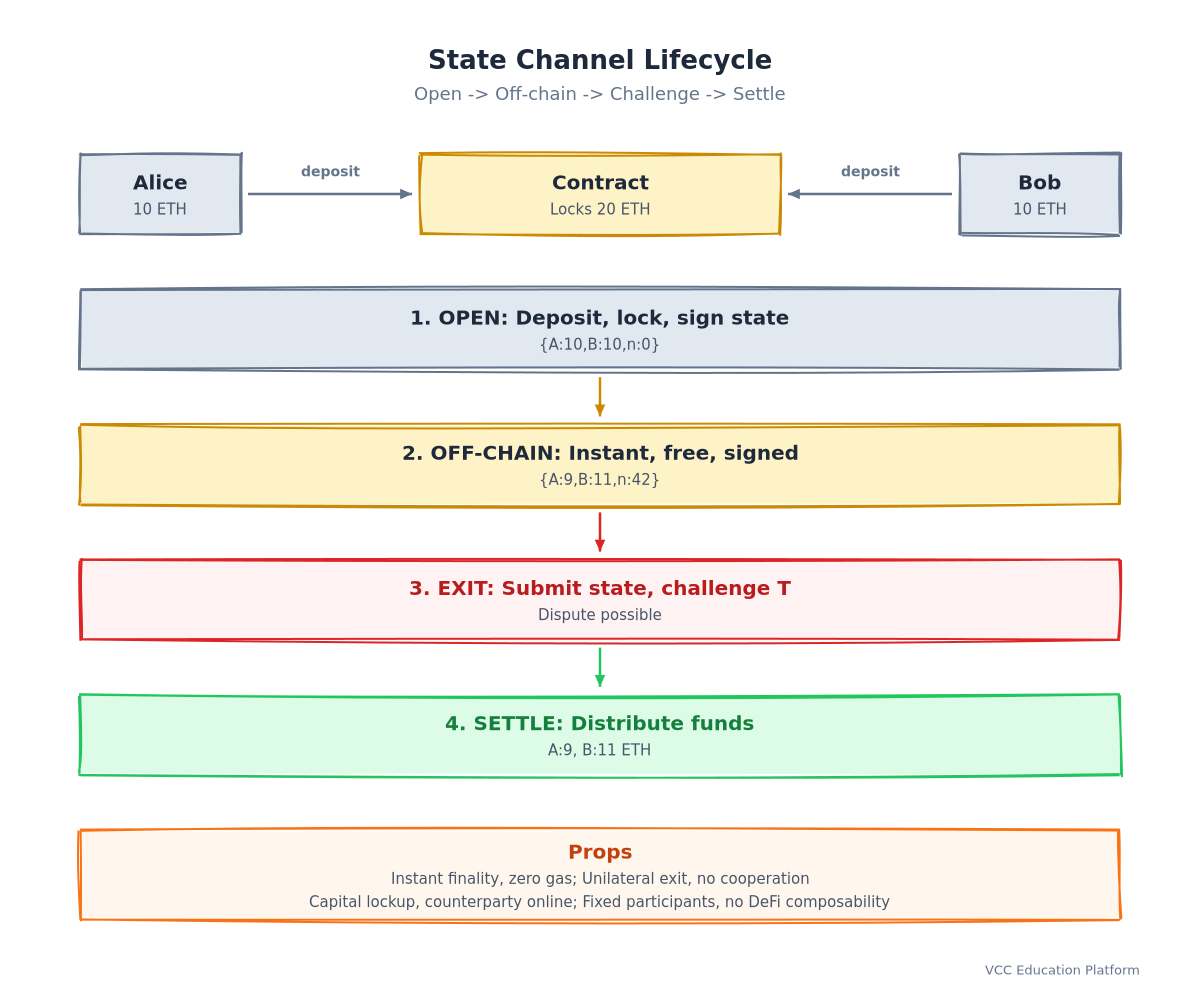
- On-chain: Alice + Bob deposit 10 ETH each → Channel Contract
- Off-chain: Signed messages update balances (Alice: 12, Bob: 8) → (Alice: 9, Bob: 11) ...
- On-chain (unilateral exit): Either submits latest signed state → Challenge period (T) → Settlement
- On-chain (cooperative close): Both sign final state → Immediate settlement
`
Key mechanism: Unilateral exit with time-locked challenge. If Alice submits an old state (Bob: 10, Alice: 10), Bob has time T to submit a newer signed state (Bob: 11, Alice: 9) and slash Alice.
DeFi Use Cases
- Payment channels: Streaming payments, micropayments (Lightning Network model)
- High-frequency trading: Off-chain order matching, on-chain settlement
- Gaming: Move-by-move state updates, final settlement on-chain
Limitations
| Limitation | Impact |
|---|---|
| Capital lockup | Funds committed for channel duration |
| Counterparty online | Need watchtowers for safety |
| Fixed participants | Can't add/remove without on-chain tx |
| No general composability | Can't call arbitrary contracts |
| Liquidity fragmentation | Each channel = isolated liquidity pool |
Sharding: The L1 Scaling Endgame
Ethereum's Danksharding Roadmap
Ethereum abandoned "execution sharding" (separate shard chains with independent state) in favor of danksharding—data availability sharding where L2s are the execution layers.
Phase 1: Proto-Danksharding (EIP-4844, March 2024)
- Introduces blobs: ~125 KB data packets per block (target 3, max 6)
- Blobs are not EVM-accessible—only commitment (KZG) visible to execution layer
- Blob gas market: Separate from regular gas, priced by demand
- Result: L2 data costs reduced 10-100x (from ~16 calldata gas/byte to ~1 blob gas/byte)
Phase 2: Full Danksharding (2025-2026+)
- 64 blobs per block (~8 MB/block, ~1.3 MB/s data throughput)
- Data Availability Sampling (DAS): Light clients verify availability by sampling random blob chunks
- Proposer-Builder Separation (PBS): Builders construct blob-containing blocks; proposers choose highest bid
- Shared sequencing: Atomic cross-L2 composability via shared sequencer
Technical Mechanics
Data Availability Sampling (DAS): Instead of downloading all blobs (impossible for light clients), clients sample random indices. If 50% of samples available → 99.9999% confidence full data available. This enables trust-minimized light clients and stateless validation.
Cross-shard (cross-L2) transactions: With shared sequencing, a single block can include transactions on Arbitrum, Optimism, and zkSync that atomically execute or all revert. This solves the "fragmented liquidity" problem.
Interaction with L2s
| Phase | L2 Benefit |
|---|---|
| Pre-4844 | L2s post calldata: ~16 gas/byte, expensive |
| Post-4844 (now) | L2s post blobs: ~1 gas/byte, 10-100x cheaper |
| Full danksharding | 64x blob capacity, DAS for light clients, shared sequencing |
The modular thesis realized: L1 = Data Availability + Settlement. L2 = Execution. This is the endgame architecture.
Vietnamese DeFi Context
Local Adoption Landscape
Vietnam consistently ranks top 5 globally in Chainalysis Global Crypto Adoption Index (2021-2023). Key drivers:
- Remittances: $18B+ annual inflows (World Bank 2023) — crypto offers 1-2% vs 5-7% traditional
- Young demographics: Median age 32, high smartphone penetration
- DeFi yield seeking: USDT/USDC stablecoin farming, L2 airdrop farming
L2 adoption in Vietnam (2024 estimates from local exchanges/on-chain):
- Arbitrum — Largest TVL, early airdrop (ARB) created awareness
- zkSync Era — Heavy airdrop farming activity (ZK token launch 2024)
- Base — Coinbase brand trust, low fees, easy fiat onramp via Coinbase
- Polygon PoS — Legacy familiarity, but migrating to zkEVM
- StarkNet — Developer community, STRK airdrop anticipation
Regulatory Context
State Bank of Vietnam (SBV): Crypto not legal tender; not recognized as payment method. However, holding and trading are not explicitly prohibited for individuals. DeFi operates in gray zone—no licensing framework exists.
Taxation: No clear guidance. Most VN users treat crypto gains as personal income (20% tax) or capital gains (unclear). Airdrop taxation particularly ambiguous.
Implication for scaling: L2s with low fees + fast finality (ZK-rollups, Base) align best with VN use cases (remittance, high-frequency trading, airdrop farming). 7-day optimistic withdrawals are a friction point for users needing quick VND off-ramp.
Vietnamese Projects on L2
| Project | L2 | Category | Notes |
|---|---|---|---|
| Coin98 Wallet | Multi-L2 (Arbitrum, zkSync, Base) | Wallet/SuperApp | Native L2 support, fiat onramp |
| Kyber Network | Arbitrum, zkSync | DEX/Aggregator | KyberSwap deployed on major L2s |
| KardiaChain | Own L1 + EVM bridge | Interoperability | Dual-node architecture |
| Ancient8 | zkSync, Arbitrum | Gaming L2 | Game-focused rollup stack |
| BHO Network | BNB Smart Chain → migrating | DeFi/Launchpad | VN-focused yield products |
Choosing the Right Scaling Solution
Decision Framework
| Use Case | Recommended Solution | Rationale |
|---|---|---|
| General DeFi (DEX, lending, yield) | Optimistic or ZK-Rollup | Security inheritance, composability, tooling |
| High-frequency trading / Market making | ZK-Rollup (Type 2) | Instant finality, no withdrawal delay |
| Gaming / NFTs with micropayments | State Channel or App-chain | Low latency, custom economics |
| App-specific custom logic (custom VM, gas token) | Sidechain / App-chain | Sovereignty, customization |
| Maximum security (institutional, high TVL) | ZK-Rollup Type 1 (future) / Optimistic Stage 2 | Cryptographic guarantee / trust-minimized fraud proofs |
| EVM-equivalent migration (existing contracts) | Optimistic Rollup | Drop-in deployment |
| Cross-border remittance (VN corridor) | Base / Arbitrum / zkSync | Low fees, fiat onramps, fast finality |
Multi-Layer Strategy
The emerging architecture is layered:
- L1 (Ethereum): Settlement, high-value transfers, staking, validator ops
- L2 (Rollups): General DeFi execution, liquidity hubs
- L3 / State Channels: Specialized high-frequency apps (gaming, HFT, micropayments)
- Shared Sequencing / Intents: Unified UX across layers
Future Outlook
Emerging Architectures
Based Rollups (L1-Sequenced): Instead of centralized sequencer, L1 validators propose L2 blocks. Taiko (Type 1 ZK-EVM) and Nethermind's Based Rollup design. Benefits: decentralized sequencing, L1 MEV capture, simpler trust model.
Shared Sequencing Layers:
- Espresso Systems: HotShot consensus for shared sequencing
- Astria: Shared sequencer for sovereign rollups
- Radius: Encrypted mempool + shared sequencing
Enable atomic cross-rollup transactions without full danksharding.
ZK-Aggregation Layers:
- Nexus (StarkNet): Recursive STARK aggregation
- =nil; Foundation: ZK-sharding with unified proving
- RISC Zero: Bonsai proving network for general ZK execution
Interoperability Standards
| Standard | Purpose | Status |
|---|---|---|
| ERC-7683 | Cross-chain intents (user signs intent, solvers execute) | Draft |
| RIP-7755 | Rollup interoperability (standardized messaging) | Draft |
| ERC-4337 + ERC-7562 | Account abstraction + paymaster for cross-L2 UX | Live (4337) |
| IBC / Hyperlane | General cross-chain messaging | Live |
The Endgame Vision
` User Intent (ERC-7683) ↓ Solver Network (competitive execution) ↓ Shared Sequencer (atomic ordering across L2s) ↓ L2 Execution (Optimistic / ZK / App-chain) ↓ Blob Submission (EIP-4844 / Danksharding) ↓ L1 Settlement (Ethereum) `
Unified UX: User signs once. Solvers handle routing, bridging, gas payment across chains. Account abstraction (ERC-4337) sponsors gas in any token. The blockchain becomes invisible infrastructure.
FAQ
1. What is the difference between L2 and sidechain?
L2 inherits L1 security—execution is verified by L1 (via fraud/validity proofs). Sidechain has independent security—its own validators secure execution; bridge is a separate trust assumption. L2 withdrawals are trust-minimized; sidechain withdrawals require bridge validator honesty.
2. Why do optimistic rollups have 7-day withdrawals?
The challenge window allows anyone to submit a fraud proof if the sequencer posted an invalid state. 7 days is a conservative parameter ensuring sufficient time for detection even under adverse network conditions. Third-party bridges (Hop, Across, Orbiter) offer instant withdrawal for ~0.1-0.5% fee by fronting liquidity.
3. Are ZK-rollups better than optimistic rollups?
Depends on priorities. ZK: faster finality, stronger security, but higher proving costs, newer code, EVM compatibility trade-offs. Optimistic: EVM-equivalent, battle-tested, lower operating cost, but 7-day withdrawals and liveness assumption. For most DeFi today, both are viable—choice depends on specific needs.
4. Can I use DeFi apps on multiple L2s simultaneously?
Yes, but not atomically. You need separate wallets/addresses per L2, bridge assets between them, and manage gas tokens on each. ERC-4337 account abstraction + ERC-7683 intents will enable unified accounts and atomic cross-L2 execution in the future.
5. What happens to my funds if an L2 sequencer goes down?
Optimistic: Anyone can become sequencer by posting batches to L1 (permissionless in Stage 1+). L1 verifies state transitions. Funds safe on L1. ZK: Prover network can be decentralized. L1 verifier contract accepts valid proofs from anyone. Funds safe on L1. Both: L1 is the ultimate source of truth. Sequencer downtime = delayed finality, not fund loss.
6. How does EIP-4844 help L2s?
Introduces blobs—cheap data storage (~1 gas/byte vs 16 for calldata). L2s post compressed transaction data as blobs instead of calldata. Result: 10-100x reduction in L2 data posting costs, directly lowering user fees. Live since March 2024 (Dencun upgrade).
7. Is sharding still happening on Ethereum?
Yes, but redefined. "Execution sharding" (separate shard chains) was abandoned. Danksharding (data availability sharding) is the roadmap: L1 provides massive data bandwidth (blobs) + DAS; L2s handle execution. Proto-danksharding (EIP-4844) is live; full danksharding targets 2025-2026+.
8. Which L2 has the highest TPS?
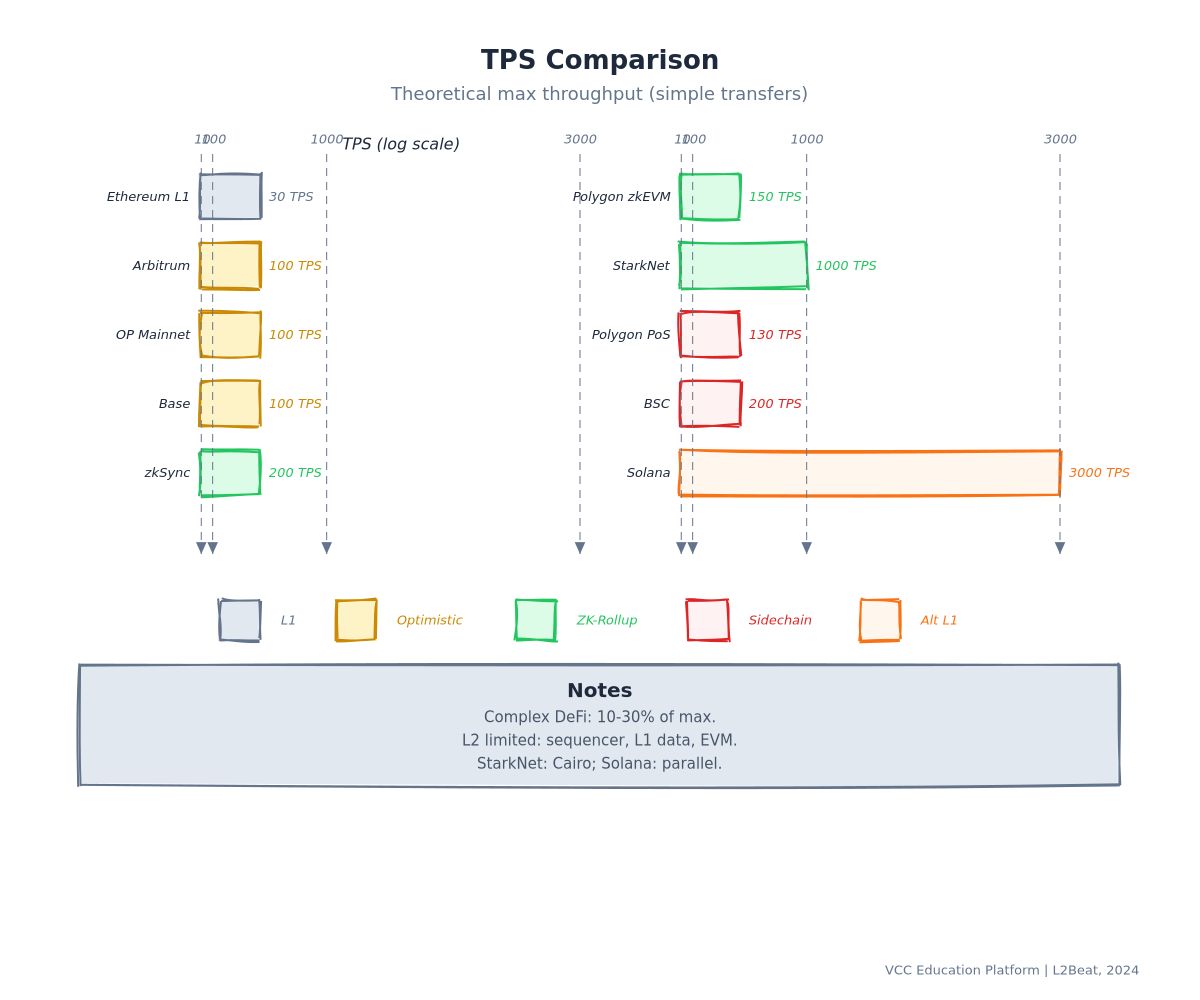
Theoretical vs practical: StarkNet claims ~1,000+ TPS (Cairo VM, parallel execution). zkSync Era ~100-200 TPS (Type 2 EVM). Arbitrum/Optimism ~40-100 TPS (EVM-equivalent, single-threaded). But TPS alone is misleading—measured in simple transfers. Complex DeFi ops (swaps, multi-hop) have lower effective throughput. Cost per DeFi action is a better metric.
Conclusion
DeFi scaling is no longer theoretical—it's production reality. Rollups (both optimistic and ZK) have won the mindshare and TVL battle for general-purpose DeFi on Ethereum. Sidechains persist for app-specific sovereignty. State channels serve niche high-frequency use cases. Sharding (danksharding) is the L1 endgame that will make L2s dramatically cheaper.
For Vietnamese users and builders, the practical choice today is:
- Arbitrum/Base for general DeFi (liquidity, tooling, fiat onramps)
- zkSync/Scroll for cost-sensitive high-frequency use (airdrops, trading, remittance)
- Watch shared sequencing + intents (ERC-7683) for the next UX leap
The modular blockchain thesis is playing out: L1 secures, L2 executes, users transact. The infrastructure is ready. The next phase is making it invisible.
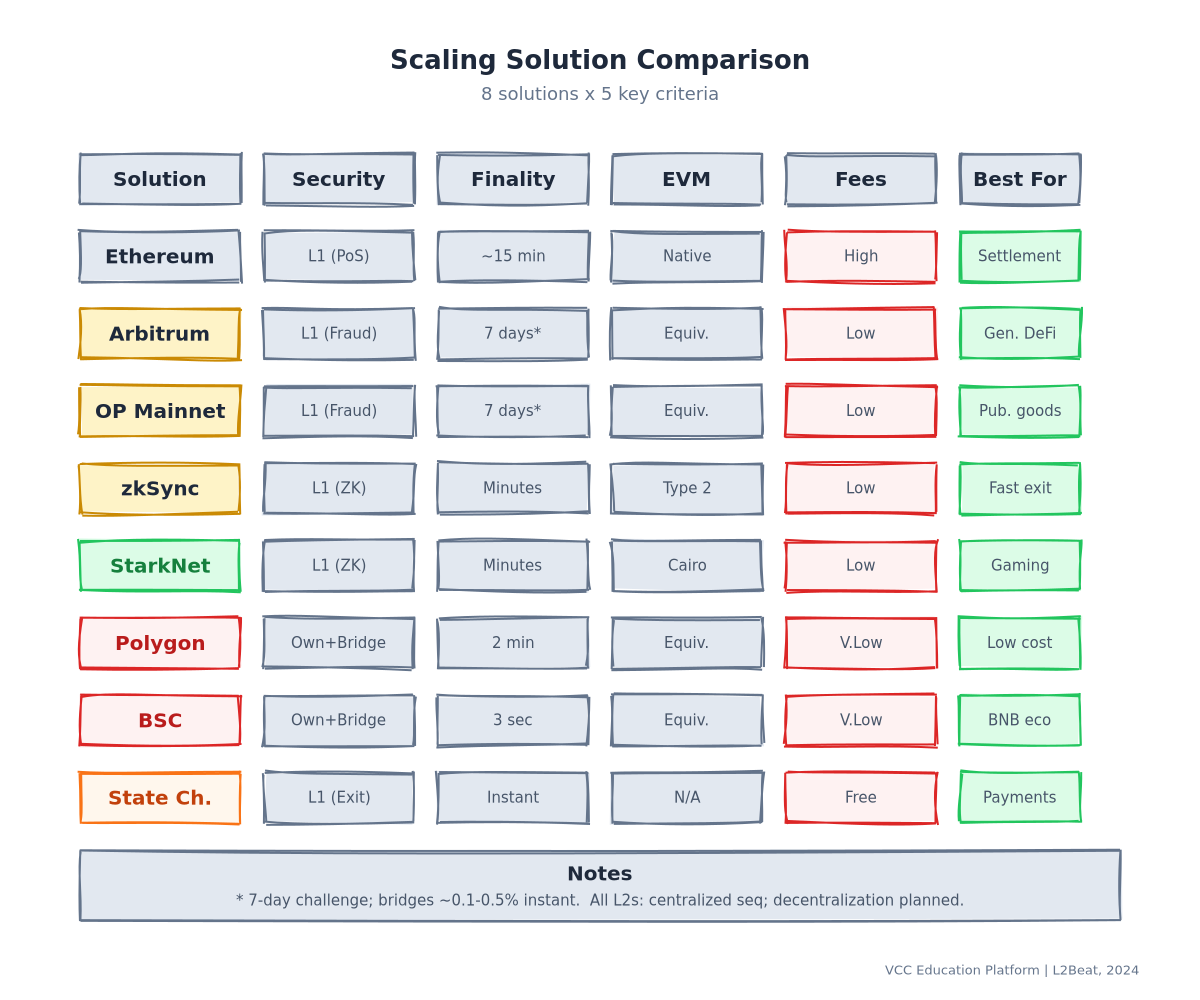
Word count: ~3,200 Primary keyword: "DeFi scalability solutions" (H1, first 100 words, slug, meta title) Secondary keywords distributed: layer 2 DeFi, rollups, sidechains, state channels, sharding, throughput Visual markers: 5 placed