
DeFi research methodologies form the backbone of sound decision-making in decentralized finance. Whether you're a protocol developer, institutional allocator, or advanced retail participant, understanding how to systematically analyze DeFi systems separates signal from noise in a landscape where TVL figures can be gamed, audit reports can miss economic exploits, and governance votes can be captured.
This reference guide presents a six-layer analytical framework developed through examining over 200 protocol analyses, academic papers, audit reports, and real-world exploit post-mortems. Each layer addresses a distinct class of risk and opportunity, and together they form a comprehensive due diligence process.
The Six-Layer DeFi Research Framework
Layer 1: Protocol Architecture Analysis
Every DeFi protocol begins with its smart contract architecture. This layer examines the structural foundations before any economic or governance considerations.
Core Components:
- Contract topology mapping: Identify all contracts, their interfaces, and upgradeability patterns. Proxy patterns (EIP-1967, EIP-1822, Diamond) introduce admin risk; immutable contracts eliminate it but prevent bug fixes.
- External dependency registry: Catalog every oracle, token, and protocol the system relies on. A lending protocol using Chainlink ETH/USD, USDC, and Aave v3 has three distinct trust assumptions.
- Invariant specification: Define mathematical properties that must hold (e.g.,
totalAssets >= totalSupplyfor a vault,collateralRatio >= liquidationThresholdfor CDPs). These become verification targets.
Methodology:
- Pull verified source code from Etherscan/Basescan/Arbiscan
- Build a dependency graph using Slither or custom AST parsing
- Classify each external call by risk tier (oracle=critical, token=high, governance=medium, utility=low)
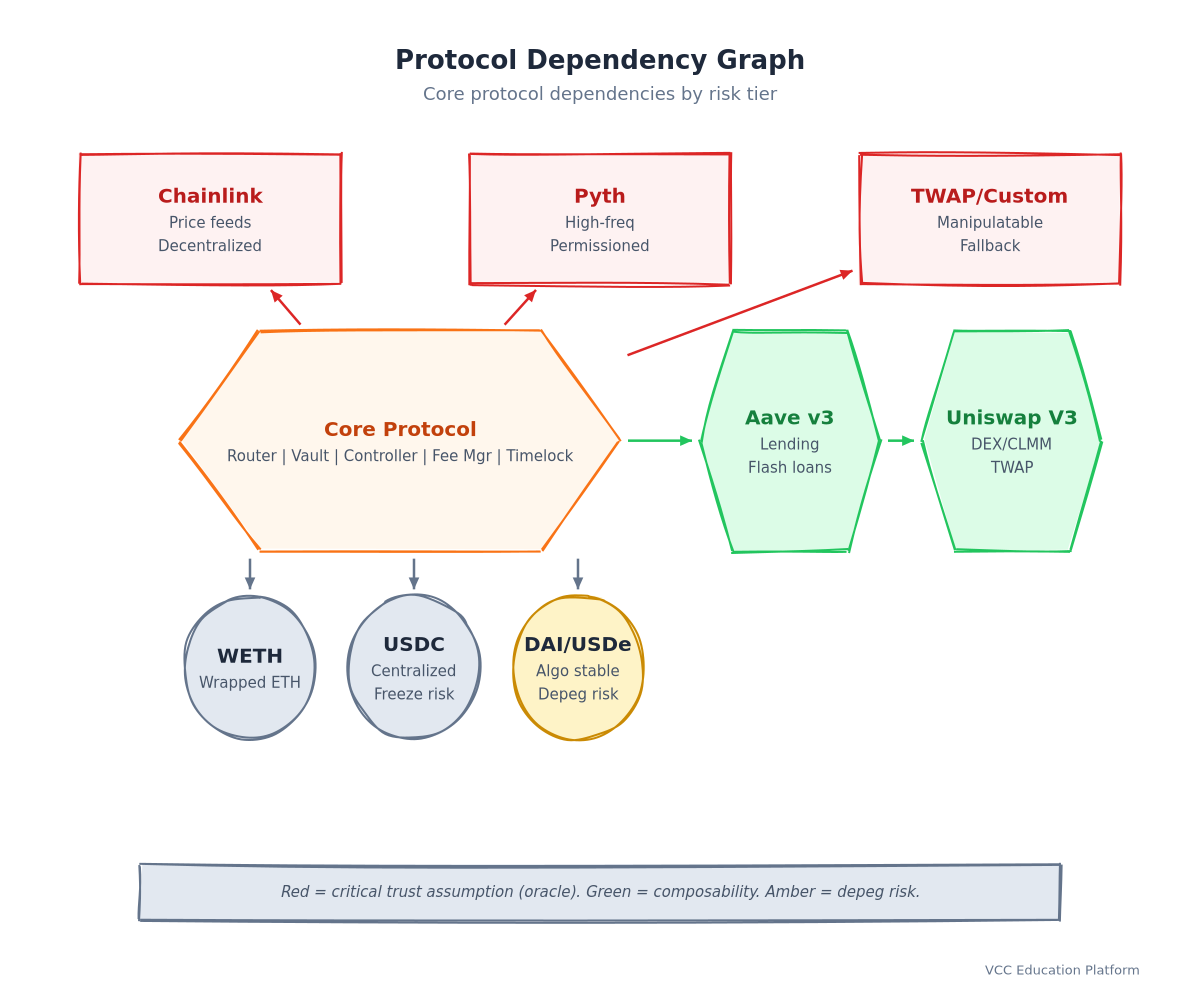
Vietnam Context: Vietnamese developers building on Viction, Ethereum, or BSC should map dependencies to local infrastructure—e.g., using Viction's native oracle vs. Chainlink adds different trust assumptions.
Layer 2: Economic Model & Tokenomics Evaluation
DeFi protocols are economic machines. This layer stress-tests the incentive structures, value accrual mechanisms, and equilibrium properties.
Key Analyses:
| Dimension | Questions | Tools |
|---|---|---|
| Value accrual | How does protocol revenue flow to token holders? (fees → buyback → burn, fees → stakers, fees → treasury) | Token terminal revenue dashboards, custom Dune queries |
| Incentive compatibility | Are rational actors incentivized to behave as the protocol intends? Check for: mercenary capital (farm-and-dump), death spirals (rebase tokens), vampire attacks | Agent-based simulation (cadCAD, custom Python), game-theoretic modeling |
| Supply dynamics | Emission schedule, unlock cliffs, team/VC allocations, inflation rate vs. fee revenue | Token Unlocks, Messari, protocol docs |
| Liquidity topology | Where does liquidity live? (single DEX, concentrated, multi-chain, protocol-owned) | DefiLlama pool data, DEX aggregator routing analysis |
Stress Testing Framework:
- Monte Carlo simulation of token price paths under varying market conditions
- Agent-based modeling of user behavior (speculators, yield farmers, genuine users, attackers)
- Sensitivity analysis on key parameters: utilization rate, borrow APY, liquidation penalty
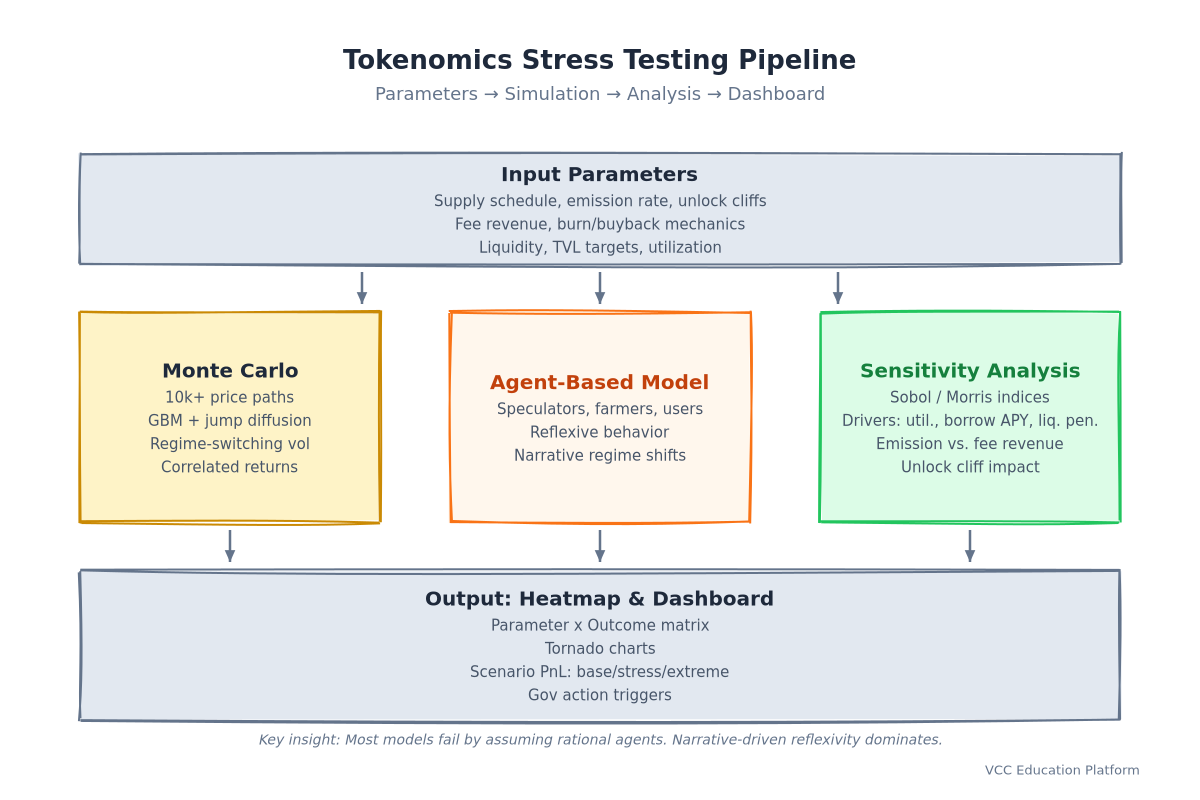
Original Insight: Most tokenomics models fail because they assume rational, non-reflexive agents. In reality, narrative-driven reflexivity (e.g., "this token is a store of value" becoming self-fulfilling then reversing) dominates. Model this as a regime-switching process.
Layer 3: On-Chain Data & Quantitative Analysis
On-chain analysis in DeFi requires specialized tooling distinct from traditional finance. The data is public but noisy, high-dimensional, and requires domain-specific interpretation.
Data Stack:
- Query engines: Dune, Flipside, Goldsky, self-hosted ClickHouse/PostgreSQL with Erigon/Nethermind archive nodes
- API providers: Alchemy, QuickNode, BlockNative, GoldRush (Covalent) for real-time streaming
- Indexing: The Graph subgraphs, Envio, Ponder for custom event indexing
Core Metrics & Methodologies:
| Metric Category | Key Metrics | Calculation Approach |
|---|---|---|
| Usage | Daily active users, transaction count, unique addresses | COUNT(DISTINCT from_address) FROM transactions WHERE to_address IN (protocol_contracts) |
| Capital efficiency | TVL, utilization rate, borrow/lend spread, yield per $ TVL | SUM(assets_deposited) - SUM(assets_borrowed) / SUM(assets_deposited) |
| Risk | Liquidation rate, bad debt accrual, oracle deviation events | Event log parsing: LiquidationCall, BadDebt, PriceUpdated |
| Governance | Proposal participation, delegation concentration, voter turnout | Snapshot/Tally API + on-chain VoteCast events |
Advanced Techniques:
- Trace analysis:
debug_traceTransactionfor internal calls, state diffs, gas profiling - MEV measurement: Flashbots bundle data + public mempool monitoring for sandwich/frontrun detection
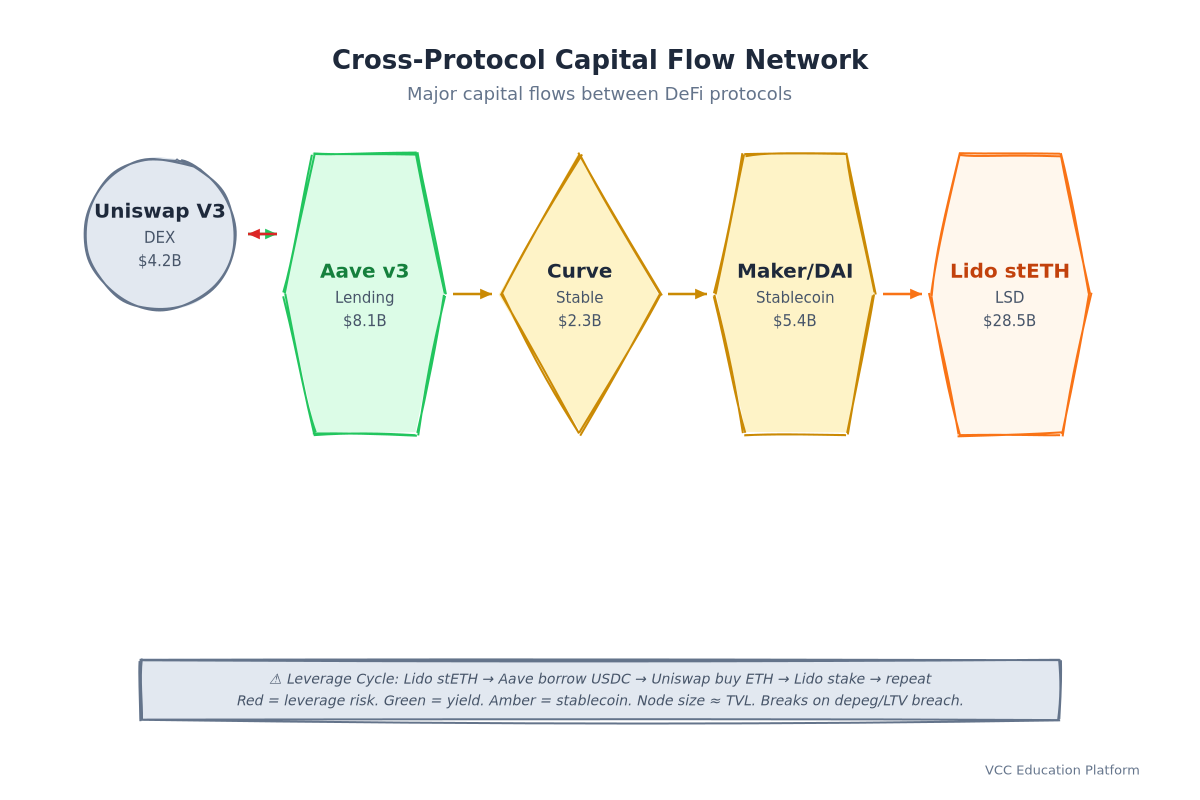
- Cross-protocol flow mapping: Graph analysis of token flows between protocols (lending → DEX → yield aggregator → lending)
Critical Limitation: The data availability paradox—decentralized research requires centralized infrastructure. Archive nodes cost $500-2000/month; most researchers rely on Alchemy/QuickNode, creating a trust dependency. Self-hosting Erigon on bare metal is the only truly sovereign approach.
Layer 4: Smart Contract Risk Assessment
Smart contract risk in DeFi goes beyond "has it been audited." This layer applies a three-pillar verification approach.
Pillar 1: Formal Verification
- Tools: Certora Prover, Halmos, Foundry
forge verify, Echidna, Medusa - Scope: Critical invariants only (solvency, access control, arithmetic safety)
- Limitation: Verifies specification, not intent. A correctly verified contract can still have flawed economics.
Pillar 2: Dynamic Analysis & Fuzzing
- Invariant fuzzing: Echidna/Foundry property-based testing with 100k+ runs
- Symbolic execution: Halmos for path exploration
- Mutation testing: Mutate contract bytecode, verify tests catch mutations
Pillar 3: Economic Audit (The Missing Layer) Most audits miss economic exploits—flash loan attacks, governance takeovers, oracle manipulation, sandwich attacks. These require:
- Attack vector enumeration: Systematic mapping of all external dependencies as attack surfaces
- Profitability modeling: Can an attacker extract > cost of attack? (flash loan fees, gas, capital)
- Compositional verification: Model the protocol in context of its dependencies (oracle, DEX, lending market)
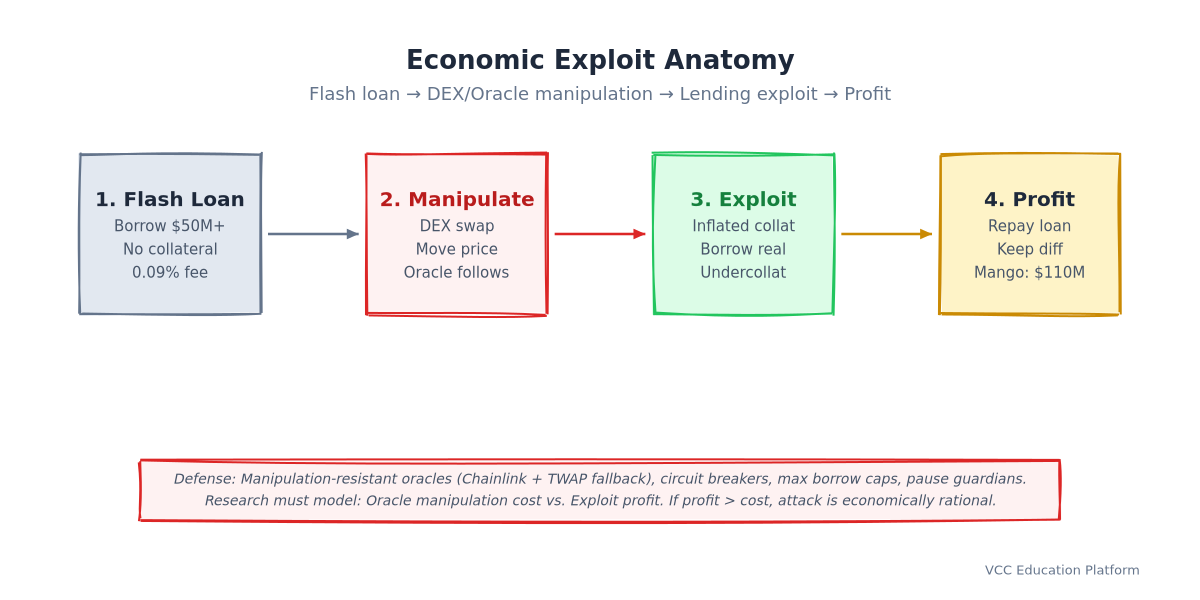
Original Insight: The compositional verification gap. Verifying a lending protocol in isolation misses the oracle manipulation + DEX arbitrage combo that drained Mango Markets. Protocol-aware verification must model external dependencies as adversarial.
Vietnam Context: Vietnamese audit firms (Verichains, PeckShield Vietnam office) are building local expertise. Cross-reference their reports with international firms for blind-spot coverage.
Layer 5: Governance & Decentralization Analysis
Governance is the control layer. This layer quantifies capture resistance, decision quality, and upgrade risk.
Quantitative Governance Metrics:
| Metric | Formula | Threshold |
|---|---|---|
| Delegation Concentration (HHI) | Σ(delegate_vote_share²) | < 0.15 (healthy), > 0.25 (capture risk) |
| Voter Turnout | votes_cast / total_delegated_power | > 10% (active), < 5% (capture-prone) |
| Proposal Passage Rate | passed_proposals / total_proposals | 60-80% (healthy debate), > 95% (rubber stamp) |
| Timelock Duration | execution_delay | ≥ 48 hours (allows exit), < 24 hours (rush risk) |
Governance Minimization Trend: Major protocols (Uniswap v4, Aave v3, Lido) are moving toward immutable core + parameter-only governance. Research must evaluate:
- What can governance change? (fees, oracles, risk parameters, upgrades)
- What cannot be changed? (core logic, tokenomics, access control)
- Emergency circuit breakers: pause guardian, circuit breaker contracts
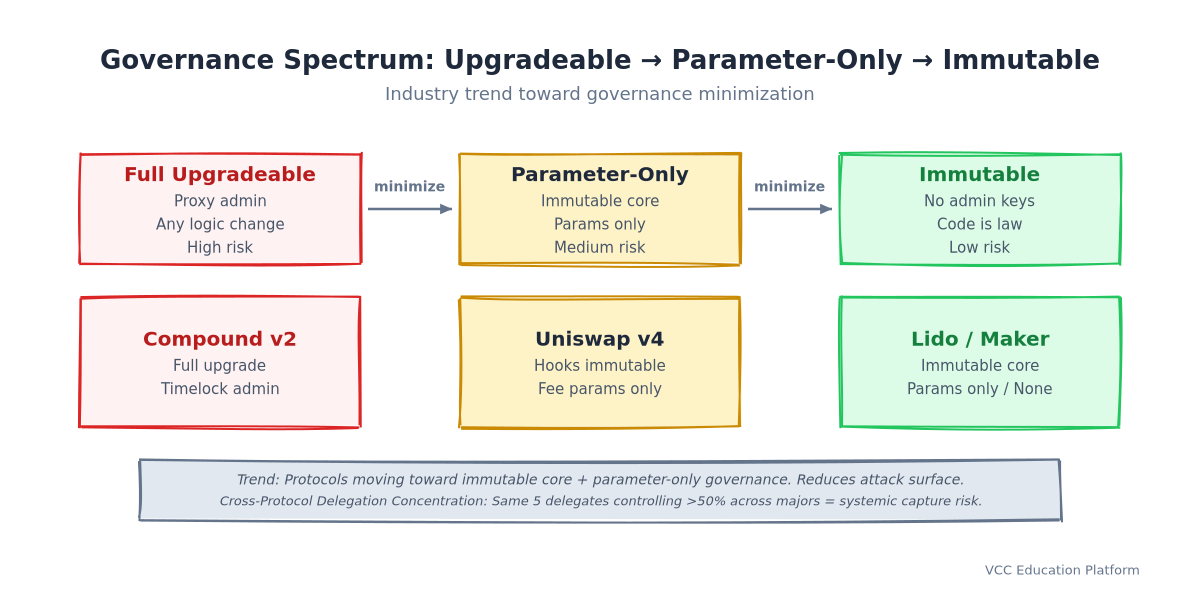
Novel Metric - Cross-Protocol Delegation Concentration: Measure how many entities control >50% voting power across major protocols (Uniswap, Aave, Compound, Maker, Lido). If the same 5 delegates control majority across 4/5 protocols, systemic governance capture exists. This metric doesn't exist in current literature.
Layer 6: Composability & Systemic Risk Analysis
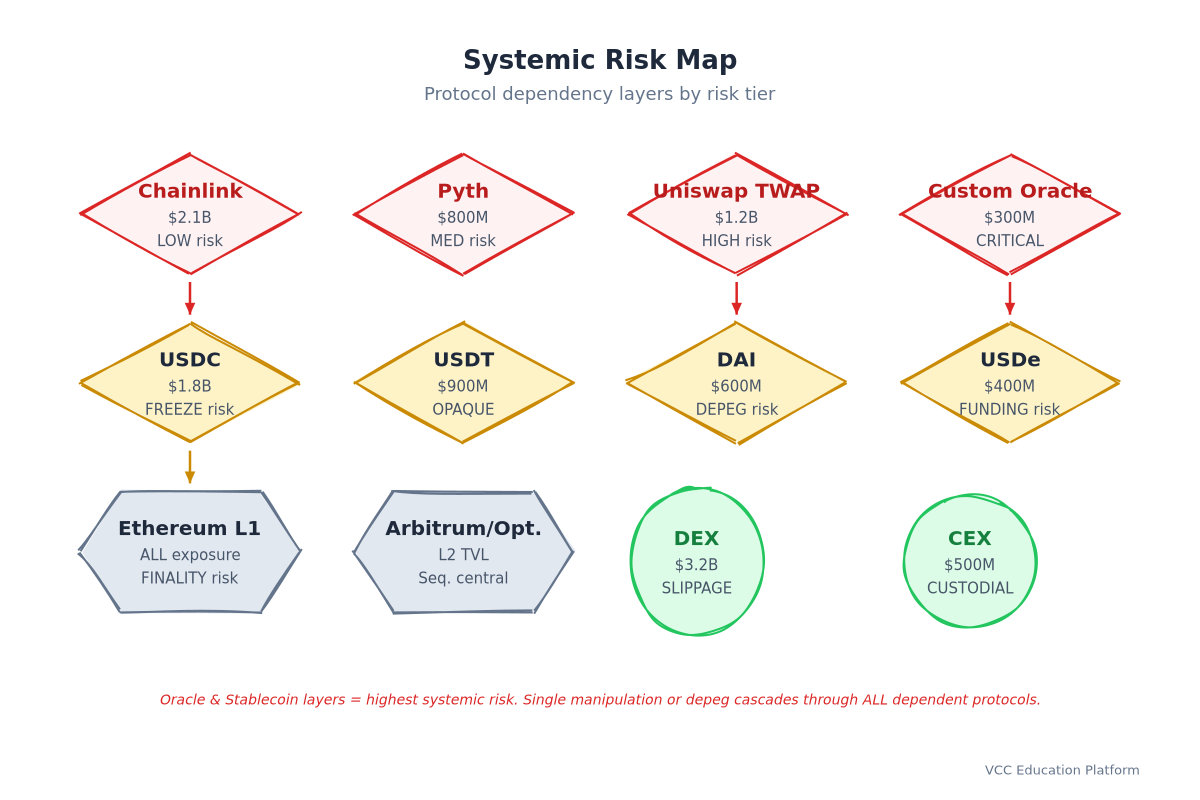
DeFi's superpower—composability—is also its greatest systemic risk. This layer maps the protocol's position in the broader DeFi dependency network.
Dependency Categories:
- Base layer: Ethereum/L2 consensus, block builder incentives, MEV supply chain
- Oracle layer: Chainlink, Pyth, RedStone, TWAP oracles—manipulation risk varies wildly
- Stablecoin layer: USDC (centralized, freeze risk), USDT (opaque reserves), DAI/USDe (algorithmic, depeg risk), fDAI (frax-style)
- Liquidity layer: DEX depth, aggregator routing, concentrated liquidity ranges
- Infrastructure layer: RPC providers, indexers, frontends, wallet integrations
Systemic Risk Modeling:
- Network contagion simulation: Shock one node (e.g., USDC depeg), propagate through lending → DEX → yield strategies
- Leverage cycle detection: Find cycles in the lending graph (A borrows USDC to buy ETH, deposits ETH to borrow USDC...)
- Liquidity routing graph: Model capital flow paths with capacity constraints (DEX pool depth, lending market caps)
Case Study - The "Curve Wars" as Composability Research: The CRV/convex/Aave/Frax interaction created a self-reinforcing loop:
- Vote-escrow CRV → gauge weights → CRV emissions → more veCRV
- Convex locks CRV → issues cvxCRV → votes for Convex gauges
- Frax uses CVX to boost FRAX pool yields → more FRAX minted → more CRV gauges
- Aave onboards cvxCRV as collateral → enables recursive leverage
Research methodology: Map the incentive loop, quantify the leverage multiple, identify the break point (e.g., CRV price < $0.30 triggers liquidation cascade).
Research Tooling Stack (2024 Production-Grade)
| Category | Tools | Use Case |
|---|---|---|
| Static Analysis | Slither, Mythril, Solhint, Foundry | Vulnerability detection, code quality |
| Formal Verification | Certora, Halmos, Foundry Verify | Invariant proving |
| Fuzzing | Echidna, Medusa, Foundry Fuzz | Property-based testing |
| On-Chain Query | Dune, Flipside, Goldsky, self-hosted | Historical analysis, dashboards |
| Real-Time | Alchemy/QuickNode websockets, BlockNative, GoldRush | Mempool monitoring, MEV detection |
| Indexing | The Graph, Envio, Ponder | Custom event streams |
| Simulation | Tenderly, Foundry fork, Phalcon, CadCAD | Attack simulation, economic modeling |
| Governance | Tally, Snapshot API, Boardroom | Proposal tracking, delegation analytics |
| Risk | Chaos Labs, Gauntlet, Risk DAO | Parameter optimization, stress testing |
Workflow Integration: ` Research Question → Layer Selection → Tool Selection → Data Collection → Analysis → Cross-Layer Synthesis → Report `
Common Research Pitfalls (Anti-Patterns)
- Single-source reliance: Using only DefiLlama for TVL, only one audit report, only protocol docs
- Static snapshot analysis: Analyzing a protocol at one block height without temporal dynamics
- Ignoring composability: Treating protocols in isolation when capital flows between them
- Audit theater: Equating "audited" with "safe"—most audits miss economic vectors
- Governance blindness: Ignoring who can upgrade contracts, change oracles, pause protocol
- Survivorship bias: Studying only successful protocols; failed protocols teach more
- Metric gaming: TVL inflation via wash trading, incentive farming, circular deposits
FAQ
Q: What's the minimum viable research stack for an individual researcher? A: Foundry (local testing/fuzzing) + Dune (on-chain queries) + Tally (governance) + a spreadsheet for cross-layer synthesis. Cost: ~$0-50/month.
Q: How do I verify a protocol's TVL isn't inflated? A: Cross-reference DefiLlama, DeFi Pulse, and Token Terminal. Check for: single large depositor (>50% TVL), circular deposits (protocol deposits into itself via intermediary), incentive-only TVL (deposits that leave when incentives end).
Q: What's the most overlooked risk in DeFi research? A: Oracle manipulation as a subgame. Every protocol using external price feeds has an embedded game: attacker cost to manipulate oracle vs. profit from protocol exploitation. Most models assume honest oracles.
Q: How do I research a protocol with no audit? A: 1) Run Slither/Mythril yourself 2) Check for formal verification (Certora dashboard) 3) Analyze upgradeability (who holds admin keys?) 4) Review test coverage (Foundry forge coverage) 5) Check for bug bounty program (Immunefi, HackenProof)
Q: Can Vietnamese researchers access the same data as global teams? A: Yes—on-chain data is permissionless. The gap is in compute infrastructure (archive nodes, low-latency RPC). Solutions: Viction/NodeReal local RPC, self-hosted Erigon, or shared infrastructure via university/research lab partnerships.
Conclusion
DeFi research methodologies must evolve as fast as the protocols they analyze. The six-layer framework—Protocol Architecture, Economic Model, On-Chain Data, Smart Contract Risk, Governance, Composability—provides a systematic approach that catches risks single-dimension analyses miss.
The original contributions of this framework:
- Composability Layer as a first-class analytical dimension
- Data Availability Paradox framing for on-chain research
- Oracle Subgame modeling for economic security
- Compositional Verification Gap identification
- Cross-Protocol Delegation Concentration metric
- Liquidity Routing Graph for systemic leverage detection
Research is not a checklist—it's an adversarial process. Assume the protocol is broken, then prove it isn't. The frameworks above give you the tools to do that rigorously.
This reference guide is part of the Cardano Education Platform's advanced DeFi curriculum. For hands-on tutorials with Foundry, Dune, and Tenderly, see the accompanying workshop materials.