
DeFi protocol governance is the set of rules, processes, and smart contracts that allow token holders to collectively decide the future of a decentralized finance protocol. Unlike traditional companies where a board of directors makes decisions, DeFi protocols encode governance into immutable code — proposals, votes, and execution all happen on-chain, transparent to anyone with an internet connection.
But here's the paradox: the more decentralized a protocol claims to be, the more complex its governance machinery becomes. Compound, Uniswap, Aave, and Maker each took different paths. Some prioritize security with multi-day timelocks. Others optimize for agility with emergency executors. A few experiment with quadratic voting to reduce whale dominance. None have solved the fundamental tension between decentralization, security, and speed.
This article breaks down how decentralized governance DeFi works in practice — the models, the mechanisms, the attack vectors, and the hard-won lessons from protocols managing billions in TVL.
Why Governance Exists: The Upgrade Problem
Imagine you deploy a lending protocol. The interest rate model works fine for six months. Then a new collateral type launches, or a math bug is discovered, or market conditions shift and the utilization curve needs adjusting.
In TradFi, the CTO calls a meeting, engineers push a patch, and users never know. In DeFi, the contract is immutable. You cannot change it. The only way to "upgrade" is to deploy a new contract and migrate users — or to have built a governance system from day one that can authorize parameter changes, contract upgrades, and treasury spends.
This is why every major DeFi protocol eventually builds governance. Not because "decentralization" is a marketing buzzword, but because immutable code cannot adapt to a changing world.
The Governance Stack: Four Layers
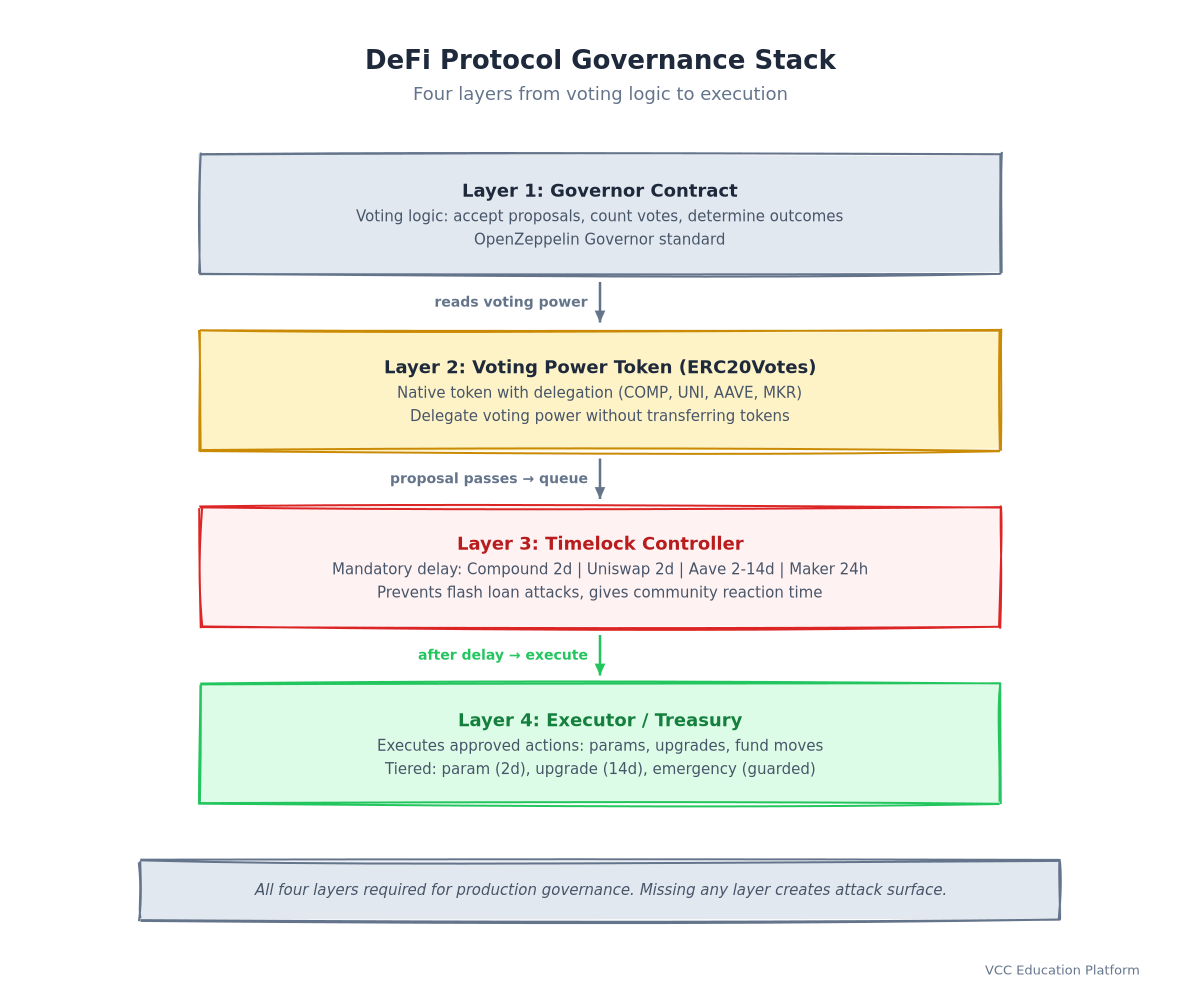
Every production-grade DeFi governance system has four components working together:
- Governor Contract — The voting logic. Accepts proposals, counts votes, determines outcomes. OpenZeppelin's
Governoris the de facto standard. - Voting Power Token — Usually the protocol's native token (COMP, UNI, AAVE, MKR) wrapped with
ERC20Votesfor delegation support. - Timelock Controller — A mandatory delay between vote passage and execution. Prevents instant malicious changes.
- Executor / Treasury — The destination of approved actions: parameter setters, contract upgraders, fund movers.
Governance Models Compared: Not All Token Voting Is Equal
The CSV SEOKeywords column lists "defi governance models" as a secondary keyword — and for good reason. The industry has converged on several distinct models, each with different trade-offs.
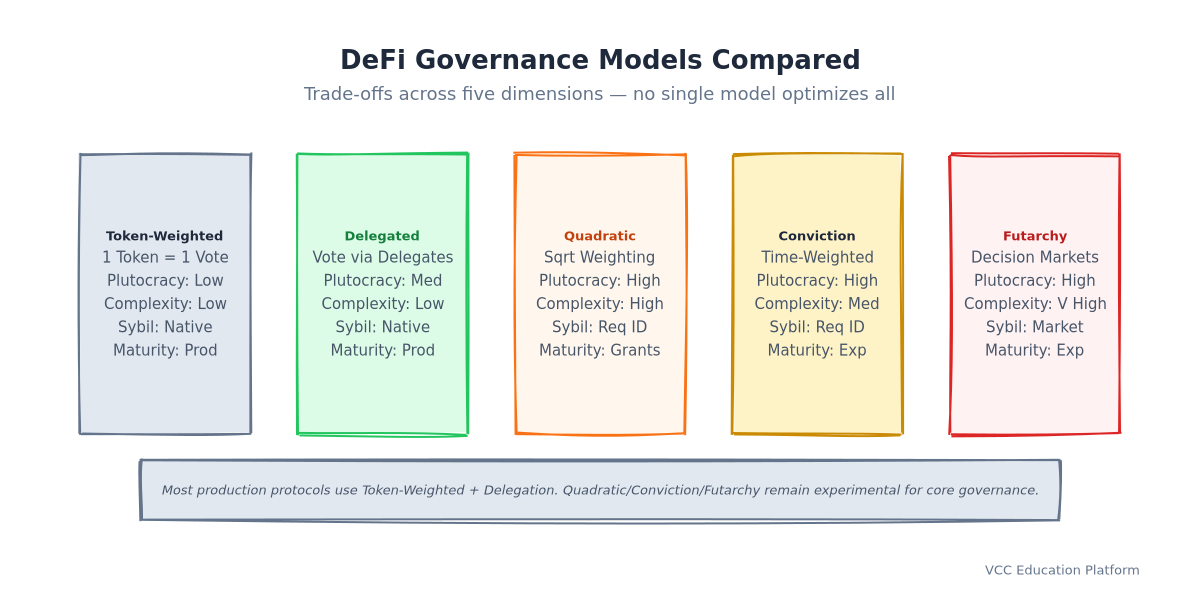
1. Token-Weighted Voting (1 Token = 1 Vote)
Used by: Compound, Uniswap, early Aave
The simplest model: your voting power equals your token balance. If you hold 10,000 UNI, you control 10,000 votes.
Pros: Simple to implement, easy to understand, Sybil-resistant (tokens are scarce). Cons: Plutocratic — whales dominate. Vulnerable to flash loan vote buying (borrow tokens, vote, repay in same block).
Compound requires 400,000 COMP (~$2M at writing) to create a proposal. Uniswap requires 2.5M UNI (~$15M). These thresholds filter spam but also concentrate power in a handful of delegates.
2. Delegated Voting (Vote Without Transferring Tokens)
Used by: Compound (Governor Bravo), Uniswap, Aave
ERC20Votes and ERC5805 let token holders delegate voting power to an address — without transferring tokens. You keep custody; the delegate votes on your behalf.
This solves the "rational apathy" problem: most token holders don't want to read every proposal. They delegate to experts (Gauntlet, Blockchain Capital, individual researchers) who do.
Key metric: Delegation rate. Compound ~60% delegated. Uniswap ~40%. Aave ~70% (staked in Safety Module).
3. Quadratic Voting (Square Root Weighting)
Proposed by: Vitalik Buterin, Glen Weyl; Implemented in grants: Gitcoin, Optimism RetroPGF
Voting power = (sum of square roots of contributions)². A whale with 10,000 tokens gets 100 "voice credits." 100 users with 100 tokens each get 1,000 voice credits combined.
Pros: Reduces plutocracy, amplifies broad consensus. Cons: Requires strong Sybil resistance (identity verification). Not yet used for core protocol governance — only for grant allocation.
4. Conviction Voting (Time-Weighted Continuous Voting)
Used by: Commons Stack, 1Hive; Proposed for: Protocol parameter tuning
Votes accumulate "conviction" over time. The longer you stake on a proposal, the more weight it gains. You can change your mind anytime — conviction decays.
Pros: No snapshot deadlines, resistant to last-minute whale swings, continuous signaling. Cons: Complex UX, hard to execute discrete actions (contract upgrades need finality).
5. Futarchy (Decision Markets)
Proposed by: Robin Hanson; Experimented by: Gnosis, Prophet
"Vote on values, bet on beliefs." Governance creates prediction markets: "If we approve Proposal X, will metric Y increase?" Traders bet. The market price becomes the decision signal.
Pros: Aligns incentives with outcomes, filters noise. Cons: Thin markets manipulable, regulatory gray area, complex to implement.
The Governance Lifecycle: Proposal to Execution
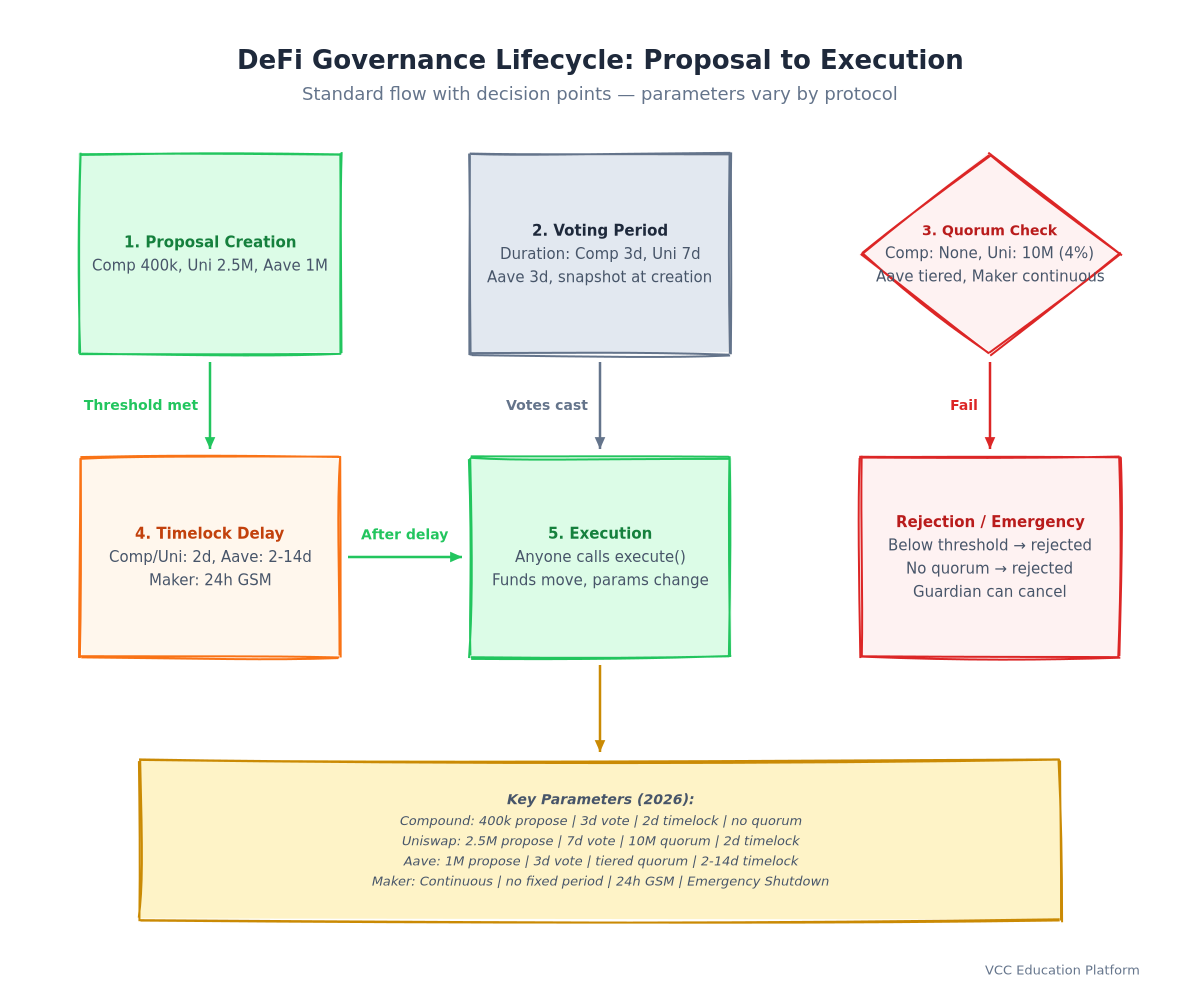
Every protocol governance crypto system follows a similar flow, though parameters differ.
Step 1: Proposal Creation
A proponent (address with sufficient voting power) submits a proposal containing:
- Target contract addresses
- Calldata for each action (function signatures + encoded parameters)
- Description (human-readable explanation)
Thresholds:
- Compound: 400k COMP
- Uniswap: 2.5M UNI (1% supply)
- Aave: 1M AAVE (staked in Safety Module)
- Maker: No threshold (continuous approval)
Step 2: Voting Period
Token holders cast votes: For / Against / Abstain. Voting power is snapshotted at proposal creation (prevents flash loan manipulation).
Durations:
- Compound: 3 days (17,280 blocks)
- Uniswap: 7 days
- Aave: 3 days (configurable per proposal type)
- Maker: Continuous (no fixed period)
Step 3: Quorum Check
Minimum participation required for validity.
- Compound: No explicit quorum (majority of votes cast wins)
- Uniswap: 10M UNI (4% supply)
- Aave: Varies by proposal type (typically 20-30% of staked AAVE)
- Maker: Continuous approval — no quorum, but requires sustained majority
Step 4: Timelock Delay
Critical security layer. After a proposal passes, it enters a timelock queue. No execution until delay expires.
- Compound: 2 days
- Uniswap: 2 days (via
TimelockController) - Aave: Variable (2 days for params, 14 days for upgrades)
- Maker: 24 hours (Governance Security Module)
Why this matters: The 2022 Beanstalk attack ($182M stolen) exploited a missing timelock. The attacker flash-loaned BEAN, voted a malicious proposal, and executed in the same block. A 2-day timelock would have given the community time to detect and organize a counter-proposal.
Step 5: Execution
Anyone can call execute() on the timelock after the delay. The timelock calls the target contracts with the encoded calldata. Funds move, parameters change, contracts upgrade.
Evolution: How Real Protocols Matured
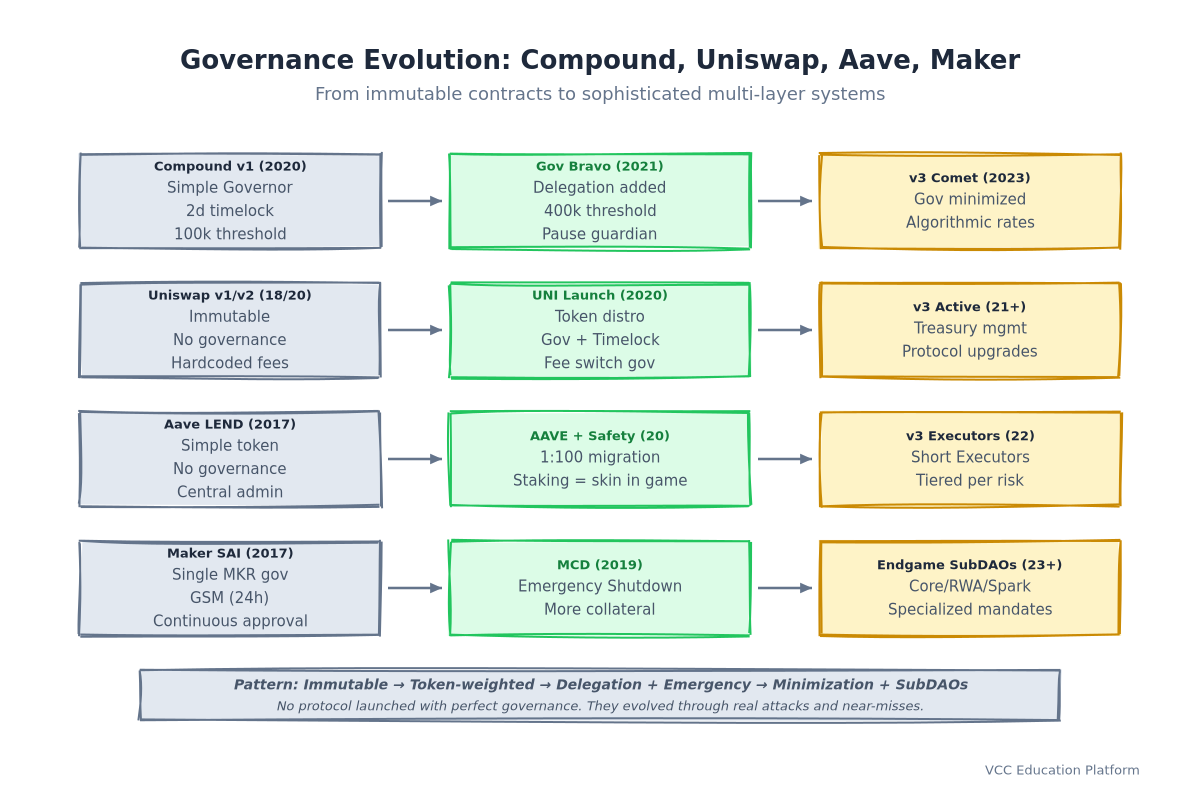
No protocol launched with perfect governance. They evolved through versions — and the pattern is instructive.
Compound: v1 → Governor Bravo → Compound v3
| Version | Key Change |
|---|---|
| v1 (2020) | Simple Governor, 2-day timelock, 100k COMP threshold |
| Bravo (2021) | Delegation (ERC20Votes), 400k threshold, proposal cancellation, emergency pause guardian |
| v3 (2023) | Comet architecture — governance minimized, fewer upgradable components |
Lesson: Compound added delegation after launch when they realized whale concentration was a problem. The "guardian" role (can cancel proposals) was a direct response to Proposal 62 near-miss.
Uniswap: No Governance → UNI Token → Active Governance
| Version | Key Change |
|---|---|
| v1 (2018) | Immutable, no governance |
| v2 (2020) | Immutable, no governance |
| UNI Launch (2020) | Token distribution, Governor + TimelockController |
| v3 (2021) | Governance active: fee switches, treasury management, protocol upgrades |
Lesson: Uniswap proved you can launch without governance (v1/v2 immutable). But once you need fee switches or treasury spending, governance becomes mandatory.
Aave: LEND → AAVE → Safety Module → v3 Executors
| Version | Key Change |
|---|---|
| LEND (2017) | Simple token, no governance |
| AAVE Migration (2020) | 1:100 swap, Governor + Safety Module staking |
| v2 (2021) | Short Executors (emergency), AIP process formalized |
| v3 (2022) | Multiple executors per risk tier, cross-chain governance |
Lesson: Aave's Safety Module (stakers slashable for shortfall) creates skin in the game for voters. Their "Short Executors" can execute critical fixes in hours, not days — solving the timelock paradox for emergencies.
Maker: Single DAO → SubDAOs (Endgame)
| Version | Key Change |
|---|---|
| SAI (2017) | Single MKR governance, GSM timelock |
| Multi-Collateral DAI (2019) | Expanded governance scope |
| Endgame (2023+) | SubDAOs: Core, RWA, Spark, each with own tokens & mandates |
Lesson: Maker recognized that one governance body cannot competently manage lending, RWA, and protocol engineering simultaneously. SubDAOs specialize.
The Governance Trilemma: Security vs Decentralization vs Agility
Original analysis: Every protocol navigates a three-way trade-off. You can optimize for two, but the third suffers.
` SECURITY / \ / \ / \ DECENTRALIZATION —— AGILITY `
- Compound: Security + Agility (high threshold, short timelock) → Less decentralized (whale-dominated)
- Uniswap: Decentralization + Agility (low quorum, delegation) → Less secure (lower barriers to malicious proposals)
- Aave: Security + Decentralization (Safety Module skin-in-game, emergency executors) → Less agile (complex multi-executor system)
- Maker: Decentralization + Security (SubDAOs, continuous voting) → Less agile (slow, complex)
There is no free lunch. The "right" choice depends on what the protocol protects. A lending protocol with $10B TVL (Aave) prioritizes security. A DEX with upgradeable fee switches (Uniswap) prioritizes agility. A stablecoin issuer (Maker) prioritizes decentralization of risk.
Attack Vectors: How Governance Gets Hacked
The SEO brief specifically calls out "attack vectors" as a competitor gap. Here are the real ones with numbers.
1. Flash Loan Vote Buying
Mechanism: Borrow governance tokens → vote → repay in same transaction. Real case: Beanstalk (April 2022) — $182M drained. Attacker borrowed $1B BEAN, voted malicious proposal to send funds to themselves, executed, repaid loan. Defense: Snapshot voting power at proposal creation (not execution). Timelocks. High proposal thresholds.
2. Proposal Threshold Manipulation
Mechanism: Accumulate tokens just below threshold, then coordinate multiple proposers. Real case: Compound Proposal 62 (2022) — "Give $24M COMP to Golden Boys." Narrowly defeated after community uproar. Revealed that 400k threshold was too low for treasury spends. Defense: Higher thresholds for treasury actions. Multi-sig guardians. Community vigilance.
3. Delegation Centralization
Mechanism: Top 10 delegates control >50% voting power. They can collude or be coerced. Real case: Uniswap delegate concentration — top 5 delegates control ~35% of voted UNI. Defense: Delegation dashboards, vote decay (delegation expires), incentivized re-delegation.
4. Sybil Attacks on Quadratic/Conviction Voting
Mechanism: Create fake identities to amplify quadratic voice credits. Real case: Gitcoin Grants rounds — continuous arms race with Sybil defenders (Gitcoin Passport). Defense: Identity verification (BrightID, Proof of Humanity), social graph analysis.
5. Timelock Bypass via Emergency Functions
Mechanism: If emergency guardian key is compromised, attacker skips timelock. Real case: None major yet, but a persistent fear. Aave's Short Executors and Maker's GSM are high-value targets. Defense: Multi-sig guardians (3-of-5, 4-of-7), hardware security modules, time-delayed emergency upgrades.
Governance Minimization: The Endgame Strategy
Vitalik's insight: "The best governance is the governance you don't need."
Governance minimization means reducing the surface area that requires human decisions:
- Immutable core: Deploy contracts that never need upgrades (Uniswap v1/v2, Liquity)
- Automated parameters: Algorithmic interest rates (Aave v3, Compound v3) instead of governance-set rates
- Bounded governance: Governance can only change parameters within safe ranges (min/max collateral factors)
- SubDAOs / Modules: Delegate domain-specific decisions to specialized groups (Maker Endgame)
Practical steps for protocol teams:
- Audit every governance action: "Can this be automated?"
- Set parameter bounds in code, not governance
- Use timelocks as minimum delays, not maximums
- Build emergency pause before you need it
- Plan for governance capture: what happens if a hostile actor gets 51%?
Vietnamese Context: DAOs in a Regulatory Gray Zone
For Vietnamese builders and contributors, decentralized governance DeFi operates in a unique environment.
Legal Status
- No DAO legal entity recognition in Vietnam (2024)
- Most Vietnamese DAOs register as Công ty TNHH (LLC) in Singapore, Cayman, or BVI
- Governance tokens may be classified as securities if marketed to Vietnamese residents (Decree 01/2024 sandbox framework)
- Personal income tax: 20% on governance rewards for tax residents
Operational Reality
- Timezone coordination: Core teams in SG/VN (GMT+7/8), community global → async governance (Discourse, Snapshot, Tally) essential
- Language barrier: Technical proposals in English; community discussion in Vietnamese on Telegram/Discord
- Banking: No direct fiat onramp for treasury → stablecoin (USDC/USDT) dependence for contributor payments
- Talent: Strong technical talent pool (blockchain engineers, cryptographers) but limited governance-specific experience
Cultural Framing
- "Quản trị cộng đồng" (community governance) resonates better than "DAO" or "phi tập trung hóa"
- "Hội đồng quản trị" (board of directors) maps to multisig/timelock guardians for traditional business partners
- Trust-building: Vietnamese business culture values relationships → transparent governance forums, regular AMAs, Vietnamese-language summaries critical
Practical Checklist: Building Governance for Your Protocol
If you're designing how DeFi governance works for a new protocol:
Phase 0: Do You Need Governance?
- [ ] Can core parameters be immutable? (Uniswap v1 approach)
- [ ] Can algorithms replace human decisions? (algorithmic rates, automated liquidations)
- [ ] Is TVL < $10M? Consider multisig + timelock instead of full token governance
Phase 1: Minimum Viable Governance
- [ ] OpenZeppelin Governor + ERC20Votes + TimelockController
- [ ] Proposal threshold: 1-2% of circulating supply
- [ ] Voting period: 3-7 days
- [ ] Timelock: 2 days minimum (48h for community reaction)
- [ ] Emergency pause guardian (3-of-5 multisig)
Phase 2: Hardening
- [ ] Delegation support (ERC20Votes / ERC5805)
- [ ] Tiered timelocks: 2d params, 14d upgrades, 0d emergency (guarded)
- [ ] Proposal cancellation by guardian
- [ ] Quorum for treasury spends (4-5% supply)
- [ ] Vote simulation / dry-run tooling (Tally, Snapshot integration)
Phase 3: Maturation
- [ ] Executor roles (separate param executor, upgrade executor, treasury executor)
- [ ] Governance minimization audit: what can be automated?
- [ ] SubDAO / module architecture for domain separation
- [ ] Formal verification of governance contracts
- [ ] Bug bounty specifically for governance logic
FAQ: DeFi Protocol Governance
What is a timelock and why does it matter?
A timelock is a mandatory delay (typically 2-14 days) between a governance proposal passing and its execution. It gives the community time to detect malicious proposals, organize opposition, or exit the protocol. Without a timelock, a flash loan attacker can propose, vote, and execute a malicious change in a single block — as happened in the $182M Beanstalk hack.
How do flash loan governance attacks work?
An attacker borrows a large amount of governance tokens via flash loan, uses them to vote on a malicious proposal (e.g., "send all treasury funds to attacker"), executes the proposal, and repays the loan — all in one transaction. Defenses: snapshot voting power at proposal creation, high proposal thresholds, and timelocks.
What is governance minimization?
Governance minimization is the principle of reducing the number and scope of decisions that require human voting. Examples: making core contracts immutable, using algorithmic parameter adjustment instead of governance votes, setting hard bounds in code (e.g., collateral factor 0-90%), and delegating domain-specific decisions to specialized SubDAOs.
Token-weighted vs quadratic vs delegated voting — which is best?
No single model is "best" — they solve different problems. Token-weighted is simplest and Sybil-resistant but plutocratic. Delegated voting adds expertise without token transfer. Quadratic voting reduces whale dominance but requires strong identity verification. Most production protocols use token-weighted + delegation (Compound, Uniswap, Aave). Quadratic voting remains experimental for protocol governance (used in Gitcoin grants).
How does delegation work without transferring tokens?
ERC20Votes (OpenZeppelin) and ERC5805 (EIP-5805) let you sign a delegation message assigning your voting power to another address. Your tokens stay in your wallet. The delegate votes on your behalf. You can revoke or change delegation anytime. This is how ~60% of COMP and ~70% of staked AAVE participate in governance.
What happens if a malicious proposal passes?
If caught during the timelock: community can organize a counter-proposal, guardians can cancel (if guardian role exists), or users can exit the protocol. If executed: funds may be lost, parameters changed maliciously. Recovery requires a new governance proposal (if governance still functional) or a hard fork (social consensus). This is why timelocks and guardians are critical.
Can a protocol upgrade itself without governance?
Yes — if designed with immutable contracts (Uniswap v1/v2, Liquity) or factory patterns where new versions deploy separately and users migrate voluntarily. However, for protocols needing parameter adjustments (interest rates, collateral factors, fee switches), some governance mechanism is unavoidable.
What is the difference between on-chain and off-chain governance?
On-chain: Votes recorded on blockchain, execution automatic via smart contracts (Compound, Uniswap, Aave). Binding and transparent. Off-chain: Signaling via Snapshot (gasless), Discourse polls, or token-weighted Discord votes. Non-binding — requires multisig or team to execute. Most protocols use both: off-chain for temperature checks, on-chain for binding decisions.
Key Takeaways
- Governance is infrastructure, not ideology — you need it because immutable code cannot adapt.
- The stack is standardizing: Governor + ERC20Votes + TimelockController + Executor.
- Models differ on the decentralization/security/agility trilemma — choose based on what your protocol protects.
- Timelocks are non-negotiable — the Beanstalk hack proved this conclusively.
- Governance minimization is the endgame — automate what you can, bound what you can't, delegate the rest.
- Vietnamese builders: plan for legal entity, timezone async, Vietnamese-language transparency, and stablecoin treasury from day one.
The protocols that survive aren't the ones with the "most decentralized" governance — they're the ones that match their governance design to their risk profile, and evolve it as they grow.
This article reflects governance patterns as of August 2026. DeFi governance evolves rapidly — always verify current parameters on official protocol documentation before making decisions.