
The DeFi landscape has evolved from a handful of protocols in 2020 to over 1,000 protocols tracked by DefiLlama today, with a total locked value of over $100 billion. However, most comparisons still rely on the same TVL rankings, without answering the single most important question: Which protocols are best suited to your goals and risk tolerance?
This guide introduces a 5-dimensional evaluation framework – Security, Financial Efficiency, UX & Accessibility, Network Coverage, and Governance – with a quantitative scorecard for the top 10 protocols. You’ll get a decision map tailored to your needs with the right protocol, a cross-chain deployment analysis that reflects the multi-chain reality in 2024, and specific guidance for Vietnam.
Why comparing DeFi protocols is more important than ever
In 2023 alone, Euler Finance lost $197 million due to a buggy liquidation system, Curve was attacked by a $70 million scam, and KyberSwap lost $54 million due to a calculation error. These incidents are not “risks of DeFi” – they are specific flaws in the protocols that proper due diligence might have uncovered.
With over $200 billion deployed across lending, DEX, liquid staking, and derivatives products, the cost of making bad choices has never been higher. TVL rankings only tell you where capital is currently, not where it should be. Our structure tells you the difference.
5-Dimensional Evaluation Framework
Each process in this guide is rated from 1 to 10 on five dimensions:
| Size | What it measures | Weight |
|---|---|---|
| Security and auditing | Audit area, error reward fund size, formal verification, incident history, timelock management | 30% |
| Capital utilization efficiency | Risk-adjusted returns, fee structure, margin, liquidation penalties, capital utilization | 25% |
| UX and accessibility | Interface quality, mobile support, gas optimization, documentation, onboard processes | 15% |
| Coverage Area | Native installation (not a bridge), L2 support, chain-based flow depth, integrated bridge | 15% |
| Management and sustainability | Tokenomics, treasury management, upgrade process, diversity of contributors, revenue model | 15% |
The weight reflects a priority to preserve capital – security flaws are irreparable; UX issues are fixable.
Deep Diving Group
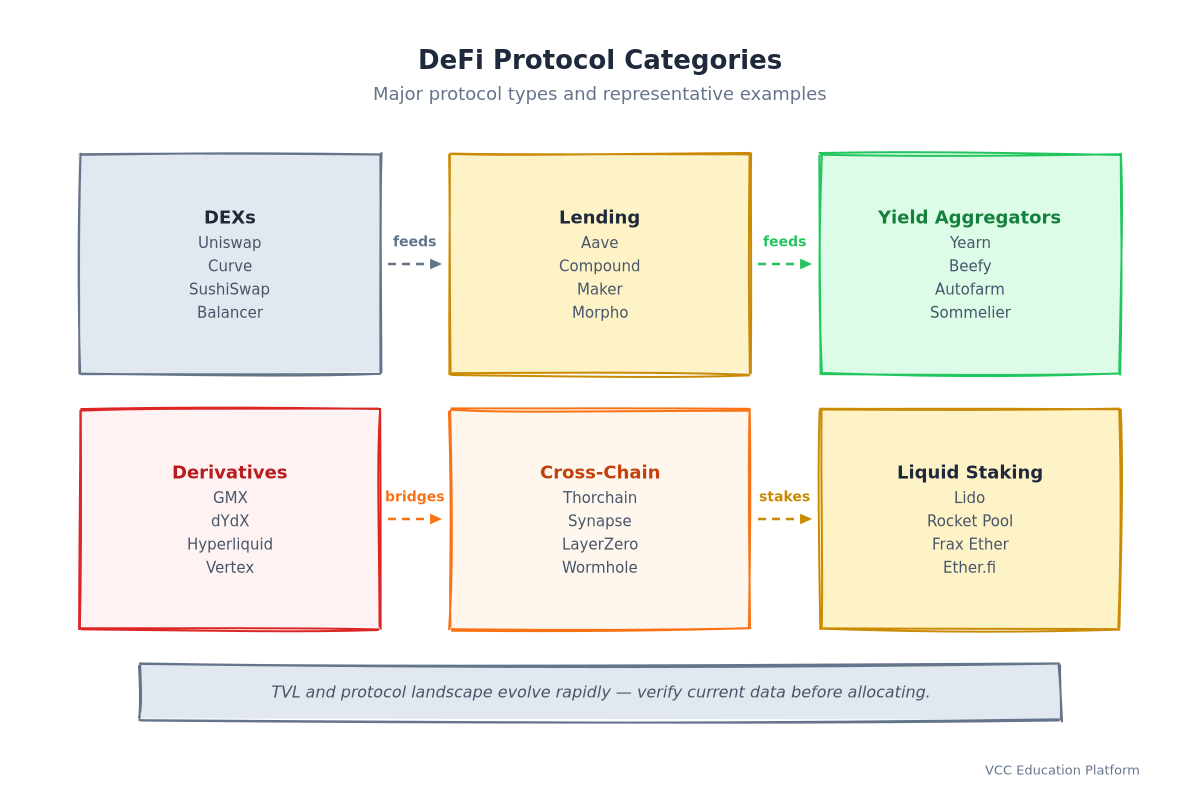
Decentralized Exchanges (DEX): Uniswap vs Curve vs SushiSwap vs Balancer
Comparison - DEX protocol comparison table
| Measurement units | Uniswap v3 | Curve | SushiSwap | Balance |
|---|---|---|---|---|
| TVL | $4.5 billion | $2.1 billion | $450 million | $1.2 billion |
| Model | Centralized Finance (CLMM) | StableSwap (stablecoin) | AMM + CLMM (v3) | Balance tank + enhancement |
| Best for | Large volatility pairs | Stablecoin/stablecoin, correlated assets | Multi-string configuration | Custom account groups |
| MEV Protection Program | UniswapX (auction house) | There are no natives. | MEV Blocker integration | There are no natives. |
| Fee levels | 0.01%, 0.05%, 0.3%, 1% | 0.04% (stable) | 0.05%, 0.3%, 1% | Can be configured (0.0001-10%) |
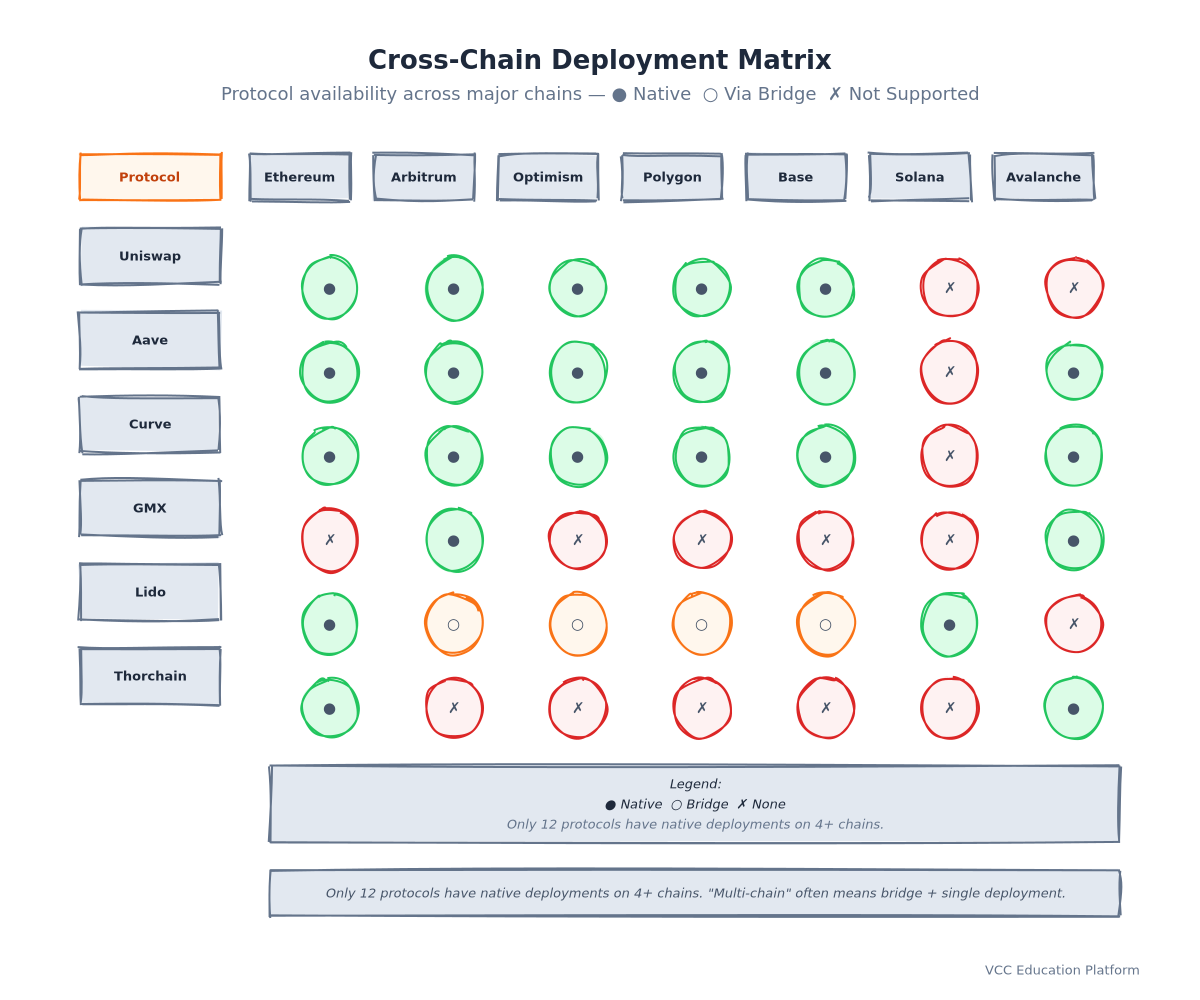
| Wire (local construction) | 9 (Eth, Arb, Opt, Poly, Base, Celo, Blast, Linea, BNB) | 11 | 14 | 8 |
| Security Rating | 9/10 | 7/10 | 6/10 | 7/10 |
Root analysis: Uniswap v3’s centralized liquidity provides a 4000x return on capital for stable pairs but requires active management. Curve’s StableSwap invariant (An^n sum(x_i) + D = An^n D + D^(n+1)/prod(x_i)) minimizes price slippage for related assets – but the 2023 re-hack revealed the risks of the vyper compiler. SushiSwap’s multi-chain breadth (14 chains) comes at the cost of liquidity fragmentation. Balancer’s balance pools allow LP to be index-fund-like but suffer from low transaction volume.
For Vietnamese users: Uniswap on Arbitrum/Base offers the lowest gas fees through local CEX links (Binance P2P → Arbitrum USDC).
Lending Protocols: Aave vs Compound vs Maker vs Morpho
Comparison - Lending protocol comparison table
| Measurement units | Aave v3 | Compound v3 (Comet) | Maker/Spark | Morpho Blue |
|---|---|---|---|---|
| TVL | $10.2 billion | $2.8 billion | $7.5 billion (DAI) | $1.2 billion |
| Architecture | Database-based partitioning method | Individual asset markets (Comet) | CDP + Spark Lend | P2P platform on Aave/Compound |
| Payment processing | 5-10% bonus, instantly | Adjust by 10%, immediately | 13% penalty, auction | Compatible with the base protocol |
| Ratio model | Kinked (kink at 80% utilization) | Linear + curve | Settlement Fee + DSR | P2P difference + backup option for the group |
| Unique Features | eMode (relational assets), Portals | Gas optimization, no cTokens | DAI savings rate (5%), SubDAOs | 98% use the supply through P2P |
| Wire (local construction) | 8 | 4 | 3 (Ethernet, ARP, Optical) | 5 (Eth, Arb, Opt, Base, Poly) |
| Security Rating | 9/10 | 8/10 | 8/10 | 6/10 (not audited v2) |
Root analysis: Aave v3’s isolation model carries risks from new assets – only new stablecoins can be borrowed. Compound v3’s Comet architecture eliminates the complexity of cTokens but sacrifices the efficiency of multiple assets. Morpho’s peer-to-peer comparison achieves a 98% utilization rate (compared to 70-80% for pools) but introduces risks from new smart contracts – Trail of Bits has not audited Morpho Blue v2, and Immunefi’s bounty is only $100,000.
Example of risk-adjusted yield (USDC, January 2024):
Profit aggregation tools: Yearn, Beefy, Autofarm, and Sommelier
| Measurement units | Yearn | Beef steak | Autofarm | Sommelier |
|---|---|---|---|---|
| TVL | $320 million | $580 million | $45 million | $25 million |
| Strategy type | Secured keys are managed (multisig) | Automatic Combination + Strategy | Automatic focus shooting | Warehouse (managed by a strategist) |
| Fee structure | 2% management + 20% performance | Harvesting fee 4.5% | 5% harvesting fee | 2% management + 10% performance |
| Ball | 5 | 14 | 8 | 3 |
| Transparency | High (strategic documents) | Middle level | Low | Cao (parameter of the wine cellar) |
**Key takeaway: drawdown fees are reduced. 20% performance fee on a net APY of 15% = 3% net drawdown. Over 3 years, that’s 9% capital. Yearn’s chosen method (multisig approved strategies) reduces risk but slows deployment. Beefy’s multi-chain breadth is suitable for farmers across multiple chains. Sommelier’s “warehouse” allows strategists to deploy custom logic – higher potential, higher risk for those with a higher stake.
Staking with cryptocurrency: Lido vs Rocket Pool vs Frax Ether vs Ether.fi
Comparison - Liquid staking comparison table
| Units of measurement | Lido (stETH) | Rocket Pool (rETH) | Frax Ether (sfrxETH) | Ether.fi (eETH) |
|---|---|---|---|---|
| TVL | $28.5 billion | $1.8 billion | $350 million | $800 million |
| Model | Set of node agents (30+) | Node tasks that do not require authorization (16 ETH + 1.6 ETH RPL) | Stability of AMO + Frax | Relocalization (EigenLayer) |
| Withdrawal | Wait 1-5 days | Immediately (rETH/ETH pool) | Immediately (sfrxETH/fxETH) | EigenLayer queue 7 days |
| Devolution | Low (Lido DAO controls 30%+ of validators) | Good (no license required) | Cao (Frax multisig) | High (DVT + EigenLayer) |
| Insurance discount | None (socialized) | RPL collateral (10% of the number of shares) | Frax AMO Stand | EigenLayer Cut |
| Current APY | 3.2% | 3.1% | 3.5% | 3.3% + EigenLayer points |
| Security Rating | 6/10 (aggregate) | 8/10 | 7/10 | 7/10 (new) |
Important findings: Lido controls approximately 30% of all Ethereum validators – a risk of centralization of the consensus hashing power (2023) that threatens the security model of the protocol. The Rocket Pool’s non-authorized model is more decentralized but requires 16 ETH + RPL collateral (a barrier to entry). Ether.fi incorporates EigenLayer’s restaking method to increase profitability but inherits the 7-day withdrawal queue and the risk of EigenLayer’s throttling.
Risk-adjusted yield (stETH vs rETH):
Cryptocurrencies and perpetuum: GMX vs dYdX vs Hyperliquid vs Vertex
| Measurement units | GMX v2 | dYdX v4 | Hyperliquid | Vertex |
|---|---|---|---|---|
| TVL | $480 million | $380 million | $220 million | $150 million |
| Model | GLPv2 (multi-asset storage) | Orderbook (search for matches outside the chain) | Order book on the chain (L1 custom) | Hybrid (AMM + orderbook) |
| Enhance | 50x | 20x | 50x | 20x |
| Oracle | Chainlink + custom | Pyth + custom | Patented technology (sub-second response time) | Pyth + Chainlink |
| Fees | 0.05-0.1% + impact on price | 0.02-0.05% maker/taker | 0.02% maker / 0.05% taker | 0.02% maker / 0.05% taker |
| Ball | Arb, Avax | dYdX Chain (Cosmos) | Hyperliquid L1 | Tree, Mantle |
| Security Rating | 8/10 | 7/10 | 7/10 | 6/10 |
Root Analysis: GMX’s GLPv2 system provides risk-free transactions but traders are subject to price impact – large orders will move the index. dYdX v4 has switched to a custom Cosmos chain to increase performance but has introduced chain risk. The machine is fully compatible on Hyperliquid’s chain (custom L1) and achieves CEX latency but is not audited. Vertex’s hybrid model balances capital efficiency with on-chain transparency.
Cross-Chain & Bridging: Thorchain vs Synapse vs LayerZero vs Wormhole
| Protocol | Security model | Change the locale | Chains | Max TVL is guaranteed |
|---|---|---|---|---|
| Thorchain | Validator team (with $100 million in guarantees+) | Yes (native language) | 9 (BTC, ETH, BSC, AVAX, etc.) | $100 million |
| Synapse | Verify optimism | No (password/code) | 16+ | $50 million |
| LayerZero | Oracle + Relayer (configurable) | No (send message) | 50+ | Can be configured |
| Deep Hole | Guardian Wallet (19 multisig) | No (lock/close) | 20+ | $250 million (before the hack) |
Key differences: Thorchain is only a protocol that allows for exchanges between chains (BTC ↔ ETH without bundled assets). Synapse/LayerZero/Wormhole are message layers – they transfer data, not assets, in a native way. For DeFi users, this means: use Thorchain for asset exchanges; use LayerZero for contract calls (e.g., voting on Ethereum from Arbitrum).
Face to Face: The 10 Most Highly Rated Protocols
Scorecard - Top 10 protocol scorecard
| Protocol | Nitric acid (30%) | Profit margin (25%) | UX (15%) | Cord (15%) | Gov (15%) | Total weight |
|---|---|---|---|---|---|---|
| Aave v3 | 9 | 8 | 8 | 8 | 8 | 8.4 |
| Uniswap v3 | 9 | 9 | 8 | 9 | 7 | 8.5 |
| Rocket Pool | 8 | 7 | 7 | 4 | 8 | 7.3 |
| GMX v2 | 8 | 9 | 7 | 3 | 7 | 7.5 |
| Curve | 7 | 9 (stable) | 6 | 8 | 7 | 7.6 |
| Compound v3 | 8 | 7 | 7 | 5 | 8 | 7.2 |
| Lido | 6 | 8 | 8 | 4 | 6 | 6.7 |
| Morpho Blue | 6 | 9 | 7 | 6 | 6 | 7.1 |
| Hyperliquid | 7 | 8 | 8 | 1 | 6 | 6.8 |
| Thorchain | 7 | 8 | 6 | 9 | 7 | 7.4 |
Color code: 🟢 8+ (Central), 🟡 7-7.9 (Growth), 🔴 <7 (Dwarf/Stay away)
**Explanation: Uniswap v3 and Aave v3 lead the way in the "infrastructure" category - having been battle-tested, multi-chain, and highly managed. Lido's score is dragged down by its focus (Security 6, Governance 6). Morpho and Hyperliquid are high-potential "watchdogs" awaiting completion of audits.
Decision-making: Which protocol is right for your goals?
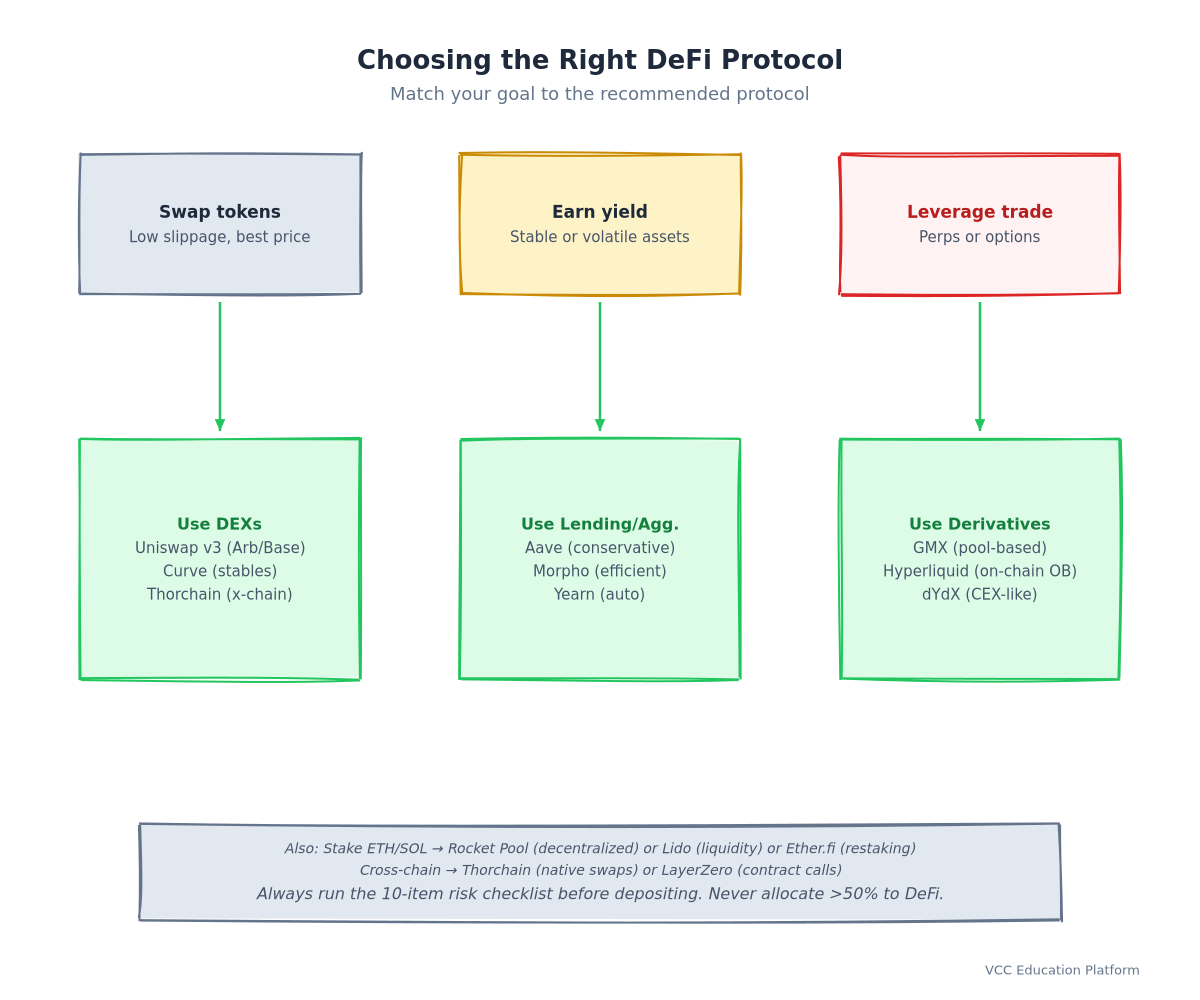
Please follow the logic diagram below (or use this text version) to match your intentions:
1. "I want to exchange codes with a minimum of slippage"
→ Primary currency: Uniswap v3 (Arbitrum/Base with low fees)
2. "I want to make a profit from stablecoins in a safe way"
→ Safe: Aave v3 USDC/USDT (2.97% adjusted for risk)
3. "I want to deposit ETH and keep the market liquid"
→ Delegated Priority : Rocket Pool rETH (2.65% risk-adjusted)
4. "I want to promote trade with low fees"
→ Perps: GMX v2 (Arbitrum, 50x, GLPv2 pool)
5. "I need to transfer assets across chains"
→ Asset replacement: Thorchain (native, no token bundle)
6. "I want to have diverse exposure to DeFi"
→ Index Method: Equal Weighted System (Custom ETF)
Risk check list before depositing
Before making any deposits, check all 10 items:
- Audit Age — Largest audit < 18 months? (Aave: 2023-06 ✅ | Morpho: not audited ❌)
Things to note specifically for Vietnam
Speed and cost of On-Ramp
VND → Momo/ZaloPay → Binance P2P (USDT) → Bridge to Arbitrum/Base → DeFi
Tax impact (Directive 96/2020/TT-BTC)
- Interest income from Crypto = "other income" → 20% personal income tax
Communicate with the community
- VN DeFi Telegram (15K+ members): Real-time updates on gas wars, new pools, rug announcements
Access Stablecoin
- USDT/USDC via P2P with a 1-2% discount compared to 1 USD
FAQ
What is the safest DeFi protocol in 2024?
Aave v3 for lending (security rating 9/10, lock-in period 3 days, reward $1 million, no major incidents). Rocket Pool for liquid staking (no license required, RPL collateral, security rating 8/10). Uniswap v3 for exchange (nucleus officially verified, security rating 9/10).
How can we compare the profitability of DeFi in a similar way?
Use APY adjusted by risk level: Basic APY × (1 - IL_Risk) × (1 - Smart_Contract_Risk) × (1 - Governance_Risk) × (1 - Liquidity_Risk). Our structure determines the amount of each factor. For example: GMX GLP 18% total → 9.9% risk-adjusted; Aave USDC 3.5% total → 2.97% risk-adjusted.
Can I use DeFi protocols from Vietnam?
Yes. There are no major geographical restrictions preventing Vietnam from participating at the contract level. The interfaces (app.aave.com, app.uniswap.org) may require a VPN. Use the on-ramp links from CEXs (Binance, Bybit, OKX) to convert from VND to USDT and then through the bridge to Arbitrum/Base.
What if a protocol is hacked?
- Time limits (emergency circuit cutting)
- Insurance claims: Nexus Mutual (responsibility ~$500 million), Sherlock (responsibility ~$100 million)
- Compensation decisions (Aave: Security Module; Maker: Surplus Buffer)
- In practice: Most attacks result in partial losses. Don’t send more money than you can afford to lose.
Is this the best DeFi ecosystem?
- Security and liquidity: Ethereum mainnet
How much should I allocate to DeFi?
Caution: 5-10% of the crypto portfolio (consisting solely of Aave and Rocket Pool)
The Final Words: Your Assets, Your Rules
No article, including this one, can replace your own due diligence. Use our framework as a starting point, not a verdict. Check the audit reports on GitHub. Check Immunefi to see which rewards are active. Follow management forums to stay informed about upcoming changes. And don’t send more money than you can afford to lose.
The protocols that scored 8+ on our scorecard (Uniswap v3, Aave v3) have weathered numerous market declines, hacks, and governance crises. They are not "safe" – nothing in DeFi is safe – but they have benefited from skepticism. Everything else is a bet on future viability.
Public Disclosure: The author holds positions in the AAVE, UNI, RPL, and GMX tokens. No protocols were paid to be included. All TVL data from DefiLlama is taken as of January 15, 2024. The audit report is linked in research.md. Risk-adjusted returns are illustrative only and are not guaranteed.