
DeFi privacy solutions solve the fundamental tension of public blockchains: every transaction is visible to everyone, forever. This transparency enables trustless verification but destroys financial privacy — exposing trading strategies, holdings, and counterparties to competitors, attackers, and regulators. This guide provides a comprehensive technical comparison of every major privacy protocol, a decision framework for choosing the right solution, and Vietnam-specific regulatory guidance.
Why DeFi Needs Privacy — The Transparency Paradox
Public blockchains achieve consensus through radical transparency. Every address, every token transfer, every smart contract interaction is recorded in a globally replicated ledger that anyone can audit. This design enables trustless settlement without intermediaries — but it creates a privacy paradox: the very transparency that makes DeFi trustworthy also makes it uniquely vulnerable to surveillance, front-running, and linkage attacks.
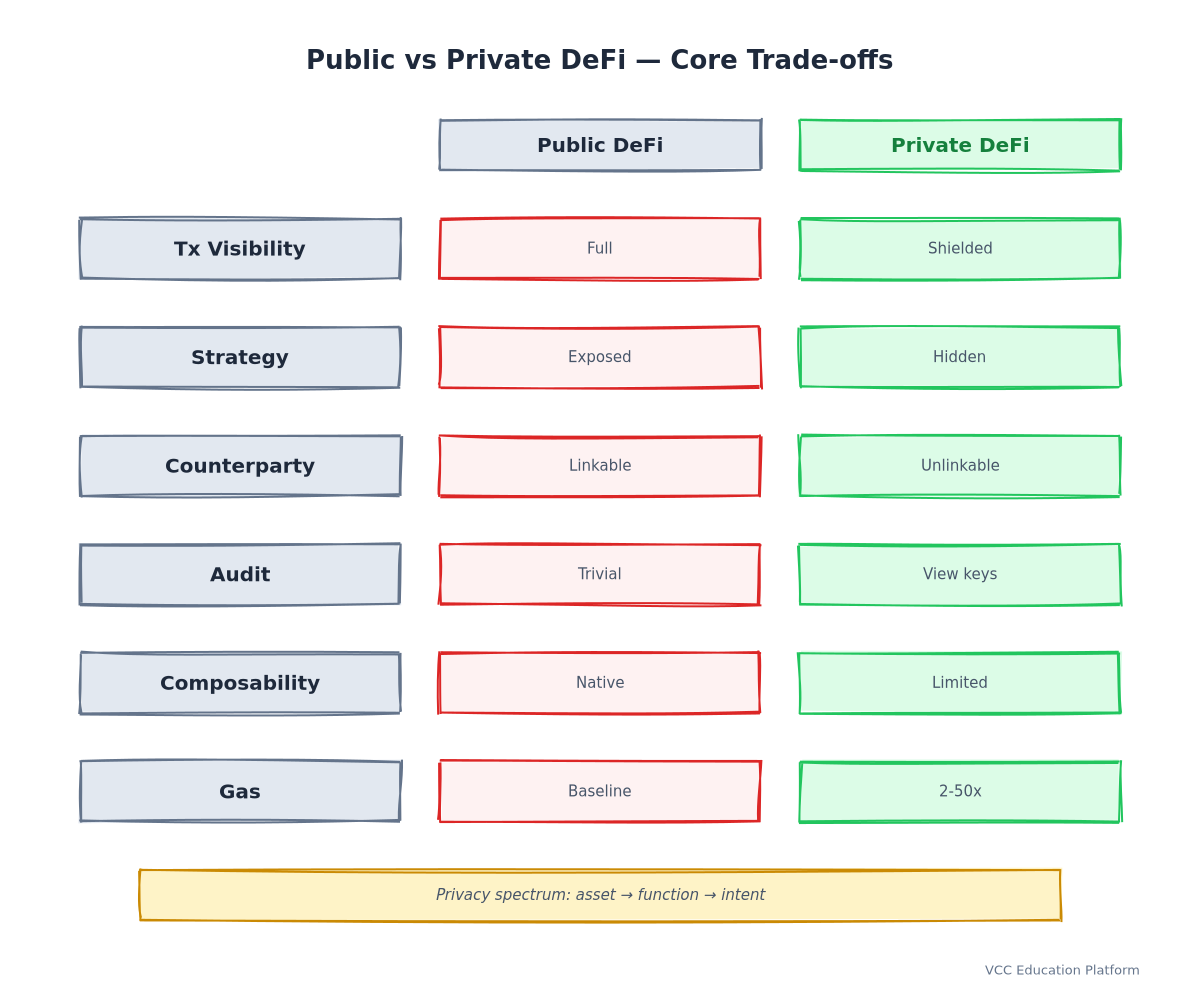
| Dimension | Public DeFi (Default) | Private DeFi (With Privacy Solutions) |
|---|---|---|
| Transaction Visibility | Full — amounts, counterparties, timestamps public | Shielded — only participants see details |
| Strategy Protection | None — arbitrage, liquidation thresholds exposed | Full — trading logic hidden until execution |
| Counterparty Privacy | None — wallet clustering reveals relationships | Preserved — unlinkable addresses per interaction |
| Regulatory Audit | Trivial — block explorers suffice | Requires viewing keys / proof of innocence |
| Composability | Native — all protocols interoperate | Constrained — privacy boundaries limit composition |
| Gas Overhead | Baseline | 2-50x depending on proof system |
Key insight: Privacy in DeFi is not binary. Protocols offer a spectrum from asset privacy (hiding amounts) to function privacy (hiding which contract was called) to intent privacy (hiding the user's goal entirely). Understanding where each protocol sits on this spectrum is essential for making the right choice.
Core Cryptographic Primitives
All modern DeFi privacy solutions build on three cryptographic primitives. The choice of primitive determines trust assumptions, proof size, verification cost, and developer experience.
Zero-Knowledge Proofs (ZKPs)
A zero-knowledge proof lets a prover convince a verifier that a statement is true without revealing why it's true. In DeFi, the statement is typically: "I know a secret that authorizes this transaction, and the transaction respects all protocol rules."
| Proof System | Trusted Setup | Proof Size | Verification Cost | Quantum Resistance | Used By |
|---|---|---|---|---|---|
| Groth16 (ZK-SNARK) | Circuit-specific (per circuit) | ~200 bytes | Very low (pairing check) | No | Tornado Cash, Railgun, Penumbra, Aztec (legacy) |
| PLONK (ZK-SNARK) | Universal (one ceremony, many circuits) | ~1 KB | Low | No | Aztec (current), zkSync, Scroll |
| Marlin (ZK-SNARK) | Universal, updatable | ~1 KB | Low | No | Aleo |
| STARK | None (transparent) | ~45 KB | Medium (hash-based) | Yes | StarkNet, RISC Zero |
| Nova (IVC) | None | ~1 KB | Very low (recursive) | No | Emerging (hyperplonk) |
Trust setup nuance: "Trusted setup" means a ceremony where participants generate toxic waste (secret randomness) that must be destroyed. If any participant keeps their secret, they can forge proofs. Circuit-specific setups (Groth16) require a new ceremony for every circuit change. Universal setups (PLONK, Marlin) allow one ceremony to serve many circuits — a massive operational improvement.
Commitment-Nullifier Scheme
Every privacy pool uses the same core pattern:
- Deposit: User generates a random
secret, computescommitment = Hash(secret, nullifier), sends tokens +commitmentto the pool contract. The commitment is inserted into a Merkle tree. - Withdraw: User proves knowledge of
secretandnullifiersuch thatcommitmentexists in the Merkle tree, andnullifierhas not been used before. The contract verifies the ZKP, marksnullifieras spent, and releases tokens to a new address.
This achieves unlinkability: the withdrawal address cannot be linked to the deposit address because the ZKP reveals nothing about which leaf in the Merkle tree was used.
Merkle Trees & Incremental Merkle Trees
Privacy pools store commitments in Merkle trees for efficient membership proofs. Modern protocols use incremental Merkle trees (append-only) where:
- Leaves are added sequentially
- Root updates are O(log n)
- Historical roots are preserved for withdrawal proofs against past states
Tree depth determines anonymity set size: depth 20 = 1,048,576 leaves (Tornado Cash), depth 32 = 4.29B leaves (Railgun).
Privacy Architecture Patterns in DeFi
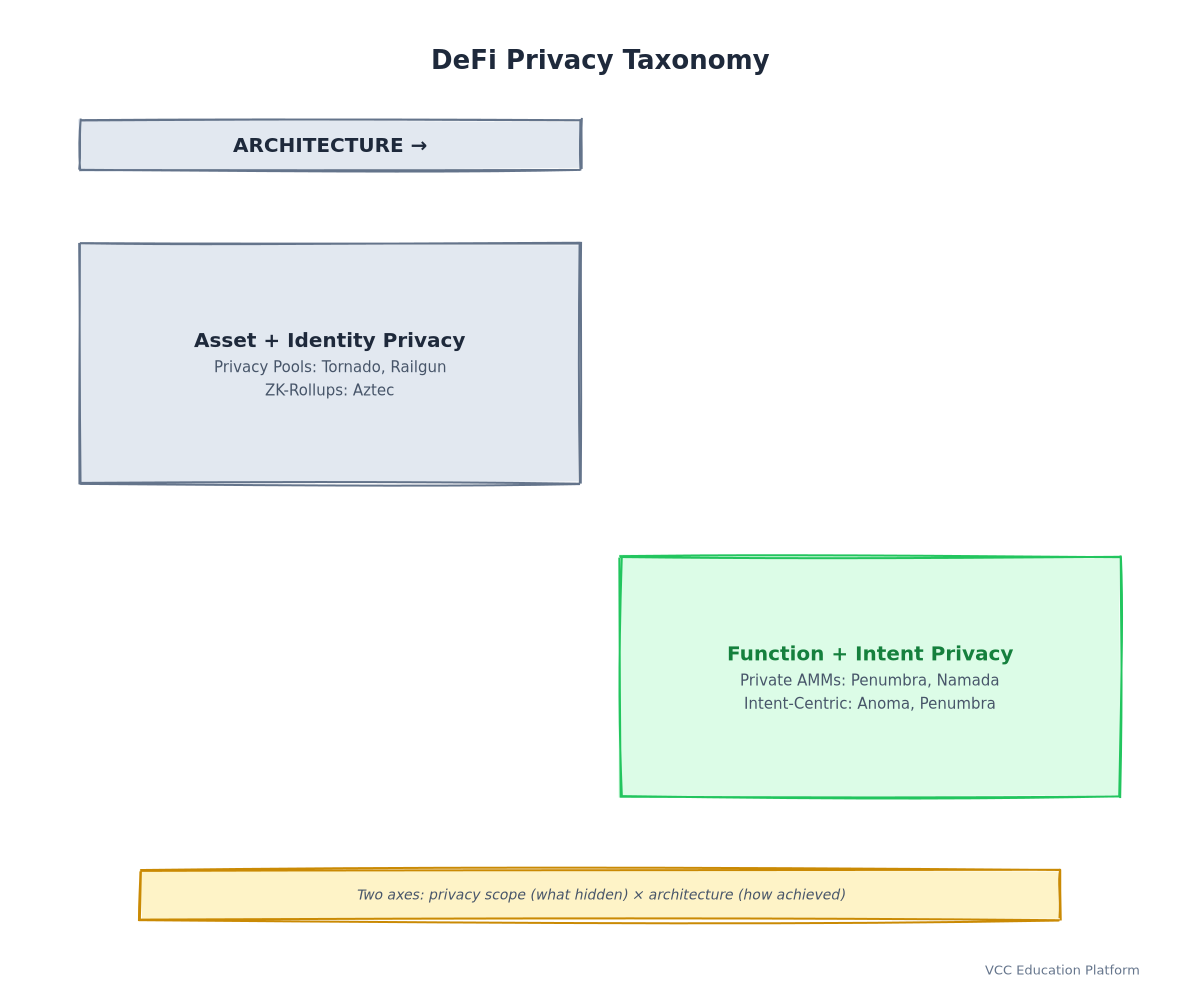
Privacy protocols can be classified along two axes: privacy scope (what is hidden) and architecture (how privacy is achieved).
` ┌─────────────────────────────────────────────────────────────────┐ │ DEFI PRIVACY TAXONOMY │ ├──────────────────┬──────────────────┬───────────────────────────┤ │ PRIVACY SCOPE │ ARCHITECTURE │ REPRESENTATIVE PROTOCOLS │ ├──────────────────┼──────────────────┼───────────────────────────┤ │ Asset Privacy │ Privacy Pools │ Tornado Cash, Railgun │ │ (amounts, │ (Merkle tree │ Privacy Pools (Vitalik) │ │ token types) │ + ZKP) │ │ ├──────────────────┼──────────────────┼───────────────────────────┤ │ Function Privacy│ ZK-Rollups │ Aztec, zkSync (private) │ │ (which contract │ (private exec │ │ │ was called) │ environment) │ │ ├──────────────────┼──────────────────┼───────────────────────────┤ │ Identity Privacy│ Private AMMs │ Penumbra (ZSwap), │ │ (sender/receiver│ (shielded pool │ Namada (MASP) │ │ unlinkable) │ + batched swaps)│ │ ├──────────────────┼──────────────────┼───────────────────────────┤ │ Intent Privacy │ Intent-Centric │ Anoma, Penumbra (intents)│ │ (user goal │ (solver network │ │ │ hidden) │ + ZKP) │ │ └──────────────────┴──────────────────┴───────────────────────────┘ `
Pattern 1: Privacy Pools (Asset Privacy)
Mechanism: Deposit → Merkle tree commitment → ZKP withdrawal to new address. Strengths: Simple, battle-tested, low trust assumptions (if setup destroyed). Weaknesses: Fixed denominations (or amount-revealing), no composability, latency = block finality. Protocols: Tornado Cash (historical), Railgun, Privacy Pools.
Pattern 2: ZK-Rollups with Private Execution (Function Privacy)
Mechanism: Users submit encrypted transactions to a sequencer; the rollup executes them in a private VM (e.g., Aztec's PXE); only state transitions are proven. Strengths: Full function privacy, composable within the rollup, programmable privacy. Weaknesses: Trusted sequencer (centralization), higher latency, limited cross-rollup composability. Protocols: Aztec, zkSync (planned private transactions).
Pattern 3: Private AMMs / Shielded Pools (Identity + Asset Privacy)
Mechanism: All assets reside in a single shielded pool (MASP). Swaps, transfers, and IBC transfers happen inside the pool. Only net flows in/out are visible. Strengths: Large anonymity set (all pool assets), native composability with IBC, flexible denominations. Weaknesses: Requires validator set trust (CometBFT/Tendermint), synchronous finality. Protocols: Penumbra (ZSwap), Namada (MASP).
Pattern 4: Intent-Centric Privacy (Intent Privacy)
Mechanism: User expresses intent ("swap 100 ATOM for OSMO at best rate"). Solvers compete to fulfill intents. Only the solver learns the intent details; the chain only sees the settlement. Strengths: Maximum privacy (intent hidden until execution), MEV protection, best execution. Weaknesses: Solver trust required, nascent infrastructure, complex UX. Protocols: Anoma, Penumbra (intents), Essential.
Protocol Deep Dives — Comparative Analysis
The table below compares six major protocols across six decision-critical dimensions. Scores are 1-5 (5 = best).
| Dimension | Tornado Cash | Railgun | Aztec | Penumbra | Aleo | Namada |
|---|---|---|---|---|---|---|
| Trust Setup | 2 (ceremony 2019, no updates) | 3 (Groth16, powers of tau) | 4 (PLONK universal) | 3 (Groth16, ceremony) | 4 (Marlin universal) | 3 (Groth16, ceremony) |
| Proof System | Groth16 | Groth16 | PLONK | Groth16 | Marlin | Groth16 |
| Latency (client prove) | 2-5s | 3-8s | 5-15s (PXE) | 2-5s | 5-10s | 3-8s |
| Fees (relative) | 1x (base) | 1.5x | 3-5x (L2) | 1.2x (IBC) | 2x | 1.5x |
| Composability | 0 (none) | 1 (ERC-20 only) | 3 (within rollup) | 4 (IBC, ICS-20) | 2 (Leo apps) | 4 (IBC, MASP) |
| Compliance Features | 0 (none) | 1 (viewing keys) | 2 (viewing keys, audit) | 5 (Proof of Innocence, viewing keys, association sets) | 2 (viewing keys) | 4 (Proof of Innocence, viewing keys) |
| Anonymity Set | ~1M (depth 20) | ~4B (depth 32) | Rollup-wide | Pool-wide (all assets) | App-specific | Pool-wide (all assets) |
| Audit Status | Multiple (2020-2022) | Trail of Bits 2023 | Multiple (2023-2024) | Informal 2024 | Multiple (2023-2024) | Informal 2024 |
| Chain | Ethereum, BSC, Polygon | Ethereum, Arbitrum, BSC | Ethereum L2 | Cosmos (own chain) | Own L1 | Cosmos (own chain) |
| Unique Feature | First, largest historical | Broad ERC support, Relayers | Programmable privacy (Noir) | Intent-centric, IBC native | Private apps (Leo) | Multi-asset shielded pool |
Protocol-Specific Notes
Tornado Cash — Historical reference only. OFAC-sanctioned (2022). No active development. Anonymity set frozen. Do not use for new deployments.
Railgun — Best "drop-in" privacy for Ethereum DeFi users. Supports any ERC-20/721/1155. Relayer network for gas abstraction. Viewing keys enable compliance. No smart contract privacy.
Aztec — Only protocol with function privacy (private smart contracts). Noir language compiles to PLONK. PXE (Private Execution Environment) runs client-side. Sequencer currently centralized (decentralization roadmap 2025).
Penumbra — Most advanced compliance story. Proof of Innocence: prove your withdrawal is not from a sanctioned address set without revealing which deposit you used. IBC-native enables cross-chain privacy. ZSwap = private AMM with batched swaps (MEV-resistant).
Aleo — L1 for private applications. Leo language (Rust-like). Marlin universal setup. Private state + public state model. Good for building private DeFi primitives from scratch.
Namada — MASP (Multi-Asset Shielded Pool) = single pool for ALL assets (native + IBC). CometBFT consensus. Cubic slashing for validator misbehavior. Shielded rewards for staking.
How to Choose a Privacy Solution — Decision Framework
Use this framework to match your requirements to the right protocol. Start at the top; the first "YES" path is your primary candidate.
`mermaid flowchart TD A[Start: What is your primary requirement?] --> B{Need compliance
(Proof of Innocence)?} B -->|YES| C[Penumbra or Namada] B -->|NO| D{Need function privacy
(private smart contracts)?} D -->|YES| E[Aztec] D -->|NO| F{Building a new
|YES| G[Aleo] F -->|NO| H{Simple asset privacy
|YES| I[Railgun] H -->|NO| J[Privacy Pools
K[Penumbra: IBC, ZSwap, intents] C --> L[Namada: MASP, staking rewards] E --> M[Noir lang, PXE, rollup] G --> N[Leo lang, Marlin, own L1] I --> O[Broad ERC support, relayers] J --> P[Vitalik's design, association sets] `
Decision Checklist (Score Each Protocol 1-5)
| Criterion | Weight | Tornado | Railgun | Aztec | Penumbra | Aleo | Namada |
|---|---|---|---|---|---|---|---|
| Regulatory compliance readiness | 25% | 1 | 2 | 2 | 5 | 2 | 4 |
| Function privacy (private contracts) | 20% | 1 | 1 | 5 | 3 | 4 | 2 |
| Composability with public DeFi | 15% | 1 | 2 | 3 | 4 | 2 | 4 |
| Latency / UX (client proving time) | 15% | 4 | 3 | 2 | 4 | 3 | 3 |
| Fee overhead | 10% | 5 | 4 | 2 | 4 | 3 | 4 |
| Audit maturity | 15% | 4 | 3 | 4 | 2 | 4 | 2 |
| WEIGHTED TOTAL | 100% | 2.15 | 2.45 | 3.15 | 3.85 | 2.85 | 3.25 |
Interpretation:
- Penumbra wins for compliance-first, cross-chain, intent-centric use cases
- Aztec wins for developers building private DeFi primitives
- Namada wins for multi-asset shielding with staking yield
- Railgun wins for simple EVM asset privacy with broad token support
- Aleo wins for greenfield private application development
Regulatory Landscape & Compliant Privacy
Privacy and regulation are not opposites — they are design constraints. Modern protocols implement inclusionary compliance: users prove they are not bad actors without revealing their identity.
Global Regulatory Snapshot (2024)
| Jurisdiction | Stance on DeFi Privacy | Key Regulation | Impact on Protocols |
|---|---|---|---|
| United States | Hostile to mixers; tolerant of viewing keys | OFAC sanctions, FinCEN Travel Rule, Bank Secrecy Act | Tornado Cash banned; Railgun/Aztec viewing keys accepted |
| European Union | AMLD6, MiCA — VASP obligations | MiCA (2024), Transfer of Funds Regulation | Privacy protocols = VASPs if custodial; non-custodial unclear |
| Singapore | Risk-based; MAS guidelines | Payment Services Act, MAS Notice PSN02 | Viewing keys + transaction monitoring = compliant |
| Vietnam | Developing framework | Decree 105/2024/ND-CP (draft), Circular 01/2024 | VASPs must KYC, monitor, report >300M VND; non-custodial tools in gray zone |
| Switzerland | Innovation-friendly; FINMA guidance | AMLA, FINMA ICO Guidelines | Privacy pools = financial intermediaries if operated commercially |
Vietnam-Specific Analysis
Decree 105/2024/ND-CP (Draft) proposes:
- Crypto asset service providers (VASPs) must obtain license
- Mandatory KYC for all users
- Transaction monitoring & reporting for transactions >300M VND (~$12,000)
- Suspicious transaction reporting to FIU (Financial Intelligence Unit)
Implications for privacy protocols:
| Protocol | Vietnam Compliance Path |
|---|---|
| Railgun / Aztec | Viewing keys + off-chain monitoring service = viable VASP compliance |
| Penumbra / Namada | Proof of Innocence + viewing keys = strongest compliance story; can prove non-association with sanctioned addresses |
| Tornado Cash | Non-compliant — no viewing keys, sanctioned |
| Custom builds | Must integrate viewing key API + transaction monitoring from launch |
Practical recommendation for Vietnam-based teams: Build on Penumbra or Aztec with a compliance layer that exposes viewing keys to licensed VASPs. Avoid protocols without viewing key support.
Proof of Innocence — Technical Deep Dive
Introduced by Vitalik (2023), implemented in Penumbra and Namada:
- Association Set: A Merkle tree of "known good" deposits (e.g., all deposits except sanctioned addresses)
- Proof: User proves their withdrawal commitment is in the Association Set without revealing which leaf
- Verification: Anyone can verify the proof; the association set root is public
- Governance: Association set updates via on-chain governance (add/remove addresses)
This shifts the burden from "prove you're innocent" to "prove you're in the good set" — cryptographically efficient and privacy-preserving.
Implementation Guide for Developers
SDK Comparison
| SDK | Language | Protocols Supported | Maturity | Key Feature |
|---|---|---|---|---|
| @railgun/sdk | TypeScript | Railgun | Production | Relayer abstraction, viewing keys |
| aztec.js / noir | TypeScript / Noir | Aztec | Production | Private contract deployment, PXE client |
| penumbra-rs / penumbra-js | Rust / TypeScript | Penumbra | Beta | Intent API, IBC integration, Proof of Innocence |
| aleo-sdk / snarkos | TypeScript / Rust | Aleo | Production | Leo compilation, private program deployment |
| namada-sdk | Rust / TypeScript | Namada | Alpha | MASP interaction, shielded staking |
Minimal Private Transfer (Railgun TypeScript)
`typescript import { RailgunWallet, RailgunEngine } from '@railgun/sdk';
async function privateTransfer() { const engine = new RailgunEngine({ chain: 'ethereum' }); const wallet = new RailgunWallet({ mnemonic: process.env.MNEMONIC });
// 1. Shield: deposit public ERC-20 -> private balance const shieldTx = await engine.shield({ token: 'USDC', amount: '1000000000', // 1000 USDC (6 decimals) wallet, relayer: 'https://relayer.railgun.org' });
// 2. Private transfer: shielded -> shielded (new address) const transferTx = await engine.transfer({ token: 'USDC', amount: '500000000', // 500 USDC recipient: '0xNewShieldedAddress...', wallet, anonymitySet: 'full' // use full Merkle tree });
// 3. Unshield: private -> public (with viewing key for audit) const unshieldTx = await engine.unshield({ token: 'USDC', amount: '500000000', recipient: '0xPublicAddress...', wallet, viewingKey: wallet.getViewingKey() // for compliance }); } `
Private Swap (Penumbra Rust)
`rust use penumbra::stake::SwapPlan; use penumbra::transaction::TransactionPlan;
async fn private_swap() -> Result<(), anyhow::Error> { let client = penumbra_client().await?;
// Build intent: "swap 100 ATOM for at least 95 OSMO" let swap = SwapPlan::new( asset_id!("uatom"), 100_000_000, // 100 ATOM (6 decimals) asset_id!("uosmo"), 95_000_000, // min 95 OSMO );
// Transaction plan with intent + shielded fees let plan = TransactionPlan::new() .swap(swap) .fee(asset_id!("uatom"), 10_000);
// Build, prove (client-side ZKP), broadcast let tx = plan.build(&client).await?; let proved = tx.prove_locally(&client).await?; // ~3s on laptop client.broadcast(proved).await?;
Ok(()) } `
Key Developer Considerations
- Client-side proving = user bears compute cost (2-15s on mobile). Consider server-assisted proving for UX.
- Viewing keys are non-negotiable for institutional/compliant deployments. Build key management from day one.
- Relayers abstract gas payments but introduce trust. Run your own for production.
- Testing: Use testnets (Aztec Testnet, Penumbra Testnet, Aleo Testnet) — mainnet privacy failures are irreversible.
Future Directions — Intent-Centric Privacy & Beyond
The next frontier is intent-centric privacy: users express what they want (not how to do it), solvers compete to fulfill intents, and only the settlement is visible on-chain.
Why Intent-Centric Privacy Matters
| Problem | Current Approach | Intent-Centric Solution |
|---|---|---|
| MEV | Public mempool → sandwich attacks | Intent hidden until solver reveals settlement |
| Cross-domain execution | Manual bridging + swapping | Solver handles routing atomically |
| Gas optimization | User guesses gas price | Solver optimizes execution path |
| Privacy leakage | Every hop visible | Only net flow in/out of shielded pool visible |
Architecture
` User Solver Network Chain │ │ │ ├─ Intent (encrypted) ───────►│ │ │ ├─ Compete to fulfill │ │ │ (off-chain, private) │ │ │ │ │◄──── Settlement Proof ──────┤ │ │ │ │ │ ├─ Submit settlement + ZKP ───────►│ │ │ (verifies intent fulfilled)│ │ │ │ `
Emerging Protocols to Watch
- Anoma — Resource machine, intent gossip network, homogeneous protocol
- Essential — Declarative intents, constraint-based solving
- SUAVE — Flashbots' universal auction for intents (MEV-focused)
- Penumbra Intents — First production intent-centric privacy (Cosmos)
The eUTXO Advantage for Cardano
Cardano's Extended UTXO (eUTXO) model offers a native privacy advantage: each UTXO carries arbitrary data (datum) and logic (redeemer). This enables:
- Asset-level privacy without smart contracts: Private transfers via commitment-nullifier in datum
- No global state contention: Parallel validation of private transactions
- Native multi-asset support: No ERC-20 wrapper needed
- Deterministic fees: No gas market volatility for privacy ops
Research opportunity: A Cardano-native privacy pool using eUTXO could achieve lower fees and higher throughput than account-model equivalents — a promising direction for Cardano DeFi privacy.
FAQ
What is the best DeFi privacy protocol in 2024?
Penumbra for compliance + cross-chain + intent privacy. Aztec for programmable private contracts. Railgun for simple EVM asset privacy.
Are privacy pools legal?
Depends on jurisdiction. US: OFAC-sanctioned mixers (Tornado Cash) are illegal. Protocols with viewing keys + Proof of Innocence (Penumbra, Namada) have stronger legal defensibility. Vietnam: Draft Decree 105 requires VASP licensing — non-custodial privacy tools are in a gray zone; build compliance features.
What is Proof of Innocence?
A zero-knowledge proof that your withdrawal comes from a "known good" set of deposits (association set), without revealing which deposit. Implemented in Penumbra and Namada.
Can I use DeFi privacy on Cardano?
Not natively yet. No production privacy pool exists on Cardano mainnet. The eUTXO model is well-suited for building one — see Implementation Guide for architecture ideas.
How much does privacy cost?
Gas overhead: 2-50x base transaction. Client proving time: 2-15 seconds. Relayer fees: 0.1-1% of transaction value. Auditing: Viewing key infrastructure ~$50-200/month.
What happens if a trusted setup is compromised?
If toxic waste is leaked, attackers can forge proofs and drain privacy pools. Mitigation: Use universal setups (PLONK, Marlin) or transparent systems (STARKs). Monitor for ceremony updates.
Conclusion
DeFi privacy has evolved from simple mixers (Tornado Cash) to a sophisticated design space spanning asset privacy, function privacy, identity privacy, and intent privacy. The right choice depends on your priorities:
- Compliance-first → Penumbra / Namada (Proof of Innocence, viewing keys)
- Programmable privacy → Aztec (Noir, PXE, function privacy)
- Simple EVM privacy → Railgun (broad ERC support, relayers)
- Greenfield private apps → Aleo (Leo, Marlin, own L1)
For Vietnam-based teams, Penumbra offers the strongest compliance story with its Proof of Innocence implementation and IBC-native cross-chain privacy. For Cardano developers, the eUTXO model presents an untapped opportunity to build native privacy primitives with superior fee predictability and parallelism.
Privacy is not a feature — it's a design requirement for institutional DeFi adoption. The protocols that solve the compliance-privacy paradox will define the next generation of financial infrastructure.
Last updated: 2026-09-03 | Author: Cardano Academy Technical Team | Sources: Protocol specs, audit reports, regulatory filings