
DeFi prediction markets let anyone bet on future events using crypto — no bookie, no permission, no borders. From "Will ETH hit $5,000 in 2025?" to "Who wins the 2026 World Cup?", these markets aggregate global belief into a single price. That price isn't just a number; it's a forecast backed by money.
Traditional prediction markets (Betfair, PredictIt, Iowa Electronic Markets) proved the concept: crowds beat experts. But they're centralized, geo-fenced, and limited by regulation. Decentralized prediction markets remove those walls. They run on smart contracts, settle on-chain, and accept capital from anywhere.
This article explains how they work, the major protocols, the unsolved oracle problem, and why Vietnam's betting culture makes this space uniquely relevant.
What Are DeFi Prediction Markets?
A prediction market is a marketplace where participants trade contracts tied to future outcomes. Each contract pays $1 if the event occurs, $0 if it doesn't. The market price = probability. If "Trump wins 2024" trades at $0.63, the market implies a 63% chance.
Crypto prediction markets add three properties:
- Permissionless: Anyone can create a market, provide liquidity, or trade. No KYC, no geographic restrictions.
- Self-custodial: Funds stay in your wallet until settlement. No counterparty risk from a centralized operator.
- Composable: Markets are ERC-20/ERC-1155 tokens. You can use them as collateral, bundle them, or build derivatives on top.
The primary keyword defi prediction markets captures this intersection: decentralized finance infrastructure applied to forecasting.
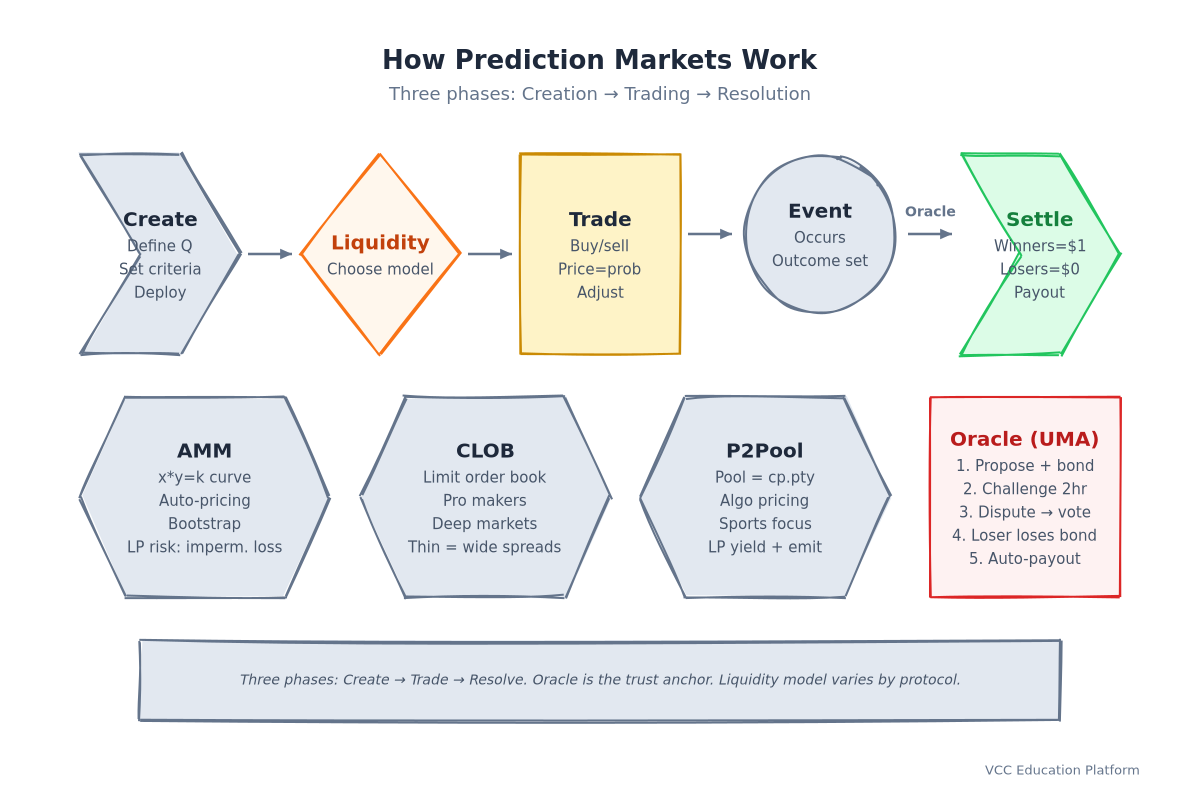
How Prediction Markets Work: The Core Mechanics
Every prediction market has three phases. Understanding each reveals where value accrues and where risk hides.
Market Creation & Liquidity
Someone proposes a question: "Will Bitcoin exceed $100k by Dec 31, 2025?" The protocol validates the format (binary, categorical, scalar) and deploys a market contract.
Liquidity bootstrapping is the hard part. Early markets have no depth. Protocols solve this differently:
- Polymarket: Central Limit Order Book (CLOB) — makers place limit orders, takers match them. Professional market makers provide depth.
- Augur v2: AMM (Automated Market Maker) using constant product formula. LPs deposit outcome tokens; price adjusts algorithmically.
- Azuro: Peer-to-pool. LPs deposit USDC into a pool; the pool is counterparty to all bets. Pool shares (LP tokens) earn fees + mining rewards.
- Gnosis/Omen: Conditional tokens (ERC-1155). Each outcome = a token. LPs mint full sets, providing balanced liquidity across outcomes.
Key insight: Order books need professional makers. AMMs need subsidized LPs. Peer-to-pool needs deep pools. There's no free lunch — liquidity costs must be paid by fees, inflation, or subsidies.
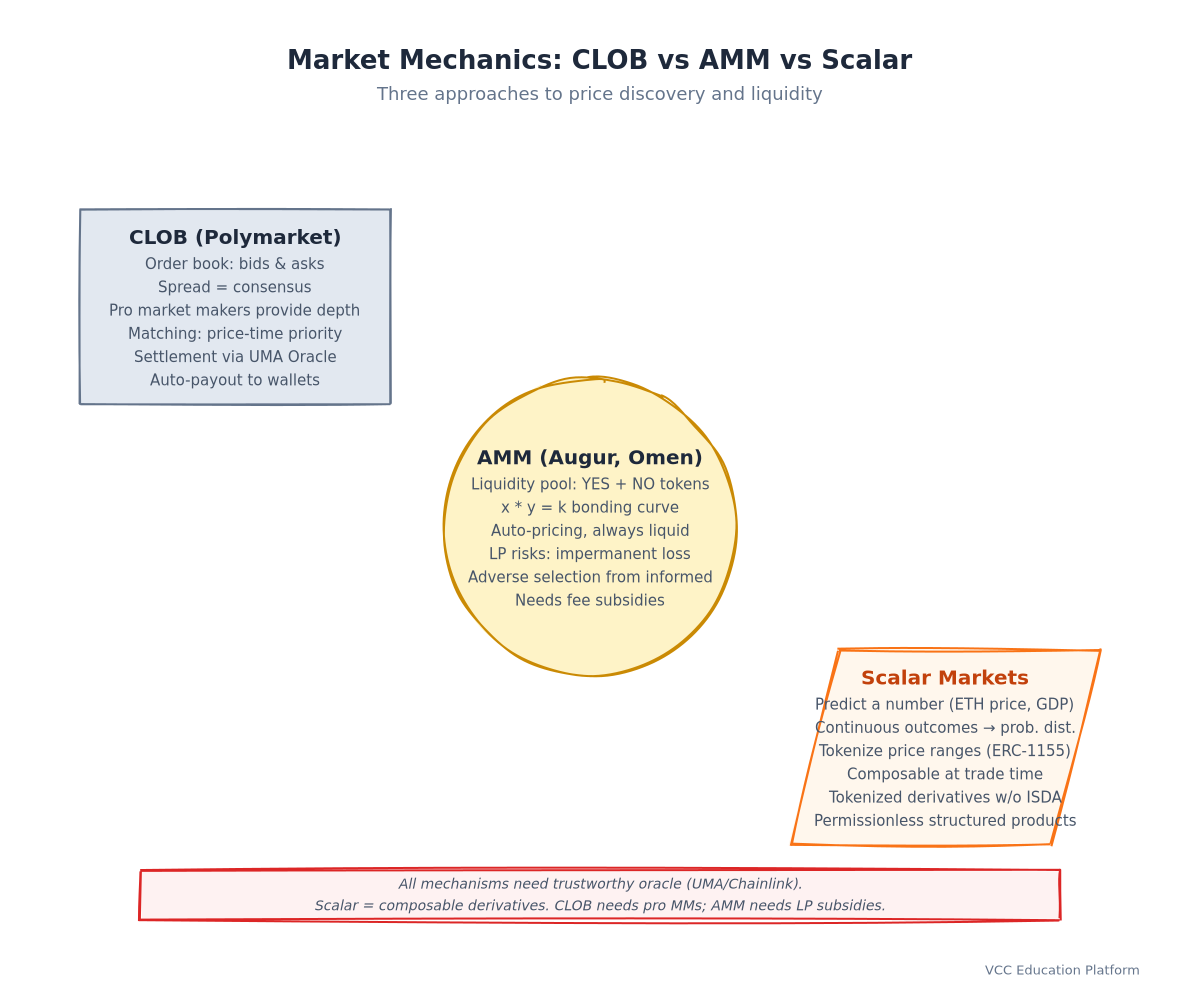
Trading Shares: AMM vs Order Book vs Scalar
| Mechanism | How Price Forms | Best For | Weakness |
|---|---|---|---|
| CLOB (Polymarket) | Limit orders match; spread = consensus | High-volume, binary markets | Thin order books = wide spreads |
| AMM (Augur, Omen) | x * y = k curve across outcome tokens | Bootstrapping, long-tail markets | Impermanent loss for LPs; slippage |
| Peer-to-Pool (Azuro) | Pool prices via algorithm (Black-Scholes-ish) | Sports, high-frequency | Pool can go bankrupt (tail risk) |
| Scalar (Gnosis, Polymarket) | Price = expected value of continuous variable | ETH price, GDP, temperature | Complex pricing; fewer participants |
Scalar markets deserve attention. Instead of "ETH > $5k?" (binary), you trade "ETH price on Dec 31" — the market outputs a probability distribution. This is a tokenized derivative without ISDA docs, clearinghouses, or accredited-investor rules. Regulatory arbitrage at its purest.
Resolution & Oracles: The Oracle Trilemma
The moment of truth: the event occurs, the market must settle. Who tells the blockchain what happened?
This is the Oracle Trilemma — no protocol optimizes all three:
| Property | What It Means | Protocols Prioritizing It |
|---|---|---|
| Trust-minimization | No single party can dictate outcome | Augur (REP disputes), UMA (DVM) |
| Latency | Time from event → finality | Chainlink (minutes), centralized APIs |
| Cost | Fees to request + dispute | UMA (optimistic, cheap if undisputed), Azuro (Kleros) |
Flowchart - Oracle resolution process (UMA optimistic oracle)
UMA's Optimistic Oracle (used by Polymarket, Sherlock, Across):
- Propose: Anyone submits an answer + bond.
- Challenge window (default 2 hours): Anyone can dispute by posting a counter-bond.
- Escalate: If disputed → UMA DVM (Data Verification Mechanism). UMA tokenholders vote. Loser loses bond.
- Finality: After vote (48-72 hrs), outcome is final.
Augur's approach: Designated reporter → public dispute → fork (nuclear option). Forking splits the REP token universe — catastrophic but ultimate credibility guarantee.
Azuro: Data providers submit results → Kleros court for disputes. Faster, cheaper, but more trusted parties.
Original analysis: The Oracle Trilemma explains why no single oracle dominates. High-stakes markets (Polymarket politics) accept UMA's latency for trust-minimization. High-frequency sports (Azuro) accept Kleros trust for speed. There is no universal solution.
Major DeFi Prediction Market Platforms
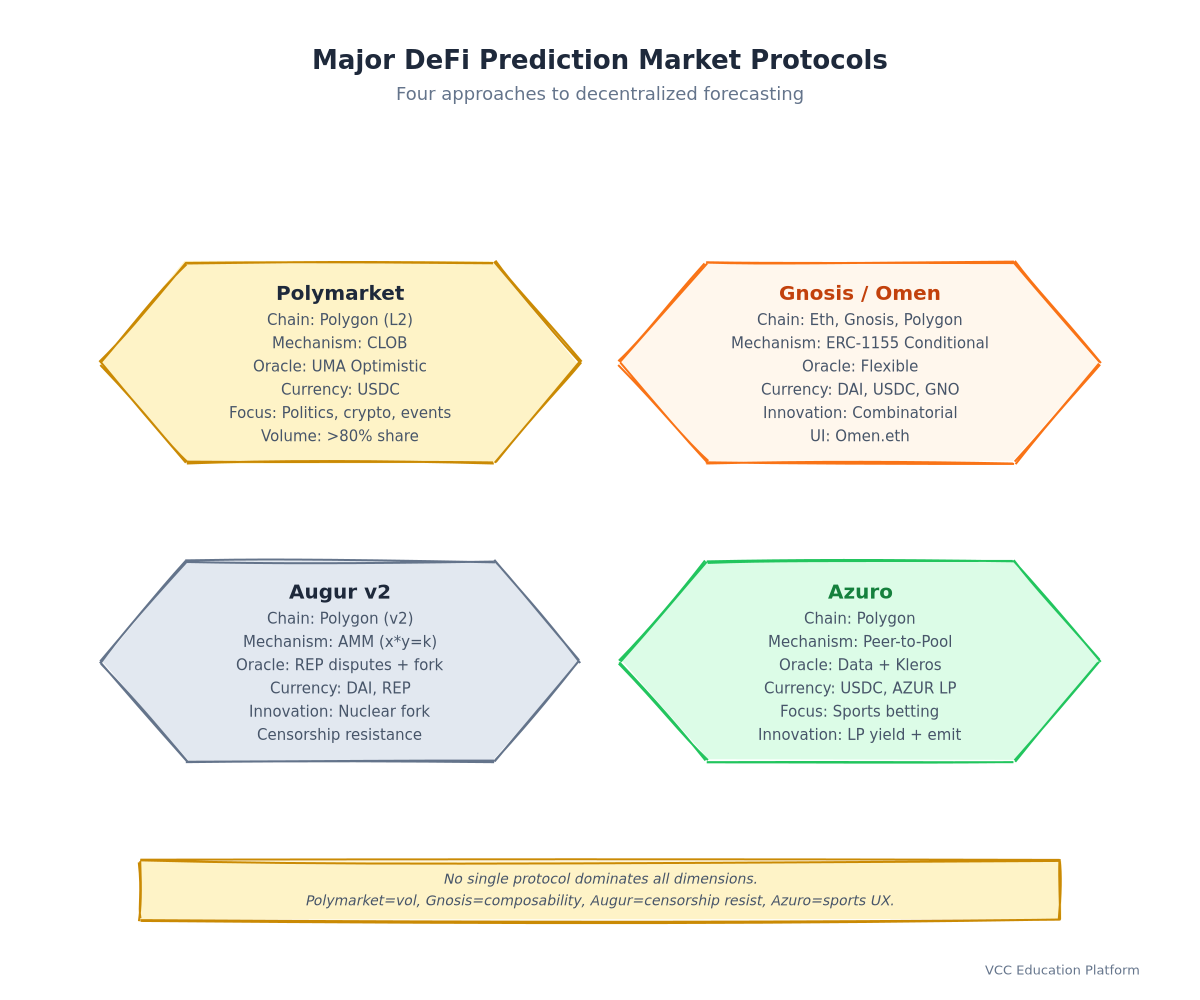
Polymarket: The Volume Leader
- Chain: Polygon (L2 for low fees)
- Mechanism: CLOB + UMA Optimistic Oracle
- Currency: USDC
- Focus: Politics, crypto, current events, sports
- Stats (2024): >80% of DeFi prediction market volume, $50M+ TVL, 50k+ monthly active users
- Differentiation: Best UX, deepest liquidity, real-world event coverage
- Regulatory note: Paid $1.4M CFTC fine (2022) for unregistered binary options. Now geo-blocks US users.
Gnosis / Omen: The Conditional Token Pioneer
- Chain: Ethereum mainnet, Gnosis Chain, Polygon
- Mechanism: ERC-1155 Conditional Tokens + DutchX auction + various oracles
- Currency: DAI, USDC, GNO
- Focus: General purpose, developer platform
- Innovation: Conditional tokens enable combinatorial markets — atomically combine "France wins" + "Over 2.5 goals" without pre-creating every combo. Solves exponential state explosion.
- Omen.eth: Consumer UI built on Gnosis Protocol.
Augur: The OG With Nuclear Option
- Chain: Ethereum (v1), Polygon (v2)
- Mechanism: AMM + REP-based dispute resolution + forking
- Currency: DAI (v2), REP (staking)
- Focus: Censorship resistance above all
- Innovation: Forking — if a dispute can't be resolved, the REP token splits into child universes. Honest reporters migrate; dishonest ones are left on a worthless chain. Never triggered in production.
- Status: v2 live but low volume; v3 in development.
Azuro: Peer-to-Pool for Sports
- Chain: Polygon
- Mechanism: Peer-to-pool + Kleros disputes + data providers
- Currency: USDC, LP tokens
- Focus: Sports betting (football, tennis, basketball, esports)
- Innovation: LPs earn yield from betting volume + AZUR emissions. Data providers stake AZUR; slashable for bad data.
- Differentiation: Purpose-built for high-frequency sports; not general-purpose.
Emerging Protocols Worth Watching
| Protocol | Innovation | Stage |
|---|---|---|
| Manifold | Play-money prediction markets (not DeFi) — but testing mechanisms | Live |
| Foresight | ZK-proofs for private predictions | Testnet |
| Sway | Social prediction markets (Farcaster integration) | Beta |
| Kalshi (CeFi) | CFTC-approved political contracts | Live (US only) |
Competitive gap: No protocol has solved discovery. Users find markets via Twitter, not protocol UIs. A unified aggregator (like Coingecko for prediction markets) could unlock long-tail liquidity.
Market Types: Binary, Categorical, Scalar, Combinatorial
Comparison - Market types: Binary, Categorical, Scalar, Combinatorial
| Type | Example | Outcomes | Complexity |
|---|---|---|---|
| Binary | "BTC > $100k by 2025?" | Yes / No | Low |
| Categorical | "2026 World Cup winner" | 32 teams | Medium |
| Scalar | "ETH price Dec 31, 2025" | Continuous ($0 - ∞) | High |
| Combinatorial | "France wins AND >2.5 goals" | Exponential (2^n) | Very High |
Combinatorial markets are the final frontier. 10 binary markets → 1,024 combined outcomes. Liquidity fragments into dust. Gnosis Conditional Tokens solve this: you mint outcome tokens for atomic conditions, combine them at trade time, not at creation time. The protocol never enumerates all combos — users compose them.
The Oracle Problem: Why Resolution Is Hard
If the oracle lies, the market dies. Three attack vectors:
1. Data Source Compromise
API goes rogue, feed is hacked, website shows wrong result.
- Mitigation: Multi-source aggregation (Chainlink), economic stakes (UMA, Augur), dispute courts (Kleros).
2. Subjectivity in Outcomes
"Did Russia 'invade' Ukraine?" "Is this a 'recession'?" Language ambiguity.
- Mitigation: Precise resolution criteria (e.g., "per IMF World Economic Outlook"), fallback to trusted entities, forking.
3. Economic Attacks
Attacker buys outcome tokens → manipulates oracle → profits.
- Cost of attack must exceed value secured. UMA: attacker needs >50% of voting UMA. Augur: >50% of REP. Polymarket: manipulate UMA vote (expensive) or bribe proposer (bond at risk).
Vietnam context: In a market like "Vietnam GDP growth > 6% in 2025", the oracle source matters. GSO (General Statistics Office) vs. IMF vs. World Bank can disagree by 0.5%. Resolution criteria must specify exactly which release, which table, which cell.
Risks & Challenges
Liquidity & Adverse Selection
LPs in AMMs/peer-to-pool face informed traders. If you know the election result before the market, you drain the pool. This is adverse selection — the same problem Uniswap LPs face, but worse because information asymmetry is the product, not a bug.
Result: LPs lose money on average unless subsidized. Azuro's emissions, Augur's fees, Polymarket's market makers — all are subsidies. Sustainable liquidity requires real demand (hedgers, speculators), not just mercenary capital.
Regulatory Uncertainty
| Jurisdiction | Status | Implication |
|---|---|---|
| USA | CFTC: binary options = swaps → regulated. Polymarket fined. Kalshi approved. | Geo-blocking, legal risk for developers |
| EU | MiCA: unclear if prediction markets = gambling or financial instruments | Fragmented national laws |
| Vietnam | Decree 06/2017/ND-CP: online gambling illegal. Crypto = grey zone. | High user demand, high legal risk |
| Singapore | PSA license required for DPT services. Prediction markets likely regulated. | Compliance burden |
CFTC vs. "Sufficiently Decentralized": The CFTC targeted Polymarket (centralized frontend, known team) but not Augur (no admin keys, anonymous-ish devs). The line is: who can the regulator sue? This shapes protocol architecture.
Oracle Manipulation & Disputes
- 2020: Augur market "Will Trump win?" — disputed for weeks. REP holders voted.
- 2022: UMA dispute on "Will ETH merge by Sept 15?" — resolved correctly but showed latency.
- 2023: Polymarket "Covid origin" market — scientific consensus unclear, dispute escalated.
Disputes are features, not bugs. But they add latency (days) and cost (bonds, gas).
UX & Discovery Barriers
- Wallet friction: MetaMask, USDC, Polygon bridge — 5 steps before first bet.
- Market discovery: No "Google for prediction markets". Users rely on Twitter/Telegram.
- Terminology: "Shares", "outcome tokens", "conditional tokens" — confusing for normies.
- Mobile: Most UIs desktop-first. Vietnam is mobile-first.
Vietnam Context: Cultural Fit & Regulatory Landscape
Cultural Affinity: "Soi Cầu" Meets DeFi
Vietnam has a massive underground betting culture:
- Football betting (cá cược bóng đá) — estimated $2B+ annually, mostly illegal
- "Soi cầu" (analyzing odds, form, stats) — a skill, not pure luck
- Momo/ZaloPay — ubiquitous digital wallets, potential fiat on-ramps
- Community-driven — Telegram groups, Zalo communities share tips
Prediction markets map perfectly: "Soi cầu" = fundamental analysis. Market price = consensus odds. Trading shares = taking a position. The mental model exists; the infrastructure doesn't.
Regulatory Reality Check
- Decree 06/2017/ND-CP: Prohibits online gambling. "Games of chance" = illegal. "Games of skill" = potential exemption.
- Circular 02/2020/TT-NHNN: Crypto not legal tender; banks cannot process crypto payments.
- Draft Digital Asset Law (2024): May create framework for tokenized assets. Prediction markets unclear.
Opportunity: If Vietnam creates a "regulatory sandbox" for prediction markets (like Kalshi in US), local protocols could serve the massive latent demand legally. Risk: Crackdown drives users to offshore/VPN — capital flight, no tax revenue, no consumer protection.
Localization Needs
- Language: Vietnamese UI (not just Google Translate)
- Payment: Momo/ZaloPay/VNPay integration via P2P or stablecoin ramp
- Markets: V-League football, Vietnam GDP, VN-Index, local elections (if allowed)
- Community: Zalo/Telegram integration for market discussions
- Education: "Dự đoán" (prediction) vs "Cá cược" (gambling) framing
Future Outlook: Where DeFi Prediction Markets Are Heading
1. Aggregators & Discovery Layers
A unified frontend indexing all protocols (Polymarket + Azuro + Omen + Augur) with unified UX, notifications, portfolio tracking. The "Kayak for prediction markets."
2. Institutional Adoption
Hedging real-world risk: farmers betting on weather, importers on FX rates, DAOs on governance outcomes. Requires: better oracles, regulatory clarity, API access.
3. ZK-Privacy for Predictions
Zero-knowledge proofs let users bet without revealing position size or identity. Critical for sensitive topics (politics, corporate earnings).
4. AI + Prediction Markets
LLMs as market participants: auto-trading on news, generating market questions, summarizing dispute evidence. "AI agents as liquidity providers."
5. Conditional Token Standards Go Mainstream
ERC-1155 conditional tokens (Gnosis) or similar become the universal primitive. Composable, portable, DeFi-native.
6. Vietnam-Specific Protocol?
A locally-compliant, Vietnamese-language prediction market on a Vietnam-friendly chain (or L2) with Momo integration, V-League markets, and "skill-based" legal framing. First mover captures the narrative.
FAQ
How are prediction markets resolved?
Markets use oracles to fetch real-world outcomes. Approaches vary: UMA's Optimistic Oracle (propose → dispute → vote), Augur's REP-weighted voting + forking, Chainlink's multi-source aggregation, Kleros courts. Resolution criteria are defined at market creation (e.g., "per official FIFA result").
What oracles are used by major platforms?
- Polymarket: UMA Optimistic Oracle
- Augur: Native REP-based oracle + dispute system
- Gnosis/Omen: Flexible — supports Chainlink, UMA, Reality.eth, custom
- Azuro: Data providers + Kleros dispute resolution
Are DeFi prediction markets legal in Vietnam?
Currently: No clear legal status. Online gambling is prohibited (Decree 06/2017/ND-CP). Crypto payments are restricted. However, enforcement targets operators, not users. Many Vietnamese access Polymarket/Azuro via VPN. A future regulatory sandbox could change this.
What's the difference between AMM and order book markets?
AMM (Augur, Omen): Algorithm sets price via bonding curve. Always liquid but slippage + impermanent loss. Order book (Polymarket): Humans set limit orders. Tighter spreads at scale, but thin markets = no liquidity. Peer-to-pool (Azuro): Pool is counterparty; algorithm prices risk.
Can I create my own prediction market?
Yes. Omen.eth (Gnosis) lets anyone create binary/categorical/scalar markets in minutes. Augur has market creation UI. Polymarket restricts creation to approved partners (for quality/liquidity). Azuro requires pool deployment.
What are scalar markets and why do they matter?
Scalar markets predict a number (ETH price, GDP, temperature) not a yes/no. They output a probability distribution. Functionally: permissionless tokenized derivatives. No ISDA, no clearinghouse, no accredited investor check.
How do combinatorial markets work?
Combine multiple conditions atomically: "France wins" AND "Over 2.5 goals". Naively: 2^n outcomes. Gnosis Conditional Tokens solve this: each condition = token; combine at trade time. No exponential state explosion.
What happens if an oracle gives the wrong answer?
Dispute mechanisms activate. UMA: counter-proposal + bond → tokenholder vote. Augur: dispute rounds → forking (nuclear). Kleros: random juror selection → vote → appeal. Economic penalties for dishonest reporters.
Can prediction markets be manipulated?
Yes, if cost of attack < profit from manipulation. Thin markets are vulnerable. Deep markets (Polymarket US election: $100M+ volume) resist manipulation. Oracle attacks require compromising the dispute layer (expensive).
What's the "Oracle Trilemma"?
No oracle optimizes all three: trust-minimization, latency, cost. UMA = trust + cost (slow). Chainlink = latency + cost (trusted nodes). Augur = trust + latency (expensive). Protocol choice reveals priority.
How do LPs make money in prediction markets?
Fees (trading fees, creation fees), emissions (protocol tokens like AZUR), spread (market making), arbitrage (cross-market). Risk: adverse selection from informed traders. Most LPs lose net of impermanent loss without subsidies.
Are there prediction markets for Vietnamese events?
Currently very few. Polymarket occasionally lists "Vietnam GDP" or "ASEAN summit" markets. Azuro has V-League football sometimes. No dedicated Vietnamese-language protocol exists — a clear gap.
What's the biggest barrier to mainstream adoption?
Not technology — UX and regulation. Wallet onboarding, fiat on-ramps, clear legal status, and market discovery. The tech works; the product doesn't yet serve non-crypto natives.
How do prediction markets compare to traditional sportsbooks?
| Aspect | Traditional (Bet365, etc.) | DeFi (Polymarket, Azuro) |
|---|---|---|
| Custody | Custodial | Self-custodial |
| Geography | Geo-fenced | Global (mostly) |
| Markets | Operator-curated | Permissionless creation |
| Fees | Vig (4-10%) | Protocol fees (1-3%) + gas |
| Transparency | Opaque | On-chain auditable |
| Limits | KYC limits, winning bans | No limits (capital-based) |
| Settlement | T+1 to T+3 | On-chain finality |
This article provides educational information only. Not financial advice. Prediction markets involve risk of total loss. Check local regulations before participating.