
DeFi performance analysis isn't about chasing the highest APY. It's about understanding why a protocol generates yield, how sustainable that yield is, and what risks you're actually taking. After analyzing dozens of protocols across market cycles, I've learned that the protocols surviving 2022's carnage weren't the ones with the sexiest marketing — they were the ones with measurable revenue, transparent risk parameters, and capital efficiency that didn't rely on token emissions.
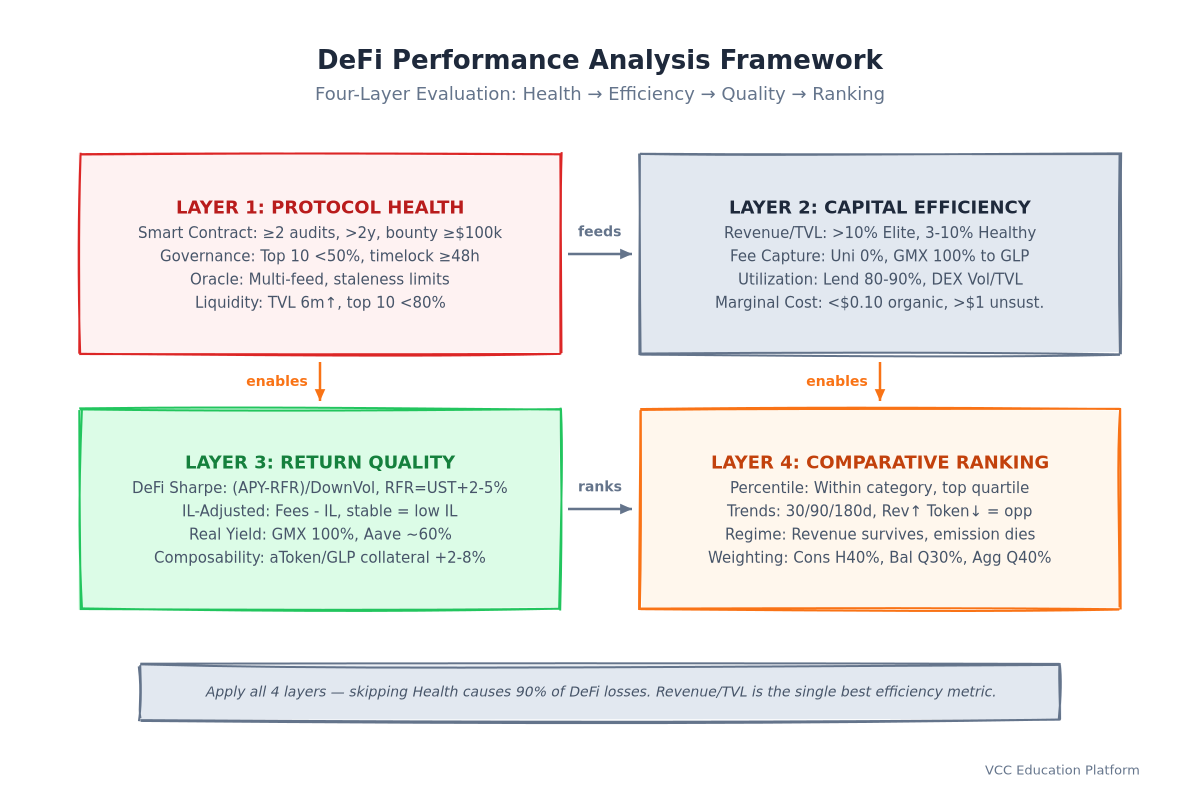
In this guide, we'll build a four-layer framework you can apply to any protocol: Protocol Health → Capital Efficiency → Return Quality → Comparative Ranking. We'll use real data from Uniswap, Aave, GMX, and Pendle to show the framework in action, and I'll share the Vietnamese-specific adjustments you need if you're measuring returns in VND.
Why Most DeFi Analysis Fails
Let me start with a story. In November 2021, a friend — let's call him Minh — aped into a "high-yield" farm on a new BSC fork promising 3,000% APY. The TVL was $50M. The audit? "Coming soon." The team? Anonymous. Two weeks later, the rug pulled. Minh lost $12,000 — his entire DeFi stack.
Minh's mistake wasn't greed. It was using TVL and APY as his only filters. He didn't check:
- Whether the protocol actually earned revenue or just printed tokens
- Who controlled the admin keys
- What happened to liquidity when the music stopped
- How the yield would look after a 50% market drawdown
This pattern repeats every cycle. The tools exist — DefiLlama, Token Terminal, Dune, Gauntlet — but most users don't know how to combine them into a decision framework. That's what we're fixing today.
Layer 1: Protocol Health — "Is It Safe?"
Before you calculate a single yield number, you need to answer: Can I trust this protocol with my capital?
Smart Contract Risk
The checklist:
- Audit count & quality: ≥2 audits from top-tier firms (Trail of Bits, OpenZeppelin, Spearbit, Sigma Prime). Unaudited = automatic pass.
- Time since deployment: Lindy effect is real. Protocols >2 years without major exploits (Uniswap V2, Aave V2, Curve) earn trust premiums.
- Bug bounty size: Immunefi bounty ≥$100k signals seriousness. $1M+ is gold standard.
- Formal verification: Rare but valuable. Certora, fuzzing campaigns, invariant testing.
Real example: GMX's GLP vault has been live since 2021, holds $400M+, survived the FTX crash with zero bad debt, and runs a $1.5M Immunefi bounty. That's a risk score of ~20/100. A 3-week-old fork with a $10k audit? Score 85/100.
Governance Risk
Who can change the rules?
- Token distribution: Top 10 holders <50% = decentralized enough. >70% = single entity control.
- Upgrade timelock: ≥48 hours minimum. No timelock = exit immediately.
- Emergency pause: Can guardians halt the protocol? Aave, Compound, Maker have this. Most forks don't.
Oracle Risk
Price feeds determine liquidations. Ask:
- Diversity: Chainlink + Redstone + Pyth > Chainlink only
- Staleness thresholds: How old can a price be before transactions revert?
- Manipulation history: Has the oracle been gamed? (e.g., Mango Markets 2022)
Liquidity Risk
- TVL trend (6 months): Growing, flat, or bleeding?
- Concentration: Top 10 addresses owning >80% of TVL = whale exit risk
- Withdrawal queue depth: For lending protocols, how long to exit?
Vietnam context: VNDT on KyberSwap has ~$2M TVL, top 5 LPs hold 60%. That's concentrated but manageable for retail sizes. If you're deploying $100k+, you move the market.
Layer 2: Capital Efficiency — "Does It Work?"
Health gets you in the door. Efficiency tells you if the business model works.
The "DeFi P/E": Revenue per TVL
This is the single most important metric. Revenue/TVL (annualized) tells you how much fee income the protocol generates per dollar locked.
| Protocol | TVL | Annualized Revenue | Rev/TVL | Category |
|---|---|---|---|---|
| Uniswap V3 | $3.2B | $380M | 11.9% | DEX |
| Aave V3 | $8.1B | $120M | 1.5% | Lending |
| GMX | $420M | $65M | 15.5% | Derivatives |
| Pendle | $1.1B | $45M | 4.1% | Yield |
| Curve | $2.8B | $85M | 3.0% | StableSwap |
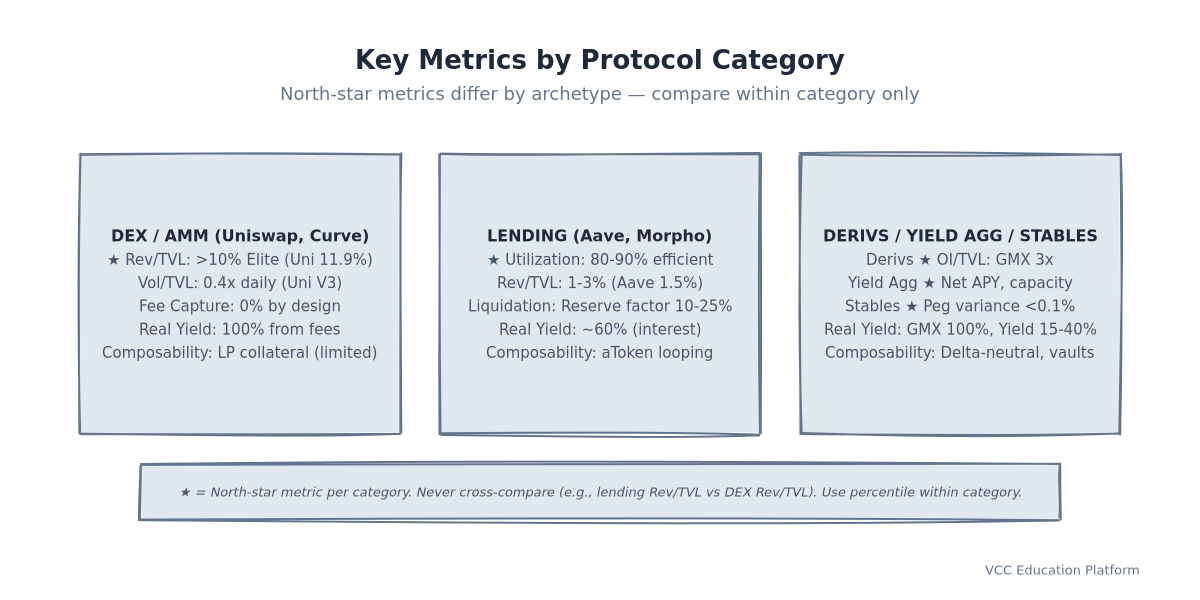
Rule of thumb: Rev/TVL > 10% = elite (Uniswap, GMX). 3-10% = healthy (Pendle, Curve). <3% = question the model (most lending protocols without fee switches).
Data: Token Terminal, 30-day trailing, annualized. Your numbers will differ by window — use 90-day for stability.
Fee Capture Ratio
Of the total fees users pay, how much does the protocol keep?
- Uniswap V3: 100% to LPs, 0% to protocol (unless fee switch on) → 0% capture
- GMX: 100% of trading fees to GLP holders → 100% capture (by token holders)
- Aave: Reserve factor (10-25% of interest) → 10-25% capture
- Pendle: 3% of YT yield + 0.5% swap fees → ~3-5% capture
High capture ≠ better. Uniswap's 0% capture is the product — it maximizes LP yield to attract liquidity. The token captures value differently (governance, future fee switch).
Capital Utilization
- Lending: Borrow / Supply. 80-90% = efficient. >95% = liquidation spiral risk. <50% = capital sitting idle.
- DEX: Volume / TVL. Uniswap V3: ~0.4x daily (high). Curve stable: ~0.1x (low, but low slippage is the product).
- Derivatives: Open Interest / TVL. GMX: ~3x (high leverage efficiency).
Marginal Cost of Liquidity
How much in token incentives does the protocol spend per $1 of TVL acquired?
- Healthy: <$0.10 per $1 TVL (organic growth)
- Concerning: $0.50-$1.00 (mercenary capital)
- Unsustainable: >$1.00 (Ponzi dynamics)
Most "high APY" farms spend $2-5 per $1 TVL. When incentives stop, TVL evaporates.
Layer 3: Return Quality — "Is It Worth It?"
Now we get to what you actually care about: risk-adjusted returns in your denominator currency.
The DeFi Sharpe Ratio
Traditional Sharpe = (Return - Risk-Free) / Volatility. DeFi adaptation:
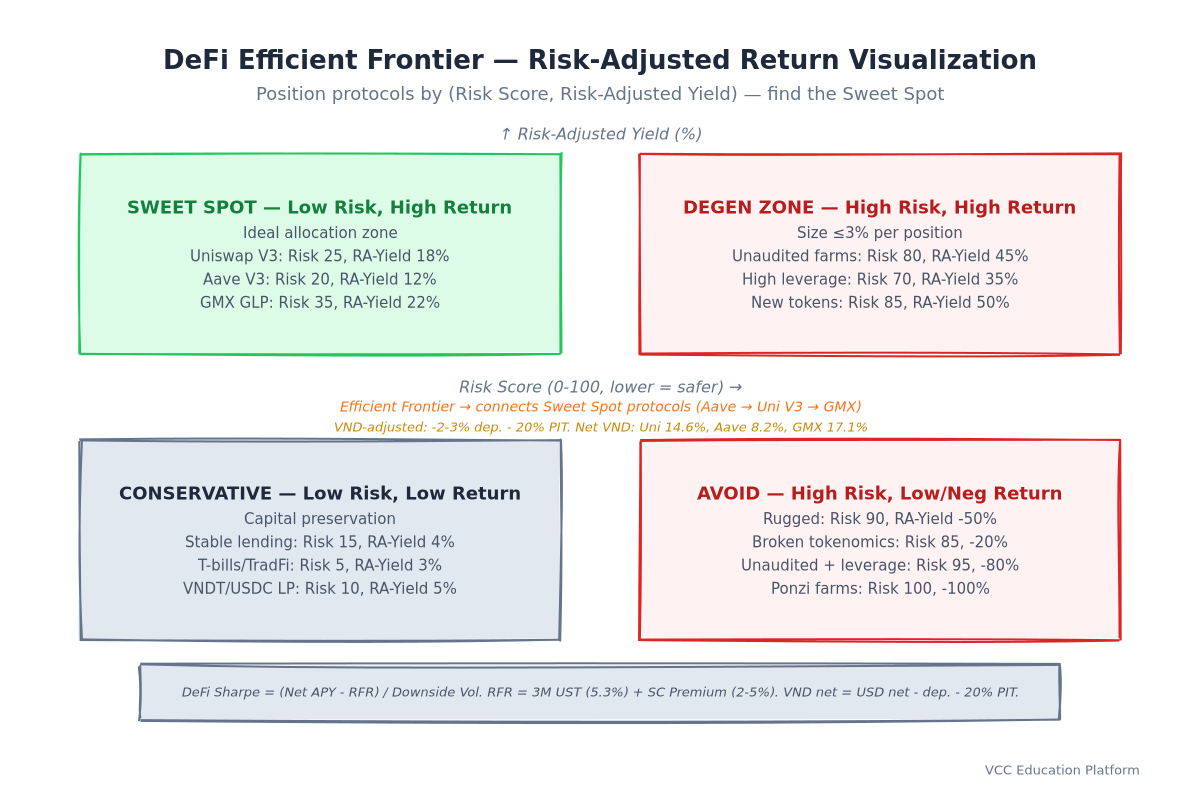
` DeFi Sharpe = (Net APY - Risk-Free Rate) / Downside Volatility `
Where:
- Net APY = Gross yield - fees - IL - slippage - gas
- Risk-Free Rate = US 3M Treasury (5.3%) + Smart Contract Risk Premium (2-5%)
- 2%: Battle-tested (Uniswap, Aave)
- 3-4%: Audited, 1+ year (GMX, Pendle)
- 5%: Newer, single audit
- Downside Volatility = Sortino denominator (only negative deviations)
Example: USDC lending on Aave V3 (Ethereum)
- Gross APY: 8%
- Risk-free: 5.3% + 2% = 7.3%
- Downside vol: 2% (mostly utilization spikes)
- DeFi Sharpe = (8% - 7.3%) / 2% = 0.35 — mediocre
Example: GLP (GMX) on Arbitrum
- Net APY (fees + escrowed GMX): 22%
- Risk-free: 5.3% + 3% = 8.3%
- Downside vol: 18% (crypto beta + GLP drawdowns)
- DeFi Sharpe = (22% - 8.3%) / 18% = 0.76 — strong
Impermanent Loss Adjustment
For LP positions, IL-Adjusted Return = Fee Income - Impermanent Loss
Uniswap V3 ETH/USDC 0.05% (1-year backtest):
- Fee APR: 18%
- IL (vs. holding): -8%
- Net: 10% — but concentrated positions change this dramatically
KyberSwap VNDT/USDC (concentrated, ±1% range):
- Fee APR: 35%
- IL risk: Low (stable-stable), but de-peg risk exists
- VNDT/USDC spread: 0.5-2% = hidden cost
- Net (VND terms): ~28-32%
Tokenomics Sustainability
Real Yield % = (Non-inflationary revenue) / (Total yield paid to users)
- GMX: 100% real yield (all from trading fees)
- Aave: ~60% real yield (interest), 40% emissions (AAVE rewards)
- Typical farm: 0-10% real yield, 90-100% emissions
FDV/TVL ratio: <5 = undervalued, 5-15 = fair, >20 = overvalued. Many 2021 farms launched at FDV/TVL >100.
Composability Bonus
Can you use the position as collateral elsewhere?
- aUSDC (Aave): Deposit → borrow against it → leveraged loop
- GLP (GMX): Not widely accepted as collateral (improving)
- Pendle YT/PT: Emerging integrations (Euler, Morpho)
- Uniswap V3 LP (NFT): Limited — NFTfi, but illiquid
This "bonus yield" can add 2-8% APY but adds smart contract risk on the second protocol.
Layer 4: Comparative Ranking — "Vs. Peers"
Absolute numbers lie. Context is everything.
Percentile Ranking Within Category
Don't compare Aave to Uniswap. Compare Aave to Compound, Venus, Morpho, Spark.
Lending protocols (by Rev/TVL, 90d):
- Morpho Blue: 8.2% (peer-to-peer, no reserve factor drag)
- Spark: 3.1% (DAI-focused, Maker subDAO)
- Aave V3: 1.5% (diversified, battle-tested)
- Compound V3: 1.2% (conservative)
- Venus: 0.9% (BNB Chain, higher risk)
If you're allocating to lending, Morpho wins on efficiency, Aave wins on safety. Your risk tolerance decides.
Trend Analysis
30d / 90d / 180d momentum on each metric:
| Metric | 30d Trend | 90d Trend | Signal |
|---|---|---|---|
| TVL | +12% | -5% | Recovering |
| Revenue | +8% | +15% | Growing |
| Rev/TVL | -3% | +21% | Improving efficiency |
| Token price | -15% | -40% | Diverging from fundamentals |
Key insight: Token price often leads fundamentals by 3-6 months. Falling token + rising Rev/TVL = potential accumulation zone.
Regime Awareness
How does the protocol perform in different markets?
| Protocol | Bull (2021) | Bear (2022) | Sideways (2023) | Current |
|---|---|---|---|---|
| Uniswap V3 | High volume, high fees | Volume -60%, fees -70% | Stable, efficient | Strong |
| Aave | High utilization, high rates | Bad debt managed, survived | Conservative, steady | Steady |
| GMX | Launched late 2021 | GLP outperformed (delta neutral) | Consistent fees | Strong |
| High-yield farms | 1000%+ APY | -99% TVL, rugged | Dead | Avoid |
Lesson: Protocols with real revenue (Uniswap, GMX, Aave) survive regime changes. Emission-dependent protocols don't.
Putting It Together: The Evaluation Workflow
Here's the exact 7-step process I use for every new protocol:
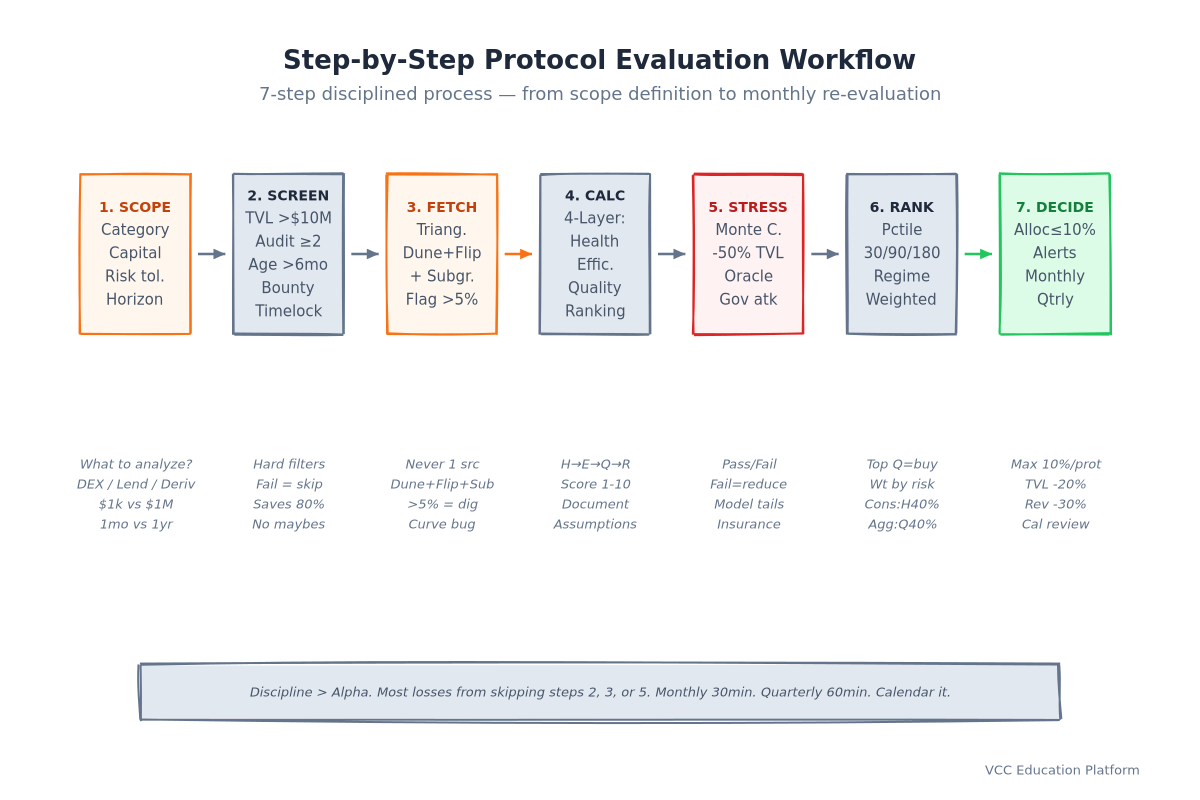
Step 1: Define Scope
- Category: DEX, lending, derivatives, yield, stablecoin?
- Capital: $1k, $100k, $1M? (Affects slippage, capacity, gas sensitivity)
- Risk tolerance: Conservative (preserve principal) / Balanced / Aggressive (max yield)
- Time horizon: 1 month / 3 months / 1 year+?
Step 2: Screen Protocols
Hard filters (fail = skip):
- TVL > $10M (liquidity floor)
- ≥2 audits from reputable firms
- Deployed >6 months
- Bug bounty >$50k
- Admin keys timelocked ≥48h
Soft filters (score 1-10):
- Team transparency
- Community activity
- Integration ecosystem
Step 3: Fetch Data (Triangulation Protocol)
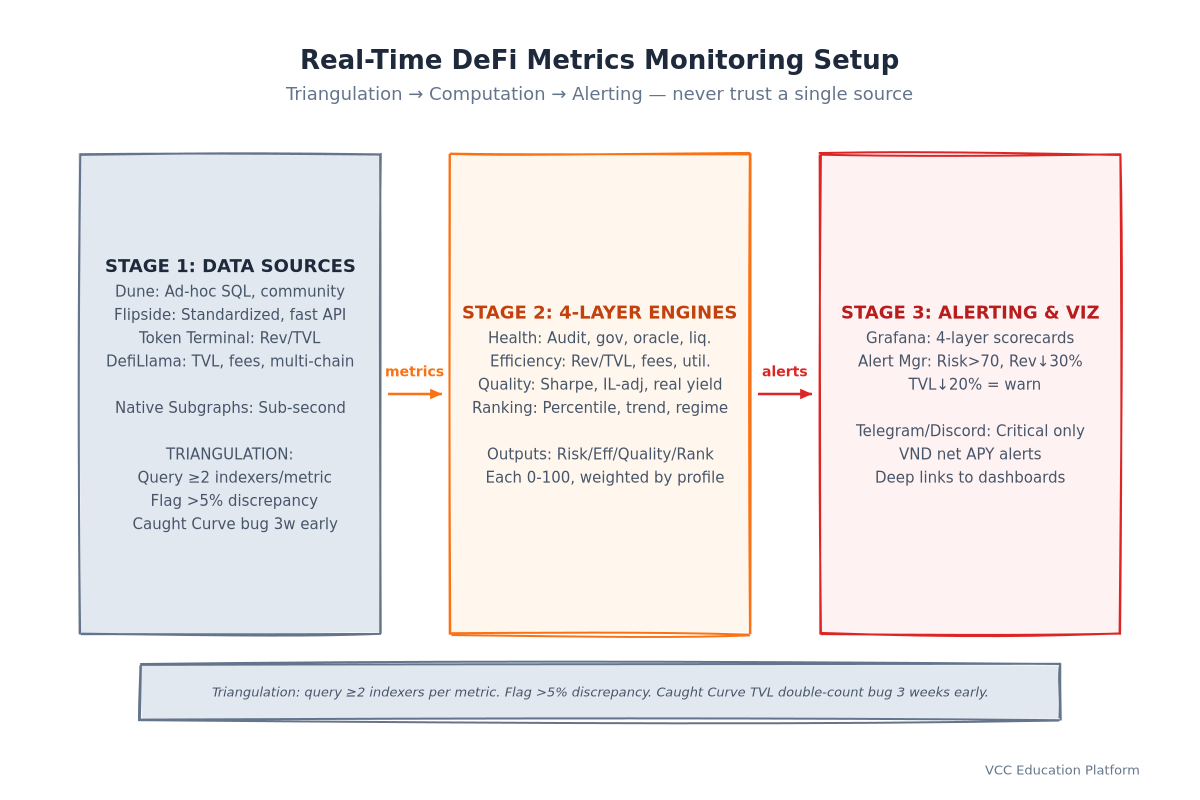
Never trust one source. For each metric, query ≥2:
- Dune Analytics (ad-hoc, community dashboards)
- Flipside Crypto (standardized schemas, fast)
- Native subgraph (real-time, protocol-owned)
- Token Terminal (revenue, standardized)
- DefiLlama (TVL, fees, cross-chain)
Flag any >5% discrepancy for manual investigation.
Step 4: Compute 4-Layer Metrics
Run the framework. Score each layer 1-10:
- Health: Audit score, governance, oracle, liquidity
- Efficiency: Rev/TVL, fee capture, utilization, marginal cost
- Quality: DeFi Sharpe, IL-adjusted, real yield %, composability
- Ranking: Percentile, trend, regime
Step 5: Stress Test
Monte Carlo simulation (or mental model) for:
- -50% TVL outflow: Can the protocol function?
- Oracle failure: 1-hour stale prices → liquidation cascade?
- Governance attack: Malicious proposal passes → funds drained?
- Smart contract exploit: 10% TVL lost → insurance fund coverage?
If any stress test fails catastrophically, reduce allocation or skip.
Step 6: Compare & Rank
Build a scorecard. Weight layers by your risk tolerance:
- Conservative: Health 40%, Efficiency 20%, Quality 20%, Ranking 20%
- Balanced: Health 25%, Efficiency 25%, Quality 30%, Ranking 20%
- Aggressive: Health 15%, Efficiency 25%, Quality 40%, Ranking 20%
Step 7: Decide & Monitor
- Allocate per sizing rules (max 5-10% per protocol for balanced)
- Set alerts: TVL -20%, Rev/TVL -30%, audit expiration, governance proposals
- Monthly re-evaluation: Full framework refresh. Quarterly: stress test update.
Vietnamese DeFi Investor Addendum
If you're Vietnamese, measuring in USD hides real costs. Here's the VND-Adjusted Framework:
1. Convert Everything to VND
` VND Net APY = (USD Net APY × (1 + USD/VND forward premium)) - VND depreciation - Tax drag `
- Current USD/VND: ~25,400
- 1-year forward premium: ~3-4% (interest rate differential)
- VND depreciation (5y avg): ~2-3%/year
- PIT (Personal Income Tax): 20% on gains (Circular 92/2020/TT-BTC)
Example: 20% USD APY on GLP → 20% × 1.035 = 20.7% gross VND → -2.5% depreciation = 18.2% → -20% tax = 14.6% net VND APY
2. Stablecoin Basis Risk
VNDT/USDC spread on KyberSwap: 0.5-2%. This is a real cost every time you enter/exit.
- Wide spread = expensive to rotate
- Monitor VNDT peg (should be 1:1 with VND, not USD)
3. Local Liquidity Realities
- KyberSwap: Main VND venue. Concentrated V3 positions on VNDT/USDC, VNDT/USDT
- Uniswap V3: No direct VND pairs. Bridge → USDC → VNDT adds steps + fees
- CEX off-ramp: Binance, OKX, Bybit VND P2P. Spreads 0.5-1.5%
4. Tax Documentation
Track every transaction. Vietnam tax authority (TCT) increasingly requests:
- Wallet addresses
- Transaction hashes
- USD/VND rates at time of trade
- Tool suggestion: Koinly, CoinTracker, or custom Dune dashboard with VND conversion
Case Studies: Framework Applied
Case 1: Uniswap V3 ETH/USDC 0.05% (Conservative LP)
| Layer | Score | Notes |
|---|---|---|
| Health | 9/10 | 3+ audits, 2.5y live, $1M bounty, timelock |
| Efficiency | 9/10 | 11.9% Rev/TVL, 0% capture (by design), 0.4x vol/TVL |
| Quality | 7/10 | DeFi Sharpe ~0.8, IL -8%, 100% real yield, composability low |
| Ranking | 8/10 | #1 DEX by volume, revenue, trust |
| Weighted (Balanced) | 8.2/10 | Allocate: 5-10% of DeFi stack |
Case 2: Aave V3 USDC (Conservative Lending)
| Layer | Score | Notes |
|---|---|---|
| Health | 9/10 | Battle-tested, emergency pause, Guardian |
| Efficiency | 5/10 | 1.5% Rev/TVL, 15% reserve factor, 85% utilization |
| Quality | 6/10 | DeFi Sharpe ~0.35, no IL, 60% real yield, aToken composability |
| Ranking | 7/10 | #2 lending, losing share to Morpho |
| Weighted (Balanced) | 6.8/10 | Allocate: 3-8% for stable yield |
Case 3: GLP on GMX (Balanced/Aggressive)
| Layer | Score | Notes |
|---|---|---|
| Health | 7/10 | 2 audits, 2.5y, $1.5M bounty, but complex contract |
| Efficiency | 9/10 | 15.5% Rev/TVL, 100% fee capture, 3x OI/TVL |
| Quality | 8/10 | DeFi Sharpe ~0.76, no IL (single asset), 100% real yield |
| Ranking | 8/10 | #1 perp DEX, growing market share |
| Weighted (Balanced) | 8.0/10 | Allocate: 5-15% for beta + yield |
Case 4: "New High-Yield Farm" (Avoid)
| Layer | Score | Notes |
|---|---|---|
| Health | 2/10 | 1 audit (unknown firm), 3 weeks live, no bounty, no timelock |
| Efficiency | 3/10 | Revenue near zero, incentives = 95% of yield |
| Quality | 1/10 | DeFi Sharpe negative (token dump risk), 0% real yield |
| Ranking | 2/10 | Bottom percentile, no regime history |
| Weighted | 1.8/10 | DO NOT TOUCH |
Tools & Data Stack (Copy-Paste Ready)
Free Tier
- DefiLlama: TVL, fees, revenue (basic) — free API
- Dune Analytics: 10k query results/month free — community dashboards
- Token Terminal: 30-day trial, then $49/mo — best revenue data
- Artemis Terminal: Free dashboard — cross-protocol comparison
- Coingecko API: Free tier — prices, volumes
Pro Tier (Worth It If Managing >$50k)
- Flipside Crypto: $99/mo — standardized schemas, SQL + REST
- Gauntlet/Chaos Labs: Custom — risk parameters for DAOs
- Goldsky/Graph: $200+/mo — sub-second indexing
- Kaiko: $500+/mo — institutional market data
My Personal Stack
` Daily: DefiLlama (TVL/fees) + Artemis (comparison) + Twitter (alpha) Weekly: Dune (custom queries) + Token Terminal (revenue deep-dive) Monthly: Full 4-layer framework refresh + stress test update Quarterly: Regime analysis + tool audit (any better sources?) `
FAQ
Q: What's the minimum TVL I should trust? A: $10M for established categories (lending, major DEX). $50M for newer categories (derivatives, yield aggregators). Below that = personal capital at risk, not investment.
Q: How often should I rebalance? A: Monthly framework review. Rebalance only if: (a) score drops >2 points, (b) stress test fails, (c) allocation drifts >50% from target. Don't churn for noise.
Q: Can I automate this? A: Partially. Dune + Flipside APIs can feed a Google Sheet / Notion database with the 4-layer scores. But stress testing and regime judgment require human context. Automate data, not decisions.
Q: What about points farming / airdrop hunting? A: Different game. Points = speculative option on future token. Size accordingly (1-3% of stack max). Don't confuse with fundamental analysis.
Q: How do I handle cross-chain protocols? A: Analyze each deployment separately. Aave Ethereum ≠ Aave Polygon ≠ Aave Avalanche. Different TVL, utilization, risk profiles. Aggregate only at portfolio level.
Q: Vietnamese tax — do I really pay 20% on DeFi gains? A: Yes. Circular 92/2020/TT-BTC classifies crypto gains as "other income" at 20% PIT. Enforcement is increasing. Track cost basis in VND at acquisition time.
Q: What's the best stablecoin for VND yields? A: VNDT (VND-pegged, KyberSwap native) for local pairs. USDC/USDT for global DeFi. Avoid algorithmic stablecoins (UST taught us that).
Summary Checklist
Before your next DeFi position, run this mental checklist:
- [ ] Health: ≥2 audits, timelock, bug bounty >$50k, TVL >$10M, growing
- [ ] Efficiency: Rev/TVL >3% (or category leader), fee capture logical, utilization 70-90%
- [ ] Quality: DeFi Sharpe >0.5, IL understood, real yield >50%, composability bonus mapped
- [ ] Ranking: Top quartile in category, positive 90d trends, survives bear regime
- [ ] VND-adjusted: Net VND APY calculated, tax drag modeled, VNDT spread accounted
- [ ] Stress tested: -50% TVL, oracle failure, governance attack scenarios survive
- [ ] Sized: ≤10% per protocol (balanced), ≤5% (conservative), alerts set
- [ ] Documented: Entry thesis, exit criteria, review date in calendar
Final Thought
DeFi performance analysis is a discipline, not a destination. The framework here works today because it's built on first principles: revenue, risk, efficiency, comparison. The specific metrics will evolve — new protocols, new categories, new data sources. But the structure holds.
Start small. Pick one protocol you're currently in. Run the 7-step workflow. See where it scores. The act of scoring forces clarity — and clarity prevents the next Minh story.
Your capital deserves more than APY chasing. Give it a framework.
Disclaimer: This article is educational, not financial advice. DeFi carries smart contract, market, and regulatory risk. Never invest more than you can lose. Consult a qualified advisor for your specific situation. Vietnam tax treatment based on Circular 92/2020/TT-BTC — verify with a local tax professional.