
DeFi onboarding strategies represent one of the most critical yet overlooked aspects of cryptocurrency adoption. While the industry obsesses over TVL, yield rates, and protocol innovation, the simple question — "How does a newcomer safely make their first DeFi interaction?" — remains poorly answered. This guide provides a battle-tested, progressive framework that takes you from zero to confident DeFi participant without losing your shirt (or your seed phrase) along the way.
The DeFi Onboarding Challenge: What Makes It Hard
Imagine walking into a bank where there are no tellers, no deposit insurance, the fees change every minute, and if you click the wrong button your money vanishes forever. Welcome to DeFi.
Traditional finance onboards you with KYC, a friendly app, and deposit insurance. Centralized exchanges (CeFi) like Binance or Coinbase bridge the gap — they feel like banks but hold your keys. DeFi removes all intermediaries. You become the bank, the compliance officer, and the security team simultaneously.
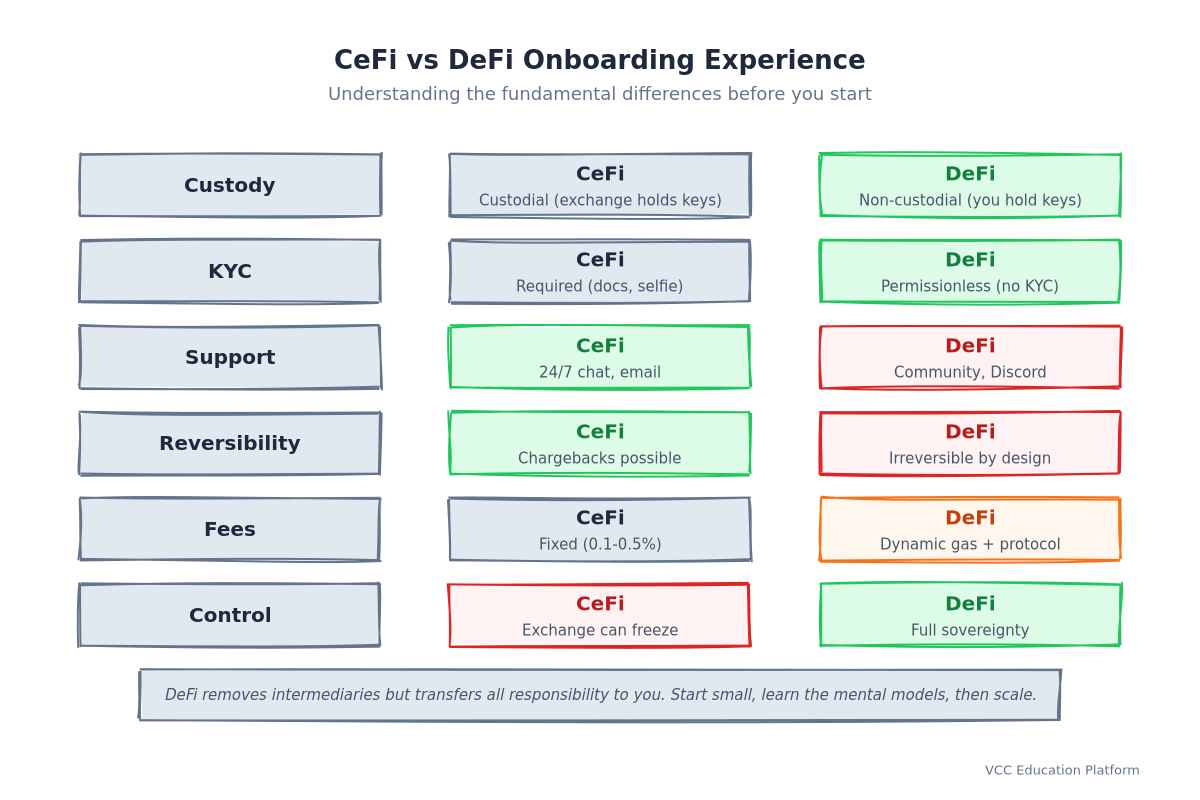
The Three Core Friction Points:
- Custody Mental Model Shift: "Not your keys, not your coins" sounds empowering until you realize you are now responsible for key generation, backup, and recovery. No "forgot password" button exists.
- Dynamic, Unpredictable Costs: Gas fees on Ethereum mainnet can swing from $2 to $50 in hours. A $100 swap might cost $5 in fees — 5% gone before you start. New users interpret this as "DeFi is expensive" rather than "I chose the wrong network for my capital."
- Irreversibility by Design: Sent to wrong address? Fat-fingered a decimal? Approved a malicious contract? There's no support ticket, no chargeback, no undo button. The blockchain finality that makes DeFi trustless also makes it unforgiving.
Data from the trenches: ConsenSys 2024 research shows 73% of users drop off at wallet creation. Of those who continue, 41% abandon at their first transaction due to gas fee surprise. The survivors who reach their first LP position? Only 18% remain active at 30 days if they started with liquidity provision directly.
The problem isn't DeFi's complexity — it's that we've been teaching people to swim by throwing them into the ocean.
Foundation Layer: Wallet Security & Network Basics
Before you touch a single protocol, you need a security foundation that scales with your portfolio. Think of this as building your financial immune system.
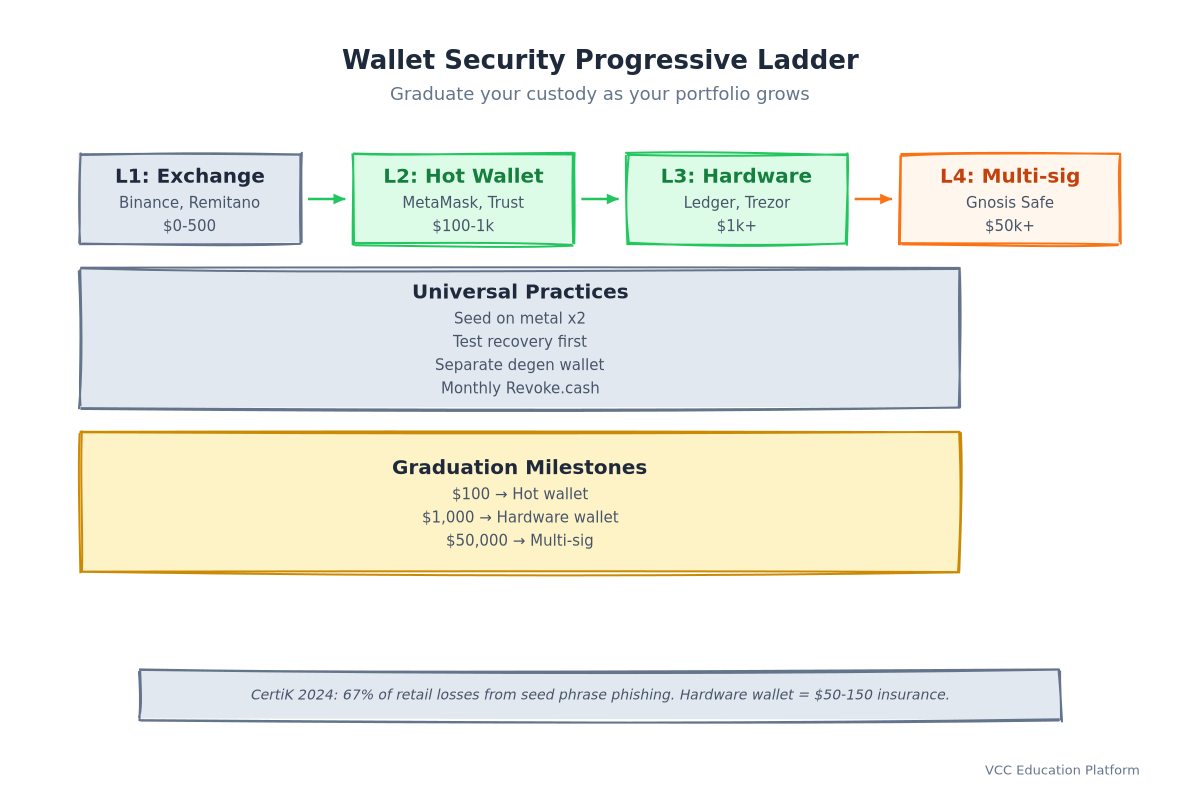
Wallet Selection: The Custody Spectrum
` Custodial Exchange → Hot Wallet (Mobile/Browser) → Hardware Wallet (CeFi) (Non-custodial) (Cold Storage) Low Control Full Control Maximum Control High Convenience Medium Convenience Low Convenience Counterparty Risk User Error Risk Physical Risk `
For your first $100-500: A reputable mobile wallet (Trust Wallet, Rainbow, MetaMask Mobile) is the right starting point. It's non-custodial (you hold keys) but convenient enough for daily learning.
Graduation milestone ($1,000+): Hardware wallet (Ledger, Trezor, Keystone). The $50-150 cost is insurance against the 67% of retail losses caused by seed phrase phishing (CertiK 2024).
Never skip: Seed phrase backup. Write 12-24 words on physical paper (metal backup plates are better). Store in two separate physical locations. Never screenshot, never cloud backup, never type into any website.
Network Selection: Start Where Fees Don't Teach Wrong Lessons
Ethereum mainnet is the "settlement layer" — secure, decentralized, expensive. For learning, it's a terrible classroom. A $5 fee on a $100 trade teaches "DeFi costs too much" instead of "AMMs work this way."
Recommended starting networks (2024):
| Network | Typical Swap Fee | Best For | Bridge Difficulty |
|---|---|---|---|
| Arbitrum | $0.05-0.20 | General DeFi, high liquidity | Easy (native bridge) |
| Optimism | $0.05-0.15 | OP Stack ecosystem, low fees | Easy (native bridge) |
| Base | $0.01-0.10 | Coinbase ecosystem, growing DeFi | Easy (native bridge) |
| Polygon | $0.01-0.05 | High frequency, gaming DeFi | Easy (multiple bridges) |
| BSC | $0.05-0.20 | VN user familiarity, low fees | Moderate |
Vietnam-specific guidance: With average VN retail deposits of $200-500 (Remitano 2024), a $5 Ethereum fee represents 1-2.5% of portfolio. Start on Arbitrum or Base — fees stay under 0.1% per transaction, letting you focus on learning mechanics, not cost optimization.
Gas Fee Budgeting Framework
Adopt this rule: Maximum 1% of transaction value in fees. If you're swapping $100, max fee = $1. On Arbitrum/Base, this is easily achievable. On Ethereum mainnet, it means minimum $100 trade size — which defeats the purpose of learning with small amounts.
Track your "gas budget" like a monthly subscription. $10-20/month in L2 fees buys you dozens of learning transactions.
First Interaction: Token Swapping on a DEX
Your first DeFi transaction should be a simple token swap on a battle-tested DEX. This teaches: wallet connection, transaction signing, slippage, and confirmation — without complex position management.
Step-by-Step: Your First Swap
Prerequisites:
- Wallet installed and funded with ~$50-100 on Arbitrum/Base
- Native token (ETH on Arbitrum/Base) for gas
- Target token (USDC, USDT, or a blue-chip like ARB/OP)
Process:
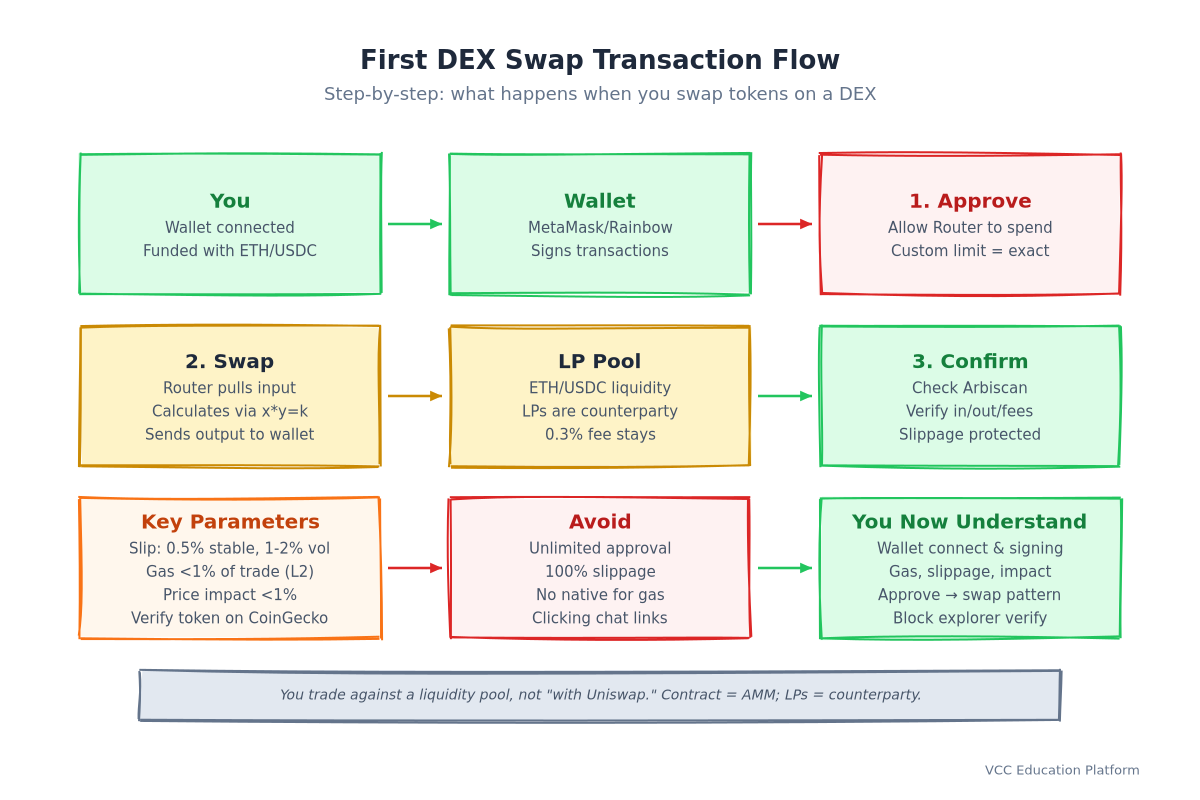
- Visit the official DEX (app.uniswap.org, app.sushiswap.com) — type URL manually, never click chat links
- Connect wallet — click "Connect Wallet," select your wallet, approve connection
- Select tokens — ETH → USDC (stablecoin minimizes price volatility during learning)
- Set slippage tolerance — 0.5% for stablecoin pairs, 1-2% for volatile pairs
- Review the quote — check: input amount, output amount, fee, price impact
- Confirm in wallet — verify destination address, amount, and gas fee before signing
- Wait for confirmation — check transaction on block explorer (Arbiscan, Basescan)
Understanding What Just Happened
- You interacted with a smart contract — the Router contract executed your swap
- Liquidity came from an LP pool — other users provided the USDC you received
- You paid: swap fee (0.3% typically) + gas fee (network) + price impact (your trade size vs pool depth)
- Slippage protection — your 0.5% tolerance meant the trade would revert if price moved >0.5% against you
Key insight: You didn't "trade with Uniswap." You traded against a liquidity pool using Uniswap's smart contract as the automated market maker. The protocol took a fee; LPs provided the counterparty.
Common First-Swap Mistakes
| Mistake | Consequence | Prevention |
|---|---|---|
| Wrong token address (scam token) | Funds lost to honeypot | Verify token on CoinGecko/CoinMarketCap, check contract address |
| 100% slippage (default on some UIs) | Sandwich attack, terrible fill | Always set 0.5-2% manually |
| Insufficient native token for gas | Transaction fails, gas still deducted | Keep 0.005-0.01 ETH equivalent for gas |
| Approving unlimited token spend | Future exploit risk | Use "Custom Spend Limit" = exact swap amount |
Leveling Up: Liquidity Provision & Yield Basics
After 5-10 successful swaps across different pairs, you understand: wallet connection, signing, gas, slippage, confirmation. Now you're ready to provide liquidity instead of just consuming it.
The LP Mental Model
When you provide liquidity to an AMM pool (e.g., ETH/USDC on Uniswap v3), you become the counterparty for other traders. You earn: swap fees (0.05-1% per trade) + potential incentives (protocol tokens).
But you take on: impermanent loss (IL) — the difference between holding tokens vs LPing them.
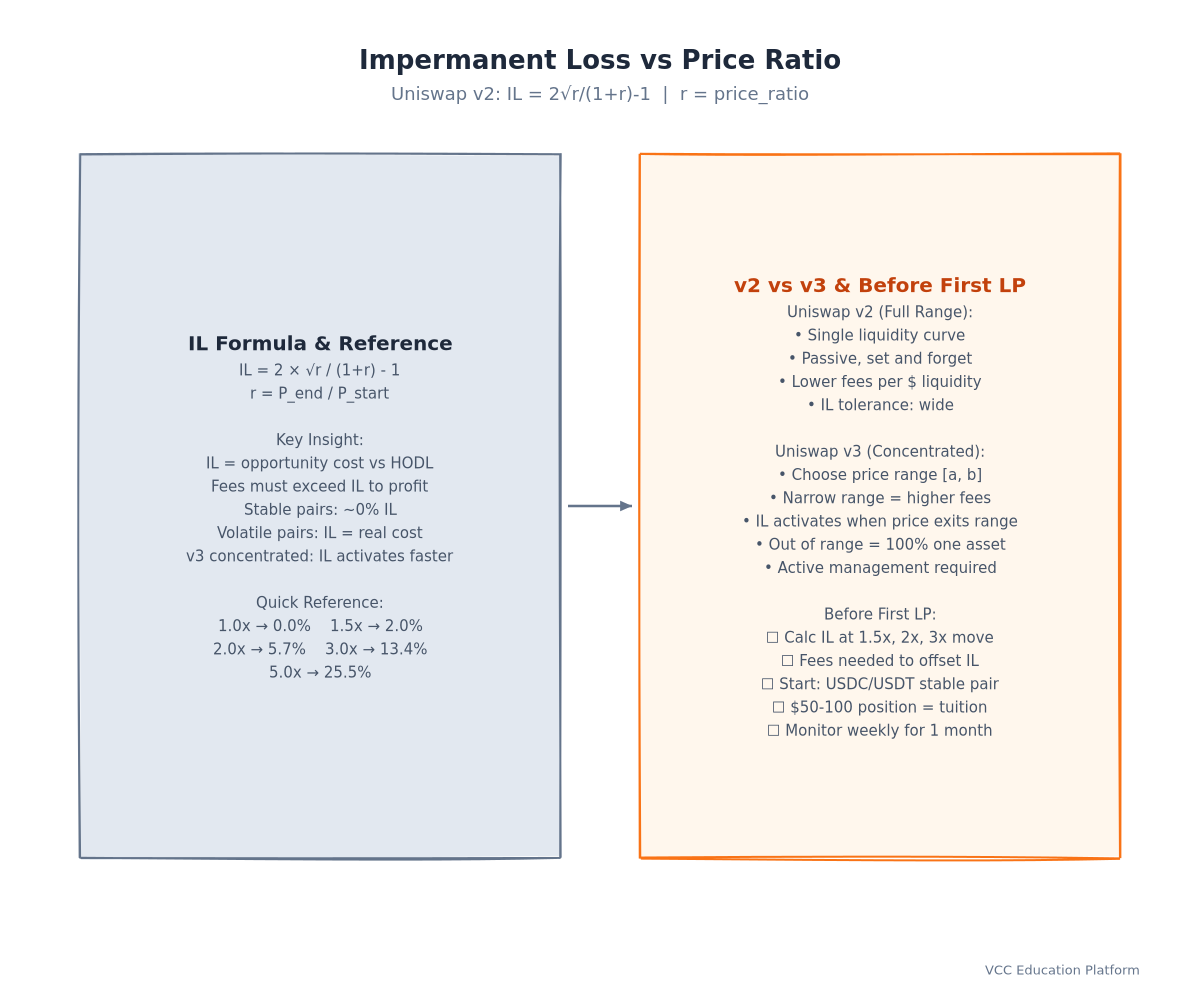
Impermanent Loss: The Concept Every LP Must Grasp
Simple version: If ETH doubles vs USDC, your LP position is worth less than if you'd just held the tokens. The "loss" is impermanent only if prices return to your entry ratio.
Formula (Uniswap v2, constant product): ` IL = 2 * sqrt(price_ratio) / (1 + price_ratio) - 1 `
| Price Change | Impermanent Loss |
|---|---|
| 1.25x | 0.6% |
| 1.5x | 2.0% |
| 2x | 5.7% |
| 3x | 13.4% |
| 5x | 25.5% |
Uniswap v3 concentrated liquidity changes this — you choose a price range. Narrow range = higher fees but IL activates faster if price leaves your range. Wide range = lower fees, more IL tolerance.
Your First LP Position: Conservative Approach
- Start with stablecoin pair (USDC/USDT, USDT/DAI) — near-zero IL, ~0.01-0.05% fees
- Use wide range or full range on v3 — behaves like v2, easier to understand
- Small position — $50-100, treat as tuition
- Monitor weekly — track fees earned vs IL, understand the math
Graduation to volatile pairs: Only after you can explain IL to a friend and calculate it for a given price move.
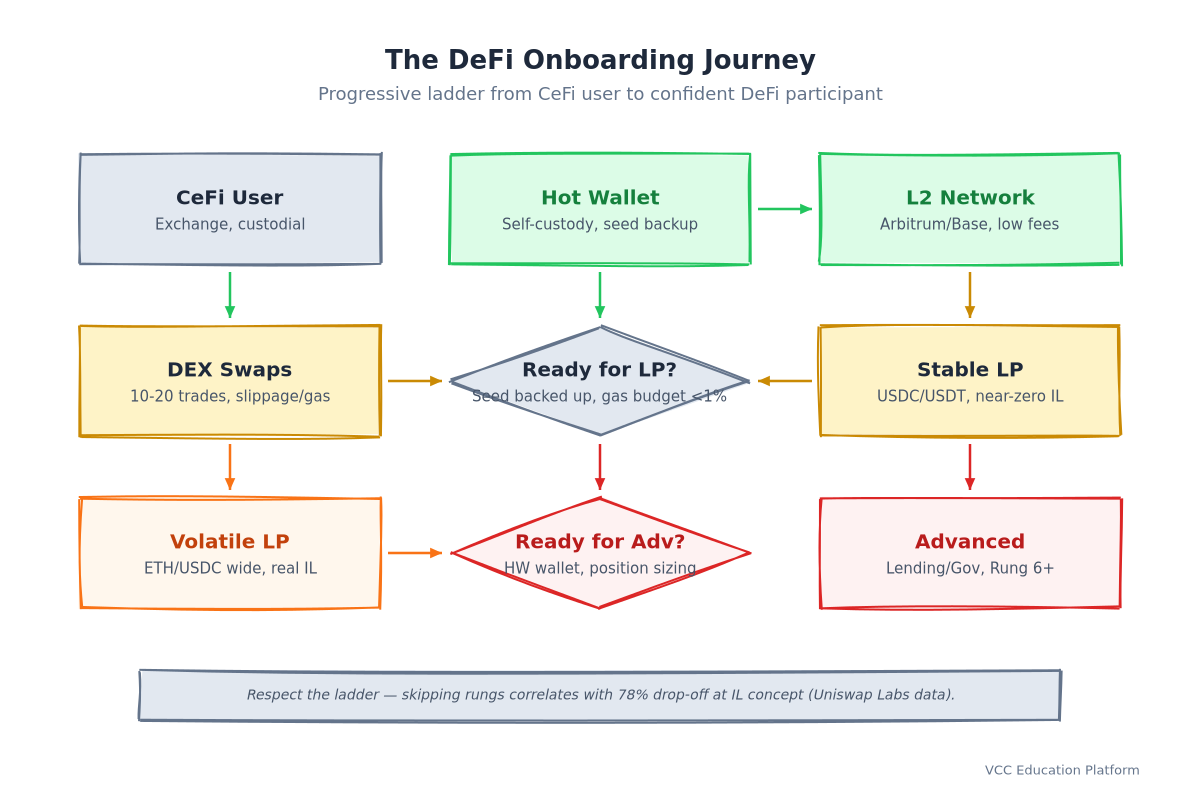
The Progressive Complexity Ladder
Don't climb the whole ladder at once. Each rung requires demonstrated competence at the previous level.
` Rung 0: Custodial Exchange (CeFi) → Buy first crypto, learn basics Rung 1: Hot Wallet + L2 Network → Self-custody, send/receive, gas mechanics Rung 2: DEX Swaps → Trading, slippage, price impact, approvals Rung 3: Stablecoin LP → Yield, fees, position management, IL basics Rung 4: Blue-chip Volatile LP (ETH/USDC wide range) → Real IL experience Rung 5: Concentrated LP (v3 narrow range) → Active management, range orders Rung 6: Lending/Borrowing (Aave, Morpho) → Collateral, liquidation risk, health factor Rung 7: Leverage/Looping → Amplified risk, degen territory Rung 8: Governance/DAO → Protocol ownership, voting, delegation Rung 9: Multi-chain/Bridging → Cross-chain capital efficiency Rung 10: Advanced Strategies → Options, perp DEX, structured products `
Time estimates (part-time learner):
- Rungs 0-2: 2-4 weeks
- Rungs 3-4: 1-2 months
- Rungs 5-6: 3-6 months
- Rungs 7+: Years, or never needed
The Vietnam reality check: Most VN users jump from Rung 0 → Rung 4 (yield farming) in weeks, skipping safety fundamentals. This correlates with the 78% drop-off rate at IL concept (Uniswap Labs data). Respect the ladder.
Risk Framework: Protecting Yourself from Day One
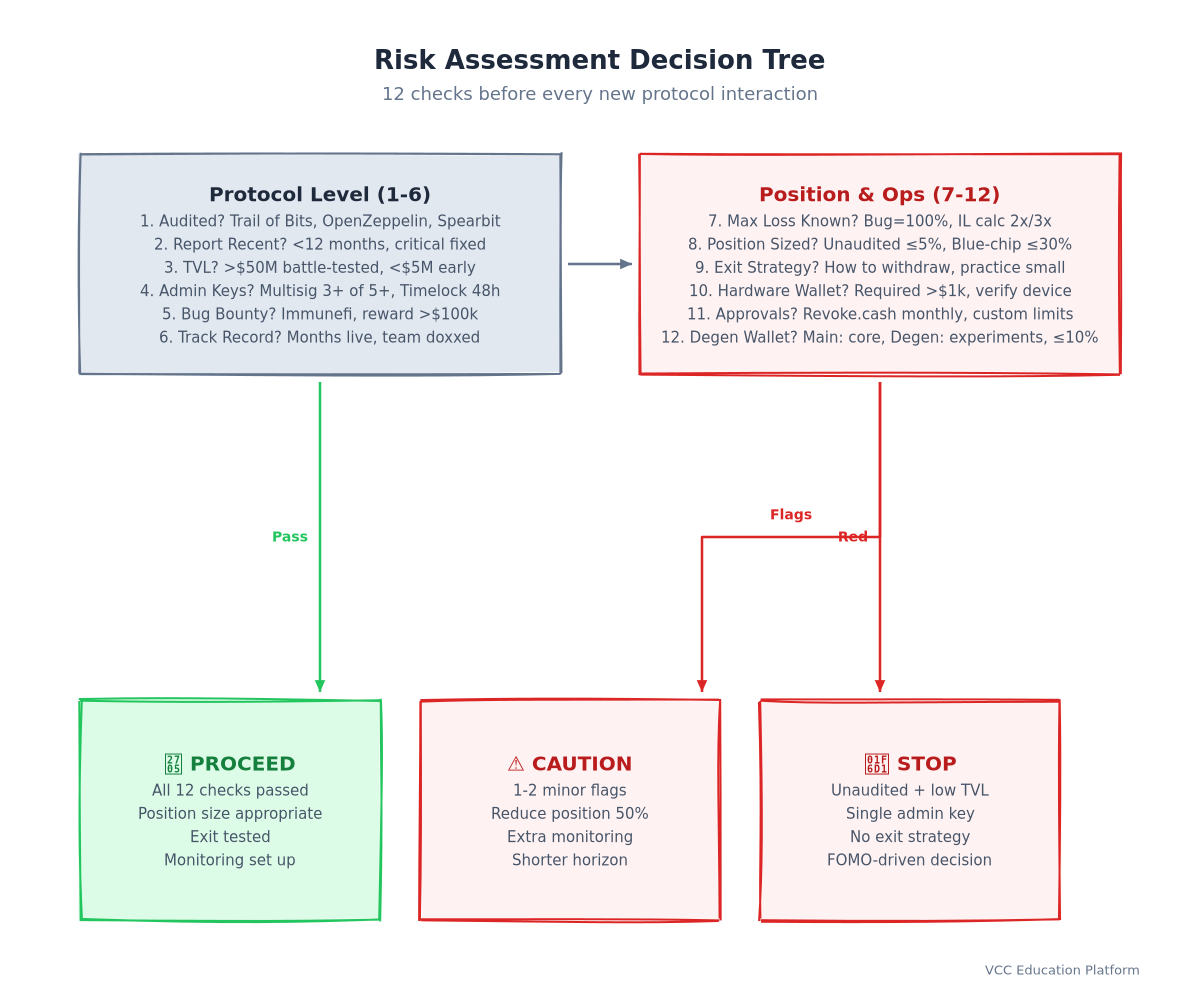
DeFi risk isn't binary (safe/unsafe). It's a spectrum you learn to navigate. Build this mental checklist before every new protocol interaction.
The "Before You Ape" Checklist
Protocol Level:
- [ ] Audited by reputable firm (Trail of Bits, OpenZeppelin, Spearbit, Sigma Prime)?
- [ ] Audit reports public and recent (<12 months)?
- [ ] TVL > $50M (battle-tested) or < $5M (early, higher risk)?
- [ ] Admin keys: multisig? timelock? upgradable contracts?
- [ ] Bug bounty program active (Immunefi, HackenProof)?
Position Level:
- [ ] Maximum loss scenario understood? (IL, liquidation, smart contract bug)
- [ ] Position size ≤ 5% of DeFi portfolio for unaudited/early protocols?
- [ ] Exit strategy defined? (how to withdraw, unbonding periods, cooldowns)
- [ ] Monitoring set up? (DeBank, Zapper, protocol dashboard, alerts)
Operational Level:
- [ ] Using hardware wallet for positions >$1,000?
- [ ] Revoke.cash approvals reviewed monthly?
- [ ] Separate "degen wallet" for high-risk experiments?
- [ ] Seed phrase backed up on metal, tested recovery?
The Vietnam Scam Playbook
VN users face localized attack vectors:
- Fake Support on Zalo/Telegram: "Admin từ [Protocol] hỗ trợ bạn" → asks for seed phrase / screen share / "verification transaction"
- Defense: No legitimate protocol ever asks for seed phrase. Verify via official website → Discord → verified admin role.
- Fake Token Airdrops: "Claim $ARB/$OP/$ARB airdrop" → malicious contract approval → wallet drain
- Defense: Check official Twitter/website for announcements. Use Revoke.cash before claiming.
- P2P Exchange Scams: "Buy USDT cheap" → send VND, receive fake USDT / locked funds / police report
- Defense: Only use escrow P2P (Remitano, Binance P2P). Never direct bank transfer to stranger.
- YouTube/TikTok "Strategies": "Copy this 1000% APY strategy" → hidden rug pull / honeypot / approval exploit
- Defense: If it sounds too good, it's a trap. Verify contract on etherscan/arbiscan — check "Contract" tab for verified source code.
Multi-Chain Reality: Choosing Your Starting Network
"Which chain should I start on?" is the new "which wallet?" The answer depends on your capital, goals, and risk tolerance.
Decision Framework
` Capital < $500 + Learning Focus → Arbitrum or Base Capital $500-5,000 + Yield Focus → Arbitrum + Polygon (diversify) Capital > $5,000 + Long-term → Ethereum mainnet (security) + L2s (activity) Vietnam User + VND Thinking → Base (Coinbase brand trust) or Arbitrum (ecosystem depth) `
Don't bridge until: You've done 20+ transactions on source chain, understand gas on both sides, and can explain bridge risk vectors (finality, validator sets, upgradeability).
Bridge safety: Use canonical bridges (Arbitrum Bridge, Optimism Gateway, Base Bridge) for first bridges. Third-party bridges (LayerZero, Wormhole, Synapse) add smart contract risk — appropriate for Rung 9+.
Common Pitfalls & How to Avoid Them
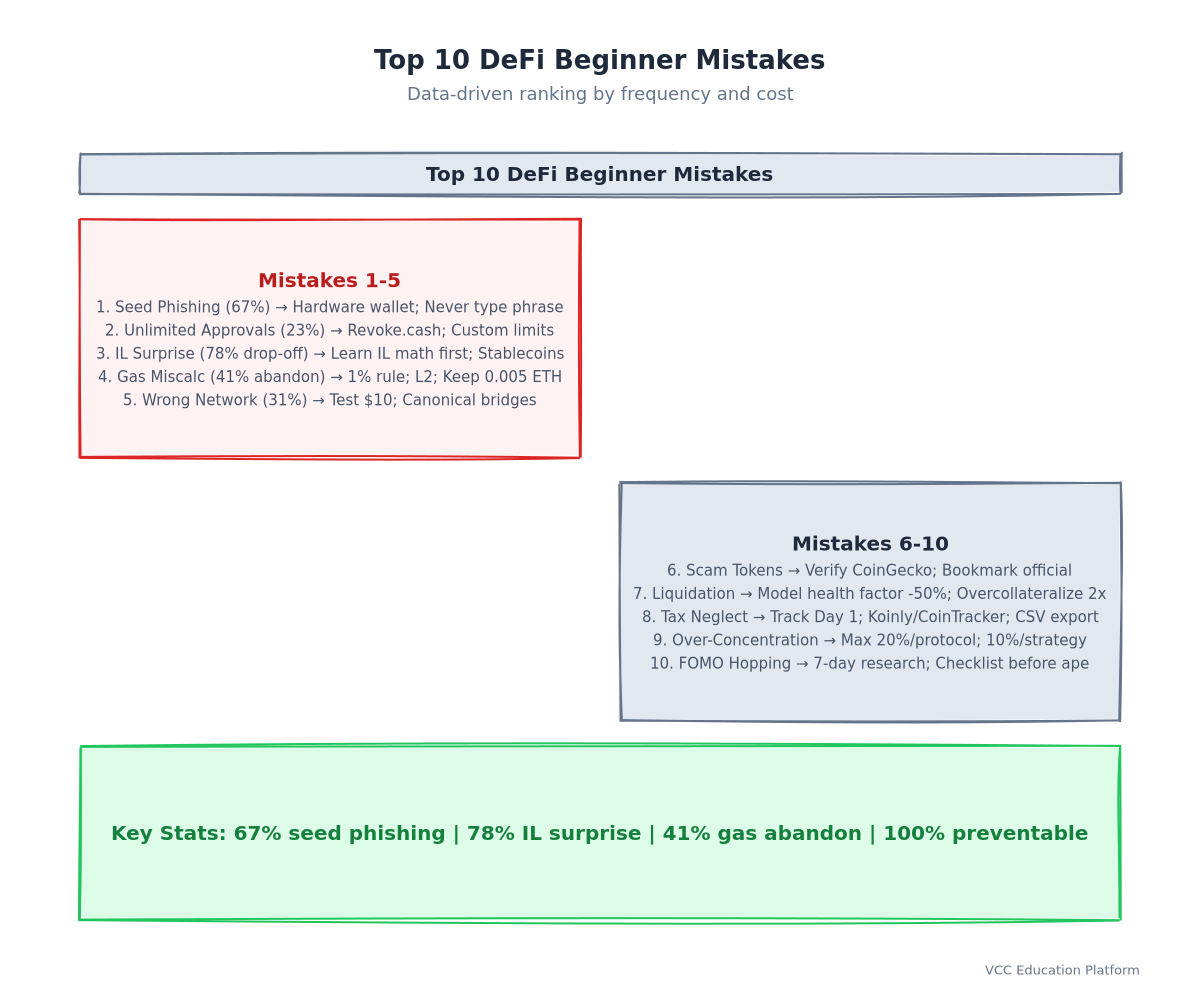
| # | Pitfall | Frequency | Cost | Prevention |
|---|---|---|---|---|
| 1 | Seed phrase phishing | 67% of losses | 100% funds | Hardware wallet, never type phrase anywhere |
| 2 | Unlimited approvals | 23% of exploits | Partial/total | Use Revoke.cash, set custom spend limits |
| 3 | Impermanent loss surprise | 78% LP drop-off | 5-25% principal | Learn IL math before first LP |
| 4 | Gas fee miscalculation | 41% first-tx abandon | Failed tx + lost gas | Gas budget framework (1% rule) |
| 5 | Wrong network/bridge | 31% bridge losses | 100% bridged funds | Test with $10, verify addresses |
| 6 | Scam token purchase | Rising | 100% invested | Verify on CoinGecko, check contract |
| 7 | Liquidation misunderstanding | High in lending | 10-50% collateral | Model health factor at -50% price |
| 8 | Tax/record keeping neglect | Universal | Legal/financial | Track from day one (Koinly, CoinTracker) |
| 9 | Over-concentration | Common | Portfolio blowup | Max 20% per protocol, 10% per strategy |
| 10 | FOMO-driven protocol hopping | Very common | Fees + bad timing | 7-day research rule before new protocol |
Tools & Resources for Continued Growth
Analytics & Portfolio Tracking
- DeBank / Zapper / Zerion — Multi-chain portfolio dashboard
- DeFiLlama — Protocol TVL, yields, comparisons
- APY.Vision / Beefy — LP position analytics, IL tracking
Safety & Security
- Revoke.cash — Review and revoke token approvals
- Rabby Wallet — Transaction simulation, shows exactly what you're signing
- Pocket Universe / Wallet Guard — Browser extension, simulates tx outcome
Education & Community
- Bankless Academy / DeFi Pulse — Structured curricula
- Ethereum Vietnam / Cardano Vietnam / DeFi Vietnam — Local communities (Discord/Telegram)
- Coin98 Insights / Kyber Network Blog — VN-market relevant analysis
Vietnam-Specific On-Ramps
- Remitano — P2P VND/USDT, escrow protection
- Binance (Global) — VND trading pairs via P2P
- Coinhako — SG-regulated, VND on-ramp
- Bvnex — VN exchange, local support
FAQ
Q: What is the safest way to start with DeFi? A: Start on a low-fee L2 (Arbitrum/Base) with $50-100 in a mobile wallet. Do 10-20 swaps on Uniswap/Sushi. Only then consider LPing. Hardware wallet at $1,000+ portfolio.
Q: How much money do I need to start DeFi? A: $50-100 on Arbitrum/Base covers dozens of learning transactions. Ethereum mainnet requires $500+ for reasonable fee/transaction ratios.
Q: Which wallet should I use for DeFi? A: MetaMask (browser), Rainbow (iOS), Trust Wallet (mobile), Rabby (security-focused). All support Arbitrum/Base. Hardware wallet (Ledger/Trezor) for $1,000+.
Q: What are gas fees and how do they work? A: Network fees paid to validators for computation. On L2s: $0.01-0.50. On Ethereum: $2-50+. Always keep native token (ETH) for gas.
Q: How do I know if a DeFi protocol is safe? A: Check audits (reputable firm, <12 months), TVL (>$50M for conservative), admin keys (multisig + timelock), bug bounty. Never 100% safe — only risk-managed.
Q: Can I lose all my money in DeFi? A: Yes. Smart contract bugs, admin key compromise, oracle manipulation, user error (phishing, wrong address), bridge hacks. Never invest more than you can lose.
Q: What's the difference between CeFi and DeFi onboarding? A: CeFi = custodial, KYC, support, reversible errors. DeFi = non-custodial, permissionless, irreversible, self-responsibility. CeFi onboards like a bank; DeFi onboards like handing you a vault key.
Summary: Your 30-Day DeFi Onboarding Plan
Week 1: Set up mobile wallet, fund $50 on Arbitrum via exchange withdrawal. 10 swaps on Uniswap (ETH↔USDC, ETH↔ARB). Track gas, confirmations, block explorer.
Week 2: Add $50. Provide liquidity to USDC/USDT pool (stable pair). Monitor fees daily. Read Uniswap v3 docs on concentrated liquidity.
Week 3: Add $100. Wide-range ETH/USDC LP position. Calculate IL at various price points. Compare returns vs holding.
Week 4: Research Aave on Arbitrum. Supply $50 USDC, borrow $25 USDC. Monitor health factor. Understand liquidation threshold.
Ongoing: Monthly Revoke.cash audit. Quarterly hardware wallet consideration. Join one VN DeFi community. Never stop learning — the protocol you use today may not exist in two years, but the security habits last forever.
Disclaimer: This article is educational content, not financial advice. DeFi carries substantial risk including total loss of principal. Always do your own research (DYOR) and consider consulting a financial advisor.