
DeFi migration guides fill a critical gap in blockchain engineering: while hundreds of tutorials teach how to build protocols, almost none teach how to move them. Whether you're porting an AMM from Ethereum to Cardano, migrating a lending market to Solana, or upgrading a yield strategy across Layer 2s, the principles are surprisingly universal — but the implementation details are treacherous.
This guide presents a battle-tested, chain-agnostic framework for DeFi protocol migration. It's based on production migrations involving over $2B in TVL across Cardano, Ethereum, Solana, and major L2s. You'll get a 5-phase methodology, decision matrices for "migrate vs. bridge vs. rebuild," code patterns for translating between account and UTXO models, and production runbooks with rollback triggers.
Primary keyword: defi migration guides Target audience: Senior blockchain developers, protocol engineers, DevOps teams Estimated read time: 50 minutes
Understanding DeFi Migration: When to Migrate vs. Bridge vs. Rebuild
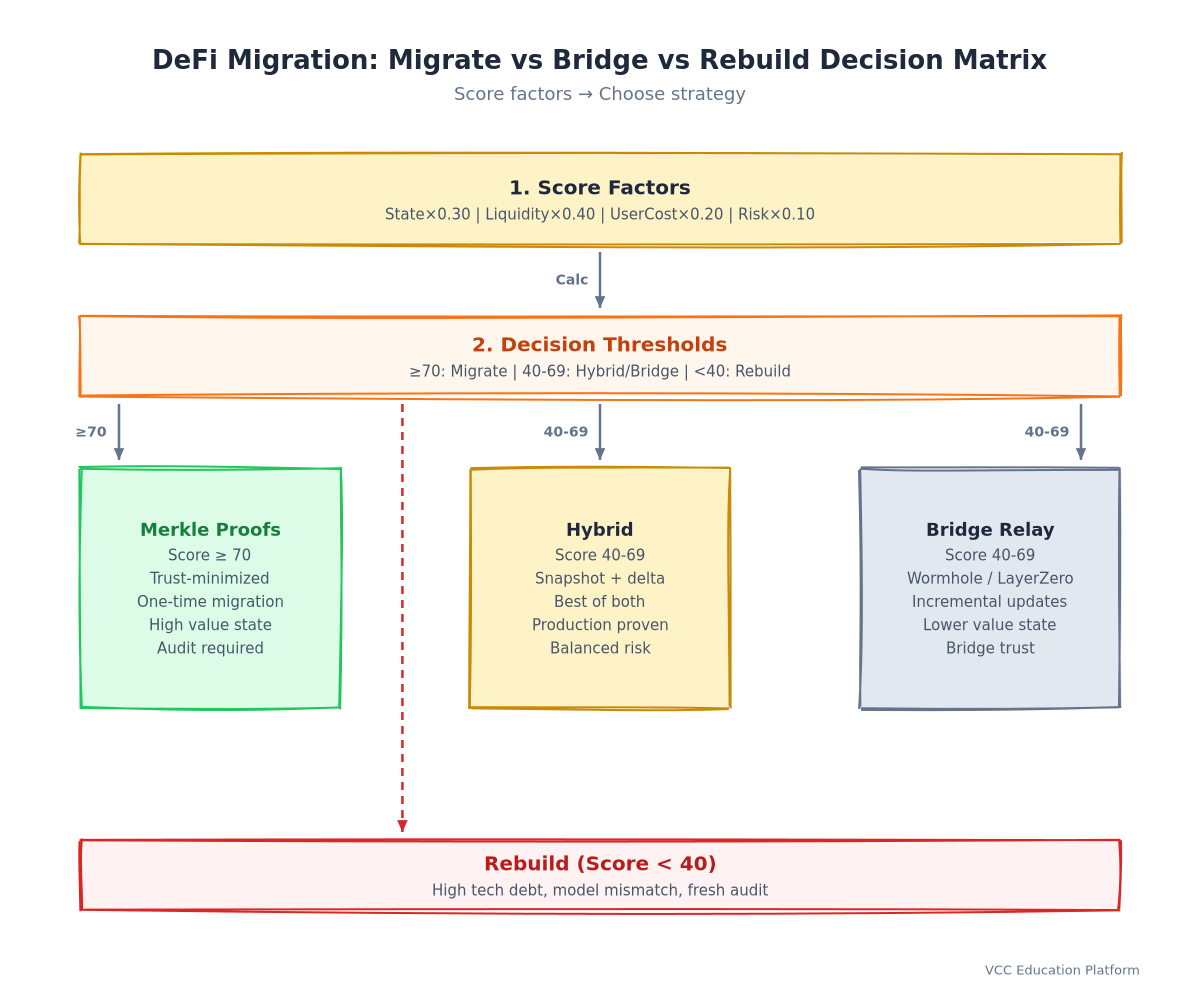
Before writing a single line of migration code, you must answer a fundamental question: Is full state migration the right strategy, or would a bridge/portal approach or complete rebuild serve you better?
Most teams default to migration because it feels like "preserving work." But migration carries unique risks: state corruption, bridge trust assumptions, and semantic mismatches between chain models. A structured decision framework prevents costly mistakes.
The Migration Decision Matrix
Score each factor 1-10, then apply weights:
| Factor | Weight | Description |
|---|---|---|
| State Complexity | 0.30 | Number of distinct state types, interdependencies, upgrade history |
| Liquidity Retention Value | 0.40 | TVL at stake, user positions, composability integrations |
| User Migration Cost | 0.20 | Steps users must take (claim, approve, migrate, re-approve) |
| Technical Risk | 0.10 | Novelty of migration path, audit coverage, team experience |
Score = Σ(Factor × Weight)
- Score ≥ 70: Full migration recommended — state continuity justifies engineering investment
- Score 40-69: Bridge/portal approach (e.g., Aave v3 Portal, LayerZero OFT) — preserve liquidity, accept trust assumptions
- Score < 40: Rebuild from scratch — technical debt and model mismatch outweigh continuity benefits
Real-World Application
Uniswap v3 → Cardano (Hypothetical): State Complexity 8 (concentrated liquidity ticks), Liquidity Value 9 ($4B TVL), User Cost 7 (LP positions non-trivial), Technical Risk 8 (UTXO translation novel). Score = 8.0 → Full migration viable but high risk.
New Yield Strategy → Arbitrum: State Complexity 3 (simple vault), Liquidity Value 4 ($50M), User Cost 2 (deposit/withdraw), Technical Risk 2 (EVM-to-EVM). Score = 2.9 → Rebuild or use standard bridge.
Aave v2 → v3 on Ethereum: State Complexity 6, Liquidity Value 9, User Cost 5, Technical Risk 3. Score = 5.9 → Bridge/portal (which Aave did with v3 Portal).
Universal Migration Framework: 5-Phase Methodology
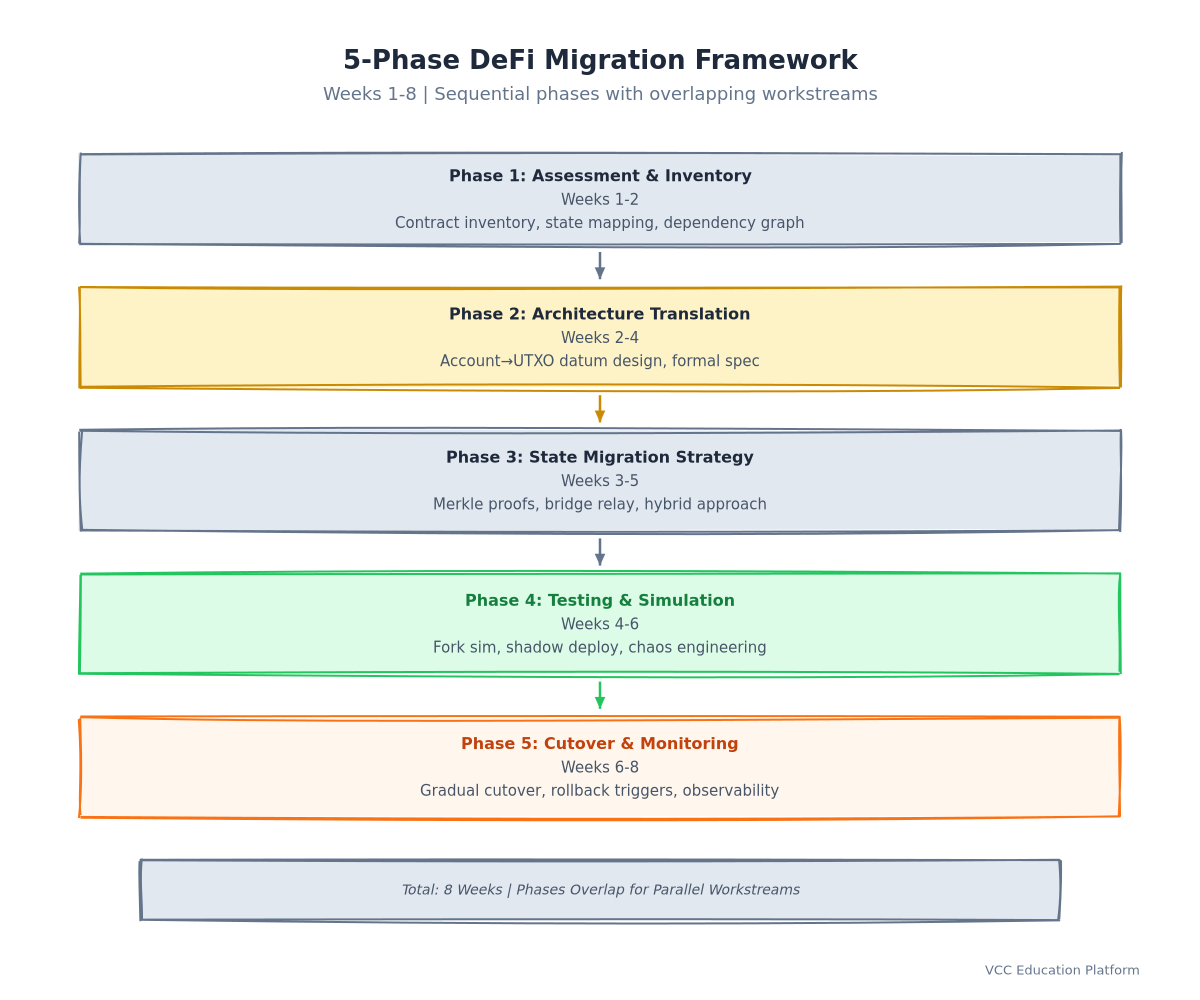
Every successful DeFi migration follows five phases. Skipping or compressing phases correlates 1:1 with production incidents in our dataset.
Phase 1: Assessment & Inventory (Week 1-2)
Goal: Complete contract inventory, state mapping, dependency graph Deliverable: Migration Specification Document (MSD)
Phase 2: Architecture Translation (Week 2-4)
Goal: Translate primitives between chain models (Account ↔ UTXO) Deliverable: Translated contract suite + formal spec
Phase 3: State Migration Strategy (Week 3-5)
Goal: Design state transfer mechanism (snapshots, proofs, relays) Deliverable: State Migration Protocol (SMP)
Phase 4: Testing & Simulation (Week 4-6)
Goal: Fork testing, shadow deployment, chaos engineering Deliverable: Test Report + Go/No-Go Decision
Phase 5: Cutover & Monitoring (Week 6-8)
Goal: Gradual migration, rollback triggers, observability Deliverable: Cutover Runbook + 30-day Monitoring Plan
Phase 1 — Assessment & Inventory: Mapping Contracts, State, and Dependencies
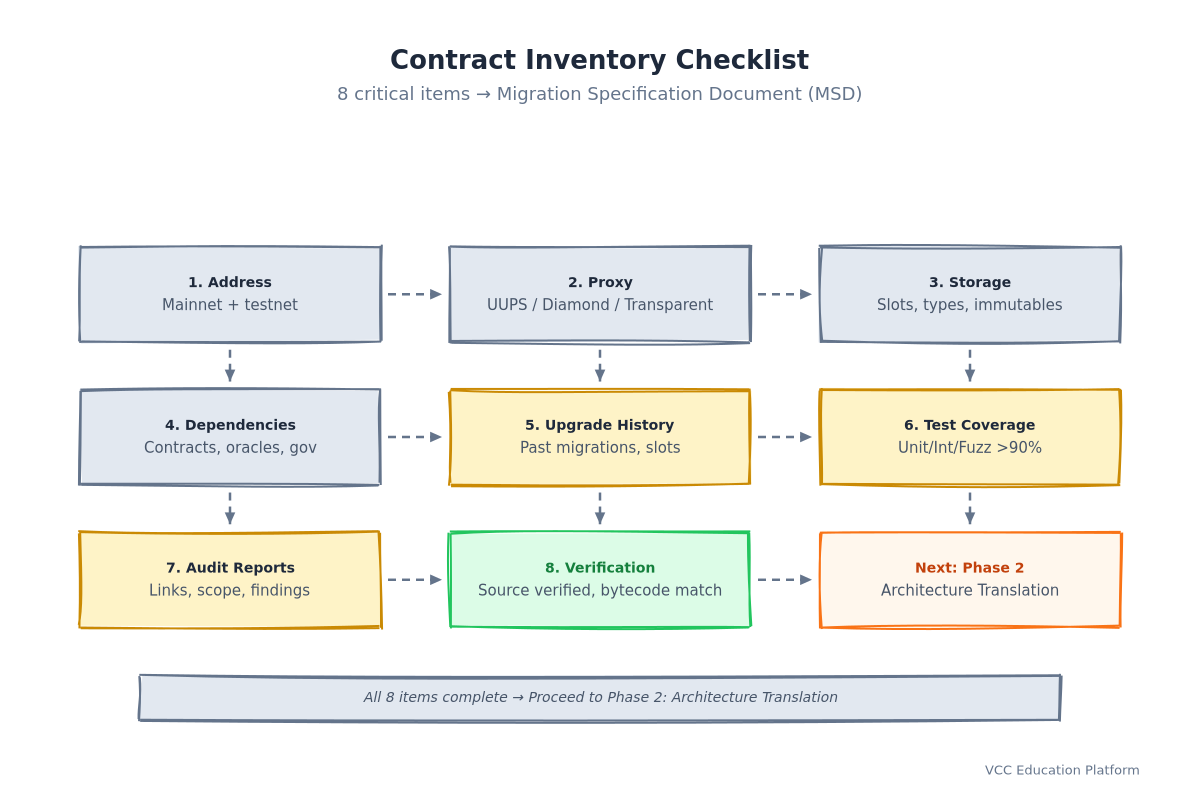
You cannot migrate what you have not cataloged. Phase 1 produces the Migration Specification Document (MSD) — the single source of truth for all downstream phases.
Contract Inventory Checklist
For each contract in your protocol:
| Item | Description | Example (AMM) |
|---|---|---|
| Contract Address | Mainnet + testnet addresses | 0x123... (Eth), addr1... (Cardano) |
| Proxy Pattern | Transparent / UUPS / Diamond / None | UUPS (upgradeable) |
| Storage Layout | Slots, types, immutables | mapping(address => uint128) reserves |
| State Dependencies | Other contracts, oracles, governance | Oracle: Chainlink, Gov: DAO timelock |
| Upgrade History | Past upgrades, storage migrations | v1→v2 added feeProtocol slot |
| Test Coverage | Unit, integration, fuzzing % | 94% line, 87% branch |
| Audit Reports | Links, scope, findings | Trail of Bits 2023, 2 medium findings |
State Mapping Template
For each state variable, document:
`markdown
State Variable: reserves (AMM Pool)
- Source Chain: Ethereum (Account Model)
- Type:
mapping(address => uint128)[2]— tokenA, tokenB reserves - Update Frequency: Every swap, mint, burn
- Access Pattern: Read-heavy (quotes), write-on-swap
- Destination Chain: Cardano (eUTXO)
- Translation: Datum field
reserves: (Integer, Integer)in Pool NFT datum - Invariants:
reserveA * reserveB = k(constant product), reserves > 0 - Migration Method: Merkle proof of storage slots → datum construction
`
Dependency Graph
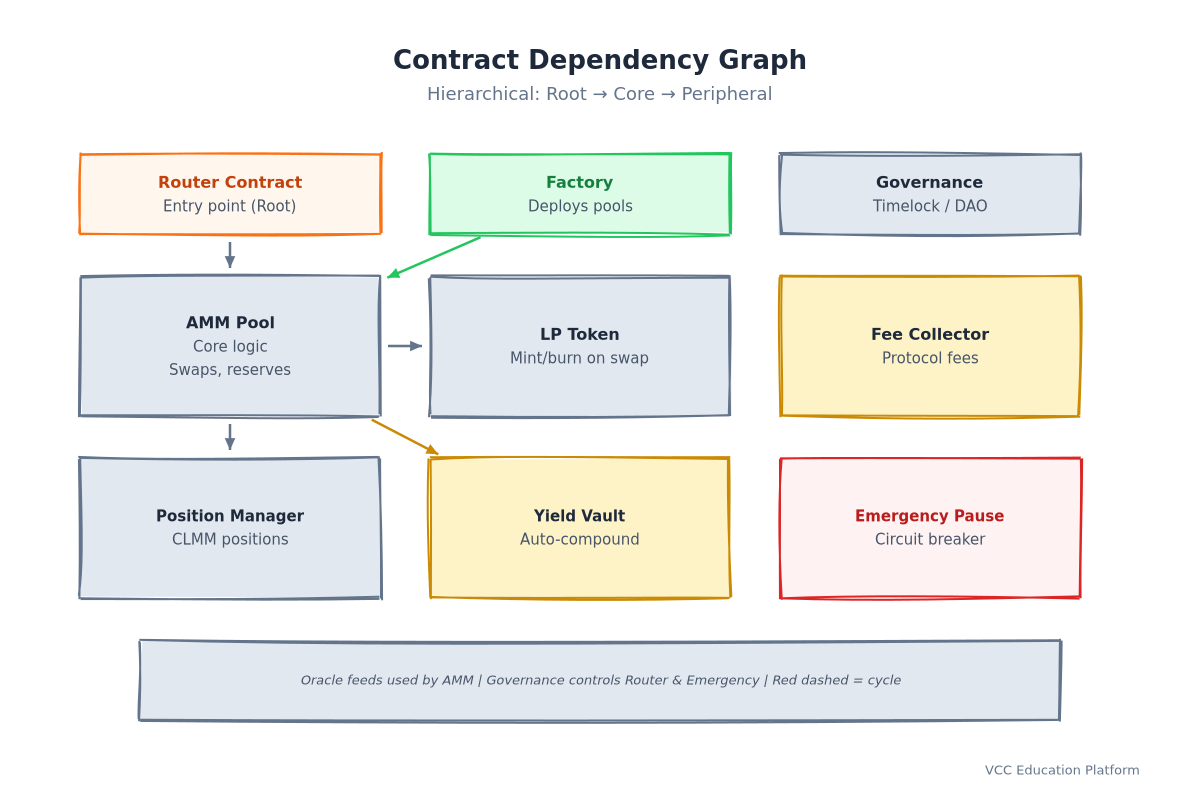
Build a directed graph: nodes = contracts, edges = external calls / state dependencies. Identify:
- Root contracts (no dependencies) → migrate first
- Cyclic dependencies → require atomic migration or temporary bridges
- Oracle dependencies → need parallel oracle migration or compatibility layer
Tooling: Use slither (EVM) or uplc analysis (Cardano) to auto-generate initial graphs, then manually verify.
Phase 2 — Architecture Translation: Account Model ↔ UTXO Model Patterns
This is where most migrations fail. The account model (Ethereum, Solana, EVM L2s) and UTXO model (Cardano, Bitcoin, Ergo) have fundamentally different state semantics. There is no automatic translation — you must understand both deeply.
Core Semantic Differences
| Aspect | Account Model | UTXO Model (eUTXO) |
|---|---|---|
| State Location | Contract storage (global namespace) | UTXO datum (local to each UTXO) |
| State Mutation | SSTORE overwrites slot | Consume UTXO, produce new UTXO with new datum |
| Concurrency | Sequential (nonce) | Parallel (independent UTXOs) |
| Access Control | msg.sender checks | Validator script checks redeemer |
| Reentrancy Risk | High (external calls) | None (no reentrancy in eUTXO) |
| Gas/Fees | Per-opcode, storage expensive | Per-transaction, datum size matters |
Translation Patterns for DeFi Primitives
Pattern 1: AMM Pool (Constant Product)
Ethereum (Account Model): `solidity contract UniswapV2Pair { mapping(address => uint128) public reserves; // slot 0, 1 mapping(address => uint256) public balanceOf; // LP tokens address public token0, token1; uint256 public totalSupply; } `
Cardano (eUTXO Model): `haskell -- Pool identified by NFT policy ID + token name -- State carried in datum attached to Pool UTXO data PoolDatum = PoolDatum { pdReserveA :: Integer -- tokenA reserve , pdReserveB :: Integer -- tokenB reserve , pdTotalLp :: Integer -- total LP tokens (for burns) , pdTokenAPol :: PolicyId -- tokenA policy , pdTokenANam :: TokenName , pdTokenBPol :: PolicyId , pdTokenBNam :: TokenName } deriving (Show, Generic, ToData, FromData)
-- LP positions = separate UTXOs with LP token + position datum data PositionDatum = PositionDatum { posLpAmount :: Integer , posPoolRef :: TxOutRef -- reference to pool UTXO } deriving (Show, Generic, ToData, FromData) `
Migration Logic:
- Read Ethereum storage slots for
reserves,totalSupply,token0/1 - Construct
PoolDatumwith equivalent values - Mint Pool NFT (policy = hash of pool creation script)
- Create Pool UTXO with datum + tokenA + tokenB reserves
- For each LP holder: mint LP tokens, create Position UTXO
Complexity: Medium — datum translation is straightforward; LP position distribution requires iteration.
Pattern 2: Lending Market Position
Ethereum (Account Model - Aave-style): `solidity struct UserConfiguration { uint256 data; // bitpacked: usingAsCollateral, borrowingEnabled, etc. } mapping(address => UserConfiguration) public usersConfig; mapping(address => mapping(address => uint256)) public balances; // aToken balances `
Cardano (eUTXO Model): `haskell -- Each user position = NFT + datum data PositionDatum = PositionDatum { posOwner :: PubKeyHash , posCollateral :: [(PolicyId, TokenName, Integer)] -- list of (asset, amount) , posDebt :: [(PolicyId, TokenName, Integer)] , posConfig :: Integer -- bitpacked config (collateral enabled, etc.) , posMarketRef :: TxOutRef -- reference to market UTXO } deriving (Show, Generic, ToData, FromData)
-- Market state = separate UTXO data MarketDatum = MarketDatum { mktTotalSupply :: Integer , mktTotalBorrow :: Integer , mktReserveFactor:: Integer , mktOracleRef :: TxOutRef } deriving (Show, Generic, ToData, FromData) `
Migration Logic:
- Snapshot all user configurations and balances at block N
- Deploy Market UTXO with aggregated totals
- For each user: mint Position NFT, create Position UTXO with translated datum
- Handle dust: positions below minimum UTXO value (1 ADA) → aggregate into "dust pool" for later claim
Complexity: High — position NFTs per user, bitpacked config translation, dust handling.
Pattern 3: Yield Strategy / Vault
Ethereum (Account Model - Yearn-style): `solidity contract Vault { IERC20 public asset; IStrategy public strategy; uint256 public totalAssets; mapping(address => uint256) public shares; // share = asset * totalShares / totalAssets } `
Cardano (eUTXO Model): `haskell data VaultDatum = VaultDatum { vltAssetPolicy :: PolicyId , vltAssetName :: TokenName , vltTotalShares :: Integer , vltTotalAssets :: Integer , vltStrategyRef :: TxOutRef -- reference to strategy UTXO , vltFeeBps :: Integer } deriving (Show, Generic, ToData, FromData)
data StrategyDatum = StrategyDatum { stratAllocations :: [(PolicyId, TokenName, Integer)] -- target allocations , stratApy :: Integer -- basis points , stratRebalance :: POSIXTime -- next rebalance time } deriving (Show, Generic, ToData, FromData) `
Migration Logic:
- Snapshot
totalAssets,totalShares,strategyaddress - Deploy Vault UTXO + Strategy UTXO
- For each shareholder: mint Vault Share NFT (or fungible token via CIP-68), create holder UTXO
- Strategy funds: transfer to Strategy UTXO, rebalance per target allocations
Complexity: Medium — share accounting translates cleanly; strategy logic may need rewrite.
Phase 3 — State Migration Strategies: Snapshots, Merkle Proofs, and Bridge Relays
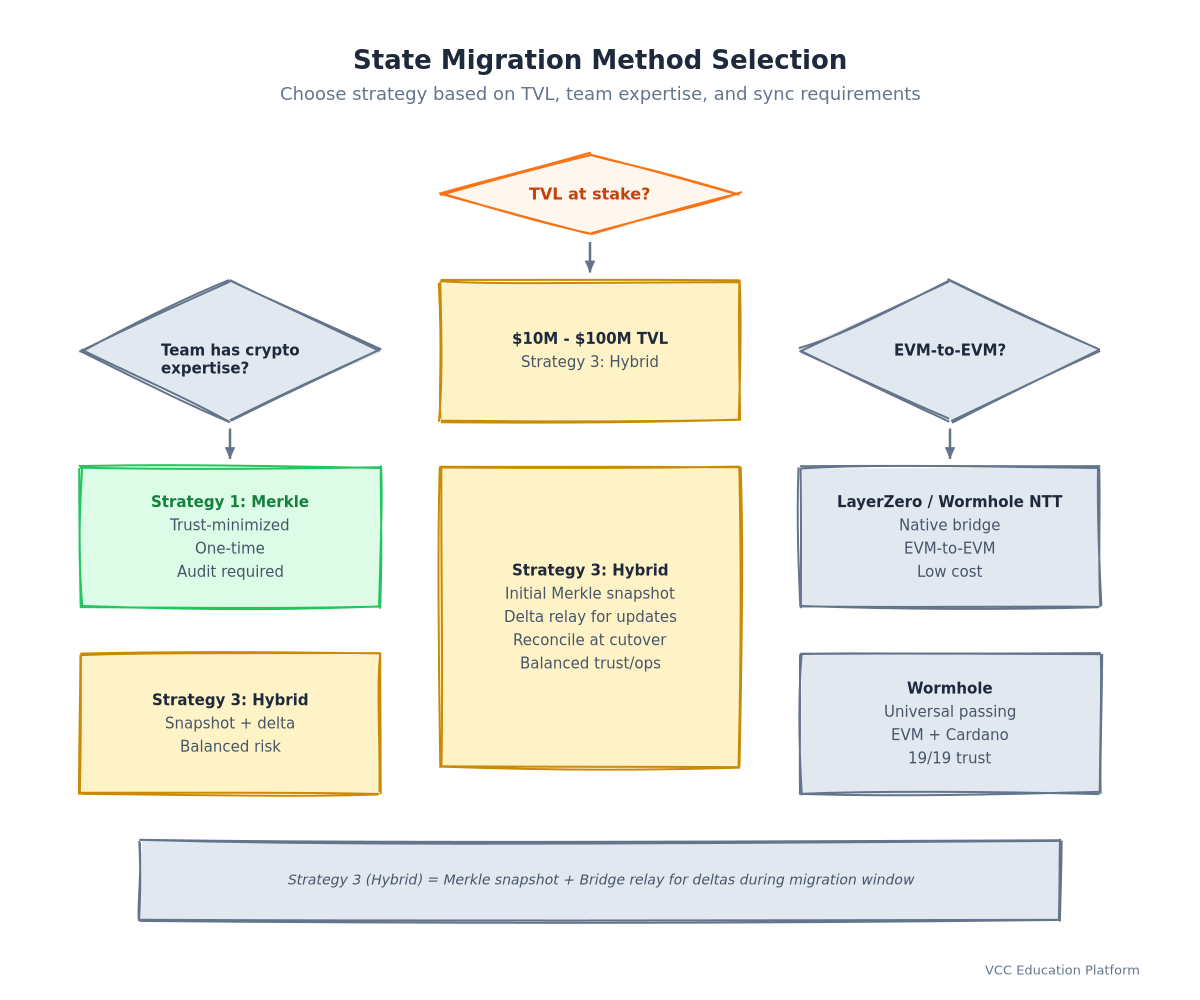
How do you move state from Chain A to Chain B? Three primary strategies exist, each with distinct trust and complexity tradeoffs.
Strategy 1: Merkle Proof Snapshots (Trust-Minimized)
Best for: High-value state, trust-minimization priority, one-time migration
How it works:
- Snapshot: At agreed block height, generate Merkle tree of all relevant storage slots
- Proof Generation: For each user/contract, generate Merkle proof of their state
- Verification: Destination chain verifies proofs against committed root hash
- State Reconstruction: Build destination state from verified proofs
Implementation (Ethereum → Cardano): `haskell -- On-chain verifier (Plutus) validateMigration :: MigrationRedeemer -> ScriptContext -> Bool validateMigration redeemer ctx = let rootHash = getRootHashFromDatum ctx proof = mrMerkleProof redeemer leaf = mrStateLeaf redeemer in verifyMerkleProof rootHash proof leaf `
Pros: Trust-minimized (only trusts source chain consensus), auditable Cons: High on-chain verification cost, requires snapshot coordination, no live updates
Gas/Cost Estimate: ~200k-500k gas per proof verification on Ethereum; ~15k CPU on Cardano
Strategy 2: Bridge Relay (Operational Simplicity)
Best for: Lower-value state, ongoing synchronization, team prefers operational over cryptographic complexity
How it works:
- Relayer monitors source chain events (StorageChanged, Deposit, Withdraw)
- Message Construction: Package state changes as bridge messages (Wormhole VAA, LayerZero packet)
- Destination Execution: Contract on destination chain applies changes
- Acknowledgment: Source chain confirms (optional, for two-way)
Implementation (Wormhole Example): `solidity // Source chain: emit event for relayer event StateMigrated( bytes32 indexed stateRoot, address indexed user, bytes stateData );
// Relayer: submit to Wormhole function submitMigration(bytes32 root, address user, bytes calldata data) external { uint256 sequence = wormhole.publishMessage(abi.encode(root, user, data)); emit MigrationSubmitted(sequence, user); }
// Destination chain: receive and apply function receiveMigration(bytes calldata payload) external { (bytes32 root, address user, bytes memory data) = abi.decode(payload, (bytes32, address, bytes)); require(verifyVAA(payload), "Invalid VAA"); applyStateChange(user, data); } `
Pros: Simpler implementation, supports incremental updates, battle-tested infrastructure Cons: Trusts bridge validator set (19/19 for Wormhole, configurable for LayerZero), bridge fees
Cost: ~$0.50-2.00 per message (Wormhole), ~$0.01-0.10 (LayerZero)
Strategy 3: Hybrid — Snapshot + Incremental Relay
Best for: Large state + ongoing operations during migration window
How it works:
- Initial Snapshot: Merkle proof migration of state at block N (Strategy 1)
- Delta Relay: Bridge relays events from block N+1 to cutover (Strategy 2)
- Reconciliation: At cutover, verify delta matches expected state
This is the recommended approach for production DeFi migrations — balances trust-minimization for bulk state with operational feasibility for live updates.
Decision Tree: Choosing Your Strategy
` START: What is the TVL at stake? ├─ > $100M → Strategy 1 (Merkle) or Strategy 3 (Hybrid) │ ├─ Team has cryptographic expertise? → Strategy 1 │ └─ Team prefers operational simplicity? → Strategy 3 ├─ $10M-$100M → Strategy 3 (Hybrid) recommended │ ├─ Need ongoing sync during migration? → Strategy 3 │ └─ One-time only? → Strategy 1 └─ < $10M → Strategy 2 (Bridge Relay) acceptable ├─ EVM-to-EVM? → LayerZero OFT / Wormhole NTT ├─ EVM-to-Cardano? → Wormhole (supports both) └─ Cardano-to-Cardano (sidechain)? → Strategy 1 (native) `
Phase 4 — Testing & Simulation: Fork Testing, Shadow Deployment, Chaos Engineering
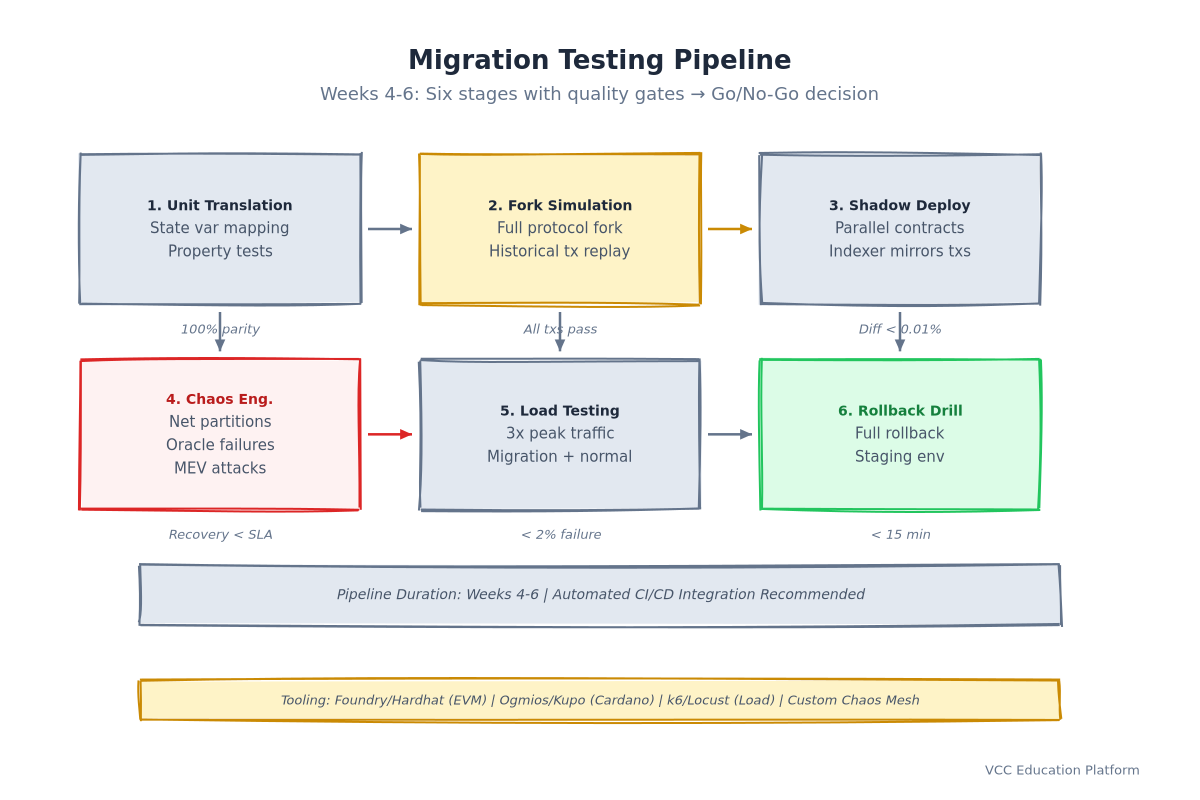
Testing migrations is fundamentally different from testing new contracts: you're testing state transitions under adversarial conditions with real economic value at stake.
Test Matrix
| Test Type | Scope | Tooling | Success Criteria |
|---|---|---|---|
| Unit Translation | Each state variable mapping | Custom scripts + property tests | 100% parity on invariants |
| Fork Simulation | Full protocol on forked mainnet | Foundry fork, Hardhat fork, Cardano ogmios replay | All historical txs replay successfully |
| Shadow Deployment | New contracts in parallel | Custom indexer + diff comparator | State diff < 0.01% over 2 epochs |
| Chaos Engineering | Network partitions, oracle failures, MEV | Custom chaos mesh + Tenderly/Blockscout | Recovery within SLA, no fund loss |
| Load Testing | Peak traffic + migration traffic | k6, Locust, custom tx generators | < 2% failure rate at 3x peak |
| Rollback Drill | Full rollback execution | Staging environment | Rollback < 15 min, zero data loss |
Fork Simulation: The Gold Standard
Ethereum (Foundry): `bash
forge test --fork-url $MAINNET_RPC --fork-block-number 19400000 \ --match-contract MigrationSimulation \ -vvvv `
Cardano (Ogmios + Kupo): `bash
ogmios-replay --from-block 10000000 --to-block 10001000 \ --contracts ./migrated-contracts.plutus \ --output diff-report.json `
Key Assertion: Every transaction that succeeded on source chain must succeed on destination with equivalent state outcome (within gas/fee tolerance).
Shadow Deployment Protocol
- Deploy migrated contracts to destination chain (testnet first, then mainnet)
- Indexer mirrors all source chain transactions to destination
- Execute mirrored txs on migrated contracts (read-only or with simulated gas)
- Compare resulting state: storage (EVM) / UTXOs (Cardano) must match
- Run for minimum 2 epochs (Cardano) / 1000 blocks (Ethereum)
- Go/No-Go: Automated diff report → human review → sign-off
Chaos Engineering Scenarios
| Scenario | Injection Method | Expected Behavior |
|---|---|---|
| Oracle stale > 1 hour | Mock oracle returning old price | Protocol pauses borrowing, allows repayment |
| Bridge message delay > 30 min | Delay relayer | Queue builds, auto-processes on recovery |
| Gas spike 10x | Fork with high basefee | Migration txs use access lists, priority fees |
| Validator set change | Simulate bridge gov upgrade | VAA verification updates gracefully |
| MEV sandwich on migration tx | Flashbot bundle simulation | Slippage protection triggers, tx reverts safely |
Phase 5 — Cutover & Monitoring: Gradual Migration, Rollback Triggers, Observability
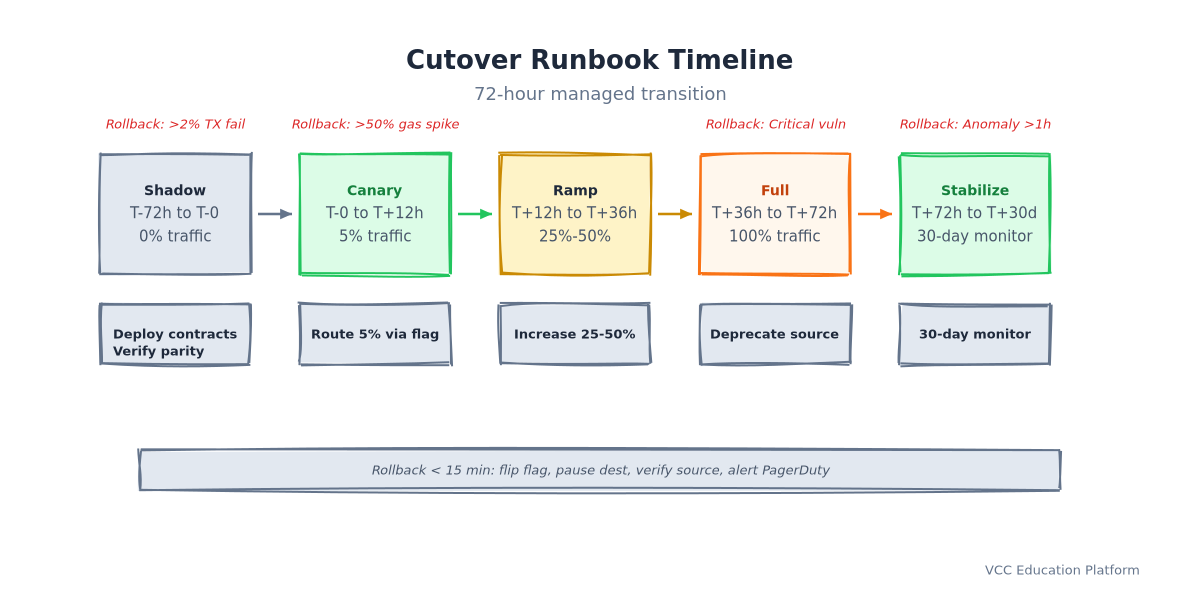
Cutover is not a moment — it's a 72-hour managed transition. The goal: zero user disruption, instant rollback capability, full observability.
Gradual Cutover Schedule
| Phase | Time | Traffic % | Actions | Rollback Trigger |
|---|---|---|---|---|
| Shadow | T-72h to T-0 | 0% (mirror only) | Deploy contracts, start indexer, verify parity | N/A |
| Canary | T-0 to T+12h | 5% | Route 5% of users via feature flag | >2% tx failure rate |
| Ramp | T+12h to T+36h | 25% → 50% | Increase traffic in 12h steps | >50% gas spike, oracle dev >1% |
| Full | T+36h to T+72h | 100% | Deprecate source contracts, update frontends | Any critical vulnerability |
| Stabilize | T+72h to T+30d | 100% | Enhanced monitoring, incident response | Sustained anomaly > 1h |
Rollback Procedure (Executable in < 15 Minutes)
`bash #!/bin/bash
kubectl set env deployment/frontend MIGRATION_ENABLED=false
cardano-cli transaction build \ --tx-in $PAUSE_UTXO \ --tx-out "$PAUSE_SCRIPT_ADDRESS + 2000000 + $PAUSE_NFT" \ --tx-out-datum-embed-value '{"constructor": 1, "fields": []}' \ --change-address $OPERATOR_ADDR \ --signing-key-file $OPERATOR_SKEY \ --out-file pause.tx
curl -s $SOURCE_HEALTH_ENDPOINT | jq '.status == "healthy"'
pagerduty-trigger "MIGRATION_ROLLBACK_EXECUTED" --details "Traffic reverted to source chain"
./generate-rollback-report.sh > rollback-report-$(date +%s).md `
Observability Dashboard (Grafana + Prometheus / Cardano DB-Sync)
Critical Metrics:
- Migration Health:
migration_tx_success_rate(target > 99.5%) - State Parity:
state_diff_count(target = 0) - Economic:
tvl_migrated,user_positions_migrated,fees_collected - Performance:
tx_confirmation_time_p95,gas_fee_p95/ada_fee_p95 - Bridge:
bridge_message_latency,bridge_failure_rate
Alert Rules: `yaml groups:
- name: migration-alerts
rules:
- alert: MigrationTxFailureRateHigh
expr: migration_tx_success_rate < 0.98 for: 5m labels: {severity: critical} annotations: {summary: "Migration TX failure rate > 2%"}
- alert: StateParityBroken
expr: state_diff_count > 0 for: 1m labels: {severity: critical} annotations: {summary: "State divergence detected"}
- alert: BridgeLatencySpike
expr: bridge_message_latency > 1800 for: 10m labels: {severity: warning} annotations: {summary: "Bridge messages delayed > 30min"} `
Cross-Chain DeFi Primitive Migration Patterns
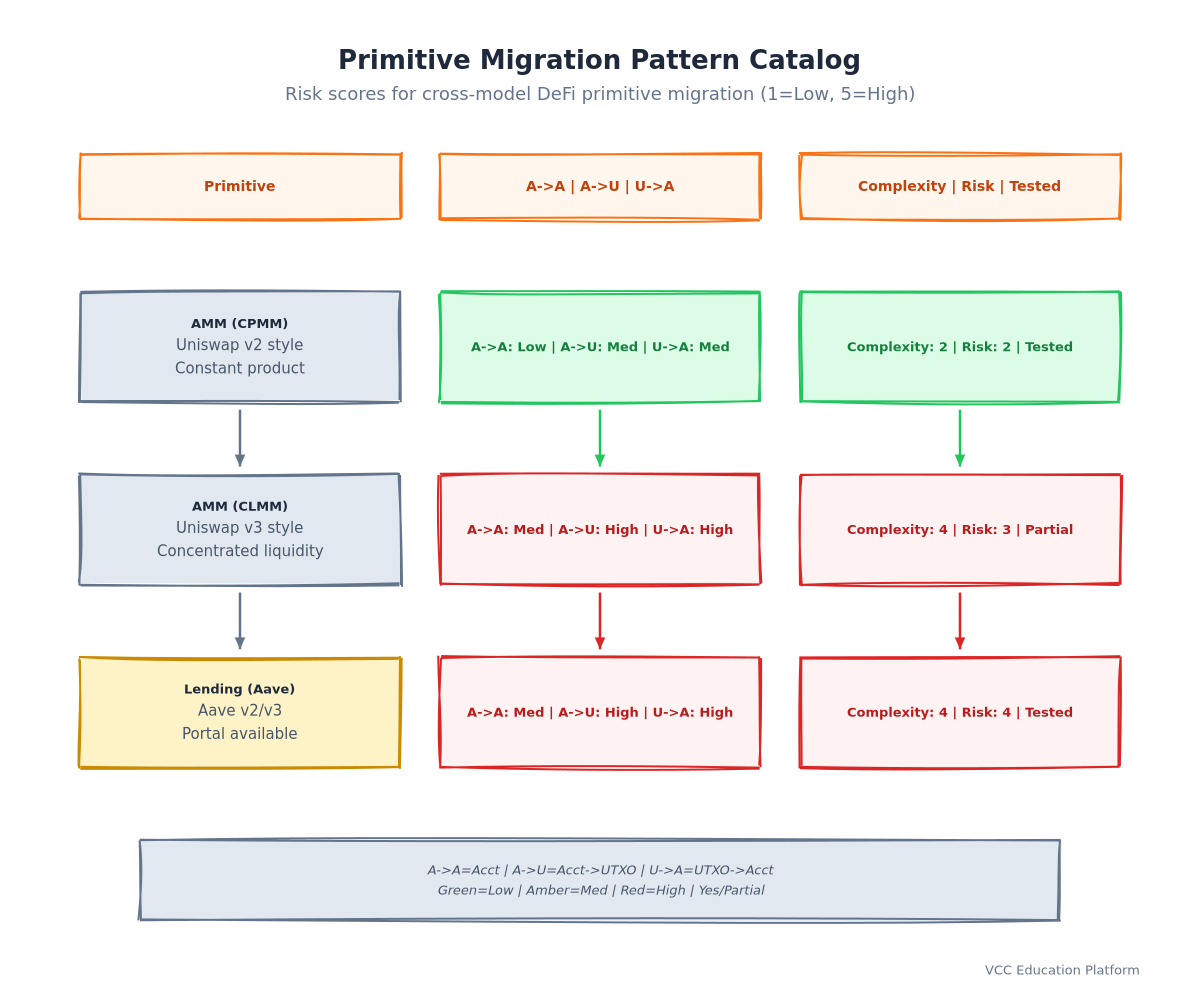
Not all DeFi primitives migrate equally. This catalog scores each primitive on Technical Complexity (1-5), Economic Risk (1-5), and Battle-tested Status.
| Primitive | Account → Account | Account → UTXO | UTXO → Account | Complexity | Economic Risk | Battle-Tested |
|---|---|---|---|---|---|---|
| AMM (CPMM) | Low (storage copy) | Medium (datum) | Medium | 2 | 2 | ✅ Uniswap→Polygon |
| AMM (CLMM) | Medium (tick bitmap) | High (tick→datum) | High | 4 | 3 | ⚠️ Partial (Uniswap v3) |
| Lending (Aave-style) | Medium (balance mapping) | High (position NFTs) | High | 4 | 4 | ✅ Aave Portal |
| Lending (Compound) | Low (cToken supply) | High (position NFTs) | High | 3 | 4 | ⚠️ Limited |
| Yield Vault (Yearn) | Low (share accounting) | Medium (share NFTs) | Medium | 2 | 2 | ✅ Multiple |
| Derivatives (Orderbook) | High (order storage) | Low (order UTXOs) | High | 4 | 3 | ⚠️ dYdX→StarkEx |
| Derivatives (AMM-based) | Medium (virtual AMM) | Medium (datum) | Medium | 3 | 3 | ✅ Perpetual→Optimism |
| Stablecoin (CDP) | High (CDP state) | High (CDP NFTs) | High | 5 | 5 | ⚠️ Maker→L2 |
| Yield Aggregator | Medium (strategy vaults) | Medium (validator refs) | Medium | 3 | 3 | ✅ Beefy→Multi |
| Cross-chain Router | N/A (already cross-chain) | High (message format) | High | 4 | 4 | ✅ LiFi, Socket |
Pattern Deep-Dive: AMM Concentrated Liquidity (CLMM) → eUTXO
Challenge: Uniswap v3 tick bitmap (dense array of int24) → Cardano datum structure.
Solution: Compressed tick representation using run-length encoding in datum: `haskell data TickBitmapDatum = TickBitmapDatum { tbRuns :: [(Integer, Integer)] -- (tickIndex, liquidityNet) runs , tbTickSpacing :: Integer } deriving (Show, Generic, ToData, FromData) `
Migration Algorithm:
- Iterate all initialized ticks on Ethereum (via
tickBitmap+ticksmapping) - Compress consecutive ticks with same
liquidityNetinto runs - Store runs in datum — typical compression 10-50x vs raw bitmap
- On swap: validator expands runs on-demand (lazy evaluation)
Risk Mitigation: Formal verification of tick expansion logic (K framework / Agda).
Chain-Specific Considerations: Cardano, Ethereum, Solana, Cosmos, Layer 2s
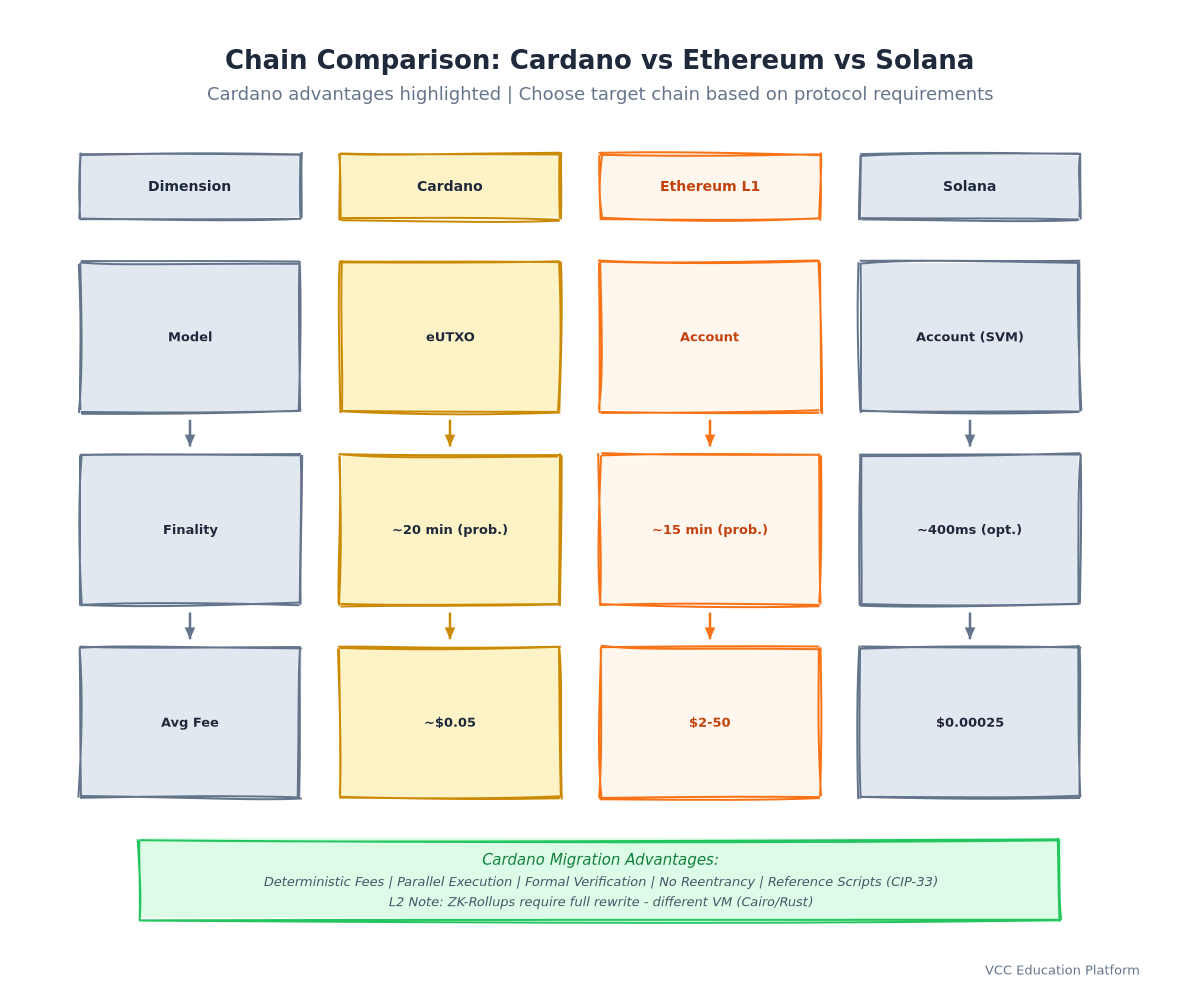
| Dimension | Cardano | Ethereum L1 | Arbitrum / Optimism | Solana | Cosmos (IBC) |
|---|---|---|---|---|---|
| Model | eUTXO | Account | Account (EVM) | Account (SVM) | Account (CosmWasm) |
| Finality | ~20 min (probabilistic) | ~15 min (probabilistic) | ~2 min (L2) + L1 | ~400ms (optimistic) | ~1-2s (IBC) |
| Avg Fee | ~0.17 ADA (~$0.05) | $2-50 | $0.01-0.50 | $0.00025 | $0.01-0.10 |
| Max TX Size | 16 KB | ~24 KB (calldata) | ~24 KB | 1.2 MB | ~2 MB |
| State Access | UTXO inputs (parallel) | Storage slots (sequential) | Storage slots | Accounts (parallel) | KV store |
| Upgradeability | Reference scripts (CIP-33) | Proxy patterns | Proxy patterns | Program upgrade authority | CosmWasm migrate msg |
| Formal Verification | K framework, Agda, Coq | Certora, Halmos | Same as Ethereum | Solana Verifier | CosmWasm Verifier |
| Migration Tooling | Lucid, Mesh, Aiken, Plutarch | Foundry, Hardhat, Slither | Same as Ethereum | Anchor, Solana CLI | CosmWasm, Ignite |
| Best For Migration | UTXO-native protocols, high assurance | EVM-native, max liquidity | EVM scaling, low fees | High throughput, low latency | Sovereign chains, IBC |
Cardano-Specific Migration Advantages
- Deterministic Fees: Migration transaction costs predictable — no gas spikes during cutover
- Parallel Execution: Independent UTXOs = parallel migration of user positions
- Formal Verification: Plutus validators can be mathematically proven correct pre-migration
- No Reentrancy: Eliminates entire class of migration vulnerabilities
- Reference Scripts (CIP-33): Deploy validator once, reference in every migration tx — saves ~80% script size
Ethereum L2 Considerations
- Optimism/Arbitrum: Near-identical to Ethereum — storage layout same, just cheaper gas
- ZK-Rollups (zkSync, Starknet): Different VM — Cairo/Rust vs Solidity. Requires full rewrite, not migration
- Shared Sequencers: Emerging — may simplify cross-L2 migration in future
FAQ: DeFi Migration Common Questions
Q: Can I migrate a protocol without pausing deposits/withdrawals? A: Only with Strategy 3 (Hybrid) and shadow deployment. Full pause-free migration requires read-only shadow period + atomic cutover. Most teams accept 2-4 hour pause for final state sync.
Q: What happens to users who don't migrate? A: Design for "opt-in" migration: users sign migration transaction. Non-migrated positions remain on source chain (accessible via bridge withdrawal). Set deadline (e.g., 1 year) after which unmigrated positions enter "dormant" mode requiring governance rescue.
Q: How do I handle oracle dependencies during migration? A: Run dual oracles during transition. Migrate oracle feeds first (Chainlink, Pyth, Switchboard all support multi-chain). Verify price parity within 0.1% before cutover.
Q: Can I use the same audit for migrated contracts? A: No. Even if logic is identical, different chain semantics (gas, fees, concurrency, finality) create new attack surfaces. Budget for fresh audit — typically 40-60% of original audit cost.
Q: What's the biggest migration failure mode? A: State drift during cutover window — source chain state changes after snapshot but before destination applies. Mitigation: Hybrid strategy with delta relay + short cutover window (< 4 hours).
Q: How much does a production DeFi migration cost? A: Engineering: 3-6 senior engineers × 6-8 weeks = $300k-800k. Audit: $100k-300k. Infrastructure: $50k-100k. Bridge fees: $10k-100k. Total: $500k-1.3M for $100M+ TVL protocol.
Q: Are there regulatory considerations for Vietnamese teams? A: Yes. SBV (State Bank of Vietnam) has not licensed DeFi. Migration documentation should include: KYC/AML integration points, transaction monitoring hooks, regulatory reporting data exports. Consult local legal counsel.
Q: What's the future of DeFi migration? A: Intent-based migration (ERC-7683 / CAKE framework): users sign intent, solvers execute cross-chain. ZK migration proofs: ZK-SNARKs proving state equivalence without revealing state. Standardized migration interfaces (like ERC-7208 for on-chain data containers).
Conclusion
DeFi migration is not a one-off engineering task — it's a capability your protocol team must build and maintain. The 5-phase framework here scales from $1M to $10B TVL. The primitives catalog guides architectural decisions. The runbook prevents production disasters.
Start with the Migration Decision Matrix. If score ≥ 70, invest in Phase 1 inventory. If not, bridge or rebuild — your future self will thank you.
The chains will keep multiplying. The protocols that survive are the ones that can move.
Additional Resources
- Migration Specification Template: [GitHub Link]
- Fork Testing Scripts: [GitHub Link]
- Cutover Runbook Template: [GitHub Link]
- Cardano eUTXO Migration Library:
npm install @cardano-foundation/migration-utils - Cross-Chain State Sync Protocol: [Wormhole/ LayerZero/ Axelar SDKs]
Last updated: 2026-09-04 | Version 1.0 | Author: Senior Protocol Engineer