
defi market making strategies have evolved dramatically since Uniswap v2 introduced the "set and forget" liquidity provision model. Today, the spectrum ranges from passive full-range LPs earning baseline fees to sophisticated operations running just-in-time (JIT) liquidity with delta hedging — capturing value that was once exclusive to centralized exchange (CEX) market makers. This guide walks you through that spectrum, explaining the mechanics, risks, and infrastructure required at each level, with practical context for Vietnamese DeFi users.
The Core Insight: Same Economic Role, Different Mechanics
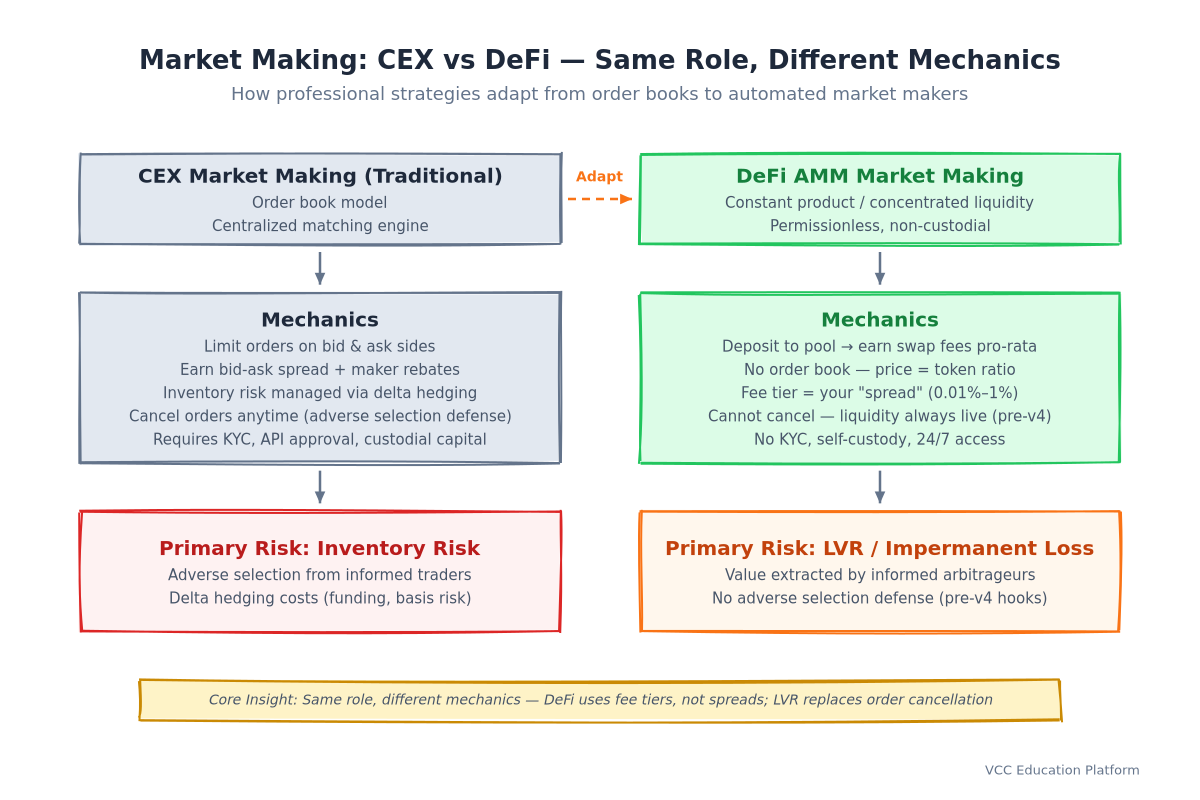
Comparison - Traditional CEX market making vs DeFi AMM market making: order book model with bid/ask
Traditional market makers on CEXs like Binance or Coinbase place limit orders on both sides of an order book. They earn the bid-ask spread plus maker rebates, while managing inventory risk through delta hedging — shorting futures when they accumulate long spot positions, and vice versa. It's a high-speed, capital-intensive game requiring exchange APIs, colocation, and risk engines.
DeFi market making fulfills the same economic function — providing liquidity so traders can execute — but the mechanics are fundamentally different:
| Dimension | CEX Market Making | DeFi AMM Market Making |
|---|---|---|
| Pricing mechanism | Order book (bids/asks) | Constant product (x·y=k) or concentrated liquidity |
| Revenue source | Spread capture + rebates | Swap fees (pro-rata to liquidity share) |
| Primary risk | Inventory risk (adverse selection) | Impermanent loss / LVR (Loss-Versus-Rebalancing) |
| Execution | Limit orders, cancellable | Atomic transactions, irreversible once confirmed |
| Permission | KYC, API approval, custody | Permissionless, non-custodial |
| Infrastructure | Matching engine, risk engine | Smart contracts, mempool monitoring, hedging bots |
The critical realization: DeFi doesn't have a bid-ask spread in the traditional sense. Price is determined by the pool's token ratio. When you provide liquidity, you're not "quoting" prices — you're committing capital to a pricing curve. Your "spread" is the fee tier (0.01%, 0.05%, 0.3%, 1%), and your "inventory risk" manifests as impermanent loss — or more precisely, LVR.
Understanding LVR: The True Cost of Liquidity Provision
Research by Milionis, Moallemi, and Roughgarden (2022) introduced Loss-Versus-Rebalancing (LVR) as a unified framework. LVR measures the value that informed traders (arbitrageurs) extract from LPs by trading against stale AMM prices.
Think of it this way: when ETH price moves from $2,000 to $2,100 on Binance, the Uniswap pool still quotes $2,000 until an arbitrageur pushes it to $2,100. That arbitrageur buys ETH from the pool at $2,000 and sells on Binance at $2,100. The $100 difference per ETH comes directly from LP pockets. That's LVR.
LVR = ∫ (P_CEX - P_AMM) × d(Liquidity)
This reframes impermanent loss not as a "loss" but as adverse selection cost — the same concept CEX market makers face. The difference: on a CEX, a market maker can cancel orders when they detect toxic flow. On an AMM, your liquidity is always "live" — you cannot cancel a limit order because there are no limit orders (pre-v4).
Key implication: Any strategy that reduces adverse selection directly reduces LVR. This is why JIT liquidity, limit orders (v4 hooks), and dynamic fees matter — they let LPs be more selective about when and at what price they provide liquidity.
The Market Making Spectrum: Five Tiers
Based on our research, we categorize DeFi market making into five tiers. Most Vietnamese users operate at Tier 0-1. Understanding the spectrum helps you decide where you want to be — and what it takes to move up.
Tier 0: Passive Full-Range LP (Uniswap v2 Style)
- Mechanics: Deposit tokens across the entire price range (0 to ∞)
- Capital efficiency: 1x (baseline)
- Management: Zero — "set and forget"
- Risk: Maximum impermanent loss exposure
- Typical APY: Fee tier × volume / TVL (often 5-15% on major pairs)
- VN context: Most common for VN users on USDC/USDT or ETH/USDC pools via Coin98 Wallet or KyberSwap
Tier 1: Wide-Range Concentrated LP (Uniswap v3)
- Mechanics: Concentrate liquidity in a wide range (e.g., ±50% from spot)
- Capital efficiency: 2-5x vs full-range
- Management: Monthly/quarterly rebalance when price exits range
- Risk: Moderate IL if price moves out of range; zero fees while out of range
- Tools: Uniswap v3 UI, KyberSwap Elastic, VISOR (auto-compound)
- VN context: Accessible on BSC/Polygon/Arbitrum where gas makes rebalancing economical
Tier 2: Narrow-Range Active LP
- Mechanics: Tight ranges (±5-10%), active fee tier selection (0.05% for stable, 0.3-1% for volatile)
- Capital efficiency: 10-50x vs full-range
- Management: Daily/weekly monitoring, manual rebalance
- Risk: High — positions frequently go out of range, earning zero fees + accumulating IL
- Skill required: Understanding ticks, price ranges, volatility regimes
- VN context: Requires active monitoring; few VN-friendly tools for tick-level management
Tier 3: Algorithmic Rebalancing (Managed Vaults)
- Mechanics: Deposit into vaults (Gamma Strategies, Arrakis Finance, Steer, Panoptic) that auto-rebalance via smart contract strategies
- Capital efficiency: 20-100x (strategy-dependent)
- Management: Passive for user; active for vault strategy
- Risk: Smart contract risk + strategy risk (wrong rebalance timing)
- Fees: Management fee (10-20% of fees) + performance fee
- VN context: Growing interest; Gamma/Arrakis have Vietnamese documentation
Tier 4: Professional Market Making (JIT + Delta Hedging)
- Mechanics:
- JIT Liquidity: Monitor mempool → detect large swaps → atomically mint concentrated position at exact tick via flash loan → capture fees → burn position → return capital + profit
- Delta Hedging: Continuously hedge net delta exposure using perpetual futures (GMX, Hyperliquid, CEX perps) or options (Lyra, Dopex, Panoptic)
- Capital efficiency: Theoretical maximum (single-tick positions)
- Management: Fully automated, requires dedicated infrastructure
- Risk: Smart contract / oracle / basis risk; gas wars; hedging costs
- Infrastructure: Mempool monitoring (Flashbots, Blocknative), atomic execution (Flashbots Protect), hedging engine, risk management
- VN context: Not accessible to retail — requires $100k+ capital, devops team, colocation-equivalent infra
Deep Dive: Concentrated Liquidity Position Lifecycle
Flowchart - Concentrated liquidity position lifecycle: Analysis (select range, fee tier, volatility)
Managing a concentrated position (Tier 1-2) is an active loop. Here's the practical workflow:
1. Analysis: Range Selection & Fee Tier
Price range: Choose lower/upper ticks based on:
- Historical volatility: 30-day realized vol → set range to cover ~1-2 standard deviations
- Time horizon: Longer horizon → wider range
- Asymmetric views: If you're bullish, skew range upward (more token0, less token1)
Fee tier selection:
| Pair Type | Recommended Fee Tier | Rationale |
|---|---|---|
| Stable/Stable (USDC/USDT) | 0.01% or 0.05% | Low vol, high volume, tight ranges |
| Blue-chip (ETH/USDC, BTC/USDC) | 0.05% or 0.3% | Medium vol, deep liquidity |
| Volatile/Low-liquidity | 0.3% or 1% | High adverse selection, need fee buffer |
Pro tip: The 0.05% tier on ETH/USDC often outperforms 0.3% for active LPs because tighter ranges + lower fees = more volume through your position.
2. Deploy: Minting the Position
On Uniswap v3/v4 (or KyberSwap Elastic, PancakeSwap v3):
- Input lower tick, upper tick, token amounts
- Critical: The token ratio is determined by the current price vs your range. If price is near the middle, you deposit ~50/50. If price is near the edge, you deposit mostly one token.
- Gas optimization: Batch approvals, use multicall, deploy on L2 (Arbitrum/Optimism) for <$1 gas vs $20-50 on Ethereum mainnet
3. Monitor: The Daily Dashboard
Track these metrics daily:
- In-range %: Time price spends within your ticks (target >80%)
- Fee APR: Actual fees earned / position value (annualized)
- IL estimate: Current IL vs fees earned (use tools like APY.vision, Liquidity.vision, or custom spreadsheet)
- Tick proximity: Distance from current tick to lower/upper boundary
4. Rebalance Decision: The Critical Moment
When price approaches your boundary (within 5-10% of tick), decide:
- Rebalance now: Withdraw, calculate new range, redeploy. Costs gas + potential slippage.
- Wait: Risk going out of range (zero fees, 100% IL exposure on the out-of-range portion).
- Let it ride: If you believe price will reverse (mean reversion bet).
Rebalancing strategies:
- Threshold-based: Rebalance when price hits 80% of range width
- Time-based: Rebalance every N days regardless of price
- Volatility-adjusted: Widen range when vol spikes, narrow when vol compresses
- Gamma-aware: Rebalance to maintain target gamma exposure (advanced)
5. Collect Fees & Exit
- Fee collection: Periodic (weekly/monthly) to compound or realize income
- Exit: Close position when strategy thesis changes. Realized P&L = Fees collected - Impermanent loss + Token price appreciation
JIT Liquidity: The Atomic Advantage
Sequence - JIT liquidity workflow: Mempool monitoring (large swap detected) → Oracle price check (fa
Just-In-Time (JIT) liquidity is the closest DeFi gets to traditional market making. Here's how it works:
The JIT Loop
- Mempool monitoring: Bots watch for large pending swaps (e.g., $500k USDC → ETH)
- Profitability check: Simulate swap through a theoretical single-tick position at current price. Calculate: fees captured - gas cost - flash loan interest > 0?
- Atomic execution via Flashbots: Bundle transactions:
- Flash loan capital (e.g., 500k USDC + equivalent ETH)
- Mint concentrated position at exact tick where swap will execute
- Swap executes through the JIT position (JIT LP earns fees)
- Burn position, repay flash loan, keep profit
- All in one block: No inventory risk — position exists only for the swap's execution
Why JIT Wins
- Zero adverse selection: You only provide liquidity when a trade happens, at the exact price the trade executes. No stale quotes.
- Capital efficiency: Single-tick position = theoretical max capital efficiency (4000x)
- No inventory: Position created and destroyed atomically — no delta to hedge during the swap
The Catch
- Infrastructure arms race: Competing with Wintermute, Jump, Flow Traders, specialized MEV firms
- Gas wars: Flashbots bundles bid up priority gas — only profitable for large swaps
- Technical barrier: Requires mempool access, simulation engine, smart contract deployment, Flashbots relay relationship
- Ethereum mainnet only: L2 mempools less transparent, different economics
VN reality check: JIT is not feasible for Vietnamese retail users. It's included here for completeness — understanding it helps you appreciate why passive LP returns are compressed (JIT captures the most profitable flows).
Delta Hedging: Managing the Unmanageable Risk
If you run a concentrated position (Tier 2-3) and don't want to rebalance constantly, delta hedging is the professional alternative.
The Gamma Problem
A concentrated LP position has non-linear payoff — its delta (sensitivity to price) changes as price moves. This is gamma (rate of change of delta).
- Near range center: Low gamma, delta ≈ 0.5 (for 50/50 pool)
- Near range edges: Gamma spikes, delta shifts rapidly toward 0 or 1
- Result: Your directional exposure changes fastest when price is most volatile — exactly when you least want it to.
Hedging Approaches
1. Perpetual Futures Hedge (Most Common)
- Mechanism: Short perps when net long the volatile asset (e.g., short ETH-PERP when LP holds ETH exposure)
- Rebalancing: Adjust hedge size as LP delta changes (continuous or threshold-based)
- Venues: GMX, Hyperliquid (on-chain), Binance/Bybit/OKX (CEX — requires custody)
- Cost: Funding rates (pay when long, receive when short) + trading fees + basis risk
2. Options Hedge
- Mechanism: Buy puts / sell calls to cap downside / generate premium
- Venues: Lyra, Dopex, Panoptic (on-chain options), Deribit (CEX)
- Advantage: Defined max loss, no liquidation risk
- Cost: Option premium (theta decay)
3. Gamma-Neutral Strategies
- Concept: Combine multiple concentrated positions at different ranges to flatten gamma
- Example: Wide range (low gamma) + narrow range (high gamma, opposite direction) ≈ net zero gamma
- Tools: Panoptic, Gamma Strategies vaults
The Hedging P&L Equation
` Net P&L = LP Fees + Hedging P&L - Gas - Funding/Theta - Slippage `
Hedging P&L = -∫ (Delta_LP × dP) — you profit from hedging when price moves against your LP delta.
Break-even condition: Fees earned > LVR + Hedging costs
This is why professional MMs only operate on high-volume pairs (ETH/USDC, BTC/USDC) with deep perp markets — the fee revenue must exceed the combined cost of LVR and hedging.
Risk-Return Comparison: Where Do You Fit?
Comparison - Risk-return profile across 6 dimensions: Capital Efficiency, Fee Income Potential, Impe
| Dimension | Passive LP (Tier 0) | Active Concentrated LP (Tier 1-2) | Professional MM (Tier 3-4) |
|---|---|---|---|
| Capital Efficiency | 1x (baseline) | 10-50x | 100-4000x (theoretical) |
| Fee Income Potential | Baseline (5-15% APR) | 2-10x baseline (20-150% APR) | 10-100x baseline (JIT + rebates) |
| Impermanent Loss / LVR Risk | High (full exposure) | Higher if wrong range; manageable with skill | Actively hedged (residual basis risk) |
| Operational Complexity | Near zero | Medium (daily monitoring, weekly rebalance) | Very High (24/7 infra, devops, risk mgmt) |
| Adverse Selection Exposure | Maximum (always quoted) | Reduced (narrow range = less toxic flow) | Minimal (JIT avoids; hedging offsets) |
| Infrastructure Required | Wallet only | Monitoring bot, rebalance alerts | Mempool, atomic execution, hedging engine, risk limits |
| Min Capital (Practical) | $100 | $1,000-10,000 | $100,000+ |
| VN Accessibility | High (Coin98, KyberSwap, PancakeSwap) | Medium (L2/BSC, gas costs) | Low (infra, capital, regulatory) |
The Vietnamese User Decision Framework
Ask yourself:
- Capital: <$1,000 → Tier 0-1 only. $10k-100k → Tier 2-3 viable. >$100k → Tier 4 possible.
- Time: Can't monitor daily → Tier 0 or Tier 3 (managed vaults).
- Technical skill: No coding → Tier 0-1 or Tier 3. Can script bots → Tier 2.
- Risk tolerance: Hate IL → Tier 0 stable pools or Tier 4 hedged. OK with IL for higher fees → Tier 1-2.
- Gas budget: Ethereum mainnet → Tier 0-1 only (rebalancing too expensive). Arbitrum/Optimism/BSC/Polygon → Tier 1-3 viable.
Uniswap v4 Hooks: The Game Changer
Uniswap v4 (launched 2024) introduces hooks — custom smart contracts that execute at specific points in the swap/liquidity lifecycle. This narrows the CEX-DeFi feature gap:
| Hook Capability | CEX Equivalent | Impact on Market Making |
|---|---|---|
| Limit orders | Limit order book | LPs can set price bounds — reduces adverse selection |
| Dynamic fees | Volatility-adjusted spreads | Fees auto-adjust to vol — LPs compensated for risk |
| TWAMM / large orders | Iceberg / VWAP orders | Execute large orders with minimal market impact |
| Custom oracles | Proprietary price feeds | Better pricing for exotic assets |
| KYC/AML hooks | Compliance layer | Institutional on-ramp |
For Vietnamese users: v4 hooks mean future DEXs can offer "limit order LPing" — you set a price range and a max price you're willing to buy/sell at. This is a massive UX improvement for active LPs.
Practical Tooling for Vietnamese Users (2024-2025)
Position Management & Analytics
- APY.vision / Liquidity.vision — Cross-chain LP tracking, IL calculation, rebalance alerts
- KyberSwap Elastic — Vietnamese UI, v3 concentrated liquidity on multiple chains
- PancakeSwap v3 (BSC) — Low gas, familiar interface for VN users
- Coin98 Wallet LP Interface — Built-in, mobile-first, VN language
Managed Vaults (Tier 3 Access)
- Gamma Strategies — Automated active management, multiple strategies
- Arrakis Finance — PALM (Protocol-Automated Liquidity Management)
- Steer Finance — Custom strategy framework
- Visor Finance — Auto-compounding concentrated positions
Rebalancing Automation (DIY Tier 2)
- Gelato / Keep3r — Decentralized automation for rebalance transactions
- Custom scripts — Python/JS bots using Uniswap SDK + web3.py/ethers.js
Risk Calculation
- IL Calculator (Uniswap, various forks) — Input range, current price → estimated IL
- LVR Estimator — Experimental tools from academia (Milionis et al.)
- Custom spreadsheet — Track entry price, current price, fees collected, token quantities
Common Pitfalls & How to Avoid Them
Pitfall 1: "Narrow Range = Free Money"
Reality: Narrow ranges earn high fees only while in range. A 5% range on ETH/USDC might last 2 days before price exits. Out of range = zero fees + 100% IL on that liquidity. Fix: Size range to volatility, not greed. Use 30-day realized vol × √time_horizon as guide.
Pitfall 2: Ignoring Gas Costs on Rebalancing
Reality: On Ethereum mainnet, a rebalance costs $20-50. If your position earns $5/day in fees, you need 4-10 days just to break even on gas. Fix: Use L2s (Arbitrum, Optimism, Base) or alt-L1s (BSC, Polygon) for active management. Mainnet only for large positions ($50k+).
Pitfall 3: Confusing Rebalancing with Market Making
Reality: Rebalancing is defensive (maintaining a range). Market making is offensive (providing liquidity at prices you believe are fair, managing inventory). Fix: If you rebalance reactively, you're a Tier 2 active LP. To be a market maker, you need predictive views + hedging.
Pitfall 4: Underestimating Adverse Selection
Reality: Every swap through your pool could be informed flow. On volatile pairs, >50% of volume may be toxic (arbitrage, MEV). Fix: Prefer stable pairs or correlated pairs (stETH/ETH, wbETH/ETH) where adverse selection is lower. Use v4 limit order hooks when available.
Pitfall 5: No Exit Strategy
Reality: Many LPs hold losing positions hoping for mean reversion, accumulating IL. Fix: Set stop-loss rules: "If IL > 2× fees earned, exit." Or time-based: "Review position every 30 days; close if thesis invalid."
FAQ: DeFi Market Making Strategies
Q1: What's the difference between "market making" and "liquidity provision" in DeFi?
A: Liquidity provision (LPing) is the act of depositing tokens to a pool. Market making is the strategy of actively managing that liquidity — selecting ranges, rebalancing, hedging, optimizing fee tiers — to maximize risk-adjusted returns. All market makers are LPs; not all LPs are market makers.
Q2: Can I do delta hedging as a retail user?
A: Technically yes — you can short perps on GMX/Hyperliquid against your LP position. But practically: funding rates, basis risk, gas costs, and position sizing make it uneconomical below ~$50k notional. Managed vaults (Arrakis, Gamma) that include hedging are more accessible.
Q3: Is impermanent loss really a "loss"?
A: It's an opportunity cost vs holding tokens. If you provide ETH/USDC liquidity and ETH doubles, you end up with less ETH and more USDC than if you'd just held. The "loss" is real in USD terms if you exit. LVR reframes it as value transferred to informed traders — economically identical to adverse selection on CEXs.
Q4: Which chain is best for active LPing from Vietnam?
A: Arbitrum or Base for Ethereum ecosystem (low gas, deep liquidity, v3/v4). BSC for PancakeSwap v3 (very low gas, VN-friendly). Polygon for mature DeFi. Avoid Ethereum mainnet for active strategies unless position >$50k.
Q5: How do I calculate my real APR on a concentrated position?
A: Real APR = (Fees collected in USD / Initial position value in USD) × (365 / days active). Must subtract IL (current position value vs HODL value) to get net return. Tools: APY.vision, custom spreadsheet with daily snapshots.
Q6: What's the minimum capital for Tier 2 (active concentrated LP)?
A: ~$1,000 on L2/BSC (gas ~$0.01-0.10 per rebalance). ~$10,000 on Ethereum mainnet (gas ~$20-50 per rebalance). Below this, gas eats returns.
Q7: Are managed vaults (Tier 3) safe?
A: They add smart contract risk (vault contract + strategy contract) on top of LP risk. Audit history matters: Gamma, Arrakis, Steer have multiple audits. But no vault is risk-free. Allocate only what you can afford to lose.
Q8: How does JIT liquidity affect my passive LP returns?
A: JIT bots capture the most profitable swaps (large, low-slippage), leaving smaller, higher-slippage swaps for passive LPs. This compresses fee APR for passive LPs by ~10-30% on major pairs (per Capponi et al. 2023). It's the "cost" of permissionless liquidity.
Q9: What are "ticks" and why do they matter?
A: Ticks are discrete price intervals in Uniswap v3/v4. Each tick = 0.01% price change. Your range is defined by lower/upper tick. Tick spacing depends on fee tier (1 for 0.01%, 10 for 0.05%, 60 for 0.3%, 200 for 1%). You can only place liquidity on ticks — this discretization enables concentrated liquidity math.
Q10: Should I provide liquidity to volatile token pairs for higher fees?
A: Only if you understand the adverse selection. High fee tiers (1%) on volatile pairs attract informed traders who know more than you. The 1% fee often doesn't compensate for the LVR. Stable/stable or blue-chip/major pairs usually have better risk-adjusted returns for active LPs.
Key Takeaways
- DeFi market making is a spectrum — from passive LP (Tier 0) to JIT + hedging (Tier 4). Know your tier.
- LVR is the true cost — impermanent loss = value extracted by informed traders. Reduce adverse selection to reduce LVR.
- Concentrated liquidity requires active management — narrow ranges earn high fees but go out of range fast. Rebalance discipline > range selection.
- Gas costs dictate strategy — Ethereum mainnet = passive only for retail. L2/BSC/Polygon = active management viable.
- Vietnamese users have a clear path: Start Tier 0-1 on KyberSwap/PancakeSwap v3 (BSC/Arbitrum) → learn range management → graduate to managed vaults (Tier 3) if capital/time allow.
- v4 hooks change everything — limit orders, dynamic fees, and custom logic bring DeFi MM closer to CEX parity.
- Professional MM (Tier 4) is an infrastructure play — not a strategy retail can replicate. Respect the moat.
Next Steps for Vietnamese DeFi Users
| Your Profile | Recommended Starting Point |
|---|---|
| New to DeFi, <$500 | USDC/USDT on KyberSwap Elastic (Arbitrum) or PancakeSwap v3 (BSC) — Tier 0 |
| Some experience, $1k-10k | ETH/USDC 0.05% tier, ±20% range on Arbitrum — Tier 1, rebalance monthly |
| Active trader, $10k-100k | Narrow ranges (0.3% tier, ±5-10%), daily monitoring, consider Gamma/Arrakis vaults — Tier 2-3 |
| Institution/Whale, >$100k | Custom infrastructure, JIT + hedging, v4 hooks — Tier 4 (hire a team) |
The DeFi market making landscape rewards skill, discipline, and infrastructure — in that order. Start where you are, master the current tier, then decide if the next tier's returns justify its costs.
Disclaimer: This article is educational content, not financial advice. DeFi involves significant risks including smart contract failure, impermanent loss, and total capital loss. Always do your own research and never invest more than you can afford to lose.