
Providing liquidity to DeFi is the backbone of decentralized trading. Whenever you exchange tokens on Uniswap, Raydium, or PancakeSwap, there is a liquidity provider on the other side charging a fee to make that transaction possible. This guide will walk you through how it works, the risks (especially non-permanent losses), and how to choose a strategy that aligns with your risk tolerance – whether you’re on Ethereum, Solana, Cardano, or BSC.
Comparing the Market Maker: From Wall Street to Your Wallet
Traditional markets rely on market makers – companies that set buy and sell prices, making a profit from the spread. They require millions of dollars in capital, members of exchanges, and low-latency infrastructure.
DeFi has reversed this model. Automated Market Makers (AMMs) replace companies with smart contracts. Anyone with two tokens can become a market maker by depositing them into a flow pool. Through a process, transactions are priced, executed, and charged automatically. There are no order books. No licenses are required. Just open source code.
Think of the liquidity pool as a vending machine that always has two snacks – say, ETH and USDC. You supply it with equal values of both. When someone buys ETH, they put in USDC and take out ETH. The machine adjusts the price based on the remaining amount. You earn a small fee from each transaction.
This is the liquidity-providing mechanism of DeFi in one word: you provide the inventory, the store provides the process, and the exchange provides the volume.
How AMM values assets: The constant product formula
The breakthrough result that enables AMM to work is a simple formula: x × y = k
In this case: - x = supply of Token A (e.g., ETH) - y = supply of Token B (e.g., USDC) - k = a constant
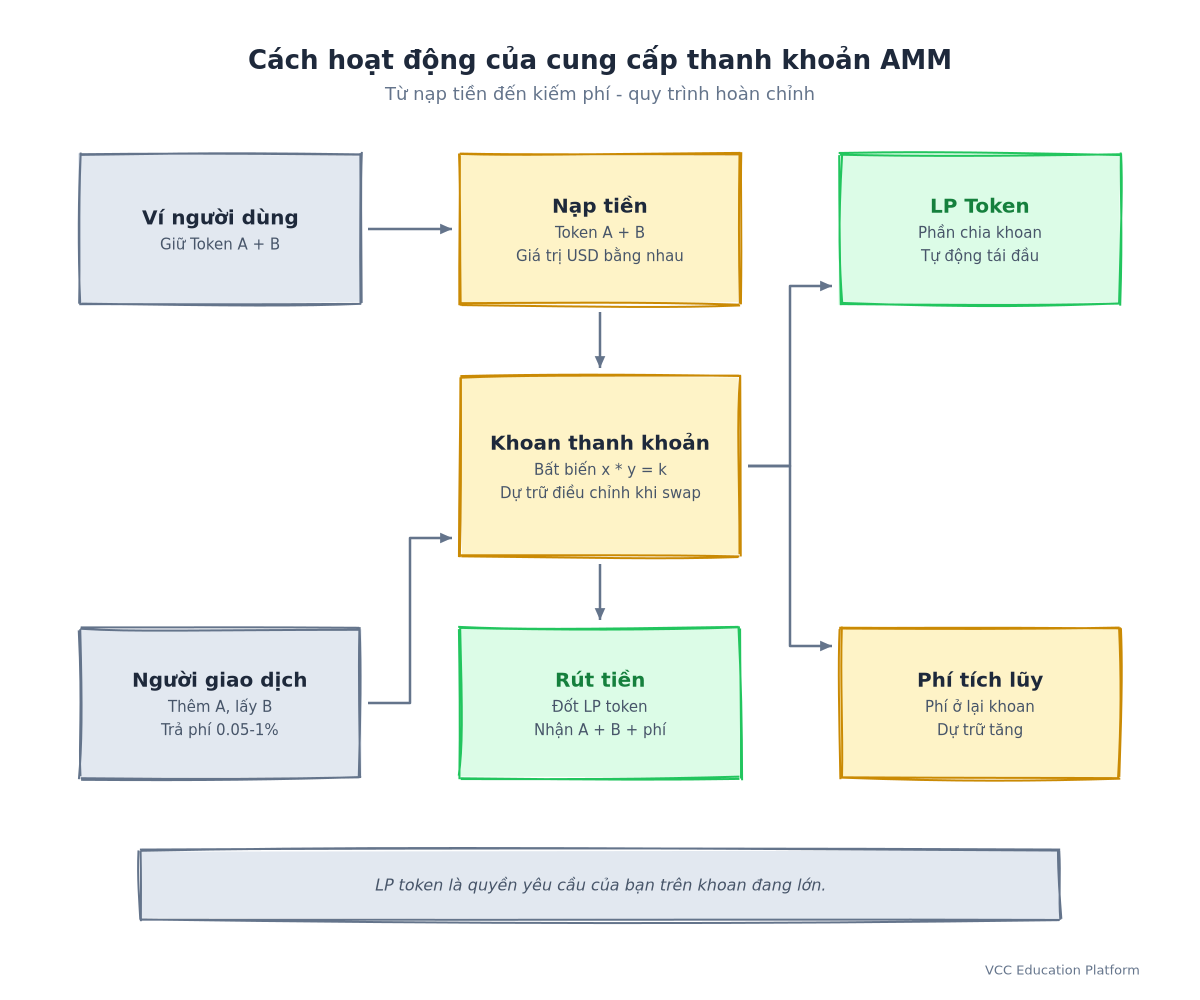
When a trader makes an exchange, they will increase the quantity in one inventory and decrease the quantity in another. The product must always remain the same, so prices will automatically adjust:
Price of ETH in USDC = y / x
If the wallet has 100 ETH and 200,000 USDC (k = 20,000,000), the ETH price is 2,000 USDC. The trader buys 1 ETH, adding 2,000 USDC and removing 1 ETH. The new balance is 99 ETH, 202,000 USDC. The new price is 2,040 USDC. The price impact (2%) is transferred to the wallet as a discount cost to the trader – and as a fee income to you.
Key: The formula creates a linked curve, not a fixed price. Large trades significantly change the value. Large inventories (k high) have a lower price impact. This is why liquidity depth is important – it is the “stock volume” that helps keep prices stable.
LP Digital Currency: The Means to Receive and Earn Profits
When you deposit tokens, you receive LP tokens (liquidity provider tokens). These tokens represent your percentage of the pool.
Your share = Your LP tokens / Total LP token supply
If you deposit 1% of the value of the pool, you will receive 1% of the LP tokens. When traders trade, the fees (usually 0.3% on Uniswap v2) are accumulated in the pool – the reserves increase. The number of your LP tokens does not increase, but each token becomes more valuable.
Income from fees is the main source of profit. No staking, no lock-in, no requirements – it accumulates automatically in the vault.
Effective interest rate: APY vs APR
Protocols often advertise attractive APYs. These are honest calculations:
| Measurement units | Equation | It tells you what |
|---|---|---|
| Annual interest rate | (cost per 24 hours × 365) / TVL | Total annual fee revenue at the current rate |
| APY Rate | (1 + APR rate/365)^365 - 1 | Income from accumulated fees (assumed to be reinvested) |
| Actual rate | APR fees – Unstable losses – Opportunity costs | What you really keep |
Warning: Many "APY" figures include incentive tokens (emissions farms). This is not a sustainable yield – it is tokenomics speculation. A sustainable LP yield = only swap fees.
The crow in the room: Failure is inevitable
This is the concept that scares most new participants. Instability loss (IL) is the difference between holding your tokens versus providing liquidity when prices differ.
Mathematics (simplified)
You deposit 1 ETH + 2,000 USDC (price = 2,000). ETH doubles to 4,000 USDC.
- Holding Strategy: 1 ETH + 2,000 USDC = 6,000 USDC value
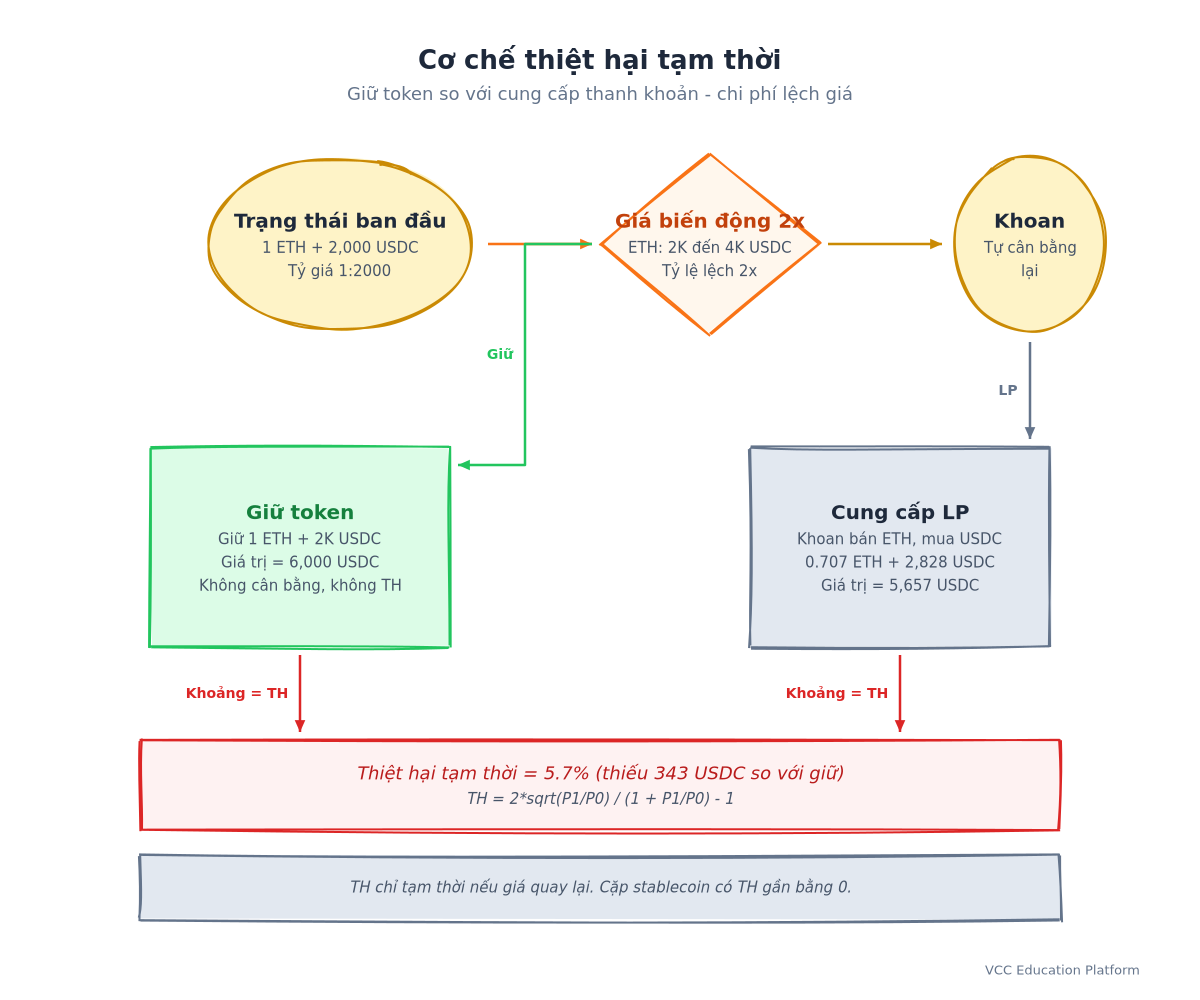
Formula: IL = 2√(P₁/P₀) / (1 + P₁/P₀) – 1
In this case, P₀ = the initial price ratio, and P₁ = the new price ratio.
| Change price | The damage is not sustainable |
|---|---|
| 1.25x | 0.6% |
| 1.5x | 2.0% |
| 2x | 5.7% |
| 3x | 13.4% |
| 5x | 25.5% |
Why is it called "not durable"?
It is only permanent if you exit when the price is dispersed. If the price returns, the loss will disappear. However, in markets that tend to move (e.g., ETH during a bull run), IL becomes a reality – you would be better off holding.
When IL is not important
- Stable cryptocurrency pairs (USDC/USDT): Price ratio ~1:1, IL close to 0
Concentrated liquidity: The Uniswap v3 revolution
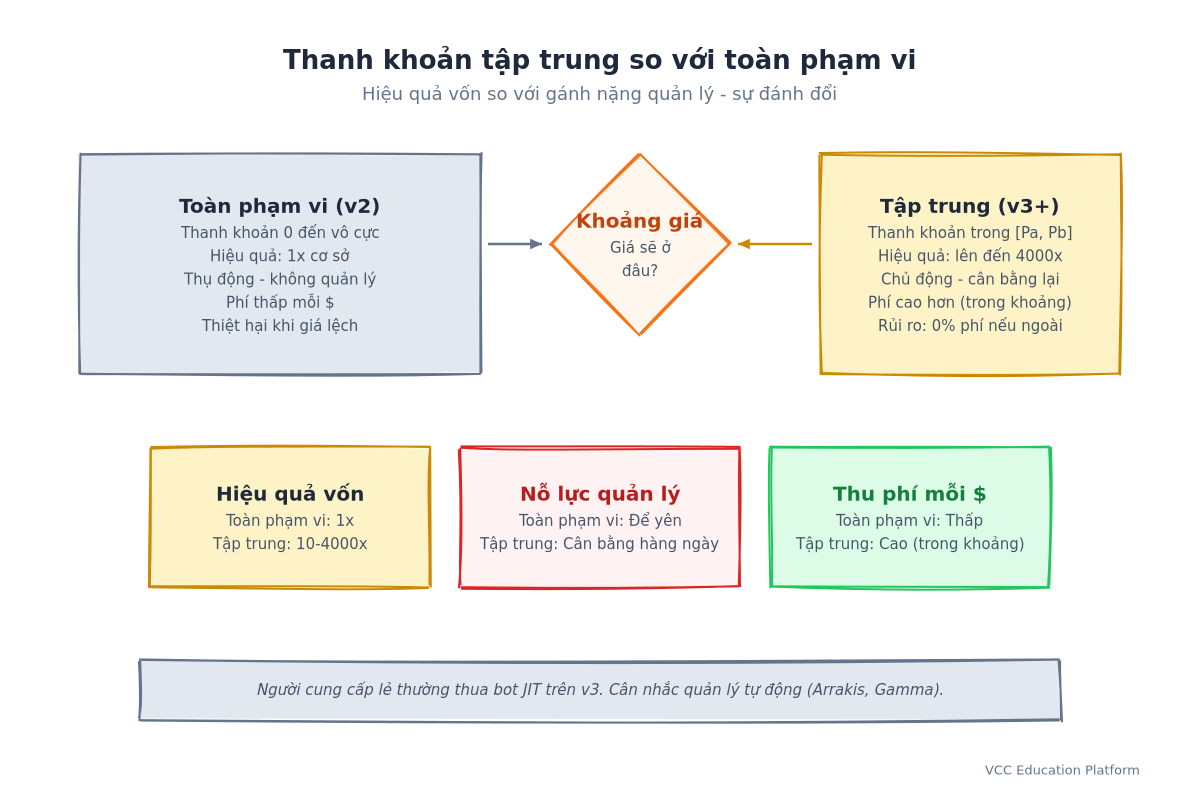
Uniswap v2 distributes liquidity from 0 to infinity. The capital efficiency is very poor – most of the liquidity is at a price point that is never traded.
Uniswap v3 introduced concentrated liquidity: you choose a price range [Pₐ, P_b]. Your liquidity only operates within that range.
Inheritance
| Aspect | Wide band (v2) | Focus (v3) |
|---|---|---|
| Capital utilization efficiency | 1x (reference point) | Up to 4,000x (hypothesis) |
| Collection Fees | Low by $ | High rate per $ (when within range) |
| Manage | Lack of movement | Activity - rebalancing when prices move out of range |
| Risk | IL always | IL + out of range = no charge |
Tick orders and limit orders
The price range is divided into ticks (segment price step: 1.0001^tick). You select a low tick and a high tick. This creates a limit order - essentially a fee-based limit order that waits.
Example: ETH is trading at $2,000 in USDC. You provide liquidity between $1,800 and $2,200. You receive a fee for each trade within this range. If ETH reaches $2,201, your position will be 100% USDC – no further fees until the price returns.
Professionalizing LPing
The concentration of capital has turned LPing from a passive investment into a positive market-making strategy. Data shows that the top 10% of LPs earn 80% of v3 fees. Retail LPs face the following challenges:
For non-experts: Automated LP managers (Arrakis, Gamma, Visor, Steakhouse) handle rebalancing at a fee. However, they add the risk of smart contracts.
Multi-chain scenario: Where liquidity is provided
Providing liquidity in DeFi is not just for Ethereum. Each chain has its own unique characteristics:
Ethereum: Deep Channel
- Main DEXs: Uniswap (v2/v3/v4), Curve, Balancer
Solana: Speed combined with CLMM
- Primary DEXs: Raydium (CLMM + AMM), Orca (Whirlpools), Phoenix (orderbook)
BSC: Low-cost testing
- DEX dominance: PancakeSwap (v2 fork + v3 via ALM)
Cardano: The Competition of eUTXO
- Main DEXs: Minswap, WingRiders, Spectrum
Choose a string as a strategy
Don’t just go for APY. Choose the chain that fits your strategy:
Comparison of common protocols
| Protocol | Cable (cables) | Model | Key features | Best for |
|---|---|---|---|---|
| Uniswap | Ethereum, Polygon, Arbitrum, Optimism, Base, BSC | CPMM (v2), CLMM (v3) | The highest capacity, v4 hooks coming soon | For general purposes |
| Curve | Ethereum + L2s | StableSwap (stable against fixed assets) | Nearly zero slippage for stable machines | The profitability of stablecoins |
| Balancer | Ethereum + L2s | Groups with weights (n-token, custom weights) | LPing in a Portfolio style | Continued multi-asset exposure |
| PancakeSwap | BSC, Ethereum, Aptos | CPMM + CLMM (ALM) | Gamified, emissions from large farms | BSC Users |
| Raydium | Solana | Hybrid CLMM + AMM | Orderbook + AMM liquidity source | Solana Users |
| Orca | Solana | Spill tank (CLMM) | Best UX for focused positions | Solana Retail |
| Minswap | Cardano | AMM (eUTXO) | Multi-pond technology, profitable tree planting | Cardano Ecosystem |
Risk assessment mechanism
Before depositing, evaluate each group according to the following criteria:
1. Risks of smart contracts
- [ ] Audited by a reputable company (Trail of Bits, OpenZeppelin, Spearbit)?
2. Economic risk
- [ ] Pair correlation: stability/stability (low) vs. volatility/variance (high)
3. Operational risks
- [ ] Can gas costs be controlled with your location size?
4. Vietnamese user information
- [ ] Docs/community in Vietnamese? (Coin68 team, VN DeFi)
Step 1: Your first liquidity position
Pre-requisites
- Non-custodial wallets (MetaMask, Phantom, Eternl, Trust Wallet)
On Uniswap v3 (Ethereum/Mainnet)
- Go to app.uniswap.org → Pool → New Position
- Select the pair (e.g. ETH/USDC with a fee of 0.05%)
- Set the price range: start wide (e.g. ±50% from the current price) for learning purposes
- Deposit amount (automatically balanced to 50/50)
- Approve tokens → Confirm transaction
- Monitoring: Check the position daily. Rebalance if the price is close to the range limit.
On PancakeSwap (BSC) – Learn how to play with low stakes
- Go to pancakeswap.finance → Liquidity → Add Liquidity
- Select v2 (all types) for simplicity
- Deposit CAKE/BNB or USDT/BUSD
- Receive CAKE-LP or BUSD-LP tokens
- Optional: Stake LP in Farms to reduce CAKE emissions (be aware of the token’s risks!)
On Raydium/Orca (Solana) — CLMM Native
- Connect the Phantom wallet
LP Profile: Which Group Are You In?
| Strategy | Personal information | Effort | Typical production volume | Risk |
|---|---|---|---|---|
| Curve stablecoin | Passive, conservative | Install and forget | 2-8% (fees + CRV) | Very low (IL close to 0) |
| Wide range v2 | Automatic vending machine | Check monthly | 5-20% (fee) | Average (IL on difference) |
| v3 with extended range | Automatic vending machine | Check weekly | 10-50% (fee) | Medium-High (risk of escaping from range) |
| v3 has a narrow range | Active | Every day / every hour | 50-200%+ (fee) | High (performs regular rebalancing, using gas) |
| ALM / Vault | Authorized | Low (secure cabinet) | 10-100% (management fees) | High (smart contract + management risk) |
Recommendation statement for newbies: Start with stablecoin pairs on Curve or ETH/USDC with a wide range on Uniswap v3 (0.05% spread). Learn the mechanics with the amount of capital you can afford to lose. Move to concentrated positions only after you have experienced a drawdown.
FAQ
Question: Can I lose capital when providing payment services?
A: Yes, there are 3 ways: (1) Sustained losses exceed fees, (2) smart contract exploitation depletes the pool, (3) a token becomes 0 (rug pull). Don't invest money you can't afford to lose.
Question: What is the difference between APR and APY in DeFi?
A: APR = simple annual interest rate. APY = compounded interest. DeFi fees are compounded in the auto pool (reserve assets increase), so APY is more accurate for profit from fees. However, many protocols advertise APY that includes token farm – you should ignore that information.
Question: Do I need to request manual billing?
A: On Uniswap v2/v3 and most AMMs: No, fees are automatically accumulated in the pool. On some CLMMs (Raydium, Orca): Yes, fees are accumulated separately and must be requested (takes 1 transaction).
Question: How do I calculate the temporary loss for my position?
A: Use online calculators (Uniswap v3's IL calculator, Daily DeFi, APY.vision). Enter: deposit amount, price range (for v3), current price. Or use the formula: IL = 2√(P₁/P₀) / (1 + P₁/P₀) - 1.
Question: Can LP tokens be transferred?
A: Yes, these are standard ERC-20/SPL tokens. You can sell, transfer, or use them as collateral (for example, on Aave). However, when transferring LP tokens, you are transferring your stake — the recipient will receive the fees and IL.
Question: What happens if a reservoir is depleted or attacked?
A: You will lose the remaining assets. There is no insurance by default. Some protocols (Nexus Mutual, InsurAce) offer insurance – purchase before sending funds if interested.
Question: Can I provide liquidity with just one token?
A: Not directly – AMM requires both sides. However, you can: (1) Use a zapper (Zapper, DeFiSaver) to swap half for you, (2) Use a unidirectional vault (some pools of Balancer, Curve metapool), or (3) Send to a stablecoin pool where you only need one stablecoin.
Question: How does taxation work for LPing in Vietnam?
A: Vietnamese tax law considers profits from cryptocurrency as personal income (20%). Each exchange/receipt of funds may be a taxable event. Keep track of: deposit value, withdrawal value, fees earned. Use Koinly/CoinTracker with Vietnam settings. Consult a tax professional.
Things to keep in mind
- Creating liquidity supply for DeFi = You become a market maker. Earn trading fees to provide inventory. 2. AMM price according to the formula x×y=k – simple math, but with deep meaning (price action, slippage, IL). 3. Unsustainable losses are the cost of automated market making. Manage it: stable pairs, relevant assets, high fee levels, concentrated range. 4. Centralized liquidity supply (v3) = 10 to 4000 times ROI, but requires active management. Not for everyone. 5. Key sectors: Ethereum (security), Solana (speed/CLMM), BSC (low price), Cardano (day one). 6. Real returns = only trading fees. Farming cryptos is speculative. Do the math: APR fee rate – IL – opportunity cost. 7. Start small, learn the mechanics, then scale up. The best teacher is a small position that you track daily.
Are you ready to provide capital? Start with the stablecoin pair on Curve or the wide ETH/USDC position on Uniswap v3. Watch for a week. Hear the accruing fees. Hear the IL as prices change. That’s how you learn – not by reading, but by practicing.