
DeFi liquidity aggregation transforms fragmented markets into unified execution layers. When you swap tokens on a single DEX, you tap one liquidity pool. When you swap through an aggregator, you access hundreds — simultaneously. The difference determines whether you lose 2% or 0.2% to price impact.
The Fragmentation Problem: Three Dimensions
DeFi liquidity doesn't sit in one place. It spreads across three dimensions that no single DEX can solve alone.
Horizontal fragmentation — multiple DEXs per chain. Ethereum hosts Uniswap V2, V3, V4, Curve, Balancer, SushiSwap, and dozens more. Each maintains separate pools for the same token pairs. A USDC/ETH pool on Uniswap V3 0.05% fee tier knows nothing about the Curve 3pool or Balancer weighted pool next door.
Vertical fragmentation — multiple chains. The same assets exist on Ethereum, Arbitrum, Optimism, Base, Polygon, Solana, Avalanche, and Cardano. Bridging moves assets but fragments liquidity further: USDC on Arbitrum isn't fungible with USDC on Optimism without a bridge transaction.
Temporal fragmentation — liquidity migrates with incentives. When a new farm launches on Base, TVL shifts. When incentives end, it drains. Pools that were deep yesterday become shallow today. Static routing fails because the map changes daily.
How Aggregators Work: The Path Finding Engine
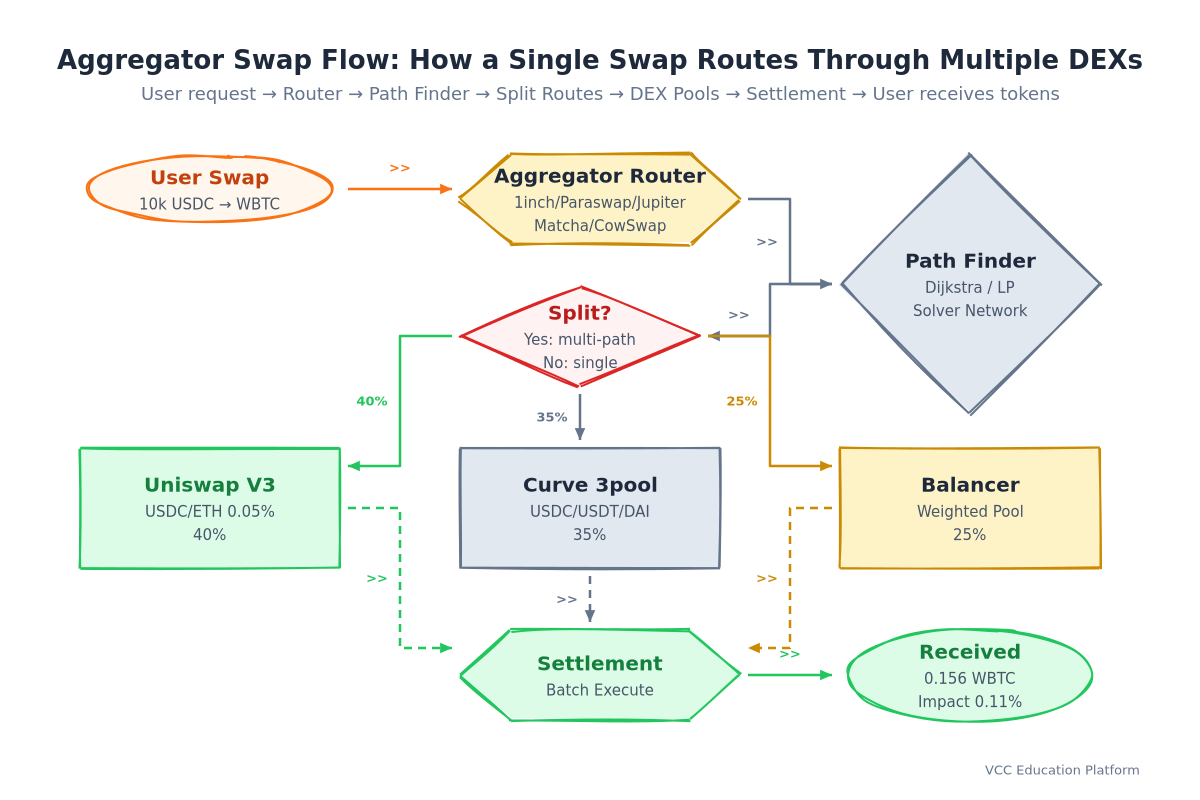
An aggregator doesn't hold liquidity. It computes the optimal path through existing liquidity, then executes atomically.
Quote Layer (Off-Chain)
The process starts off-chain. When you request a quote for 10,000 USDC → WBTC, the aggregator's API:
- Queries on-chain state (reserves, fees, gas) from indexed DEX data
- Runs path finding algorithms across all known pools
- Returns a signed quote: "Send 10,000 USDC to Router, receive ≥ 0.156 WBTC"
Path Finding Algorithms
Three approaches dominate:
Dijkstra/A* on Pool Graph — Treat each pool as an edge, tokens as nodes. Find shortest path weighted by effective price. 1inch's legacy Pathfinder uses this. Fast but struggles with splits.
Linear Programming / Convex Optimization — Formulate as: maximize output subject to reserve constraints. Paraswap's Augustus uses this for split routing. Handles 50+ splits per swap.
Solver Networks / Intent-Based — User submits intent ("I want WBTC for USDC"). Solvers compete to fill it. 1inch Fusion, CowSwap, Uniswap X. Shifts computation off-chain to specialized actors.
Split Routing: The Core Innovation
Single-path routing hits a ceiling: the best pool for 10,000 USDC might only have 5,000 USDC depth before price impact spikes. Split routing divides the input across multiple pools simultaneously.
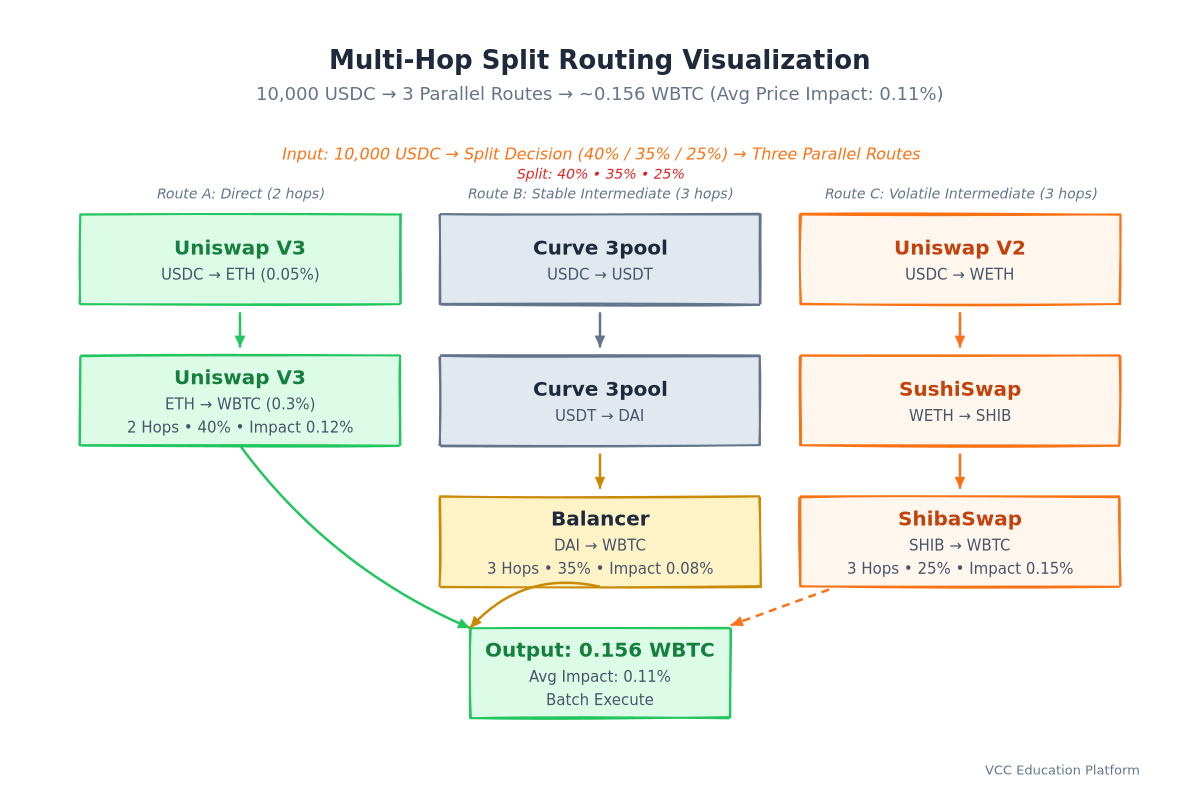
Example: 10,000 USDC → WBTC
- Route A (40%): Uniswap V3 USDC/ETH 0.05% → Uniswap V3 ETH/WBTC 0.3%
- Route B (35%): Curve 3pool USDC/USDT → Curve 3pool USDT/DAI → Balancer DAI/WBTC
- Route C (25%): Uniswap V2 USDC/WETH → SushiSwap WETH/SHIB → ShibaSwap SHIB/WBTC
Each sub-swap executes in the same transaction. The aggregator router contract calls each pool sequentially, passing intermediate tokens forward. Atomic execution means all succeed or all revert.
Multi-Hop Routing
Sometimes the best path isn't direct. USDC → WBTC direct might cost 0.5% price impact. USDC → ETH → WBTC might cost 0.12%. The intermediate hop (ETH) acts as a bridge currency with deeper liquidity on both legs.
Advanced aggregators chain 3-5 hops. Each hop adds gas but reduces price impact. The algorithm balances: total cost = gas fees + price impact + slippage buffer.
Major Aggregators: Architectural Comparison
Five protocols define the category. Each makes different tradeoffs.
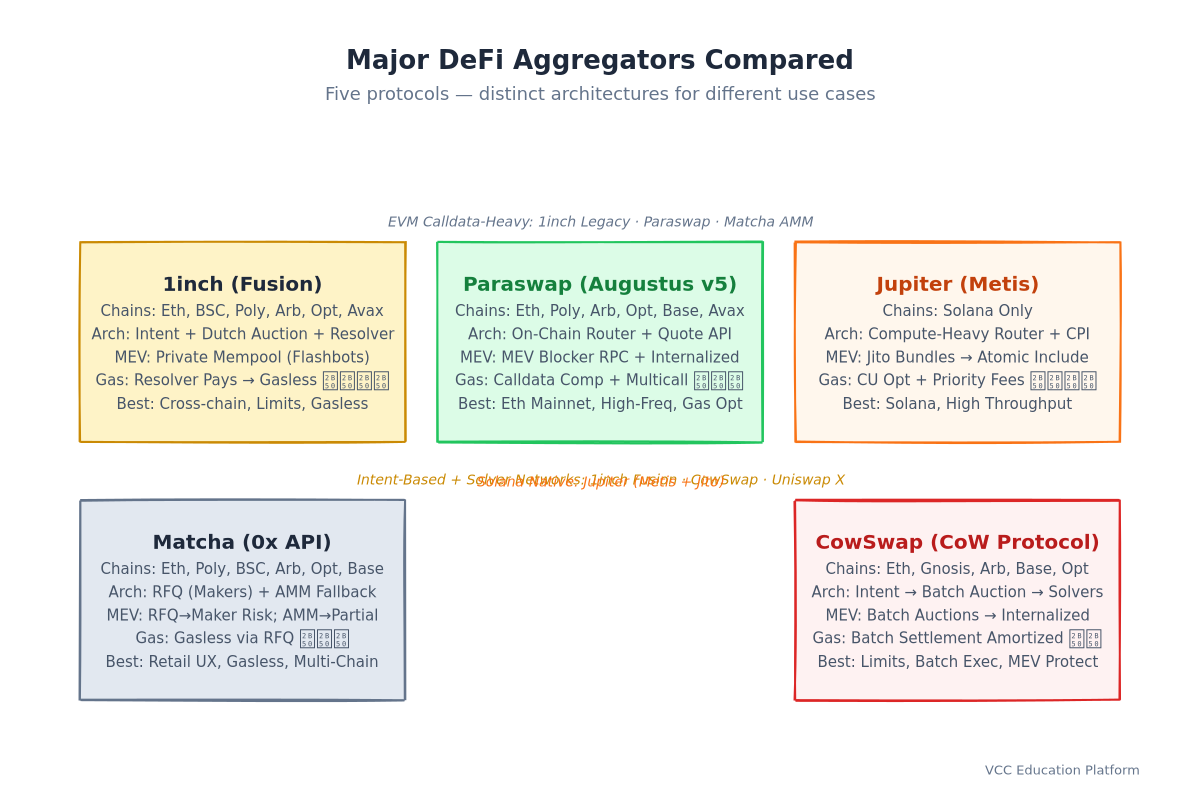
| Aggregator | Architecture | Chains | MEV Protection | Gas Strategy | Best For |
|---|---|---|---|---|---|
| 1inch | Legacy: Router + Pathfinder. Fusion: Intent + Dutch Auction + Resolver Network | Eth, BSC, Poly, Arb, Opt, Avax, Base, Gnosis | Fusion: Private mempool (Flashbots). Legacy: None | Fusion: Resolver pays gas. Legacy: User pays, multicall optimization | Cross-chain, limit orders, gasless swaps |
| Paraswap | Augustus v5 Router (on-chain) + Quote API (off-chain) + MEV Blocker RPC | Eth, Poly, Arb, Opt, Base, Avax, BSC | MEV Blocker RPC + Internalized MEV via router | Calldata compression, multicall, custom precompiles | Ethereum mainnet, high-frequency, gas optimization |
| Jupiter | Metis Router (on-chain compute-heavy) + Quote API + Jito Bundle Integration | Solana only | Jito Bundles (validator-level atomic inclusion) | Compute unit optimization, priority fees, dynamic cu budget | Solana, high throughput, MEV resistance |
| CowSwap | CoW Protocol: Intent → Batch Auction → Solver Competition → Settlement | Eth, Gnosis, Arb, Base, Optimism | Batch auctions internalize MEV to solvers | Batch settlement amortizes gas across orders | Limit orders, batch execution, MEV protection |
| Matcha | 0x API: RFQ (Market Makers) + AMM Fallback + 0x Settlement | Eth, Poly, BSC, Arb, Opt, Base, Avax | RFQ: Maker bears risk. AMM: Partial via 0x | Gasless via RFQ (maker pays). AMM: Standard | Retail UX, gasless quotes, multi-chain |
Key Differentiators
1inch Fusion — Shifts from "router executes" to "resolver executes." User signs permit, resolver fills via Dutch auction (price improves over time). Resolver bears gas and MEV risk. Enables gasless limit orders.
Paraswap Augustus — Pure on-chain router. All logic in calldata. Quote API computes off-chain, returns exact calldata for router. No resolver network. MEV Blocker RPC sends tx to Flashbots Protect.
Jupiter Metis — Solana's compute model changes everything. No calldata limit, but compute units (CU) are scarce. Metis router fits complex routes in single transaction using CPI (Cross-Program Invocation). Jito bundles guarantee atomic inclusion.
CowSwap CoW Protocol — Batch auctions every ~30 seconds. Solvers submit solutions for all orders in batch. Best solution wins. MEV (arbitrage, liquidation) captured by solvers, not extracted from users. Settlement contract executes atomically.
Matcha/0x — Hybrid RFQ + AMM. Professional market makers sign quotes off-chain (RFQ). If RFQ fails, falls back to AMM routing via 0x settlement. Best UX for retail: "gasless" when RFQ fills.
Technical Deep Dive: Router Architecture
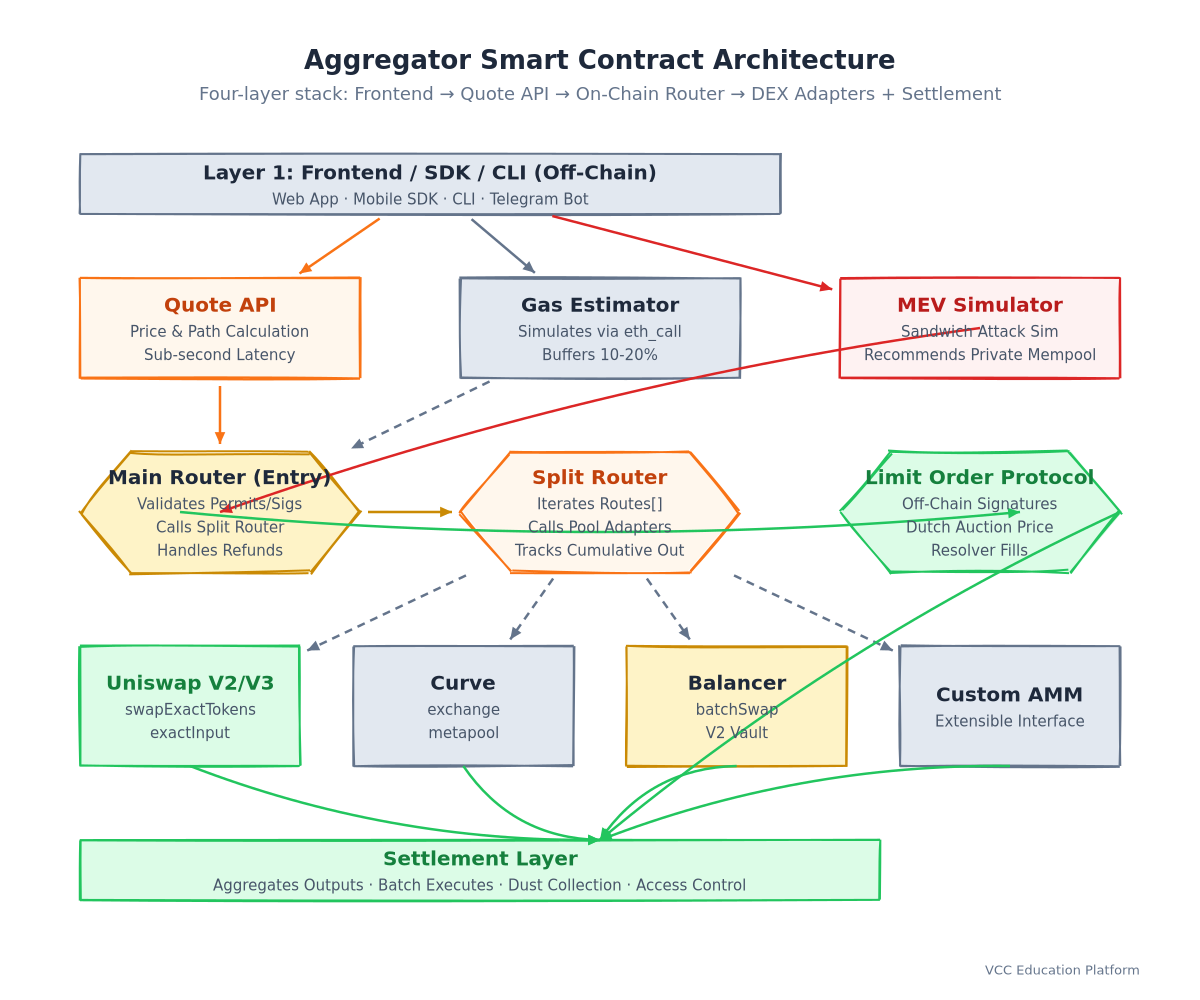
On-Chain Components
Main Router (Entry Point)
- Receives user calldata (tokenIn, tokenOut, amountIn, minAmountOut, deadline)
- Validates permits/signatures
- Calls split router or executes direct swap
- Handles refunds for unspent input
- Emits events for indexers
Split Router (Multi-Hop Engine)
- Iterates through pre-computed routes
- For each route: transfers input → calls pool → receives intermediate → passes to next hop
- Tracks cumulative output
- Reverts if final output < minAmountOut
- Uses
multicallpattern to batch pool interactions
DEX Adapters (Per-Protocol Logic)
- Uniswap V2:
swapExactTokensForTokens - Uniswap V3:
exactInputSingle/exactInput(multihop) - Curve:
exchange/exchange_underlying/ metapool routing - Balancer:
swap/batchSwap(V2 vault) - Custom: Adapter pattern allows new DEXs without router upgrade
Settlement Layer
- Receives all output tokens from split routes
- Aggregates into single tokenOut
- Transfers to user (or permits for gasless)
- Handles dust collection (sweep small balances)
- Implements access control (pausable, owner)
Off-Chain Components
Quote API
- Indexes on-chain state (reserves, fees, ticks) via subgraph or custom indexer
- Runs path finding algorithm (LP, Dijkstra, or solver network)
- Returns: routes[], estimatedOutput, gasEstimate, priceImpact, expiresAt
- Caches aggressively (sub-second latency critical)
Gas Estimator
- Simulates transaction via
eth_call/estimateGas - Accounts for: calldata size, storage reads/writes, precompile calls
- Adds buffer (10-20%) for state changes between quote and execution
MEV Simulator (Advanced)
- Simulates sandwich attack on proposed route
- Calculates worst-case output under adversarial conditions
- Adjusts minAmountOut or recommends private mempool
MEV Protection: The Arms Race
Split routing creates MEV surface. Each sub-swap is a sandwich target. Aggregators respond differently.
Private Mempools (Flashbots Protect, MEV Blocker)
Transaction sent to builder directly, not public mempool. Builder includes in block without revealing to searchers. Tradeoff: slower inclusion (next block), builder centralization.
Batch Auctions (CowSwap)
Orders batch together. Solvers see all orders, compete for best aggregate solution. MEV (arbitrage between orders) captured by solver as fee. User gets surplus. Tradeoff: latency (batch interval), solver centralization.
Resolver Networks (1inch Fusion, Uniswap X)
User submits intent. Resolvers (specialized fillers) compete to fill. Resolver bears MEV risk — if sandwiched, resolver loses. User gets guaranteed output. Tradeoff: resolver set permissioned (currently), intent expressiveness limited.
Validator-Level Inclusion (Jupiter + Jito)
On Solana, Jito validators run MEV-aware client. Bundles submitted directly to leader. Atomic inclusion: all transactions in bundle succeed or fail together. Tradeoff: Solana-only, depends on Jito validator set.
Internalization (Paraswap Augustus)
Router contract designed to minimize MEV surface: single entry point, no intermediate token exposure where possible, slippage bounds enforced on-chain. MEV Blocker RPC adds private mempool layer.
Reality Check: No solution eliminates MEV. They redistribute it. Private mempools → builders. Batch auctions → solvers. Resolver networks → resolvers. The question: who captures value, and does the user benefit?
Gas Optimization: Beyond Calldata Compression
Pre-EIP-4844 Techniques
- Gas Tokens (GST, CHI): Mint when gas cheap, burn when expensive. Deprecated post-London/EIP-4844.
- Calldata Compression: Custom encoding (1inch v4, Paraswap v4). Pack addresses, amounts, flags into minimal bytes.
- Multicall Batching: Single transaction calls multiple functions. Reduces base fee overhead (21k per tx → 21k per batch).
- Precompile Abuse: Use
identityprecompile (0x04) for cheap memory copy,ECRECOVERfor signature validation.
Post-EIP-4844 (Blobs)
- Blob Data: Rollups (Arbitrum, Optimism, Base) post calldata to blobs. 128 KB/blob at ~1/10 calldata cost.
- Aggregator Adaptation: Paraswap, 1inch route via L2s where blob fees apply. Mainnet still uses calldata.
- EIP-7702 (EOF): Future: account abstraction lets aggregators sponsor gas, batch user ops.
Gas Abstraction: The Real Innovation
1inch Fusion, CowSwap, Uniswap X let users pay in output token, not ETH. Resolver/solver fronts gas, deducts from output. User signs permit for output token. No ETH balance needed. This removes the biggest UX friction for new users.
Cross-Chain Aggregation: The Bridge-Swap Blur
Cross-chain swaps combine two hard problems: bridging + swapping. Two architectural models:
Bridge-Then-Swap (Meta-Aggregators)
Li.Fi, Socket, Across, Relay
- Aggregate bridges (Wormhole, Axelar, LayerZero, CCTP, native bridges)
- Aggregate DEXs on destination chain
- Optimize: bridge route + swap route jointly
- User signs once, protocol handles bridge + swap
- Risk: Bridge finality delays, bridge hack exposure, filler solvency
Atomic Cross-Chain (Intent-Based)
1inch Fusion Cross-Chain, Uniswap X Cross-Chain
- Single intent: "USDC on Arbitrum → WBTC on Base"
- Filler (resolver) handles: bridge USDC → swap on Base → deliver WBTC
- Filler bears bridge risk, execution risk, MEV risk
- User gets atomic guarantee or revert
- Requires: Filler capital, bridge liquidity, trust in filler
Settlement Layers
Circle CCTP (Cross-Chain Transfer Protocol) — Burn USMC on source, mint on destination. No bridge contract risk. Finality ~13 min (Ethereum) to ~1 sec (Solana). Becoming standard for USDC routes.
Wormhole / Axelar / LayerZero — General message passing. Higher flexibility, higher trust assumptions (guardian sets, validator sets).
Reality: Users don't care about architecture. They want "best price from Chain A to Chain B." The category boundary between "aggregator" and "bridge" is dissolving. Li.Fi calls itself "bridge aggregator." 1inch calls Fusion "cross-chain swap." Same user intent.
Risks & Considerations
Smart Contract Risk
Aggregator routers are high-value targets. 1inch, Paraswap, 0x, CowSwap all hold billions in TVL flow. Audits help (Trail of Bits, OpenZeppelin, Sigma Prime), but complexity grows faster than audit coverage. Upgradable contracts add admin key risk.
Centralization Pressure
- Quote APIs: Off-chain, closed source (Paraswap, 1inch, Jupiter, Matcha). Single point of failure/censorship.
- Resolver/Solver Networks: Permissioned sets (1inch Fusion, CowSwap, Uniswap X). Who decides who resolves?
- MEV Infrastructure: Flashbots, Jito, MEV Blocker — all centralized operators today.
Oracle Manipulation
Path finding relies on on-chain reserves as price oracle. Large swaps manipulate spot price. TWAP oracles (Uniswap V3) help but lag. Aggregators using stale quotes execute at worse prices.
Liquidity Dependency
Aggregators don't create liquidity. They redistribute it. If underlying DEXs lose depth (incentives end, exploits, regulation), aggregator quality degrades. No aggregator can fix empty pools.
Regulatory Surface
RFQ (Matcha), Resolver Networks (1inch Fusion), Solvers (CowSwap) involve identifiable counterparties. KYC/AML pressure may force permissioning. Pure AMM routing (Paraswap legacy, Jupiter) more censorship-resistant but less feature-rich.
Future Outlook: Intent-Based, Solver Networks, AI Routing
Intent-Based Architecture (Converging Standard)
ERC-7683 (Cross-Chain Intents), ERC-7521 (General Intents) standardize: "I want X, I'll pay Y, anyone can fill." User signs intent. Solvers compete. Best fill wins. Aggregators become intent interfaces + solver networks.
Solver Specialization
- Arbitrage Solvers: Capture CEX-DEX arb, pass savings to user
- Bridge Solvers: Specialize in cross-chain fills, manage bridge risk
- MEV Solvers: Internalize MEV, bid for order flow
- Retail Solvers: Gasless fills for small orders, monetize via volume
AI-Driven Routing
Current: Deterministic algorithms (LP, Dijkstra). Future: RL agents trained on historical execution data. Predict: gas spikes, liquidity shifts, MEV probability. Dynamic split ratios per block. Early experiments: 1inch "AI Pathfinder" (internal), academic research (arXiv:2405.xxxxx).
Verifiable Computing
ZK-proven path finding: Prover computes optimal route, generates ZK-proof of optimality. Verifier (router contract) checks proof on-chain. Removes trust in quote API. Projects: RISC Zero, SP1, zkCNN for routing proofs.
User-Owned Order Flow
Users auction their order flow to solvers directly (MEV-Share, Order Flow Auctions). User captures MEV value instead of aggregator/builder. Wallet-level integration (Rabby, Coin98, MetaMask Snaps).
Practical Guide: Choosing an Aggregator
| If You... | Use... | Why |
|---|---|---|
| Swap on Ethereum mainnet, large size (>$50k) | Paraswap (Augustus) or 1inch Fusion | Best gas optimization, MEV protection |
| Swap on Solana | Jupiter | Native architecture, Jito bundles, best Solana routing |
| Want limit orders, DCA, gasless | 1inch Fusion or CowSwap | Intent-based, resolver/solver pays gas |
| Need cross-chain (Arbitrum → Base) | Li.Fi, Socket, or 1inch Fusion | Bridge + swap optimization |
| Prioritize censorship resistance | Jupiter (Solana) or Paraswap (self-hosted API) | Minimal trusted parties |
| Build a product on top | 1inch API, Paraswap API, 0x API, Jupiter API | Best docs, SDKs, rate limits |
| Are in Vietnam / Southeast Asia | Coin98 Wallet (built-in) or Jupiter | Local chain support, low fees, VN language |
Pro Tip: Always compare 2-3 aggregators before large swaps. Use aggregator aggregators (Li.Fi, Socket) for meta-comparison. Check: quoted output, gas estimate, price impact %, MEV protection mode.
FAQ
Q: What's the difference between a DEX aggregator and a bridge aggregator? A: DEX aggregator routes within one chain. Bridge aggregator routes across chains (bridge + DEX). The line is blurring: 1inch, Li.Fi, Socket do both.
Q: Does split routing always save money? A: Not for tiny swaps (<$100). Gas cost of extra pool calls exceeds price impact savings. Aggregators auto-disable splits below threshold.
Q: Can I get sandwiched using an aggregator? A: Yes, on public mempool. Use MEV protection: 1inch Fusion, Paraswap MEV Blocker RPC, CowSwap, Jupiter + Jito.
Q: Why do quotes differ between aggregators for the same swap? A: Different DEX coverage, different path algorithms, different gas models, different fee structures (some charge protocol fees, some don't).
Q: Is my token approval safe with aggregators? A: Approve the router contract, not the aggregator API. Router contracts are audited, immutable (or timelocked). Use revoke.cash to manage allowances.
Q: How do aggregators make money? A: Protocol fees (0.01-0.1% of swap), positive slippage capture (quote 0.156 WBTC, execute 0.158, keep 0.002), resolver/solver fees, API subscriptions.
Conclusion
DeFi liquidity aggregation is the execution layer of DeFi. It transforms fragmentation from a user problem into a computational problem. The winners will be those who: (1) compute better paths faster, (2) protect users from MEV credibly, (3) abstract gas and chain complexity, (4) decentralize the solver/resolver layer.
The next phase isn't "better routing" — it's intent-based execution networks where users express outcomes, specialized solvers compete to deliver them, and value accrues to users, not intermediaries. The aggregator becomes a thin interface. The heavy lifting moves to an open, competitive solver marketplace.
For now: compare quotes, use MEV protection, understand what you're signing. The best aggregator is the one that gives you the most output tokens — today, on this chain, for this size.