
DeFi interoperability is the ability for decentralized finance applications, assets, and liquidity to move seamlessly across different blockchain networks. Without it, DeFi remains fragmented—capital trapped in silos, users forced to navigate complex bridging workflows, and developers building the same primitives repeatedly on every new chain.
The stakes are high: over $3 billion has been lost to cross-chain bridge hacks since 2020, while legitimate cross-chain volume now exceeds $15.8 billion per month across major bridges. The infrastructure connecting these chains isn't just plumbing—it's the foundation determining whether DeFi scales to serve global finance or collapses under its own fragmentation.
Why DeFi Interoperability Matters
The Fragmentation Problem
Today's DeFi landscape resembles the early internet before TCP/IP: dozens of incompatible networks (Ethereum, Solana, Arbitrum, Base, Avalanche, and 50+ others) each hosting their own DEXs, lending markets, and stablecoins. A user wanting to move USDC from Arbitrum to Solana for a yield opportunity faces a gauntlet: find a bridge, approve transactions, wait for finality, hope the bridge doesn't get hacked, then navigate the destination chain's UI.
This fragmentation creates three compounding inefficiencies:
- Liquidity fragmentation — The same asset (USDC, WETH, WBTC) exists as separate liquidity pools on every chain, each with its own depth, slippage, and price discovery.
- Composability breakdown — DeFi's superpower is "money legos": protocols calling other protocols atomically. Cross-chain calls break atomicity, forcing developers to build complex asynchronous workflows.
- User experience debt — Every bridge interaction adds friction, gas costs on multiple chains, and cognitive load. The average user abandons at the first bridge.
The Institutional Imperative
Institutions won't touch DeFi until interoperability meets TradFi-grade standards: SOC 2 compliance, audit trails, circuit breakers, and legal enforceability. Chainlink CCIP achieved SOC 2 Type 2 and ISO/IEC 27001:2022 certification—making it the first interoperability protocol to clear this bar. Swift, DTCC, Euroclear, UBS, and Wellington Management now use CCIP for cross-chain corporate actions settlement. ANZ Bank and Fidelity International leveraged it for the HKMA's e-HKD pilot. Without this infrastructure, the "hundreds of trillions in traditional assets" Chainlink cites will never migrate onchain.
Core Interoperability Primitives
DeFi interoperability isn't a single technology—it's a stack of primitives, each solving a different layer of the problem.
1. Cross-Chain Messaging (General Message Passing)
The foundation: arbitrary data passed from a smart contract on Chain A to a smart contract on Chain B. This enables cross-chain contract calls—a lending protocol on Arbitrum triggering a liquidation on Base, or a DAO on Ethereum executing a vote on Polygon.
Key protocols:
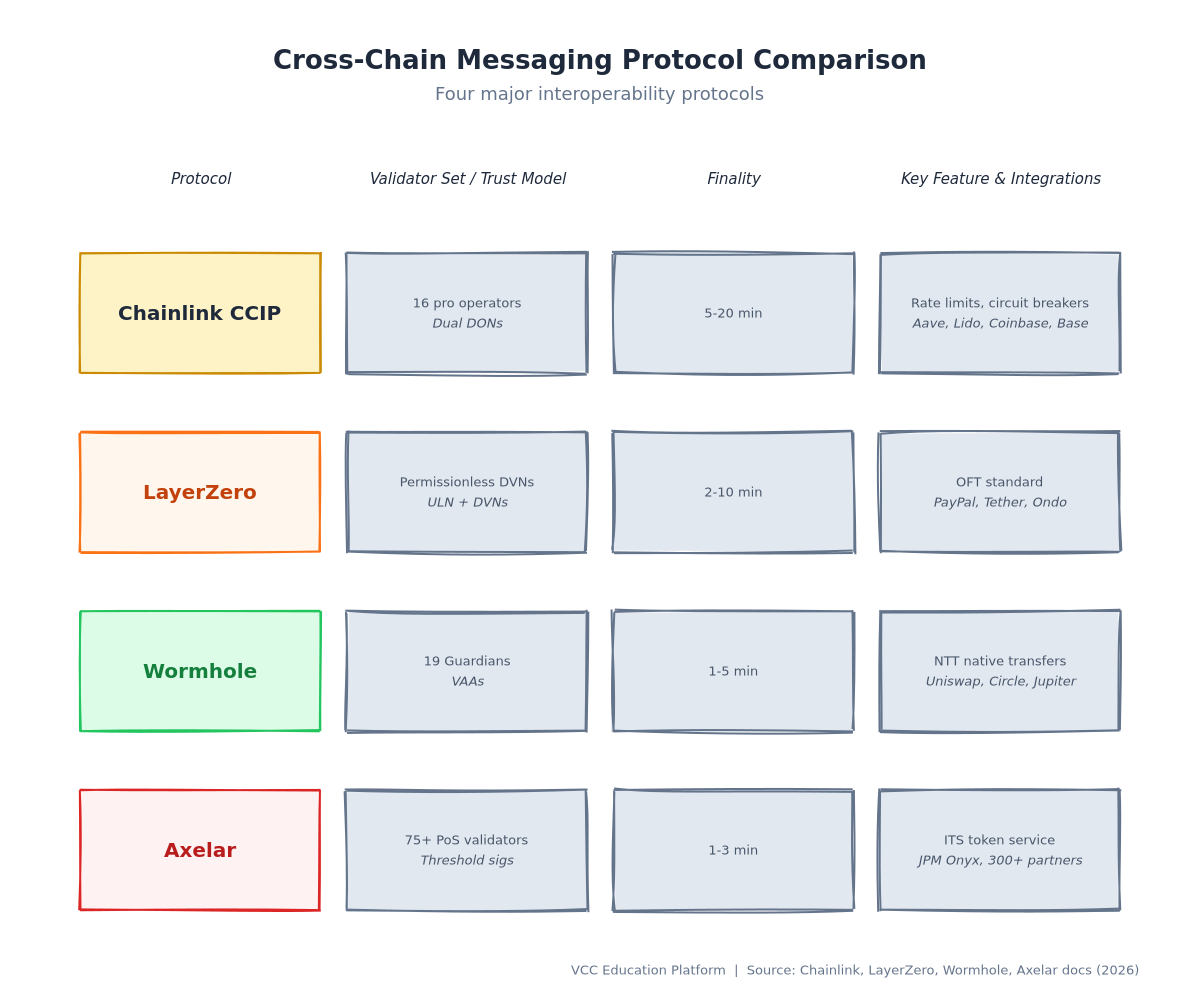
- Chainlink CCIP — Defense-in-depth architecture with separate committing and executing DONs (Decentralized Oracle Networks). 16 independent node operators validate every message. Rate limits and circuit breakers at protocol level. Token Developer Attestations let asset issuers approve/reject transfers.
- LayerZero — Omnichain messaging via Ultra Light Nodes (ULNs) and Decentralized Verifier Networks (DVNs). Used by PayPal, Tether, Ondo for stablecoin issuance across 50+ chains.
- Wormhole — Guardian network (19 validators) signs Verifiable Action Approvals (VAAs). Supports messaging, token transfers (NTT and wrapped), and settlement via intent-based routing.
- Axelar — Proof-of-stake validator set (75+ validators, zero exploits). Interchain Token Service (ITS) enables "deploy once, scale everywhere" for tokens. Mobius Development Stack (MDS) abstracts chain differences for developers.
>
2. Token Transfer Standards
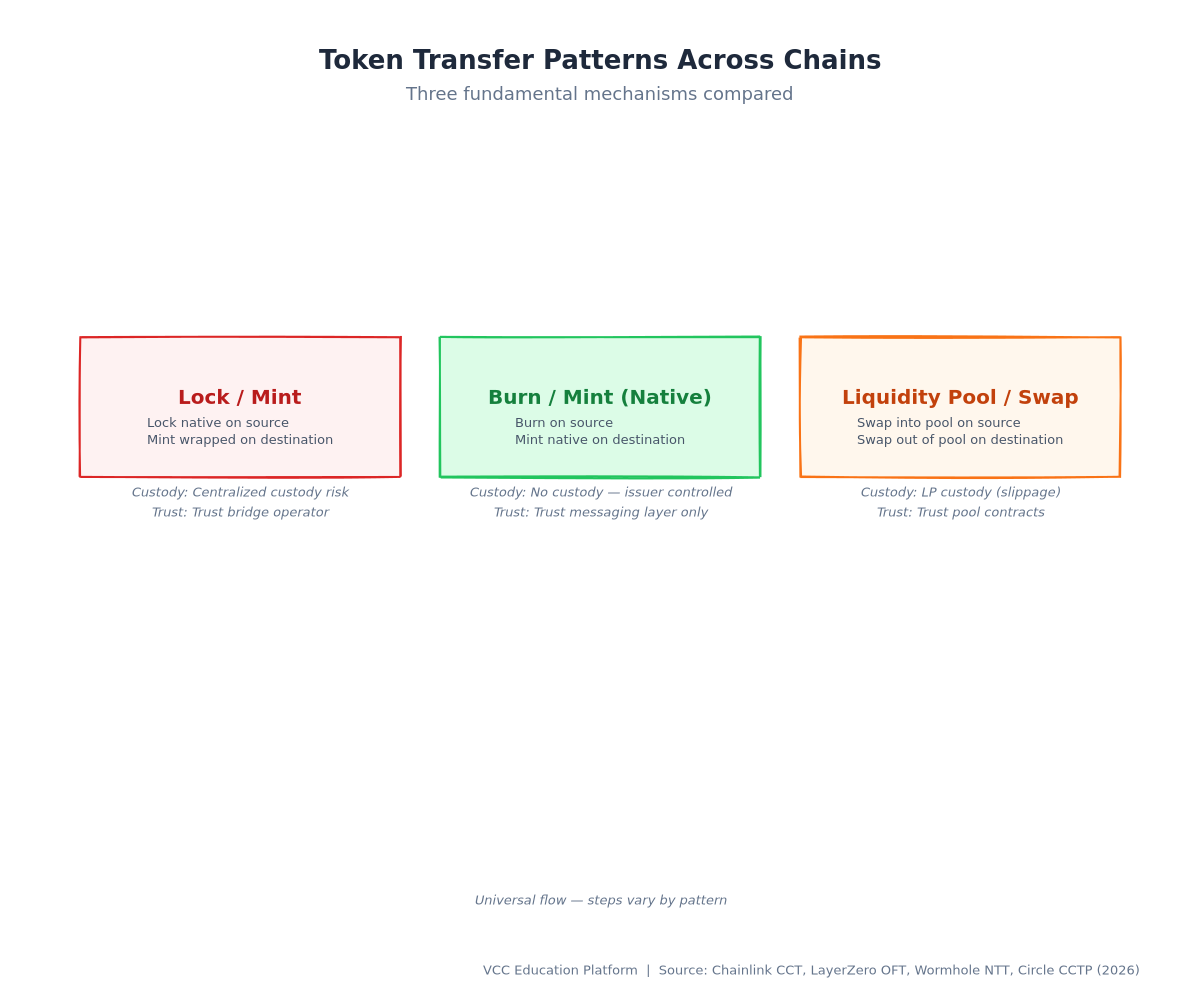
Moving tokens safely is harder than moving messages. The industry has converged on three patterns:
| Pattern | Mechanism | Trade-offs |
|---|---|---|
| Lock/Mint | Lock native token on source chain, mint wrapped representation on destination | Centralized custody risk; liquidity fragmentation |
| Burn/Mint | Burn on source, mint native on destination (requires native deployment) | Requires issuer cooperation; best UX |
| Liquidity Pool | Swap into pool on source, swap out of pool on destination | Capital efficient; slippage on large transfers |
Emerging standards:
- Chainlink CCT (Cross-Chain Token) — Token-pool architecture. Issuer deploys pool contracts; token contract stays unchanged. Zero vendor lock-in. Supports rate limits, circuit breakers, compliance hooks. Adopted by Aave (GHO), Lido (wstETH), Coinbase (cbBTC, cbETH), Ondo, Maple Finance.
- LayerZero OFT (Omnichain Fungible Token) — Unified token supply across chains. Single supply accounting. Native transfers without wrapping.
- Wormhole NTT (Native Token Transfers) — Issuer controls minting/burning on each chain. Transceivers handle chain-specific logic. No wrapped assets.
>
3. Cross-Chain Liquidity Aggregation
Even with messaging and token standards, users need best-execution routing across fragmented liquidity. Bridge aggregators and intent-based systems solve this:
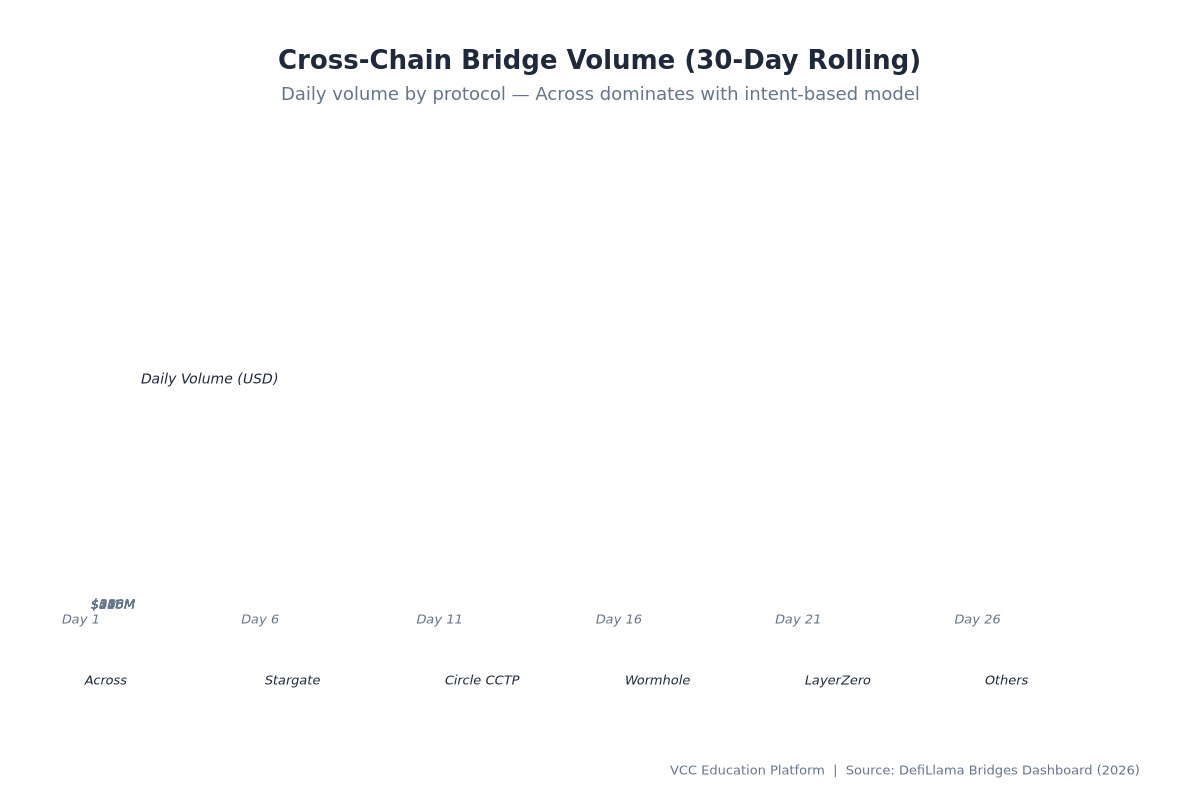
- Across — Intents-based bridging. User signs intent; relayers compete to fill. $307M/day volume (largest by volume on DefiLlama). Optimistic verification with dispute window.
- Stargate — Unified liquidity pools on each chain. Delta algorithm balances pools. $36M/day volume. Native asset transfers (no wrapping).
- Circle CCTP (Cross-Chain Transfer Protocol) — Native USDC burn/mint. No wrapped USDC. $60M/day volume. Institutional-grade, regulated.
- deBridge — Intent-based with solver network. Supports arbitrary calldata. $6M/day volume.
>
4. Chain Abstraction & Intent Architectures
The endgame: users shouldn't know which chain they're on. Chain abstraction hides gas tokens, RPC endpoints, and bridging behind a single interface.
- ERC-4337 Account Abstraction + Cross-chain messaging = Smart accounts that execute multi-chain operations atomically (via synchronous composability on shared sequencers) or asynchronously (via messaging).
- Intent-based systems (Across, Anoma, SUAVE) — Users express what they want ("swap 100 USDC on Arbitrum for SOL on Solana"), solvers figure out how (routing, bridging, execution).
- Unified gas payment — Pay gas on destination chain with source-chain tokens (LayerZero lzReceive, Axelar GMP with gas service).
Security: The Interoperability Trilemma
Every bridge makes trade-offs across three dimensions—you can only pick two:
` ┌─────────────────────────────────────┐ │ INTEROPERABILITY TRILEMMA │ │ │ │ Security ◄──────► Speed │ │ ▲ ▲ │ │ │ │ │ │ ▼ ▼ │ │ Decentralization │ └─────────────────────────────────────┘ `
| Protocol | Security Model | Speed | Decentralization |
|---|---|---|---|
| CCIP | Defense-in-depth (dual DONs, rate limits, attestations) | ~5-20 min (configurable) | 16 professional node ops + risk controls |
| LayerZero | ULN + configurable DVN/Executor sets | ~2-10 min | Permissionless DVN marketplace |
| Wormhole | 19 Guardian multisig + VAAs | ~1-5 min | Fixed guardian set (decentralizing) |
| Axelar | PoS validators (75+) + threshold signatures | ~1-3 min | Dynamic validator set |
| IBC (Cosmos) | Light client verification | ~10 sec - 2 min | Trust-minimized (light clients) |
| Canonical bridges (Arbitrum, Optimism, Base) | Fraud proofs / ZK proofs | 7 days (OP) / ~10 min (ZK) | Single operator (sequencer) initially |
>
The $3B Lesson: Bridge Security Failures
| Hack | Date | Loss | Root Cause |
|---|---|---|---|
| Ronin Bridge | Mar 2022 | $625M | 5/9 validator keys compromised (social engineering) |
| Wormhole | Feb 2022 | $325M | Signature verification bypass (missing guard) |
| Nomad | Aug 2022 | $190M | Replay attack (zero-initialized root) |
| Multichain | Jul 2023 | $126M | Centralized key management (CEO arrest) |
| Harmony Horizon | Jun 2022 | $100M | 2/5 validator keys compromised |
Pattern: Centralized trust assumptions (multisigs, single operators, upgradable contracts without timelocks) create single points of failure. The protocols surviving at scale (CCIP, LayerZero, Axelar, Wormhole NTT) all moved toward defense-in-depth: multiple independent verification layers, protocol-level rate limits, and issuer-controlled safeguards.
DeFi Use Cases Enabled by Interoperability
Cross-Chain Lending & Leverage
Aave v3 + CCIP — GHO stablecoin transfers cross-chain with governance messages. Users deposit ETH on Ethereum, borrow GHO on Arbitrum, deploy to yield strategy on Base—all coordinated via cross-chain messaging.
Morpho Blue — Vault-based lending where vault curators can deploy strategies across chains using LayerZero or CCIP for position management.
Cross-Chain Yield Aggregation
Yearn v3 — Multi-chain vaults that rebalance across Arbitrum, Optimism, Base, and Polygon based on real-time yield signals. Requires reliable cross-chain data (Chainlink Data Streams) + execution (CCIP/LayerZero).
Beefy Finance — Auto-compounding vaults on 15+ chains. Cross-chain harvesting via bridge aggregators to minimize gas.
Cross-Chain DEX & Perpetuals
UniswapX + Across — Cross-chain swaps via intent-based filling. User signs on Arbitrum, solver fills on Ethereum, settles on Optimism.
Hyperliquid — Native L1 with EVM bridge. Cross-chain deposits via Hyperliquid Bridge ($16M/day volume). Perpetuals trading with shared liquidity across bridged assets.
Institutional DeFi & RWAs
Ondo Finance — Tokenized Treasuries (OUSG) and yield products (USDY). CCIP for cross-chain distribution. "Institutions need one integration, not 50."
Maple Finance — syrupUSDC upgraded to CCT standard. Institutional borrowers access liquidity across Ethereum, Solana, Base via single token.
Figure/Provenance — $8B+ HELOCs tokenized. CCIP for cross-chain portfolio rebalancing (J.P. Morgan Onyx case study: 80% faster time-to-market).
Building Blocks for Developers
Choosing Your Interoperability Stack
| If you need... | Use... |
|---|---|
| Maximum security, institutional compliance | Chainlink CCIP (CCT standard) |
| Maximum chain coverage, permissionless | LayerZero (OFT standard) |
| Fast finality, native token transfers | Wormhole NTT or Circle CCTP |
| Sovereign chain integration, PoS security | Axelar ITS |
| Cosmos ecosystem, trust-minimized | IBC |
| L2 → L1 canonical exits | Optimism/Arbitrum/Base native bridges |
Developer Workflow (CCIP Example)
`solidity // 1. Deploy TokenPool for your ERC20 (one-time) MyTokenPool pool = new MyTokenPool(token, ccipRouter);
// 2. Register pool with CCIP (issuer controls) ccipRouter.registerTokenPool(token, address(pool));
// 3. Cross-chain transfer (user or contract) function crossChainTransfer( address token, uint64 destinationChainSelector, address receiver, uint256 amount, bytes memory data ) external { // Rate limits, circuit breakers enforced at protocol level ccipRouter.ccipSend( destinationChainSelector, abi.encode(token, receiver, amount, data) ); }
// 4. Receiver handles tokens on destination function _ccipReceive(Client.Any2EVMMessage memory msg) internal override { (address token, address receiver, uint256 amount, bytes memory data) = abi.decode(msg.data, (address, address, uint256, bytes)); // TokenPool automatically mints/unlocks // Execute arbitrary logic (deposit to vault, vote, etc.) } `
>
Testing & Simulation
- Chainlink CCIP Local Simulator — Run full CCIP stack locally (commit + execute DONs).
- LayerZero Testnet — Sepolia, Arbitrum Sepolia, Base Sepolia, Polygon Amoy.
- Wormhole Devnet — Local guardian set for VAA signing.
- Axelar Localnet — Full validator set + Amplifier for custom chain connections.
- Tenderly / Fork testing — Simulate cross-chain calls against mainnet state.
The Road Ahead: 2025-2026 Trends
1. Intent-Centric Interoperability
From "how" (which bridge, which route) to "what" (outcome). Solvers compete for user intents. ERC-7683 (Cross-Chain Intents) standardizes intent format across protocols.
2. Shared Sequencing & Synchronous Composability
Espresso, Astria, Radius — Shared sequencers enable atomic cross-L2 transactions. No bridging needed for L2-to-L2 calls. Changes the game for DeFi composability.
3. Institutional-Grade Compliance Primitives
Chainlink ACE (Automated Compliance Engine), Axelar ITS compliance hooks, LayerZero custom DVNs for KYC/AML — Programmable compliance at protocol layer, not application layer.
4. Chain Abstraction Wallets
Particle Network, Xion, Near — Smart accounts that manage keys, gas, and bridging across 20+ chains. User sees one balance, one address, one UX.
5. Verifiable Cross-Chain State
ZK light clients (Succinct, Lagrange, Herodotus) — Prove chain A's state to chain B without trusted committees. Ultimate trust minimization.
Key Takeaways
- DeFi interoperability is infrastructure, not a feature — It determines whether DeFi becomes a unified global financial layer or a collection of isolated casinos.
- Security is non-negotiable — $3B+ in bridge hacks proves centralized trust assumptions fail. Defense-in-depth (CCIP), permissionless verification markets (LayerZero), and sovereign validation (Axelar, IBC) are the surviving models.
- Token standards matter more than bridges — CCT, OFT, NTT move the trust boundary to the issuer, not the bridge. Issuers control supply, compliance, and upgrades.
- Volume is real and growing — $15.8B/month across bridges (DefiLlama). Across ($307M/day) and CCTP ($60M/day) prove product-market fit.
- Institutions are arriving — Swift, DTCC, J.P. Morgan, ANZ, Fidelity using CCIP. The infrastructure they require (audits, certifications, compliance hooks) is now live.
- The UX endgame is chain abstraction — Users won't "bridge"; they'll sign intents. Wallets and solvers handle the complexity.
FAQ
What's the difference between a bridge and a messaging protocol?
A bridge typically moves assets (lock/mint or burn/mint). A messaging protocol moves arbitrary data (function calls, governance votes, oracle updates). Modern protocols (CCIP, LayerZero, Wormhole, Axelar) do both: messaging is the primitive; token transfers are an application built on top.
Which bridge is safest for large transfers?
For institutional/large transfers: Chainlink CCIP (rate limits, circuit breakers, SOC 2, ISO 27001, issuer attestations) or Circle CCTP (regulated, native USDC, no wrapping). For DeFi-native assets: LayerZero OFT or Wormhole NTT (issuer-controlled, no bridge custody).
Can I build cross-chain DeFi without a bridge?
Yes, if you stay within a shared sequencing cluster (e.g., Espresso-based L2s) or use IBC (Cosmos ecosystem). For Ethereum L1 ↔ L2 or L2 ↔ non-IBC chains, you need a messaging protocol.
What happens if a bridge gets hacked?
- Lock/mint bridges: Wrapped tokens on destination chain become unbacked. Issuer must freeze/upgrade.
- Burn/mint (CCTP, NTT, OFT): No wrapped tokens exist. Only the issuer can mint. Hack affects messaging layer, not token supply.
- Messaging-only (CCIP, LayerZero, Wormhole core): No asset custody. Hack = message injection/failure. Rate limits and circuit breakers contain blast radius.
How do I choose between CCIP, LayerZero, Wormhole, Axelar?
| Priority | Recommendation |
|---|---|
| Institutional compliance, max security | CCIP |
| Maximum chain coverage, permissionless | LayerZero |
| Fast finality, native tokens, low cost | Wormhole NTT / CCTP |
| Sovereign chain, PoS security, token service | Axelar ITS |
| Cosmos ecosystem | IBC |
Further Reading
- Chainlink CCIP Documentation
- LayerZero V2 Whitepaper
- Wormhole Protocol Architecture
- Axelar Interchain Token Service
- DefiLlama Bridge Analytics
- ERC-7683: Cross-Chain Intents
- Interoperability Trilemma Research
This article is for educational purposes only and does not constitute financial advice. DeFi protocols carry smart contract risk, bridge risk, and market risk. Always conduct your own research and never invest more than you can afford to lose.